Monorails, Maglevs And 'Cabin' Transports - Including PRT
Navigating through this website is easier with the navigator frame which should be to the left of this window. If it is not there then click here to turn it on! Alternatively there is a system map at the foot of this page.
More information about this website & why it was created can be found by visiting this website's "front" pages (link opens in a new window)
 .
.
Most images are "clickable" - run the mouse over them and if a "hand" appears then click & a larger version will open in a new window!
About These Transports
Most of the transports featured on this page require complete 'grade separation', which means that they must be completely fenced in and all interfaces with either pedestrians or other transports must be made with one passing under the other. The only exception to this rule will be at stations, but even here safety will (usually) dictate that passengers must not walk on the 'track'.
Some of the transports featured are fully automated, others will have a driver at the front, however this page is only concerned with types of transport and not how they are driven.
Page Index
What Is A Monorail?
According to The Monorail Society http://www.monorails.org which is a free-to-join
Internet-based pro-monorail promotional
"A single rail serving as a track for passenger or freight vehicles. In most cases rail is elevated, but monorails can also run at grade, below grade or in subway tunnels. Vehicles are either suspended from or straddle a narrow guideway. Monorail vehicles are WIDER than the guideway that supports them."
As a contrast a 'traditional' railway is actually a 'duo-rail' because its trains run on two rails.
Although Less Commonly Adopted,
Monorail Technologies Offer A Viable Alternative Solution To Duo-rail Transport Systems
 |
|
|

Image & license: UE-PON2600 / Wikipedia encyclopædia. CC BY-SA 3.0 http://commons.wikimedia.org/wiki/ File:Tokyo_Monorail_2031_Showajima_20060521.jpg |
|

Image & license: Stéphane Gottraux / Wikipedia encyclopædia. CC BY-SA 3.0 http://commons.wikimedia.org/wiki/File:ShonanSerie500.JPG. |
| The Two Main Types Of Monorails
Left: Straddle - 2000 series set 2031 at Showajima Station, Tokyo, Japan, Right: Suspended (hanging) - 500 series set 559, Shonan Monorail, Japan. |
||
Monorails are often thought of as futuristic "space age" transports, yet instead of seriously proposing their introduction into the modern "real world" cityscape most transport planners seem to have condemned them to just 'fun' locations - such as the 1990 National Garden Festival Gateshead, England. There could be several reasons for this, including...
|
 Monorail at the 1990 National Garden Festival Gateshead. Vehicle looks somewhat like a caterpillar! |
|
Whilst it is true that low-capacity monorails trains do exist, the full story is that just like most other forms of public transport there is a range of vehicle capacities (ie: small, medium, large) which will be selected depending on expected traffic flows and planned service frequencies. |
||
 |
|
 |
| The former Sydney monorail and inside a train of the same type from a monorail installation that was built for EXPO86 in Vancouver, Canada but is now at Alton Towers in England.
These trains comprise small compartments which seat just 12 passengers and do not offer any space for standing passengers.
The closure of the Sydney monorail was politically motivated - the system was well patronised and along with structures such as the famous Harbour Bridge had become an iconic symbol of the city. |
||
 |
|
 |
The Seattle monorail trains feature a high capacity walk-through design.
Seattle's "Alweg" trains are 122' (37.2m) long, 10'3" (3.1m) wide, and 14' (4.27m) high. Each train can seat 124 passengers and can carry 326 standing passengers for a total of 450 passengers. Seattle's monorail opened in 1962 and has been very successful - both financially and in the popularity stakes. Despite their age the "Alweg" trains it uses still look futuristic. They are in fact not tied to any proprietary manufacturer and therefore whilst currently none are being built anywhere there would be no copyright infringement issues if a transit manufacturer (or any other enterprising company) so liked their forward looking design that they wanted to build a fleet of replica vehicles. A different issue relates to the traction package and a few other technical specifications, but there are specialist companies which would, if required, be able to supply present-era electrics and train control packages. Some Recent Monorail Lines To Open |
||

Image & license: Mumbai Metropolitan Region Development Authority. Free use with attribution. http://mmrda.maharashtra.gov.in/disclaimer |
|

Image & license: Karthikndr / Wikipedia encyclopædia. CC BY-SA 3.0 http://commons.wikimedia.org/wiki/File:Interior_seating_if_Mumbai_Monorail,_2015.jpg. |
| The first 8.9km phase of Mumbai (India) monorail opened in February 2014. In 2015 a second phase will extend the line to 20km in length with 18 stations. The trains come in one of three liveries; royal pink, apple green and ice blue, with the external train livery being replicated in the internal seat colours. | ||

Image & license: Bjoertvedt / Wikipedia encyclopædia. CC BY-SA 4.0 http://commons.wikimedia.org/wiki/File:Dubai_Monorail_01.jpg |
|

Image & license: Maurits90 / Wikipedia encyclopædia. CC0 Public Domain http://commons.wikimedia.org/wiki/File:Palm_Jumeirah_Monorail_Interior_2.JPG. |
| The United Arab Emirates Palm Jumeria monorail was built to serve the spectacular man-made island which was built near Dubai in the shape of a palm. Initially 5.4km in length with just two stations, two mid-way stations are scheduled to open in 2016 plus a 2km extension is planned to facilitate interchange with the urban metro. | ||

Image & license: Sri Lanka / Wikipedia encyclopædia. CC BY-SA 3.0 http://commons.wikimedia.org/wiki/File:Chongqing3haoxian.jpg |
|

Image & license: Azylber / Wikipedia encyclopædia. CC BY-SA 3.0 http://commons.wikimedia.org/wiki/File:Chongqing_Rail_Transit_-_Line_3_train.JPG. |
| The Chinese city of Chongqing has two metro lines which use monorail technology. These images show trains on Line 3 which opened in 2011, however when combined with Line 2 (which opened in 2005) the Chongqing Monorail system is 80km in length and has 59 stations. This is a high capacity rapid transit urban metro service which operates as an underground railway (subway) in the city centre with open air tracks elsewhere that is designed to carry 30,000 passengers per hour at peak hours. |
||
a.jpg)
Image & license: Government of São Paulo / Wikipedia encyclopædia. CC BY 2.0 http://commons.wikimedia.org/wiki/File:Monotrilho_de_SP_(2).jpg. |
|

Image & license: Minseong Kim / Wikipedia encyclopædia. CC BY-SA 4.0 http://commons.wikimedia.org/wiki/File:Daegu_Metro_Line_3.jpg |
| November 2014 saw the opening of the first 2.9km of São Paulo (Brazil) metro line 17 (silver) which when fully built will be 26km in length with 18 stations. This line will use 54 seven carriage trains and has been designed for rush hour crush loads of 48,000 passengers per hour. | |
Daegu (Korea) metro line C uses monorail technology. 24km in length it opened in April 2015 and features 30 stations. |
Japanese MonorailsAlso in Asia, Japan is a country which has embraced the monorail as a serious mode of urban transport. Unlike most urban railway systems in Britain / Europe / The Americas and Australasia most of these Japanese monorails are profitable in operation - which means that they need neither subsidy nor fares revenue support! |
||

Image & license: Fg2 / Wikipedia encyclopædia. Public Domain http://commons.wikimedia.org/wiki/File:TamaToshiMonorail6061.jpg. |
|

Image & license: Stéphane Gottraux / Wikipedia encyclopædia. CC BY-SA 3.0 http://commons.wikimedia.org/wiki/File:TokyoMonorailS1000.JPG. |
| These trains operate on a 16km line in Tama, which is a western suburb of Tokyo. On a clear day, the monorail offers spectacular views of Mt. Fuji. | |
These trains operate on a 16.9km airport service linking Tokyo Haneda International Airport with JR Hamamatsucho railway station in the city centre. |
 |
|
 |
| These trains operate on a 6.6km line to the north of Osaka. | |
These trains operate on an 8.4km line in Kitakyushu city which is located in the northernmost part of Kyushu. |
| The two images above were sourced from transport manufacturers' promotional material. | ||

Image & license: Fg2 / Wikipedia encyclopædia. Public Domain. http://commons.wikimedia.org/wiki/File:TamaMonorail0841.jpg |
|

Image & license: RSA / Wikipedia encyclopædia. CC BY-SA 3.0 http://commons.wikimedia.org/wiki/File:OsakaMonorail2612.jpg. |
A close encounter with a Tama Toshi monorail train which is in advertising livery and an Osaka monorail train at Minami Ibaraki station.
It is highly unlikely that when in the station the average person will even be able to tell whether these are monorail or a duorail trains. Of course, just like duorail railways, it is possible for monorail railways to have junctions where trains can switch from one track to another. The two images below show monorail railway 'points' ('switches' / 'turnouts' in US English) |
||

Image & license: as365n2 / Flickr. CC BY-NC-ND 2.0 http://www.flickr.com/photos/as365n2/376438357/in/photostream/. |
|

Image & license: Stéphane Gottraux / Wikipedia encyclopædia. CC BY-SA 3.0 http://commons.wikimedia.org/wiki/File:TokyoMonorailAiguille.JPG. |
| The pointwork for a reversing sidings between the tracks near to Senri-chuo station in Osaka. | |
Pointwork just outside Showajima station in Tokyo. This view also shows the power supply rails, one of which is shrouded. |
The images seen so far all depict 'straddle' type monorails. They are called this because the vehicles sit upon (ie: straddle) the track. Another type of monorail is the 'suspended' monorail. As the name suggests they are called this because the vehicles 'hang' below the rail. Both Japanese suspended monorails seen below use the Safege system which originated in France. |
||
 |
Three types of suspended monorail guideway columns...
 'T' type column 'gate' type column 'racket' type column
Image sourced from transport manufacturers' promotional material. |
|
| Above-left: Suspended monorail pointwork showing the routes set for straight and curved.
The links below include an 'intermediate stage' image which is not shown here. Both images & license: Toshinori baba / Wikipedia encyclopædia. CC BY-SA 3.0. http://commons.wikimedia.org/wiki/File:Syounan_monorail_railroad_switch_the_first.JPG http://commons.wikimedia.org/wiki/File:Syounan_monorail_railroad_switch_the_second.JPG http://commons.wikimedia.org/wiki/File:Syounan_monorail_railroad_switch_the_third.JPG |
||
At 15.5km in length the Chiba City "Townliner" Urban Monorail is the longest suspended monorail system to have been built so far. It is also the only dual-beamed (monorail equivalent of 'twin-track') Safege-type system. Long term plans are for this monorail to be over 40km in length. At present it features two lines and 18 stations. A suspended monorail was chosen for this location because the area occasionally suffers wintry weather - so with the running surfaces and train bogies fully enclosed inside the beams this type of monorail enjoys greater protection from the elements. |
|
 Chiba City "Townliner" Urban Monorail 1000 Series EC train above a pedestrian area. Exact location not stated. Image & license: KoroKoroColon / Wikipedia encyclopædia. CC BY-SA 3.0 http://commons.wikimedia.org/wiki/File:Chiba_Urban_Monorail_1000_Series_EC_001.jpg |

Image & license: Shadow Fox / Wikipedia encyclopædia. CC BY-SA 3.0 http://commons.wikimedia.org/wiki/File:Chiba_Urban_Monorail_Line_2.jpg |
|

Image & license: KoroKoroColon / Wikipedia encyclopædia. CC BY-SA 3.0 http://commons.wikimedia.org/wiki/File:Chiba_Monorail_Urban_Flyer_24_(007).jpg. |
| Chiba Monorail 1000 series trains arriving at Dobutsu-Koen station and on a section of route that is over a river through the urban area. Note the different types of support columns along the different sections of track. |
||

Image & license: PekePON / Wikipedia encyclopædia. CC BY-SA 3.0 http://commons.wikimedia.org/wiki/File: Chiba_Urban_Monorail_0_series_201206-01.jpg |
|

Image & license: SMRAR / Wikipedia encyclopædia. CC BY-SA 3.0 http://commons.wikimedia.org/wiki/File:Chiba_Urban_Monorail_Line_1.jpg. |
| Chiba Monorail Urban Flyer 0 series train and internal seating layout. | ||
Another Japanese suspended monorail is the 6.7km Shonan Enoshima Line which links Ofuna railway station to the coastal area of Enoshima (20 miles southwest of Tokyo). Opening in 1970 this was the first fully commercial monorail based on the French-developed Safege system. This line is predominately single-track, with passing loops at stations. It features sharp grades (up to 10%) and several tunnels. |
|
 The Shonan Enoshima Line. Image sourced from transport manufacturers' promotional material. |

Shonan monorail type 500 electric multiple unit Image & license: Niyute / Wikipedia encyclopædia. CC BY-SA 2.1 JP http://commons.wikimedia.org/wiki/Image%3AShonan_monorail_type_500.JPG |
|

Approaching Fujimicho station, which is also a passing point. Image & license: Stéphane Gottraux / Wikipedia encyclopædia. CC BY-SA 3.0 http://commons.wikimedia.org/wiki/File:ShonanFujimicho.JPG.jpg |

Shonan Monorail train about to exit the north portal of Mount Katase tunnel. Image & license: Stéphane Gottraux / Wikipedia encyclopædia. CC BY-SA 3.0 http://commons.wikimedia.org/wiki/File:ShonanMtKatase.JPG |
|

A Shonan Monorail train plus the Kanagawa Prefectural Route 301 at Ofuna, in Kamakura, Kanagawa Prefecture. Image & license: Aimaimyi / Wikipedia encyclopædia. CC BY-SA 3.0 http://commons.wikimedia.org/wiki/File:Kanagawa_Route_301_-01.jpg |

Image & license: Micha L. Rieser / Wikipedia encyclopædia. CC BY-SA 3.0 http://commons.wikimedia.org/wiki/File:Shonan-monorail-2.jpg |
|

Image & license: Nagara373 / Wikipedia encyclopædia. CC BY-SA 3.0 http://commons.wikimedia.org/wiki/File:Shonanmonorail500syanai.jpg |
Inside a Shonan Monorail train, the side view also shows the railway logo above the vehicle's fleet number.
Note how the seats are properly lined up with the windows - this being something which offers the passengers the best possible view out the windows.

Europe's most successful suspended monorail is the German Wuppertal Schwebebahn |
||
 |
|
 |
| The Wuppertal Schwebebahn. Most of the Schwebebahn's route is over the river Wüpper, however at the western end of the lline (in the suburb of Vohwinkel) the line operates over a roadway. Being elevated makes it immune to traffic delays. The trains travel on the right. |
||
Wuppertal's monorail first opened in 1901, and for most of its 11km route is located above the river Wüpper, however at the western end it runs above a main road where by not requiring any roadspace it very effectively avoids traffic congestion. Admittedly the system is not the prettiest to look at and is a little noisy but the superstructure is from a different era when people just marvelled at the technology. This system was built by the same person (Eugen Langen) who had previously built the Schwebebahn in Dresden (also Germany). The Dresden Schwebebahn is a short distance suspended funicular railway, it is looked at in greater detail on the Niche Transports page. |  The Schwebebahn avoiding street-based traffic delays in the Wuppertal suburb of Vohwinkel |
|
|
In June 2016 the existing fleet of trains is to be retired and replaced with 31 new monorail trains, the first of which arrived in November 2015. |
||
 |
|
 |
| This station platform view shows how the path of the monorail is completely open. Obviously no-one must walk there when a train is approaching, however there is little danger between trains.
Image & license: Stefan17675 / Wikipedia encyclopædia. Public Domain http://commons.wikimedia.org/wiki/Image%3ASchweb09112005-026.JPG |
|
Inside view: the side with the doors is kept clear for standing passengers whilst the other side features forward facing seats. |
|
A more modern German suspended monorail is the H-Bahn. Located at Dortmund University this demonstration line provides low capacity but very frequent transport between several campuses, the science park, the local S-Bahn railway station and the suburb of Eichlinghofen. The first section of the H-Bahn opened on 2nd May 1984. Since then it has been extended several times so that nowadays the total length of the system is about 3km (about 1.9 miles) with the most recent extension being a 1.2km route from the S-Bahn station to the science park. The route comprises a bi-directional single track over which two independent interleaved services are operated. One train shuttles every 5 minutes between Campus Nord (North) and Campus Süd (South) stations. The service between the science park and Eichlinghofen runs every 10 minutes and is operated by two trains which pass each other whilst calling at the S-Bahn station. These trains also call at Campus Süd. Unlike the Wuppertal installation this system is whisper quiet and features fully automatic driverless operation. For safety - especially at the elevated stations - the H-Bahn stations feature platform doors which open slightly in advance of the trains' doors. The vehicles have a maximum speed of 50 km/h (31mph), a maximum elevation of 16 metres above ground and seat 22 passengers with space for a further 20 standing. Average daily ridership exceeds 5,000. |
||
 |
|
 |
| An H-Bahn vehicle arrives at Eichlinghofen. As this a terminus station from which no further extensions are planned, it was possible for this station to be located at grade (ie: normal ground level). |
||
 |
|
 |
| The junction near the main university campus where the route splits to serve Campus Nord and the S-Bahn station / the science park. | |
Eichlinghofen station (without train) as seen from the far side of the road which passes its frontage. |
 |
|
 |
| The route to the science park and Science Park station are located above a road. The image on the left also shows a sign advising of the 4.5 metre height limit for road vehicles travelling below the H-Bahn track. There has been an instance when a vehicle actually breached this height limit - 22 passengers were injured on 5th May 2010 when an overheight container lorry fouled the path of H-Bahn car No.2. | ||
 |
|
 |
| With the platform doors almost open the H-Bahn vehicle's doors will now start to open. |
|
View inside an H-Bahn vehicle. |
The H-Bahn is very well integrated with the local S-Bahn railway by being located directly above the subterranean Dortmund Universität S-Bahn station. Indeed with the elevated H-Bahn station (which comprises a central island platform located between both tracks) straddling the S-Bahn station (which comprises two side platforms located on the outsides of the tracks) passengers enjoy the easiest possible interchange in the minimum of walking distance. This integration extends to the entire public transport network of the city of Dortmund, including the regional fares tariff system. This means that passengers in possession of a ticket valid for the local trains / trams / buses can travel on the H-Bahn at no extra cost. |
||
 |
This image predates the extension to the Science Park which nowadays continues on to the left of the station, going through the number 3.
Nos. 1 and 2 are steps / escalators down to the two S-Bahn platforms. Nos. 3 and 4 are next to the steps and lifts which link the H-Bahn with the street level and subterranean S-Bahn platforms. |
|
|
Small vehicles such as these are often called Cabin transports. Their function is to provide low capacity transports at locations where passengers need frequent services (typically every 2 - 10 minutes). They usually feature fully-automated 'driverless' operation which also makes them what are known as automated guided transits and / or people-movers. Varying the service frequency is just one way of tailoring overall capacity to demand. Another option is to adjust the train lengths - usually cabin transports will feature trains of between one and three 'cabins' at a time. Whilst longer trains are technically possible it would often be more economic to use fewer but longer vehicles The most typical locations for cabin transports are airports where they ferry passengers and staff between the various termini and indeed the first full commercial H-Bahn installation is located at the nearby Düsseldorf airport, where it is known as the Sky-Train. The Düsseldorf airport "Sky-Train"Based upon H-Bahn technology the Düsseldorf airport "Sky-Train" is about 2.5km (1.6 mile) in length and features four stations which link the nearby Bahnhof Düsseldorf Flughafen (Dusseldorf Airport railway station) - which is served by local and longer-distance InterCity trains - and the off-site car park with the main airport terminal building. Travelling between the airport and the main railway station takes about 5 minutes. Passengers coming from Düsseldorf and Solingen can also use a local train which uses the airports' suburban railway station, this being located next to the airport hotel and just a few minutes walk from the terminal building. |
||
 |
|
 |
| This system is double-track and uses two-car trains. | |
Approaching the station for the off-airport car park. |
 |
|
 |
| Just outside the airport terminal building the Sky-Train flies over several complex multi-level road junctions. It then goes around the edge of the semi-circular shaped terminal following a route which sees it travelling within the overall superstructure of the building and calling at two stations. |
||
 |
|
 |
| The view from a Sky-Train vehicle within the airport complex as it approaches a junction in the overhead trackage. | |
From within the passenger terminal it is possible to see the Sky-Train travelling above the ticket sales area. |
|
The introduction of the Sky-Train is reported to have resulted in a significant drop in road traffic levels around the airport. Furthermore by linking the airport to an existing mainline railway (without having to divert the trains along a new alignment) the airport's catchment area has been significantly increased. This also helps reduce air congestion (in the skies) as passengers on shorter journeys can take the high speed 175mph ICE (InterCity Express) train instead of short-haul connecting flights. It is a shame that a similar philosophy could not be followed for other airports, such as London's Heathrow and Luton airports which are also located very close (but not right next to) trunk route mainline railways. Wuppertal, Dortmund & Düsseldorf are cities in the Ruhr area of Germany. H-Bahn in RussiaDateline February 2016: An H-Bahn system is currently under construction by a company named Morton in the Krasnogorsk district of Moscow, Russia. The first trains is expected to arrive in March 2016 and a 1km test line, depot and station are expected to be completed by July 2016. This will facilitate the system achieving its homologation / certification process. Marketed as "Arrow" this line is expected to be over 8km in length. It will serve the first stage of a new residential area and will extend along the Riga highway as far as the transport interchange node M-9 which is near the Globus shopping centre. The stations will be close to major infrastructure facilities along the Riga highway, their exact number and locations is yet to be agreed - this will depend on the wishes of future settlers and local residents. In addition there will be a connection with a new high speed tram line which will link in with Myakinino station of the Moscow metro. The reasons for choosing this system include that it has been in use for many decades and is considered to represent mature technology. The choice of a monorail was because it is elevated and therefore both immune to and cannot be blamed for causing traffic delays. A hanging monorail with a track that only has an underside opening should be less likely to experience disruption from heavy snow during the snowy Russian winters. More information (in Russian)
Straddle Type Cabin-Sized MonorailA straddle type of cabin-sized monorail can be found in Jacksonville, Florida. Opening in 1989, the Jacksonville Skyway originally used the French VAL 256-type rubber-tyre automated metro system. At that time this starter system was just 0.7 mile (1.1km) in length and only had three stations. As part of planned extensions, in 1997 the VAL trains were replaced by Bombardier Transportation monorail trains. The two VAL cars were sold to O'Hare International Airport Transit System. Since the conversion to monorail technology there have been several modest extensions so that nowadays the system has eight stations on two routes (which comprise two branches that also share a common section of line) and in total is 2.5 miles (4.0 km) in length. However the number of passengers using the Skyway remains significantly lower than initial hopes and projections. The reasons for this partly include a decline in the number of people working in the area it serves and that it is a standalone system which does not have the right connections to either other modes of transport or other communities within the city. This will be because this system was intended to act as an urban distributor for a much larger subway transit system - which was never built. But, whilst these reasons are valid, they do not tell the whole story. When, in February 2012, the system temporarily became free to use (whilst a new fares payment system was installed) there was a 61% surge in passenger numbers which suggests that many local people had seen the fares as representing a barrier to their using the Skyway system. Whilst passenger numbers still remain significantly lower than the original hopes, so far (2015) the system has remained free to passengers and in an attempt to boost usage an extension to a fast growing neighbourhood is planned. At present services solely operate on weekdays; weekend services are only run in conjunction with special events. |
||
 |
|
 |
| Trains on the Jacksonville Skyway comprise two cabin sized vehicles with connecting walkway. Image & license: Dream out loud / Wikipedia encyclopædia. Public Domain http://commons.wikimedia.org/wiki/File:JTA_Skyway_train.jpg. |
|
This train leaving Hemming Plaza Station is quite clearly part of a straddle type monorail transport system. Image & license: Jeff Cragar / Wikipedia encyclopædia. CC-BY-SA-3.0 http://commons.wikimedia.org/wiki/File:Hemming_Plaza_Station.JPG. |
Monorails And Complaints Of Visual IntrusionVisual intrusion is a subjective issue - certainly for new developments where the transport can be incorporated as an integral part of the buildings (as seen below - left) there should be no problem, although their installation in older, historic, areas with narrow streetscapes could meet with some perhaps justified resistance. But then for such locations the solution is to go underground - as with duo-rail services! |
||
 |
|
 |
| Sometimes complaints about visual intrusion can be justified - so when installed within the urban streetscape the optimum solution is to incorporate
the transport as an integral part of the buildings. Of course this is easier when the buildings are new too and therefore designed from the outset to allow for the monorail. NB: These images of the former Sydney monorail have been sourced from S-VHS-C videotape and the larger versions are a little fuzzy. |
||
 |
|
 |
| Even when in the street scene monorail's take up virtually no 'ground space'. | |
Monorails are also ideal for pedestrianised areas - seen crossing Pyrmont Bridge which leads to the harbourside area.
The quiet whine of the electric motors and gentle clatter of the passing trains' wheels on the track joints make for a much safer, calmer, and friendlier walking ambiance than that of rubber tyred buses or land-trains. |
What About Being Overlooked?Allied to the topic of visual instrusion is that of being overlooked. The reality is however that for many locations monorail transport is no better or worse than duo-rail trains which pass close to residential buildings. |
||
|
This is not solely a topic that relates to elevated transports, as especially in countries where the railways were built up over 100 years ago so there are many locations where the passing trains overlook the many back gardens which line the tracks. In many ways the situation is little different to people walking along a footpath in a suburban residential street being able to peer in to front gardens and ground floor rooms (especially the main living rooms) as they walk by. |
|
 Some back gardens as seen from a passing Inter-City train whilst travelling from London Euston to Manchester Piccadilly. |
 |
|
 |
Both monorail and duorail trains which pass near to residential buildings offer the possibility of passengers being able to peer into
people's private property. The image above-right was taken at a railway station somewhere in London. In situations such as this many householders
erect fences and use net curtains to increase their privacy.
A solution which was adopted on an elevated transport in Singapore is that when trains pass near to residential areas the side windows become opaque, so that passengers cannot see through them... and the householders cannot see the passengers! This is illustrated in the section which looks at Cabin transports below.. Monorails In The UKIn Britain the period 1991 - 1996 saw a similar monorail technology to that which was used in Sydney being used at the Merry Hill shopping centre and retail park in the West Midlands. The system featured four stations, with a fifth planned but never built. The Merry Hill site is a former steel works and comprises a large shopping centre plus several stand-alone retail units and restaurants at various locations within the larger retail park. The monorail linked some of the peripheral units (near to Boulevard station) with two stations serving the main shopping centre (Times Square and Central Station) with a station (Waterside East) at an offsite location nearby where there was also a large overflow car park. |
||
 |
|
 |
| Times Square station featured a single bi-directional track and platform. | |
Waterfront East station featured a double track station with an island platform, although pending a never built extension (to Waterfront West station) only one of the tracks and platforms were actually used. |
Whilst there are a few other monorails in the UK, none of these operate as serious urban public transports. This comment includes the Alton Towers monorail, as although its primary use is on a park and ride service it is at a lesure based theme park. Transports for leisure parks, garden festivals etc are a very different topic.  Several videos showing these monorails in action have been placed on the ‘YouTube’ film / video website and can be watched by clicking the links below,
from where links to further videos can also be found. The Merry Hill films include some comparative views taken in April 2010.
Several videos showing these monorails in action have been placed on the ‘YouTube’ film / video website and can be watched by clicking the links below,
from where links to further videos can also be found. The Merry Hill films include some comparative views taken in April 2010.
Cabin TransportsCabin transports are at the lower end of passenger transport vehicle capacities, often serving routes where high frequency is valued even though actual passenger numbers (per journey) are not very high. Typically cabin vehicles will be between 3 metres (10') and 12 metres (40') in length. Cabin-Sized Cable Cars, Gondolas, Slope CarsSuspended (or hanging) cabin transports use small gondola type vehicles. Typically these will be found at leisure-orientated locations - rather than as part of an urban transport system. Notable exceptions include New York and Singapore where the suspended transports link the main cities with nearby small islands. Sometimes the smaller cabins will carry (seat) so few passengers that they will be thought of as being "Personal Rapid Transports" (or "Transits" in the American dialect), which is often just referred to as PRT. However it is not possible for any of these suspended 'mini' cabin transports to be true PRT's - this is because the principle behind PRT is that once aboard the passengers tell the vehicle where they wish to go and it will take them there, travelling via the best route, whilst these systems only serve fixed routes over which the passengers do not (usually) have any control. |
||

Image & license: SGTOSA / Wikipedia encyclopædia. CC BY-SA 2.5 http://commons.wikimedia.org/wiki/File:SG_Sentosa_02.jpg |
|

Image & license: Kris Arnold / Wikipedia encyclopædia. CC BY-SA 2.0 http://commons.wikimedia.org/wiki/File:Roosevelt_Island_Tramway_foggy.jpg |
A selection of hanging / suspended cable cars (also known as 'aerial trams' in the American dialect) seen in Singapore (left) and alongside the Queensboro
Bridge on a foggy day in New York City (right). As with other transports the cabins often come in a variety of sizes and passenger capacities.
This type of transport is looked at in greater detail on a page which is dedicated to Cable Transports, which is a broad topic that also includes funicular railways and other transports which are sometimes mistakenly described as monorails. Another example of an urban cablecar can be found in London's Docklands area. Opening just months before the London 2012 Olympic and Paralympic Games, this system is not just aimed at tourists who wish to see the locality from a different angle but also at local people who may prefer to use it as an alternative to a cross-river journey which cannot be made by walking. However this installation has not found favour with London's commuters - probably this is because the fare is significantly higher than the alternative route which requires travelling on two trains; and that even passengers who have bought 'pay-once ride-at-will' season tickets are charged an extra fare to travel on the cable car. |
||
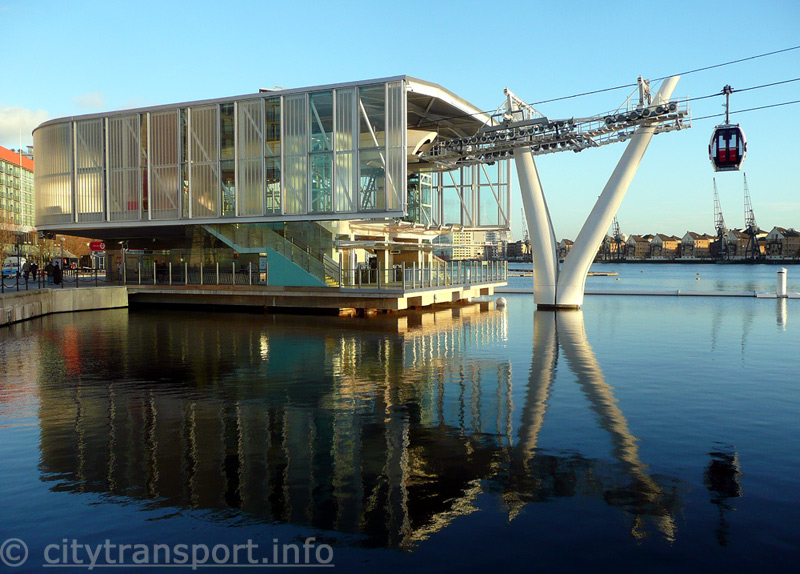 |
|
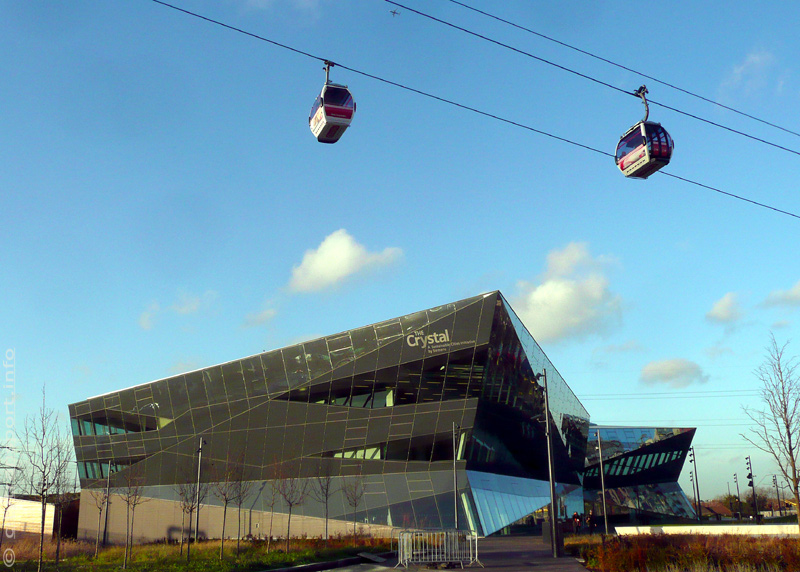 |
| Emirates Royal Victoria cable car terminus and some cranes from when the Royal Victoria Dock was a working dockyard. Close nearby is Royal Victoria DLR station. | |
Two Emirates Air Line cable cars and an aircraft (seen near the top of the image) pass by the distinctively styled Crystal building, close to Royal Victoria DLR station. |
The Japanese Skyrail gondola transport is new variant of gondola carriage. It is a fusion between a suspended monorail, an aerial cable car, and a people-mover. It features driverless gondola-sized carriages which are designed to carry either 25 or 37 passengers (depending on information source), travel at up to 18 km/h and are suspended from a single concrete track. Between stations traction comes via an attached cable whilst in the stations the carriages release the cable and (for acceleration and braking) use linear motors. With this system the carriages can climb steep slopes like cable suspended gondola systems and follow curves like normal monorails. Officially known as the Hiroshima Short Distance Transit Seno Line this line is just 1.3km in length it features three stations. It was built to connect a housing development with Midoriguchi station of the JR-West San-yô railway. Originally listed as a Japanese AGT (automated guided transport / transit) it has since been reclassified as a monorail. Different sources suggest that it was opened either on 28th August 1998 or the same date in 1999. |
||

Image & license: Sui-setz / Wikipedia encyclopædia. CC BY-SA 3.0 http://commons.wikimedia.org/wiki/Image%3AHiroshima-skyrail.jpg |
|

Image & license: Sui-setz / Wikipedia encyclopædia. CC BY-SA 3.0 http://en.wikipedia.org/wiki/Image:Skyrail-car.jpg |
The Japanese Skyrail Midorizaka Line.
A more well known (in Asia) version of this is the Slope Car, which is installed in over 80 locations in Japan and South Korea. The principle behind Slope Cars is the fusing of monorail and funicular technologies to provide localised and often 'on demand' transports where there are steep slopes or stairways, for instance between entrance gates and buildings. Often they will also be installed to provide 'special needs' access, however as they are normally fairly slow moving so people who can walk may still prefer to do so. Sometimes however they may be used at locations where there is no foot access, so obviously this precludes the walking alternative. Most slope cars come in the form of straddle-beam monorails, but there are also suspended monorail variants too. Unlike normal monorails which generally use rubber tyres running on a concrete track, slope cars use a combination steel wheels plus cog wheels / rack rail and pinions. This is what gives them their hill climbing ability. Slope car systems will typically operate like lifts (elevators) and provide an on-demand service where to start the journey a user pushes a button, and it automatically stops at the destination. The smaller sized vehicles will carry just a few people, but as explained elsewhere on this page they will not be PRT's - because they still only follow a fixed route over which the passengers have no control. Cable-powered transports for hilly locations are looked at in greater detail on a page dedicated to Cable Transports. |
||
 |
|
 |
| Above & Below Some Japanese Slope Cars.
The above images come from the vehicle manufacturers' website http://www.kaho-monorail.com. |
||

Image & license: Corpse Reviver / Wikipedia encyclopædia. CC BY-SA 3.0 http://commons.wikimedia.org/wiki/File:Taiyo_park_Opening_day_12.jpg |
|

Image & license: RSA / Wikipedia encyclopædia. CC BY-SA 3.0 http://commons.wikimedia.org/wiki/File:Highway_Naruto_Bus_stop_Slope_car-02.jpg |
This link http://en.wikipedia.org/wiki/Slope_car leads to a page at "Wikipedia" encyclopædia where further information can be found Airport People-Mover Cabin TransportsCabin transports are very widely used at airports where they ferry passengers between car parks, terminals, departure gates and sometimes more. The suspended H-Bahn monorail Düsseldorf airport "Sky-Train" people-mover has already been seen in the monorail section above, this section focuses on several variants which use rubber-tyred duorail style technologies and are also sometimes used away from airports too. Perhaps one of the most extensive airport Cabin transport systems to have been built was the original APM (airport people mover) at Dallas Fort Worth (DFW) airport in the USA. Whereas most airport people-movers usually just shuttle to and fro between two stations (and possibly calling at an intermediate station or two) this one was different because it was 15 miles (24km) in length and featured over 30 stations. So it was more like a transit system for a small town(!) providing a variety of overlapping services serving different stations and featuring one, two and three car train formations. However, this was not a PRT, as despite the extensive nature of the system the trains still followed pre-set routes and called at specified groups of stations; plus, the trains were for people who were not always travelling between exactly the same start and end points. The DFW Airtrans APM Airport People-Mover |
||
 |
|
 |
| A vehicle about to arrive at a station which serves a car parking area and hire car collection point located at the outskirts of the airport. | |
Looking down on the transit from a terminal building this view shows an Airtrans APM vehicle on a public 'non-secure' working leaving a station and the front of an airport staff train calling at a staff station. |
 |
|
A service dedicated to airport and airline staff, which to ensure that the general public did not use called at different stations and used vehicles with doors on
the right-hand side of the cabin - in contrast to the services which the public used which had their doors on the left. Note the track immediately to my right, this is for non-stopping trains. |
 |
|
 |
| A twin-unit train passes the airport apron with a multi-storey car park in the distance. |
|
Turn left to call at a station; continue straight ahead to bypass the station. |
 |
|
A route map depicting the three intersecting passenger services which were operating on this visit in summer 1998. In 2003 these services were replaced by services provided by contracted-out motor buses. |
 |
|
 |
| An image showing a passenger train around the time the system first opened. Image & license: Noah Jeppson / Wikipedia encyclopædia. CC-BY-SA-2.0. http://commons.wikimedia.org/wiki/File:Airtrans_Cargo_Vehicle.jpg. |
|
For many years freight services were also operated.
Image & license: Noah Jeppson / Wikipedia encyclopædia. CC-BY-SA-2.0. http://commons.wikimedia.org/wiki/File:Airtrans_Cargo_Vehicle.jpg. |
 |
|
 |
| The front of a passenger car showing the complex power collection equipment. Image & license: Noah Jeppson / Wikipedia encyclopædia. CC-BY-SA-2.0. http://commons.wikimedia.org/wiki/File:Airtrans_Power.jpg. |
|
A Skylink Innovia 200 APM train as seen from an aircraft window. In 2005 these replaced the airside passenger transport function of the Airtrans APM.
Image & license: Aykleinman / Wikipedia encyclopædia. Public Domain. http://commons.wikimedia.org/wiki/File:DFW_Skylink_from_plane.jpg. |
Additional information: Known as the Airtrans APM it opened in 1974. Services provided varied but at the height of operations it was providing three sets of services for passengers, airport staff
and a special service for American Airlines. The fleet consisted of 68 cabin-sized vehicles which seated 16 passengers and offered standing room for a further 24 passengers. The system had an overall capacity
rated at 9,000 passengers per hour (pph). The top speed was just 17mph (27km/h). Although there were some initial teething problems it eventually became very reliable. During its 31 years of operation there
were many technical upgrades, some of which took advantage of advancing technology, eg: circuit boards were replaced with microchips and the original eight-track cartridge system which was used for the passenger
announcements was later updated to a compact cassette system and still later to a digital voice synthesizer.
|
||
Another US airport which uses Bombardier Innovia 200 APM Transits is Phoenix Sky Harbor International Airport. The route of the PHX Sky Train includes a 30 metre / 100ft bridge over Taxiway R, this being one of the three aircraft taxiways which connect the north and south runways. The bridge is tall enough to accommodate a Boeing 747, but not an Airbus A380. This is the first location anywhere globally where a rail system of any kind crosses over an active taxiway. |
|

Mesa Airlines Bombardier CRJ-900 aircraft passes below the PHX Sky Train bridge with two (of the networks' 18) Bombardier Innovia APM 200 trains passing above. Image & license: redlegsfan21 / Wikipedia encyclopædia. CC-BY-SA-2.0. http://commons.wikimedia.org/wiki/File:N915FJ_(8607004805).jpg. |
The Most Used Airport People-Mover TechnologyThe Bombardier Innovia Transits which are used by DFW Skylink is part of a range of automated transit cars which have become very widely used at major airports planetwide. It draws its historical lineage upon the Westinghouse Transportation Systems people movers which began operating at Tampa International Airport in 1971. Over the years ownership of this APM system has changed several times (AEG-Westinghouse, AEG Transportation, Adtranz and now Bombardier Transportation) and the actual rolling stock has also been updated, albeit in a way which maintains operational links with what is now seen as being a 'legacy' technology. These small bus-sized rubber tyred transits are fully automated and driverless. To meet with passenger demand they can operate singly or with several coupled together in trains. The exact number which can be used coupled varies depending on the requirements of the specific site and the generation of the rolling stock. Traction comes from dual tyred wheels which use a concrete running surface whilst guidance comes from horizontal guidewheels which grip a central I beam. Although the original C-100 rolling stock is no longer made, many airports still use it and can still obtain spare parts for it. The replacement was the CX-100, which was later renamed as the Innovia APM 100. Whilst this too has been superseeded by newer designs it is still available for older existing installations which wish to replace the older rolling stock or to expand. Use At British AirportsSeveral British airports also use automated people-movers, including Stansted and Gatwick; at one time the latter even had two of these systems. The installation which is still open links the two passenger terminals and usually uses triple unit trains, although sometimes shorter trains are operated instead. The other installation linked one of the terminals with a 'satellite' terminal and used single unit trains. Closure came as part of a major rebuilding project which included both significant expansion of the terminal and the installation of a moving walkway system - which was thought to be better able to cope with larger aircraft depositing 100s of arriving passengers at the same time plus would make it easier to keep arriving and departing passengers separate. Stansted Airport's single route has three stations. Apart from at the Terminal building these are all underground. To better cope with large numbers of arriving passengers this system uses multiple-unit trains; passenger separation is ensured through arriving and departing passengers being served by different calling points - with the trains being fully empty before travelling between the platforms. This system first opened in 1991 when it was equipped with five Westinghouse C-100 cars. In 1998 airport expansion required that the Transit system be enlarged as well, so four new Bombardier CX-100 cars were added to the fleet. Terminal 5 at London's Heathrow Airport has a three station installation which uses the newer Innovia APM 200 Transit cars. This is fully enclosed and not illustrated here. |
||
 |
|
 |
| The original single car people-mover at Gatwick airport which linked the 1958 terminal building with a new circular satellite building that contained 8 extra gates at which aircraft could dock. This opened in 1983 and was only accessible to 'airside' passengers. These images date from 1986. | ||
 |
|
 |
| The triple-unit Gatwick Airport people-mover was built in 1987 as part of a construction project that included a new terminal building - which became known as the North Terminal.
In 2009 - 2010 this Transit was rebuilt and nowadays uses Bombardier APM 100 transit cars. This transit is 'land-side' so is accessible to everyone. |
|
All the stations on both of the people movers at Gatwick Airport featured platforms on both sides of the train. Passengers exit the trains via the outside platforms and board via the central island platform.
This image looks through the open doors of one train to see the closed platform screen doors for the other train. |
 |
|
 |
| Stansted airport people-mover seen at a subterranean 'satellite' station used by passengers arriving at the airport by air who then need to go to the main terminal building to collect their luggage, pass through passport / customs procedures and enter the UK. This system is fully 'airside'. | |
Approaching a junction; the train switches here to the other track so that it can stop at the platform where arriving passengers can enter the main Stansted Airport terminal building.
Image & license: Wikipedia encyclopædia. Public Domain. http://commons.wikimedia.org/wiki/File:Stansted_Airport_Transit_System_switch.JPG. |
Use Away From AirportsWhilst primarily installed at airports there are a few urban areas which chose to use these cabin-sized trains as part of their urban transit networks. These include Zhujiang New Town in Guangzhou, China; Singapore and Miami, Florida, USA. The Zhujiang New Town line operates as an urban metro, mostly serving the new Zhujiang New Town CBD (central business district) in Guangzhou. This fully underground installation opened in Nov 2010, it uses 14 APM 100 trains and features 9 stations. (not illustrated) Singapore LRTIn Singapore there are three such automatic guided transport systems which use these cabin sized vehicles on services that serve new high rise housing estates and act as localised feeders to the Mass Rapid Transit railway (MRT) - this being an island-wide urban / suburban heavy rail system which links many areas of Singapore Island with Singapore City. The Bukit Panjang LRT line opened in 1999. 7.8km in length it has 14 stations and (originally) used 19 Adtranz CX-100 vehicles which outside the rush hours were operated singly. However with the system becoming busier 2014 saw another 13 vehicles being added to the fleet, these being the newer Innovia 100 APM, and twin-unit trains are now used throughout the day. One unusual feature is that where the line passes close to residential buildings the window glass automatically becomes opaque. This is achieved using similar technology to LCD display systems and is done to preserve the privacy of local residents. |
||

Image & license: mailer_diablo / Wikipedia encyclopædia. CC BY-SA 3.0 http://commons.wikimedia.org/wiki/File:BPLRT-ExtMid-CX100.JPG. |
|

Image & license: mailer_diablo / Wikipedia encyclopædia. CC BY-SA 3.0 http://commons.wikimedia.org/wiki/File:BPLRT-Int-CX100.JPG. |
Two views of Bukit Panjang LRT people-movers showing the elevated private right of way nature of the system and inside a vehicle.
Fully automated rubber tyred airport style people-mover systems were chosen because it was felt that despite the higher initial installation costs fixed infrastructure transports would be more beneficial than motor bus based systems. There are various reasons for this, including that (unlike road-based motor buses) these transports...
In Singapore these are known as LRT lines (light rail transport / transit). The systems are still being developed, so that some stations (and sections of line) will remain unopened until the residential developments they have been built to serve are populated. |
||
 |
|
 |
| A Light Rail Transit train travelling between Bukit Panjang LRT/MRT Station and Senja LRT Station. Services A and C utilise the lower track to Senja.
Image & license: 2679D. / Wikipedia encyclopædia. Copyrighted free use. http://commons.wikimedia.org/wiki/File:BukitPanjangToSenja.JPG. |
|
A C-100 train at Fajar station on the Singaporean Bukit Panjang LRT automatic guided transport / people-mover system.
Image & license: Singaporean / Wikipedia encyclopædia. Copyrighted free use. http://commons.wikimedia.org/wiki/File: Light_Rail_Transit_train_at_Fajar_LRT_Station,_Singapore_-_20060422.jpg. |

Image & license: Willis Chong / Wikipedia encyclopædia. CC BY-SA 3.0 http://commons.wikimedia.org/wiki/File:Unmistedscr.png. |
|

Image & license: Willis Chong / Wikipedia encyclopædia. CC BY-SA 3.0 http://commons.wikimedia.org/wiki/File:Mistedscr.png. |
| To preserve the privacy of local residents the window glass automatically becomes opaque when passing close to residential areas, as seen here. This is achieved using similar technology to LCD display systems. | ||
 |
|
 |
| A bird's eye view of South View LRT Station, Singapore.
Image & license: 2679D. / Wikipedia encyclopædia. Copyrighted free use. http://commons.wikimedia.org/wiki/File:South_View_LRT_Station,_Singapore_-_20120204.jpg. |
|
Automated fare gates at Fernvale LRT Station. Being normal public transport passengers must pay a fare to travel on these trains!
Image & license: Sengkang / Wikipedia encyclopædia. Copyrighted free use. http://commons.wikimedia.org/wiki/File:Fernvale_LRT_Station_2,_Aug_06.JPG. |
|
Only the Bukit Panjang LRT line uses the Westinghouse / Adtranz / Bombardier system, although at one time it was also used on the Singapore Changi Airport 'Skytrain' people-mover. The other two lines (Sengkang LRT and Punggol LRT) use the Japanese Hitachi Crystal Mover system. In addition the people-mover at Changi Airport has been updated with the Japanese system. This was done as part of a project which included building more terminals at the airport and enlarging the people-mover to serve them. As the three urban LRT systems are used as mainstream urban public transports passengers must pay fares to travel on them. However there is no charge for travelling on the people-mover at Changi Airport. |
||

Image & license: Terence Ong / Wikipedia encyclopædia. CC BY-SA 3.0 http://commons.wikimedia.org/wiki/File:Punggol_LRT_Line.JPG. |
|

Image & license: mailer_diablo / Wikipedia encyclopædia. CC BY-SA 3.0 http://commons.wikimedia.org/wiki/File:ThanggamLRT.JPG. |
| Approaching an unidentified station on the Punggol LRT line. | |
Thanggam station on the Sengkang LRT line. |

Image & license: Sengkang / Wikipedia encyclopædia. Copyrighted free use. http://commons.wikimedia.org/wiki/File:Ranggung_LRT_Station_3,_Sep_06.JPG. |
|

Image & license: Terence Ong / Wikipedia encyclopædia. CC BY-SA 3.0 http://commons.wikimedia.org/wiki/File:Ranggung_LRT.JPG. |
| Two views of Ranggung LRT station on the Sengkang LRT line. | ||

Image & license: Terence Ong / Wikipedia encyclopædia. CC BY-SA 3.0 http://commons.wikimedia.org/wiki/File:Renjong_LRT_Station,_Aug_06.JPG. |
|

Image & license: Sengkang / Wikipedia encyclopædia. Copyrighted free use. commons.wikimedia.org/wiki/File:Sengkang_Light_Rail_Transit_viaduct_2,_Nov_05.JPG. |
| These views better demonstrate the elevated nature of the Sengkang line. | ||
The Sengkang LRT (SKLRT) is 10.7km in length. The East Loop opened in 2003 and has 5 stations, all of which are open. The West Loop opened in 2005 and has 9 stations, one of which remains closed as it is in an area with little development. The Punggol LRT (PGLRT) is 10.3km in length. The East Loop opened in 2005 and has 8 stations, one of which opened in 2007 and another one in 2011 The West Loop opened in 2014 and so far only 4 of the planned 8 stations are open. Right: One of the Crystal Mover vehicles on the Sengkang LRT line. |
|

Image & license: Calvin Teo / Wikipedia encyclopædia. CC BY-SA 3.0 http://commons.wikimedia.org/wiki/File:Singapore_Crystal_Mover.jpg. |

Image & license: Terence Ong / Wikipedia encyclopædia. CC BY-SA 3.0 http://commons.wikimedia.org/wiki/File:Changi_Airport_Skytrain_Crystal_Mover.JPG. |
|

Image & license: mailer_diablo / Wikipedia encyclopædia. CC BY-SA 3.0 http://commons.wikimedia.org/wiki/File:CrystalMover-Changi-Int.JPG. |
External and internal views of a Changi Airport Skytrain Crystal Mover vehicle.
These vehicles are slightly different to those used on the two urban transport systems. Further information and images can be found at the online "Wikipedia" encyclopædia; at these links:
Miami, Florida, USAThe Miami system is a free automated transport system called Metromover. 4.4 miles (7.1km) in length it is operated by Miami-Dade Transit and serves the city centre plus some nearby neighbourhoods. There are 21 stations, two of which connect into the Metrorail subway / urban metro system. Services are arranged in three overlapping circuits. The Downtown / Inner Loop commenced operations in April 1986 and all trains travel clockwise around the loop. Two extensions opened in May 1994 and these serve (different) nearby areas and then in the city centre form the outer loop, sharing the same track and running anti-clockwise. In the central area all but two stations are served by trains travelling in both directions - these two stations are on a part of the Downtown Loop where the trains follow slightly different routes. Services are very frequent, with inner loop trains (which usually comprise two cars) between 90 seconds and three minutes apart, depending on time of day and expected demand. Outer loop trains run singly and run evey 5-6 minutes on the two branches and 2½ - 3 minutes on the city centre loop - where they provide a joint service. The rolling stock consists of 46 Bombardier Innovia APM 100 vehicles. These were delivered in several batches starting in 2008 and by early 2014 had replaced the first 12 Westinghouse C-100 vehicles which date from when the system first opened in 1984 and most of the follow-on fleet of 17 AEG-Westinghouse C-100 vehicles which date from 1992. Although a 25¢ flat fare used to be charged to travel on Metromover it is now free to use. The reasons for this are varied and include the fact that the cost of collecting the fares almost equalled the amount raised and that many passengers are already paying to use Metrorail so are still seen as contributing towards the cost of their travels. In addition, it was felt that free travel would encourage some local residents to not use their cars in the areas Metromover serves. |
||
 |
|
 |
| Train calls at Riverwalk Metromover station in Miami which is next to the Miami River. Image & license: Marc Averette. / Wikipedia encyclopædia. CC BY-SA 3.0 http://commons.wikimedia.org/wiki/ File:Riverwalk_Metromover_station_Downtown_Miami.jpg. |
|
Miami Metromover
Image & license: Miami92 / Wikipedia encyclopædia. Public Domain. http://commons.wikimedia.org/wiki/File:Miami_Metromover_back.jpg. |
 |
|
 |
| The Loft 2 condominium tower in Miami city centre is one of several buildings which include a tunnelled section through which Metromover trains pass.
Image & license: Kolossos / Wikipedia encyclopædia. CC BY-SA 3.0 http://commons.wikimedia.org/wiki/File:Miami-Metromover.jpg. |
|
A twin-unit train about to pass below / through the Loft Tower prior to arriving at First Street station. Image & license: Phillip Pessar / Wikipedia encyclopædia. CC BY 2.0 http://commons.wikimedia.org/wiki/ File:Metromover_The_Loft_2_tunnel_Miami_2015-03.jpg. |
 |
|
 |
| Metromover train arrives at Third Street station which is only served by outer loop trains. Image & license: FrickFrack / Wikipedia encyclopædia. Free use with attribution. http://commons.wikimedia.org/wiki/ File:Miami_Metromover_Third_Street_Station.jpg. |
|
Metrorail and Metromover trains approach Brickell Station
Image & license: FrickFrack / Wikipedia encyclopædia. Public Domain http://commons.wikimedia.org/wiki/File:Brickell_Station.jpg. |
'Hovercraft Lift' Floating Cabin-Sized People-MoversAnother cabin transport system is the Otis Hovair. This replaces wheels with hovercraft lift pads - so that the vehicles float along a paved road-like surface on a 0.2 millimetre layer of pressured air. The idea is to eliminate rolling resistance and allow very high performance, while also simplifying the infrastructure needed to install new lines. The technology was originally developed by General Motors as an automated guideway transit system, however they were forced to divest the system as part of an anti-trust ruling and it eventually ended up at Otis Elevator who replaced the linear motor with a cable propulsion technology. Otis are well-known for their vertical lifts (elevator in the American dialect) which can be found in many buildings; when combined with Hovair technology the system becomes more like a horizontal version of funicular railways. In some ways Hovair technology can be seen as a competitor to both magnetic levitation (Maglev) technology - which attempts to meet the same basic goals using magnets for levitation rather than air cushions - and the Westhinghouse / Adtranz / Bombardier Transit system. Especially for smaller installations which are relatively short in length. The Otis Hovair system is the only hovertrain transport technology which has successfully entered commercial service. Cable-powered transports are looked at in greater detail on a page dedicated to Cable Transports. |
||
Locally known as a tram, the Huntsville Hospital Transit system is an automated people mover system which serves the Huntsville Hospital complex in Huntsville, Alabama, USA. Developed by Poma-Otis Transportation Systems, this 580 metre installation connects Huntsville Hospital with the Huntsville Hospital for Women & Children. The two concrete guideways are elevated 30ft (9.1 m) above the ground. The Swiss-built cabin-sized vehicles feature three seats and space for 38 standing passengers. In addition, they were designed to accommodate the largest bed the hospital uses for the transport of patients. |

Huntsville Hospital 'Tram'. Image & license: Nhlarry / Wikipedia encyclopædia. CC BY-SA 3.0 http://commons.wikimedia.org/wiki/File:Huntsville_Hospital_Tram_System.jpg. |
|
There are two intermediate stops and the system operates two different services, these being Local Mode which calls at all stations and primarily travels along the northern track and Express Mode which only serves the two termini and primarily uses the southern track. In 2004 this system was credited for the elimination of approximately 4,500 annual ambulance trips and the use of two full-time shuttle vans between the two main facilities. Because of this Huntsville Hospital was awarded an Industrial Air Pollution Control Achievement Award from the city of Huntsville Air Pollution Control Board. |
||
 |
|
 |
| Upper station of the Getty Center Monorail (sic), connecting the parking garage with the actual museum.
Image & license: Andreas Praefcke / Wikipedia encyclopædia. CC BY-SA 3.0 http://commons.wikimedia.org/wiki/File:Getty_Center_Monorail_station.jpg. |
|
The airport people mover (which locally is known as an express 'tram') at Detroit Metropolitan Wayne County Airport McNamara terminal.
Image & license: Esun / Wikipedia encyclopædia. CC BY-SA 3.0 http://commons.wikimedia.org/wiki/ File:The_Express_Tram_in_the_McNamara_Terminal.jpg. |
 |
|
 |
| Railway and tunnel of the Skymetro, the airport people mover at Zürich, Switzerland, International Airport between terminals B and E.
Image & license: Ad Meskens / Wikipedia encyclopædia. CC BY-SA 3.0. http://commons.wikimedia.org/wiki/File:Zurich_Airport_Skymetro.JPG. |
|
Skymetro train at a station. The stations all have platform screen doors. |
Since the two examples seen below were first added to this page they have ceased operating. The Narita International Airport installation closed in 2013, having been replaced with walkways - this being the same as happened with the original transit at Gatwick Airport, as seen above. |
||

Image & license: Specious / Wikipedia encyclopædia. CC BY-SA 3.0 http://commons.wikimedia.org/wiki/ File:Shuttle_of_Narita_Turminal_2_200507-2.jpg. |
|

Image & license: G-TOKS / Wikipedia encyclopædia. CC BY-SA 3.0 http://commons.wikimedia.org/wiki/File:OTIS-Narita.jpeg. |
The former shuttle between the main building and satellite of Narita International Airport Terminal, as seen in July 2005.
The Duke University Medical Center Patient Rapid Transit closed in 2009 because the hospital was expanding and it was in the way of the new buildings. Unlike the other Hovair systems seen on this page, this 1979 installation used vehicles which were propelled by linear induction motors and they could move sideways, as well as backwards and forwards! |
||

Image & license: Specious / Wikipedia encyclopædia. CC BY-SA 4.0 http://commons.wikimedia.org/wiki/File:2008-07-24_Duke_Hospital_PRT_4.jpg. |
|

Image & license: Specious / Wikipedia encyclopædia. CC BY-SA 4.0 http://commons.wikimedia.org/wiki/File:2008-07-24_Duke_Hospital_PRT_5.jpg. |
The former Patient Rapid Transit train connecting parts of the Duke University Medical Center (DUMC) in Durham, North Carolina.
Unknown TechnologyAnother hospital transit system.... this one, which uses rolling stock which is larger than cabin size is the Indiana University Health People Mover. Previously known as the Clarian Health People Mover this 1.5 mile (2.3 km) long installation is in the city of Indianapolis, Indiana, USA. It opened in June 2003 to connect three hospital operations which had been combined into one organisation that had a shared staff of over 10,000 employees whose work duties could require them to travel between the various sites. Prior to the opening of the transit system the hospital staff had to commute between the various sites by shuttle bus, a journey which was complicated and required crossing the Interstate 65 highway. This system is open to the public and operates around the clock, with journeys taking just 5 minutes. During the daytime trains run at every six minutes. It is notable for being the only private transportation system in the United States constructed to run above public streets. |
||
 |
|
 |
| One of the people-mover trains at an unidentified station.
Image & license: the.urbanophile / Flickr CC-BY-ND-2.0 http://www.flickr.com/photos/urbanophile/3263083839/. |
|
Looking up upon a passing train as seen through the 4ft (1,219mm) gauge track. The large gap between the rails prevents winter snow from blocking the line. Between the tracks can be seen the pneumatic tubes which are used for document and sample transfer.
Image & license: Dina Wakulchik / Wikipedia encyclopædia CC-BY-2.0 http://commons.wikimedia.org/wiki/ File:Clarian-people-mover-underneath-duorail-and-piping.jpg. |
A European Cabin Urban Transport SystemCabin sized transports are relatively rare in Europe too. (This comment excludes buses and trams). One that has actually been built but is very different operationally is the funicular style Italian MiniMetro which can be found in the city of Perugia. Faced with severe environmental issues related to motor vehicle exhaust fumes the Italian city of Perugia decided that the only solution lay in restricting car and motorcoach access to parts of the city centre. However they also recognised that another part of the solution lay in improving public transport so that fewer people would want to drive their own cars and that visitors who come by motorcoach should also be happy to leave their vehicles outside of the city centre. Therefore, in addition to increasing car and coach parking capacity on the outskirts of the historic city centre and installing escalators between the parking areas and the city centre, they built a new metro system. Being a small city (population a little below 165,000) on a hilly location they reasoned that they needed a lower capacity system capable of climbing steeper gradients, and wanting to maintain attractiveness by means of a high service frequency they opted to use lower capacity 'cabin' type vehicles which would operate as a funicular railway. Known as the MiniMetro the Perugia system can operate so frequently that waiting time is almost non-existent. 3.2km (2miles) in length the system currently has seven stations, although a second line with two further stations is planned. There are 25 rubber-tyred vehicles which like other automated urban metro railways can be added or removed from service as required depending on expected passenger numbers. Five metres long each, they are fitted with eight tip-up and one fixed 'special needs' seats and have a maximum capacity of 50 passengers. Other features include an acoustic 'doors closing' alarm and LED display which provides 'next station' and destination updates. The systems' top speed various between 36-43km/h (22-26mph) Services are only cable operated between stations, as at the stations they are automatically detached from the cable and conveyed through the station by an independent conveyor system. Although generally welcomed the MiniMetro has attracted some complaints by people who live close to the route who cite the continuous hum of the cable pulleys as being somewhat noisy. The name MiniMetro is a registered trade mark, so can only be used on systems developed by the Italian company Leitner, who are specialists in automatic aerial ropeways and chairlifts - so it is not surprising that some practices from these transports (such as disengaging from the cable at stations) have been ported over. Funicular / cable railway system are looked at in greater detail on the Niche Transports page. |
||
 |
|
 |
| Being fully automated means that where the line is at or below grade (ground level) safety dictates that it has to be fenced in, with crossing points either above or below - as seen in the distance.
Image & license: Pava / Wikipedia encyclopædia. Public Domain. http://commons.wikimedia.org/wiki/File:Lavalledelminimetr%C3%B2.jpg. |
|
An elevated section of line showing how it has been dovetailed to fit between existing residential buildings. In the distance can be seen one of the cutting-edge designed stations.
Image & license: Pava / Wikipedia encyclopædia. Public Domain. http://commons.wikimedia.org/wiki/File:Inforndominimetr%C3%B2.jpg. |
 |
|
 |
| Part of the system operates as a fully fledged underground railway.
Image & license: Radapanda / Wikipedia encyclopædia. Public Domain http://commons.wikimedia.org/wiki/File:90410MiniMetroPG03.JPG. |
|
Calling at an underground station.
Image & license: Radapanda / Wikipedia encyclopædia. Public Domain http://commons.wikimedia.org/wiki/File:90410MiniMetroPG02.JPG. |
 |
|
 |
| Inside one of the MiniMetro 'cabin' sized vehicles showing their bright red colour scheme.
Image & license: Pava / Wikipedia encyclopædia. Public Domain. http://commons.wikimedia.org/wiki/File:Interni_minimetr%C3%B2.jpg. |
|
At the park and ride facility on the outskirts of the city centre.
Image & license: Pava / Wikipedia encyclopædia. Public Domain. http://commons.wikimedia.org/wiki/File:Minimetr%C3%B2_primopiano.jpg. |
This link http://en.wikipedia.org/wiki/MiniMetro
leads to a page at the "Wikipedia" encyclopædia where further information can be found
.A British Street-Compatible Cabin TransportNone of the above transports are "street compatible", which means that they require extensive (and possibly costly) infrastructure to be built before they could be brought into service. This in itself is not a problem because for many locations such transports will be appropriate and by being away from the street scene they will be able to provide timetabled, reliable services which will offer travellers a viable and environmentally sound alternative choice to driving and the all-too-familiar problems caused by traffic congestion / air pollution, etc... However there will also be some locations where there is a need for very frequent lower capacity transports which are capable of operating both on their own private right of way and in the "street" domain - whether shared with pedestrians, other road traffic, or both. Traditionally this would have meant using minibuses (although they would only really be suitable for use on paved roads) these being the cheapest and simplest form of public transport. However, experience with bus deregulation here in Britain has shown that whilst buses are easy to bring into service their lack of fixed infrastructure also equates to a possible lack of commitment to providing a long term service - or, in other words buses which are "here today" can just as easily be "gone tomorrow"! And then there is the question of air pollution... although it is true that battery electric buses do exist this is an option few transport operators seem to want to explore. Electric minibuses are looked at on the Electric Buses page. |
||
 |
|
 |
| An example of ultra light rail - a Parry people-mover 50 (PPM50) in low floor format suitable for street operation. Image sourced from manufacturer's promotional material
- http://www.parrypeoplemovers.com |
|
The first commercial use of a Parry People Mover is as a replacement for a 'heavy' rail service, so uses a variant of the PPM60 railcar adapted for use on a mainline railway, rather than a street tramway. |
|
By far the most popular street compatible form of public transport is the tram (or streetcar) and these exist in "Cabin" size too. However as light rail is a duo-rail technology it is looked at on the Passenger Train Variations - Trams, Streetcars & Light Rail Vehicles and the Light Rail Fits In pages.
Magnetic Levitation (Maglev) TrainsOpening on 16th August 1984 the Birmingham (UK) airport Maglev people-mover was a global innovation by being the first public transport installation (in the present era) to use magnetic levitation. Linking Birmingham International Railway Station with Birmingham International Airport and the National Exhibition Centre (NEC) it used two 'cabin' sized vehicles which featured electromagnets at each corner (to provide the lift) and linear induction motors (for propulsion). The trains "flew" at an altitude of 0.6" (15mm), carried up to 40 passengers (plus luggage) and with a maximum speed of 26mph (42km/h) the approximately 2000' (620 metre) journey lasted for about 90 seconds. Because the Maglev system always formed part of the airport's essential infrastructure as the link to the railway station no fares were ever charged for its use. Maglev technology uses powerful electro-magnets so that the transports float along the track on a cushion of air. This reduces friction, gives a very smooth quality of ride and makes such vehicles relatively quiet. Magnetics are also used for propulsion and braking. The advantage of this technology over conventional steel wheel technologies is that there are massive savings in maintenance and there is the possibility of full 24-hour service - conventional railway tracks must have every stretch inspected every 72 hours (or even more frequently) and as this involves railway staff walking along the tracks it requires the lines to be closed to moving trains. This is usually done at night - and partly explains why conventional railways cannot offer 24 hours / all-night services. Maglev does not have this issue, as the system should only need periodic maintenance shutdowns - although most travellers and safety officials would probably feel happier if (at a minimum) this was done on a weekly basis. |
||
 |
|
 |
| The former Birmingham Airport Maglev. | ||
 |
|
 |
|
In addition to meeting a real transport need this 'showpiece' installation was intended as a working demonstration of the new technology of magnetic levitation. However no further systems were built using the same technology and with the Birmingham installation working reasonably well so no need was seen to keep it up to date with newer technologies as they became available. Advocates of magnetic levitation technology suggest that especially the latter was another reason for the system's ultimate demise. In the end it became a victim of its own success - because it had been so dependable, for so long, that when it finally needed spare parts there was no replacement parts industry. Furthermore its electronics had by then become several generations behind the times (isn't it just amazing that something so technologically advanced as a maglev can become 'old fashioned' so soon!). Closure came on the 19th June 1995. Some of this information was sourced from a House of Commons Written Answers session, this link should open a copy of Hansard for the relevant date:
http://www.publications.parliament.uk/pa/cm199899/cmhansrd/vo990526/text/90526w08.htm
Instead there is now a people-mover (marketed under the name of "Air-Rail Link ") which uses the Austrian Doppelmayr/Siemens CABLE Liner Shuttle system. This rubber-tyred system features automated cable traction, and apart from here is also used in Las Vegas, USA and Venice, Italy. |
||
 |
|
 |
The Birmingham Airport - NEC and International Railway Station 'SkyRail' people-mover.
These trains feature what are effectively two identical cabin vehicles "back-to-back". Formally opened 7th March 2003 it cost £11 million to install. Services run at speeds of up to 22mph (35km/h) and a journey along the two new 585metre trackways takes about 90 seconds. The system is somewhat like a flat funicular (or horizontal lift / elevator) with trains being hauled by a cable which is powered via a winding house, although in this installation the two vehicles are able to operate independently of each other. Services operate every few minutes so although each cabin has a stated capacity of just 27 passengers (which equates to 54 passengers per train) the system can transport up to 1600 passengers per hour. Often thought of as a 'magnetic levitation' transport was the (West) Berlin, Germany, M-Bahn. This system used a linear synchronous motor in the guideway which reacted with permanent magnets on the vehicles to provide 85% of the support as well as propel the trains. The vehicles were also fitted with small lateral and vertical rollers which provided 15% of the support as well as helping keep the vehicle within preset lateral limits. |
||
 |
|
 |
| The former (West) Berlin, Germany, M-Bahn.... Left: at Gleisdreieck, where it used part of a U-Bahn platform which had been closed as a result of the erection of the Berlin Wall. Right: Bernburger Str. which was the intermediate station. On the ground to the right can be seen a flea market / car boot sale (filmed looking in the direction of the sun and through glass which has a blue tint). |
||
 |
|
 |
| Kemperplatz was the third station, which is from where these two views were sourced. | ||
 Inside an M-Bahn train. |
A video of the M-Bahn has been placed on the ‘YouTube’ film / video website and can be watched by clicking the link below, from where links to further videos can also be found.
http://www.youtube.com/watch?v=PcaZcSGSReM
Also of interest may be this video which includes many different views. http://www.youtube.com/watch?v=Qv4QsYJcTZ0 |
|
Very much experimental in nature there were just three stations along a 1.6 km route which took the train very close to the former division between the Eastern and Western sectors of the city. Public services began on 28th August 1989, as this was on a trial basis so passengers could travel for free. Final approval for use as a passenger transport came on 18th July 1991, and from then on passengers were charged normal urban transport fares. But only for two weeks! This very short duration was because after Berlin's reunification it was felt desirable to reopen the sections of U-Bahn (underground railway / subway) which had been closed as a result of the city's division, and this required the M-Bahn to be closed. In March 2005 the 9.2km Tobu-Kyuryo Japanese "Linimo" urban maglev monorail carried its first passengers. Unlike previous Japanese applications of maglev technology which had been developed with high-speed long-distance travel in mind, Linimo was intended to develop a variant suitable for urban transport which could provide an alternative to steel wheel and rubber tyred urban railway (metro / subway) systems. In this way Linimo has become both the first application of maglev technology on a monorail and the first commercial automated urban maglev. The trains are based on the well-tested HSST-100 maglev design. They have a theoretical top speed of 200km/h, although being an urban line with 9 stations in virtually as many kilometres the station spacing is too close to allow such speeds to be reached in practise. On this system the top speed is about 130km/h. Traction comes from linear motors, with the trains floating 8mm above the track when in motion. As with some of Japan's other urban transports most of the line is elevated, including sometimes directly above city streets, although there is also a tunnel section of about 1km in length. Curiously, services have to be suspended for safety reasons when wind speeds exceed 25 m/s, with (apparently) this being a relatively common occurrence in the area. Being the first commercial implementation of a new type of transport technology the line has suffered a number of highly publicised technical breakdowns, especially during the 2005 Expo when twice in March 2005 far higher peak hour demand than the line's carrying capacity saw the number of people inside trains exceeding the design capacity of 244 passengers/train. As a result the trains were unable to levitate. The design capacity of the system with these triple carriage trains is 4000 passengers/direction/hour. Internally the Linimo trains feature the usual (for Asia) full walk-through facility whilst the fronts are of a novel see-through "gem cut" design with doorways that in an emergency will allow evacuation through either end. |
||

Image & license: Chris 73 / Wikipedia encyclopædia. CC BY-SA 3.0 http://commons.wikimedia.org/wiki/File: Linimo_train_as_seen_from_the_Toyota_Automobil_Museum.jpg. |
|

Image & license: Chris 73 / Wikipedia encyclopædia. CC BY-SA 3.0 http://commons.wikimedia.org/wiki/File: Linimo_approaching_Banpaku_Kinen_Koen,_towards_Fujigaoka_Station.jpg. |

Image & license: Chris 73 / Wikipedia encyclopædia. CC BY-SA 3.0 http://commons.wikimedia.org/wiki/File: LINIMO_between_Hanamizukidori_and_Irigaike_Koen.jpg. |
|

Image & license: Rsa / Wikipedia encyclopædia. CC BY-SA 3.0 http://commons.wikimedia.org/wiki/File:Linimo_cabin.JPG. |
Exterior and interior views of the Linimo Maglev Monorail.
Several videos of this maglev can be found on the ‘YouTube’ film / video website. These can be watched (in new windows) by clicking the links below, from where links to further videos can also be found.
http://www.youtube.com/watch?v=s5RzchADGLc (especially note the trains switching tracks at the end of the film)
http://www.youtube.com/watch?v=uXOVXVFw9qI .Meanwhile, in December 2003 Shanghai, China, become the home of a global innovation with the first commercial high-speed maglev line. |
||
 |
|
 |
The first commercial application of high-speed maglev is the 30km (18.6 miles) double-track line which connects Shanghai to the new Pudong International Airport. With a peak operating
speed of 430 km/h (267mph) and average speed of 250 km/h (150mph), each one-way trip has a duration of just 7 minutes 20 seconds.
Pictures sourced from manufacturer's promotional material. For more information visit their websites at:- http://www.transrapid.de or http://www.transrapid-usa.com
For information on a proposed application of this technology on the British mainland visit http://www.500kmh.com In February 2016 a new maglev monorail opened in Incheon, (South) Korea. This 6.1km (3.8 miles).line links Incheon International Airport Maglev with Yongyu metro / subway station. Thre are six intermediate stations and journeys take about 15 minutes. No fare is charged and at present services only operate during the daytime - between 9am and 6pm (09:00 and 18:00). The four two-car trains carry up to 230 passengers each. The service interval is every 15 minutes. Trains 'fly' at an altitude of 8mm. Although designed for speeds of up to 110km/h (68mph), for the time being trains are limited to 80km/h (50mph). The maglev train, called ECOBEE, was co-developed by the Korea Institute of Machinery and Materials (KIMM) and Hyundai Rotem. Two more stages are planned, these will be 9.7km and 37.4km in length and once completed this will become a circular line. Hyundai-Rotem is exporting the same technology for the planned Leningrad Maglev System, which if built will become the first urban commuter Maglev system in Europe. |
||
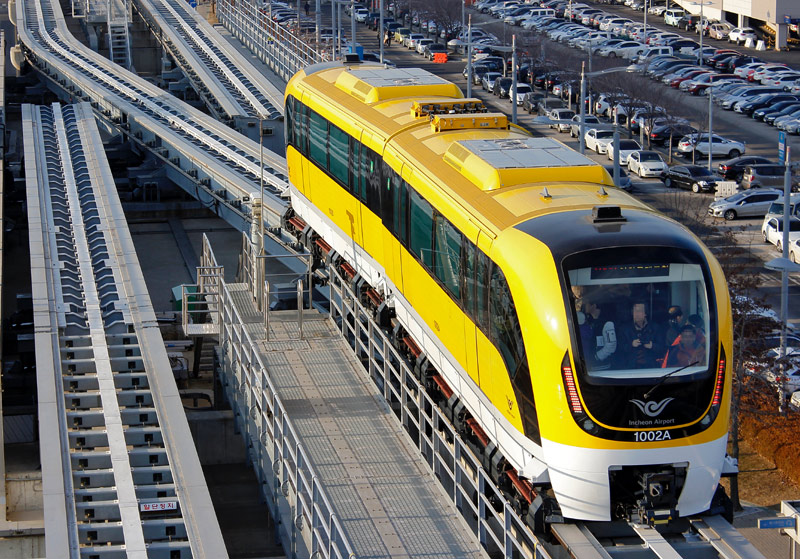 |
|
 |
| An ECOBEE maglev train after having just switched tracks.
Image & license: Minseong Kim / Wikipedia encyclopædia. CC BY SA 4.0 http://commons.wikimedia.org/wiki/File:ECOBEE.jpg. |
|
Inside the ECOBEE maglev train.
Image & license: Minseong Kim / Wikipedia encyclopædia. CC BY SA 4.0 https://commons.wikimedia.org/wiki/File:ECOBEE_Interior.jpg. |
PRT (Personal Rapid Transport / Transit)Also known as Personal Automated Transport (PAT); Automated Transit Networks (ATN); Intelligent People Mover (IPM) and PodCar. PRT systems operate on the basis that the passengers tell the vehicle where they wish to go and it will use its special dedicated track to take them there, travelling via the best route. It is this feature which primarily differentiates PRT from normal people-movers and others types of public transport, as the latter only follow fixed routes over which the passenger (usually) has no control. An issue which needs resolving is that PRT cabin vehicles are typically designed for just a small number of passengers (between 2 and 6 depending on its size), but sometimes passengers travel in larger groups (eg: families) and it could be that these groups would be required to split up and take a second cabin - or will they be allowed to just 'cram in' with perhaps children sitting on adult's laps, etc?. Especially if there is just one adult (or other responsible person) in the group it would be felt undesirable to allow children to travel alone. Likewise, expecting children to travel in another cabin with a complete stranger... PRT is still an emerging technology, with only a few PRT style systems having been created. Some people would question whether PRT can even be seen as true public transport, with instead it being more akin to travelling by taxicabs private cars which are hired on a short time basis (either from a specialist commercial hiring company or a car club) rather than being bought / owned by the principal user or their employer. Another distinction is that typically public transports will carry people who are not known to each other, whilst with private transport the passengers tend to know each other, perhaps as friends, family, work colleagues, students at the same educational facility, etc. A British System In Daily Public ServiceSince 16th September 2011 the British "ULTra" (Urban Light Transit) cabin transport system has been in passenger service at Terminal Five of London's Heathrow Airport. The ULTra system uses very small battery electric powered cabins which have a maximum speed of 25mph (40 km/h).. At Heathrow Airport 21 of these battery-powered driverless vehicles carry passengers between the business car park with the terminal, providing a more rapid and frequent service than the more traditional services that use normal motor buses. |
||
Passengers arriving at the car park before flying out from the airport are able to summon an ULTra cabin from the nearest 'stop' and after a wait which typically is under a minute are taken directly to the airport terminal - rather than being required to travel on a bus journey which follows an often circuitous pre-set route. Passengers flying into the airport who then wish to collect a car from the car park first use a touch-screen computer to select their destination and then board a vehicle which is having its batteries topped up in one of the four platforms / waiting bays. Once their destination has been confirmed they can press the buttons to close the doors and start the journey. The Heathrow installation is 2.4 miles (3.9km) in length and journeys take approximately 5 minutes. It is in operation for 22 hours a day. If it proves to be successful then it could be extended throughout the airport - needing 400 vehicles! |

Above and Below - both: ULTra cabin vehicles carrying passengers between London's Heathrow Airport Terminal 5 and car parks. All three images come from Ultra publicity material. http://www.ultraglobalprt.com. |
|

At Terminal 5. |
|

At a car park. |
Other PodCar / PRT systems |
||
 |
|
 |
| One of the ParkShuttle automated vehicles which links Rotterdam's Kralingse Zoom metro station and the Rivium business park. This uses 6 vehicles, there are 8 stations and a 1.8km track.
The route includes at grade crossing points for pedestrians and other traffic, which are negotiated in fully automatic mode.
Image & license: Maurits Vink / Wikipedia encyclopædia. Public Domian. http://commons.wikimedia.org/wiki/File:Parkshuttle.jpg. |
|
Automated driverless vehicles at the 2002 Floriade flower show. 25 such vehicles operated over a 700m route journey at 25 second intervals. Research conducted during the show found that despite being driverless people of all ages were happy to use the system without any reservations. Image & license: The system supplier: http://www.2getthere.eu/. |
 |
|
 |
| Masdar City PRT podcar, Abu Dhabi, United Arab Emirates. This new-build car-free community was planned to rely entirely on solar energy and other renewable energy sources, with a sustainable, zero-carbon,
zero-waste ecology. In 2011 ten electric podcars commenced a one year trial for a PRT system, however it was decided not to proceed beyind the stage that had already been reached - it seems that this was because
of the cost of building dedicated roadways.
Image & license: Jan Seifert / Wikipedia encyclopædia. CC BY 2.0 http://commons.wikimedia.org/wiki/File:Masdar_PRT_(1).jpg. |
|
Morgantown Personal Rapid Transit, near Beechurst Station, July 2008. See below for further information.
Image & license: Michlaovic / Wikipedia encyclopædia. Public Domain. commons.wikimedia.org/wiki/File:Morgantown_Personal_Rapid_Transit.jpg. |
The ParkShuttle, Floriade and Masdar City systems are commercial products of a Dutch company called 2getthere. The Morgantown (West Virginia, USA) PRT comprises an 8.2mile (13.2km) route with 73 vehicles and 5 stations. Whilst the system operates as a true PRT at off-peak times of the day, at peak times it operates in a mode whereby the vehicles follow fixed routes of known demand, whilst during low-demand periods the system switches to a mode whereby a small number of vehicles constantly circulate, calling at every station, as per a normal urban public transport people-mover. This system serves a university so is only operational Monday - Saturday when students are attending classes. The system is credited with saving the town of Morgantown from the nightmare of gridlocked streets. A small two station PRT line is operating in Suncheon, (South) Korea. Called Skycube this uses the Vectus system. Alas, without at least three stations there can be no choice of destinations so although this is a podcar system it does not and can not represent a true PRT system. To avoid copyright infringement this PRT is not illustrated here, however a very good article which includes many illustrations and some videos can be found on the Kojects.com website in the links below. More information about these systems can be found at these websites (all links open in new windows |
||

 |
|
|
|
|
|
|
|
|
|
|
|
|
|
|
|
|
|
|
|
|
|
|
|
|
|
|
|
|
|
|
|
|
|
|
|
|
|
|
|
|
|
|
|
|
|
|
|
|
|
|
|
|
|
 |
|
||||||||||||||||||||||||||||||||||||||||||||||||||||
 |
 |
 |
 |
 |
 |
 |
 |
|
|||||||||||||||||||||||||||||||||||||||||||||
 |
 |
 |
|
||||||||||||||||||||||||||||||||||||||||||||||||||
 |
 |
 |
|
||||||||||||||||||||||||||||||||||||||||||||||||||
 |
 |
 |
 |
 |
 |
|
|||||||||||||||||||||||||||||||||||||||||||||||
 |
 |
|
|||||||||||||||||||||||||||||||||||||||||||||||||||
 |
 |
 |
|
||||||||||||||||||||||||||||||||||||||||||||||||||
 |
 |
|
|||||||||||||||||||||||||||||||||||||||||||||||||||
 |
 |
|
|||||||||||||||||||||||||||||||||||||||||||||||||||
 |
|
||||||||||||||||||||||||||||||||||||||||||||||||||||
 |
 |
 |
|
||||||||||||||||||||||||||||||||||||||||||||||||||
 |
 |
|
|||||||||||||||||||||||||||||||||||||||||||||||||||
 |
 |
 |
|
||||||||||||||||||||||||||||||||||||||||||||||||||
 |
|
||||||||||||||||||||||||||||||||||||||||||||||||||||
 |
 |
|
|||||||||||||||||||||||||||||||||||||||||||||||||||
 |
 |
 |
|
||||||||||||||||||||||||||||||||||||||||||||||||||
 |
 |
 |
|
||||||||||||||||||||||||||||||||||||||||||||||||||
 |
 |
 |
|
||||||||||||||||||||||||||||||||||||||||||||||||||
 |
 |
 |
|
||||||||||||||||||||||||||||||||||||||||||||||||||
 |
|
||||||||||||||||||||||||||||||||||||||||||||||||||||
 |
 |
 |
|
||||||||||||||||||||||||||||||||||||||||||||||||||
 |
|
||||||||||||||||||||||||||||||||||||||||||||||||||||
 |
|
||||||||||||||||||||||||||||||||||||||||||||||||||||
 |
|
||||||||||||||||||||||||||||||||||||||||||||||||||||
 |
 |
 |
|
||||||||||||||||||||||||||||||||||||||||||||||||||
 |
 |
 |
|
||||||||||||||||||||||||||||||||||||||||||||||||||
 |
|
||||||||||||||||||||||||||||||||||||||||||||||||||||
 |
 |
 |
 |
 |
 |
|
|||||||||||||||||||||||||||||||||||||||||||||||
 |
 |
 |
|
||||||||||||||||||||||||||||||||||||||||||||||||||
 |
|
||||||||||||||||||||||||||||||||||||||||||||||||||||
 |
 |
 |
|
||||||||||||||||||||||||||||||||||||||||||||||||||
 |
 |
|
|||||||||||||||||||||||||||||||||||||||||||||||||||
 |
 |
 |
|
||||||||||||||||||||||||||||||||||||||||||||||||||
 |
|
||||||||||||||||||||||||||||||||||||||||||||||||||||
 |
 |
 |
|
||||||||||||||||||||||||||||||||||||||||||||||||||
 |
|
||||||||||||||||||||||||||||||||||||||||||||||||||||
 |
|
||||||||||||||||||||||||||||||||||||||||||||||||||||
 |
 |
 |
|
||||||||||||||||||||||||||||||||||||||||||||||||||
 |
|
||||||||||||||||||||||||||||||||||||||||||||||||||||
 |
 |
 |
 |
 |
 |
|
|||||||||||||||||||||||||||||||||||||||||||||||
 |
|
||||||||||||||||||||||||||||||||||||||||||||||||||||
 |
|
||||||||||||||||||||||||||||||||||||||||||||||||||||
 |
|
||||||||||||||||||||||||||||||||||||||||||||||||||||
 |
 |
|
|||||||||||||||||||||||||||||||||||||||||||||||||||
 |
 |
 |
|
||||||||||||||||||||||||||||||||||||||||||||||||||
 |
|
||||||||||||||||||||||||||||||||||||||||||||||||||||
 |
|
||||||||||||||||||||||||||||||||||||||||||||||||||||
E & OE.
© Copyright 2001 - 2026 Simon P Smiler and named image sources.
Privacy Policy.
 >
>