I took all these photographs over many years of travelling overseas from the 1980s onwards. Many of the towns and cities will now
have more modern rolling stock, but I can only include any photographs of them if I have returned to see the present-day scene! Also,
this album is only a snapshot of images - there is far too much to show everything from everywhere I've visited!
Australia |
 |
 |
| Adelaide 1929 H class trams operating singly and in multiple-unit. |
 |
 |
| Melbourne tram calls at a tram stop along Victoria Parade. |
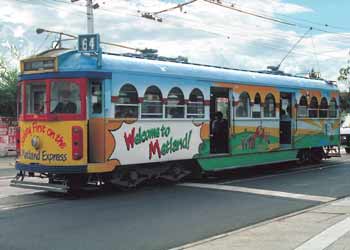
Historic Melbourne 'toastrack' tram at its St Kilda terminus with the driver swinging the trolleypole from one
end of the vehicle to the other, so that it is at the back relative to direction of travel. 'Toastrack' trams are
so called because of the full-width crossbench seats which can only be reached from the vehicle sides. |
 |
 |
| Melbourne |
Melbourne |
Canada & USA |
 |
 |
Two San Francisco cablecars.
Look carefully and you will notice that they are different!
The one on the left operates on the California Street service, this vehicle is double-ended (can be driven from either end) and uses a simple
'stub-end' track at the route terminus; the one on the right operates on the Powel - Mason / Hyde routes and must use a turntable to turn round. |

The real meets the pastiche!
A real San Francisco Cable Car and a rubber tyred replica meet.
This image was taken using a 'stretch' or 'panoramic' camera which explains the wide but narrow format. |
 |
 |
| A section of street trackage showing slotted third (centre) rail through which a device attached to a cablecar grips onto the moving cable. |
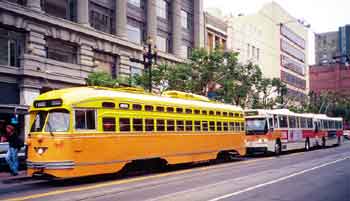
Older Boeing and newer Breda streetcars in San Francisco. |
 |
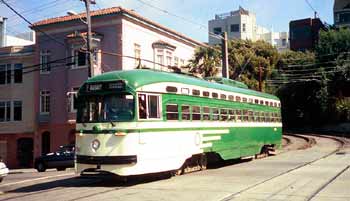 |
| PCC type streetcar in Los Angeles Railway livery on route F plus some trolleybuses (New Flyer, I think) in San Francisco. |
Although this San Francisco liveried PCC streetcar shows an F destination it was on a depot journey travelling towards the F route. |
 |
 |
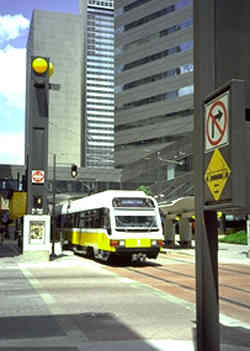
| Dallas, USA, DART (Dallas Area Rapid Transit) train in the city centre. |
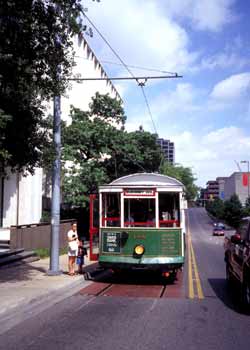
The McKinney Avenue historic streetcar, Dallas. |
 |
 |
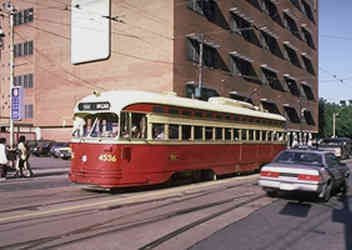
| When introduced in the 1930's the American PCC Streetcar was a significant advance on anything that had been produced before.
These images come from Toronto, Canada. |
 |
 |
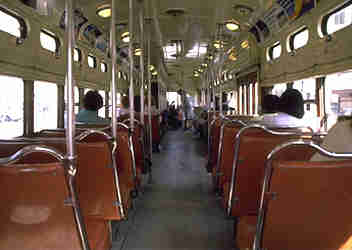
| Toronto, Canada. The two sides of the articulated Canadian Light Rail Vehicles (CLRV). |
 |
 |
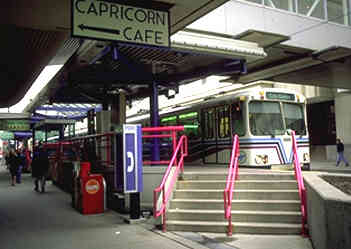
| A Calgary, Canada C-Train calls at a 'high-level' platform in the city centre Transit Zone where travel is free. |
Like some other cities, Calgary varies train lengths according to time of day and expected passenger demand.
This image shows a single unit in the Transit Zone on a dull, wet, Sunday morning. |
 |
 |
| A two / twin unit train. |
A three / triple unit train. |
 |
 |
MAX Light Rail vehicle in Portland, Oregon, USA.
Europe |
 |
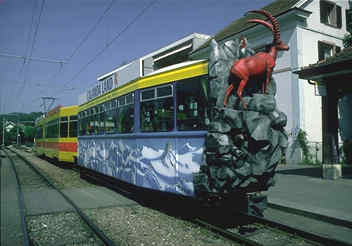 |
| Two Basle, Switzerland, special tram trailers. Basle used to have several of these vehicles, which did carry passengers(!) They usually operated on Monday - Friday
peak and Saturday shopping hours services. 'Novelty' vehicles such as these add colour and interest to the local street scene. After being withdrawn from service the piggy tram
(which locally was known as Säulitram) was sold to the Stuttgart, Germany Schweinemuseum. |
 |
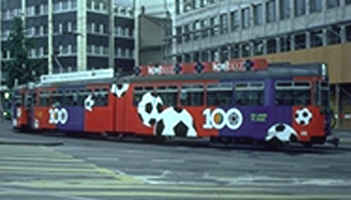 |
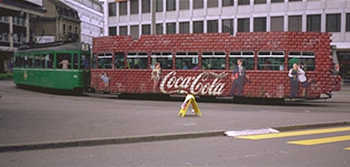
Two more Basle 'specials'!
Left: All-over advertising tram trailer, complete with larger than life bottle (at the back).
Right: Specially decorated trams to celebrate the local football (soccer) team's 100th anniversary. |
 |
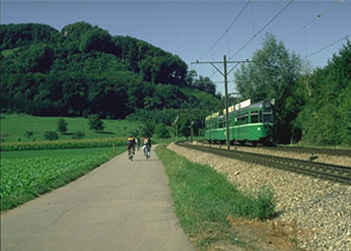 |
Different types of inter-urban trams in Basle.
The yellow tram is at a tram stop located in the middle of the road;
for added passenger / pedestrian safety traffic signals stop the traffic as the tram arrives. |
 |
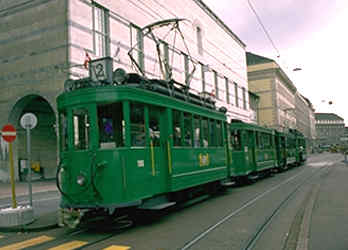 |
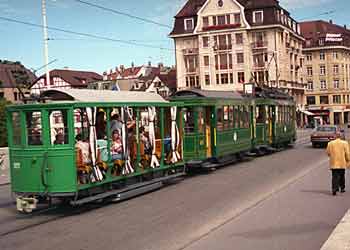
Even more Basle: Historic motor + trailer trams.

Also in Basle, lawn tram track flanked by privet hedges, railings, a road and a narrow section of parkland. Hidden in the shade someone can be seen sitting on a park bench.
This page (on this website) also looks at lawn track - and more! Lawn Track - Creating Green Corridors. |
 |
 |
| Zwickau, Germany, an alternative variant to lawn track sees the growing of low-level flowering plants around the tracks - in this instance the
visual difference compared to the green of the turf helps delineate the swept path of the tramway. |
Kassel, Germany, for locations where there is no alternative to
visible overhead wire support poles a solution which reduces
their visual effect would
be to mask the poles by growing climbing
evergreen plants over and trees around them. |
 |
 |
Karlsruhe, Germany. perfected the concept of using light rail vehicles on mainline railway tracks
and now has a large network of such services.
Earlier in the project some single voltage trams were extended along a little used goods line and then (as a tramway)
through the centre of a small village. |
 |
 |
Later in the Karlsruhe project dual voltage trams (750v dc and 15,000v ac) commenced operating.
On one route they experienced
a 500% increase in passenger numbers, with overcrowding becoming an issue.
More about this can be found at this page about track sharing on this website. |
 |
 |
| More German track sharing ... Nordhausen has some dual-mode trams which operate as regular electric trams on the city streets and
as fossil fuel powered trams when travelling over the (not electrified) privately owned HSB's (Harz Narrow-Gauge Railway - Harzer Schmalspurbahn) to
Ilfeld, where they supplement services already provided by the railway's own diesel trains. |
 |
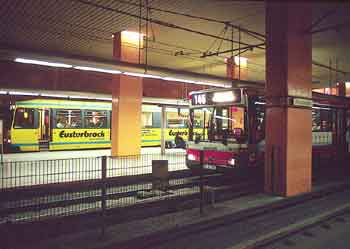 |
| A different type of Germnan track sharing - standard gauge lightweight diesel trains share one metre gauge tram line in Zwickau so that they can reach its city centre. |
For a while Essen also ran self-steering O-Bahn (kerb guided buses) through part of its underground tramway system. To protect air quality the
buses were electrically powered as trolleybuses. This was done as part of a Federal government funded project which because of German reunification
closed early, leaving the unfinished project to flounder and ultimately, to fail. |
 |
 |
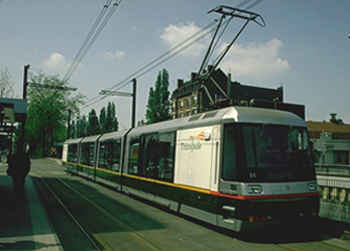
| Innsbruck, Austria; a single track inter-urban light rail line to Igls. |
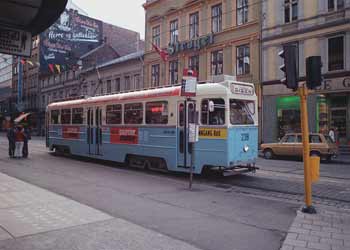
Oslo, Norway. |
 |
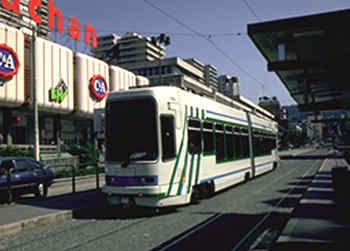 |
| Lille, France. |
St Etienne, France.
When I took this photograph St. Etienne's trams were still using trolleypoles. However they have now changed over to pantographs. |
 |
 |
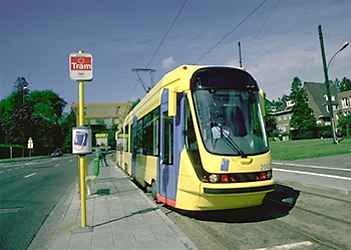
| Brussels, Belgium |
Helsinki, Finland |
 |
 |
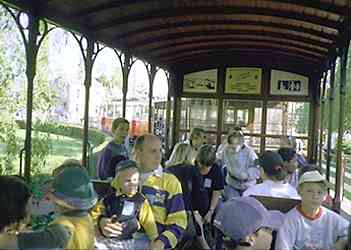
| Most trams are electrically operated, however in Belgium the Vicinal (a secondary national Light Rail system) also used steam and later diesel trams on many of its cross-country
services. Almost all of these services have now closed, but a few diesel trams still exist at what amounts to a living museum in the Ardennes village of Han-Sur-Lesse, where they carry
tourists to the local caves which after a walking tour they exit by battery operated boat. To reduce harmful air pollution in 2014 the diesel trams started being converted to battery-electric propulsion. |
 |
 |
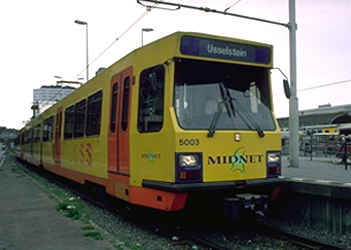
| Light rail in Utrecht, Holland. |
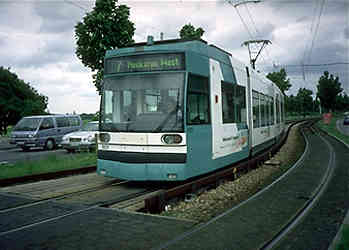
Mannheim, Germany. |
 |
 |
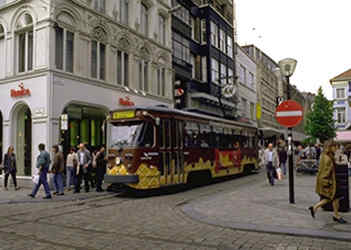
| Gent, Belgium. |
 |
 |
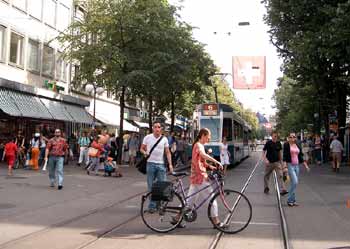
| The pedestrian zone in Zürich, Switzerland. |
|
 |
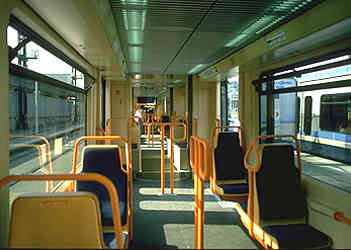 |
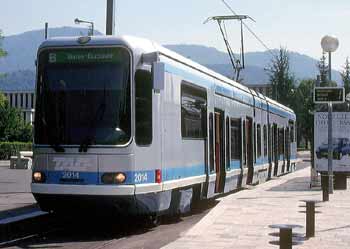
| TFS trams in Grenoble, France. |
 |
 |
| TFS tram in Paris, France. |
An Amsterdam tram passes over a motorway. |
 |
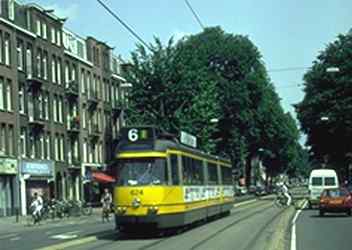 |
| Amsterdam, Holland. |
 |
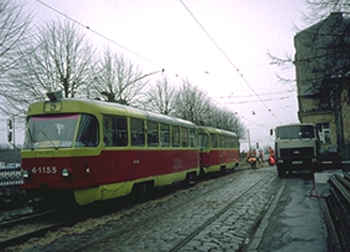 |
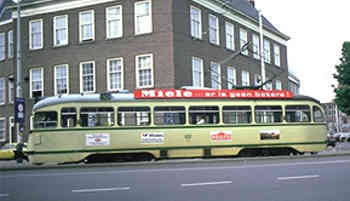
| PCC Derivative, The Hague, Netherlands. |
Riga, Latvia. |
|
|
| Brussels, Belgium |
Helsinki, Finland |
 |
 |
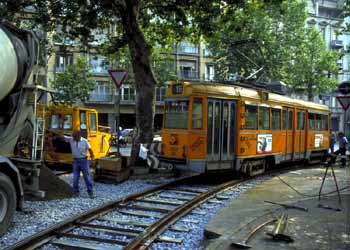
| Trackwork in Turin does not have to mean the cessation of services. |
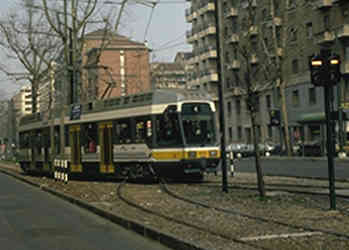
Turin - where trams which only have passenger doors on one side that are travelling on a private right-of-way to travelling 'on the left' so that
at tramstops they can use island platforms located between the tracks. |
 |
 |
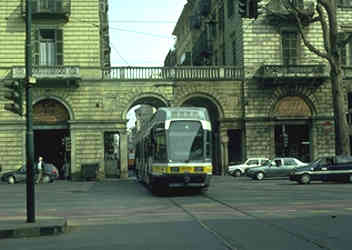
Turin 5000 class tram passing through an archway
at the perimeter of the historic city centre. |
Combined kerbside bus and tramstop in Turin, Italy |
 |
 |
| A narrow street in Turin where the physical presence of the tramway aids traffic flow by ensuring that at least one lane (in each direction) always remains clear. |
Many sections of tramway in Turin are along the edge of the road.
Vehicles which need to stop tend to do so on the middle of the road. |
 |
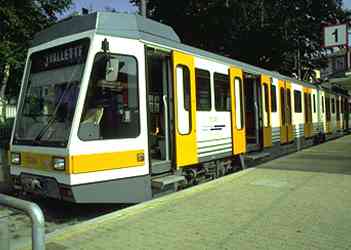 |
7000 class Light Rail Vehicle in Turin, Italy travelling on lawn track (left) and calling at a stop (right).
Note the extending step just below the open doorways - these shoot out somewhat quickly - woe betide anyone standing too close! |
 |
 |
A pedestrian crossing point across a light rail line located on a dual-carriageway median in Düsseldorf, Germany.
For safety this crossing is fitted with wig-wag flashing lamps which advise passengers when a vehicle is coming (left)
and a linked signal (a flashing white light) to give LRV drivers confidence that the pedestrian signals are working correctly (right).
 A video showing some German Light Rail Pedestrian Crossing Safety Signals similar to these seen here in Düsseldorf plus variants from Manchester and Calgary, Canada, has been placed on the ‘YouTube’ film / video website
and can be watched (in a new window) by clicking either the projector icon or here - http://www.youtube.com/watch?v=M28tGs253NM
A video showing some German Light Rail Pedestrian Crossing Safety Signals similar to these seen here in Düsseldorf plus variants from Manchester and Calgary, Canada, has been placed on the ‘YouTube’ film / video website
and can be watched (in a new window) by clicking either the projector icon or here - http://www.youtube.com/watch?v=M28tGs253NM
|
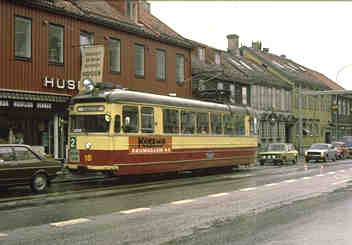 |
| Trondheim, Norway |
 |
 |
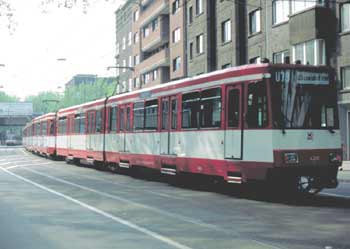
An extra long (4 units) Düsseldorf Stadtbahn B type tram on the route
to the exhibition centre which includes a section of street tramway. |
Stuttgart, Germany, is a hilly city and route 10 of its Light Rail system features the 'rack and pinion' principle as is often used by mountain railways. Attached to each passenger
vehicle is a cycle carrier, and here we see cycles being unloaded at the Degerloch stop, which is the upper terminus of the line. |
|
Whilst most street tramways try to minimise the amount of visible overhead wiring Stuttgart uses a fully tensioned system which (just like mainline railways) uses weights to maintain the tension in different climatic conditions,
The two red crosses in the image on the below-left identify the support poles (one of which is partially hidden behind the trees) with the equipment which keeps the overhead wire at the correct tension. Note how the
weights hang low enough to be reached by the man with the red shirt. Of course everything is both electrically and mechanically 'safe' - its just that for a section of street tramway - where the transports travel relatively
slowly - this type of overhead wiring could be said to be somewhat 'over the top'. |
 |
 |
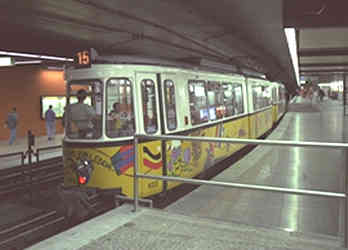
| Stuttgart, Germany.
The station above-right where the LRV's open their doors on both sides is Pragsattel. |
 |
 |
Over a period of several decades Stuttgart upgraded its metre gauge tramway in to an extensive light rail network using standard gauge rolling stock. Most of the network
is now fully segregated from road traffic - but there are still a few locations which feature street running.
Because of the upgrade some sections of the Stuttgart Stadtbahn (city railway) have three tracks, over time most of the redundant rails are being removed - but the intent is save sufficient
to allow the use of 'Old-timer' metre-gauge heritage trams along one route through the city centre, plus to / from the depot where the heritage / vintage trams are stored. |
 |
 |
Uni-directional street running along a space-constricted busy section of dual carriageway.
Traffic signals give the approaching LRV priority, note the flashing white light. |
 |
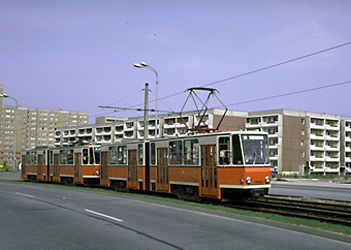 |
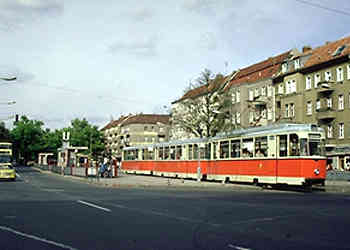
| (East) Berlin, Germany in 1990 |
 |
 |
| (West) Berlin in 1990. Historic tramcar running on a section of U-Bahn that had been closed following the division of the city into two sections. |
The Schwebebahn (suspended monorail) in Wuppertal, Germany. |
 |
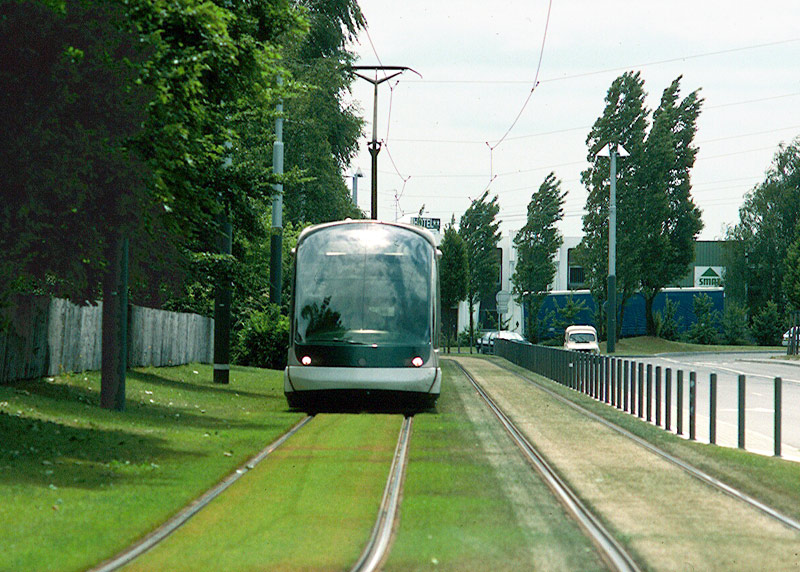 |
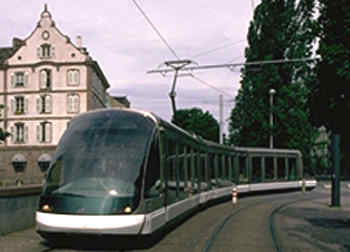
| Strasbourg, France |
 |
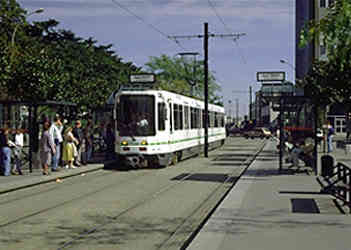 |
| Lyon, France |
Nantes, France |
 |
 |
Bordeaux, France.
Left: The plants seen between the two tracks are vines!
Right: Much of the Bordeaux tramway is powered via a specially designed electric rail system called APS.
More about APS Ground Power can be found at this page on this website.
Two French cities used to have rubber tyred vehicles which were called trams but were also capable of detaching
from the single guidance rail and operating as buses. Both systems have now been replaced - Caen has normal steel wheel trams and Nancy has a TBRT Trolleybus Rapid Transport (Transit) system.
More about what is called the TVR and its commercial rivals can be found at this page on this website. |
 |
 |
| In Caen the vehicles were powered from one overhead wire and used the guidance rail for electrical return. When away
from the track their electric motors were powered by an onboard diesel-electric power pack. |
The Nancy vehicles operated as trolleybuses so although
they also had diesel power packs they only used them
when
away from the overhead wire power supply. |
|
A different French rubber tyred tram system is the Translohr. The original plans included the possibility of these being able to
detach from the single guidance rail and operate like buses but this function was dropped from the final production version. I have only been to
two of the cities which use Translohr trams. As far as I'm aware no new installations have been built for many years and the long-term outlook for
when an existing system need new rolling stock is questionable.
More about what the Translohr can be found at this page on this website. |
 |
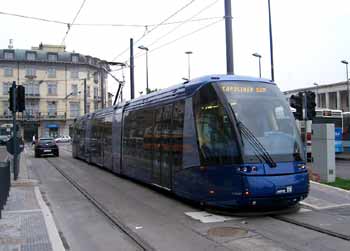 |
| Translohr in Padua, Italy. |
 |
 |
| Switching tracks at the stop outside the railway station. Note how the articulation covers open up when negotiating curved track. |
 |
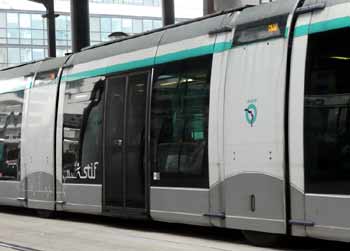 |
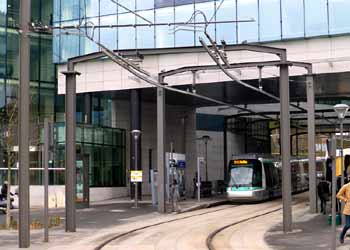
Two of the tram routes in Paris, France uses Translohr trams. These views were taken on route T6.
The view on the right shows the rubber tyred nature of these trams. |
 |
 |
| Although little-known the use of overhead conductor bars instead of wires is a well-proven tramway and railway feature as an alternative
to overhead wires. |


