Fares & Ticketing Systems
Navigating through this website is easier with the navigator frame which should be to the left of this window. If it is not there then click here to turn it on! Alternatively there is a system map at the foot of this page.
More information about this website & why it was created can be found by visiting this website's "front" pages (link opens in a new window).

Most images are "clickable" - run the mouse over them and if a "hand" appears then click & a larger version will open in a new window!
Fares and Ticketing Systems are looked at on several pages. This is page 3.
These topics are on page 1
- Why Pay Fares?
- In many ways the ticketing system can hold the key to success in public transport.
- Station gating and accessibility.
- Multi-modal through ticketing.
- European Ticketing.
- North American Ticketing.
- Other Ticketing Systems.
These topics are on page 2
- 'Smart' Card and contactless RFID Ticketing.
- Smart Card Operator Cash Flow Bonanza
- Asia - Hong Kong and Octopus.
- Asia - Public Transport, Road Toll Payment & ID Card Integration.
- Europe - The Dutch OV Chipkaart.
- The 'IFM' Project - one card for all Europe!
- Elsewhere - Wellington (NZ) and Snapper.
- RFID Ticketing in Britain / ITSO: e-The Ticket For The Entire Nation.
- Bradford: Where Smart Cards came with BusMiles to encourage Customer Loyalty.
- London's Oyster.
- EMV / NFC / 'Wave & Go' / You have several cards, which is read? / RFID Smart Cards & Big Brother.
- Evidence Suggesting Transport Ticketing Is Being Used As Backdoor Route For ID Cards / Optimal Ticketing Solution.
Page 3
Overflow Page
Created during site updates in December 2016, this page contains detailed information (which is NOT being updated) about the smart card ticketing systems in various locations around the planet which which was written in the earlier days of this website.
The reason for creating this 'overflow' page is to retain much data that was removed from page 2 (and would otherwise have been deleted) because updating the continuously changing ticketing solutions looked at in these towns and cities acts as a diversion from the original intended aim of the Fares and Ticketing Systems pages, which was simply to be about the ticketing systems per se.
- Asia - Hong Kong and Octopus.
- Elsewhere - Wellington (NZ) and Snapper.
- Europe - The Dutch OV Chipkaart.
- Bradford: Where Smart Cards came with BusMiles to encourage Customer Loyalty.
- London's Oyster.
 |
|
||
Hong Kong and OctopusLaunched in 1997 the first location to widely adopt RFID contactless smart card ticketing was Hong Kong. Here the system is marketed under the Octopus label, and although originally intended as just an upgrade on the Mass Transit Railway's (MTR) stored value ticketing system as described on page 1 it has grown in scope and usage so that in addition to being accepted on virtually all of Hong Kongs' public transports it has become a widely accepted payment and personal identification system which can be used at over 253 different commercial and other organisations including convenience stores, self service outlets (eg: vending machines) conferences and exhibitions, recreational facilities, as access control cards in residential / office buildings, for school administrative functions, to pay at parking meters / car parks, and more... What made it possible for a product intended to be used for paying transport fares to become used in so many other ways as well is that in 2000, the Hong Kong Monetary Authority granted a deposit-taking company license to the operator, removing previous restrictions that had prohibited it from generating more than 15% of its turnover from non-transport related functions. The Octopus card is so named because it originally joined together payment systems for 8 types of transport, emulating the 8 legs of an octopus. There are two main types of Octopus card (On-Loan and Sold), and two less common types (the Airport Express Tourist and the MTR Airport Staff). On-Loan cards are issued for usage in day-to-day functions, primarily being for fare payment in transport systems. There are four types of On-Loan cards, with the first three based on age and different amounts of fare concession, and each of them being a different colour. These are Child (pink), Adult (yellow), Elder (jade green), and Personalised (special design comprising of all other colours). Initially there was a blue student card too, but in 2005 these were withdrawn in favour of Personalised student cards. With the exception of the Personalised cards, On-Loan cards are anonymous and no identification is required for the purchase of these cards. If an owner loses an On-Loan card the stored value and card deposit are not refunded. Prices for the cards vary according to type, and include varying amounts of credit to enable immediate use. The multi coloured Personalised card is available on registration. The name and, if desired, photograph of the holder are imprinted on the card. These can function automatically as a Child, Adult, or Elder card by recognising the cardholder's age stored on the card, hence accounting for different concessionary fares. Student status Personalised cards are available to full-time students in Hong Kong aged between 12 and 25. These cards are automatically issued to students who apply for student concessionary privileges. In addition to all the functions of ordinary cards, the Personalised variant can be used as a key card for access to residential and office buildings. If lost then Personalised Octopus cards should be reported as such to prevent unauthorised use and minimise any possible financial loss. In this way liability will only be for any loss arising from unauthorised use of the card within six hours after the loss report. The deposit plus financial value on the card (after six hours) are then refunded, less a HK$30 card cost and a HK$20 handling fee. Visitors / tourists staying less than 14 days can buy a special Octopus card which includes the cost of using the airport express railway, 3 days of unlimited travel on MTR railways plus HK$50 cash stored value. These are not available at the vending machines - visitors will find it is cheaper and easier to purchase these at the special kiosk near the exit to the express railway. There are two variants, offering either one or two journeys on the airport express railway, with the latter journeys (only) being valid for 180 days from the date of purchase. Note that users may be required to produce an air ticket showing their arrival date in Hong Kong and passport to prove their visitor status. As with all Octopus cards these include the cost of a deposit which can be refunded when leaving Hong Kong - although many visitors like to retain their cards as a souvenir or for use during the next visit. Sold Octopus cards are sponsored and branded souvenir cards which are frequently released by Octopus Cards Limited. These cards are sold at a premium, have limited or no initial stored value, and cannot be refunded, but they can otherwise be used as ordinary cards. The MTR Airport Staff Octopus card is for staff of Hong Kong International Airport and AsiaWorld-Expo, a convention centre close to the airport, for commuting at a reduced fare between the airport and MTR stations via the Airport Express. This card is available upon application via the company for which that a staff member works. In addition to credit card sized cards, it is possible to buy various types of wrist & pocket watches, mobile phone covers, wristbands and key fobs which function as anonymous Octopus cards. Using OctopusWhen travelling on the MTR network using an Octopus card many fares are often between 5% and 10% cheaper than ordinary fares paid in other ways. Plus bus services also often offer discounts or other special offers. The maximum value which an Octopus e-purse can hold is HK$1,000. If the (financial) value on an Octopus is positive (ie. HK$0.1 or above) but insufficient to cover the full cost of the next transaction it is permitted to incur a negative value of up to HK$35, which will be re-covered when the card is reloaded. However an Octopus with zero or negative value cannot be used until it is reloaded. Once loaded the value is valid for up to three years. After that time the value can be reactivated when it is next reloaded. There is also a frequent user loyalty scheme called Octopus Rewards. With Octopus not only is it possible to spend money almost anywhere, but it is possible add value to the e-purse almost anywhere too - not only at MTR stations but also at establishments such as large-chain fast food establishments and local (neighbourhood) grocery stores. To make life even easier for Octopus users, some financial institutions offer automatic Octopus AAVS (Automatic Add Value Services) whereby a person can register their Octopus card number with the bank / financial institution and then whenever its financial value reaches zero, a negative balance or when its remaining plus the maximum negative value is insufficient to settle the full cost of the transaction it will be automatically topped up with HK$250 - with the funds coming from a designated bank account or credit card. Octopus e-purses can be automatically reloaded in this way once a day. Many participating credit card issuing banks or companies also give bonus points or cash rebates for AAVS transactions. Some financial institutions also offer this service for up to 3 other people aged 12 or above holding an Octopus card. For the convenience of visitors from Hong Kong a few retailers in Shenzhen and Macau also accept Octopus, although it only possible to add value to Octopus cards within Hong Kong. Cross-Border OctopusIn 2012 it became possible to buy two different types of twin-currency Adult Octopus cards that can also be used in a range of cities in mainland China. These retain all the usual Octopus features, including AAVS and Octopus Rewards (albeit only on HKD purchases in Hong Kong) and also feature a separate Chinese currency (Reminbi - RMB) e-purse which can be topped up to a maximum of RMB1,000. All cards are sold anonymously and no personal information is stored on them. At present it is only possible to top-up the HKD e-purse within Hong Kong and the RMB e-purse within China. Future plans include merging the three cards - Octopus, Lingnan Pass and Shenzhen Tong - although before this can happen there are some unspecified technical issues which will need resolving.
GlitchesAlthough electronic purse systems are generally very secure it is worth noting that when Octopus first started (in 1997) there was a smart university student who found a way to add-value to it "for free". Also, in February 2007 it was found that when customers added value to their cards at certain self-service add-value points located at MTR and KCR stations, their bank accounts would still be debited even if the transactions had been cancelled. A few months later (July) it was announced that following an investigation 15,270 instances of wrong transactions had been traced back to 2000, with over HK$3.7 million having been incorrectly deducted from people's bank accounts. Furthermore, it was added that there were possibly more instances of wrong transactions dating from before 2000 but as transaction data is only kept for seven years so it was impossible to be sure. Dating from 1997 Octopus is so old that it predates all international standards regarding electronic smart cards. So therefore it does not comply with them. This represents a typical scenario for those who are amongst the first with something new. Whether this will prove to be a severe handicap in the longer term remains to be seen. For more information visit the Octopus (English language) website at http://www.octopuscards.com/eng/index.htm |
|||
 |
|
 |
|
| Ticket machines at Wu Kai Sha Kowloon-Canton Railway (KCR) Station. The two machines on the left are Octopus "add-value machines".
Image & license: Alanmak / Wikipedia encyclopædia. CC BY-SA 3.0 commons.wikimedia.org/wiki/File:WuKaiShaStation-TicketMachines.png |
|
This Hong Kong light rail station features separate card readers for using when entering and leaving the system.
To make it easier to distinguish one from the other they are physically separated, have been logically angled for the direction in which the passenger would be walking at the start / end of a journey and are differently coloured - orange for 'in' (seen at the far end of the entrance walkway), green for 'out'.. Image & license: TUmuMATo / Wikipedia encyclopædia. CC BY-SA 2.5 http://commons.wikimedia.org/wiki/File: HK_TM_LRT_Pui_To_Station_Look_left-right_n_In-Out_point.JPG |
|

RFID Tickets In Holland (The Netherlands)Holland is one of several European countries where rather than being dedicated to a specific town / city or transport operator the RFID ticketing is nationwide. In this way the aim was for it to mimic* and (eventually) replace the pre-existing paper "Strippenkaart" (strip ticket) system which from 1980 until 2011 could be used for local journeys virtually anywhere nationwide. Known as the OV-chipkaart (Public Transport Chipcard) this smart card system is being run by a privately owned corporation as a self-financing business, which perhaps makes it more expensive and less beneficial than systems where city-specific cards are used. * Whilst this was the desired outcome electronic incompatibilities between OV-chipkaart cards issued by different transport companies mean that the reality is sometimes different to what was planned - as detailed under the heading Problems, Significant Fares Hikes - Plus A Few Reductions! further down this page. The introduction of the OV-chipkaart has now progressed to a stage whereby it has replaced all other types of ticketing in most major conurbations and can also be used on almost all services in most rural areas. However paper based ticketing is still available on some rural bus services - including one area where it had to make a hasty come-back after the introduction of the OV-chipkaart saw passenger numbers plummet by 20% (see below). The main Dutch railway operator (NS) phased out paper tickets (for journeys wholly within the Netherlands) in July 2014, although some passengers making international journeys to / from neighbouring countries may still be issued with paper tickets. There are several types of OV-chipkaart. The simplest version is the Disposable OV-chipkaart which is made out of cardboard and meant for one-time use only. Intended to replace paper tickets these are primarily aimed at people who rarely use Dutch public transport, (for instance) someone who boards an Amsterdam tram or arrives at a railway station and needs to buy a ticket for immediate use. Disposable cards are also intended for special purposes and one-off marketing promotions. Depending on location disposable cards are sold with a range of different pre-loaded travel 'tokens'. By way of example the list of options can include a single / return journey, a one-day regional pass, a one-day nationwide rail pass or a three-day pass to all public transports in one city. Some transport operators may also give them out free of charge during emergency situations and to help passengers travel via alternative routes when railway services have been suspended by engineering works. Single-use cards can only be used with the one (previously added) travel product and are not capable of e-purse transactions. After use they should be thrown away - although as with paper tickets some people may wish to retain them as receipts or souvenirs and transport ticket collectors will instantly recognise their future nostalgic and financial value - especially if they feature special and "limited edition" decorative designs / images. Especially when bought for railway journeys passengers are charged a €1 surcharge to cover the cost of production and handing (installing in ticket machines, etc). The Anonymous OV-chipkaart is a semi-permanent re-usable smart card aimed at people who travel more frequently. In addition to travel 'tokens' it can also store an electronic purse. This type of OV-chipkaart is transferable (ie: can be shared between family members, friends, etc.,) - although only one person can use it at a time. However it cannot be used for discounted travel, monthly or annual season tickets. Anonymous OV-chipkaarts are sold at many locations at and near railway / bus stations, as well as transport operators customer service desks, tobacconist shops (Tabacs), newsagents, supermarkets, etc; and once some financial value has also been added to the e-purse are available for bus / tram / metro travel immediately. At some locations their price includes some e-purse value. To use on the railways anonymous cards usually need validating before the can be used, this process includes selecting whether the system should charge 1st or 2nd class fares. This can be changed at a later date at a NS ticket machine. The Personal OV-chipkaart is dedicated to one person and includes a photograph and the date of birth of the holder. Because of this it can be used by a passenger who is entitled to cheaper or zero rate fares (eg: children aged between 4 and 11, students, senior citizens or holders of discount cards). This is also the only type of OV-chipkaart which can hold a monthly or annual season ticket, and can be stopped if lost or stolen. Another feature is that the electronic purse can be set to automatically top up its balance when it drops below a certain level. With these cards the keeping tabs of the holder's every movement becomes a realistic proposition. Originally Personalised cards were only easy to buy by people resident in Holland who had a Dutch bank account, however in December 2011 the possibility was introduced for residents of Belgium, Germany and Luxembourg (BeDuLux) to also be able to buy them, paying with iDEAL (a Dutch payment system), PayPal and / or credit cards. However automatic top-ups of the e-purse are only possible via iDEAL. The Business / Corporate OV-chipkaart which is supplied by employers to their staff, for the purpose of business travel so as to simplify paying for business travel expenses. These are sourced from one of the specialist business travel solutions companies, who charge the business directly for the travel incurred. The employer can also stipulate whether the travel can be 1st or 2nd class. These should not be used for private travel, and if passengers also have their own personal or anonymous cards then they must be careful to use the correct one at the correct time! OV-chipkaarts always remain the property of Trans Link Systems (TLS), which is a company that was created by the five largest Dutch public transport companies to implement a single payment system for public transport within Holland. The public can either source OV-chipkaarts direct from TLS (from the website) or through the various private or municipal transport operators. In all cases however TLS only sell the right to use their products, and on the basis that at any time the card holder's right to use it can be revoked - which effectively means be denied the ability to travel on public transport (except with a disposable card). The individual organisation which sells the OV-chipkaart determines its price. TLS have a public assistance telephone helpline but in the time honoured way it charges premium rates. If an OV-chipkaart needs replacing, perhaps because of loss or theft, the organisation from which it was bought will decide how much to charge for the replacement. Generally the e-purse value on anonymous cards is not refundable, although since personal cards which have been lost or stolen can be blocked so the e-purse value can be protected and refunded. Defective cards are replaced for free, with credit being returned to your bank account without handling fees being charged and season tickets transferred to the replacement cards. It is for the public transport company who supplied the card to decide how you pay your transport fares whilst waiting for the replacement card. Sometimes cards which do not work are not defective - the reason could be too many journeys where you have not checked out or there is a negative balance which means that more money needs adding to the e-purse. Anonymous and personal OV-chipkaarts can be returned and the value of the electronic purse refunded. However there may be minimum refund limits (eg: €5.00) and handling fees and depending on the value of the refund it may be repaid in cash or directly to a Dutch bank account. When returning an OV-chipkaart people should be grateful to receive the refund of the electronic purse and not expect too much else - such as the cost of the card to also be refunded. Using cash to add value to the electronic purse is free, although there might be a fee if you are using a credit / debit / charge card - especially for low values. The various transport operators have different policies with respect of plastic card / cash acceptance. Some locations will only accept Maestro chip & pin debit cards and coins, others will also accept paper money and / or credit cards as well. Ordinary people are not paid interest on the value of the OV-chipkaart e-purse, although no doubt some organisation somewhere benefits from the large amounts of money involved. Limited Life - Replacements Are Chargeable!OV-chipkaarts need periodic replacing, which effectively means buying new cards. Anonymous cards expire after 4 - 5* years; personal cards are valid for 5 years. This timescale has been determinated by the expected thermal, electrical and mechanical 'durability' of the material from which the cards are made, when subjected to what has been determined as 'normal' day-to-day use. The cost of replacement cards will depend on the charge set by the transport provider through which it is bought. As yet it is too soon to be sure how things will 'pan out' and it remains to be seen whether people replacing life-expired cards will be offered the replacements for free / at discounted rates. Perhaps a lot will depend on how much fuss the Dutch people create when the present cards start expiring en masse. Anonymous cards cannot be renewed, but a refund of unused credit can be made, exactly how depends on the amount and what the transport provider wishes to do. The cost of the card is non-refundable. *The reason for the slight timeframe difference is unknown, however this is what the website says!...
|
|||
 |
|
 |
|
| A six zone paper 'Strippenkaart' strip ticket which was valid throughout Holland for local journeys.
As I was travelling with another person the ticket was validated twice, with zones 5 and 6 remaining unused. Following the nationwide rollout of the OV-chipkaart these paper tickets were withdrawn in November 2011. |
|
Ticket validators on an Amsterdam tram, as seen during the transition period when both the paper and OV-chipkaart smart card ticketing are being used. The paper ticket validator is No.1 and smart card
reader No.2. The latter needs to be by the doorway as passengers using smart cards are required to check out when they leave the tram - even day and season ticket holders, despite there being no financial
justification for their needing to do this (after all, they have already paid their fare).
Image & license: Sg sg1 / Wikipedia encyclopædia. CC BY-SA 3.0 http://commons.wikimedia.org/wiki/File%3AChipkaartlezer_GVB-tram.jpg |
|
| To allow for fare rises, increased security features of the ticket printing, (etc) the Strippenkaart sometimes expired, being replaced by versions
which feature slightly different wordings, colours etc. The ticket seen above dates from 1981 and fares were charged in Dutch Guilders / Florins. A more recent 15 zone Strippenkaart dating from the €
'Euro' currency era can be seen at the Wikipedia link below.
http://commons.wikimedia.org/wiki/File:Strippenkaart.jpg Using The OV-chipkaartAs with other RFID transport smart cards the OV-chipkaart requires placing on (or very near) a specialist card reader at the start and end of all journeys. The Dutch call this checking in and checking out. Passengers with season (or other pay-once ride-at-will) tickets are also required to check in and check out at the start and end of every journey, which many will find a nuisance when passing through 'open' stations where there are no ticket gates and mere possession of a valid paper ticket used to suffice. Financial and other penalties have been introduced to force these passengers to check in/out - see below. Passengers using the electronic purse to pay fares as they travel ("pay as you go" - PAYG) would have had to validate paper tickets anyway, so especially at the start of the journey they will just do it in a different way. As before, failing to check in will result in being seen as someone who wanted to avoid paying the fare. PAYG passengers will also have to get used to a different style of fares calculation (see below) and checking out at the end of their journey. Because e-purse journeys are priced using an initial boarding fee so failing to check out can work out somewhat expensive - see below. If it is not possible to check out because of a technical fault with all the card readers then users can obtain a refund of the boarding fee from the public transport company. Distance-Based Fares: Bye Bye Free Travel Periods. Bye Bye Zonal Calculations.The paper-based strippenkaart charged fares based on zonal regions, with passengers cancelling the required number of zones from the paper ticket plus one extra. They then had a time limit to complete their journey during which they could travel freely within the zones. So it was like buying a ride-at-will ticket valid for set period of time. The e-purse ticketing system uses a very different fare scale which is based upon distance travelled plus a fixed basic rate. Every journey is chargeable and the freedom to travel within a fixed time limit is no longer allowed. The basic rate is the same nationwide but the rate per kilometre is set by local governments in mutual agreement with public transport companies. Passengers who need to interchange to complete their journey must check out and then check in on every transport they use, and providing this is done within 35 minutes they are not supposed to be charged a further basic fare. This time period might be too short in some areas, especially in rural areas if the bus to which a person is transferring only runs hourly. There is also a boarding fee which varies depending on the transport provider. Typically in urban areas this is €4.00. The Dutch mainline railway varies its boarding fee depending on whether the passenger has subscribed to any of its discounted (or free) travel plans, and other factors. The highest boarding fee is €20.00, although it reserves the right to increase this for people who have a bad record for trying to cheat the system. Boarding fees are charged when the passenger checks in and then when they check out the boarding fee - less the actual cost of the journey - is reimbursed. People who forget to check out end up being charged the full boarding fee. To check in successfully an OV-chipkaart must have sufficient balance - at least €0.00 - in the e-purse - even if there is a valid travel product (like a season ticket) on the card. A card with a zero balance can only check in once as it will then go negative and the e-purse will need reloading before the card will successfully check in again. Another aspect of the distance based fares system is that if a person is travelling from a bus (tram) stop served by several routes, with any of them being suitable for them to use to reach their destination but one of them following a different, more direct route than the others, then the fare for the journey will vary depending on which transport the passenger used. So, if the more direct route only operates Monday - Friday daytime, then passengers who travel in the evenings and at weekends will pay higher fares. The difference may only be a few Euro cents, but passengers dislike being financially penalised for things which are not even within their control. For many people paying fares electronically with the e-purse means that they no longer need to work out how many zones they will be travelling through when validating the Strippenkaart paper ticket. At railway stations they can walk straight to the platform and forget about ticket office queues, etc. Especially younger people see this as the 21st century way to pay fares and are very happy with it. As a general theme passengers are protected from double reads when checking in/out as card readers have time limits (which vary between the different transport companies) that prevent a card from being used twice in quick succession. The e-purse aspect of the OV-chipkaart is still in its early days and the various public transport companies retain the right to apply different terms as time progresses. It is assumed that this would be done in agreement with local governments. Incomplete Transaction ChargeWhether using a season ticket or the e-purse passengers who fail to check in or check out incur an incomplete transaction on their card. Cards which incur 12 incomplete transactions in a fortnight are disabled. To get them restored requires a visit to the local transport operator's sales and information desks. Many people wonder why passengers who have prepaid season tickets should need to check in/out at locations where there are no turnstiles - after all, since their fare is fully paid so they cannot be accused of trying to avoid paying the correct fare for their journey. Most likely this is to help the transport industry determine how many people travelled on each transport so that the correct percentage of the total fares income can be paid to the various transport providers, and also to help transport planners map general travel trends so that they can ensure that the services best meet the needs of the passengers. Early indications suggest that 2% of passengers are failing to check out, which is providing the transport operators involved a tidy cash bonus - its like winning an intermediate (ie: middle) prize on the lottery... easy money! In July 2013 some transport user groups launched an investigation to discover how much money transport companies are earning from people who did not check out after completing their journey. This topic is also raised at the top of the page under the headline of Smart Card Operator Cash Flow Bonanza in the generic section about smart card tickets and can be reached at this link. A clickable link has also been placed there which returns back to here. Railways And The OV-ChipkaartThe introduction the OV-chipkaart has taken railway ticketing to a brand new level which is much beyond what was allowed with the paper Strippenkaart. As with urban transports passengers (who do not have season tickets) no longer need to buy a ticket before travelling - as long as they check-in at the start of their journey and check-out when they arrive at their destination then the e-purse will pay their fare for them. It will automatically adjust the fare according to the time of the journey and take into account of any discounted or free travel plans to which the passenger has subscribed and loaded on to their OV-chipkaart. There are several railway operators in Holland who charge different boarding fees and fare scales. Most of these comments refer to the national system - Nederlandse Spoorwegen (NS) Before use on the railways the OV-chipkaart may need activating. This depends on from where the OV-chipkaart was sourced and how it is used. Passengers who bought a OV-chipkaart with the intention of using the e-purse from an NS ticket machine or service desk only need to add monetary value. The card will then be ready to use. However if the OV-chipkaart was sourced from another public transport operator then it will need activating before it can be used on the railways. This is a one-time process which is accomplished in one of two ways. One option is to add monetary value at an NS ticket machine (or service desk) and also choosing whether they plan to travel first or second class. The other option is for OV-chipkaart cards which already have sufficient credit on their e-purse. This too requires a visit to an NS ticket machine or service desk, and selecting the option to a product called 'pre-paid travel with NS'. With many stations being fully open (ie: they only have free-standing OV-chipkaart card readers) so the railways see the electronic tickets as only being legally valid when they have been checked in/out. Otherwise a €35 fine is payable. Passengers are not supposed to check in for their journey more than 30 minutes in advance of its departure, if they do then they are allowed to use the 60 minute rule to check out and then check in again nearer the correct time. However it is permitted to check in early in order to avoid paying a second basic rate when interchanging between services. If someone checks in but then decides to not travel then after 3 minutes (but no longer than 60 minutes) they can check out again at the same station without being charged. After 60 minutes the boarding fee is deducted from the card. This also makes it simple for people who are not travelling to visit retail outlets within the fares paid area, and also results in a free platform ticket for when meeting arriving passengers, etc., Passengers should always have checked out within 6 hours of checking in. The significance of this is that under normal circumstances no railway journey should take as long as this, and if someone has forgotten to check out after completing a journey they then have a grace period in which to do this. However, this rule is instantly negated once the OV-chipkaart is used again, for instance when catching the bus from the station to home, and the 6 hour period expires at the end of the day. The introduction of electronic ticketing on the railways has seen many changes to the off-peak discounted fares that were offered to passengers. As a general theme the older schemes were replaced with passengers now being able to buy new reduced cost or even free travel products which are loaded on personalised OV-chipkaart cards and then will be automatically invoked when checking in/out. These offers include 40% reductions on off-peak fares, various offers which include free weekend travel in the package, and more. A side effect of this is that visitors from outside Holland are less likely to be able to benefit from these offers and discounts, this especially affects senior citizens from outside Holland who during the days of paper ticketing were able to purchase the discounted travel products. However there is a partial work-around... passengers travelling with someone who has bought an off-peak discount travel product are allowed to add a "travel along discount" to any personal or anonymous OV-chipkaart at the NS ticket vending machines, and then their next journey will be at the reduced rate. For return journeys the "travel along discount" will need adding again before checking in. Passengers who travel in the mornings and used to buy two tickets (known as split fares) so that the part of the journey which was outside the morning rush hour could be charged at an off-peak rate are now automatically charged the cheaper fare for the portion of the journey that was during the off-peak hours. Passengers are allowed to break their journey but only if the entire journey is completed in one day. Electronic ticketing systems will know if this rule is honoured or breached! Return tickets, which used to be cheaper than two single tickets, are not available with fares paid with the smart card e-purse. It is claimed that single ticket fares were reduced so that return journey costs did not rise. One other noteworthy change is that peak fares are now also charged in the evening rush hour period. Passengers are still expected to check in/out when trains are replaced with buses, whether scheduled or otherwise. Sometimes there will be mobile card readers for this purpose. Ticket Barriers And Station AccessConcurrent with the July 2014 full implementation of the electronic ticketing 90 stations which had previously been open became gated so that passengers are not be able to reach or leave the platforms without passing through a physical gate. Until this date many stations had gates which were permanently open. At some locations this is causing much controversy because the stations may also be walking routes and / or may have catering and other retail outlets which will lose money if they cannot be accessed by non travellers. To make it easier for passengers to access these facilities it has been suggested that they could become fares NOT paid enclaves within the fares paid areas. This is possible because of the 60 minute rule which allows people to enter and leave the fares paid area within 60 minutes for free. This would also make it possible for passengers to avoid breaching the rule about not checking in more than 30 minutes in advance of their train. What happens with people who are not travelling and / or do not have an OV-chipkaart remains to be seen. It is assumed that passengers with e-tickets will be able to use the barcode scanner to enter and leave as required. E-TicketWith NS having abolished normal paper tickets on 9th July 2014 passengers who simply do not need or want even an anonymous OV-chipkaart have the option of two other possible ticketing options. One of these is the disposable paper single-fare ticket, as detailed above. These tickets attract a €1 surcharge on ordinary fares to cover the cost of their production and handing (installing in ticket machines, etc). But for irregular passengers, visitors to Holland who simply do not need or want an OV-chipkaart so disposable tickets represent the easiest way to pay transport fares. This is probably the only way that someone can buy a ticket for someone else, especially if the ticket needs posting to them - such as a relative coming to visit from another town which may even be outside Holland. The other possibility is the print-at-home e-ticket. These are typically chosen for longer distance travel and are also ideal for special promotion fares. e-tickets have to be purchased online in advance of travel and because they are personalised they are only valid if the passenger has both the e-ticket and valid proof of identity with them. These will be needed when tickets are checked by ticket inspectors. e-tickets are sold for travel on a specific day / date. They must be printed on A4 paper. Passengers with e-tickets are not subject to the 30 minute rule that applies to users of the OV-chipkaart. At stations with closed ticket barriers passengers should use the bar code scanner to enter or leave the platform. Although e-tickets can be bought from the Dutch Railways website this is only easy for people with Dutch bank accounts, as payment has to be made via iDEAL, which entails a direct transfer from a Dutch bank account. An alternative option is to buy them (as an international journey) from the website of the Belgian Railways as this accepts credit cards. Free Platform TicketsEspecially for longer distance journeys non-passengers often like to walk right up to the train their friends / relatives are travelling on so as to be able to wave them goodbye or welcome them if at the destination station. The OV-chipkaart includes a platform ticket function whereby no charge is made when a person checks in and then between 3 and 60 minutes later checks out at the same station. If a person is longer than 60 minutes they are charged the boarding fee. Anonymous Online Journey ReceiptsEven users of anonymous OV-chipkaart cards are able to create an online account and print out journey data receipts which can be submitted to employers and even used on a tax return as travel expenses. All that is needed to create an account is a user name and password. Once the account has been activated the user can log in and from the list of journeys select which ones which they would like to be included in the printed receipt. However, whilst no personal details are required the act of creating an account still requires that the person has a valid email address, and it is possible that the ip address of the computer where the online transaction is carried out is also recorded. Both of these leave electronic trails which can be used to identify someone and their location. |
|||
 |
|
 |
|
| Ticket barriers / gates at a metro station in Amsterdam. Seen in September 2006 they were open because at the time the OV-chipkaart ticketing system was not yet being used by passengers. Note the yellow ticket validator - this is so that passengers using a paper 'Strippenkaart' can validate their ticket. |
|
Concurrent with the introduction of the electronic ticketing has been the introduction of ticket gates at 90 Dutch mainline railway (NS) stations. This image shows Amsterdam Central station whilst
the gates were being installed.
Image & license: Wikipedia encyclopædia. Public Domain. http://commons.wikimedia.org/wiki/File:OV-chipkaart_Amsterdam_Centraal.jpg |
|
Problems, Significant Fares Hikes - Plus A Few Reductions!The implementation of the OV-chipkaart has been riddled with problems, and the cost of the project is proving to be massively more expensive than originally anticipated. The Dutch people were promised that the introduction of the OV-chipkaart would not see fares rise - but in Amsterdam the former basic charge for travelling even a few stops on a tram soared from €1.45 (€1.60 if bought
on the bus or tram) to €2.60. This is because the trams no longer sell single-journey tickets - instead passengers must buy a one-hour ride-at-will ticket which is a very different product. In addition, there are complaints about railway
fares having increased because return tickets (which are cheaper than two single tickets) are not available for OV-chipkaart users.
In August 2009 newspaper reports talked of 50% of the ticket machines breaking down on a daily basis.
Despite the intended multi-operator integration so many transport companies have developed their own system and fee structure that passengers are faced with a complex system of charges which costs them money. For example, people changing trains from
the mainline NS Dutch railway to a privatised Veolia train have to pay a second basic fee because the two rail companies have different systems. The same applies to passengers using single tickets bought on Amsterdam's trams when changing to
privatised Connexxion buses.
It is reported that it is not possible to load several season tickets from different transport companies on the same OV-chipkaart card (eg: GVB Amsterdam urban travel and NS mainline trains) so that passengers need several OV-chipkaart cards.
There are also reports of wrong fares being charged when passengers check out, (to be pedantic, it is the wrong refund value of the boarding fee). When this occurs passengers can apply for a refund from the public transport company, however this can only be paid to a Dutch bank account. There are also reports of problems caused by the card readers not being set to the correct time and even date, especially on trams and buses, so that passengers end up having their deposits retained. The question of card readers being set to the wrong date and time can occur with paper ticketing systems too, especially those where passengers buy tickets which must be validated before use. This happened to me once, in Germany where the mechanical ticket validator stamped a time and date from a few days previous. I was saved from a serious problem because I noticed this and when I visited the customer service enquiry desk I was able to prove that I had not used the ticket on the stamped date. This was because the date I purchased the ticket was also printed on it - and it is not possible to validate a ticket a few days before it has even been bought! Normally tickets do not show the date of purchase, especially not when bought from ticket vending machines located close to bus and tram stops, but my ticket was bought from a touch screen machine located in a station ticket hall which sold a wide range of different tickets that were then printed at the time of purchase. However it is not all bad news - under the distance based system some fares have come down, especially where a relatively short journey had previously crossed a zonal fares boundary so the journey used to cost the price of travelling in two rather than one zone. These links will also be of interest, especially the reader's comments.
In August 2013 a report claimed that since 2011, when the Strippenkaart was replaced by the OV-chipkaart, fares had risen very significantly, with the cost per kilometre rising by 47% in The Hague and 38% in Amsterdam. Nationwide the rise is about 8%. The
disparity in increase percentages is because the OV-chipkaart makes it possible to set the kilometre charge ( with the Strippenkaart it was set nationally) and the higher prices are related to budget deficits in the big cities which have seen subsidies fall and
increases in the percentage of overall transport costs that comes out of passenger farebox revenues.
Socially-Exclusive Activation Routine Deters People From Travelling On Public Transport People who have difficulty understanding present-day technologies and / or who do not use the Internet are finding themselves being disadvantaged because some activities (such as activating a personalised OV-chipkaart) must be done online. First a person must create an account at the OV-chipkaart website, then they need to make a 'purchase' from the webshop, with the item being bought called activate my chipcard. Then they must tell the system where they wish to 'collect' the activation, which will either be a ticket machine or transport company service desk. The blog linked below details one person's experience of trying to use their card on the railways, and having to activate it before being able to do so. The blogger also complains that the confirmation email which they are supposed to have received within an hour actually took a day
to arrive and expresses their dismay that the weekend return discounts that were offered on paper tickets were not made available to OV-chipkaart users.
A blog entitled Dutch public transport chip-card system flawed at introduction comprises a litany of gripes, including a dystopian tale of senior citizens who found the OV-chipkaart to be so user unfriendly that they gave up using public transport. It was just too difficult
and the simple option of going to a customer service desk and having things done for them was not offered.
|
|||
 |
|
 |
|
| Amsterdam Duivendrecht station is one of several where the metro and mainline railway share the same 'fare paid' area and with the rise of smart card ticketing passengers using the street entrances must use the correct OV-chipkaart card readers for the transport they used. | |
Two card readers side by side, one for the metro, the other for the mainline railways - this being something that has to be done this way because of the different value of the deposits taken when checking in.
Woe betide passengers using the wrong card reader - this could result in an expensive mistake.
Image by Flickr user hilderik71. © Copyright hilderik71. http://www.flickr.com/photos/hilderik71/3925723119/
Reproduced here with permission, with grateful thanks. |
|
Stations With Shared Fares Paid AreasSome railway stations have OV-chipkaart readers for more than one transport provider located in close proximity. Passengers must be careful to use the correct one! In some conurbations the station's fares paid area is shared between a mainline railway and the urban metro. Especially where the metro and mainline railway benefit from cross-platform interchange passengers changing between trains MUST remember to check out on the correct card reader for the transport provider they just used and then check in for the transport provider they are about to use. If using the same card then this must be done in the correct order otherwise they will be financially penalised. (This must be done everywhere but its especially easy to forget do this when the trains share the same island platform) As of 2013 investigations are underway to work out how to make seamless through journeys possible, so that interchanging passengers will only need to check in/out at each end of their entire journey. Passengers wanting to travel between two stations both of which are served by direct trains operated by two (or more) transport providers would think that it should be possible to take which ever train came first. Unfortunately this is not necessarily so. Instead they need to choose whose trains to travel on when they arrive at the station and then check-in using its card readers - and remember to use the correct card readers when they check out afterwards! This also applies to passengers travelling on the Amstelveen route where Amsterdam trams and metro provide a joint service - although here the card readers on the platform are for the metro whilst tram passengers must use the card readers inside the tram. Long-Term Data Storage!Electronic travel records of people's movements using both public transport with the OV-chipkaart and private motoring distance-based user toll information are all being stored for seven (7) years. This will help with any issues related to possibly incorrect charging years after the event. However this is probably not the reason why such data is being held. Civil liberty campaigners are concerned that because the travel records can be accessed by the police, judicial system, tax service, etc., so these organisations will find such data to be veritable goldmines of possibly incriminating information, with probably innocent people being seen as guilty until proven otherwise. The official mantra may be that only criminals will have something to fear, but who wants a knock at the door at 5am in the morning because electronic records show that they just happened to be near the scene of a major crime? |
|||
 |
|
 |
|
| In Holland there has been some criticism because of defective OV-chipkaart machines and readers, as seen here.
Image & license: Wikipedia encyclopædia. Public Domain. commons.wikimedia.org/wiki/File:Defecte_OV-chipkaartautomaat.jpg |
|
As a general theme stations at ground level are only being equipped with free-standing card readers, such as seen here. Electronic ticket barriers were considered too dangerous, as they would encourage fare-dodgers to bypass them
and access the platforms by walking on the tracks.
Image & license: Smiley.toerist / Wikipedia encyclopædia. CC BY-SA 3.0 http://commons.wikimedia.org/wiki/File:Nieuwegein_OVC.JPG |
|
Passenger Numbers Plummet 20%! Paper Tickets Return - For Some!It should be noted that in many parts of Holland there still remain some other ways to pay public transport fares, especially bus fares, as outside the big towns and cities some local bus companies still sell paper based tickets which are accepted on their own services only. In the Dutch region of Limburg the switch to the RFID OV-chipkaart coincided with a 20% reduction in passenger numbers which was attributed to the public's dislike of the Big Brother police state RFID ticketing system and the way in which even passengers with prepaid day-tickets must check-in/out every time. In the end the previous paper-based day tickets were reintroduced. Future Expansion: Travel Now / Pay Later Accounts, Bar Codes, 'Only' 75% SatisfactionOV-chipkaart acceptance has also extended beyond public transports to car parking, bicycle and Green Wheels electric car hire (rental). In 2011 there were trials with the e-purse at other locations as well, and with permission having been granted by the financial regulators at the Netherlands Bank so it was planned that in autumn 2013 that OV-chipkaart acceptance would widen. In March 2014 it was revealed that only 75% of passengers are happy using the OV-chipkaart, with reasons for dissatisfaction including difficulty checking out, forgetting to check out, difficulty with the way in which excess payments and refunds are handled and difficulty adding value to the e-purse. So in an attempt to make life easier for these passengers as well as create new ways for all passengers to pay their fares trials are to start in Rotterdam with travel accounts (where fares are collected from bank accounts on a monthly basis) and contactless bankcard acceptance. Initially these trails involve a small number of people, but if all goes well they will be available to virtually all passengers later in 2014. Also being discussed are other ways to pay for travel, such as using a barcode, with the suggestion that a theatre could include discounted travel in the overall entrance fee, with the passenger using a barcode that is printed on the admission ticket to pay their fare. Information sources: http://www.nltimes.nl/2014/03/03/rotterdam-experiments-travel-account/ Facial Recognition CamerasAlthough not directly linked to ticketing, in 2011 Rotterdam trialed the use of facial recognition cameras for when passengers board trams. The idea was stated as being to alert the tram driver if someone who a court of law had banned from using public transport (perhaps for fares dodging or being violent to other passengers) was boarding the tram. However, as the comments section points out, the technology would be so easy to extend to photographing and attempting to identify everyone when they board a tram, bus, enter a railway station, etc., and / or when they check-in/out. Information source: http://www.dutchnews.nl/news/archives/2011/09/facial_recognition_cameras_to.php
Elsewhere globally the list of towns and cities using RFID smart card ticketing systems is increasing, especially in the more technically advanced nations, and already the list is too long to name them all. However what is happening in New Zealand may be of relevance to Britain - especially towns and cities where the same on-street competition between bus companies is to be found. Wellington, New ZealandNew Zealand operates a deregulated bus system where the bus companies compete against each other for passengers, much like Great Britain outside of London and Northern Ireland. In Wellington the RFID ticket follows the nautical theme of Hong Kong and London (see below) and is known as Snapper. Snapper's cards come in several variants and colours; Snapper Red is for adults and secondary school children and Snapper Green is for primary and intermediate school children. Children using a Snapper Green automatically receive child fare discounts on some bus services. Snapper Green can also be used to buy items from shops where Snapper is accepted, including some school tuck shops. As well as normal credit card sized cards which are normally kept in wallets there are several variants which can be kept on keyrings or hung from lanyards and mobile phones. These include the Snapper Sprat which is an extra tough / robust small Snapper card and the Snapper USB which a user can also plug in to a computer's USB port to check their balance and top up using the special My Snapper computer software. Snapper USB is available in Windows and Applemac variants. Other items also available from the Snapper shop include a tough Snapper Holder which features a ring that allows a credit card sized Snapper card to be attached to a key ring or lanyard without having to punch a hole in it, a Snapper branded Lanyard, and the Snapper Feeder which a user can plug in to a computer's USB port and in conjunction with the special My Snapper computer software top-up a Snapper's e-purse, and more. See below. Snapper is also compatible with the NFC feature of some Android smartphones. This requires the free Snapper Mobile app which can be downloaded from Google Play. This app also includes a widget which can be placed on the smartphone's home screen and displays the Snapper balance, and if you have a travel pass then also how many days remain on it. Some Snapper Mobile functions are only available on Touch2pay smartphones which have a Touch2Pay SIM from 2degrees and / or next generation Snapper cards which have a '+' symbol on the top right hand corner of the card. Since iPads and iPhones are not NFC enabled Snapper Mobile is not available for Apple users. Once a Snapper card has been purchased either funds need adding to its e-purse or some other type of travel ticket needs adding; then it is ready to use. Feed Me, Feed Me, Feed Me Now!With Snapper being named after a fish / a living being it is perhaps not surprising that adding monetary value is known as 'Feeding', although the term ' top up' is also used. There are several ways to feed a Snapper.
The maximum monetary value which a Snapper can 'eat' is NZ$300. Snapper's e-purse is accepted to pay fares on all trolleybus and some motorbus services within Wellington, at railway station ticket offices and at a growing list of retail establishments. Snapper can also be used to pay car parking charges, ferry and taxi fares, although there may be an electronic transaction fee which varies from taxi operator to taxi operator. Passengers using Snapper must tag-on at the start of their journey and tag-off at the end. To indicate a successful tag or 'read' of the RFID smart card a green circle illuminates on the card reader and a beep is heard (two beeps for children and concessions) and at the same time the system automatically work outs the correct fare. On buses tagging-off can be done at either the front or the back of the vehicle. Since June 2009 some bus companies have given a 20% discount on adult fares paid for using Snapper. One bus company also offers discounted transfers to other buses on its network. Passengers who do not tag-off do not receive any of these benefits and depending in bus company may be charged a full fare as if they rode the bus from one end of the route to the other end. Snapper The Whole Family In One Go!When boarding a bus if the lead passenger advises the bus driver before tagging-on then one Snapper card can be used to pay for up to five passengers, who could be a mix of two adults and three children. But do remember to tag-off afterwards, otherwise no-one will benefit from any discounts and they may all end up being charged a full fare! It is only possible to Snapper multiple people in one transaction when all fares are paid for from the e-purse. In other words, a travel pass and e-purse cannot be used at the same time. Snapper is a commercial product, controlled by a wholly-owned subsidiary of Infratil (a major New Zealand business,) who also control NZ Bus, who own the former Stagecoach operations in New Zealand and have a near monopoly of the buses in Wellington - except in the suburbs of Mana and Newlands where an incompatible smart card system is used. Registration of Snapper cards is optional. If done the benefits include online account access and transaction history, plus greater protection for a Snapper which swims free from its owner and becomes lost - or was stolen. IOUIf there is insufficient money on a Snapper cards's e-purse when tagging-off, or a passenger fails to tag-off, or a passenger travels outside the area covered by a Snapper travel pass and an extension fare is charged which is greater the value stored on the e-purse, then something known as an 'IOU' is incurred. IOU's are easy to resolve - just top up the e-purse, and then the next time the Snapper card is used to tag-on the IOU is repaid. However travel passes will not work on Snapper cards which have an uncleared IOU. ExpansionSnapper was being rolled out in Auckland - already some shops accept it - and it was planned that during 2010 it will be available on NZ bus operated services too. However the choosing by the Auckland Regional Transport Authority (ARTA) of a different smart card system called Hop threw a spanner in the works. Compatibility issues have dogged plans to integrate the Snapper and Hop technologies and by July 2013 the future remain uncertain. The ARTA is New Zealand's only regional transport authority and has the power to require their system to be accepted on buses in Auckland, as well as railways and ferries. Whether some buses will end up with two smart card readers, for two different systems, remains to be seen. There is more information about Snapper on their website at
http://www.snapper.co.nz/. RFID Ticketing In Great Britain
Bradford: Where Smart Cards Came With BusMiles To encourage Customer LoyaltySome British privatised transport companies are also enthusiastic for smart card ticketing because it will facilitate the easy introduction of customer loyalty schemes for regular passengers. One city where such a scheme used to operate is Bradford, West Yorkshire, where the smart card was known as FirstCard and the promotion was marketed under the name (or brand) of BusMiles. The loyalty scheme offered 1 BusMile for every £1 the smart card's registered owner credits to it, with the registered owner being able to convert 100 BusMiles into £1 stored value. The FirstCard was free to obtain, all that the transport company required were the user's name, address and date of birth. If obtained from the local transport authority travel shop then proof of identity was also required (a utility bill showing a name and address sufficed). FirstCard holders also benefitted from discounted bus travel when purchasing an Annual, Monthly or Daily pass. Or they could use the e-purse feature as an easier way to pay bus fares. Despite being registered to one person it was permitted to share a FirstCard with friends and family, so that they could all take advantage of the value on the card. If the registered holder decided to return the card then its stored value would be refunded less a 10% administration fee. Any remaining BusMiles were converted to stored value at the normal rate. For season tickets only remaining full calendar months could be refunded, with the value being calculated proportionally on the basis of the price of an annual travel pass. Again, there was a 10% handling fee. A lost, stolen or defective FirstCard had to be reported by the registered owner; replacement FirstCards were issued after 3 full working days. Until then however all bus fares had to be paid for in the normal way and were not refundable. This was because the unauthorised use of the FirstCard could only be stopped at the time of issue of its replacement. BusMiles on a lost, damaged, stolen or unusable FirstCard could not be transferred to a replacement FirstCard. However, BusMiles existing on the original FirstCard on the date of issue of the replacement were converted into stored value (at the normal rate) and added to the replacement FirstCard. After a decade of use the BusMiles scheme ended in April 2012, because the bus company was planning a new smart card / EMV system for all its services and the older system used incompatible technology. London's RFID Oyster - A Valuable Pearl Or Worthless Lump Of Grit?In London the electronic smart card tickets are marketed under the name (or brand) of Oyster. Introduced in 2003, by 2013 the Oyster system was credited as having completely revolutionised the way in which passengers who did not have season tickets pay their fares, and it has been found that even people in rural areas well away from London often express a desire for a similar system to become available on their local bus and train services. Oyster cards can be used with both standard season tickets and as an e-purse. Unlike Hong Kong the Oyster e-purse has very few uses apart from paying for travel. To increase flexibility it is possible to load Travelcard and / or BusPass season tickets and use the e-purse PAYG monetary value feature on a single Oyster card. When used the system will always look for the appropriate period ticket first, and only charge the e-purse if nothing else is available. In London the term pay as you go (PAYG) is usually used for the e-purse feature where the correct fare is deducted as appropriate for the journey. Sometimes the older term PrePay is also used, but this seems to be slowly slipping out of favour, perhaps because it too accurately reminds users that they are effectively paying in advance. If an Adult Oyster card which has not been registered is only used for PAYG then it can be shared with friends and relatives - providing that only one person is using it at a time. The maximum e-purse amount that can be loaded on to an Oyster card is £90. Oyster cards being used for weekly Travelcards and PAYG do not need registering, and providing that whenever adding extra monetary value to the PAYG e-purse the transaction is made using cash then they will be as anonymous as paper tickets. However, because plastic cards leave 'paper trails' anonymity will be lost if plastic cards are used for any transaction which involves an unregistered Oyster card. Unregistered Oyster cards will not be stopped or replaced if lost or stolen. This means that the e-purse value will be lost (used by someone else). Oyster cards containing Travelcard season tickets of one month or longer need to be registered with the user's name. Registering a card will enable the user to view a list of recent journeys online and to use 'auto top-up' of the e-purse. It also allows lost or stolen Oyster cards to be stopped and facilitates a transfer of the tickets and / or e-purse to a new card. However these card can only be used by the owner. Oyster cards for senior citizens, children and other users who are entitled to special rates must also be registered, and in many cases will include a photograph of the user too. Not all of these tickets allow the use of the e-purse - for instance, the 'Freedom Pass' given to senior citizens is already accepted throughout London so there should not be any need to use PAYG. More information is available in the publicity given to the people who are entitled to these tickets. Oyster cards are extremely easy to purchase. There is no need to complete any paperwork, no questions are asked... all that matters is that you have a sufficient money to pay for the deposit. Within London over 3700 local shops (known as Oyster Ticket Stops) sell Oyster cards, as do Underground / London Overground railway stations, some DLR stations, the Internet, and other locations - which may just comprise a coin operated self-service vending machine. Self-service machines often include some PAYG e-purse value in the purchase price. Most of these locations will also add 'top-up' value - at stations there is a £5 minimum value if done at a ticket office and a 10p minimum value if done at a touch-screen ticket machine (the latter being the smallest / lowest value coin these machines accept). At one time passengers buying Travelcard season tickets would be given an Oyster card free of charge, however nowadays when obtained in London all passengers are charged a deposit of £5.00 (prior to January 2011 the deposit was £3.00) which is normally fully refunded if the card is returned - providing that the e-purse is not in debit - otherwise only the balance will be refunded. For the convenience of visitors from outside of London, Oyster cards can also be bought on some aircraft and trains travelling towards London, at most of London's main airports, via the Oyster website (they will post overseas) and from travel agents in 25 countries planetwide. Sometimes these retailers charge a different fee than the usual amount. Visitor Oyster cards usually include some PAYG e-purse funds so can be used immediately. This is very convenient for passengers arriving from overseas at Heathrow and City airports, plus the St Pancras Eurostar terminal, as it means that they can ignore the often long queues in the ticket sales area and walk straight to the platforms. Visitors to London who are interested in the transport systems may also find this website to be of interest. Although part of citytransport.info this page will open in a new window Depending on the amount (ideally 'very little') and how it was purchased e-purse values may be refunded in cash or by other ways, which may be by a cheque sent via the post (this may not be very useful for overseas visitors - although they could always retain the Oyster card for a future visit, or give it to a friend about to visit London). To avoid fraud (for instance: in case it was stolen) e-purse values added to an Oyster card which were paid for using credit / debit / charge plastic cards are never refunded in cash. Lost or stolen Oyster cards may attract a handling fee to replace. Whilst Oyster cards can be used on virtually all rail services in London only some mainline railway stations sell them or offer the facility to 'top-up' (ie: add monetary value to the e-purse). In addition, some mainline railway stations still issue paper Travelcard season tickets and for longer durations may also require passengers to have photocards. Photocards require a passport photograph and have a serial number which to prevent other people using them is written on the paper season ticket. Note that unlike many cities overseas, there are no additional or handling fees for a top-up whether paying by cash, automated systems from a bank account or using a plastic card. So if an Oyster Ticket Stop tries to charge a fee then this should not be paid and an official complaint should be made to the Oyster helpline. |
|||
 |
|
 |
|
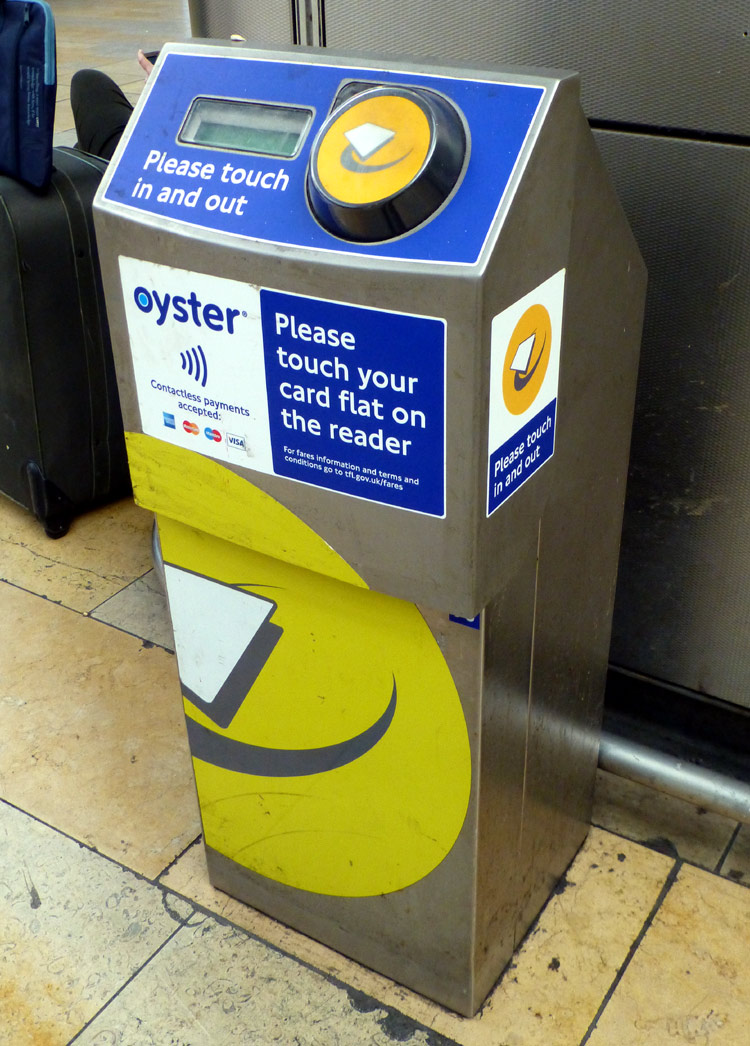 |
Above-left: A freestanding Oyster card reader at a station on London's Docklands Light Railway. Similar card readers are located at other locations where passengers might need to have their Oyster cards read.
This image dates from the early days of the Oyster system.
Above-right: A pink "route validator" Oyster card reader which allows passengers making orbital journeys around London that do not go through the central Zone 1 to benefit from cheaper fares. These must be used by all passengers using PAYG and passengers who have season tickets which are not valid in zone 1. Left: A 2015 view of a freestanding Oyster card reader - the text also refers to payments made using RFID contactless bank cards. |
||
Touch In, Touch OutTo use Oyster PAYG passengers must ensure that their ticket is electronically read by an Oyster card reader for every journey. This is known as touch in and touch out. It is the passenger's responsibility to ensure that it is read properly. The card reader will indicate whether this has been done - in general a green light or a ticket barrier which opens means that all is well. For PAYG users train journeys require a minimum amount of e-purse value to be on the card to start the journey - the amount will depend on the type of transport being used. On the buses PAYG passengers must touch in when boarding at the start of every journey. For tram travel the card readers on the platform should be used prior to boarding the tram. This will deduct the correct amount of money, but will not allow the card to go into a negative balance. As these transports charge a flat fare there is no need (or facility) to touch out. Special conditions apply to tram users at Wimbledon station - see below. When a passenger who is using PAYG touches in at the start of a railway journey a deposit (exact amount depends on where they are and which railway company controls the station) is deducted from the PAYG e-purse value on their Oyster card. When they touch out at the end of the journey, the deposit fee is refunded, minus the appropriate Oyster fare for the journey. Passengers who fail to touch in run the risk of being seen as travelling without a valid ticket, which can lead to a penalty fare being charged, or even their being taken to court for fares evasion. Oyster card readers are to be found on buses, tram stop platforms, on DLR stations before the fares paid area, and combined as part of the ticket barriers at railway (and underground) stations. Where stations do not have ticket barriers they will have stand-alone card readers. Some interchange points between the mainline railways and the DLR / underground also have stand-alone card readers (ie; without barriers) which depending on ticket type and journey may need to be touched before interchanging - even if it means missing a connecting train (or tram). To ensure that they are charged the correct fare for their journey PAYG Oyster card users must also remember to touch in/out at stations where the ticket barriers are open. Whilst passengers with weekly or longer season tickets are recommended to touch in/out at all times, including free-standing card readers and if a ticket gate is open, as a general theme they do NOT have to do so. An example of when touching is an absolute requirement is when travelling to / from stations in zones outside those covered by the season ticket and paying the balance using the stored PAYG value. This includes passengers making journeys which can follow several different routes through different fare zones and who are choosing to travel via a cheaper route - even though it may be slower - and who will be using the special pink 'route validator' card reader to tell the Oyster system that their journey followed a specific route. (See 'Different Routes Attract Different Fares' below). Passengers with season tickets must have their Oyster card with that season ticket loaded on it in their possession at all times whilst travelling - accidentally leaving it behind (ie: at home) is not accepted as an excuse. If caught passengers travelling without possession of their Oyster card could result in them being treated as suspected criminals trying to avoid paying a fare. Wimbledon StationSpecial requirements apply to tram passengers using Wimbledon station using PAYG or a BusPass. This is because the trams (which use the same fare scale as the buses) call at a platform inside a railway station where the trains all
use railway fare scales. To ensure that the correct fare is charged tram passengers starting their journey from the street will therefore have to touch in twice - first to pass the ticket barrier (a process which registers an entry to the
station) and then on the tram platforms - a process which changes that station entry to a tram journey. Following these procedures will also ensure that PAYG fares capping is applied correctly, if applicable. Failing to follow this procedure
will result in the passenger being charged the 'maximum cash fare' - in theory this also applies to passengers who have an otherwise valid BusPass.
|
|||
 |
|
 |
|
Special arrangements apply for tram passengers using Wimbledon station - see small sized text above.
EnticementsThere is a twofold policy of enticements to encourage people to switch from paying in cash to Oyster.
Time Based FaresThe concept of different peak and off-peak fares is not new, and it is also used with Oyster PAYG. Peak fares are charged between 06:30 to 09:30 in the mornings and 16:00 to 19:00 (4pm to 7pm) in the evenings on Mondays to Fridays, except public holidays. At all other times the cheaper off peak fares are charged. Special arrangements apply at a few outer-suburban stations with the peak fare time ending slightly earlier - publicity should be available at the stations concerned. PAYG peak / off peak fares are determined by the time the passenger touches in. This means that if a passenger wishes to catch a train timed to leave a station after 9:30 (am) then they should not touch in before that time, or they will be charged the peak fare. Fares capping works with time based fares to always charge the lowest fares, so that if the total cost of a day's travel journeys is less than the peak cap then the system will charge separately for any journeys taken during peak hours, plus the off-peak cap. As from January 2011 passengers starting their journeys in the outer zones who travel by many (not all) of the rail services into London Zone 1 during the evening peak are charged off-peak fares. This reflects that they will usually be travelling against the main peak flow. PAYG Benefits: Freedom From Fixed TicketingThe introduction of the Oyster system has led to a revolutionary change in fares and ticketing within London, significantly reducing the time it takes passengers boarding buses to pay their fares / have passes 'read' and reducing queues at station ticket offices. PAYG means that many of the advantages of period tickets are now available to everyone - even infrequent travellers - who on arrival at railway stations just walk straight past the ticket sales area to the ticket barriers, where they touch in and then continue directly to the platforms. The many ways to add PAYG value to the Oyster card e-purse has resulted in a significant reduction in numbers of people using staffed ticket office windows, although this does represent a double-edged sword in that it can result in staffed ticket office windows being closed with transport employees losing their jobs (or redeployed on other job functions). In March 2010 it was reported that...
|
|||
 |
 |
 |
Passengers who do not have Oyster cards and therefore need to purchase a paper ticket or who need to add PAYG value to their Oyster cards' e-purse can usually do this at the ticket machine - when they are working! (see image above - right).
To repeat: it cannot be understated just how significantly electronic RFID ticketing using e-purses has changed how people pay fares in London.
One of the most beneficial new features which the Oyster system has enabled is that rather than buy tickets which are only for pre-decided 'station-to-station' journeys (or only valid within a certain range of zones) passengers can now change their mind regarding their destination station whilst already travelling. This is because the system is able to determine the correct fare when a person leaves the network. Passengers with Travelcard season tickets on an Oyster card are now able to travel beyond the zones their season ticket covers and allow the PAYG e-purse to pay for the additional zones they just travelled through. Note that this is NOT allowed for passengers using any type of paper ticket.
PAYG Foibles: OSI, Time Limits, Auto-Complete
At some interchange stations it is necessary to leave the station (ie: touch out at the exit barrier) and then enter a different nearby station (ie: touch in at the entrance barrier) to make the interchange. The official
terminology for this is an Out Of Station Interchange (OSI), although it is rarely used publicly. The significance of the OSI is that the fares system will treat this as one seamless journey and charge PAYG passengers a through fare
- rather than a new fare. This saves money! However, for the OSI feature to work passengers must make their interchange within a preset time limit, which varies from location to location depending on how far apart the stations are. Otherwise
they will be charged a fare for new journey. An example of an OSI between two stations which are a short distance apart are Tower Gateway and Tower Hill DLR / Underground stations.
Unfortunately there is no official publicity aimed at the general public detailing OSI time limits, however this unofficial web page (which will open in a new window) will be of related interest.
http://www.oyster-rail.org.uk/out-of-station-interchange-osi/
An example of why passengers do need to know this information is detailed below.
Another type of OSI exists at the mainline railway termini (Liverpool Street, Paddington, Victoria, Waterloo and more...) where passengers switch between underground trains and those of the various mainline train operating companies. The time limits at these stations are usually much more generous when travelling away from the underground than towards the underground. This is because passengers travelling towards the underground are expected to want to continue their journey as quickly as possible whilst passengers travelling away from the underground may have to wait for their connecting train. An example of this could apply to passengers going to Hampton Court Palace and gardens, which is a very popular visitor attraction to the south west of London. Direct trains to here go from London Waterloo station and as the station is in zone 6 so Oyster PAYG represents an easy way to pay the fare. Because trains from Waterloo are every 30 minutes so the OSI time limit for passengers travelling away from London is long enough to allow for passengers who have just missed a train to catch the next train. But not the one after that! Nevertheless, passengers need to be aware that this exists and whilst waiting for their train not spend more than about 20 minutes at the platform coffee shop before touching in and passing through the ticket barrier.
All journeys using Oyster PAYG have time limits. This is linked to the day, time of day travelled and the number of zone boundaries crossed. Time limits are most generous at weekends when trains on some routes are less frequent. If a passenger exceeds the maximum journey time they are automatically charged for an unfinished journey, plus when they touch out potentially for un-started journey. Although not the official advice this does mean that passengers who exceed journey times are better off not touching out, if possible. In addition, the journey does not count towards 'fares capping'. This does mean that if there is disruption and journeys are delayed passengers may find themselves being charged maximum fares (which will feel like penalty fares, although technically they are not) to complete their journey and having to contact the Oyster helpline to resolve the issue - and get their money back.
If passengers arrive at a station and having touched in decide to leave the station without travelling (perhaps because there is a problem and services are disrupted) then providing they leave the station after 2 minutes and within 30 minutes they will only be charged the minimum fare from that station.
Entering a station's 'fare paid area' and then leaving it within 2 minutes incurs a maximum fare charge. However, if passengers re-enter the same station or any other station within 45 minutes the maximum fare will be refunded and a new journey started. BUT, the station touch out exit must be made at a ticket gate and NOT any other type of card reader and using a normal bus service (eg: to travel to a nearby alternative station) and paying the bus fare using the same Oyster card will break the link with the first entry / exit, resulting in the entry / exit charge staying on the Oyster card. The reason for this complex system is to discourage fares evasion.
PAYG Pitfall: Passengers Caught-Out As OSI And Time Limits Collide
Where journey time limits and the OSI collide is what happens if a passenger breaks their journey for just a few minutes (for instance, to drop off some clothing at the dry cleaners) and then continues their journey. At normal stations the break in journey would be treated as the end of one journey and the start of a fresh journey. But not at an OSI, and from personal experience it has been found that this increases the likelihood of falling foul of the overall journey time limit. This almost resulted in yours truly becoming stranded 30+ miles (50km) away from home on the other side of London and with no way of paying to get home. This scenario does represent a 'bind' for electronic ticketing systems which are rarely clever enough to know whether someone leaving the fares paid area at an OSI is interchanging - or ending a journey. The boffins say that time limits are an essential aspect of electronic ticketing systems which use e-purses, but they did not exist with paper ticketing and this represents just one example where the less clever paper ticketing actually provides a more customer-friendly solution.
Perhaps what should happen in the situation where a journey involves an OSI and the total journey time exceeds the maximum journey time allowed, but the time taken for each section of the journey does not exceed the maximum allowed for that journey, then the system should charge for two complete journeys, rather than two incomplete journeys / maximum fares?
Incomplete Journey Auto Complete
At exceptionally busy times (typically a major sporting event) to prevent a potentially dangerous crowd building up waiting to pass through the exit ticket gates something known as 'autocomplete' is invoked. This will allow passengers to not touch-out and working on the assumption that they going to make a return journey which starts at that station will use their touch-in to determine why their previous journey did not have a touch-out and automatically perform the touch-out for them. In this way the passenger is not charged for an incomplete journey. However, this system is not clever enough to cope with passengers who do not return via that station, perhaps because after the match someone gave them a lift (ride) home in a car.
Another type of auto-complete was introduced in summer 2011 as a result of much hostile criticism over the amount of money incomplete-journey maximum-charges were costing passengers. This benefits regular commuters who use PAYG but sometimes forget to touch-out (or are unable to touch-out - see below) at the end of a regular journey by looking at their regular journeys and assuming that if every day a person makes a return journey between station X and station Y, but once in a while does not touch-out at the end of one of these journeys, then 'the system' will perform the touch-out for them. This concessionary action is restricted to something like one transaction a month and only to failing to touch-out when ending a railway journey (DLR, Underground, mainline train) - it does NOT apply to failing to touch-in at the start of a journey.
OEP
The OEP Oyster Extension Permit system was introduced in January 2010. It was an electronic token which was placed on an Oyster card that would satisfy a travelling ticket inspector that although the passenger is travelling outside the validity of their season ticket they are not trying to evade their fare and that the extra cost would be collected from the PAYG e-purse value on their Oyster card at the end of their journey. Only journeys involving the mainline railways (National Rail) needed OEP's. However the OEP system was widely criticised for its complexity, user unfriendliness and requiring passengers to plan ahead with their travels. In March 2011 it was announced that because they were not well understood the OEP would be withdrawn, and this came to be in May 2011.
Glitches, Failed Reads, Court Case
Oyster does suffer from a few glitches.
Sometimes the ticket gates / stand-alone card readers develop faults, and especially for PAYG users this can be a problem as despite the barriers opening (or standalone card reader appearing to register that a card has been touched) it can result in the ticketing system thinking that a person has failed to touch in/out at one end of their journey and therefore the maximum (penalty) fare is charged and daily fare capping suspended.
In summer 2008 a bus passenger was taken to court for fares evasion after roving ticket inspectors said that he had failed to touch in on a bus card reader. The passenger was adamant that he did, and that it made a noise when he did so (whether the 'correct' noise remains unknown). The court agreed with him and he won his case. Also in 2008 there were two highly publicised system failures which resulted in station ticket gates being left open and PAYG passengers travelling for free on that day.
One of these 2008 glitches was a system-wide event that resulted in a four hour period during which some Oyster cards had all their stored data deleted when touched-in or used to pay bus or tram fares, whilst other Oyster cards were charged a maximum fare irrespective of the distance travelled. TfL estimated that between 60,000 and 100,000 Oyster cards were affected and needed replacing.
Whilst the onus is always on PAYG passengers to remember to touch in/out at each end of the journey, passengers sometimes allege that they did not do this because they had passed through a station where there were not enough (or any) station staff on duty and as a result the ticket gates had not only been left 'open' but had actually been switched off - so that touching in/out has no effect (in other words, it becomes impossible to touch in/out)! Of course in this scenario they are charged a maximum / penalty fare for an incomplete journey - which to resolve requires them to complain to the Oyster helpline. Apparently this is a fairly common scenario at suburban stations, especially at quiet times, for instance: evenings, with passengers returning home after working late or an evening out (socially) most frequently being affected.
An unexpected scenario which often leads to a failed touch in/out is that some passengers are 'too quick'. Living in a fast paced city in a perpetual state of 'hurry' sees passengers sometimes putting their card down on the reader at the same moment the person in front lifts his / hers off. Because the card reader is still reading the passenger in front's card so it does not read the next passenger's card. To prevent this 'doubling-up' the second passenger must wait until the person in front of them has started to walk through the ticket gate.
Nothing is infallible and very occasionally Oyster cards become corrupted and need replacing.
If an Oyster card fails to operate the user must pay cash (or use another Oyster card) and contact the helpline for advice what to do next. This can be done online, by letter post or by telephone. Note that the telephone helpline
uses a telephone number where calls may be outside of the free calling plan operated by your telephone company. If this is so then it may be financially advantageous to visit the
http://www.saynoto0870.com/ website and search for the helplines' normal London telephone number. The search page can be found here...
http://www.saynoto0870.com/search.php .
A frequent topic for conversation on several London-based discussion lists are some of the problems people encounter when using the electronic ticketing system. It seems that many people do not bother complaining when things go 'go wrong', even though they may be entitled to a refund. This could be because the claims phone number is always very busy - so that it can take 15+ minutes of waiting to speak to a real person, and that once the financial cost of the person's time plus telephone call (or letter) have been bourne in mind, the cost and hassle of making contact deters people from doing so.
Different Routes Attract Different Fares
Sometimes it is possible to make a journey via several different routes - some of which include through different fare zone combinations. Typically this means travelling around London and avoiding the central London fares zone (ie: zone 1) rather than through the centre of the city. The significance of this is that sometimes by choosing to travel via a different route a passenger can sometimes benefit from a cheaper journey.
However, the system has no way of knowing which route the passenger followed, and therefore which fare to charge. To resolve this passengers need to tell the ticketing system's computers by touching a pink coloured Oyster card reader at a designated station whilst en route. Otherwise the system will default to charging the fare for that journey on the basis that the passenger had travelled via a more expensive route. This issue applies to all passengers who are paying their fares using an Oyster card, no matter whether they are using PAYG or have a season ticket (Travelcard) which is valid for the zones travelled through via the cheaper route but not valid for the zone(s) travelled through when following the 'default' route. By way of example, if the season ticket is valid in zones 2-4 and the passenger has used the Overground to avoid zone 1 (NB: beware that Shoreditch High Street station is in zone 1).
Note that passengers using season tickets / Travelcards are automatically charged the excess fare when they touch out and the extra cost is deducted from the PAYG balance, if any is loaded. If the Oyster card does not have any (or enough) PAYG balance loaded on it then the season ticket / Travelcard will be blocked from further use until the amount due has been paid.
However there can still be complications, especially on services where through trains mean that passengers do not get the opportunity to touch the pink coloured route validating Oyster card reader (for instance, at Willesden Junction), and as the Oyster publicity advises, for some journey passengers are charged a zone 1 fare no matter which route they follow.
Of course none of these complications apply to passengers using paper ticketing solutions.
Where Oyster Is Unwelcome
As a general theme neither Oyster cards nor the ordinary ride-at-will paper Travelcards can be used on the following special railway services within London:-
- Heathrow Express trains between Heathrow Airport and Paddington station.
- Heathrow Connect services between Heathrow Airport and Hayes & Harlington station (only) - they are accepted for local journeys which do not include the airport.
- Any journey starting or finishing outside Zones 1-9 or beyond Watford Junction or Grays,
- Any journey where the passenger is travelling 1st class.
At Heathrow Airport train journeys between the railway stations for terminals 123 and terminal 4 or terminal 5 are free of charge if using the Heathrow Express or Connect trains; but a fare must be paid if using the Piccadilly Line Underground trains.
There are also a few bus services which do not accept either Oyster cards nor the ordinary ride-at-will paper Travelcards, mostly this comment refers to sightseeing etc., bus services intended for tourists and the longer distance coaches from outside of London which call at a few bus stops in London too.
What Oyster Lacks
Note that there is no Oyster version of the one day pay-once ride-at-will Travelcard. Instead passengers are required to use PAYG fares capping, which may be financially similar but is not the same in actual usage. PAYG suffers from OSI and journey time limits, plus of course failed reads which may not be the fault of the passenger but still results in them being treated as a potential miscreant. (Maximum fare / daily capping woes). Paper tickets give 100% freedom from all these woes, although it is true that they too are not infallible as sometimes the data in the magnetic stripe can be damaged / rendered unreadable and very occasionally station ticket gates do swallow them and a member of staff has to assist with their retrieval.
With a concern that over the coming years paper tickets will be phased out perhaps a solution here would be to offer a Dutch style one-day paper e-ticket? The most important aspect of this being the ability to pay once and then travel around London safe in the knowledge that providing one says within the permitted zones there simply cannot be a scenario where a passenger finds themself being held hostage to needing to pay more - or become unable to travel / stranded.
Some people have apparently opened up Oyster cards and transferred the RFID chip plus ariel to clothing, jewellery, etc. Whilst not actually a criminal offence this is not allowed and sanctions will be taken against people for doing this. That people are doing this however suggests that there is an un-met desire for different types of Oyster cards (ie: the physical device / this being a totally different topic than the types of product loaded on to the RFID chip inside the card), so that people do not have to carry credit card sized tickets. Possible reasons why a range of other types of Oyster card have not yet existed (in London) can be found under the "2012: EMV / NFC / Wave & Go Bank Cards To Usurp Oyster?" heading below.
That there is a public desire for different ways to carry RFID tickets is proven by the fact that other places which use RFID ticketing systems offer alternatives alongside the basic credit card
sized RFID cards. These include key fob style trinkets and other devices which can be hung from key rings, mobile telephones with embedded RFID chips and mobile telephone covers with integral RFID chip.
Interested readers may like to follow the two links below and see the products that are available from the Octopus and Snapper online shops. Different systems use
different alternatives, and of course over time product catalogues will vary. Note that these items are sold.
http://www.octopus.com.hk/get-your-octopus/choose-your-octopus/en/index.html
https://www.snapper.co.nz/snapper-store/.
Oyster On The 'Dog & Bone'
During winter 2007/8 trials involving 500 passengers, a mobile (cell) telephone company (and other partners) were conducted using mobile telephones which featured an Oyster compatible RFID chip. These proved to be very successful, with a reported 89% passengers involved in the trials saying that they would like to have this as a permanent feature and two-thirds also expressing an interest in their mobile telephone having credit card capabilities as well. By late 2008 media reports were suggesting that Oyster compatible mobile phones would 'soon' become available to anyone who wished to buy them, however by 2013 this was still yet to come to pass. Similarly featured mobile telephones are already available to people in some of the other countries which use RFID ticketing systems.
These telephones used what is known as an NFC chip. NFC is looked at further down this page.
'Dog & Bone' is Cockney rhyming slang for 'telephone'.
Additional information:
http://www.thisislondon.co.uk/standard/article-23549348-mobile-phones-to-be-used-as-oyster-and-credit-cards.do
Whats Best For Visitors To London?
There is no definitive answer to this question, as it largely depends on what the visitors intend to do when in London, how many are travelling, how they are coming here and for how long. These comments apply to all visitors, whether from elsewhere in Great Britain or overseas.
Visitors who just wish to see the sights and visit major tourist attractions are advised to investigate the 2for1 offer whereby 2 people can visit many major destinations for the price of 1. The only
requirements are to download vouchers from the http://www.daysoutguide.co.uk/faq.aspx#1 website
- which can be done before leaving home - and have the right type of 'mainline railway' (National Rail) ticket for travel to or within London. Paper one-day and longer
Travelcards are acceptable, but only if bought from a 'mainline railway' ticket office or machine (ie NOT an Underground / Overground / DLR station, nor an Oyster Ticket Stop). These tickets
feature an orange stripe at the top and bottom and although the wording will be different they look very similar to the platform ticket seen further up this page.
Other passengers may still prefer 'paper' Travelcards, or may prefer to use Oyster cards and PAYG (pay as you go). To avoid possible long waits at busy ticket offices at airports and Kings Cross St Pancras Underground station it is best to try to buy tickets in advance - some airlines and Eurostar sell visitor versions of the Oyster card which come with enough PAYG value pre-loaded to be used immediately on arrival in London. They may be priced slightly differently (and intended to be retained as a souvenir) but still represent excellent value for money - and possibly much saved time on arrival in London. Visitors with children may wish to source child photocards; this is permitted, even for visitors from overseas, and can be requested from the Oyster website.
Transport enthusiasts who wish to spend several days exploring London's transports may wish to investigate weekly / 7 day season tickets as they may work out cheaper than daily ride-at-will Travelcards. Especially if you wish to travel in the morning rush hour. Just be aware of the zones you wish to travel in and that you may need a free photocard which includes a passport type photograph..
Spectator Ticketing During 2012 Olympic Games
All tickets for the London 2012 Olympic Games included a free public transport ticket for that day. Initially it was thought that the ticket would come in the form of special one-day Oyster card, however
in the end spectators were given a paper one-day Travelcard. Apparently this was seen as the easiest and most robust ticketing solution.
For more information follow this link:
http://www.computerworlduk.com/news/mobile-wireless/3359470/tfl-nfc-contactless-payments-will-not-be-ready-before-olympic-games/
Further Reading...
Visitors and anyone else who wishes to read more may also find these web sites to be of interest...
london-railfan.info
http://www.londontoolkit.com/travel/lhr_underground.htm
http://www.oyster-rail.org.uk
http://www.oystercard.com (this is the 'official'Oyster website) .
 |
|
|
|
|
|
|
|
|
|
|
|
|
|
|
|
|
|
|
|
|
|
|
|
|
|
|
|
|
|
|
|
|
|
|
|
|
|
|
|
|
|
|
|
|
|
|
|
|
|
|
|
|
|
 |
|
||||||||||||||||||||||||||||||||||||||||||||||||||||
 |
 |
 |
 |
 |
 |
 |
 |
|
|||||||||||||||||||||||||||||||||||||||||||||
 |
 |
 |
|
||||||||||||||||||||||||||||||||||||||||||||||||||
 |
 |
 |
|
||||||||||||||||||||||||||||||||||||||||||||||||||
 |
 |
 |
 |
 |
 |
|
|||||||||||||||||||||||||||||||||||||||||||||||
 |
 |
|
|||||||||||||||||||||||||||||||||||||||||||||||||||
 |
 |
 |
|
||||||||||||||||||||||||||||||||||||||||||||||||||
 |
 |
|
|||||||||||||||||||||||||||||||||||||||||||||||||||
 |
 |
|
|||||||||||||||||||||||||||||||||||||||||||||||||||
 |
|
||||||||||||||||||||||||||||||||||||||||||||||||||||
 |
 |
 |
|
||||||||||||||||||||||||||||||||||||||||||||||||||
 |
 |
|
|||||||||||||||||||||||||||||||||||||||||||||||||||
 |
 |
 |
|
||||||||||||||||||||||||||||||||||||||||||||||||||
 |
|
||||||||||||||||||||||||||||||||||||||||||||||||||||
 |
 |
|
|||||||||||||||||||||||||||||||||||||||||||||||||||
 |
 |
 |
|
||||||||||||||||||||||||||||||||||||||||||||||||||
 |
 |
 |
|
||||||||||||||||||||||||||||||||||||||||||||||||||
 |
 |
 |
|
||||||||||||||||||||||||||||||||||||||||||||||||||
 |
 |
 |
|
||||||||||||||||||||||||||||||||||||||||||||||||||
 |
|
||||||||||||||||||||||||||||||||||||||||||||||||||||
 |
 |
 |
|
||||||||||||||||||||||||||||||||||||||||||||||||||
 |
|
||||||||||||||||||||||||||||||||||||||||||||||||||||
 |
|
||||||||||||||||||||||||||||||||||||||||||||||||||||
 |
|
||||||||||||||||||||||||||||||||||||||||||||||||||||
 |
 |
 |
|
||||||||||||||||||||||||||||||||||||||||||||||||||
 |
 |
 |
|
||||||||||||||||||||||||||||||||||||||||||||||||||
 |
|
||||||||||||||||||||||||||||||||||||||||||||||||||||
 |
 |
 |
 |
 |
 |
|
|||||||||||||||||||||||||||||||||||||||||||||||
 |
 |
 |
|
||||||||||||||||||||||||||||||||||||||||||||||||||
 |
|
||||||||||||||||||||||||||||||||||||||||||||||||||||
 |
 |
 |
|
||||||||||||||||||||||||||||||||||||||||||||||||||
 |
 |
|
|||||||||||||||||||||||||||||||||||||||||||||||||||
 |
 |
 |
|
||||||||||||||||||||||||||||||||||||||||||||||||||
 |
|
||||||||||||||||||||||||||||||||||||||||||||||||||||
 |
 |
 |
|
||||||||||||||||||||||||||||||||||||||||||||||||||
 |
|
||||||||||||||||||||||||||||||||||||||||||||||||||||
 |
|
||||||||||||||||||||||||||||||||||||||||||||||||||||
 |
 |
 |
|
||||||||||||||||||||||||||||||||||||||||||||||||||
 |
|
||||||||||||||||||||||||||||||||||||||||||||||||||||
 |
 |
 |
 |
 |
 |
|
|||||||||||||||||||||||||||||||||||||||||||||||
 |
|
||||||||||||||||||||||||||||||||||||||||||||||||||||
 |
|
||||||||||||||||||||||||||||||||||||||||||||||||||||
 |
|
||||||||||||||||||||||||||||||||||||||||||||||||||||
 |
 |
|
|||||||||||||||||||||||||||||||||||||||||||||||||||
 |
 |
 |
|
||||||||||||||||||||||||||||||||||||||||||||||||||
 |
|
||||||||||||||||||||||||||||||||||||||||||||||||||||
 |
|
||||||||||||||||||||||||||||||||||||||||||||||||||||