
Parking
Navigating through this website is easier with the navigator frame which should be to the left of this window. If it is not there then click here to turn it on! Alternatively there is a system map at the foot of this page.
More information about this website & why it was created can be found by visiting this website's "front" pages (link opens in a new window)
 .
.
Many images are "clickable" - run the mouse over them and if a "hand" appears then click & a larger version will open in a new window!
Wouldn't it be nice if we could always park right outside our destinations, without either parking charges or traffic wardens to worry us? Of course, we would all want to be able to do this, and all the time! Sadly, the reality is that in urban areas it is just not possible - there are too many vehicles and they would all be chasing the same few parking spaces.
Some people liken the traffic flow on our roads to the blood flow through our bodies, with major roads being the arteries and minor roads the capillaries. And, just as the build up of cholesterol in an important artery can slow down the blood flow and a blockage can have serious repercussions, so parked vehicles can cause traffic flow to slow down or even seize up altogether.
 |
|
|
|||
 |
|
 |
|||
| No-one really likes parking controls, but... unfettered parking can lead to chaos, with in the most extreme circumstances traffic flow becoming near impossible.
This is what came to pass on this road - with vehicles parked on both sides it was effectively reduced to having only a single traffic lane down the middle. At the busiest times road users frequently experienced gridlock. (The white van and other traffic on the side of the road without the street lights are all parked.) |
|||||
 |
|
 |
|||
Immediately after some new single and double yellow lines had been (partially) painted, but before they were being enforced, many motorists started observing the new order - except in the gaps in the yellow
lines which were caused by legally parked vehicles being 'in the way' when the new yellow lines were painted.
The introduction of parking controls also resulted in a very significant reduction in kerbside parking space - this is because in addition to ensuring that vehicles no longer park on both sides of the road (except where there is a marked 'blue badge' disabled driver parking spot) the opportunity was taken to stop vehicles parking near to and opposite road junctions and corners. In many cases this seriously disadvantages local residents, many of whom can no longer park where 'for many decades' they used to park. Some of the vehicles seen in these two views are parked at locations where there will eventually be double yellow lines. Whilst vehicles not being parked on road junction corners will improve visibility for vehicles leaving the side roads (and hence road safety) it is questionable how the new restrictions opposite side roads will help, especially as the often thoughtless drivers of vehicles turning right act inconsiderately towards other road users and fail to take advantage of the road space in a way which allows any road users approaching from behind who are travelling straight ahead to pass on the inside. This comment is based on observation elsewhere along the same road where road markings encouraging that this be done are totally ignored. Whilst helping to keep the traffic moving / preventing the type of gridlock seen above is in itself a noble cause, many British towns and cities also use parking control as a 'tool' to try and force a reduction in the total number of vehicles on the roads. In doing so they could be said to have fallen for the anti-car activists' argument that it is the very expectation of easy availability of parking at journey's end that encourages people to drive, so they try to restrict the amount of parking space available to private motorists who, unable to find a parking spot will then (they hope!) switch their journeys to public transport. However this flawed theory propagated by Luddite by anti-car activists usually backfires because instead the motorist will either just park illegally or, if they have the option, go somewhere else where parking is easier (ie: out of town shopping centre) - the latter being an option which eventually leads to urban decay as the lack of trade results in local shops closing. Another favoured parking control tool follows the concept that wherever there is parking, it must be chargeable - with the motto being the more expensive the better! Originally the public were 'sold' the concept of charging for parking with the fable that it would help fund new off-street parking facilities for those people who insist on driving in our towns and cities, the theory being that 'in time' almost all on-street parking will be replaced by off-street car parks. Those with long enough memories may recall that this same criteria was first used with the introduction of the parking meter in the 1950's. As yet we are still waiting for the monies raised to be spent as publically advertised and it is very probable that we will still be waiting in the 2050's. To a certain extent it is perhaps better that all these off-street spaces have not been built as they would have attracted even more traffic - but that is not the point; the issue here is that charges were introduced for a specific purpose and then the funds went astray. It happened with parking fees and now with road congestion charging - aka a new tax - the same is poised to happen again. In the meantime parking gets both harder and more expensive, so as a result the motorists vote with their accelerator pedals as they forsake places (such as town centres) where parking is difficult and / or expensive and instead drive to the large regional shopping centres, such as Brent Cross, Bluewater, Metrocentre, Merry Hill, Trafford Park, etc., where parking is free and easy. Of course this both increases traffic levels and harms local traders, established town centres and those people who are unable to travel to the regional centres. Some politicians see a solution in making the regional centres charge for parking too; so, once again, more revenue generation is seen as THE answer (sigh), whilst investing in proven successful fixed-infrastructure alternatives that provide an attractive alternative choice and thereby help reduce traffic levels is shunned. (For ideas on what is really needed, and how it could be funded, see the Enough Stick, How About Some Carrot page). |
|||||
 |
|
 |
|||
| Simply closing meters may reduce on-street parking but in itself will do nothing to encourage people to use alternative transports.... (as explained above this will usually be detrimental to local shops). | |
There is no reason why on wide roads with minimal traffic flow vehicles cannot be allowed to park along the road centre in addition to the kerbs. | |||
 |
|
 |
|||
It is far too easy to just tell people where they may not park (and then fining them for parking there) - sometimes illegal parking is for want of somewhere legal, and the knowledge where it is! The sign above
left was seen on the wall at a museum.
Parking And Bus Stops |
|||||
 |
|
 |
|||
| A major source of annoyance comes when vehicles park at bus stops. Frequently this results in the bus having to block the rest of the traffic flow, which means that all road users end up suffering delay and frustration. | |
A car parked at a trolleybus stop in Salzburg, Austria being towed away. A 'fine' solution - both for the bus passengers who can now board the bus without walking into the roadway - and for the car owner too. | |||
Parking And Bus / Tram Lanes |
|||||
 |
|
 |
|||
| Another place where vehicles should never park is a bus lane during its hours of operation. As these pictures suggest, parking at other hours is sometimes encouraged.
In spring 2008 this rush-hours only bus lane was introduced along a section of road where there is 'pay & display' parking. |
|||||
 |
|
 |
|||
| Note the use of a red coloured road surface to help delineate the bus lane. Some people might question the clarity of the parking restriction information seen in the image on the right. Others would question whether people who cannot understand what really is simple signage should be driving at all. The upper sign quite clearly states that there is 'pay & display' parking, its hours of operation, for how long a vehicle may park, where along the road this applies and where to buy the ticket which needs to be displayed on the dashboard so that it can be seen through the windscreen by a parking attendant standing on the footpath. The lower plates indicate that to the left parking and loading are prohibited Monday to Friday between 7am & 10am plus 4pm & 7pm whilst to the right these are prohibited Monday to Saturday between 7am & 7pm. Also worth noting is that although not stated on any signage, in London parking on the footpath (as seen in the image on the left) is actually prohibited at all times except where there is clear signage stating otherwise. |
|||||
 |
|
 |
|||
| Basle, Switzerland. Green lines painted on the road surface can delineate the safe area in which vehicles can park without disrupting light rail / tram services. | |
A road-centre bus lane in Geneva means that kerb space is available for parking (and, on some days, a street market). | |||
As the above two images demonstrate, given the will and a positive 'can-do' attitude parked vehicles and public transport can co-exist. There are more examples of light rail and parked road traffic happily sharing roadspace on the Light rail fits in Street sub-page |
|||||
Parking And Zebra CrossingsMost drivers know that it is absolutely forbidden to park on the zig-zag road markings either side of zebra crossings and the various types of traffic signal controlled crossings. However, as this image shows, when the zig-zag lines do not curve into the parking bays then parked vehicles and these crossings can safely and legally coexist with ease. |
 Given the will and a positive 'can-do' attitude zig-zag road markings can safely and legally coexist with parked vehicles. |
||||
Which Side of Road ParkingThis image of a park and ride sign was shown to some people who live in Australia and the USA, and even though some of the vehicles concerned are only just about visible they all commented on the vehicles parked on the roadway. Apparently in many countries it is a legal requirement that vehicles parked at the kerbside always do so facing the direction of the traffic flow on that side of the road - and the traffic police enforce this ruling enthusiastically. By way of contrast, here in Britain motorists tend to park facing either direction on whichever side of the road they can find a space. Especially on roads of this width - its less usual on very wide multi-lane roads, as to get to the 'other side' is not so easy when there are several lanes of oncoming traffic to cross. |
 Cars parked on both sides of road facing the same direction. |
||||
Technically this might be 'wrong', but especially in urban areas it does not seem to bother most motorists who feel over-regulated as it is, even without further reasons to control them. Footpath Parking |
|||||
|
In many areas of Britain parking on the footpath is illegal, and in the Devonian village of Beer they have found a novel way to ensure that motorists comply with this regulation. The thought of the possible damage if a wheel should stray into the water channel certainly focuses the mind to be very careful when parking!!! This water channel also improves road safety because it encourages pedestrians to cross the road at designated positions - and not walk out from between the parked vehicles. Note the broken yellow lines painted alongside to the kerb. For many years these markings designated that the parking restriction applied for less than the working day - which meant only part of the day eg: rush hours or short parking bans to stop commuters parking there all day - but nowadays they have been replaced by the same continuous yellow line which used to designate that the parking restriction applied for the whole of the working day. So in effect the same markings designate that very different restrictions are in force. Are you confused? Yes, so are many motorists, who now have to look for little yellow restriction plates which are supposed to be fitted to roadside posts (or street lamps) but too often are missing. The real beneficiaries of this will be whoever pockets the fines for 'illegal' parking. |
 A kerbside water channel provides an effective deterrent to vehicles parking on the footpath. |
||||
 |
|
 |
|||
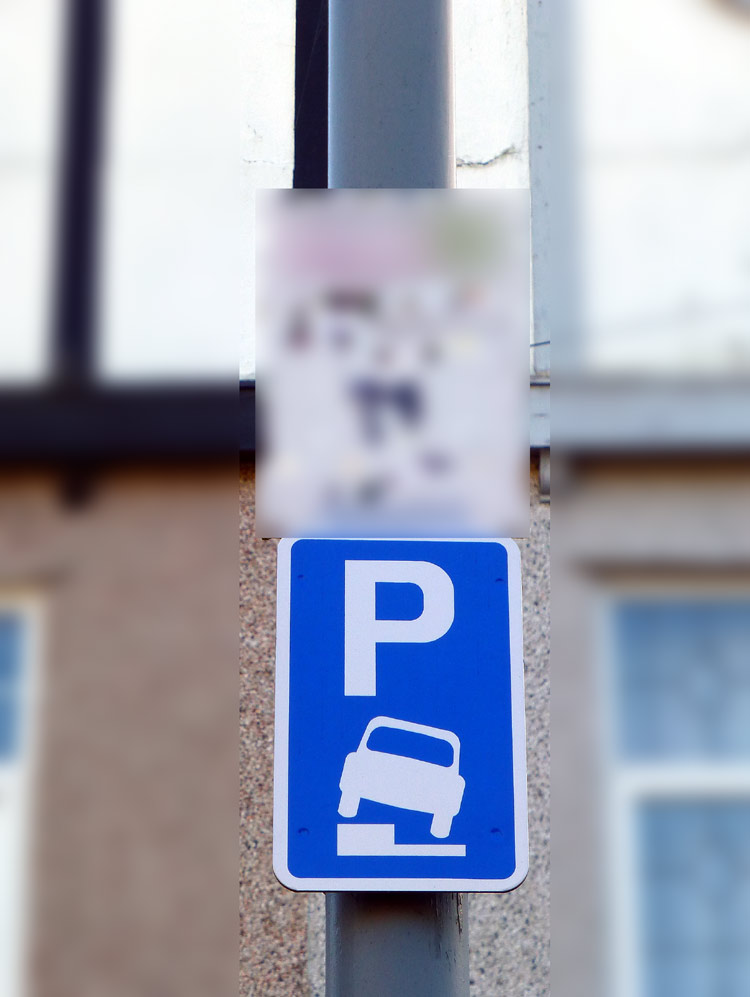
| Road sign mounted on street light poles in a quiet residential side road in London which makes it quite clear that it is permitted to park a car with one side on the footpath. | |
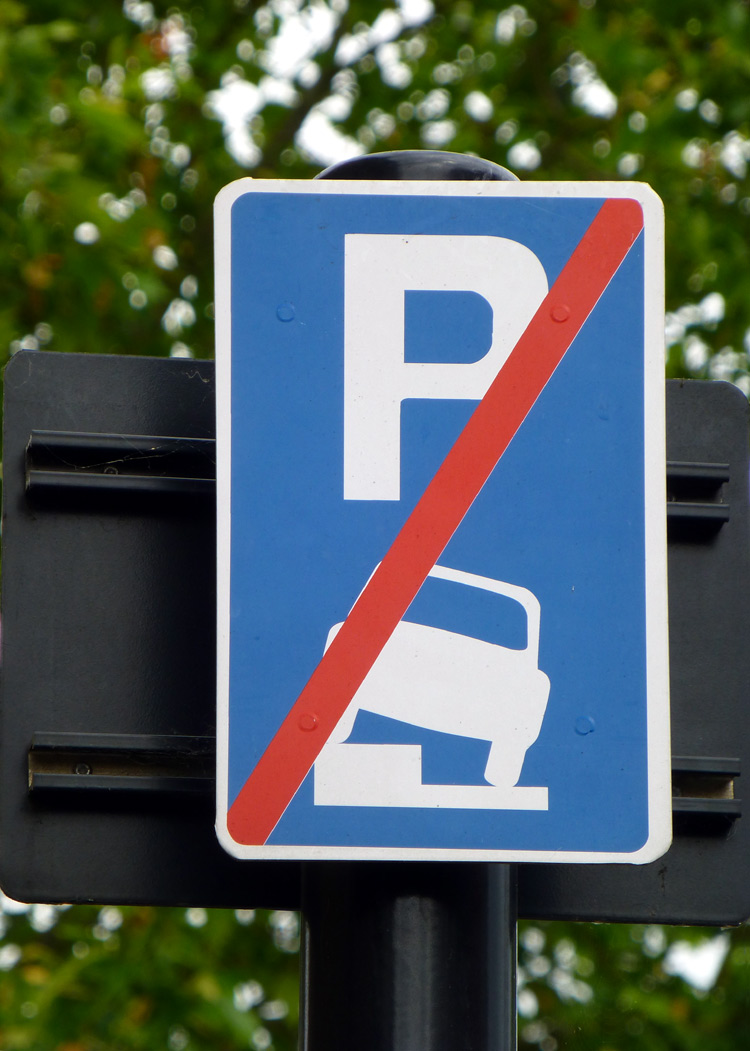
A road sign at the end of the zone where footpath parking is permitted. These signs are not always necessary, especially when the signs directly below are used. |
|||
 |
|
 |
|||
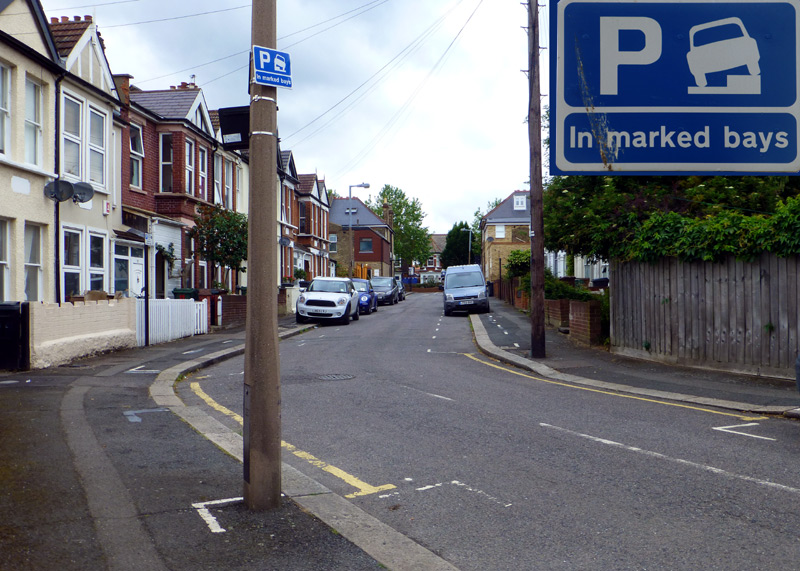
| A section of road which is inside a controlled parking zone where parking with one side of the vehicle on the footpath is only permitted inside the white painted boxes.
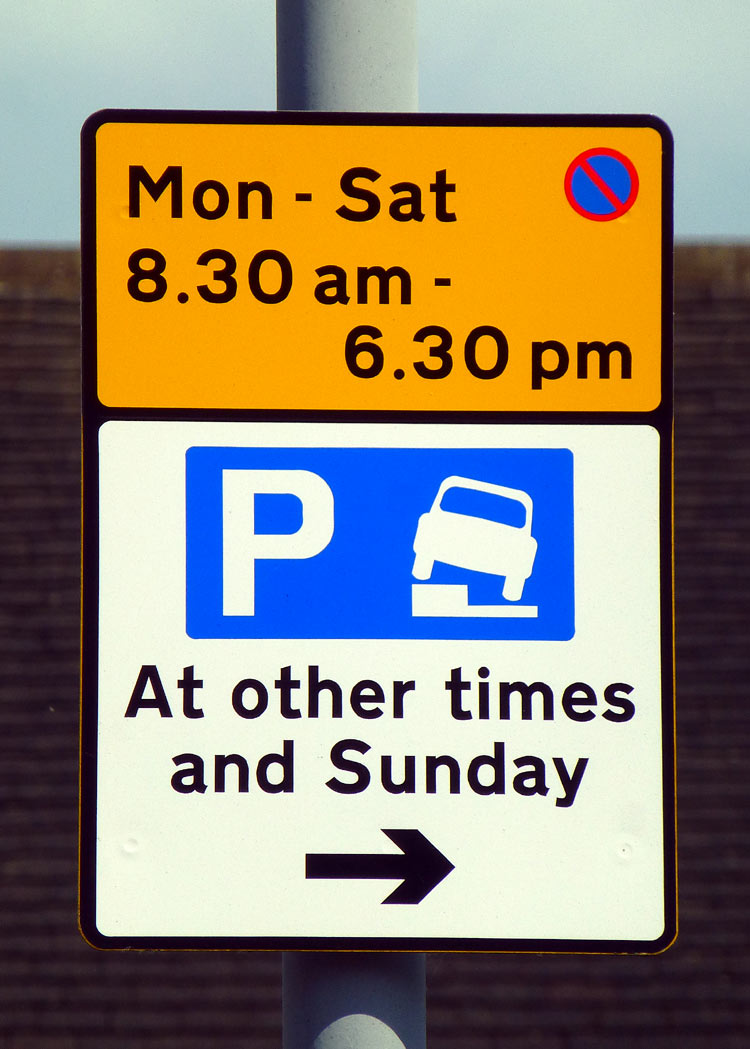
The inset shows a sign similar to that seen on the street lighting pole. |
|
Footpath parking is only permitted in the direction of the arrow, except at the times shown by the part of the sign which has a yellow background.
Footpath parking is not permitted at any time in the opposite direction of this arrow. |
|||
Off-Street Parking |
|||||
 |
|
 |
|||
| Multi-story car parks such as this are often provided to avoid clogging the roads with parked vehicles. | |
An off-street car parking area primarily designed for shop and office workers which offers a very limited number of spaces - so that there will not be enough for everyone who works here. | |||
The French seem to have a different attitude to parking than we do - as these pictures show there are places where motorists are expected to park on the footpath. |
|||||
 |
|
 |
|||
| Unfortunately though it seems that few motorists have heeded the instruction to leave a one metre space between their vehicles and the buildings. This could cause difficulty for parents with children in pushchairs or people in wheelchairs. | |||||
 |
|
 |
|||
| A rising bollard can restrict vehicle access to a pedestrian zone to authorised vehicles only. | |||||
 |
|
 |
|||
| The French are well known for their direct action, and when parking is made difficult then that sometimes extends to how they stop to unload their vehicles.
Normally even stopping briefly on tram tracks would be asking for trouble, however in this instance the 20 minute service infrequency virtually encouraged the taking of a chance.
Not seen in these images are the mother cradling a very young baby or the luggage / bags at her feet. All 6 images in this group - Bordeaux, France.  Making A Rod For One's Back! |
|||||
 |
|
 |
|||
| As with many things in life there are two sides to every story.
Motorists often moan about over-zealous traffic wardens and whilst their complaints are sometimes justified it is also the situation that too often the way they park their cars they (the motorists) really are asking for trouble. Just look here - one car has actually entered a one-way street the wrong way (the driver thought that its OK if you are just parking!!) whilst another car has been parked so far over the corner that it partially blocks the exit from the one-way street. Furthermore, they are BOTH parked on roads subject to 'waiting' (aka: parking) restrictions. Ever heard of making a rod for one's own back? |
|||||
 |
|
 |
|||
| Because of the combination of a car being parked on double yellow lines and the pedestrian crossing road centre refuge the bus was unable to proceed. The ambulance seen behind it was not
on a 'shout' but still decided to cross over to the 'wrong' side of the road, running the gauntlet of on-coming traffic. Of course if the car had not stopped there then the traffic would not have been blocked. The car driver had stopped to 'pop in' to a bakery (not seen in this image) and was only going to "be a few minutes". |
|
The Tesco lorry wanted to turn into this road but because of a car which had parked on double yellow lines it became stuck. But look again - immediately in front of the badly parked car is a marked safe and legal parking bay!!! (Whilst the car was displaying a "disabled driver" blue badge these should never be an excuse for causing an obstruction). |
|||
Try To Park Correctly In The Marked Bay! (1)An issue which primarily relates to car parks where parking places are specified is that too often people do not park properly within the marked bays. |
|||||
|
In this example the car has 'only' been parked too close to one edge, nevertheless it makes life very difficult for the motorists trying to use the next bay. Sometimes the badly parked car crosses the white line, so that it effectively uses two parking spaces. In addition to being very irksome to other motorists, both of these types of anti-social behaviour reduce the overall capacity of the car park - which mean that when a car park is (almost) full other motorists are denied the possibility to park here. |
 Badly parked car at edge of marked bay. |
||||
Usually car park operators will issue parking tickets (fines) for not parking properly within the marked bay, and often even 'disabled' / 'blue badge' motorists who would otherwise park for free can be fined for this too. Try To Park Correctly In The Marked Bay! (2) |
|||||
 |
|
 |
|||
It also does not help when vehicles park in a way which leaves unusable gaps in parking areas which are not marked out with individual bays - ie: in this
instance, closer to the yellow line.
Pedal Cyclists And ParkingTraditionally British pedal cyclists used to just leave their two wheeled transports outside the shops, etc., they were visiting, not only often resulting in a tripping / obstruction hazard for pedestrians but also making them very easy to steal. Away from the street scene (for instance: at schools, railway stations) the 'bicycle shed' is a well known location for the parking of cycles. In an effort to improve pedestrian safety and encourage more people to travel on two wheels some areas in Britain have been creating street-based cycle parking areas too. Cyclists benefit from the ability to padlock the bicycle (even better, several chains & padlocks?) which helps increase the probability of it still being there when they return. Typically these facilities will be free to use. |
|||||
 |
|
 |
|||
| A street-based bicycle parking area (in Bayswater, west London). | |
Located just yards from the 'New Scotland Yard' headquarters of London's Metropolitan Police this pedal cycle rack includes a bicycle lacking a front wheel. It will never be known whether this was stolen or removed by the cycle owner in an attempt to make the bike less attractive to thieves. | |||
As with motor cars it is possible for there to be so many parked bikes that they swamp the provided parking facilities and cause problems for other road / footpath users. |
|||||
 |
|
 |
|||
| This street scene in Amsterdam, Holland shows so many bicycles parked along the edge of the footpath that they act like a brick wall, making it nigh-on impossible for pedestrians to cross the road. | |
In Amsterdam it seems that the issue of cycle parking has become such a problem that it has been found necessary to embed these No Parking signs in the footpath next to trees, railings, etc, in a vain attempt to ensure that cyclists leave space for pedestrians too. However cyclists are cyclists and the observance was noted to be even less than that shown by car drivers for parking restrictions. | |||
 |
|
 |
|||
Just as multi-story car parks are often provided to avoid clogging the roads with parked cars, so the Dutch sometimes provide their cyclists with multi story bike parks.
Although this obviously costs the local government money to build and maintain, the considerably smaller 'footprint' of the cycles (when compared with cars) makes the total expenditure & need for land-take
significantly less. The use of pedal cycles also creates far less air pollution than motor vehicles, although cyclists should not adopt a 'holier than thou' attitude over this, as with respect to air pollution
the use of electrically powered cars would redress the balance.
Typically cycle parking is free, but some people think that just as car drivers are often required to pay to park their vehicles, so should cyclists too. These cyclist parking meters were seen on a visit to Arnhem, Holland, in the early 1990's. However they were not there on a visit made in 2006. It seems that their purpose was not just to raise money from parked cycles, but that because they secured the cycle they also made it much more difficult for it to be stolen. |
|||||
 |
|
 |
|||
| Parking meters for pedal cycles in Arnhem, Holland | |
The sign explains that the concept behind the meters is not just financial - every year hundreds of bikes are stolen and the meters also act as locks, hopefully deterring theft. | |||
Motorcycle Parking(Although comments here generally refer to motorcycles they also apply to motorscooters. Both of these transports are often classified as 'PTW', which stands for 'powered two wheelers', the difference being that scooters are usually low powered with small wheels and the engines attached to the rear wheels, whilst motorcycles are much higher powered and have larger wheels.) Although they also use two wheels motor cycles and scooters are often provided with their own parking facilities separate from those of pedal cycles. Here in Britain these are usually free of charge. It is suggested that as many as eight motorcycles can be parked in the same space as is required for an average sized car. In London one of the concessions granted to motor cycles to encourage their use is that they have been made exempt from the Congestion Charge. It is not surprising therefore that there has been a rise in the number of such vehicles on London's roads. In 2008 much controversy was aroused because on 4th August one of the local governments right at the heart of central London started charging motorcycles (and scooters) to park in the dedicated parking areas they provide. (Electric bikes are excepted from charging, but only after having been registered with the council's parking operator). To try and justify the charge Westminster City Council claimed that in conjunction with the charging it added 44% more motor bike parking spaces within the borough, that the charging was introduced to help fund this expansion and that they "believe it is only fair that motorcyclists make a small contribution if we are to provide extra dedicated bays for them". However, the motorcyclists and scooterists do not see things that way and created a 'non-political action group' which co-ordinates protests against what they see as the "illegitimate introduction of parking levies by Westminster City Council." This action group's 'mission statement' is "the total withdrawal of all parking taxes levied on motorcyclists and scooterists and a full refund of all fees paid to date by bikers who had no other option but to pay them". Initially the parking fee was £1.50 per day, although as the parking system uses the 'pay by telephone' method some bikers would have experienced additional telephone charges too. Once paid, a PTW can be moved freely between motorcycle bays without having to pay the charge again. There are also weekly and longer period charges which proportionally are cheaper, but of course these still result in a fee being paid. Fees always were chargeable for any motorcycles which parked in a car parking space - and at the considerably higher 'car' rate too! Because of the very vocal opposition to the new PTW charging scheme on 1st June 2009 on-street parking fees were reduced by approximately one third, making the daily charge £1.00. In addition the dedicated motorcycle parking spaces at the council's off-street car parks reverted to being free of charge. Some bikers dislike the telephone parking system because it is seen to discriminate against those who do not have bank / plastic card accounts, working mobile phones etc., and there is resentment that whilst it is not possible to pay for parking at local shops, some of them will accept payment for the £80 fine (in cash too, if desired) for not paying for parking. There are more comments about telephone parking (for cars) further down this page. People who use telephone parking also need to remember that all these transactions also leave trails, so that Big Brother can record their every movement. However, in cities with large CCTV systems (ie: London) this is already the situation. |
|||||
 |
|
 |
|||
| An almost empty motorcycle parking bay within the Westminster City council boundary. Also note the pedal cycle parking facility, seen towards the left of the image, on the footpath. | |
A sign advising that there is a charge to park here. | |||
 |
|
 |
|||
| A well patronised motorcycle / scooter parking bay in the neighbouring borough of Camdem. | |
Click the promotional logo or this link http://www.notobikeparkingtax.com to visit the No To the Bike Parking Tax campaign website. Note that the url is slightly different to that seen in the image. |
|||
|
The parking charge issue ended up at the High Court, with protesters arguing that the parking charge was simply part of a ploy to raise revenue and that the local council had not undertaken proper consultations, as required by law. To support this assertation it was also pointed out that the local council was earning more money from parking charges and parking fines than it received from residents paying Council Tax and that by February 2009 the £300,000 spent on creating some extra motorcycle parking bays plus additional security measures had been dwarfed by the £2.2 millions it had received from parking charges and fines. The local council won the court case. CCTV Remote SurveillanceWhilst traditionally parking supervision and the issuing of fines for illegal parking has always been carried out by police officers and traffic wardens "walking the beat" recent advances in technology and changes in legislation mean that fines for illegal parking (and a host of other motoring offences) can now be issued remotely by backroom staff using closed circuit television (CCTV) surveillance equipment. In some areas the parking enforcement agencies also use CCTV equipped cars to film parking areas so that fines can be issued (again by letter post) when the images have been viewed back at their office. Whatever the reason the first most motorists usually know about it is when the demand for payment arrives in the post (sometimes psychics are advised whilst 'in the dreamstate' that an unwelcome letter is about to be received). That is, assuming the vehicle's number plate and registration details are correct. Otherwise the vehicle's driver gets away with it. |
|||||
 |
|
 |
|||
| CCTV camera outside the British Library on London's Euston Road. Not all cameras are as easy to see as this one - sometimes they can be so well hidden as to be near invisible. | |
Local government CCTV equipped parking control enforcement car. | |||
It is said that a fifth of all the CCTV camera systems globally are here in Britain and that the average person is reckoned to be caught on film as much as 300 times daily. But, who watches them, watching us??? And, as with parking enforcement officials how can we be sure that the data they harvest is not misused to our detriment? Park & RidePark & Ride schemes are often claimed to reduce urban traffic congestion by encouraging motorists to park at outer-suburban locations and complete their journeys by public transport. Sometimes the transport will be dedicated to the Park & Ride facilities, other times the car parking will link into the regular public transport. Depending on locality and service provided the cost of the parking could be included in the transport fare, payable in the car park, or completely free. |
|||||
 |
|
 |
|||
| Park & Ride facilities at a suburban stop in Düsseldorf, Germany. In europe 'P+R' is a well proven way of increasing patronage for light rail services. | |
A British bus-based Park & Ride car park in Oxford. Note the closed circuit TV cameras keeping watch over the parked vehicles. | |||
In Britain there has been much debate whether the Park & Ride concept actually encourages more people to use public transport or not. Some studies have suggested that what could be happening is that people who would use public transport for the whole journey instead drive to the car park. This might be true with many of our bus-based schemes where the local bus services are less than attractive when compared to the high-profile (and frequent) special services dedicated to the Park & Ride routes only. However this is less likely with the railways (where the concept dates back to before WW2) which rarely provide special Park & Ride services. Kiss & RideKiss & Ride is where the journey between home (or work) and the station is by car but rather than leaving the vehicle in the station car park someone else has use of the vehicle during the day. Typically it is the husband or child who interchanges between car and public transport at the station and the person who uses the car during the day will be the wife / a parent. The term Kiss & Ride comes from the goodbye kiss when people are being dropped off (ie: left) at the station and the hello kiss when they are being collected later in the day. It could be argued that with better public transport between the stations and the point of origin / destination (typically housing area or place of employment) fewer people would feel a need to Kiss & Ride. Such a supposition is valid, however sometimes the people are travelling to / from remote destinations for which traffic congestion is not an issue and public transport would simply not be financially viable. |
|||||
Kiss & Ride is also performed at airports, such as the location of this sign, which is Luton airport. This airport is one of several that are used by people travelling to / from London. The Kiss & Ride facilities at this airport are extremely unwelcoming and inclement weather protection is non-existent. Unlike most airports it is always chargeable and as the road sign seen here suggests impromptu Kiss & Ride at the roadside is strictly forbidden. Instead Kiss & Ride passengers are encouraged to use a car park which is so far from the terminal that transfer is required on the free shuttle bus. To further encourage the use of this car park short stay vehicles are allowed to enter and leave for free. It is possible that in addition to raising finance this policy has been adopted because the access road to the airport is frequently congested, with even car park transfer shuttle buses being delayed at the busiest times. |
|

Draconian no Kiss & Ride sign at Luton Airport |
|||
Some 'Popular' Types Of Parking RestrictionIn Britain many busy urban roads are what are known as 'Urban Clearways'. These roads are subject to a blanket prohibition on parking and loading at peak periods (laybys and designated parking bays excepted), although stopping to pick up and set down passengers is permitted. This allows for overnight and daytime parking when the road is not very busy. Another type of parking restriction is the 'Clearway'. This is mostly used on more important throughroutes where the speed limit is higher and where parking provision, if provided, will be off the main carriageway. On these roads (or sections of road) it is illegal to stop for any reason other than a breakdown, an obstruction, such as stationary traffic, traffic signals, etc., or being told to do so by a police officer in uniform. The penalty for contravening 'Clearway' restrictions can include both a fine and penalty points on a driver's licence. |
|||||
 |
|
 |
|||
| Images sourced from the Department For Transport website http://www.dft.gov.uk/trafficsignsimages/index.php
and reproduced under the terms of Crown Copyright Policy Guidance issued by HMSO. Signs at the start and end of an urban clearway. Note how these (and virtually all the other British parking control signs seen on this page) include the same style of cyan disc with magenta perimeter and diagonal bar symbol which many countries globally use to represent parking controls. |
|||||
 |
|
 |
|||
| The symbol for a clearway is similar in colouration to the 'no parking' symbol but there are two diagonal bars which form a 'cross shape'. The clearway symbol is also used on 'Red Route' signage, as seen towards the bottom of this page. | |
For some business people the ability to carry trade samples makes driving an integral part of their employment. With heavy trade samples such as these they also need to be able to park close to their customers. | |||
With the exception of 'Clearways', roads which are subject to parking control will usually be painted with single or double yellow lines in the gutter. There are certain technical regulations regarding the width of these lines however the parking restrictions remain the same. If the roads are also subject to controls on when vehicles may stop to load / unload then they will also feature single or double yellow stripes on the kerb. Single yellow lines mean that parking is prohibited at times detailed on yellow coloured signs which are supposed to be nearby. Double yellow lines should be assumed to mean no parking at any time, and for this reason no longer require nearby yellow signs - but will have signage if the restrictions are different. Both sets of road markings still permit stopping for passengers to get into or out of the vehicle and to load / unload, unless there are also loading restrictions. |
 Where lines of different size meet - a 4" / 10cm single yellow line and some 2" / 5cm double yellow lines meet on a road in central London. In some places the lines could be 3" / 7.5cm in width and (for the thinner lines) a slightly different 'primrose yellow' colour. |
||||
Loading restrictions follow the same basic principle, a single yellow stripe means loading / unloading is only permitted at the certain times - as defined on white coloured signs which are supposed to be nearby - whilst double yellow stripes mean that loading / unloading is not allowed at any time of the day or night. At one time there were three sets of road and kerb markings, with double lines / triple stripes meaning on every working day and other times, single lines / double stripes meaning during every working day and dashed lines / single stripes meaning at other times. An example of the dashed line can be seen in the image with the kerbside water channel, further down this page. Roads which are Clearways normally feature signs marking the start and end of the Clearway restriction plus (sometimes) additional small 'repeater' signs along the carriageway length. Several major cities also feature what are known as 'red routes' where the parking controls are more draconian; these are looked at further down this page. The information contained here is for information purposes only and should not be seen as either a complete or a legally binding definition of the manifold and overly complicated minefield of British parking regulations. For instance: British regulations usually refer to 'waiting' and not 'parking' - the latter being the term in common daily usage and which is used on this page too. It is only the intention of this page to offer basic information; motorists who have fallen foul of parking regulations (or other motoring offences) who are wise will make their own enquiries on the many specialist legal advice / support websites, and or contact a solicitor / other legal expert. |
|||||
 |
|
 |
|||
| Single yellow line in the gutter and double yellow stipes on the kerbstones. This is a somewhat bizarre combination, as it implies that (un)loading restrictions are more stringent than simple parking restrictions - which is the opposite to the normal situation. | |
The significance of different parking and loading restrictions can be seen in this sign which shows that whilst parking is prohibited at all times (un)loading is allowed outside the rush hours. | |||
 |
|
 |
|||
| An example of double yellow lines - and a location where prohibiting parking was found to not be necessary - note the faint former double yellow lines which pass through these parking bays. | |
These kerbstone markings suggest that more yellow lines and parking restrictions are about to be introduced - they come from the gridlocked road seen at the top of this page. | |||
 |
|
 |
|||
| Some town centres have street markets on one (or more) day a week, and on other days the space is frequently available for use by shoppers as a parking area. | |
A simple half-hour lunchtime ban is all that is necessary to stop commuters from parking in local roads near the railway station in a small village in rural Kent. | |||
 |
|
 |
|||
Shopkeepers like 'time limited' parking because it keeps the commuters away and helps turnover the parking spaces so that more people have a chance to legally park nearer their shops.
The downside is that by encouraging more people to come by car it fuels traffic congestion.
Note How The Above Signs All Offer Free Parking! Controlled Parking ZonesIn an effort to try and stem the ever-growing tide of motor vehicles across Britain many of our national and local politicians have formulated a plan which ultimately will make it impossible to park anywhere (except your front / back garden) without being charged. Slowly but steadily many areas are having what (in Britain) are known as a 'Controlled Parking Zone' (CPZ) imposed upon them, with there being several different ways of charging, some of which are described below. However, not every likes or wants parking to be controlled in what could be described as a prescriptive, draconian way. For example: when the local council in Buckhurst Hill, Essex wanted to replace the existing system whereby a simple lunchtime one-hour parking ban is all that is required to stop commuters from parking all day in a local shopping street, the locals were so angry that they organised a petition, which was successful. |
|||||
 |
|
 |
|||
| Somewhat faded signs at the entry and exit of a Controlled Parking Zone, advising days / hours of operation - which sometimes vary in different areas. Both signs are on 'double-sided' poles (ie: entry and exit signs facing opposite directions 'back to back' on the same pole) although judging by the location of the tree in the image on the right the sign behind it is only visible during the winter months - when the tree does not have any foliage! | |||||
 |
|
 |
|||
Newspaper billboard with poster asking people to sign a petition against an unwanted new parking scheme in Buckhurst Hill, Essex; and a lady signing the protest.
Parking Meters: The Old OrderAt one time on-street parking was paid for at meters, which were usually located next to each parking bay. The original parking meters were clockwork mechanical and would need winding up to operate (a job done by the parking operator). However as technology progressed the mechanical parking meters were mostly replaced by battery operated variants which featured LCD digital displays. With parking meters parking was paid for by the insertion of a coin / several coins. Although sometimes the meters would accept several different value coins (eg: 3d, 6d or even 1s) it was an absolute necessity to have the right change and often when people did not have this they would ask other people nearby if they have "change for the meter". With mechanical meters inserting a coin would move a pointer along a scale which was calibrated to show time periods, and then as time progressed the pointer would slowly return back to the home position - in the process showing how much paid-for parking time was left available to use. When time was up many meters would raise a metal flag which could be seen through the window showing this; on some meters there were two flags, the first being yellow and for an 'excess' period and the second being red and showing 'penalty'. Parking meters did not give receipts, which meant that business people were not able to give their employers proof of payment. Occasionally parking meters would accept coins but fail to adjust the 'paid-for' parking time to reflect the payment. This malfunction would be infuriating, but unless it could be replicated in front of a traffic warden it was impossible to prove to officialdom. Nevertheless people would often write in to the parking operator (usually the local government) citing the meter's unique reference number asking for a refund, and sometimes they were fortunate to have their request granted. It was usually permitted to park for free at locations where the meter was not working. One of the biggest advantages of the parking meter was that if a person drove away from a parking spot where the meter still had some 'paid for' time available so the next person to park at that location would be permitted to use that time 'for free'. If more time was required the new arrival could also add extra money to increase the time they could stay there - up to the maximum time the meter would allow. Depending on location the typical maximum permitted parking time could be 30 minutes, an hour or hourly multiples with two or four hours being very common, although longer (eg: 10 hours) was not unknown. When the time had expired it was usually required that the vehicle be removed from that location. What was usually prohibited was to 'feed the meter', which means return to the meter and instead of driving away buying more time / adding extra money - although people would often do this. Meters had their disadvantages too, as sometimes their timekeeping was not very reliable and if they ran 'fast' a person could find themselves being treated as having stayed too long even when they had not. Shortly before the parking meters in a part of Central London were replaced with the 'Pay & Display' system a London newspaper published allegations suggesting that many meters were so bad at timekeeping that they regularly 'lost' as much as five minutes every half-hour, with zealous traffic wardens (as they were called in those days) frequently issuing parking tickets (ie: fines) for 'overstaying', leaving the vehicle owners who had paid for the permitted maximum parking period of two hours somewhat perplexed as to why they had been fined when they thought that there should still have been as much as 20 more minutes before the time they paid for had expired. Local ruffians would often use meters as a source of cash, although without any form of financial controls on how much money they should contain it was also not unknown for the official money collectors to 'cream off' some of the cash too. However it was not so much the cash handling costs to the meter operators which saw their falling out of favour, rather it was that with the rise of the 'Pay & Display' system it became possible for the meter operators to very significantly increase their income at a comparatively modest cost. This was because with the Pay & Display system all motorists had to pay at least the minimum fee to park - and the very valuable perk of free use of unexpired time was retired. |
|||||
 |
|
 |
|||
| A montage showing two mechanical meters - in the one on the left the pointer indicating how paid-for much time remains can be clearly seen, whilst on the right the red flag is raised indicating that paid-for time has expired.
Images: Wikipedia encyclopædia. Left: http://commons.wikimedia.org/wiki/File:Parking_meter_pd_med.jpg
Right: http://commons.wikimedia.org/wiki/File:Parkeermeter.jpg
This link leads to a page showing more and other types of parking meters, including some twin headed meters sharing the one pole (these are used for adjacent parking bays) plus other types of parking meter and parking payment facilities. http://commons.wikimedia.org/wiki/Category:Parking_meters |
|
A montage showing both sides of a rather battered digital parking meter. These images were taken at an angle so that the flashing when time is expired and two hours time limit messages immediately below the liquid crystal display
(LCD) can just about be seen. The red LCD was flashing, but this cannot be seen in a 'still' image. The inset shows that within the flashing red coloured LCD display is the word expired, albeit in barely visible thin white outline letters -
along with the text on the side of the meters this is easier to see in the clickable larger version.
This meter no longer works (the 'turn' handle was jammed pointing down when it should be pointing upwards) which means that vehicles can park here for free. |
|||
The Pay & Display Parking SystemPay & Display parking is very common in Britain and can be found at both 'on-street' and 'off-street' parking areas. The idea is that motorists pay at the machine and display what is usually a small paper 'proof of payment' ticket (or 'receipt') so that a roving attendant can verify its validity when looking through the vehicle's windows (usually the windscreen). Charges usually vary according to location; very frequently they are based on hourly or half hourly time periods which must be decided upon in advance. The regulations usually allow motorists to stay for less than the pre-paid time period (although refunds for the unused time paid for are never given) but should they stay longer then they can expect to be fined, and possibly even have their vehicles clamped or taken to the car pound. Retrieving vehicles after these actions can be *very* expensive. Similar penalties often apply if the driver fails to buy a ticket or if the ticket is 'upside down' or not left the 'correct' position in the vehicle. It cannot be stressed enough how absolutely essential it is that motorists using this system ensure that this ticket is clearly visible when leaving the car - it is 'all too easy' for them to blow off the dashboard when a door is (slammed) closed, and very frequently this results in the parking attendant not be able to see the proof of payment and issuing a fine. An issue which road users need to be aware of is that at local government boundaries it is very important to use the correct Pay & Display machines. It is too easy to be caught out and pay at a machine from one borough and park in another borough's parking bay. Parking attendants are rarely sympathetic enough to turn a blind eye! Very occasionally a payment machine will malfunction, in which case the motorist must find another one and pay there. If all the machines are not working then it is usually acceptable to leave a note (citing the time and the date) inside the vehicle so that it can be seen from the outside stating this. However, if a parking attendant finds that a machine which could have been used was working correctly then they are very likely to issue a penalty charge / fine. |
|||||
 |
|
 |
|||
| A new street-based Pay & Display machine being installed to replace individual parking meters. The flat top of the payment machine features a solar panel which charges the batteries and avoids the need for possibly costly connection of the machine to mains electricity supply - if only every aspect of motoring was sustainably powered like this...! | |
Sign at the entrance to an off-street car park where payment is made using the Pay & Display system. | |||
Confusing TerminologyThe Pay & Display system gives rise to some confusion in terminology. |
 |
||||
 |
|
||||
| A Pay & Display sign next to an on-street parking bay. | |
Some Pay & Display parking receipts / tickets. The top receipt includes a perforated tear-off section which the vehicle owner can keep with them to act as a reminder for when the paid-for time expires. |
|||
 |
|
 |
|||
| The sheer arrogance of petty (local) govt. officials who have power over others! This is what would be expected from societies ruled by thugs such as Hitler or Stalin - not in a (pseudo)-democracy If they REallY wanted to encourage people to pay then they would either use machines which give change or allow part-hour payment - as below. This sign was seen in an off-street car park. |
|
Pay & Display sign warning motorists to follow the rules - or expect to be fined. Note how in addition to expected rules (such as not underpaying or failing to display the P&D ticket) this also includes not parking properly within marked bays. |
|||
Both signs above were seen in an off-street car park.
Most Pay & Display machines require full payment for pre-set time periods and will also accept over-payment if the motorist does not have the correct change. However this system penalises motorists who have insufficient change for a complete time period or only want to park for a few minutes while they nip into a shop. Often in the latter instance rather than buy too much time or overpay they will 'take a chance', and try to 'be quick'. It is to be regretted that comparatively few councils recognise these scenarios and use the more user-friendly machines which calculate the correct parking period according to the actual payment made. |
|||||
 |
|
 |
|||
This Pay & Display machine allows payment by cash or plastic card at a city centre location where even for two hours parking can be seen to be 'very expensive' and
people may not always be expected to have sufficient funds in coins. The parking operator also benefits from allowing motorists to pay by plastic card through the lower cash handling fees and reduced likelihood of the machine being vandalised in an attempt to steal the cash.
Another feature of this machine is that rather than require motorists to pay exact amounts for fixed time periods it will calculate the correct parking period for the actual payment made. The significance of this is that it partially solves the problem of not having the exact money and being faced with having to make an make an over-payment - this being a requirement which motorists usually find infuriating. The image on the right is a close-up so that this feature can be more easily seen. Sometimes motorists who stay for less than the pre-paid period will pass the ticket to someone else, effectively letting them park for 'free'. Where the 'Display' tickets are marked as not transferable this practise is illegal, however it is very difficult to prevent people from doing this as to achieve a successful prosecution the attendants have to catch someone 'in the act'. Another way in which attendants will try to catch people is to arrive at the car parking area in an unmarked car and see if anyone offers them a no-longer required ticket. A solution which makes the transferring of tickets almost impossible is the use of a parking payment machines such as seen below that requires motorists to input part of their vehicle's registration number at the time of payment so that it can be printed onto the ticket which is displayed in the vehicle. |
|||||
 |
|
 |
|||
This Pay & Display machine requires motorists to use the keypad and enter part of their vehicles' registration number onto the ticket. The image on the right is a close-up so that this requirement can be more easily seen.
Very occasionally Pay & Display parking will allow free time too. The image seen below-left shows a machine at a large superstore which is also near to a railway station that sees much use by commuters heading for London. The idea is to encourage shoppers whilst deterring commuters who will want to park all day. To take advantage of the free parking drivers must push a special button on the machine and display the ticket in the normal way. Otherwise they will be fined (also in the normal way). Usually when the Pay & Display system is used in car parks the motorists are expected to park their vehicle and then immediately find a machine and purchase a ticket. The car park with the machine seen below-right uses a different system - motorists are supposed to pay on entry, and then find a parking spot. As the sign on the machine suggests, at busy times motorists should wait until they are sure a space is available before paying and entering. Few motorists seem to like the concept of paying for time they cannot use and instead many were doing the sensible thing and entering, parking and then walking back to the machine to buy the ticket. Where there are two or more people in the vehicle another is for one of them to get out and walk around the car park to find a free space before the driver pays and enters the car park. |
|||||
 |
|
 |
|||
| A Pay & Display machine which also gives free parking - see text above for full details. | |
Pay & Display machine at entrance to a car park - see text above for full details. Note the aircraft waste gas "chemtrail" in the top left corner of the image. | |||
As parking charges increase and payment technologies change the newest Pay & Display machines accept payment only by plastic debit and credit cards, including the traditional method which requires the inputting of four digit personal identification number code (pin) or the wireless RFID (radio frequency identification) NFC (near field communications) protocol. Whilst some people do prefer to pay using real money, there are also people who prefer not having to carry enough coins to pay for sometimes very steep parking charges. The local governments benefit as well, since parking machines which do not have cash in them do not need emptying (which reduces operating costs) and are less likely to be attacked by people looking to steal the funds they raise. |
|
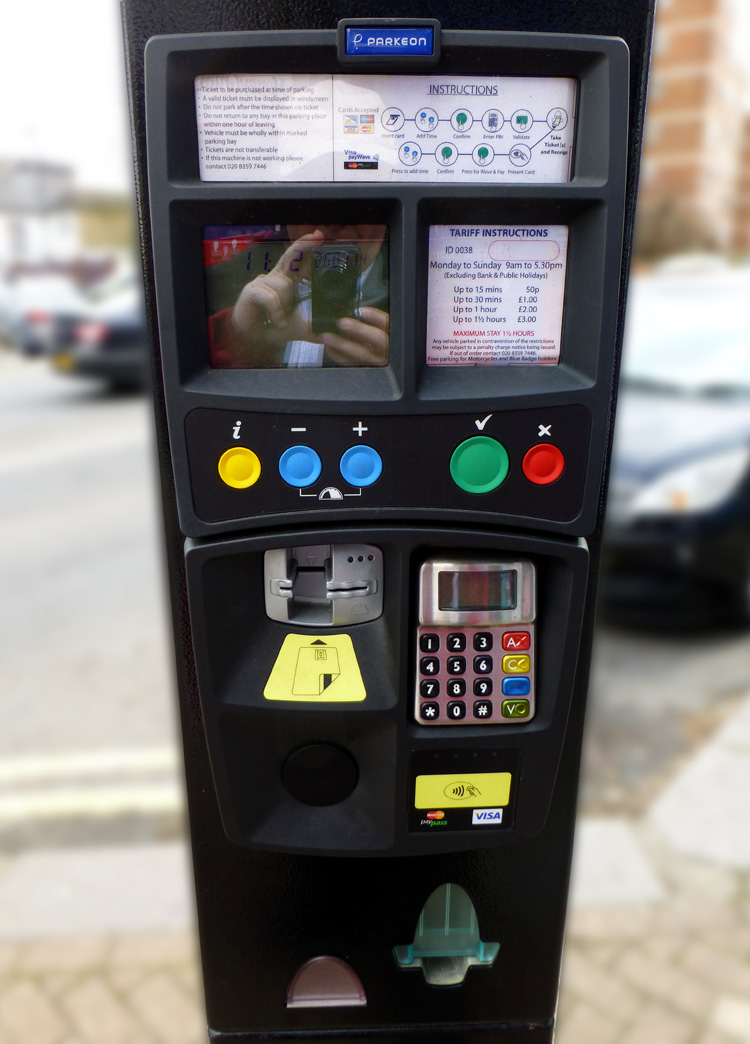 Pay & Display machine which only accepts payment by credit / debit cards. |
|||
Most of this web page was written incrementally between 2005 and 2010. The image above - right represents a 2014 update and has been added here because it shows a progression on the payment machines seen in the 1990's. The Telephone Payment Parking SystemIn recent years some towns and cities have started using cashless telephone-based payment systems which require motorists to telephone (or text) a central office and pay via a pre-arranged account, a 'plastic' card or the mobile phone telephone bill (the exact payment options may vary from one parking operator to another). To prevent violation the streets are still patrolled in the usual way, however as there are no visible displays (either next to or within the vehicle) proving that it is indeed parked legally the system is heavily reliant on the traffic wardens carrying portable electronic devices which are updated from the central server on a 'real time' basis. As ever there are both benefits and disbenefits. Perhaps one of the biggest benefits is that the operators of some schemes will allow people to buy extra time, which can be very useful if (for instance) a business meeting is running late or a plumber is making an emergency repair which is going to take half-an-hour longer than originally anticipated... Many people will also welcome the facility whereby they can receive automated text messages to their mobile phones advising them when there is a predetermined amount of 'paid time' left. Almost every will appreciate not having to face the issues of having sufficient coins with which to feed a parking meter or buy a 'pay & display' parking ticket - especially at locations where parking prices are so high that even if £2 coins are used a fair number (ie: 6 - 10 !) may be required to pay for the parking.Less welcome perhaps is that people without mobile phones and either plastic cards or pre-arranged parking contract (account) payment systems are usually unable to park (sometimes a public telephone will be nearby, but this cannot be relied upon). Furthermore, as it seems that the British systems tend to use 0870 revenue sharing 'non-geographic' telephone numbers which are always outside of mobile phone calling plans so the person making the call also has to pay extra for that call, and with these calls often include a number of minutes 'on hold' waiting for the next available person to answer so calls can become fairly expensive. (The word 'fleeced' come to mind). And then there are the service charges (ie: account fees and / or flat rate 'transaction fees') which some parking operators charge... - sometimes even every time a person parks their vehicle! From the parking operators point of view perhaps the most significant benefit is that it means that the cost of handling the physical money (coins) is taken out of the equation. Secondary benefits include that the lack of cash means that the costs of the street-based parking meters and / or 'pay & display' machines are avoided, as is the issue of loss of income from monies stolen from the street based machinery. Where available automated systems involving text messaging or voice recognition spoken systems can be very cheap to operate, although some people rate such systems as being very 'user unfriendly' and much prefer to speak with real human beings. Furthermore, in addition to the savings detailed above, the use of telephone systems actually creates a new revenue stream (ie; a 'nice little earner') for the local government operating the parking control system, with the newly sourced revenues coming by forcing people pay for parking via 0870 telephone code numbers which feature 'revenue sharing' and therefore can earn the parking control operator and / or the local council several pence a minute - even whilst the caller is 'on hold' waiting to speak with someone. Cynics would suggest that this alone is enough of an incentive for the parking control operators to make sure that there are never enough call centre staff to answer calls quickly. NB: Calls to 0845 telephone codes also often facilitate revenue sharing and whilst they are a little
less expensive to call it can be questioned whether they too are appropriate for *any* public service of *any* kind. However callers who also have Internet access also have the option of visiting
http://www.saynoto0870.com/ People who use telephone parking also need to remember that all these transactions also leave trails, so that Big Brother can record their every movement. However, in cities with large CCTV systems (ie: London) this is already the situation. As technology advances it is now often also possible to pay for parking on smartphones using mobile phone apps. This will avoid the potential hassle of making voice calls, but will only work if the person paying for the parking has a mobile internet connection or is within range of a free public wi-fi internet connection. Typically using apps will require the creation of an account with the parking operator. |
|||||
| |||||
Left: As the cover on the parking meter suggests, payment for parking is now made by telephone.
Centre: A road sign advising motorists of the parking restrictions in force at that parking bay, and the information required to pay by telephone. Right: Detailed information on how to pay for parking, which is located on the footpath-facing side of the pole seen in the centre image. The Blue Disc Parking System(Note that this is a totally different parking system than the Blue Badge system used here in Britain for people with severe mobility problems who have difficulty using public transport). Disc parking is only used in a few areas here in Britain, but over many years of European travel I've encountered many examples of this parking system. The concept is that the motorist displays a specialist parking card which features a 'dial' that can be turned to show the time (to the nearest half hour) when they arrived. They are then allowed to park for a preset time period, which typically will be 90 minutes - but the onus is on the people in the vehicle to check local signage. At one time there were regional variations in disc design, with some discs having two dials. With these discs one dial would show the approximate time of arrival (eg: 11-11.30am) and the other dial to show the time by which the vehicle had to have left the parking spot - typically this would be 1-1½ hours later (eg 12.30pm). However according to Wikipedia the EU has standardised parking discs so that nowadays they are all supposed to be the same, with just the one dial. In some areas the disks are given away free of charge, in others they are sold. The parking itself is normally free and the discs are fully transferable between vehicles - but obviously can only be used in one vehicle at a time. It is assumed that these discs are normally only valid in the location for which they are distributed, although in the 1960's and 1970's when on overseas family holidays in our motorhome I can recall us using discs from one town in another - and even comparing the times periods on the discs in our possession so that we could use whichever disc gave us the most favourable 'permitted parking' time periods! (we had two 'twin dial' discs). |
|||||
 |
|
 |
|||
| A Blue Disc zone in Basle, Switzerland. Note that the road markings delineating the parking bays are blue. | |||||
 |
|
 |
|||
| Parking disc sign in the London Borough of Havering. Disc parking was introduced to permit parking at locations where previously parking was prohibited during the day. The discs are (were?) sold and valid for one year. However the parking itself is free. | |
A Belgian 'blue zone' parking disc. The Flemish (Dutch), French and German message states that the arrow points to the time of arrival.
Image & license: Donar Reiskoffer / Wikipedia encyclopædia CC BY-SA 3.0 http://commons.wikimedia.org/wiki/File:Parkeerschijf.JPG. |
|||
The Voucher Parking SystemThis is a real nasty that could be said to encourage entrapment as it requires motorists to park and go shopping (ie: buy a parking voucher from a designated shop which they first have to find and could be several minutes walk away) and then rush back to their vehicle hopefully before the parking attendants arrive and give them a parking ticket (aka: a fine) for illegal parking. For the sake of an easy life some people will buy extra vouchers for the next time they visit this area (effectively giving the local council an interest-free cash advance); these vouchers must then be used before an expiry date otherwise the council will have received money for nothing. It wouldn't be so bad if there was a single nationwide Voucher Parking system, but unfortunately the opposite is the reality, so motorists who regularly visit different areas can also be caught out by using a voucher that is not valid where they are at that moment. The Voucher Parking system operates like a scratch card. To use them motorists must scratch over the sections for the day, date, time etc of arrival (not when they wish to leave) and display the voucher(s) from within the vehicle so that it / they can be seen by a parking attendant. Usually full instructions explaining how to use them, how many can be used at a time, how long a vehicle can stay in a parking bay etc., will be on the voucher. Of course, these must be used with care, as if a mistake is made (ie; the wrong date is displayed - a simple but common mistake) then the card is effectively voided. And the money wasted. Perhaps the only positive aspect of this system is that in areas of high street crime where the money in Pay & Display machines is frequently stolen the voucher system will remove a source of income from the thieves. A different form of parking voucher are the vouchers which are often used to allow guests to park in areas where residential parking is also controlled (see below). These vouchers are normally bought by the local residents from local council offices and sometimes there is a restriction in the number of such vouchers which a resident can buy in a calendar year. Normally this type of voucher can be used anywhere within the residential parking zone (ie: where the residents park their vehicles) and local signage would not specify the use of such vouchers. |
|||||
 |
|
 |
|||
| Parking voucher sign. This example comes from a residential area where local people will have parking permits and the vouchers allow non-residents to park, without the need for other payment systems which require street-based machines that create a financial risk for the parking operators. | |
Some parking vouchers. This image was filmed on S-VHS-C videotape in the mid 1990's in connection with the videotape upon which this website is based, and the larger clickable version will be a little fuzzy. More recently some of these local governments have stopped using prepaid parking vouchers. |
|||
Residential Parking ZoneIn addition to areas where the control is of visitor's vehicles there are places where the control is for local residents / local businesses visitors. One example of a location where this control is commonplace is near to railway stations where commuter parking is a problem. Often in such areas the locals have welcomed the creation of 'Residential Parking Zones' - if only because it reclaims the streets for their own vehicles. Depending on locality the parking restrictions in these zones might apply for just an hour or so during the day, or the whole day. The idea is that local residents (or local traders if the zone is for their benefit) pay an annual fee and display a special licence (usually personalised to the specific vehicle) in the windscreen. These licences will also be specific to a local area which can be just one street or a group of streets. Road markings and plates (either free standing or on street lamps) will indicate where parking is allowed, and for which zone. Sometimes there are also some spaces reserved for short stay visitors who can pay cash using either meters / pay and display, or must have first obtained parking disc or parking vouchers. However, most local governments will happily sell significantly more licences for their residential parking areas than there is space to park all the permit-holding vehicles - so often despite having paid some motorists cannot park legally. At least the local governments are honest enough to publically state that a licence is no more than a permit to park and does not guarantee that space will be available. (I wonder, how many other organisations, businesses, etc., can legally get away with selling a product that it warns may not be useable)?? What happened to the consumer protection legislation??? Some households have two (or more) cars; many local governments will only sell one licence per household so the extra cars must be parked elsewhere. Alternatively, the permit for the second vehicle will be available for a higher price. For short stay visitors some local governments allow residents to buy visitor permits; often on a daily basis. Often residents are restricted in how many such permits can be bought on an annual basis. Apart from the expected problems in transferring licences when a car is changed (sold / stolen / hire car whilst own vehicle is off the road for repairs etc.,) perhaps the most significant problem that this system has seen is what happens at boundaries - especially between different councils. In some areas the situation does arise whereby vehicles can only park on one side of the road because of this. Another problem is where local residents (who do not own cars) sell their right to a parking permit to someone else. They are not supposed to do this, but some do. Where the residents parking system fails is with people like plumbers, midwives making routine calls, appliance repair specialists (eg: washing machine) etc., who often do not know if their visit is going to last 10 minutes... or 3 hours. These people frequently receive tickets (or worse); they need to drive as their vehicles will carry important tools of their trade which cannot be transported any other way. It could be asked why these people should be penalised for trying to carry out their lawful daily toil? |
|||||
 |
|
 |
|||
| Information plate next to a controlled parking bay detailing when the parking restriction is enforced. Outside these hours anyone can normally park anywhere. | |
The scourge of a parking bay - a note advising that it will be closed for a while (in this case attached to hoarding protecting the refurbishment of a building). Since extra alternative facilities are not normally provided such closures only serve to exasperate an (often) already difficult situation caused by the normal unfavourable imbalance between numbers of permitted vehicles and sufficient parking spaces for them all. |
|||
 |
|
 |
|||
Sign at the entry (left) and exit (right) of a residential parking area. Such zones often have code letters so that vehicles with permits for one zone cannot be parked in a neighbouring zone,
even if it is within the same local government boundary.
CombinationsAs these images show, at some locations two / several parking systems operate in the same area. Business permit schemes are usually to allow local businesses to park their vehicles at least 'reasonably' close to the premises. However, as with residential parking systems the purchase of a parking permit only allows vehicles to park 'if space is available' - it does not guarantee that spaces *will* be available. |
|||||
 |
|
 |
|||
| Lower part of sign at the start of a combined 'Pay & Display' plus 'permit holders' parking area. | |
Sign next to parking bays indicating that they are for either 'Pay & Display' or 'business parking permit' holders. | |||


Privatised ParkingIn London (and some provincial towns & cities) parking has been privatised, which means that instead of the police (and traffic wardens) patrolling the streets and giving out 'fines' for illegal parking (parking tickets) the local council has taken the responsibility upon itself. Typically the job of patrolling the streets will then be subcontracted out to private companies, whose employees are often known as 'parking attendants'. These attendants can also issue tickets for other motoring offences, such as not having an up to date tax disc, stopping on a pedestrian crossing or the "zig-zag" road marking either side of the crossing, and more... Effectively this means that on-street parking control and supervision has been placed under the jurisdiction of commercial organisations and cash starved local councils which have vested interests in rasing as much money as possible by issuing as many tickets as possible - and although there are supposed to be codes of conduct (aka: rules of engagement) the reality is that most road users feel that war has been declared - and they are the enemy. The main reason for the privatisation of parking control was that the existing 'yellow line' parking control system was so very badly policed that many motorists just ignored it and parked where they liked. And, even if (in the unlikely event) they did get a parking ticket they would ignore that too as the chances of any follow-up action for non-payment was very slim. Privatisation also saw a shake-up of the fines procedure; the 'parking tickets' issued under the privatised system are no longer seen as criminal offences and have been renamed 'Penalty Charge Notices' (PCN); if paid within 14 days there is a 50% discount whilst if unpaid after 60 days there is a 50% surcharge. If still unpaid bailiffs can be sent in - by which time things can become seriously expensive. So far so good...
But It Isn't Just The Parking Attendants Who Need Watching...
Once a police officer even arrested a parking attendant for 'obstruction' when the attendant gave an illegally parked vehicle (near Buckingham Palace) a PCN. Funny though, despite much media coverage when it happened the newspapers were much more muted when it came to a follow-on explaining why the parking attendant was arrested. Instead, it seems some sort of behind the scenes settlement was struck. Where the parking system really falls down is in its lack of respect for the various business and utility services on which we all depend. And we all end up paying - plumbers, for instance, regularly get tickets and all they can do is charge their customers more (ie: you and me) and treat the fines as an 'expense' to be offset against their tax bills. These people carry the tools of their trade with them, they must both drive and park very close to where they are working.
Nor Just Local Councils Or The Wheelclampers...Of course it would be wrong to suggest that all parking attendants and 'officialdom' are devils whilst all motorists are angels:-
In March 2005 it was announced that to reduce the number of incorrect parking tickets its privatised parking attendants are issuing the Central London local government Westminster City Council would be giving all its parking attendants new computerised PCN issuing equipment which will be programmed with the restrictions in force on the roads being patrolled. So, if a roads's parking restrictions begin at 8.30am then it will not be possible to issue a ticket at 8.29am. The machine will not allow it. Furthermore, every parking offence will be photographed so that if a motorist complains that the ticket was incorrect, or their vehicle was not there at the time, (etc) the photograph can be used to clarify the situation - and help prove guilt / innocence. These actions are being carried out as part of a 'motorists charter' which also includes new investments designed to speed up the complaints procedure so that complaints will be handled within just 5 working days - instead of the 18 working days when the investment was announced. |


 For people who want to dispute a PCN new tribunals have been set up, and sometimes these tribunals even agree with them and cancels the PCN.
But, as the appeals procedure is somewhat slow any appellant who loses also misses out on the chance of taking the 50% discount for speedy payment. As a result many people find
it to be cheaper (and easier) to just pay up. (Note that this only applies to PCN's, and not parking tickets issued by the police which are still dealt with in magistrates courts).
For people who want to dispute a PCN new tribunals have been set up, and sometimes these tribunals even agree with them and cancels the PCN.
But, as the appeals procedure is somewhat slow any appellant who loses also misses out on the chance of taking the 50% discount for speedy payment. As a result many people find
it to be cheaper (and easier) to just pay up. (Note that this only applies to PCN's, and not parking tickets issued by the police which are still dealt with in magistrates courts).The situation is different with private car parks, some of which may look like local council facilities but are not, whilst others can include supermarket
car parks and what looks like unused land next to shops which are not car parks as such but enable people to park off the main highway. |
||
 |
 |
 |
| Typical signage as installed by parking management companies or the organisations which employ them. Legal note: NONE of the comments here refer to any specific organisation whose name may or may not be visible in any of these images. |
||
Parking Confusion
Because each of London's 33 local councils controls parking within their respective areas it often happens that rules and regulations differ. This can and does cause confusion to both Londoners and visitors alike who may not realise that this is the situation and / or may read the local road signs incorrectly (if, that is, the signs exist in the first place). The situation can be even worse at local government boundaries where vehicles parked just yards apart can be subject to very different regulations - especially where the boundary is along the centre of a road - so that different sides of the road have different parking zone restrictions. This is very much a problem for local people in areas where there are residents parking zones and as a result they can only park on 'their' side of the road.
On a wider scale the confusion extends city-wide, with some people questioning whether the numerous zones could not be amalgamated into one, which would set consistent standards. The principle objections to this would come from the 33 local councils which would lose a very lucrative revenue stream. In addition people who live in areas where the local government is not deemed to be "anti-car" would object to a change of the system if it resulted in stiffer restrictions being introduced where they live.
Public Holiday ConfusionOne example of what can happen when neighbouring boroughs adopt different parking regulations comes from the winter holidays 2004/5 when New Year's day was on a Saturday, but the official public holiday was on the following Monday. Some local councils enforced Saturday - style parking restrictions, whilst others enforced the much more lenient public holiday restrictions. In London Westminster City Council was one of the areas which enforced Saturday restrictions and its traffic wardens issued over 3,000 parking tickets worth about £180,000 in fines. Many vehicles were also towed away (stinging them for a £150 extra charge) and / or wheel clamped (the unclamp fee being an extra £65). Apparently in Westminster the roadside signs advise motorists that parking restrictions are not enforced on public holidays (so on-street parking is free plus it is permitted to park on single yellow lines) and being New Years Day most people believed that it was a public holiday. In this instance, and after much media criticism most parking tickets were cancelled (only those which would still have been issued on a public holiday still stand) and people who bought pay & display parking (and still have the receipts) were able to apply for a refund. However nothing will repay the inconvenience and time theft caused to many innocent road users whilst waiting for their vehicles to be unclamped or when retrieving their vehicles from the tow-away car pound. The above situation was in part caused by government departments wrangling over the status of Saturdays when they would normally be public holidays. As with some of the other information on this page this was sourced from news reports in the London Evening Standard newspaper and their website
http://www.standard.co.uk/news/transport |

Many Dozens Of Local Governments Slammed For Grabbing Illegal Parking Fines
In May 2008 it was revealed that despite having been told by the national parking adjudicator that their tickets did not comply with the law many dozens (at least 80, possibly more) local councils nationwide were continuing to issue illegal parking tickets.
Apparently a High Court ruling suggests that the law requires parking tickets (penalty charge notices [PCN] as they are officially called) to show both the date when the document was issued and the date when the offence took place. However, many have not been showing both of these pieces of information, so therefore are illegal. Whilst this may seem to be a very pedantic and somewhat inflexible technical detail it is no more or less so than the inflexible way in which parking regulations are enforced and these PCN's are all too frequently issued.
The Department for Transport has advised councils to "seriously consider" contacting motorists and reimbursing any fines that were illegally imposed. Whether this advice is being followed is not known.
A Catalogue of Serious Errors
But it is not just illegal PCN's that these local councils have been peddling / involved in. It seems that some local councils have been fining motorists for illegal parking even though their road markings were illegal and, in some cases, where parking bays were so narrow that a family car of normal width would need to park partially on the footpath to fit inside them. In London footpath parking is in itself illegal, except where signs expressly allow it. Some councils have been fining the wrong person, as the law states that the vehicle's owner and not the driver is liable to pay the fine.
Breaching The 1689 Bill Of Rights
District Auditor Investigations Of False Accounting!
There have been instances of local councils setting up Controlled Parking Zones around their city centre but failing to enact a Controlled Parking Zone Order to give the zone legal status. The significance of this is that some acts of Parliament, including the 1689 Bill of Rights, have primacy over other legislation, unless the measures of the previous acts are specifically repealed. According to the Bill of Rights, British citizens cannot be fined if they have not been convicted in a court of law. Parking fines do not usually include an option to go to court, so if the legislation of 1689 has not been specifically repealed this makes the parking fines illegal. Side effects of this include that a council's accounts cannot be formally approved if they contain unlawful items of income and that the council could then find itself charged with false accounting, which is such a serious offence that a District Auditor would probably have to carry out a formal investigation in to the council's actions and finances. Most people would expect this to possibly result in vehicle owners / drivers people who were fined having to be repaid, but it could also see traders whose businesses were affected adversely by the parking regulations possibly being able to withhold their business rates or begin a class action against the council! If evidence of an intent to defraud the public was found there could also be personal repercussions against individual councillors and or council officials.
The 'Red Routes'
In the late 1980's the government wanted to build a lot more high-capacity roads through heavily built-up residential areas of London, and there was so much very vociferous opposition that it reappraised its plans.
Instead the idea was hatched that a network of existing roads would be designated for a far higher standard of parking control with the aim of speeding up the traffic flow. This switched the focus of the vociferous anti-road widening lobby to the fear that their local roads would become urban racetracks, attracting more and faster through traffic to the detriment of local people. So, to help 'sell' the concept to these anti-roads protestors it was decided to put in extra bus priority measures (especially bus lanes, but not traffic signal pre-emption) and install speed cameras - even though when they were introduced the public were told that speed cameras would be restricted to accident blackspots - and not as a 'general catch all'.
The original philosophy behind the red routes was that roads should only be for moving or live vehicles and therefore parked or dead vehicles should be banished elsewhere. To achieve this the planners wanted to create a lot more off street parking facilities, but because it would have meant knocking down many buildings (which would have resulted in another public outcry) the concept was amended so that on-street parking (and loading) would still be permitted, albeit only within designated parking bays at designated times which varied according to location and even resulted in the creation of some free (either time-limited or completely unrestricted) parking spaces where none had previously existed.
|
|
|
 |
|
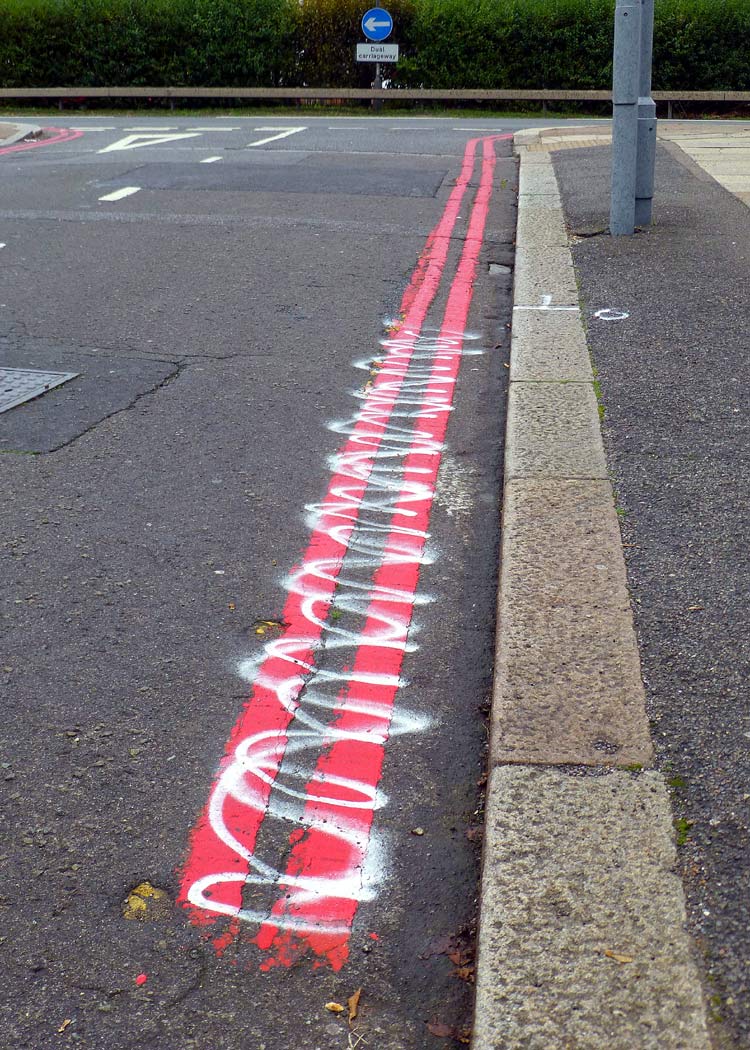 |
| Where the 'normal' and red route parking restrictions meet - double red and double yellow lines in the road gutter. | |
Partially crossed out red route markings on a residential side road along which many vehicles are normally parked. The markings were crossed out on both sides of the road.
This suggests that the parking restriction had been implemented too zealously and that there is no reason to prohibit vehicles from parking here. Photographed in November 2014. |
The red routes differ from ordinary roads in several ways. The most obvious one is that the lines painted in the gutter are red - and not yellow! On these roads the rules are very harsh and unforgiving - stopping is strictly prohibited except where road markings / plates on street lamp columns expressly state otherwise - this even applies to stopping to let someone enter or alight from a car. The use of CCTV cameras to enforce these rules means that violators frequently receive penalty charge notices in the letter post. Typically these fines are higher than parking infringement fines on other roads. (Stopping at red traffic signals / when told to by a police constable in uniform / in traffic jams / after having an accident is just about all that is allowed - even vehicles which have broken down are sometimes ticketed, unless the CCTV operatives see an attendance by a recognised breakdown service vehicle or something such as a flat tyre being changed). |
||
 |
|
 |
| Road sign on a Red Route where the road is painted with double red lines. | |
Red route regulations are so prescriptive (and so draconian) that special signs are required at bus stops giving the buses permission to stop there - although these also double-up as reminders to the drivers of other vehicles that they should NOT stop there.
Outside hospitals similar signs are sometimes used for on-street parking bays for ambulances. |
 |
|
 |
| Red Route road sign for a section of road where free (albeit time-limited) parking is allowed. At a few locations the parking is totally unrestricted. | |
Red route sign for combined loading bay / disabled parking space. In some locations where the loading bays are 'on street' the restrictions reflect the tidal directions of the peak traffic flows, which means 7am-1pm on London-bound side of the road and 1pm-7pm on the opposite side of the road. |
In an attempt to stop unauthorised use, often as ‘avatars’ on web-based discussion sites, many of the above red route images have been watermarked. However, as these are public domain road signs and as this website has benefited tremendously from other people’s images so in the spirit of fairness full-size unedited copies of the master images have been placed on the free online ‘Wikipedia’ encyclopædia so that people can download them from there - rather than pinch (which includes hot-linking) from this website and using my paid-for bandwidth. They were placed in this directory... http://commons.wikimedia.org/wiki/Category:Road_signs_in_the_United_Kingdom .Two initial red routes were chosen, one of which was the A13 through East London. Within months shopkeepers along the inner London section of this route found that although the red routes introduced draconian restrictions during the rush hours the new off peak 'short stay' free parking spaces gave them a commercial advantage over rival traders along the parallel A11, which kept its yellow lines. The other route in the red route pilot scheme was the A1 through inner North London. This included the Archway Road, part of which is a three lane dual-carriageway which suddenly ends and becomes a narrow road with shops and houses on either side. This is the road that the government had wanted to widen, against much vociferous opposition. Incidentally, that road widening scheme would have cost billions and it's a pity the government lacked any enthusiasm to balance such expenditure by spending similar sums on London's railways. Parallel to the narrow section of Archway Road is a section of railway that in 1940 was partially electrified as London Underground's Northern Line - even appearing on the famous Underground Map as lines being electrified but - in 1954 and with much of the work completed (having been suspended in 1941 because of the war) the whole line was closed (in favour of buses) on the feeble excuse of a shortage of coal for the steam engines that were then operating there. Nowadays part of this line has become a parkland walkway which may be very pleasant to walk through but does nothing to solve London's transport woes. To further give the impression that the A1 red route scheme was not just about speeding up car traffic but would also be good for public transport a new rush-hours only 'express' bus service was introduced (the X43). London Transport Buses bought a fleet of brand new specially decorated double decker buses (cost £100,000 each) many of which made just one journey per rush hour and returned to the depôt empty. (In those days LT was still publically owned so did not have to justify the cost of the new buses like a 'private' company). At the same time an existing bus route (279) was shortened so that it would no longer parallel the route 43. If that was not enough a very busy underground station along the red route (Angel) was also closed for rebuilding. Together these factors ensured that when a traffic survey was conducted the results showed that the introduction of the red route had coincided with a healthy increase in bus patronage. After a couple of years a survey was conducted by the Transport Research Laboratory which found that the A1 red route had led to a 17% reduction in road accidents which involved personal injury, bus journey reliability had improved by 33% and journey times had reduced by 10% - in fact all classes of road traffic enjoyed faster journeys. Furthermore, it suggested that the cost of implementation would be recouped within two years. |
||
 |
|
 |
| Archway Road: A 3 lane dual carriageway that changes into a narrow urban road lined with shops and residential properties. | |
Archway Road: 4.35pm and despite the lack of congestion the parking restrictions are already in force, backed by a police tow-away vehicle. |
 |
|
 |
| Crouch End station in 1994. In 1936 electrification works were began to extend Northern Line UndergrounD trains through this station and on to Alexandra Palace. Work stopped during the war and never restarted.
Restoration of rail services would have helped to alleviate congestion on the roads, as an alternative to unpopular road widening. |
|
The X43 shows its true colours! My camcorder catches a specimen off-route outside Kings Cross Station with its destination blind revealing all - Rail Replacement Service. |
Since their introduction the red routes have spread all over London and in 2003 began to be used in the West Midlands as well. Sometimes their introduction was locally unpopular, especially where residential and shopping streets were involved. Attempts to stop their spread included action in court, but because the principle of the red routes was enacted via the national government as an Act of Parliament calls for judicial reviews and other court actions were doomed from the outset and the resulting court fees have been so large that some of the people involved subsequently faced personal ruin, even bankruptcy. In most areas however the red route restrictions were accepted without significant fuss - albeit with an attitude of dejected resignation and feelings of injustice over the lack of local democratic accountability over the issue.
Some of the roads which have been converted to red routes were already clearways where illegal parking was already a criminal offence which attracted penalty points on a driver's license. Converting these roads to red route clearways may have been tidy in the urban planners' book but surely the money could have been better spent elsewhere? As with ordinary clearways the red route variant replaces the painting of lines in the gutter with frequent reminder signs along the length of the carriageway.
The stated aim of the red routes has also evolved to become more passenger transport orientated with improving road safety and speeding the movement of people and goods (ie: not vehicles) being seen as more important. Buses of course carry more people than cars, so they are treated as 'sort of' priority vehicles.
A London survey in 1997 which compared some other, more recent, red routes with their previous 'yellow line' status of 1994 found that journey time reliability improved by 10% - with all traffic benefiting - and illegal parking virtually halved, which the survey attributed to the introduction of some free short term parking and loading spaces.
Direct links to other topics within the theme...
Return to Main Roads page.
 |
|
|
|
|
|
|
|
|
|
|
|
|
|
|
|
|
|
|
|
|
|
|
|
|
|
|
|
|
|
|
|
|
|
|
|
|
|
|
|
|
|
|
|
|
|
|
|
|
|
|
|
|
|
 |
|
||||||||||||||||||||||||||||||||||||||||||||||||||||
 |
 |
 |
 |
 |
 |
 |
 |
|
|||||||||||||||||||||||||||||||||||||||||||||
 |
 |
 |
|
||||||||||||||||||||||||||||||||||||||||||||||||||
 |
 |
 |
|
||||||||||||||||||||||||||||||||||||||||||||||||||
 |
 |
 |
 |
 |
 |
|
|||||||||||||||||||||||||||||||||||||||||||||||
 |
 |
|
|||||||||||||||||||||||||||||||||||||||||||||||||||
 |
 |
 |
|
||||||||||||||||||||||||||||||||||||||||||||||||||
 |
 |
|
|||||||||||||||||||||||||||||||||||||||||||||||||||
 |
 |
|
|||||||||||||||||||||||||||||||||||||||||||||||||||
 |
|
||||||||||||||||||||||||||||||||||||||||||||||||||||
 |
 |
 |
|
||||||||||||||||||||||||||||||||||||||||||||||||||
 |
 |
|
|||||||||||||||||||||||||||||||||||||||||||||||||||
 |
 |
 |
|
||||||||||||||||||||||||||||||||||||||||||||||||||
 |
|
||||||||||||||||||||||||||||||||||||||||||||||||||||
 |
 |
|
|||||||||||||||||||||||||||||||||||||||||||||||||||
 |
 |
 |
|
||||||||||||||||||||||||||||||||||||||||||||||||||
 |
 |
 |
|
||||||||||||||||||||||||||||||||||||||||||||||||||
 |
 |
 |
|
||||||||||||||||||||||||||||||||||||||||||||||||||
 |
 |
 |
|
||||||||||||||||||||||||||||||||||||||||||||||||||
 |
|
||||||||||||||||||||||||||||||||||||||||||||||||||||
 |
 |
 |
|
||||||||||||||||||||||||||||||||||||||||||||||||||
 |
|
||||||||||||||||||||||||||||||||||||||||||||||||||||
 |
|
||||||||||||||||||||||||||||||||||||||||||||||||||||
 |
|
||||||||||||||||||||||||||||||||||||||||||||||||||||
 |
 |
 |
|
||||||||||||||||||||||||||||||||||||||||||||||||||
 |
 |
 |
|
||||||||||||||||||||||||||||||||||||||||||||||||||
 |
|
||||||||||||||||||||||||||||||||||||||||||||||||||||
 |
 |
 |
 |
 |
 |
|
|||||||||||||||||||||||||||||||||||||||||||||||
 |
 |
 |
|
||||||||||||||||||||||||||||||||||||||||||||||||||
 |
|
||||||||||||||||||||||||||||||||||||||||||||||||||||
 |
 |
 |
|
||||||||||||||||||||||||||||||||||||||||||||||||||
 |
 |
|
|||||||||||||||||||||||||||||||||||||||||||||||||||
 |
 |
 |
|
||||||||||||||||||||||||||||||||||||||||||||||||||
 |
|
||||||||||||||||||||||||||||||||||||||||||||||||||||
 |
 |
 |
|
||||||||||||||||||||||||||||||||||||||||||||||||||
 |
|
||||||||||||||||||||||||||||||||||||||||||||||||||||
 |
|
||||||||||||||||||||||||||||||||||||||||||||||||||||
 |
 |
 |
|
||||||||||||||||||||||||||||||||||||||||||||||||||
 |
|
||||||||||||||||||||||||||||||||||||||||||||||||||||
 |
 |
 |
 |
 |
 |
|
|||||||||||||||||||||||||||||||||||||||||||||||
 |
|
||||||||||||||||||||||||||||||||||||||||||||||||||||
 |
|
||||||||||||||||||||||||||||||||||||||||||||||||||||
 |
|
||||||||||||||||||||||||||||||||||||||||||||||||||||
 |
 |
|
|||||||||||||||||||||||||||||||||||||||||||||||||||
 |
 |
 |
|
||||||||||||||||||||||||||||||||||||||||||||||||||
 |
|
||||||||||||||||||||||||||||||||||||||||||||||||||||
 |
|
||||||||||||||||||||||||||||||||||||||||||||||||||||
E & OE.
© Copyright 2001 - 2026 Simon P Smiler and named image sources.
Privacy Policy
 >
>