Passenger Train Variations
A series of pages which look at different types of passenger trains
as defined by the type of service they are designed to provide.
Long Distance InterCity Trains looks at trains which are designed for InterCity express journeys with journey times usually in excess of 45 minutes and possibly lasting for many hours. This includes super-fast very high speed trains and tilting trains.
Medium Distance Trains looks at different types of trains that provide medium distance services, typically with journey times of between 30 and 90 minutes in duration, but sometimes longer too.
Short Distance Trains looks at trains designed for journeys of anything from less than a minute up to about 45 minutes within urban areas and their close hinterland. These trains could be operated by either a mainline railway company or a city-specific regional transport authority. Included within this remit are Automated 'Driverless' Metro Systems and Trams, Streetcars and Light Rail Vehicles; however to avoid making a very large page the latter two topics have their own dedicated pages.
"Walk-through" Trains looks at the need to be able to walk from carriage to carriage along an entire train's length, this being an aspect of train design where practical day-to-day passenger requirements are often compromised.
On-train Refreshment Facilities, Double-Deck Trains, & Taking Bicycles On Trains looks at three specific aspects of railway operation which transcends all the other categories as described above.
Navigating through this website is easier with the navigator frame which should be to the left of this window. If it is not there then click here to turn it on! Alternatively there is a system map at the foot of this page.
More information about this website & why it was created can be found by visiting this website's "front" pages (link opens in a new window)
 .
.
Short Distance Trains
As of January 2026 this page is being updated ... still a work in progress.
These trains would normally be designed for short journeys of anything from less than a minute (ie: the next station) up to about 45 minutes. Often such journeys will either be within urban areas and their close hinterland - or between a rural area (village / small town) and a larger town or small city.
For urban travel high capacity will usually be the criteria rather than high comfort, with the train's insides being designed along the theme of cramming in as many people as possible. In some countries the seats will be bare metal, wood or plastic, however here in the UK trains tend to have fabric covered seats - with minimal padding below the fabric.
If there is also a desire to maximise seating capacity then this will usually mean the 3+2 high density format of seating, where there are 3 seats on one side and 2 on the other side of a central gangway which typically extends along the length of the carriage. On trains which are wide enough the seating may even be in 3+3 format.
Alternatively some train operators use 2+2 seating (or even longitudinal seating) because it makes extra space for standing passengers. Indeed, especially in the rush hours there will not always be enough seating for every passenger so some passengers will expect to have to stand for all or part of their journey.
A few urban train operators even include carriages which do not provide any seating at all. Primarily this is in Asia, and only part of the train has such carriages.
As with all rail services these trains will vary in length according to city size, expected passenger flows etc., with longer trains for the busiest routes in bigger cities and shorter trains for quieter routes or smaller cities. Where the infrastructure permits (tunnels are large enough, over-bridges not too low, etc.,) some transport operators use double-deck trains, as these can carry far more passengers in a given train length and reduce the need for longer trains (and longer platforms which can be expensive to construct). Very few lines in Britain are suitable for double-deck trains and those which are suitable are generally not the busiest - so do not need them. Unfortunately the lines which suffer the most severe overcrowding (mostly commuter routes into south London) are not suitable for them.
For rural / regional services some passengers will be happy with airline style seating whilst others will prefer 2+2 seating around tables. Not everyone likes sharing table space with people they do not know.
Typically short distance trains on urban services are not equipped with toilets, buffets or other 'niceties' found on longer distance trains - however there are exceptions to this rule.
 |
|
|
|||
|
There was a time when most British train seating was fully upholstered, with metal springs and soft padding. Even for local 'all stations' trains it was known that ample and comfortable seating attracted passengers. However, as times changed the degree of seat comfort has been reduced and especially since railway privatisation - when the Department For Transport civil servants started specifying train types, seat types and passenger capacities - train seats stopped being about comfort and indeed some newer types of train have become known for being actively uncomfortable. | |||||
 |
|
 |
|||
| A typical train compartment - a hand operated (swing) door at each end and two rows of full-width bench seats for five passengers. This is a Southern Railway 100 seater carriage which has 10 compartments per carriage, each of which can seat 10 passengers (five a side). They were for passengers travelling third class. Filmed at the Bluebell Railway in 2003. |
|
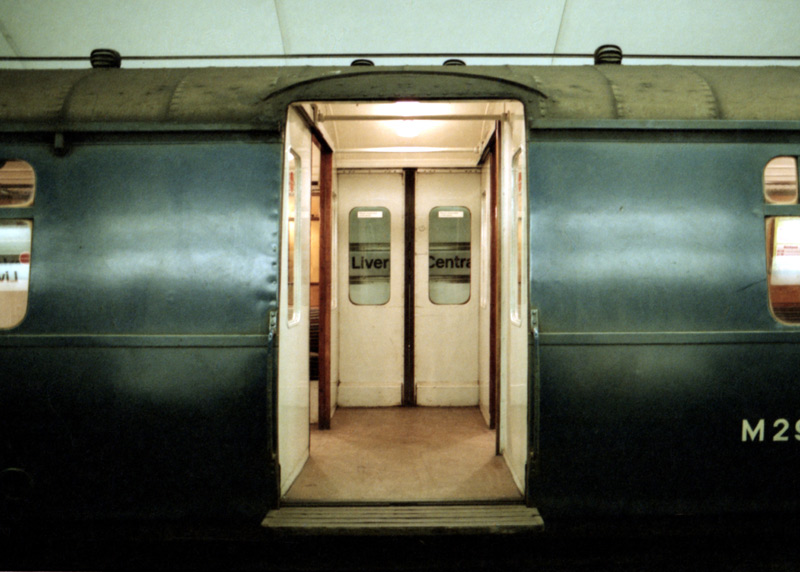
Circulating area between the doors on a train with power operated sliding doors. This is one of the trains built by the London Midland & Scottish Railway (LMS) in the late 1930s for use over some of the third rail electrified routes in the Merseyside (Liverpool, etc.,) area. Later it became known as Class 503. Filmed at Liverpool Central in 1980. |
|||
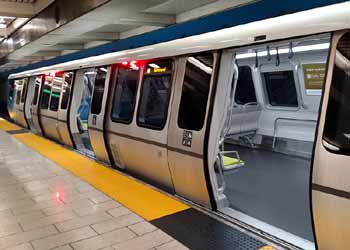
For urban and suburban travel where there are many stations in close proximity to each other three or even four sets of doors per train side are a requirement. |
|||||
 |
|
 |
|||
| When the San Francisco BART replaced its fleet in the mid-2020s it decided that to reduce station dwell times the new trains should have three sets of sliding doors on eash side. However the tactile platform edge still only shows the locations of two sets of doors. | |
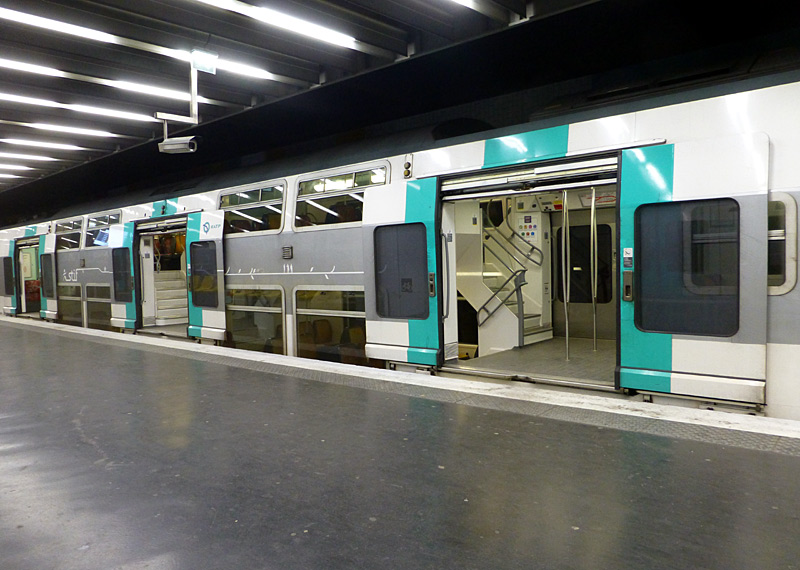
Double-deck trains very rarely have three sets of sliding doors per carriage, however such trains do exist - this example in on a high-capacity RER train in Paris, France. More information and photographs can be found on the page of this website that looks at double-deck trains. | |||
These multi-tasking trains link outer-suburban destinations around Paris on exceptionally busy routes that also pass through the inner suburbs and city centre. At the busiest times these routes could be carrying as many as 60,000 passengers an hour, per direction. |
|||||
|
To allow for passengers to exit from / enter the entire train double deck trains often require longer station dwell times than single deck trains. When compared to trains formed of solely single deck rolling stock this can reduce overall train throughput, which means that there will be fewer trains per hour on that section of track. This may not matter however if there are other constraints on train frequency, such as the overall size of the fleet of trains or that the signalling system restricts how many trains can pass through the area in a given amount of time. For outer suburban and even regional services two sets of doors will often suffice - especially on routes with fewer stations and more journey time is spent travelling between the stations. Usually the doors will be spread out along the side of the coaches, at ⅓ and ⅔ or at ¼ and ¾ positions. Many British trains have their doors at the 'thirds' positions although some passengers claim that the 'quarters' positions are better - because then all passengers will be no more than a quarter of the carriage length from a doorway. Doors at coach ends is only really suitable for longer-distance trains that call at comparatively few stations. Whilst station stop dwell times will be longer (especially at busy stations) their advantage is that passengers will usually find them more comfortable / less draughty - this also depends on whether the seats themselves are comfortable (alas, not always) and the heating and ventilation system within the carriage are working optimally.. Typically doorways with two leaves that open in opposite directions will be faster to open and create wider openings than single-leaf doorways - although the width of the individual doors is also a factor here. For the fastest passenger flow the opening needs to be wide enough to allow several passengers to pass through (side by side) at the same time - perhaps then with them walking in different directions so that they do not get in each others way. Obviously doorways used by 'personal wheeled transport'. (PWT) passengers (wheelchairs, rollaters, pushchairs / buggies / strollers) need to be wide enough for the PWT device. This does not rule out single-leaf doorways, if the doors are wide enough. |
|||||
 |
|
 |
|||
| These 'inner-suburban' trains operate in the Birmingham and Manchester areas. Manchester version shown. |
|||||
 |
|
 |
|||
'Inner-suburban' trains similar to this used to operate on services in Glasgow, Liverpool, London, Hertfordshire and south coast areas.
The train shown in the three pairs of pictures above were designed by the former British Railways and except perhaps for the liveries (paint / colour) when introduced into service were more or less identical nationwide (within the type of train). However, following railway privatisation the various train operating companies repainted their variants in a range of different liveries and in some cases have also refurbished them so that they look different and / or feature different types of seating - typically 'more comfortable' high back seating. Nowadays virtually all British trains* feature power operated doors that are controlled by either a guard or driver. Even if the trains also feature passenger operated 'open' and 'close' buttons the train driver or guard will still (usually) have the ultimate control. *(except historic trains on museum railways).A specific problem often faced by trains with power operated doors is that rather than spread out evenly throughout the carriage many passengers congregate in the doorway, which at stations blocks access to the rest of the carriage and extends the time it takes passengers to board and alight (ie; the 'dwell' time). A solution which has been adopted on some trains is to redesign the entrance area inside the train to create a larger circulating space just inside the doorway. Sometimes this involves removing seats and making a space that is setback from the doors, other times it sees transverse seats replaced with longitudinal seating - which also makes more space for standing passengers. |
|||||
 |
|
 |
|||
| Various solutions designed to discourage passengers from standing just inside the doorways and effectively blocking access to the rest of the carriage. Note the 'bum rests' in the set-back area. |
|||||
 |
|
 |
|||
| Sometimes the set-back area can also be used as a 'flexible space' for passengers with special requirements, such as personal wheeled transport or carrying heavy luggage. |
|||||
 |
|
 |
|||
| In 2009 some fully airconditioned trains were introduced in London with a fully 'walk-through' design and solely longitudinal seating; this seating layout was chosen because it creates more space for standing passengers. The image on the left was taken immediately after everyone had left the train at its end of line - which explains why it was possible to source a view of an almost empty train. Note the fixed arm rests which dictate how much seating space passengers may take (and prevent people from laying down), the draught-screens, the folding seats which create a shared space for 'personal wheeled transports' and the otherwise ordinary seat (opposite) which is in a different colour moquette to identify it as being a priority seat. Plus the discarded free newspapers which some passengers often like to read. The image on the right shows a typical 'shoulder of rush hour' view - at the busiest times the trains become even more crowded. Indeed, at one specific station the rush hour crowds are such that two Japanese-style platform staff 'packers' are required to 'help' everyone squeeze aboard. Some of the routes served by these trains were first electrified in the 1920's, using trains which at the time were noted for being the most comfortable urban trains in London. Many passengers would suggest that these new trains represent the opposite end of the transport spectrum and ponder whether there is a connection with the new trains having fewer carriages (just 4) than some of the services did when using the 1920's trains (3 at quiet times and 6 at busy times). |
|||||
 |
|
 |
|||
| Prior to the introduction of the new trains as described above a solution which had been adopted to create more standing space within the train as well as make space for 'personal wheeled transports' was the removal of some seats, including reducing the seating layout from high density 3+2 to 2+2. This sign explains it all. | |
Some trains locate litter bins between the seats, as seen here. However, as seen on the next seating bay this does not stop passengers from discarding used newspapers by leaving them laying around / on the seats. | |||
A Look Outside Of The UKThe Dublin Area Rapid Transit (DART) provides a suburban service linking coastal communities to the north and south of the city via a route which skirts just to the east of the cities' central business district. Essentially DART is an electrification and high-profile rebranding of existing diesel rail services, DART trains share tracks shared with other Irish longer-distance regional and Inter-City services. For this reason they use the 5ft 3in (1,600 mm) Irish track gauge. DART trains are electrified at 1,500v DC via overhead wires and along with the LUAS trams (also in Dublin) are the only electric trains in Ireland. Servicies are operated as four, six or eight car trains. There are several generations of rolling stock and with network expansion in mind more trains are expected in the the near future - with some (all?) also being fitted with batteries so that they can also travel over non-electrified sections of railway. Some DART trains were built with excellent real-time passenger displays in the form of LED light route describers where green indicated the route which had already been travelled, orange the route expected to be followed, solid red the train's destination station and flashing red the next station. Unfortunately they were deactivated in 2010 - it is noteworthy that this is the same year as when a new DART station was opened and its possible that the information displays were deactivated instead of being updated. Nowadays liquid crystal LCD displays should be easier to update to network changes. Much of the route of the DART is close to the coast and is noted for being very scenic, with the southern section offering fine views of sailboats, islands, the granite walls protecting the tracks from the sea (especially noteworthy at high tide) and the northern section being popular for dramatic cliff walks, lighthouse, and harbour views. Seapointis noted for being an attractive historic station and an area with much coastal charm and the area near to Killiney Hill station for panoramas of Dublin Bay and the city. |
|||||
 |
|
 |
|||
| Dublin Area Rapid Transit (DART) train. | |
DART train LED route describer, as detailed in text above. Clicking the image will display a larger version in a new window. |
|||
In Australia urban rail services (where they exist) are operated regionally, based on the various State Capitals - Perth, Western Australia (WA); Melbourne, Victoria (Vic); Brisbane, Queensland (Qld); Sydney, New South Wales (NSW) and Adelaide, South Australia (SA) which have electric urban systems. Melbourne, Adelaide and Sydney also have electric tram systems. Melbourne started electrifing its urban railway in 1919, Sydney in 1926. Both cities chose 1500v DC, which was very much a well-proven accepted technology in those days. Brisbane started in 1979 and Perth in 1992. Adelaide was somewhat late at only getting electric urban trains in 2014 - and even then only on some routes. These three cities electrified at the present-day international standard, which is 25 kV AC. In addition to different power supply voltages, Australia has to contend with different track gauges. However this does not affect any urban / suburban rail systems as all these networks are self contained within their own areas. Melbourne uses the same broad gauge as Ireland - 5ft 3in (1,600 mm). Brisbane's trains use narrow (Cape) gauge, 3ft 6in (1,067 mm), whilst Sydney and Adelaide use standard gauge (4ft 8½in / 1,435 mm ). In Perth the suburban railways use Cape gauge track whilst the regional trains use standard gauge. Queensland choosing to use narrow gauge was controversial but the government wanted the fastest possible construction timeframe at the lowest cost, and the narrow gauge facilitated this because it was possible to have sharper curves and a lower axle load than with standard gauge. This reduced the estimated overall costs to a mere 25% of a standard gauge line. Queensland and New South Wales also have electrified regional / InterCity services, and especially in Sydney there is much overlap where some services which act as urban / suburban trains within the city then continue their journeys to serve nearby regional towns. By way of contrast, Melbourne's electric network is strictly within the Metropolitan area and has actually contracted with some routes being converted to light rail / tram or even closed. In Sydney, Melbourne and Perth city centres some of the trains also travel through city centre tunnels, calling at underground stations. In many ways this is a very similar arrangement to that which exists in the English city of Liverpool. In 2026 the expected opening of the Cross River Rail project will mean that Brisbane can be added to this list. |
|||||
 |
|
 |
|||
| Nowadays most trains in New South Wales (NSW) are double deckers, these CityRail trains are known as "Millennium" left and "Tangara" right.
Image: David Johnson http://members.ozemail.com.au/%7Etrainman/main.html (Link deactivated as it no longer works) |
|
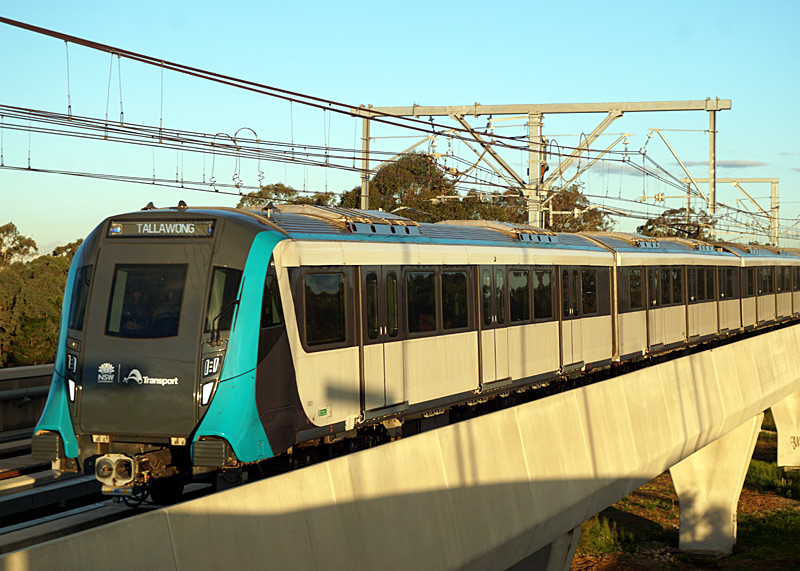
Uniquely in Australia, Sydney has a true 'urban transit' underground railway /urban metro service. Image & license: MDRX / Wikipedia encyclopædia. CC-BY-SA-4.0 https://commons.wikimedia.org/wiki/File:Sydney_Metro_Kellyville_Sunset.jpg. |
|||
With decades of experience of both single and double deck trains in the Australian state of New South Wales, when the city of Sydney built its first true urban metro service it chose to use single deck trains - because these benefit from faster alighting / boarding at station stops than double deck trains. Double deck passenger trains are looked at in greater detail on a different page. |
|||||
 |
|
 |
|||
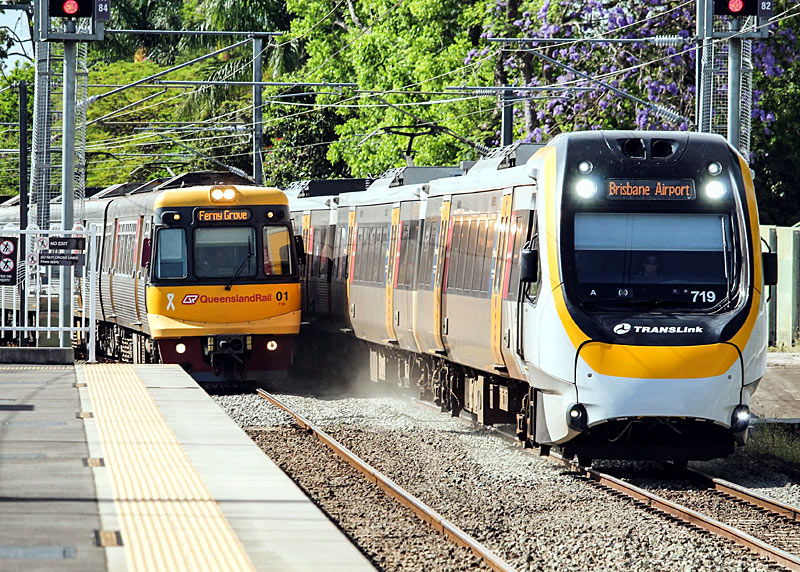
| Brisbane older (left) and newest (right) trains. . Image & license: Pytomelon87 / Wikipedia encyclopædia. CC-BY-SA-4.0 https://commons.wikimedia.org/wiki/File:Oldest_and_newest_QR_unit.jpg. |
|
TransPerth B series train speeding past morning traffic jams on the Mitchell Freeway as it heads to Perth on the Joondalup Line.
Image & license: V1213 / Wikipedia encyclopædia. CC BY-SA 3.0 http://commons.wikimedia.org/wiki/File: Mitchell_Freeway_100_N_Stirling_Civic_with_train.jpg. |
|||
|
To optimise service frequency via the new Cross River Rail tunnels the Brisbane NGR fleet (New Generation Rollingstock) uses ETCS (European Train Control System) signalling. If there is a shortage of rolling stock, Brisbane suburban trains are occasionally used on Queensland interurban routes. Whilst this increases operational flexibility, it is suboptimal as the interrurban trains have toilets and high-backed seats - these being features that are not found on suburban trains. |
|||||
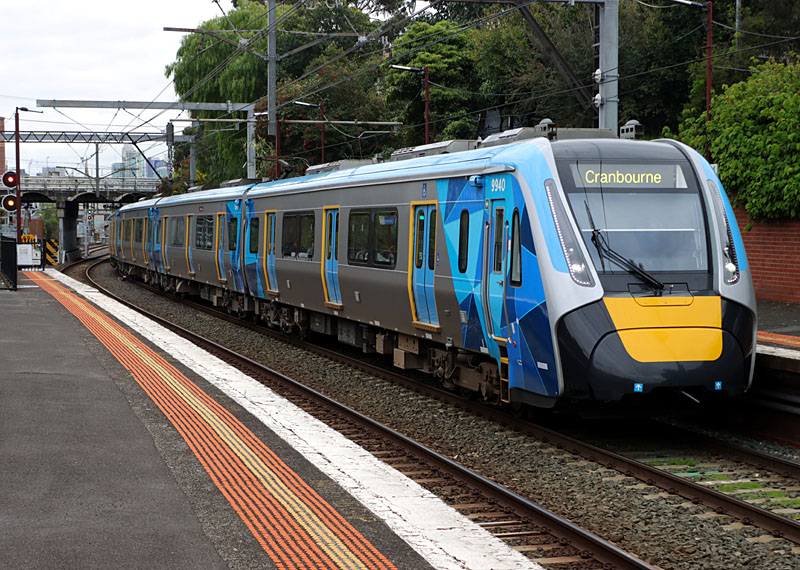
Image & license: Philip Mallis / Wikipedia encyclopædia. CC-BY-SA-2.0 https://commons.wikimedia.org/wiki/File:HCMT_train_running_a_service_to_ Cranbourne_running_express_through_Hawksburn_Station,_South_Yarra_(53187084443).jpg. |
|
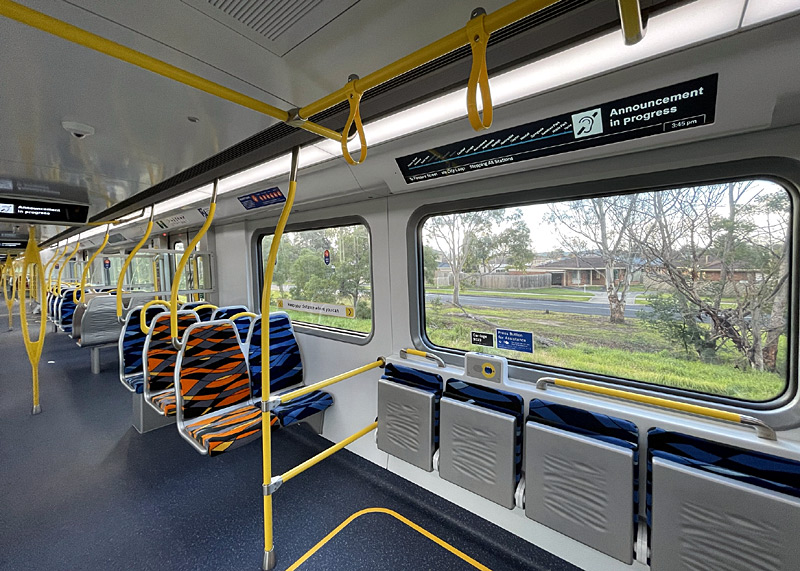
Image & license: Takoyaki42 / Wikipedia encyclopædia. CC-BY-SA-4.0 https://commons.wikimedia.org/wiki/File:High_Capacity_Metro_Train_interior.jpg. |
|||
The newest urban / suburban trains in Melbourne - the High Capacity Metro Train (HCMT).
Built to use in the new Metro rail tunnel the HCMT comprises a fleet of 7 coach trains which have a capacity of 1380 passengers. The body shells were built by CRRC Changchun in China, but 60% of their construction uses "local content" from within the manufacturing supply chain in the State of Victoria. To reduce the likelihood of train surfing the train ends have aerodynamic nose cones and retractable coupling covers. Unlike the older train fleets, the HCMT has three wide doorways per side. This will minimise station stop dwell times by allowing faster alighting and boarding. The electronic passenger information display screens show the next station, the time and route maps that include identifing the location of the train as the journey preogresses. Standing passengers will appreciate the provison of straps and grab handles and there are 28 wheelchair spaces per train. the Metro Tunnel has communications-based train control and platform screen doors, both a first for Melbourne. In addition to relieving the peak-hour ridership pressure on the existing underground City Loop that encircles the city centre, Metro Tunnels' new stations new urban localities which previously relied on trams and buses for last-mile travel to and from a railway station. Nowadays all of Melbourne's trains are single-deckers - in times past the fleet included one double-deck train (primarily for evaluation purposes) but it was decided to stay with single-deck trains. In New Zealand only two major cities have suburban networks. Because of the mountainous terrain it was decided that to reduce construction costs Wellington started electrifying its urban railways in the 1930s, using British-built trains, Later the fleet was augmented with electric trains from Hungary. Since 2016 all services have been operated by South Korean rolling stock and to increase their performance the voltage was raised from 1500v DC to 1800v DC. Trains are formed of two-carriage multiple-units and run singly or with up to four units coupled-up to form eight-carriage trains. |
|||||
 |
|
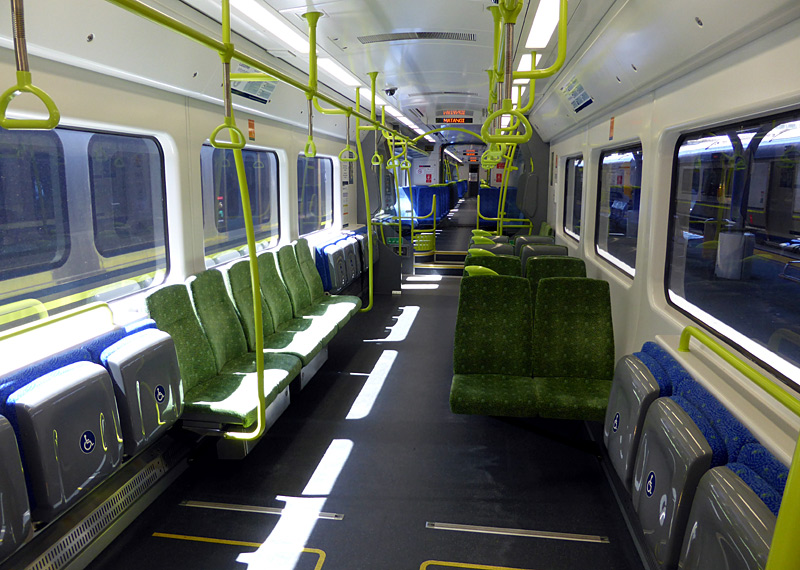 |
|||
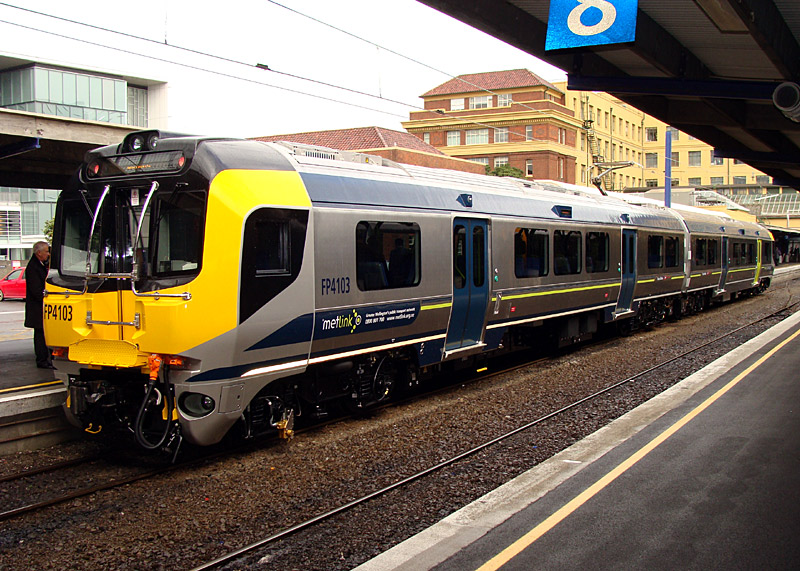
| Metlink Matangi electric multiple unit train FP/FT 4103 at Wellington railway station platform 9 for a public open day.
Image & license: Matthew25187 / Wikipedia encyclopædia. CC-BY-SA-3.0 https://commons.wikimedia.org/wiki/File:NZR_FP_class_01.JPG. |
|
Inside Metlink Matangi carriage.
Image & license: Stephen Colebourne / Wikipedia encyclopædia. CC-BY-SA-2.0 https://commons.wikimedia.org/wiki/File: Matangi_train_carriage,_Wellington,_New_Zealand.jpg. |
|||
Auckland's railway network was electrified in the 2010s at 25kV 50Hz AC using British designed overhead infrastructure. The trains are operated by Auckland One Rail for the Auckland Regional Transport Authority under the AT Metro brand. Trains are formed of three-carriage multiple-units and run either singly or with two units coupled-up to create six-carriage trains. Previously Auckland had been using heavily rebuilt / modernised diesel trains of late 1960's vintage which it bought from Perth, Australia, but were no longer needed when Perth electrified its own suburban services. When these diesel trains became life-expired Auckland decided to replace them with new electric trains because overseas experience had shown how electric trains would be cheaper to run in the long term. It was also understood how overseas cities with high-frequency urban rail services tended to always use electric trains - partly because of their quieter operation, but also because of their faster travel between stations and greater environmental benefits. New Zealand also has a small fleet of former British Railways InterCity Mk2 carriages. Bought between 1996 and 2006 these have are used on a range of services, including suburban services in Auckland - for which they have been very heavily rebuilt with suburban style sliding doors and one end of some carriages also fitted with drivers cabs, so that the trains can operate in 'push-pull' mode, being powered via a diesel engine which always remains at one end of the train. However it is planned to replace these British trains with a fleet of electric multiple-unit Tühono (meaning to connect or unite), trains built in India. Whilst travelling on non-electrified sections of railway these will be powered by onboard batteries. |
|||||
|
|
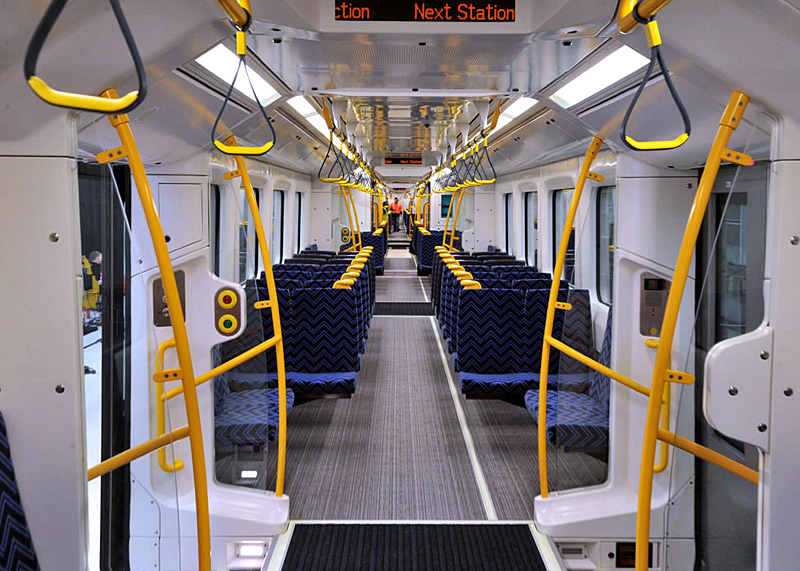 |
|||
| Two unit / six-car Auckland Metro (AM Class) electric multiple unit train.
Image & license: Takeshi Aida / Wikipedia encyclopædia. CC BY-SA 2.0 https://commons.wikimedia.org/wiki/File: Auckland_AT_Metro_AM_Class,_Parnell,_Auckland_(20240202a).jpg. |
|
AM Class train interior.
Image & license: Auckland Transport Blog / Wikipedia encyclopædia. CC BY-SA 3.0 https://commons.wikimedia.org/wiki/File: NZ_AM_class_train_interior_2_2013.jpg. |
|||
|
|||||

Converted former British Railways Mk2 carriages which now have suburban style sliding doors operating in 'push-pull' mode on local services which extend beyond the electrified network in the Auckland area. The end carriages are also fitted with diesel generators, albeit only to power the on-train services (lights, doors, etc). Image & license: Palmeriain / Wikipedia encyclopædia. CC BY-SA 3.0 http://commons.wikimedia.org/wiki/File:SD_masterton.jpg. |
|||||
|
|||||
Paris, France, has several marketing brands of urban / suburban railway services. These include "Transilien", which mostly involves trains that travel into mainline terminal stations around the centre of Paris, and the "RER" (regional express railway) which involves suburban trains that link up suburban railway routes on opposite sides of the city, mostly by means of new-build subterranean linking tunnels below the city centre. The RER is jointly operated by both the mainline railway (SNCF) and the citywide urban transport company that also runs the métro, funicular, trams and buses (RATP). Together these serve the wider built-up area plus close communities which form what is known as the Île-de-France region of France. This is in addition to the Parisian métro, which primarily serves the part of the entire Parisian conurbation that comprises the historic city of Paris. Overseeing all transport operations and co-ordinating the different transport companies in the region is a body called STIF - Syndicat des transports d'Île-de-France. The name Transilien is a variation on the word Francilien, this being a term that is frequently used to describe the inhabitants of the Île-de-France region of France. |
|||||

Image & license: Eole99 / Wikipedia encyclopædia. CC BY-SA 3.0 http://commons.wikimedia.org/wiki/File:Z50000_Groslay_versParis.JPG |
|
 |
|||
|
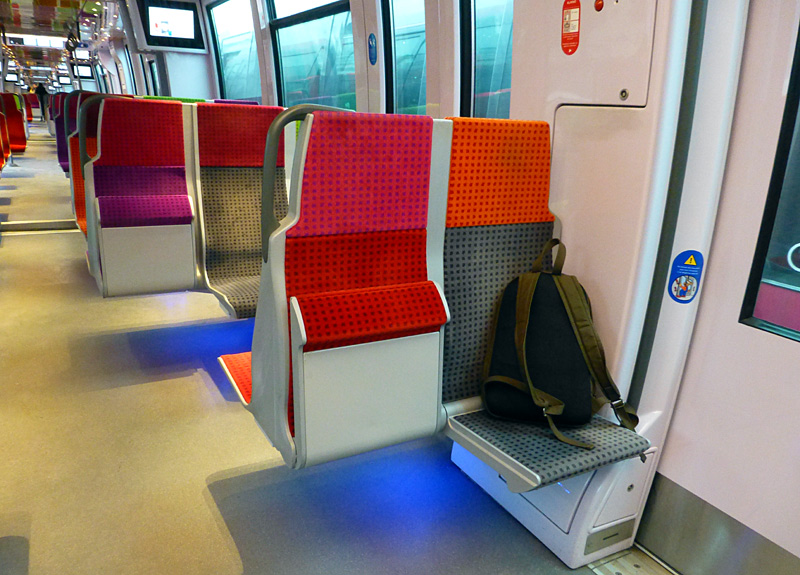
There are many different types of trains to be found on the Parisian railway network, these images show just one of them.
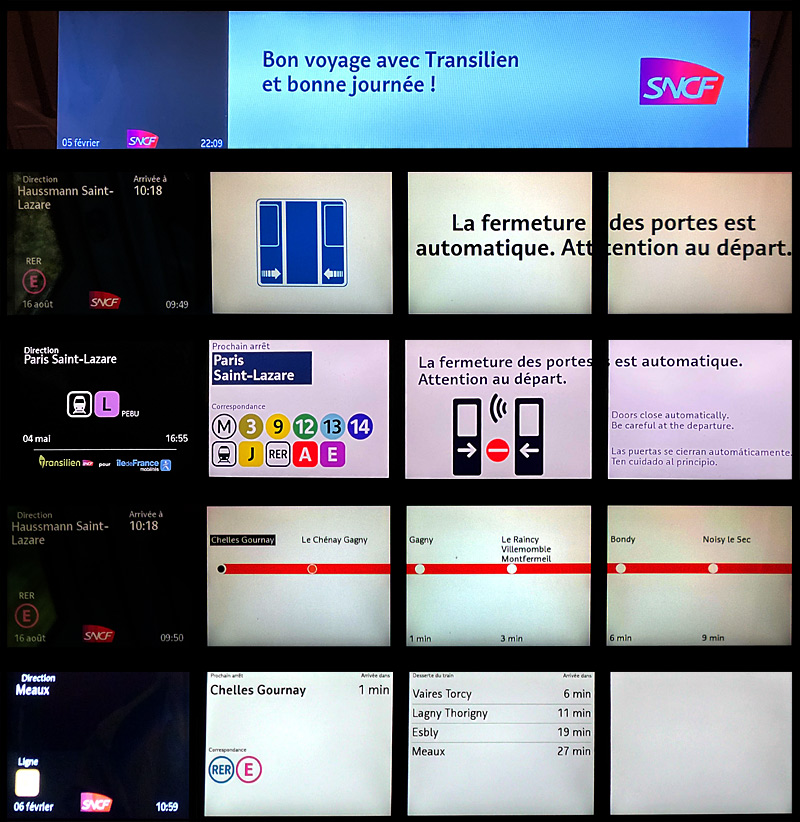
The internal view shows the LCD and TV-style passenger information displays, The multicoloured rainbow seating (with folded-up tip-up seats), Some of the colours seen in the multicolour ceiling lights in the area between the passenger doors. Launched in 2009 the Z50000 urban / suburban trains are painted in a livery which combines elements from three transport organisations:- To maximise passenger capacity they feature articulated short-length passenger carriages of just 16.53m / 54ft 3in [end carriage], 13.24m / 43ft 5in [most intermediate carriages] and 8.29m / 27ft 2.5in [central carriage on shorter trains only]. The main benefit of shorter carriages is that they need a less wide swept path on curved track, so as a result at 3.06m / 10ft 0.5in they are appreciably wider than more traditionally dimensioned types of train which typically have carriages that are circa 24m - 26m / 79ft - 86ft in length and 2.89m / 9ft 5.5in in width. |
|||||

Image & license: Poudou99 / Wikipedia encyclopædia. CC BY-SA 3.0 http://commons.wikimedia.org/wiki/File:Z50000_12dec2009_IMG_6066.jpg |
|

Image & license: Kirikou / Wikipedia encyclopædia. CC BY-SA 3.0 http://commons.wikimedia.org/wiki/File:Gare_de_Pontoise_-_mars_2013_-_Quais_(4).JPG |
|||
| The inside of a train at the articulated joint between two carriages. Also seen is a television screen - there are four of these located in each of the corners next to the articulated joints. | |
The outside of a train at the articulated joint between two carriages showing the shared Jacobs bogie and the indented body sides into which the doors slide when they are open. | |||
|
These trains come in two train lengths. Eight carriage trains seat 472 passengers, including 92 folding seats. The shorter seven carriage trains provide 380 seats, 74 of which are folding / tip-up seats. Thanks to the extra width of the train it is possible for some of these seats to be in 3 + 2 format and still maintain a central walkway between them that is 55cm / almost 22in in width. The seats are cantilever in design, which means that they only cling to the side walls, this creates space below them for luggage and also makes it easier for the cleaners to sweep the train's floor. As the images suggest, the seats are upholstered in a range of eight different colours, these being raspberry, gray, yellow, burgundy, orange, red, soft green and purple. The trains also feature blue coloured underseat lighting As if that is not enough, the ceiling lights in the areas between the doorways also vary the colours shown, with white being for when the doors are open, blue when the train is accelerating and orange when it is coasting or braking! The change between colours is by fading, so many intermediate tones and tints are also seen. |
|||||
 |
|
 |
|||
| These trains have a mix of fixed and folding / tip-up seats, one of which has my backpack holding it open for my photograph. | |
A montage of some of the passenger information shown on the LCD passenger display screens - see below for image credits. |
|||
Normally when in passenger service two such trains are coupled together to form one longer multiple-unit train; although it is possible to couple-up three such trainsets, if required.
The two end carriages include space for passengers who use wheelchairs, pushchairs / buggies / strollers, etc., ie: personal wheeled transports. In addition elsewhere along the train is shared space for cycles, although this too requires the tip-up seats to be closed. |
|
Top row: Image & license: Le cheminots / Wikipedia encyclopædia. CC-BY-SA-4.0 https://commons.wikimedia.org/wiki/File:SIVE_visuel_d%27une_rame_Z_50000.jpg 2nd row: Image & license: Skililipappa / Wikipedia encyclopædia. CC-BY-SA-4.0 https://commons.wikimedia.org/wiki/File:Z_50000_%E2%80%94_SIVE.1.jpg 3rd row: Image & license: Trainsandstations / Wikipedia encyclopædia. CC-BY-SA-4.0 https://commons.wikimedia.org/wiki/File:Z50000_%E2%80%94_ SIVE_%E2%80%94_4_%C3%A9crans_Fermeture_des_portes.jpg 4th row: Image & license: Skililipappa / Wikipedia encyclopædia. CC-BY-SA-4.0 https://commons.wikimedia.org/wiki/File:Z_50000_%E2%80%94_SIVE.2.jpg 5th row: Me! |
|||
|
The trains feature large double-glazed windows which provide 50% more glass area than the trains they replace. In addition to the gain in brightness, passengers benefit from clear unobstructed views of
the outside at eye level. As the trains are fully air-conditioned the windows cannot be opened. This both prevents loss of air conditioning efficiency and the throwing of objects out of the train.
In addition to real-time travel information displays these trains feature TV / video screens which are located at carriage ends / one per each corner. These show the digital terrestrial television (DTT), cultural information and local weather. Passengers must wear wireless headphones to listen. |
|||||
The trains are capable of operating from overhead wires energised at either 1.5 kV DC or 25 kV AC and have a top speed of 140km/h / 87mph.
These trains have been designed for various platform heights. All passengers benefit from level access at stations where the platforms are about 92cm above ground. To make life easier for passengers who use personal wheeled transports the doors in the two end carriages feature gap-fillers which automatically deploy so as to plug the approximately 10cm gap between the train and platform. When the trains call at stations with low height platforms (55cm or less) extending steps automatically deploy below all the train's doors. |
|

A composite image showing an extending gap-filler (upper image) and an extending step (lower image). Both images & license: Poudou99 / Wikipedia encyclopædia. CC BY-SA 3.0 Upper image: http://commons.wikimedia.org/wiki/File:Z50000_12dec2009_IMG_6002.jpg Lower image: http://commons.wikimedia.org/wiki/File:Z50000_12dec2009_IMG_6080.jpg |
|||
By 2005 restoration of most of the Berlin S-Bahn (suburban / city railway) and replacement of the vintage trains from the 1920's had been completed after the long "hibernation" of the post-war period when the city became divided and the system contracted. The name S-Bahn dates from 1930, with the letter S being used to differentiate it from the U-Bahn (ie: underground urban railway). As such the S-Bahn was more of a city-specific marketing name for urban / suburban / commuter 'rapid-transit' services that sometimes also extended to nearby towns in the Berlin hinterland which were (still are) operated by the main line railway. However this name is now used more widely - especially (but not exclusively) in German-speaking towns and cities. In Berlin the S-Bahn network serves many outer-suburban areas with trains then converging to either pass through the city centre via an elevated east - west route called (the Stadtbahn), or an underground north - south alignment called (the Nord - Süd Tunnel), or travelling along the Ringbahn - which is an approximately circular service that links many urban districts - but not the city centre. All trains are electrically powered collecting 750v DV from a bottom-contact third rail. |
|||||
 |
|
 |
|||
| By 2005 restoration of most of the Berlin S-Bahn (suburban / city railway) and replacement of the vintage trains from the 1920's had been completed after the long "hibernation" of the post-war period when the city became divided and the system contracted. | |
Passenger information systems on the Berlin S-Bahn includes these dot-matrix displays which will even advise passengers on which side the doors will open at the next station. | |||
|
In an effort to maximise passenger loadings the S-tog trains in the Danish capital (Copenhagen) which date from 1996 use these revolutionary short wheelbase articulated walk-through trains that when first introduced totally re-wrote the "rule book" on modern train design. Short wheelbase single axle passenger carriages were known in the early days of the railways when passenger carriages emulated horse-drawn stagecoaches, but for various reasons fell out of favour when longer carriages with bogie wheelsets at each end became possible. To facilitate the extra width of these trains they use very short carriages which on bends neither stick out so much at the ends nor have the middle of the carriage 'cut the corner' on the inside. To reduce the trains' weight and consequential power consumption they are articulated and use single axles (2 wheels) instead of 'bogie' units (which usually use twin axles / 4 wheels). Most trains are constructed as 2x4-carriage units permanently joined together. The outer carriage (with the driver's cab) has a wheelset at each end whilst the other carriages have one wheelset of their own and partially 'hang onto' the previous carriage. Despite using single wheels the ride quality is very acceptable. |
|||||
 |
|
 |
|||
| The revolutionary Copenhagen suburban trains. Each 8 carriage train is roughly the same length as a 4 carriage "conventional" train - but provides greater passenger capacity & comfort | |
Inside view showing the inter-carriage walk-through feature, see-through anti-draught internal screens (with powered sliding doors) and spacious 3+3 seating. | |||
 |
|
 |
|||
| Some carriages feature fold-up longitudinal seating, space for wheelchairs & pushchairs and even bicycle hoops. Another internal view which shows the bicycle hoops more clearly can be found by clicking here. |
|
The red LED (light emitting diode) 'real-time' route information alters along the journey with the lower row of dots switching off as the journey progresses. | |||
For those who would like more detailed information on these Danish trains: The driving carriages are 12m (metres) in length and the trailers 10m. The fleet consists of 136 trains; 105 of which have 8 carriages (and are known as Litra SA) and 31 of which have 4 carriages (and are known as Litra SE). At just under 84m in length an 8 carriage train is comparable in length to a 4 carriage version of the older trains. Especially at busier times two units operate in multiple, giving 16 carriages in total. These new trains are 3.6m wide (the older trains were 3.0m wide) and at 312 (plus 28 folding seats) they seat about 33% more passengers than the older trains - without the need for expensive lengthening of station platforms! In total 8 of the 10 axles per 8 carriage new train are motored, giving them a maximum acceleration rate of 1.3m per second and top speed of 120km/h (about 75 mph), although signalling or track limitations means that this speed is only reached on some routes. They are powered at 1650v DC and feature regenerative braking, reducing the energy requirement from the power station by approximately 40%. The shorter 4 carriage trains are a little under 43m in length, they offer 134 fixed seats plus 16 folding seats, Faced with rising traffic congestion the people of San Francisco USA did not want to emulate their southern Californian neighbours in Los Angeles who were trying (and failing) to solve traffic congestion through massive road building and after much discussion / campaigning the BART (Bay Area Rapid Transit) scheme developed. The system opened in 1972 and has been extended many times. |
|||||
Being a brand new system which does not share infrastructure with any other rail operations it was decided to build the trains to a more generous specification than might otherwise have been possible and therefore
the track gauge is 5' 6" (1.676m) compared to 4' 8" (1.435m) for standard railways / railroads; this would have been done because a wider track gauge is more suited to wider trains and
usually provides a better quality of ride. Another possible reason for this wider track gauge is that it assures none of the private freight railways that BART will ever want to extend its services over their tracks, and prevents them from wanting running rights over tracks owned by BART. The third rail power supply rails are energised at 1000 volts DC. One unusual feature from the original plans for BART is that all passengers were expected to be seated - so little provision was made for standing passengers. |

First generation (now withdrawn) BART (Bay Area Rapid Transit) train. |
||||
|
The main BART system operates five different sets of services which mostly interleave so that much of the system is served by trains on two or more routes. Four of these share the Transbay Tube which runs under San Francisco Bay (ie: under water) and at busy times congestion occurs as the multiple lines vie for shared resources. In the longer term a second tunnel is planned. This will feature four tracks - two for BART and two for other rail services - including the proposed California High Speed Rail system. The Transbay Tube is 3.6 miles (5.7 km) in length, although including the approaches from the nearest stations (one of which is underground) it totals 6 miles (9 km). At a maximum depth of 135' (41 m) below the surface it is also one of the deepest vehicular tubes known about in the public domain in service today. (Although the suggestions remain unsubstantiated it is possible / probable that the military have access to a 4000+mph [6400+km/h] maglev located approximately 4 miles [6.4km] below ground). BART also operates two feeder services - eBART travels over existing rail infrastructure and uses standard gauge Stadler GTW diesel multiple-unit trains similar to others used elsewhere in the USA and the Oakland Airport Connector which serves Oakland San Francisco Bay Airport. This is an AGT (automated guided transport / transit) that uses the DCC Doppelmayr Cable Liner system. There is some debate as to whether BART is a subway/metro or a regional service. Some people suggest that its acts more like a regional commuter railway because whilst it links two cities (San Francisco and Oakland) with their hinterlands it was not designed to provide frequent local services. So whilst it is often thought of as a subway / metro the service it provides is more akin to London's Thameslink, the Paris (France) RER, the Berlin (Germany) S-Bahn (and others) except that it does not have to share its rights of way with other railway services. In 2024 BART retired the last of its original rolling stock. Nowadays it uses trains type D and E. One major change based upon operating experience with the older trains is that to expedite passenger flows alighting from and boarding the trains at stations the new trains have three pairs of sliding doors on each side. The original trains only had two sets of sliding doors. (NB: ' means foot; " means inches; metric conversions are approximate). |
|||||
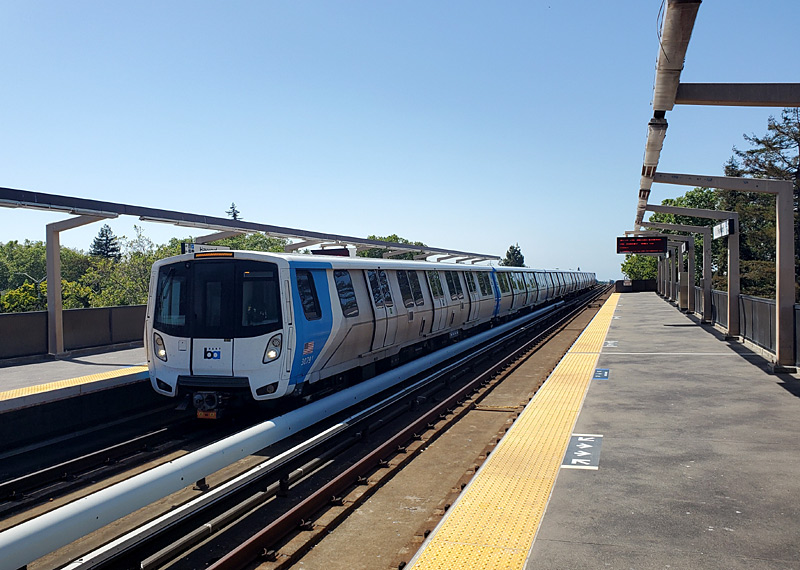
https://commons.wikimedia.org/wiki/File: Southbound_train_arriving_at_Hayward_station,_May_2024.jpg |
|
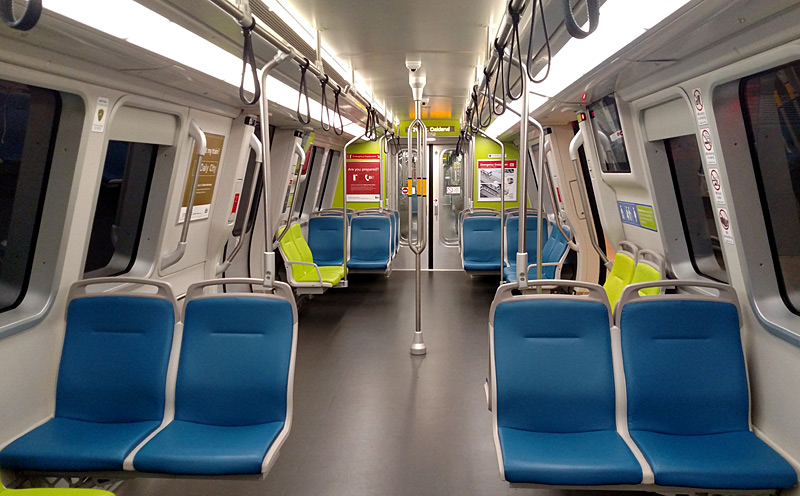
https://commons.wikimedia.org/wiki/File:Interior_of_BART_D_car,_March_2018.jpg |
|||
| A southbound Orange Line train arriving at Hayward station and inside a type D BART carriage.
Both images & licenses: Pi.1415926535 / Wikipedia encyclopædia. CC-BY-SA-3.0 |
|||||
Another form of 'short distance' trains are undergrounds, subways, métros and mini-métros. These are generally 'city-specific' transit systems which are operated by a specialist urban transit authority which often also runs the street-based transport (buses, etc,.) too. Most of these systems use traditional 'steel wheel' on 'steel track' technology however a few systems use trains that run on rubber tyres. This page makes no distinction The principal difference between a métro and mini-métro is that the latter will be designed for routes with lower traffic flows and therefore will use shorter trains. In other respects they are both more akin to 'heavy' rail in nature with fixed infrastructure, tunnels, etc., costing roughly the same to build except that where shorter trains are used there will be some savings in the cost of constructing the smaller stations. Sometimes métro and mini-métro trains will be able to negotiate sharper curves and steeper gradients than the other types of 'heavy rail' trains. As with the difference between 'light' rail (aka trams / streetcars) and 'heavy' rail the dividing line is indistinct - there are no fixed rules; instead the philosophy is that 'if it works / suits the location' then "fine". |
|||||
The first underground railway "anywhere" globally was the Metropolitan Railway which opened in London in 1863. |
|||||
 |
|
 |
|||
| Farringdon station retains many of its original Metropolitan Railway features. | |
Thameslink and Underground trains at Farringdon station. | |||
| Click either of the above images to see larger versions plus an extra view of the station in a popup window; alternatively clicking here will open the page in a new full-size window. |
|||||
 |
|
 |
|||
| London's underground trains come in two different sizes - the smaller 'tube' trains and the larger 'mainline' size trains. This view was taken at a location where the 'tube' trains heading to Heathrow Airport provide an express service whilst the larger trains call at 'all stations'. | |
Also in London the Docklands light railway includes some underground sections. This is the new subterranean Island Gardens Station which was re-sited (from an elevated location) to facilitate the extension under the River Thames towards Greenwich and Lewisham. | |||
 |
|
 |
|||
| The nickname "Tube" comes from the almost circular tube-like tunnels through which the small profile trains travel. | |
As a contrast the larger profile trains are the same size as mainline trains. | |||
Traditionally London Underground trains were painted red, however from the 1960's onwards all new trains featured aluminium sides that did not need painting to protect them against the weather. One small fleet of trains which date from the 1970's featured painted doors, this might have been to distinguish it from an earlier batch of similar rolling stock. One of the advantages of not painting the trains is that they then weigh less - and consume less energy. However, following problems in the 1990's with graffiti vandalism and a desire for a corporate image there was a rethink in policy and nowadays the trains painted red, white and blue. Even without the graffiti problem a change of policy would have been necessary. because nowadays disability legislation requires that train doors are painted in such a way as to be easily discernable by people with limited vision. |
|||||
 |
|
 |
|||
| Small profile "tube" train as built in the early 1990's - these operate on the Central and Waterloo & City lines. Internally they only provide longitudinal seating as this maximises the amount of space available for standing passengers. These trains also feature full automated train operation although overall door control and starting the train after station stops still remains in the domain of a 'real person'. When built they were also fitted with passenger operated door open & close buttons as this would help keep the trains warmer when calling at surface stations in the winter months. Much to many passengers's dismay these buttons are no longer used, indeed train drivers can be disciplined for allowing them to be used, even though this is a feature which many passengers do want. No explanation has ever been given by management for this policy but it is thought to be because some selfish passengers would close the doors to tru to prevent approaching passengers from boarding the train.. |
|||||
 |
|
A surface stock train detector. These are located on tracks which lead into tube tunnels which are only suitable for small profile trains but on sections of track which could (inadvertently) also
be accessed by large profile (mainline sized) trains. As the image suggests, small profile trains pass under with ease; however larger trains will break the three elongated 'U' shaped glass tubes (which originally were filled with mercury but nowadays use aluminium foil) thereby breaking an electrical circuit and causing an automated trainstop device (such as is also used on the signalling system) to safely bring the train to a halt before it reaches the tunnel mouth. |
|||
 |
|
 |
|||
| Large profile train as used on all subsurface lines - Metropolitan, District, Circle plus Hammersmith & City. These are NOT 'tube' trains - they are too big to fit the tube train tuunels! These trains are fully air-conditions and feature three pairs of double doors per train side for rapid entry / exit & minimum dwell time at stations. |
|
The trains used on the Metropolitan line have 8 cars. Most of them feature a mix of transverse and longitudinal seating, as some journeys can take 45+ minutes. |
|||
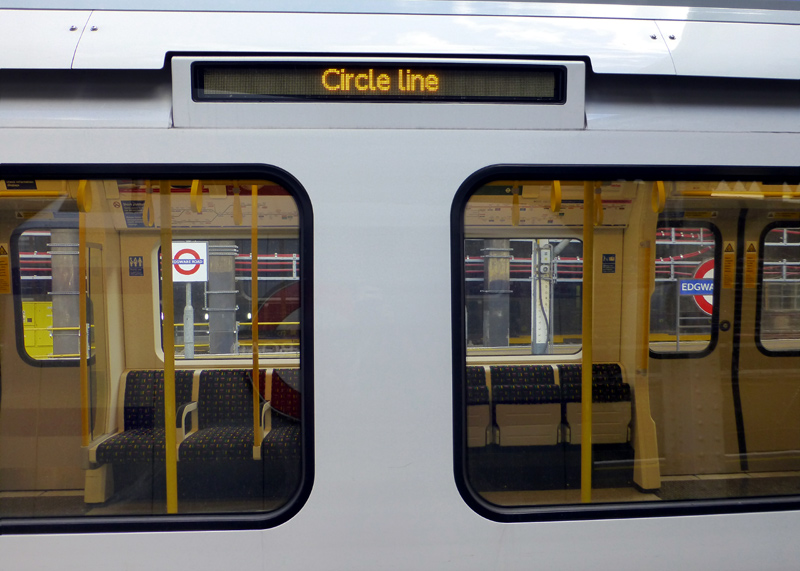 |
|
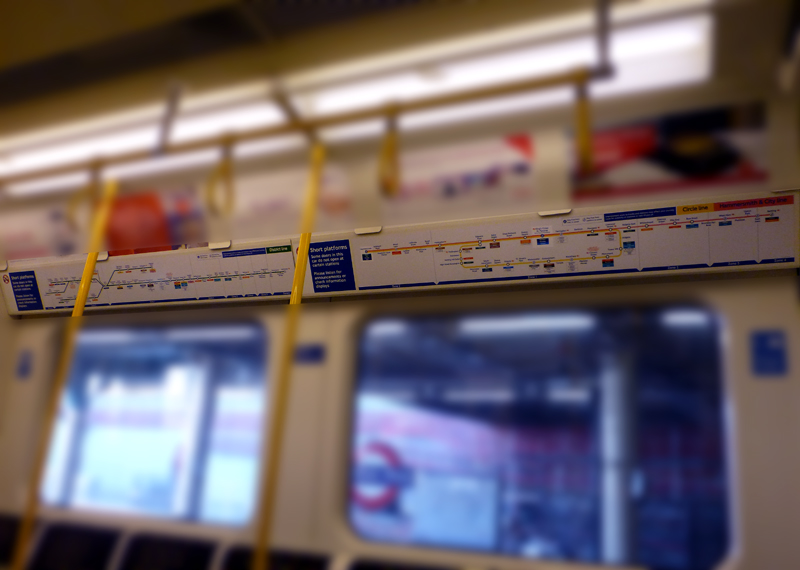 |
|||
The trains used on the District, Circle and Hammersmith & City lines have 7 cars and only offer longitudinal seating.
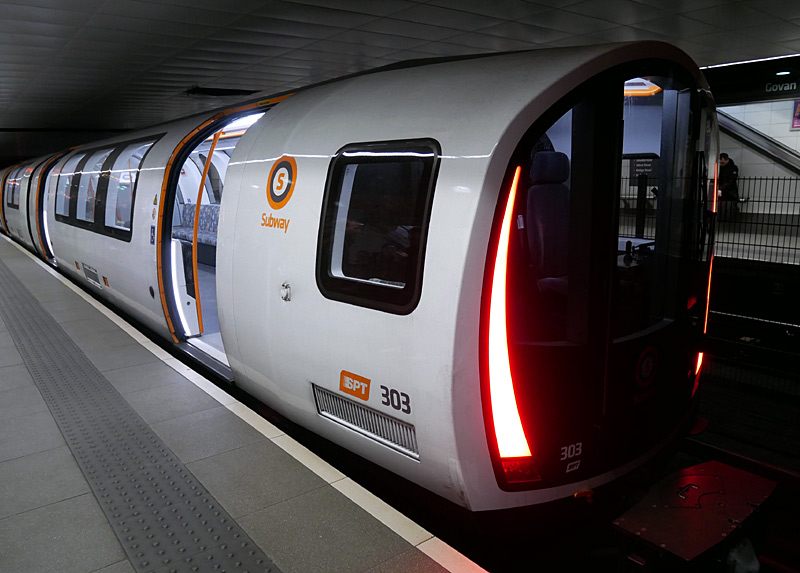
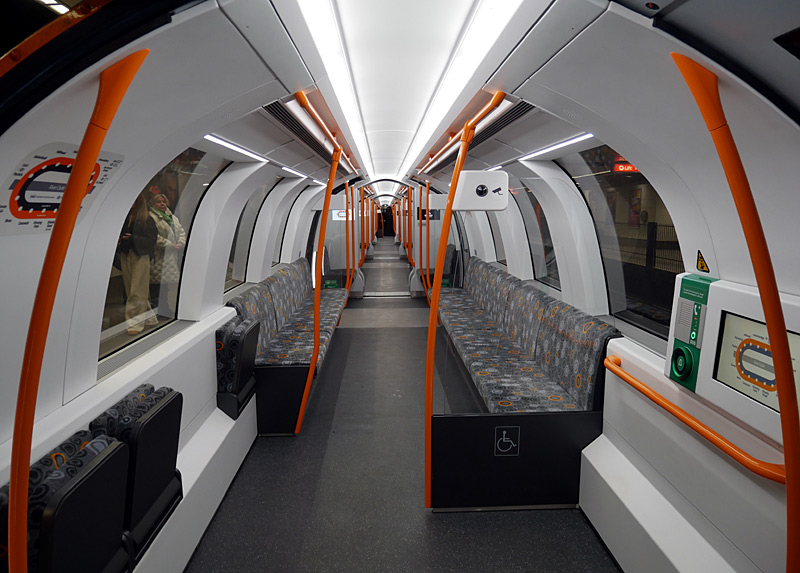
Despite dating from the same time-frame as the Parisian Z50000 trains seen above their on-train passenger information is significantly inferior. To compound the issue, these trains have two paper route maps but leave it for the passenger to decide which one is correct for their journey. This confuses many passengers (especially visitors to London) because they are not 'in the know' so often only look at one of the maps. For the record, the maps show the District line on the left and Hammersmith & City and Circle lines on the right. Apart from London, Glasgow is the only other British city with a 'city specific' Underground railway. After London and Budapest (not illustrated) Glasgow became the third city "anywhere" globally to open an urban underground railway system. Built by the Glasgow District Subway Company it 1896 it is in the form of a 6.5 mile (approx 10.4km) circle with trains travelling both clockwise and anticlockwise. Because of Glasgow's geology the subway had to be cut with great difficulty through solid rock; this accounts for both the small size of the tunnels and why the system remains the same size as when it was first opened. Between 1936 and 2003 this system was officially called the Glasgow Underground, but the name has now reverted back to Subway. Between 1977 and 1980 services were suspended to allow for significant rebuilding / modernisation which included procuring brand new rolling stock and modification to the stations which amongst other things permitted longer trains. When the system reopened it was often affectionately nicknamed "Clockwork Orange" after the plain orange livery of the new trains, although in circa 2005 they were repainted in a carmine and cream (with a small orange stripe) livery. At the time of writing (2025) the Subway has just been fully re-equipped with a fleet of walk-through Stadler trains (as seen here) and in 2025 work started installing platform screen doors, with an eventual aim of running driverless trains. In modern terminology the Glasgow Subway would be classified as a "mini-metro". This would be because when compared to mainline railway systems the Subway uses short 3 carriage trains of a smaller size which operate at high frequencies. As an aside, the subway is not the oldest underground railway in Glasgow itself; that distinction belongs to a 3-mile stretch of the North Clyde line which nowadays is part of the mainline ScotRail franchise and runs in a sub-surface tunnel under the city centre between High Street and Charing Cross (not illustrated). |
|||||
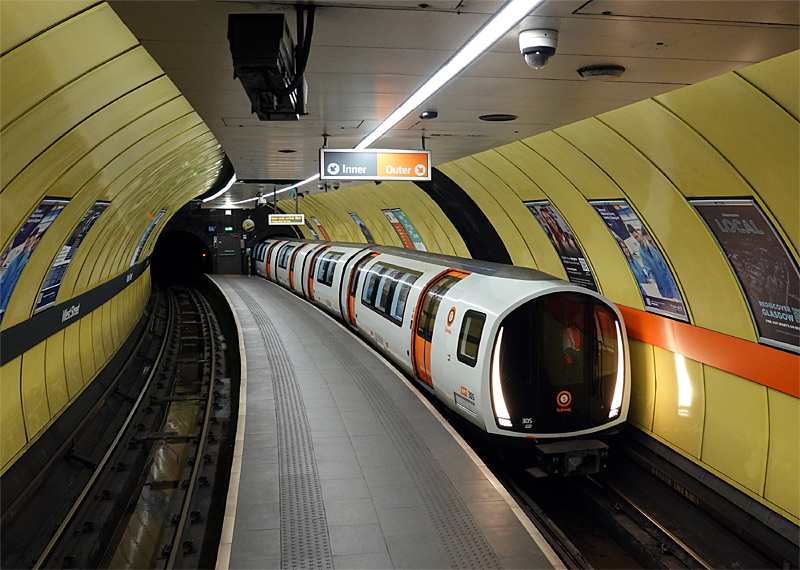
Image & licence: Foulger Rail Photos / Wikipedia encyclopædia CC-BY-SA-2.0. https://commons.wikimedia.org/wiki/File:Glasgow_Subway_ Stadler_unit_at_West_Street_160624_(53794657782).jpg |
|
 |
|||
With a tunnel diameter of 11' (3.35m) and track gauge of just 4' (1.22m) Glasgow Subway trains are even smaller than London's small profile "tube" trains.
The trains are fully accessible between train and platform but only some stations have lifts that allow wheelchair users to travel between a station entrance and the platform. Adding lifts is a challenge - especially as most stations have narrow island platforms. Possibly new station entrances would need digging. |
|
 |
|||
|
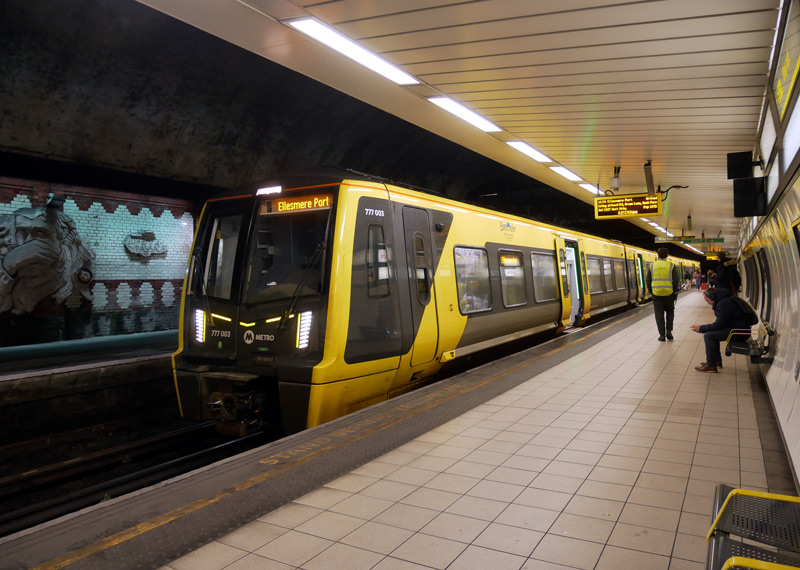
Liverpool also has some underground stations but here too services are provided by inner-suburban mainline trains operating as part of a mainline rail franchise. Known as the Loop & Link the system features two lines - one where trains travel under Liverpool City Centre linking lines to the north and the south of the city and another where trains from Birkenhead and the Wirral peninsula travel in a clockwise loop around Liverpool City Centre before returning back under the River Mersey towards the Wirral. Whilst the Loop & Link opened in 1977 the tunnel under the River Mersey actually dates from 1886. The tunnel was built by the Mersey Railway, as a steam railway, and depite its use of condensing steam locomotives that routed waste gases via a water bath the air inside the tunnel was so foul that most passengers continued to use the ferry boat across the river. In 1900 the railway was declared bankrupt and in 1901 it was bought from the liquidators by people who converted it to electric traction. The line reopened in 1903, since when it has been a tremendous success. Nowadays it forms an important part of the Merseyrail Wirral line. |
|||||
 |
|
 |
|||
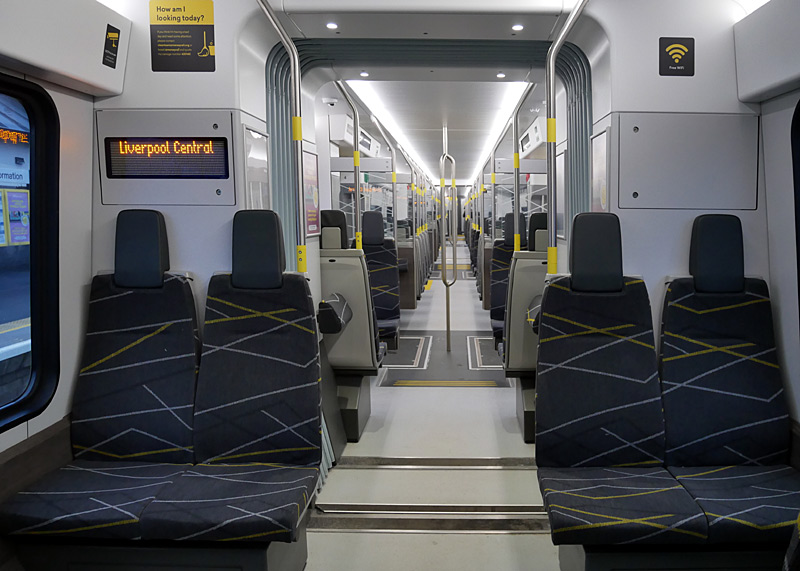
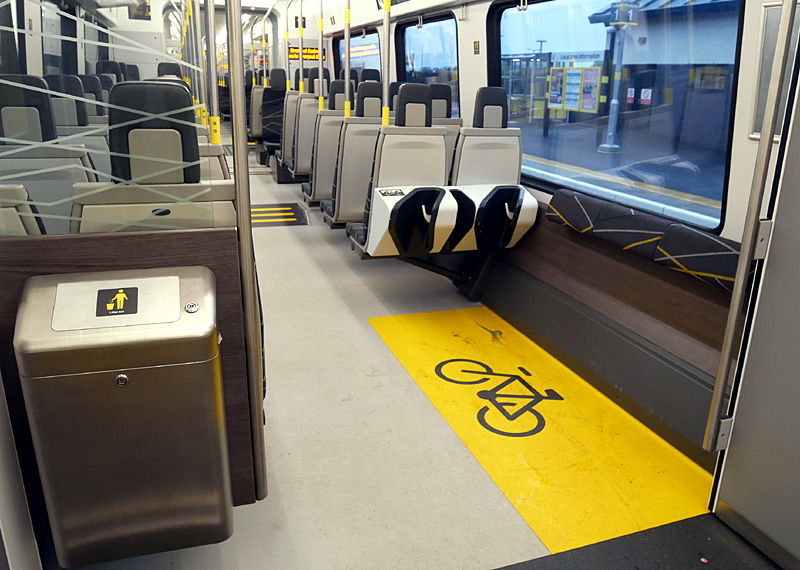
| The Merseyrail system is centred on the city of Liverpool with most of the network forming an overground suburban railway serving the Merseyside region and its close hinterland. These views show the new Stadler Class 777 trains which have just been introduced, replacing former British Rail trains built in the 1980s. | |||||
 |
|
 |
|||
In addition to spaces for wheelchairs these trains offer dedicated bicycle spaces.
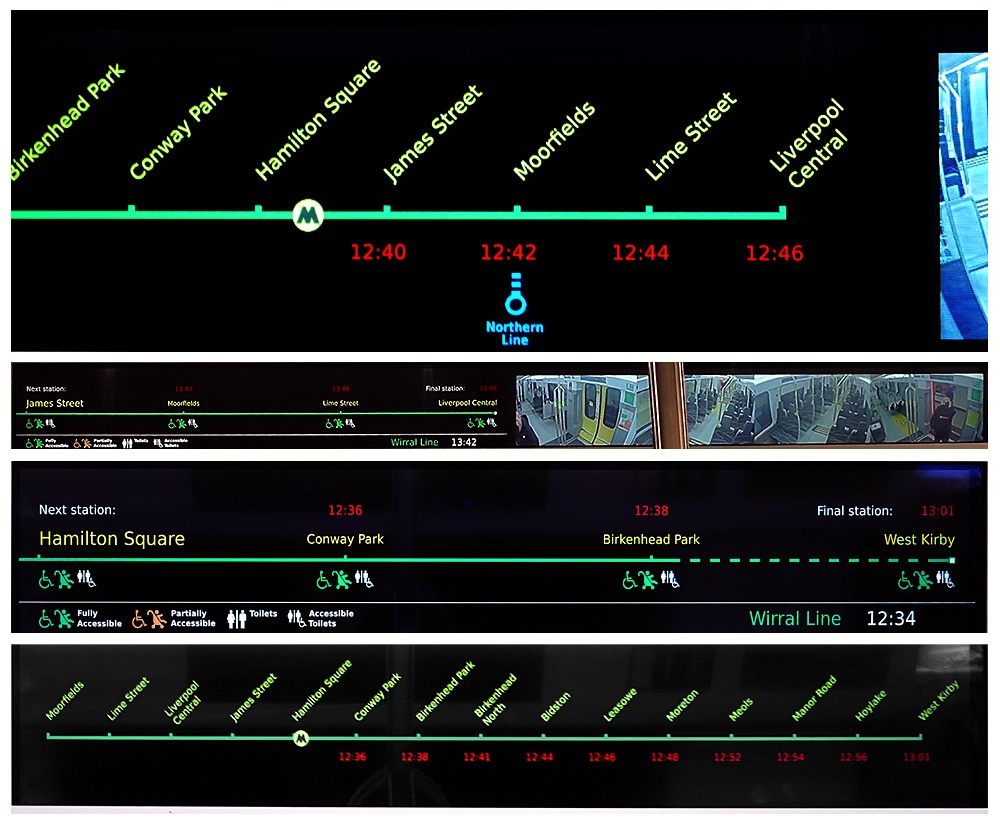
They also feature an exceptionally informative range of passenger transport information - in addition to orange LED displays they feature full colour displays - narrower variants over the train doors and wider variants spread about in the seating area - which can show two different sets of information. For example, the next few stations plus images from the on-train CCTV. Note that the letter M moves to show the train's progress and that Moorfields is an interchange station with a different Merseyrail service. At one time similar 'city centre suburban mainline railway tunnel' systems were also planned for Sheffield and Manchester but it is understood that the people of Sheffield wanted to spend the available
funds subsidising local bus fares whilst the national government point blank refused to provide sufficient investment funds for Manchester's scheme to be brought into reality. (It is said that the national
government had declared "never again" after building the Tyne & Wear Metro's underground section, even though in Manchester the aim was solely to improve access to the city centre by merging two existing
suburban electrified services which terminated at edge-of-city-centre mainline railway stations so that they became one service that served the heart of the retail and business district.).
The Tyne & Wear Metro is a regional rail system based on the city of Newcastle-Upon-Tyne where some stations are underground. When it first opened (in 1980) most of the system was effectively a re-electrification of mainline services that the former British Railways converted to diesel trains in the 1960's, although the underground section was brand new construction. When it first opened the Metro used what are essentially light rail vehicles (trams), albeit of a design that was at the 'heavy' end of the scale. They were designed to be compatible with mainline trains - a feature which stood them in good stead for the 2002 extension to the nearby city of Sunderland, which is (mostly) over pre-existing main line tracks where the Metrocars provide local services and main line trains operate longer-distance regional services. Light rail / trams are also (usually) seen as a type 'short distance' transport; to avoid making this page too large they are looked at on a dedicated Trams & Streetcars page. |
|||||
 |
|
 |
|||
| Tyneside Metrotrain calling at an underground station. From the outset the entire Metro system was designed to be pushchair / buggy / stroller (and wheelchair) friendly. |
|
Much of the southern part of the system sees the Metro sharing its alignment with mainline trains (as seen here). In 2002 some services were extended to Sunderland which was made possible by+ Metro trains travelling over tracks also used by mainline trains. | |||
| |
|
||||
| At the time of this page update the Metro is part-way through replacing its 1980s trains with a fleet of brand new Class 555 Stadler trains - as seen here arriving
at South Gosforth station and passing below the historic North Eastern Railway footbridge. Image courtesy of © Christopher Reeves. |
|
space for future use. | |||
|
Of course Britain is not the only place with urban rail systems, but there are so many in |
|||||
Another city (in addition to London) which has both "smaller" and "larger" profile underground railway trains is the German capital of Berlin. These three images show a recent type of train which was built in two versions depending on lines served. Note that only some of the train's doors are open - in Berlin (and unlike London) all the trains have "passenger operated doors" which
are opened by pressing illuminated buttons. Since reunification they also have audible & visible door closing alarms. |
 Small profile U-Bahn Berlin train of the type also seen below. |
||||
 |
|
 |
|||
Inside modern Berlin U-Bahn trains - large profile left and small profile right. Only the former has the overhead television-style display screens.
Full-width inter-carriage gangways also feature on metro trains in other European cities too... |
|||||
 |
|
 |
|||
| Madrid, Spain. Note the longitudinal seating and the television passenger information displays. | |||||
 |
|
 |
|||
| Milan Metro Line 1, Italy. As an aside, this is one of the very locations (apart from London) where a steel wheel railway line has been electrified on a 4 rail system. Even then there is a difference between here and London in that whereas for both cities the centre (negative) rail is located between the tracks and uses 'top contact', the outer (positive) live rail uses top contact in London and side contact in Milan. | |||||
 |
|
 |
|||
A fully automated (ie: computer-driven and unstaffed) metro train in Copenhagen.
To avoid making this page too big automated (self driving) railway services are looked at on the Automated 'Driverless' Metro Systems page. Although transport systems have not traditionally been seen as being places of beauty there is no 'law' as such which requires that stations should be solely functional but visually mundane / utilitarian. Realising this, and that visually uplifting buildings represent environments where people may 'wish to be' many systems have built (at least some of) their stations with good design in mind. Sometimes this will add a comparatively small amount to the overall cost (often less than 1%) but it also helps attract passengers to the system and creates something which local people can be proud of. In the former Soviet Bloc nations politics also entered into the mix, with the cities deemed to be more important being given impressive stations that were designed along the theme of Palaces of the People. Often these featured valuable materials - such as different coloured marble and semi-precious gem stones sourced from various parts of the Soviet Empire, and were lit using chandeliers, adorned with mosaics, paintings, etc., so that they would often rival many an ancient stately home, chateau, art gallery etc. Nowadays when building new systems or extending existing systems some cities employ architects of the highest calibre from around the globe, with the express intention of their designing stations to a cutting edge artistic brief - and apart from attracting passengers who just wish to travel from A to B these stations often also attract a global audience of students plus other people whose primary interest is in design & architecture who wish to see and photograph these visually distinctive buildings (stations). For similar reasons some systems also include works of art in their stations - busts, sculptures, bronze figures, stained-glass windows, etc. It is only the intention of this page to mention this aspect of station design 'in passing', and even then only with respect to short distance urban transport railways. Further information and many photographs
can be found on this excellent page at the Metro-Bits website |
|||||
 |
|
 |
|||
| The Moscow, Russia metro is famed for its Palace of the People stations. This is Kievskaya.
Image: Wikipedia encyclopædia. Image subsequently deleted from Wikipedia because of lack of freedom of panorama in Russia. http://commons.wikimedia.org/wiki/File:KievskayaAPL-mm.jpg. |
|
Some stations in Moscow have been built to a 1930's 'art deco' design. This is the airport station. Image & license: Aborisov / Wikipedia encyclopædia. Public Domain. http://commons.wikimedia.org/wiki/File:Aeroport_metro_station_Moscow_2.jpg. |
|||
Two Metros In Moscow??? Although not (yet) confirmed officially it has been suggested that Moscow has a second metro system at a deeper level than the public system. This is said to be under military jurisdiction and was built to facilitate survival during a war / natural disaster and to act as a secret escape route for key personnel, should it ever be needed. The only sort of validation which could be said to be in the public domain comes from other cities - such as Prague, Czech Republic - where rumours which talked of similar during the Soviet era were later found to be true, although the facilities were considerably less extensive than the rumours had led people to expect they would be. For the record, rumours also exist of a planet-wide deep level high-speed maglev system which links subterranean military bases and other facilities in the USA, Australia, etc. |
|||||
 |
|
 |
|||
| Vorobyovy Gory station on the Moscow metro is noteworthy because it is located on the lower level of a double deck bridge (over the Moskva River), being the only example of such anywhere globally.
The platforms are accessed from both river banks. As is seen here, the station is also weather protected with windows.
Image & license: Andrey Volykhov / Wikipedia encyclopædia. CC BY-SA 3.0 http://commons.wikimedia.org/wiki/File:Vorobyovy_Gory_subway_4.jpg. |
|
For many years the planned economy of the Warsaw Pact nations saw the same trains (rolling stock) being used in many cities throughout the Soviet Bloc. One distinguishing feature of these trains was
their corrugated metal sides. Nowadays however many cities are buying rolling stock of different designs, although where trains are still relatively modern they are refurbishing rather than replacing them.
This refurbished example comes from Prague, Czech Republic.
Image & license: User: ŠJů / Wikipedia encyclopædia. CC BY-SA 3.0 http://commons.wikimedia.org/wiki/ File:Zku%C5%A1ebn%C3%AD_kolej_Zli%C4%8D%C3%ADn.jpg. |
|||
The Flood RiskIn August 2002 heavy rains and consequential rivers bursting their banks resulted in severe flooding of large areas of Central Europe, and that included a large portion of the Prague metro. So severe was the damage that it took until March 2003 for the system to fully reopen. The reasons why this occurred are not for this page to discuss, however with climate change (and more) in mind it is to be hoped that every conurbation which has an underground railway / metro / subway system has adequate and working flood protection systems, and would remember to use them if there was a credible risk of a flood event. There would be nothing worse than trains full of passengers becoming stranded in deep level tunnels which are filling up with water. The risk is equally severe in cities where tectonic activity is a known issue (San Francisco, Japan), as it is in any city where there are rivers / waterways - including London, Liverpool, New York, Boston, Berlin, Paris, Singapore, Sydney, etc. |
|||||
 |
|
 |
|||
| Another Russian Palace of the People - this is Awtowo in St Petersburg. The person who photographed this station was fined 100 Rubles for doing so (see right). This is indeed most regrettable, as tourists flock to St Petersburg to see its fine works of art - and this includes the metro! Fines such as this 'simply for using a camera' will make the tourists think about going elsewhere. Image & license: MatthiasKabel / Wikipedia encyclopædia. CC BY-SA 2.5 http://commons.wikimedia.org/wiki/ File:Metropolitain_of_Saint_Petersburg_station_Awtowo.jpg. |
|
 Receipt for the fine levied for taking the photograph seen left. Receipt for the fine levied for taking the photograph seen left.This suggests that the transport officials have something to hide / are ashamed of their stations, and is in fact a curse which blights many urban transport systems globally. Of course some petty officials will cite 'security' as a reason for banning passengers from taking photographs at stations - but maybe they have never heard of (or seen) shirt button camera systems, jacket lapel badges and eye glasses with embedded cameras? Simplistic petty rules only harm the innocent - they will not stop photography with malicious intent! Image & license: MatthiasKabel / Wikipedia encyclopædia. CC BY-SA 3.0 http://commons.wikimedia.org/wiki/ File:Ticket_for_photographing_Petersburg_Metro.jpg. |
|||
Contradictory Camera Policy / Breach Of Human RightsThe use of either overt or covert surveillance systems to film places to where the public are admitted whilst at the same time banning the public from using their own cameras represents a breach of human rights. No person should have the right to do something in the public domain that does not require specialist safety training* whilst preventing other people from doing the same thing.(*the proper and safe use of a camera does not require special safety training). |
|||||
Finding StationsWhen stations are entirely below ground potential passengers need a way of knowing that the station is there!
|
|

The entrance to Palac Sportu station on the Kiev, Ukraine Metro. Image & license: Andrjus Shyaulis / Wikipedia encyclopædia. CC BY-SA 3.0 http://commons.wikimedia.org/wiki/File:Palac_spotru_external.JPG . |
|||
Between Street And PlatformStations which are 'under the ground' need to be linked with the surface, and for the majority of stations this is usually done by means of moving stairways - aka: escalators.
|
|

The bank of four escalators at Teatralna metro station in Kiev, Ukraine. Image & license: Jason Minshull / Wikipedia encyclopædia. CC BY-SA 3.0 http://commons.wikimedia.org/wiki/File:PhotoOfTeatralnaStation.jpg. |
|||
|
In Boston, Massachusetts USA they colour-code their urban transports according to the line on which they operate. For the subway there are four lines (Red, Orange - which I was advised serves some of the best avoided areas of the city - Blue and Green). The first three of these use 'proper' subway type cars and contrary to the international 'norms' feature red marker lights at both the front and the rear of the trains. The Green Line uses street compatible streetcars and instead features green marker lights at the front. Other colour-coded lines include "Purple", which is used for heavy rail commuter trains and "Silver", which is used for a Bus Rapid Transit service which also includes surface and subterranean operations. |
|||||
 |
|
 |
|||
| Boston's Blue line features twin system trains that collect power from an electrified 3rd rail while below ground and overhead wires when on the surface. The changeover point is at the station for the airport - which is where this train was when the photograph was taken. | |
A Red line train crosses the Longfellow Bridge over the Charles River which links Boston with the neighbouring city of Cambridge (Mass), this being where the globally-renown Harvard University is located. At Harvard station there is interchange with Boston's other bus 'subway' system. | |||
|
Toronto's subway and streetcar networks use a unique track gauge of 4ft 10 7/8in (1,495mm) rather than the usual standard of 4ft 8 1/2in (1,435mm). Although there are several theories there is no definite known reason for this, although it may be significant that the use of this gauge was established in 1861 (for the streetcars), this being ten years before Canada adopted standard gauge for rail systems. Although the subway system only dates from the 1950's it may be that the same track gauge as the streetcars was chosen because at one time serious consideration had been given to running streetcars through the tunnels and possibly having some subway routes run partially in tunnels and partially on city streets (possibly with the streetcars). Bearing in mind the cost of converting all the tracks and vehicles (and the lack of any real benefit in doing so), the unique gauge has remained to this day. The use of standard-gauge tracks on the former Scarborough RT made it impossible for there to be any track connection between it and the other lines, and so when its vehicles needed anything more than basic maintenance they had to go by road to the suitably equipped subway maintenance facility. The Scarborough RT service used an automated urban transit technology and even thought it has now closed it is still seen on the Automated 'Driverless' Metro Systems page. |
|||||
 |
|
 |
|||
| Toronto Subway train. The corrugated metal bodywork is typical for many North American (and Russian / former Soviet) systems. Back in 1954 when Toronto's
still-expanding subway was first opened they used British built trains which were painted red like those on the London Underground.
Image & license: archer10 / Flickr. CC BY-SA 2.0 http://www.flickr.com/photos/22490717@N02/2821366064. |
|
Inside an older Toronto Subway car showing the (orange vinyl) bench type of seating which many trains used to have. By looking through the car end windows which are to the left of the train driver's cab it is possible to see the inside of the tunnel. | |||
|
Traditionally Toronto's subway trains featured half-width train driver's cabs, with passengers also being able to sit at the front and enjoy a clear view of where the train is going. However the newest trains (2009) do not offer this facility. Also deprecated are the corrugated metal sides. |
|||||
 |
|
 |
|||
| A Red Rocket Toronto Subway train at Rosedale station. The full-width drivers' cabs and sloped front end are new design features. Image & license: CCC2012 / Wikipedia encyclopædia. Public Domain. http://commons.wikimedia.org/wiki/File:Toronto_Rocket.JPG. |
|
Toronto Subway's newest trains are of a full walk-through design; this image includes the inter-car articulation. Note the uniformed security guard looking towards the photographer.
Image & license: Reaperexpress / Wikipedia encyclopædia. CC BY-SA 3.0 http://commons.wikimedia.org/wiki/File:TR_Articulation_1.jpg. |
|||
On the island-state of Singapore they use what effectively is a high-capacity urban rapid transit metro as the basis for its still expanding regional transport system. In Singapore city itself the trains operate underground; elsewhere they mostly operate on viaduct. Internally the air-conditioned trains are designed for crush loads with just limited longitudinal seating and plenty of standing space. To encourage passengers to travel in less crowded parts of the train they all feature full-width inter-carriage gangways. These images show the MRT's original (and now replaced) trains from when the system first opened in the late 1980s. As with other Asian urban transport (transit) the Singaporean MRT has gone from strength to strength and expanded very significantly. |
|||||
 |
|
 |
|||
| Elevated trackage in Singapore. | |
Inside a first generation fully articulated Singapore Mass Regional Transit train. | |||
 |
|
 |
|||
In Taiwan some trains include carriages with provision for seated passengers and carriages without seats for 'standing-only' passengers.
Both images & license: Copyright © mailer_diablo / Wikipedia encyclopædia. CC BY-SA 3.0 Left: http://commons.wikimedia.org/wiki/File%3AC371-transverse.JPG Right: http://commons.wikimedia.org/wiki/File%3AC371-standing.JPG. Bangkok, Thailand is a very large city where traffic congestion is such that gridlock is commonplace. Whilst it does have some rail-based urban transport the system is not as nearly as extensive as large conurbations in countries such as Japan, China, Singapore, etc. The trains are also a rather short 3 carriages in length. |
|||||
 |
|
 |
|||
| Bangkok Skytrain train leaving Asok Station for On Nut.
Image & license: Cdha / Wikipedia encyclopædia. Public Domain http://commons.wikimedia.org/wiki/File:Train_leaving_Asok_Station.jpg. |
|
Some of the 1000 part-built concrete pillars which remain from a failed transport scheme, as described below.
Image & license: Paul_012 / Wikipedia encyclopædia. CC BY-SA 3.0 http://commons.wikimedia.org/wiki/ File:Hopewell_pillars_2,_Bangkok,_2009-01-21.jpg. |
|||
The 1997 Asian financial crisis is often blamed for the failure of one combined road and urban railway transport scheme (which was to be located over State Railway Thailand tracks), resulting in over 1000 part-built concrete pillars littering the planned routes, sections of which were subsequently blocked by the building of a new elevated toll road. In March 2012 thieves stole metal scaffolding helping to hold up a structure which had been involved in weight testing. As a consequence a few months later some of the concrete beams then fell onto the railway tracks below them. |
|||||
 |
|
 |
|||
| BTS Skytrain over Sala Daeng Intersection. Note the all-over advertising livery. Image & license: Paul_012 / Wikipedia encyclopædia CC BY-SA 2.0 http://commons.wikimedia.org/wiki/ File:BTS_Skytrain_over_Sala_Daeng_Intersection.jpg. |
|
Bangkok is on a low-lying plain which is prone to flooding so to protect against water inundating the subterranean MRT (Mass Rapid Transit - which is sometimes referred to as the Bangkok Metro) the station entrances are raised about one metre above the
ground level and equipped with built-in floodgates. This is Huay Kwang station.
Image & license: Waerth / Wikipedia encyclopædia. CC BY-SA 3.0 http://commons.wikimedia.org/wiki/File:HuayKwangstation.jpg. |
|||
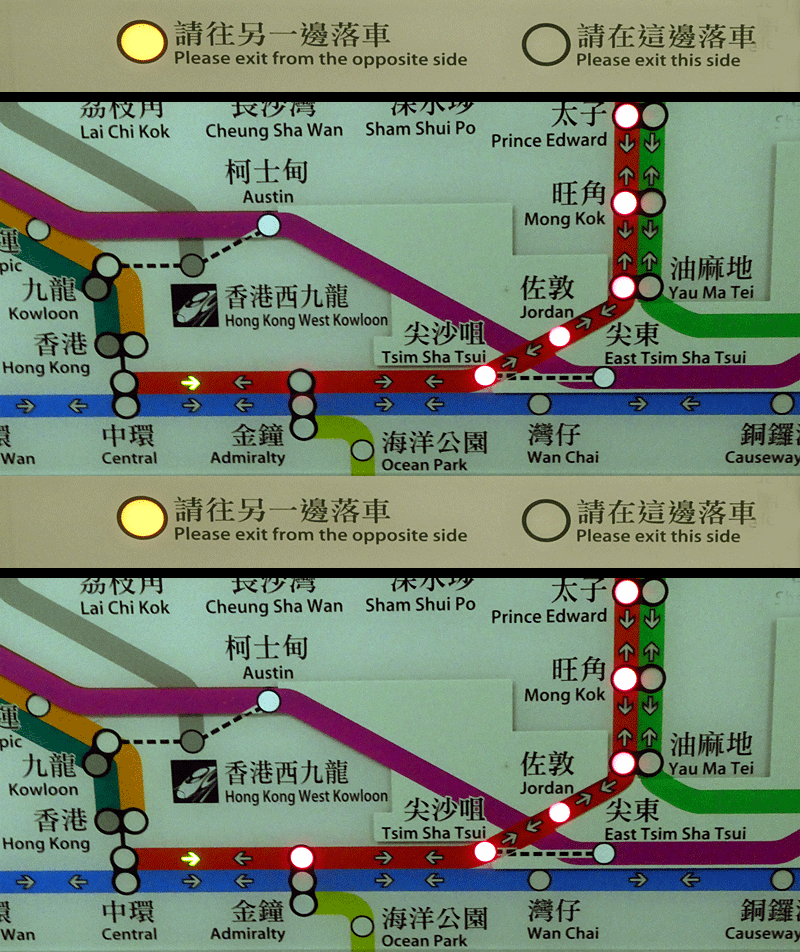
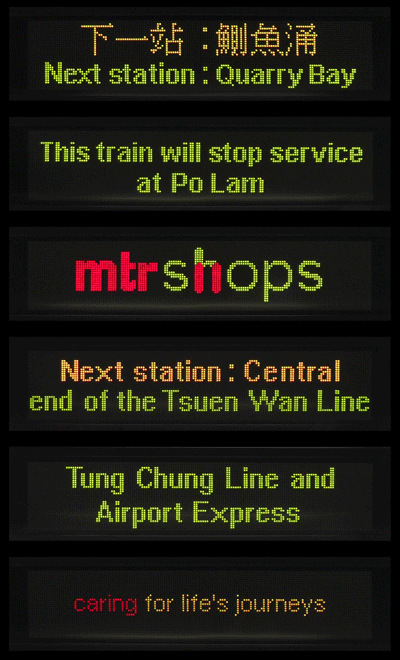
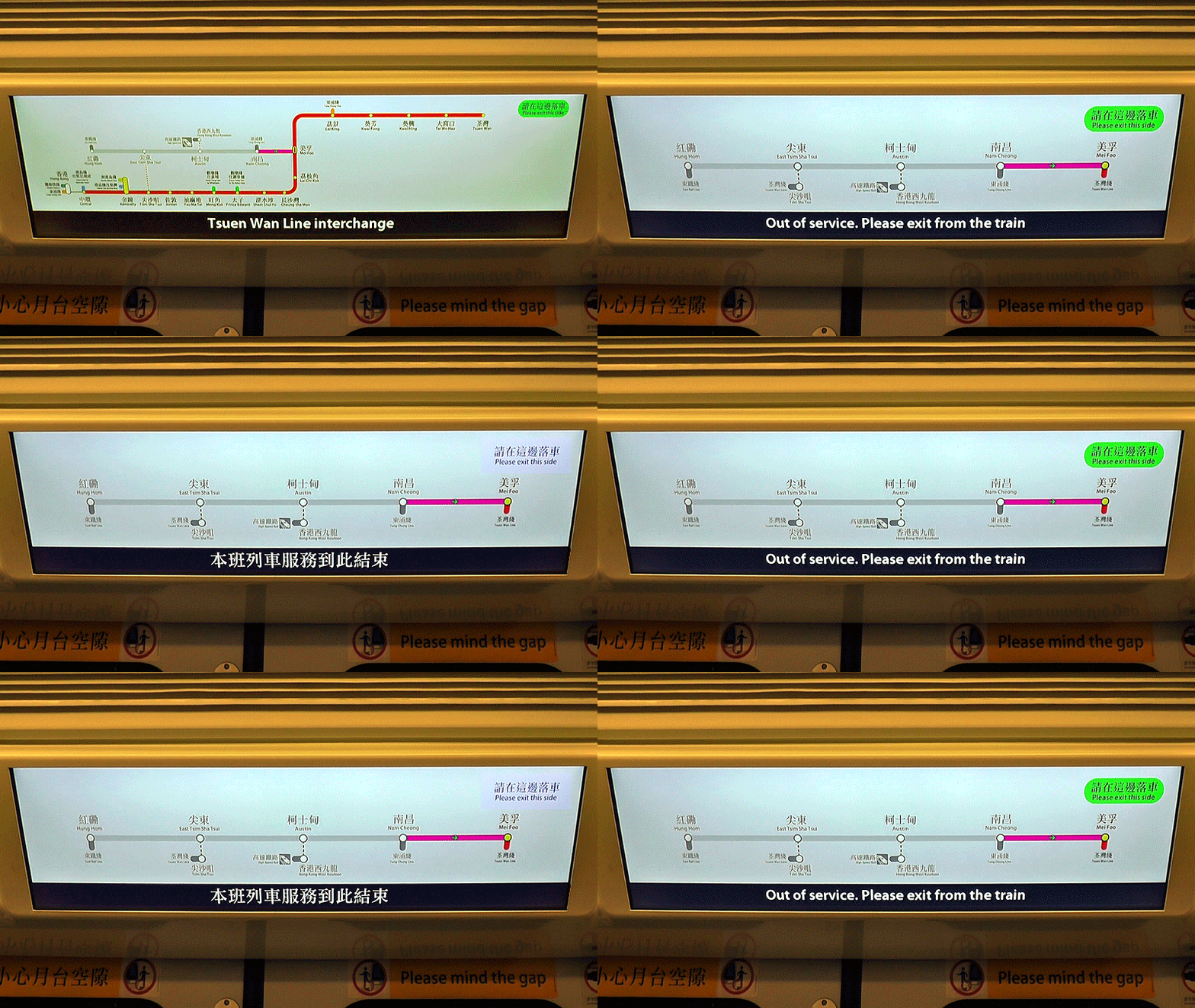
Nowadays the Hong Kong MTR (Mass Transit Railway) has many types of rolling stock which operate over its 10 lines. Virtually all of them feature longitudinal seating and four (or five) pairs of sliding doors on each side. Note that this section includes four animated images, these were all sourced from still image photographs and assembled in to working animations for this web page. The sequences shown were chosen to demonstrate some of what is possible - most images change every one or two seconds, this timing is not necessarily the same as on the real trains. |
|||||
 |
|
 |
|||
| Real-time information inside one of Hong Kong's older trains. The flashing light is the next station. Also seen here are arrows showing the direction of travel and lights indicating on which side of the train the doors will open at the next stop. |
|
The same trains also have these LED displays which in addition to travel information (next station, etc.,) also show transport operator promotional information. 'Stop Service' refers to the destination / terminus station. |
|||
 |
|
 |
|||
Left: Filmed inside a newer train which has both LCD displays and television style displays showing other information
- in this case world news headlines followed by the weather in Paris, London, Amsterdam and Zürich! Right: In the image seen here the green arrow shows that the train is travelling towards Mei Foo station, which for this train is the end of line / terminus station but is also an intermediate station on the Tsuen Wan line. Passengers then have a choice of travelling towards Tsuen Wan or Central - the latter being in the Central district in Hong Kong. (Filmed in 2018, since when this line has been extended - but this does not negate the usefulness of the animation). LCD displays show a much wider range of information than either route maps with flashing lights or LED dot-matrix displays. But each image is only seen for a while, so if (for instance - as seen in the animated image above) the next station is the 'end of line' and you wish to decide upon which train you need to catch for the next stage of your journey then you only have a limited amount of time before the image changes. In other words, there is still an important place for paper full route maps and network maps |
|||||
|
|||||
The Kowloon Canton Railway KCR dates from 1910 and when built was more of a main line type of railway which extended right in to China than an urban railway for Hong Kong. Nowadays this route is operated as the MTR East Rail line but one of its unique features is that the signalling system is designed for both computer controlled Hong Kong trains and human-driven freight (goods) and long-distance trains. The human-driven trains follow the usual railway four-aspect red / amber / double amber /green colour light signals whilst computer controlled train drivers see a blue signal. A similar solution is to be applied on two sections of London's Metropolitan line where human-driven and automated computer driven trains (will) provide jointly operated services on the same tracks. The blue signals will be between Raynors Lane - Uxbridge (jointly operated with Piccadilly line tube trains) and Harrow-On-The-Hill - Amersham (jointly operated with main line Chiltern Railways services). Another unique former KCR feature is that East Rail trains still offer first class seating. Travelling first class costs double the usual fare and does not guarantee a seat. |
|||||
 |
|
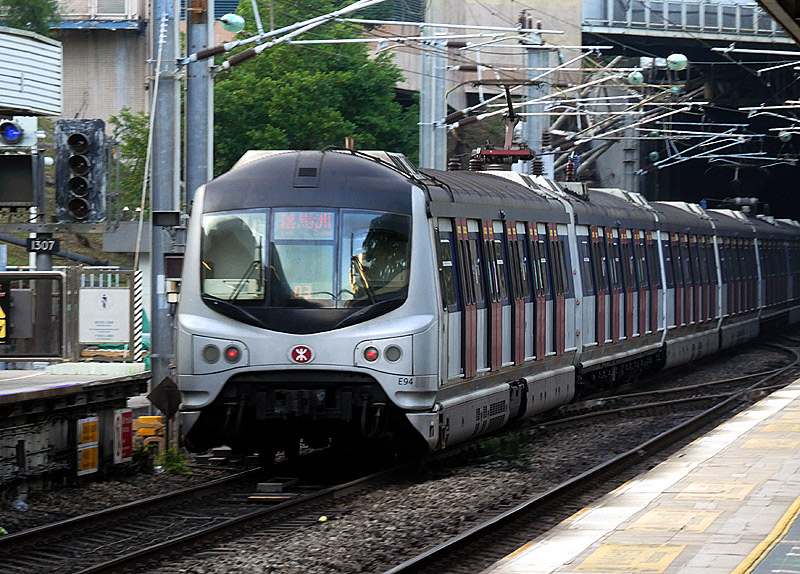 |
|||
| At some stations the platform staff have these hand-sized signs which they use to stop passengers from boarding crowded trains when it is time for the train to leave the station. |
|
East Rail train departs from a station - with a blue lamp next to the signal informing the train driver that the train is being controlled by an automated train control system. |
|||
Rubber Tyred Metro SystemsWhilst most urban railways use conventional steel wheels running on steel rails, a few use rubber tyred wheel systems. Although rubber tyred trains had already existed on the mainline railways, the French city of Paris is credited as having pioneered the use of rubber tyres on urban transport systems. The impetus behind this is said to be that at the end of WW2 the many years of heavy use but relatively little maintenance had left the métro system in a very run down condition and converting to rubber tyres was thought to be a way in which the system could be renovated and rejuvenated. The first Parisian rubber tyred train was introduced in 1951. Experimental in nature it operated a shuttle service between Porte des Lilas - Pré St Gervais over a section of track that was not in public service. The line closed again in 1961, although it is now proposed to re-open it as part of a new métro line. In 1956 line No.11 became the first full line to be converted. It was chosen because of its steep grades. Since then another three lines have been converted to rubber tyred trains, these being Nos. 1, 4, 6. Line 6 was converted in 1974 to cut down noise on its many elevated sections. However converting existing rail-based lines proved to be a very expensive process and is no longer done. For the record, whilst line 14 also uses rubber tyred trains this is because it was built this way from the outset. More information about rubber tyred metros and their genesis can be found here:
Nowadays métro trains using French rubber tyred technology operate in half a dozen French cities as well as several major global cities including Montréal Canada, Chicago USA, Santiago (Chile), Taipei, Taiwan / China and Mexico City. Other rubber tyred systems also exist, especially in Japan and with short distance airport people-mover systems. Whilst there are several variants in the implementation of rubber tyred systems, the core theme is for the rubber tyres to use twin parallel rollways, each of which will be the width of a tyre. Depending on city and the system builder these are typically formed of concrete, H-Shape hot rolled steel, or flat steel. Some systems also locate regular railway track between the rollways and the vehicles also have railway-style steel wheels with larger (taller / deeper) than normal flanges. In normal use these will be at small distance above the rails, their primary function being for guidance at points (switches/turnouts) and crossings. They are also needed in the case of a flat tyre. In Paris the steel rails also enabled mixed traffic with rubber-tired and steel-wheeled trains using the same track, particularly during the conversion periods. This use of two systems operating in parallel increases building / installation and maintenance costs. Systems without these tracks use other solutions for dealing with flat tyres and switching tracks at junctions. The essential difference between rubber-on-concrete and steel-on-steel is that rubber-on-concrete generates more friction. This increased friction results in various advantages and disadvantages... Advantages of using rubber-tyred trains (compared to steel wheel on steel rail):
Disadvantages of using rubber-tyred trains (compared to steel wheel on steel rail):
Rubber tyres have higher wear rates and therefore need more frequent replacement. Although a pair of steel wheels are more expensive than a pair of rubber tyres, the frequency of their respective replacements makes rubber tyres the more expensive option. In addition, additional rubber tyres are needed for guidance using the side rollers. In tunnels heat dissipation can be an issue as eventually all traction energy consumed by the train - except any electric energy regenerated back into the power supply system during braking - will end up as heat. Often this necessitates ventilating the tunnels. For fire resistance reasons the tyres are inflated with nitrogen. Some rubber tyred systems use single axle wheelsets flanked by side-facing guidance wheels, others copy normal 'steel wheel' railways and use twin axle bogies - which are also flanked by side-facing guidance wheels. |
|||||
 |
|
 |
|||
| The French VAL system uses single axle technology. This image comes from Lille; more about the automated (self driving) VAL system can be found on the Automated 'Driverless' Metro Systems page. | |
When Paris, France first started using rubber-tyred trains its trains used twin axle technology, as per most steel-wheel railways. This view shows the original MP 59 rubber tyred trains at Bastille station in 1963.
Image & license: jhm0284 / Wikipedia encyclopædia. CC BY-SA 2.0 http://commons.wikimedia.org/wiki/ File:JHM-1963-0074_-_Paris,_m%C3%A9tro_ligne_1,_Bastille.jpg |
|||
As the VAL system does not include steel tracks and wheels so to ensure correct route selection at junctions it uses a centrally located guidance rail. Away from junctions the mere presence of the side guidewalls is sufficient to provide the required steering functions. By way of contrast, the entire rubber tyred network on the Parisian métro was designed to also be suitable for steel wheel trains and at junctions guidance is obtained by lowering the rubber tyre rollways so that the steel wheels engage the metal tracks and the trains are steered in the traditional railway way, which is by the wheel flanges. |
|||||
 |
|
 |
|||
| VAL style switch / turnout / points as seen on the Taipei Metro Wenhu Line between ZhoneShan Jr. High School Station and SongShan Airport Station.
Image & license: Shih-Han Lin / Wikipedia encyclopædia. CC BY-SA 2.0 http://commons.wikimedia.org/wiki/File:NeiHuLine_Point.jpg. |
|
A crossover on the rubber tyred Parisian métro Line 1. In the distance is the Arc de Triomphe de l'Étoile. Image & license: Lukke / Wikipedia encyclopædia. CC BY-SA 3.0 http://commons.wikimedia.org/wiki/File: Paris_Metro_line_1_view_from_Esplanade_La_Defense.jpg. |
|||
 |
|
 |
|||
| Lyon métro train at Line B termunus of Gare d'Oullins. Trains from the same fleet are also used on Line A. Image & license: Ibou69100 / Wikipedia encyclopædia. CC BY-SA 3.0 http://commons.wikimedia.org/wiki/File: 631_TCL_Alstom_MPL75_Metro_B_Gare_Oullins_Mai_2014.JPG |
|
This roadway crossing at the exit from the depot in Lyon, France is about the nearest a rubber tyred métro train will normally get to travelling on a 'normal' road. Without the upstanding guide bars the steel wheels are essential for ensuring that
the train follows its correct pathway over the crossing.
Image & license: Romainbehar / Wikipedia encyclopædia. Public Domain. http://commons.wikimedia.org/wiki/File:Lyon-Metro-D-Atelier-Thiolley-Sortie.jpg |
|||
 |
|
 |
|||
| Inside a Lyon métro Lines A and B train when new.
Image & license: Sokl / Wikipedia encyclopædia. CC BY-SA 3.0 http://commons.wikimedia.org/wiki/File:Rame_non_rénové_en_2013.JPG |
|
Inside a Lyon métro Lines A and B train after being refurbished and given a radically different seating layout.
Image & license: Sokl / Wikipedia encyclopædia. CC BY-SA 3.0 http://commons.wikimedia.org/wiki/File: Rame_de_m%C3%A9tro_des_lignes_A_et_B_r%C3%A9nov%C3%A9.JPG |
|||
Apart from Paris and Lyon the only other French city to have a rubber tyred métro system which uses twin axles is Marseilles. More information about the several French (and other nation) métro systems which use the single axle VAL system can be found on the Automated 'Driverless' Metro Systems page. |
|||||
 |
|
 |
|||
| Marseilles métro trains at La Timone station.
Image & license: Clicsouris / Wikipedia encyclopædia. CC BY-SA 3.0 http://commons.wikimedia.org/wiki/File:Metro_de_Marseille_-_La_Timone_02.jpg |
|
Inside a Marseilles métro train.
Image & license: IngolfBLN / Wikipedia encyclopædia. CC BY-SA 2.0 http://commons.wikimedia.org/wiki/File:Marseille_-_Inside_Metro_(7537658024).jpg |
|||
Inspired by events in Paris, which at the time was converting some métro lines to rubber - tyred operation, the Montréal Canada métro - which opened in 1966 - became the first 'new build' system to choose rubber tyred technology. Being a more modern métro system it was engineered to avoid the sharp curves that are a feature of its Parisian rôle model; this allows the trains travel more quickly between stations and gives it an overall higher 'average' speed (ie: the total 'point to point' speed which includes the time spent during station stops). To reduce weather disruption in the severe and very snowy winters, the Montréal métro is fully enclosed with almost all the system underground - although some stations were designed to allow natural daylight to reach the platforms. |
|||||
 |
|
 |
|||
| The Montréal Canada métro. | |
A close-up of the wheel units which from this elevated viewpoint clearly shows how the side roller wheels fit inside the guiderail.
Image & license: GK tramrunner229 / Wikipedia encyclopædia. CC BY-SA 3.0 http://commons.wikimedia.org/wiki/File:MontrealMetroTires.JPG |
|||
 |
|
 |
|||
Real-time passenger information display system inside the Montréal métro trains. Information supplied includes the name of the next station and (as here) interchange possibilities.
When not showing travel information the displays show other local information, news, weather forecasts, etc., and paid advertising.

A video showing this system in use has been placed on YouTube and can be watched (in a new window) by clicking either the projector icon or this link - http://www.youtube.com/watch?v=HG_zyodzp7g .
The French have also sold rubber tyred métro technology to a few others cities, sometimes with these cities also using localised variants of the same types of rolling stock that were being built (at the time) for the Parisian métro. |
|||||
 |
|
 |
|||
| Rubber tyred métro train at Laraza station in Mexico.
Image & license: Tjeerd / Flickr. CC BY 2.0 http://www.flickr.com/photos/76396789@N00/755225. |
|
Inside a rehabilitated / refurbished Mexico City métro train type NM-73B CAF.
Image & license: Francisco Public Domain http://commons.wikimedia.org/wiki/File: Interior_de_un_NM-73B_con_cabina_CAF_rehabilitado _por_T%C3%A9cnicos_Mexicanos_del_STC.jpg. |
|||
 |
|
 |
|||
| Santiago (Chile) métro Line 5 train type NS74, which is the same as the Parisan MP73 Image & license: Ariel Cruz Pizarro / Wikipedia encyclopædia. CC BY 2.0 http://commons.wikimedia.org/wiki/File:NS74_L5_MetroStgo.jpg. |
|
Santiago (Chile) métro Line 5 train type NS93, which is the same as the Parisan MP89 Image & license: Ariel Cruz Pizarro / Wikipedia encyclopædia. CC BY 2.0 http://commons.wikimedia.org/wiki/File:NS_93,_Metro_de_Santiago.jpg. |
|||
 |
|
 |
|||
| Parisian MP89 métro train at Nation station before Line 1 was converted to full unattended automation and the station was fitted with platform screen doors.
Image & license: Pline / Wikipedia encyclopædia. CC BY-SA 3.0 http://commons.wikimedia.org/wiki/File:Ligne-1-Nation-2.jpg. |
|
Lausanne (Switzerland) MP89 TL métro Line 2 trains are also clones of Parisian MP89 métro rolling stock, albeit with fewer carriages. The Lausanne system was fully automated with platform screen doors right from the outset. | |||
 |
|
 |
|||
| When Lausanne métro Line M2 was built it included constructing a railway bridge under an existing road bridge. The Bessières road bridge and the St-Martin railway bridge plus the Cathedral of Notre Dame in the background. |
|
Inside a Lausanne M2 métro train. | |||
| |||||
| Detailed inspections of the Lausanne métro Line M2 tracks. Left: Guide bar, rollway and steel wheel rail. The surface of the rollway is ribbed, this is to wick water away and assist with adhesion on this steeply graded line. In addition to the normal braking systems these trains have powerful magnetic track brakes which form part of the emergency braking system and are also used at station stops to ensure that the train does not move whilst passengers alight and then board. Middle: Close up view showing an expansion joint which allows the tracks to expand / contract according to seasonal air temperatures. Photographed through a glass wall. Right: This image taken at the southern terminus and lakeside resort station of Ouchy includes an end-on view of the angle iron guide bars and the I-beam rollways which are an integral part of the track system. In the distance another train can be seen approaching. Photographed through a glass wall. |
|||||
 |
|
 |
|||
| A bogie (wheel unit) for a Paris métro rubber tyred train which includes steel-wheel railway track capability.
Image & license: Rama / Wikipedia encyclopædia. CC BY-SA 2.0 FR http://commons.wikimedia.org/wiki/File:Bogie-metro-Meteor-p1010692.jpg |
|
Close up front wheel unit of a rubber tyred métro train above an under-train inspection pit in the depot. The train is using the steel rail wheels with just fresh air directly below the rubber tyre.
Also note the blue coloured brushes on the underside of the front side-facing guidance wheel.
Image & license: greenski / Flickr CC BY-SA 2.0 http://www.flickr.com/photos/35885802@N00/3972076887/ |
|||
In Japan there are almost a dozen rubber tyred systems, these use home-grown technologies. Sapporo's Nanboku Line opened in 1971 when it became the first such system to use a central guiding rail. |
|||||

Image & license: Sameboat / Wikipedia encyclopædia. CC BY-SA 3.0 http://commons.wikimedia.org/wiki/File:ST_SN5000_20061102_001.jpg |
|

Image & license: Nobinobita / Japanese Wikipedia User CC BY-SA 3.0 http://commons.wikimedia.org/wiki/File:Sapporo_subway_shelter.jpg. |
|||
| These images were taken on the southern section of the line which is elevated and to protect it from heavy winter snowfall (as well as reduce noise) is enclosed in an aluminium shelter. | |||||

Image & license: Kinori / Wikipedia encyclopædia. Public Domain. http://commons.wikimedia.org/wiki/File:SapporoNanbokusen.jpg |

Image & license: Rsa / Wikipedia encyclopædia. CC BY-SA 3.0 http://commons.wikimedia.org/wiki/File:Sapporo_subway_test_car_suzukake.jpg |
||||
More images from Sapporo's Nanboku Line showing the shelter from the outside and a prototype vehicle - on which (at the front) it is possible to see the side rollers which grip the central guiding rail.
Other Japanese rubber tyred systems include the Kobe Port Island Line (also known as Port Liner) and New Transit Yurikamone. Both of these use side guidewalls for guidance and are automated driverless systems so are often known as 'automated guided transits' (AGT). |
|||||
 |
|
 |
|||
| Port-Liner at Sannomiya station.
Image & license: Hideyuki KAMON / Wikipedia encyclopædia. CC BY-SA 2.0 commons.wikimedia.org/wiki/File:Port_Liner_at_Sannomiya_Station.jpg. |
|
Tokyo New Transit Yurikamome at Hinode station.
Image & license: Hideyuki KAMON / Wikipedia encyclopædia. CC BY-SA 2.0 commons.wikimedia.org/wiki/File:Hinode_Station_(Tokyo)_in_2008.jpg. |
|||
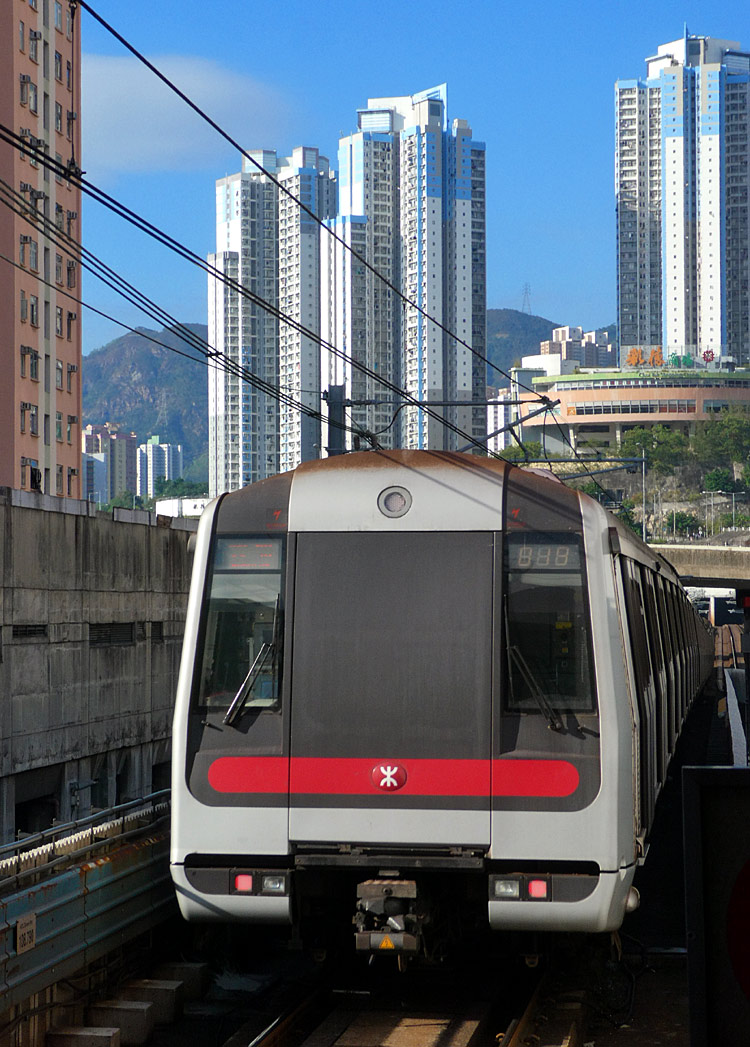
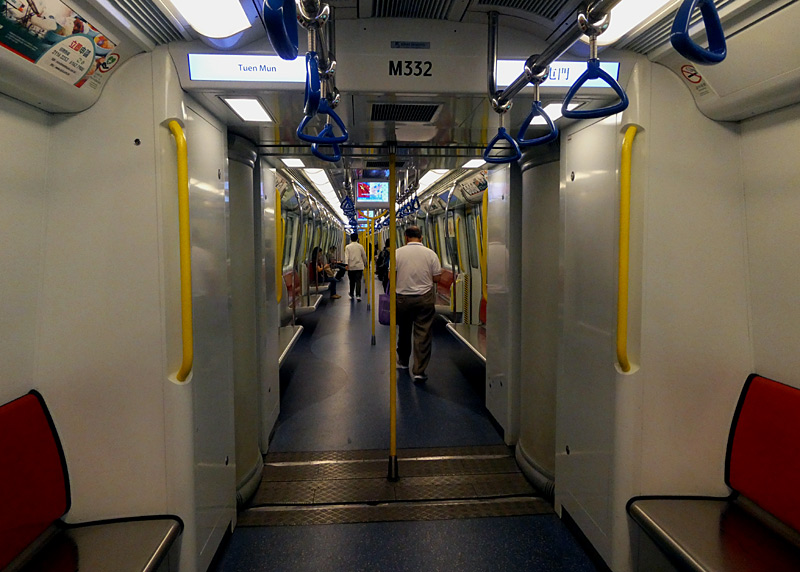
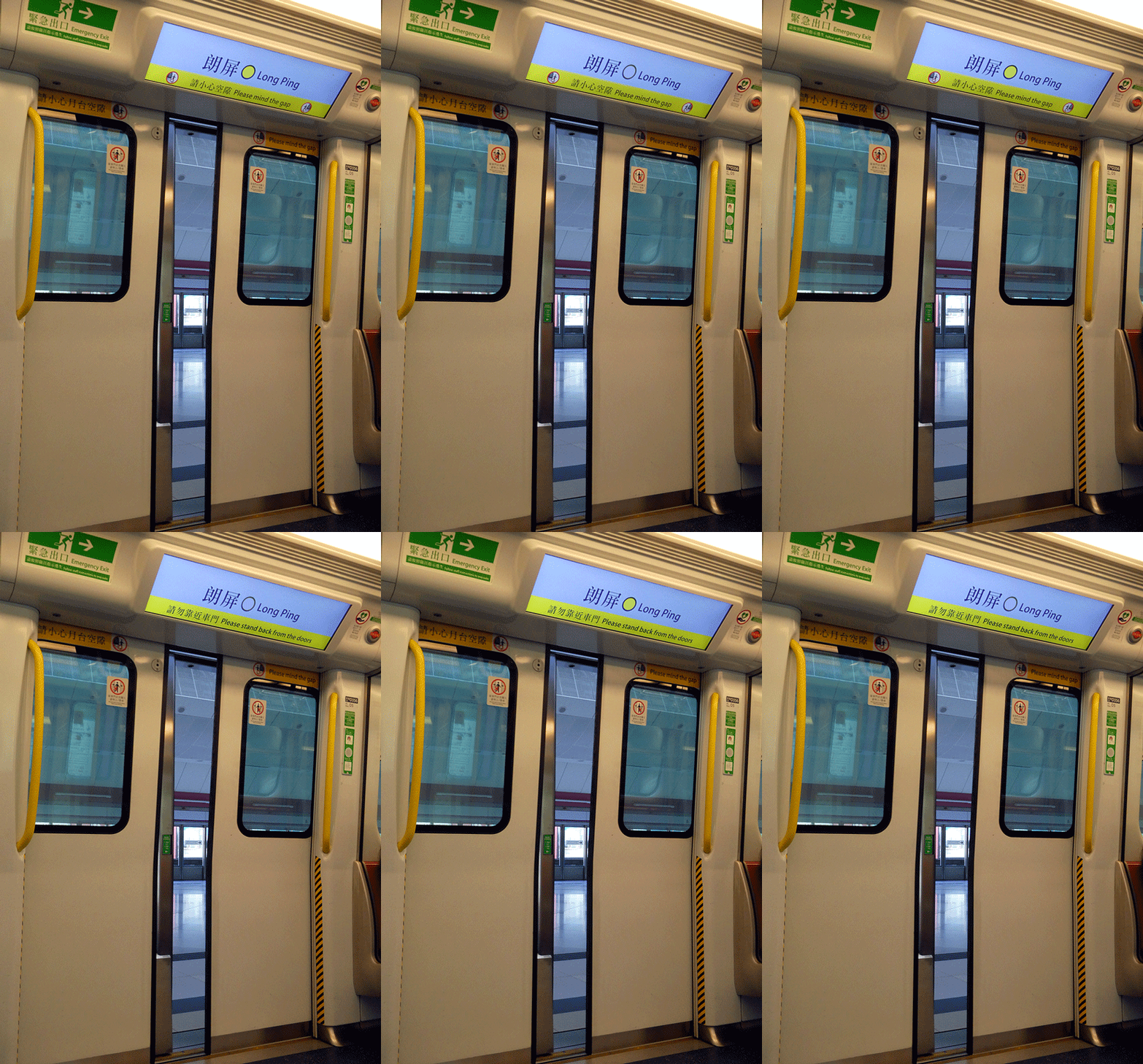


Direct links to other Passenger Train Variations pages.
- Long Distance InterCity Trains
- Medium Distance Trains
- Trams, Streetcars and Light Rail Vehicles
- Automated 'Driverless' Metro Systems
- "Walk-through" Trains
- On-train Refreshment Facilities, Double-Deck Trains, & Taking Bicycles On Trains
 |
|
|
|
|
|
|
|
|
|
|
|
|
|
|
|
|
|
|
|
|
|
|
|
|
|
|
|
|
|
|
|
|
|
|
|
|
|
|
|
|
|
|
|
|
|
|
|
|
|
|
|
|
|
 |
|
||||||||||||||||||||||||||||||||||||||||||||||||||||
 |
 |
 |
 |
 |
 |
 |
 |
|
|||||||||||||||||||||||||||||||||||||||||||||
 |
 |
 |
|
||||||||||||||||||||||||||||||||||||||||||||||||||
 |
 |
 |
|
||||||||||||||||||||||||||||||||||||||||||||||||||
 |
 |
 |
 |
 |
 |
|
|||||||||||||||||||||||||||||||||||||||||||||||
 |
 |
|
|||||||||||||||||||||||||||||||||||||||||||||||||||
 |
 |
 |
|
||||||||||||||||||||||||||||||||||||||||||||||||||
 |
 |
|
|||||||||||||||||||||||||||||||||||||||||||||||||||
 |
 |
|
|||||||||||||||||||||||||||||||||||||||||||||||||||
 |
|
||||||||||||||||||||||||||||||||||||||||||||||||||||
 |
 |
 |
|
||||||||||||||||||||||||||||||||||||||||||||||||||
 |
 |
|
|||||||||||||||||||||||||||||||||||||||||||||||||||
 |
 |
 |
|
||||||||||||||||||||||||||||||||||||||||||||||||||
 |
|
||||||||||||||||||||||||||||||||||||||||||||||||||||
 |
 |
|
|||||||||||||||||||||||||||||||||||||||||||||||||||
 |
 |
 |
|
||||||||||||||||||||||||||||||||||||||||||||||||||
 |
 |
 |
|
||||||||||||||||||||||||||||||||||||||||||||||||||
 |
 |
 |
|
||||||||||||||||||||||||||||||||||||||||||||||||||
 |
 |
 |
|
||||||||||||||||||||||||||||||||||||||||||||||||||
 |
|
||||||||||||||||||||||||||||||||||||||||||||||||||||
 |
 |
 |
|
||||||||||||||||||||||||||||||||||||||||||||||||||
 |
|
||||||||||||||||||||||||||||||||||||||||||||||||||||
 |
|
||||||||||||||||||||||||||||||||||||||||||||||||||||
 |
|
||||||||||||||||||||||||||||||||||||||||||||||||||||
 |
 |
 |
|
||||||||||||||||||||||||||||||||||||||||||||||||||
 |
 |
 |
|
||||||||||||||||||||||||||||||||||||||||||||||||||
 |
|
||||||||||||||||||||||||||||||||||||||||||||||||||||
 |
 |
 |
 |
 |
 |
|
|||||||||||||||||||||||||||||||||||||||||||||||
 |
 |
 |
|
||||||||||||||||||||||||||||||||||||||||||||||||||
 |
|
||||||||||||||||||||||||||||||||||||||||||||||||||||
 |
 |
 |
|
||||||||||||||||||||||||||||||||||||||||||||||||||
 |
 |
|
|||||||||||||||||||||||||||||||||||||||||||||||||||
 |
 |
 |
|
||||||||||||||||||||||||||||||||||||||||||||||||||
 |
|
||||||||||||||||||||||||||||||||||||||||||||||||||||
 |
 |
 |
|
||||||||||||||||||||||||||||||||||||||||||||||||||
 |
|
||||||||||||||||||||||||||||||||||||||||||||||||||||
 |
|
||||||||||||||||||||||||||||||||||||||||||||||||||||
 |
 |
 |
|
||||||||||||||||||||||||||||||||||||||||||||||||||
 |
|
||||||||||||||||||||||||||||||||||||||||||||||||||||
 |
 |
 |
 |
 |
 |
|
|||||||||||||||||||||||||||||||||||||||||||||||
 |
|
||||||||||||||||||||||||||||||||||||||||||||||||||||
 |
|
||||||||||||||||||||||||||||||||||||||||||||||||||||
 |
|
||||||||||||||||||||||||||||||||||||||||||||||||||||
 |
 |
|
|||||||||||||||||||||||||||||||||||||||||||||||||||
 |
 |
 |
|
||||||||||||||||||||||||||||||||||||||||||||||||||
 |
|
||||||||||||||||||||||||||||||||||||||||||||||||||||
 |
|
||||||||||||||||||||||||||||||||||||||||||||||||||||
This page last updated 2nd February 2026
E & OE.
© Copyright 2001 - 2026 Simon P Smiler and named image sources.
Privacy Policy.
