
Visitors to London who are also transport enthusiasts (‘railfans’) sometimes ask for advice as to the ‘best’ things to see on London’s railway network. This page is part of a guide which aims to answer that question.
If this is the first time you have reached these pages then it is best to go to the Opening Page which sets the scene, explains the difference between the small and the large profile trains, offers advice on the best type of ticket to buy and photography tips.
Alternatively, it is possible to view everything on one page
Busier Suburban Stations Of Interest
In addition to terminal stations in Central London, there are some busier suburban stations where a variety of trains can often be seen. This list only looks at those in zones in zones 1-4. These include: Clapham Junction, Richmond, Ealing Broadway, Wimbledon, West Ham and Stratford.
- Clapham Junction: (south London). With 18 platforms (numbered 1-17 plus 0, which is not used) this is one of the busiest stations in all of Great Britain.
You will see many trains from Waterloo [South Western Railway] and Victoria [Southern] passing through, including the Gatwick Express and the Southern trains which use the
West London Line to link destinations to the north of London with destinations to the south of London. Although not served by Underground trains, this station is on the London Overground network,
being served by trains which use the South and West London (Windrush and Mildmay) lines.
This page in the National Rail website includes much information about Clapham Junction station and a map showing the platforms:
http://www.nationalrail.co.uk/stations/CLJ/details.html
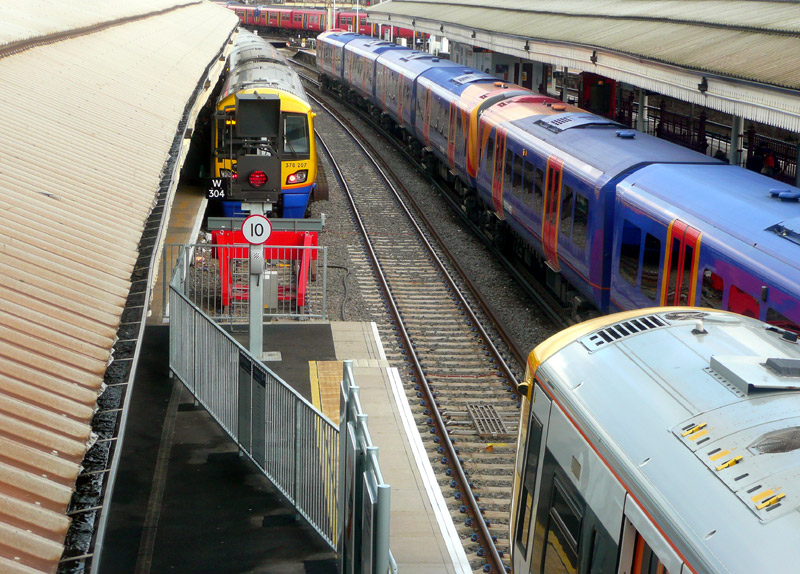
This photograph is looking east, towards Central London and Waterloo / Victoria railway stations.
Looking across the station we see two SWR Class 455 trains and a Southern train, either a Class 375 or Class 377.
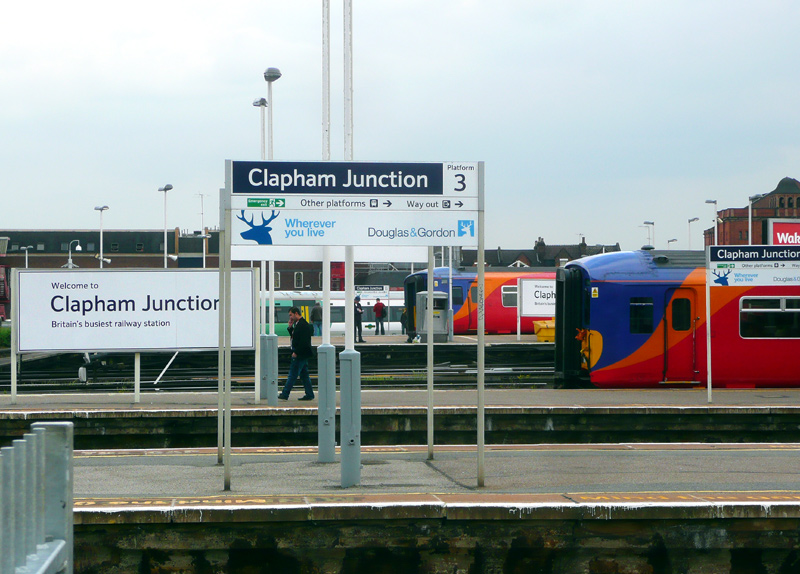
This photograph is looking south.
- Richmond: (south-west London). This is a South Western Railway station that is also used by Overground and Underground trains. The platform circulating area includes a food outlet with tables
where you can watch trains come and go. The glass skylight affords weather protection in inclement weather.
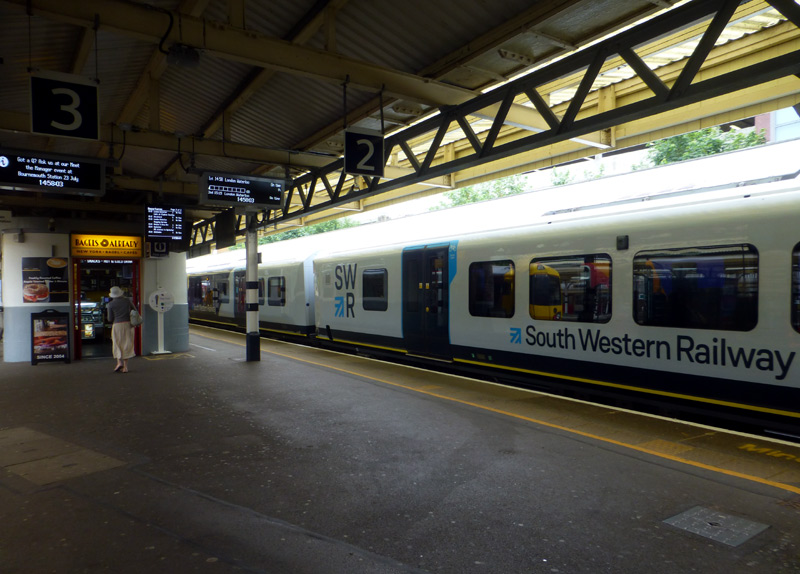
Platforms 1 and 2 are through platforms for South Western Railway services - typically nowadays just electric multiple units of various types.
Platforms 3 to 7 are terminating platforms, London Overground (North London / Mildmay line) services normally use platforms 3 and 4 but sometimes also use platforms 5, 6 or 7 whilst Underground District line trains normally use platforms 5, 6 and 7 but can also use platform 4. District line trains can not use platform 3, as there is no fourth rail (electric power supply).
This page in the National Rail website includes much information about Richmond station and a map showing the platforms:
http://www.nationalrail.co.uk/stations/RMD/details.html
 |
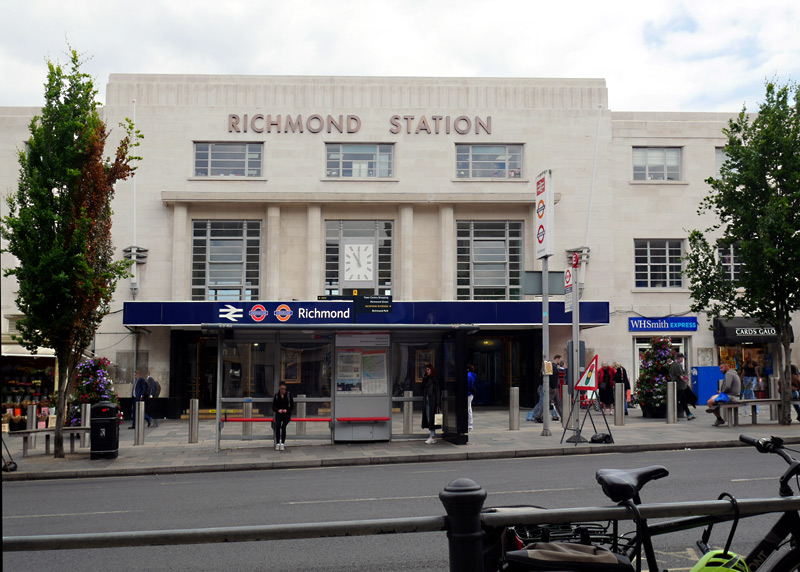
with a square clock was built by the Southern Railway in 1937.
Either side of the windows are white flagpoles which are not
easily seen against the white Portland stone.
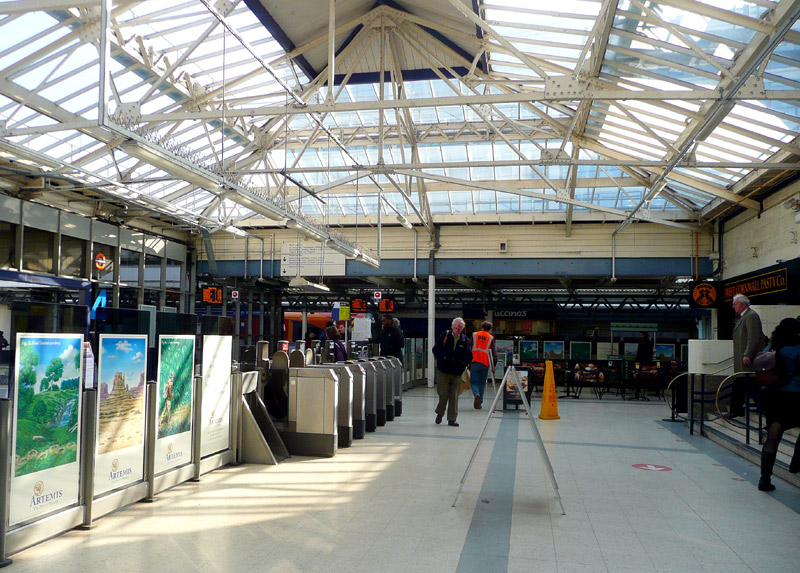
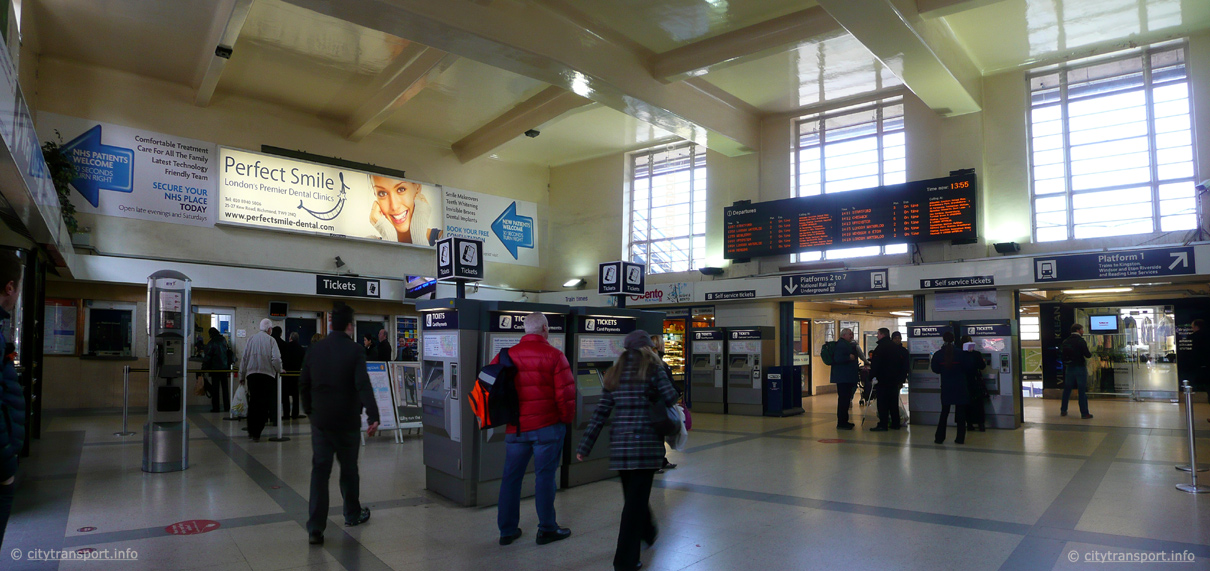
In the distance can be seen some tables and chairs where people can eat foods purchased here.
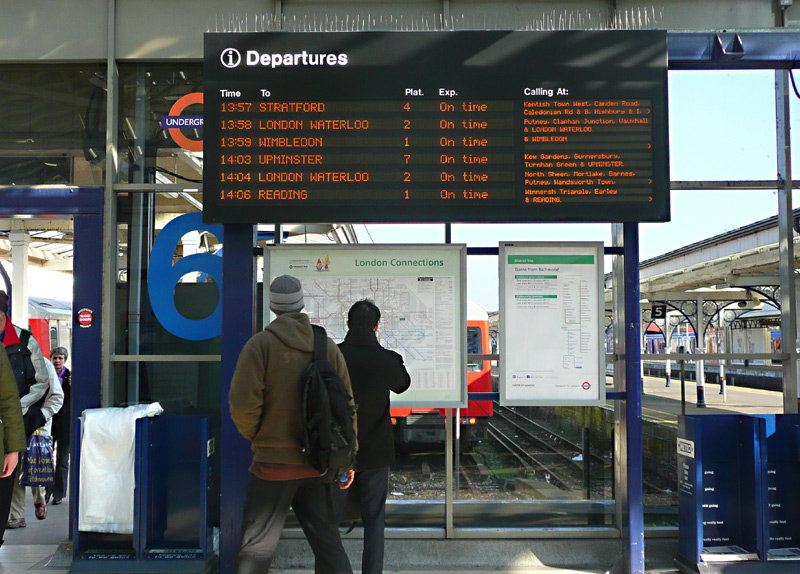
seen moments after the first train (London Overground
North London / Mildmay line to Stratford) had departed.
The next District line departure is the 14:03 from platform 7.
The barriers and electric ticket gates at Richmond station split the circulating area in front of the trains into two and mean that passengers changing trains need to effectively leave the fares paid area (ie; break their journey) to access most of the food outlets or use the toilets. For passengers using Oyster PAYG this can result in extra costs (a new fare being charged for the next part of their journey).
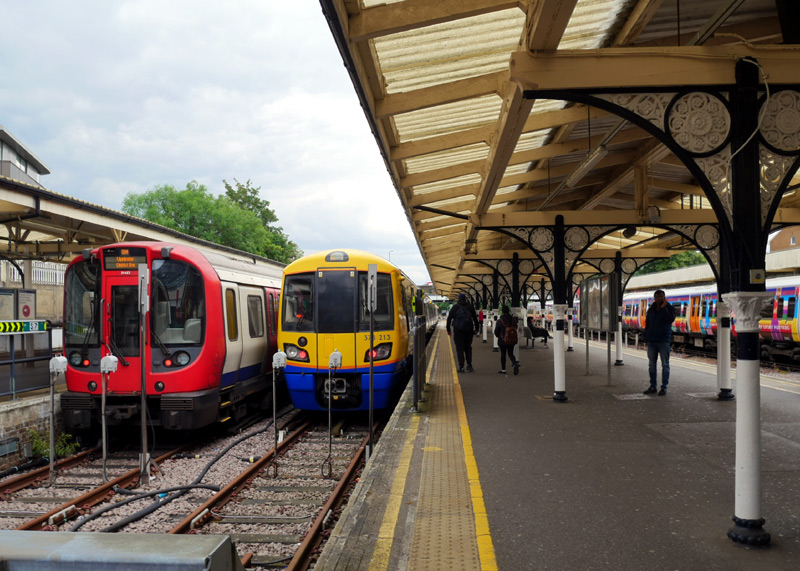
London Overground Class 378 trains at platforms 5 and 3
(the latter is in a special livery).
- Ealing Broadway: (west London). This station is served by Central, District and Elizabeth line trains.
Since the introduction of the full Elizabeth line service in May 2023 outer suburban trains operated by Great Western Railway (GWR) travelling between Paddington and Didcot Parkway no longer stop here and nowadays it is comparatively rare for GWR trains to call at this station.
Platforms 1 and 2 are normally used by non-stop trains which typically includes Intercity Express Trains travelling towards Bristol, Cardiff, Swansea and Penzance, Class 387 outer suburban multiple-unit trains travelling to various regional destinations and Heathrow Express trains travelling to Heathrow Airport.
Platforms 3 and 4 are used by Elizabeth line local 'all stations' and freight trains.
Platforms 5 and 6 are used by Central line trains. These platforms were built by the Great Western Railway for the Central London Railway in 1920, so therefore always have been part of the GWR (main line) station.
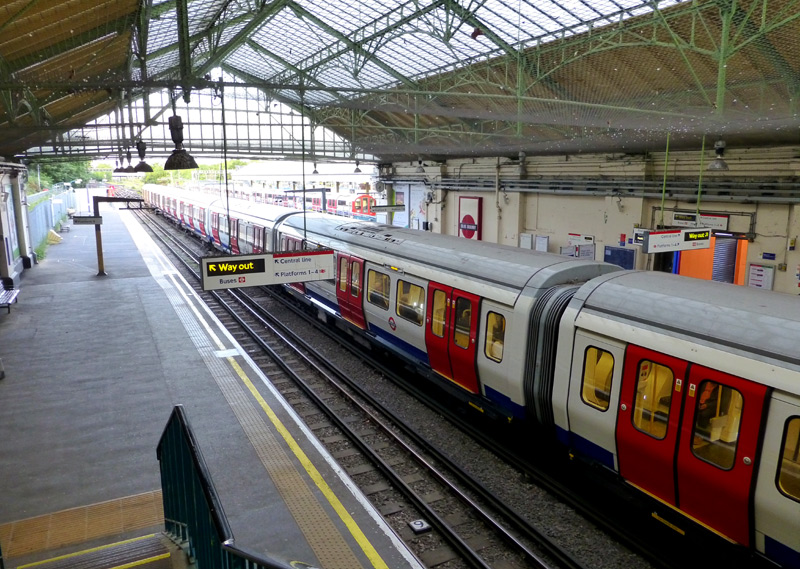
Platforms 7, 8, 9 are used by District line trains. Platforms 8 and 9 are partially inside a trainshed which features historic signage. This is the original District Railway station although nowadays the street frontage is used by various retail shops and all passengers use the main station entrance and ticket hall.
Although all passengers use the same ticket office the District line's platforms are still looked after by different staff, and as a result when using my camera at this station I have sometimes found that even though the main line staff have said 'OK' the Underground staff (on the District line platforms) have not been happy and complained that I did not also speak with them about my using my camera.
This page in the National Rail website includes much information about Ealing Broadway station and a map showing some of the platforms:
http://www.nationalrail.co.uk/stations/EAL/details.html
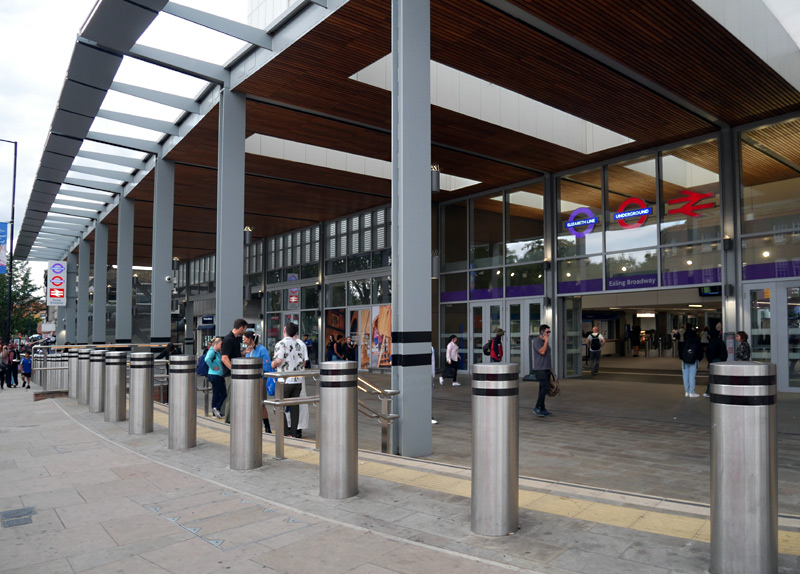
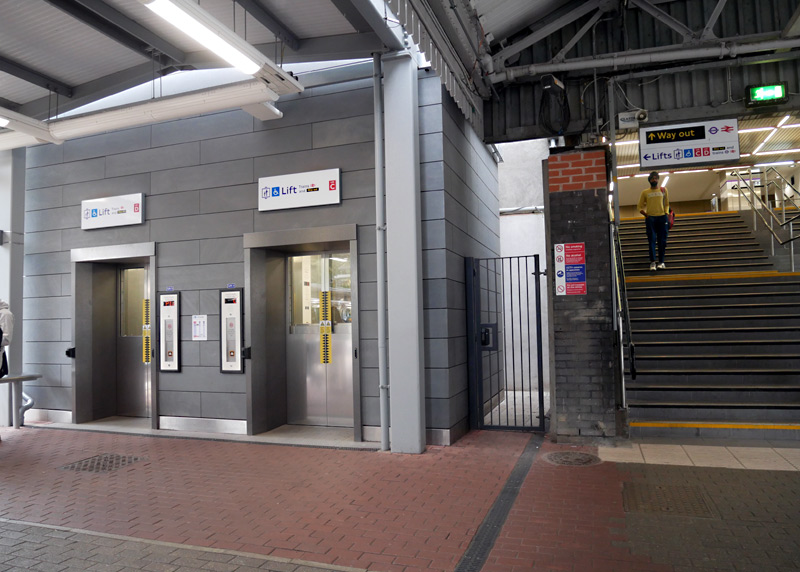
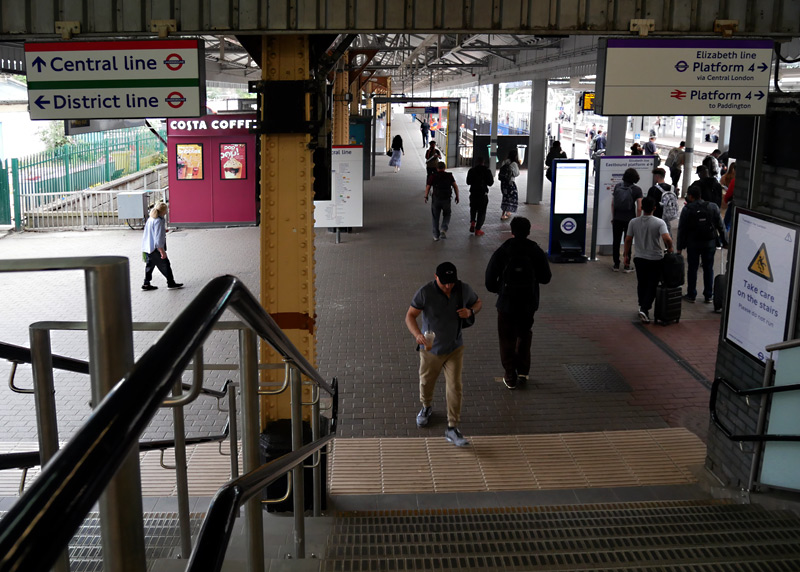
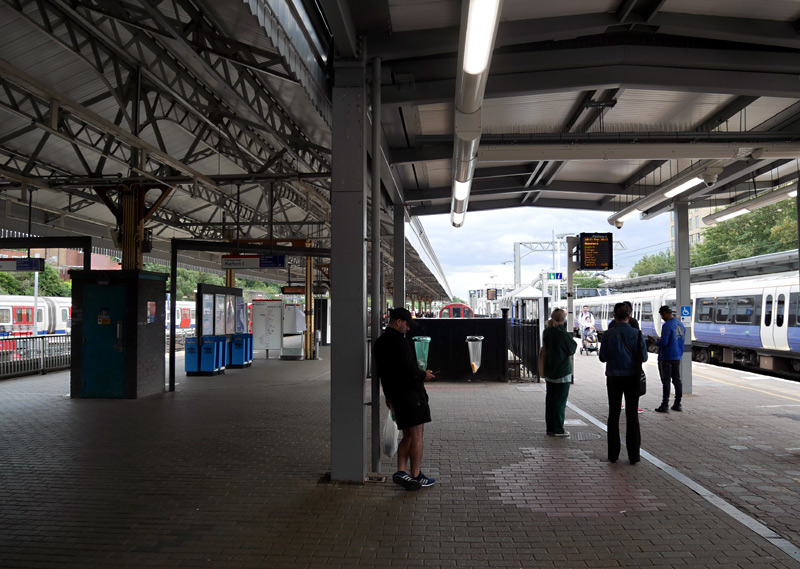
District line to the left, Central line straight ahead
Eastbound Elizabeth line to the right.
Westbound Elizabeth line trains use a different stairway.
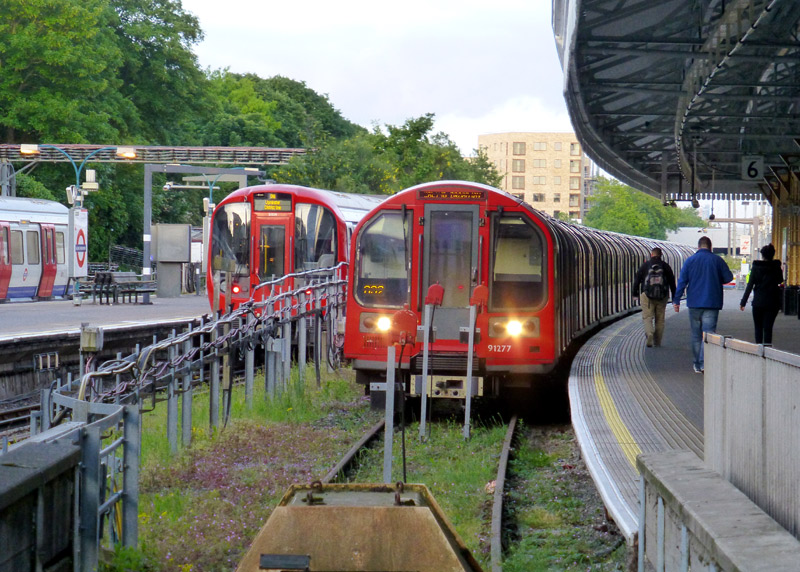
Central line 1992 tube stock trains are at both platforms 6 and 5.
Platform 4 is empty, a westbound Class 345 Elizabeth line train is at platform 3, out of sight behind it are platforms 2 and 1.
District line platforms 9 and 7 are empty
whilst there is an S stock train at platform 8.
On the far side of the trainshed wall is
one of the heritage station name signs.
In the far distance a Central line 1992 tube stock
train can be seen at platform 6.
A Central line train is at platform 6.
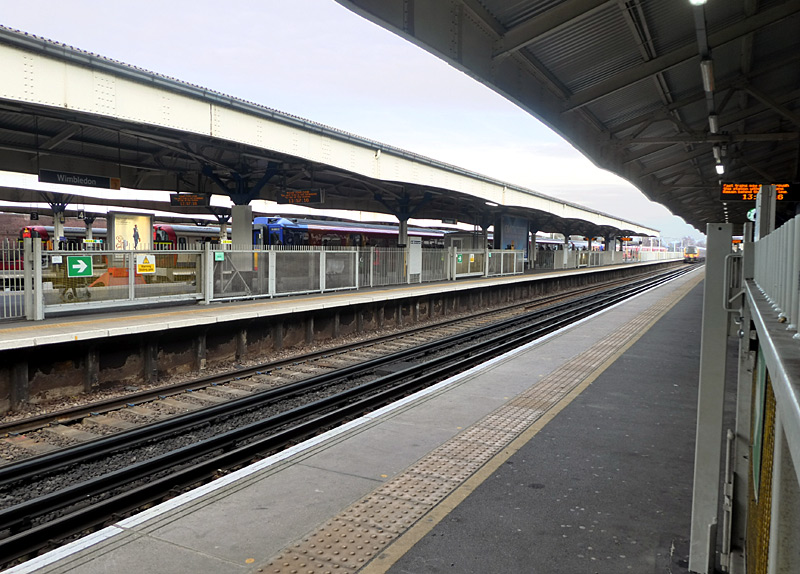
- Wimbledon: (south-west London). This is a South Western Railway station which is also served by trains - and trams - from several other railway operators.
Platforms 1 - 4 are terminating platforms and used by London Underground District line trains.
Platforms 5 and 8 are used by South Western Railway inner suburban (local) services.
Platforms 6 and 7 are fast tracks used by express and other non-stop trains. Because most trains travel through without stopping platform gates prevent access to these platforms.
Platform 9 is bi-directional and used by Thameslink trains which travel through to Elephant & Castle, Farringdon and the north of London.
Platform 10 is used by London / Croydon Tramlink. Because of a need to operate more trams than is possible with one platform this platform has been split into two sections, so that there are two tram platforms - Nos. 10a and 10b.
Special Information For Using Smart Card Ticketing (Oyster / Contactless / Other Device) In PAYG Mode At Wimbledon Station
* To reduce the risk of complications these rules should also be followed if you have an Oystercard with a Day Anytime, Day Off-peak or 7 Day Anytime Travelcard
* If you arrive here by any of the train services and are planning to depart on the tram you must 'touch-in' using a TRAM card reader on tram platform No.10, as otherwise you will end up being financially penalised for not 'touching-out' at the end of your train journey AND be travelling on the tram without having paid your fare.
* If you arrive here by tram and are continuing your journey by either the Underground or any National Rail (main line) service then you must 'touch-in' on one of the railway card readers - ideally on Thameslink platform 9 which is next to the trams but you can also use a yellow card reader on District line platforms 1 - 4. Important: Only yellow card readers should be used at platforms 1-4, NOT pink card readers. Otherwise you will be travelling on the train without a valid ticket and when you 'touch-out' at your ultimate destination station you will be financially penalised.
* Passengers who enter Wimbledon station from the street and are intending to travel on the tram must also 'touch-in' again on one of the tram card readers located on tram platform No.10. Otherwise the system will treat you as if you are travelling by one of the other railways and you will be financially penalised.
* Whilst it is usually possible to reclaim the excess charges from the Oyster helpline the process is a hassle.
* If you are using paper One Day Travelcards then you can ignore all these ticketing complications and just travel in the normal way!
* If you are using a One Day Bus and Tram pass then you must not travel on the trains.
More detailed Oyster ticketing information for passengers using Wimbledon station can be found here:-
https://www.oyster-rail.org.uk/trams-and-buses/
https://www.oyster-rail.org.uk/wimbledon/
Passengers going to the All England Lawn Tennis and Croquet Club (eg: for the annual Wimbledon Tennis Championships Tournament) should travel to Southfields station, as it is nearer than Wimbledon station.
This page in the National Rail website includes much information about Wimbledon station and a map showing the platforms:
http://www.nationalrail.co.uk/stations/WIM/details.html
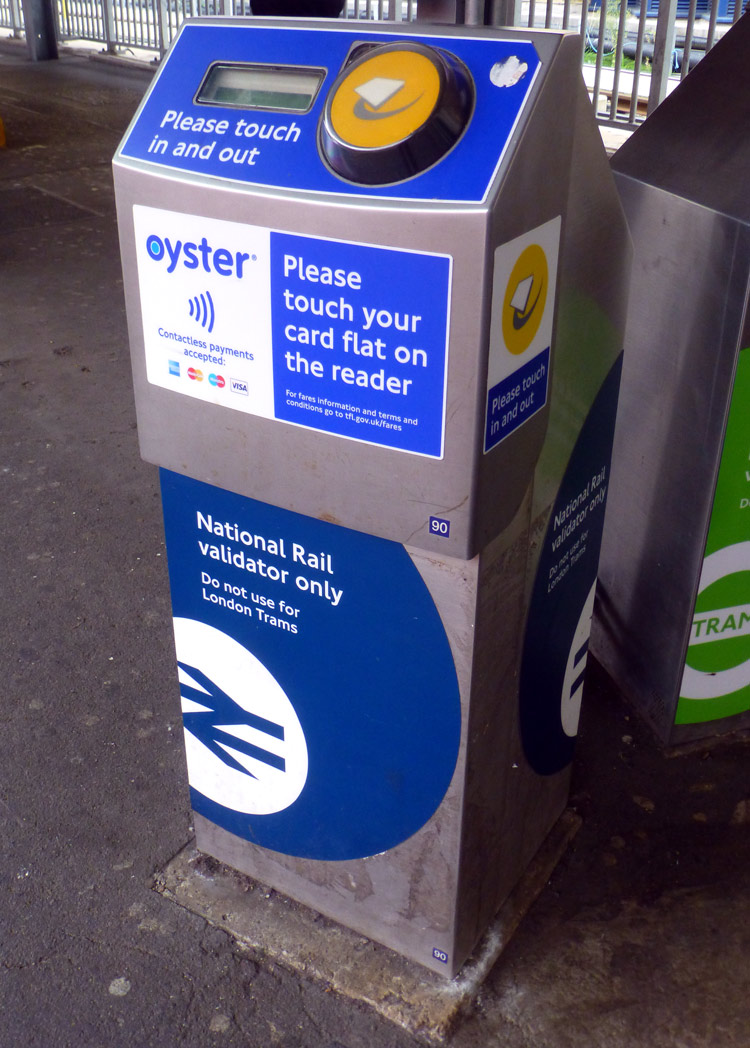
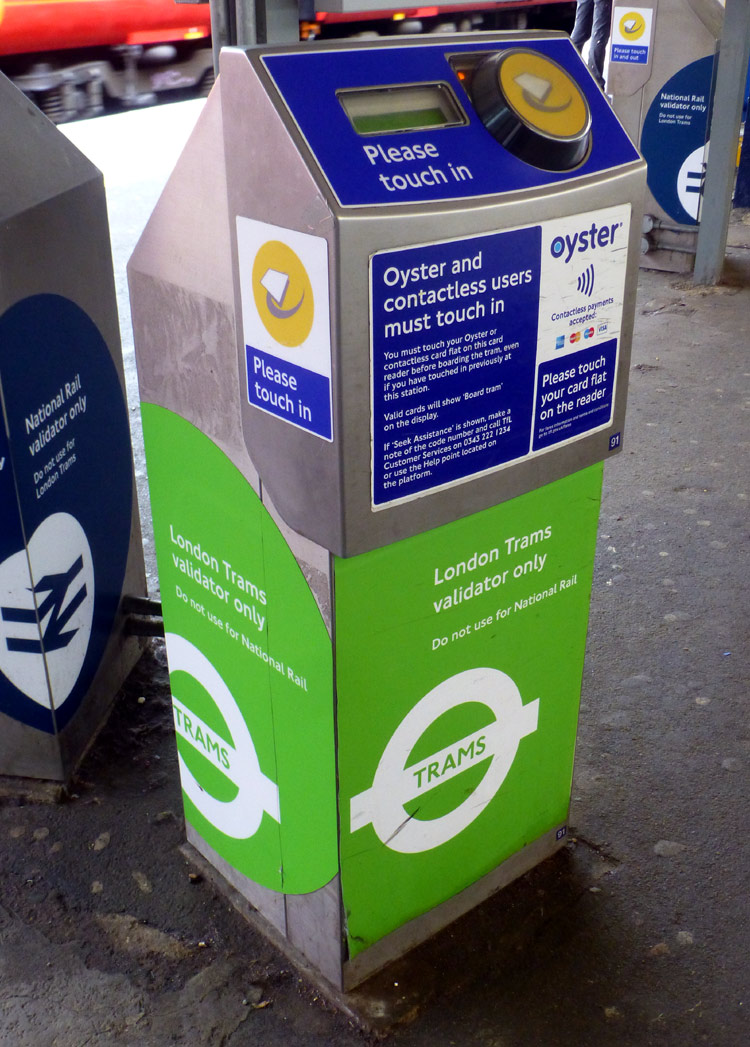
to alert passengers to their different functions - any type of train (left) and trams (right).
If paying fares using electronic smart card devices (Oyster / contactless / smartphone / keyfob, etc.,) it is very likely that you will need to use a card reader when interchanging between the trams and trains. Be careful, as forgetting to 'touch-in/out' or using the wrong card reader could prove to be very expensive!!
For the benefit of interchanging passengers there are also pink (route validator) and yellow card readers the platforms (Nos. 1-4) which are used by the District line trains - these too are for interchanging passengers - the pink card readers are for passengers making journeys where the fares are lower if the passenger avoids travelling in Zone 1 whilst the yellow card readers are for passengers who are either starting a train (underground or main line) journey after arriving here by tram or have split their fares over several tickets with paper tickets being used to travel on main line railway journeys operated by SWR or Thameslink and electronic smart card devices being used to pay their fares on the District line underground trains.
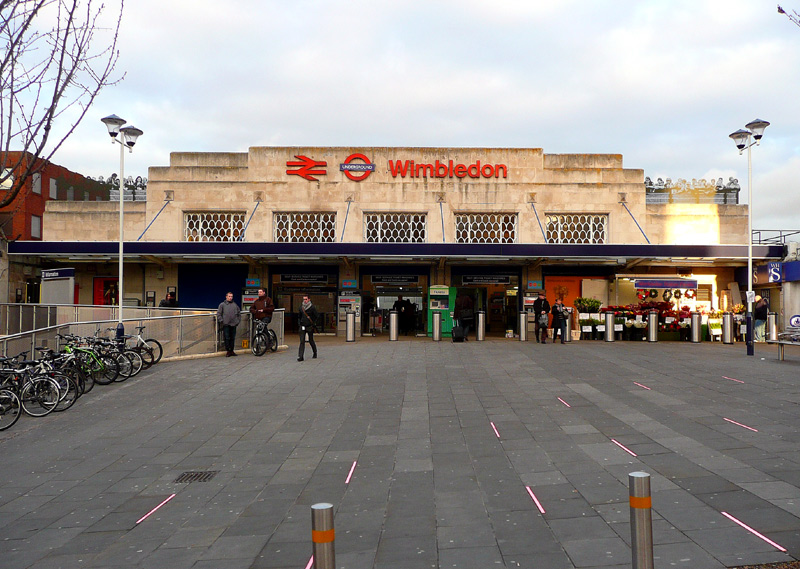

When built there was an access road directly in front of the station, for ‘kiss and ride’ passengers and a taxi rank but this area is now a pedestrian piazza which features floor lighting that cycles through a rainbow of colours.
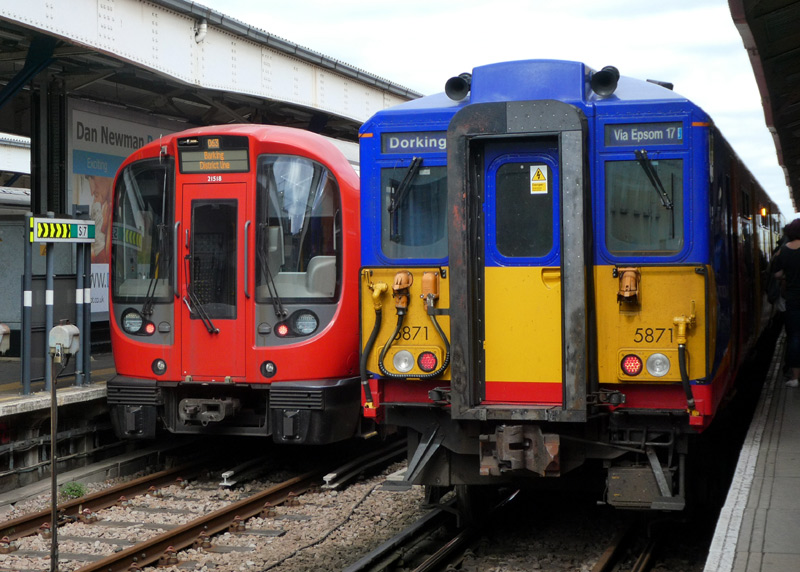
and a South Western Railway Class 455 train at platform 5.

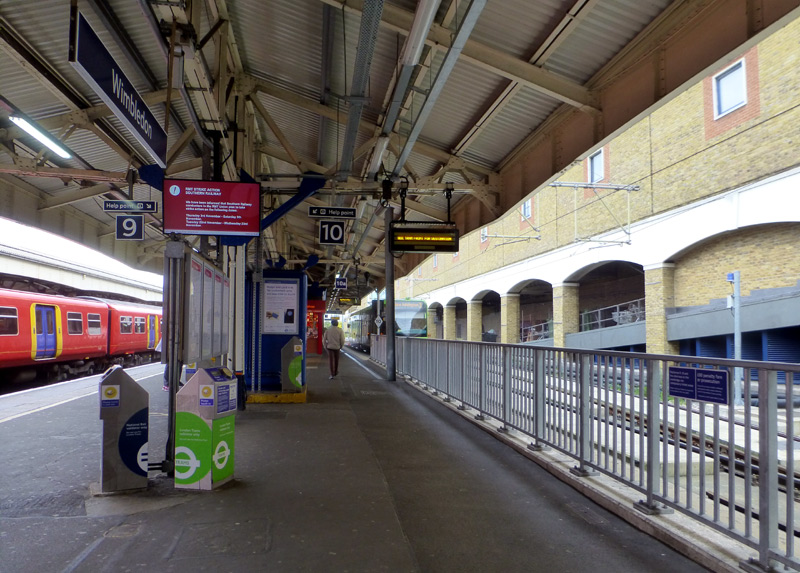
Class 700 Thameslink train arriving at platform 9.
in the distance can be seen a Bombardier tram at platform 10a.
At platform 8 on the far left is one of the Class 455 trains which includes a Class 508 carriage that was retained in London when the Class 508 trains were sent to Merseyrail (Liverpool area).
When Tramlink trams services first started using this station the trams stopped where the white railings can be seen in the photograph (above - right). This was very convenient for passengers because the steps (and lifts) were very near to here - just behind when I was standing when I took this photograph.
However so many passengers were using the trams that to reduce overcrowding there was a need for a service that was too frequent for just one platform.
The solution was to build staggered platforms, as seen below. It is unfortunate but because there is only enough space for one track at this end of the station it was necessary to move their stopping point much further along the platform.
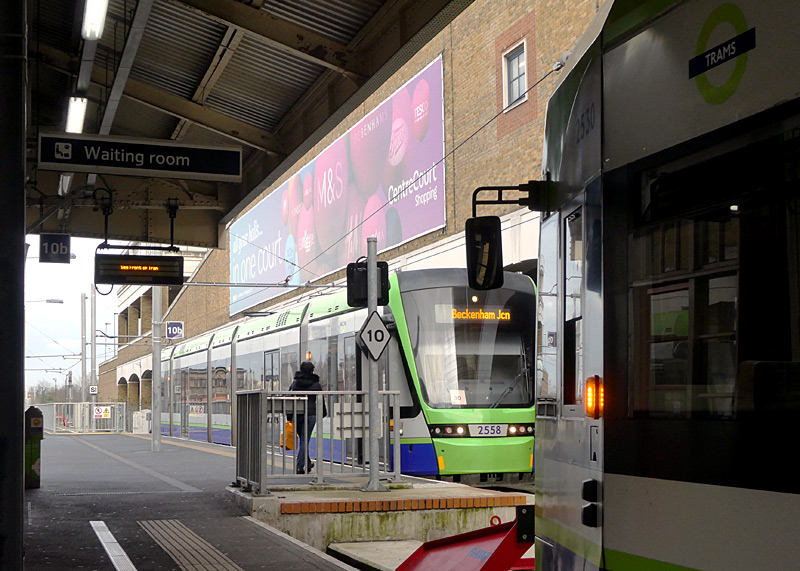
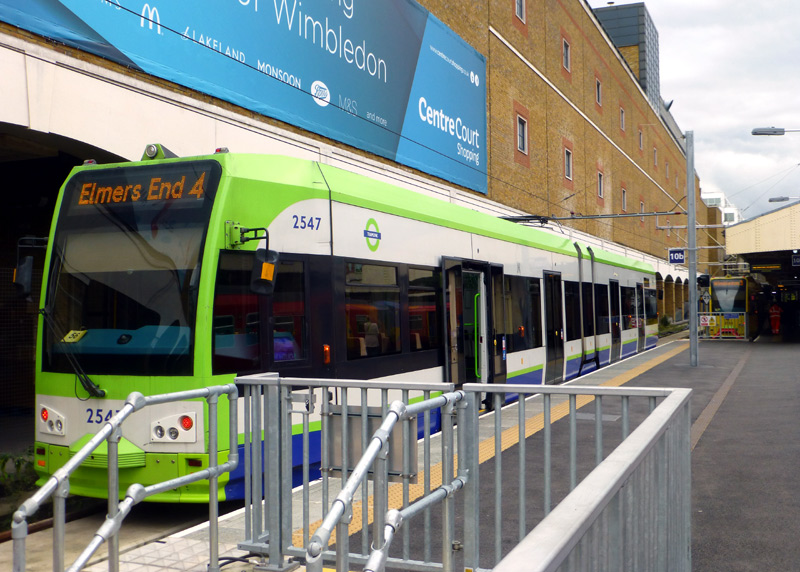
and Bombardier tram 2530 at platform 10a.
2547 at platform 10b (left) and
2550 in a special yellow advertising livery at platform 10a (right).
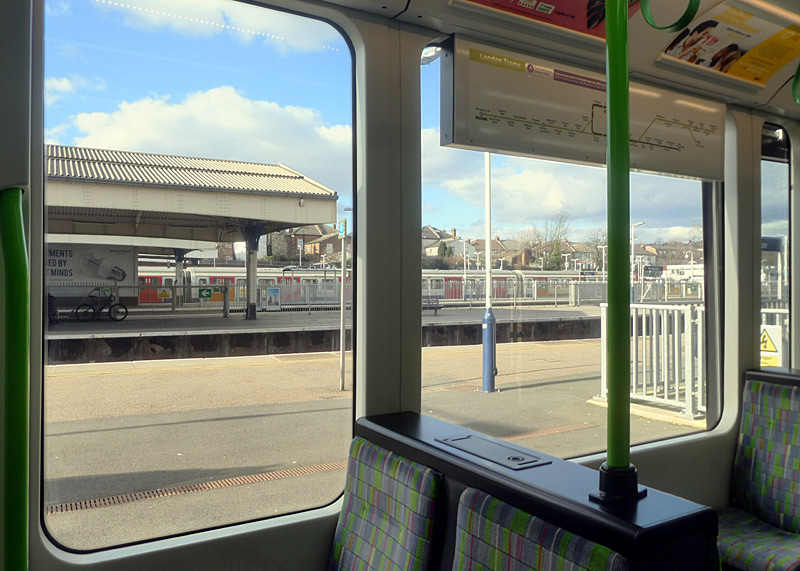
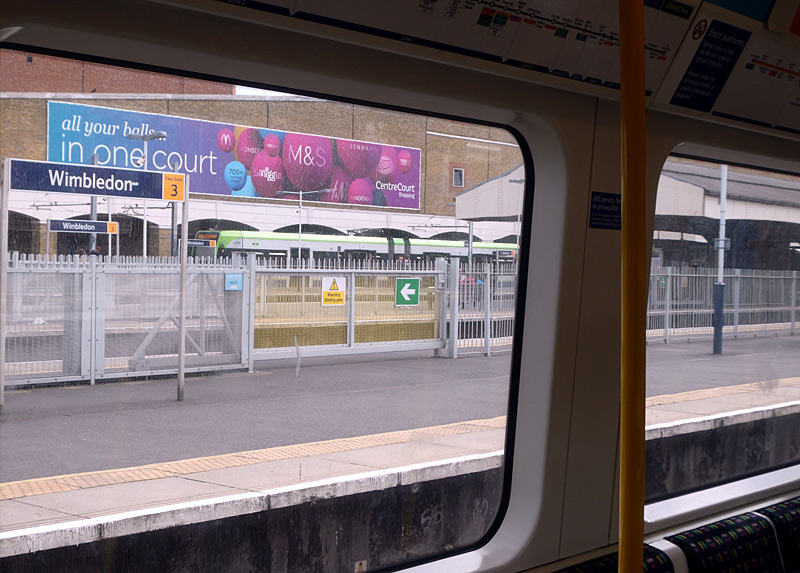
- West Ham: (east London) is served by C2C, the DLR, Jubilee, Hammersmith & City and District line trains.
Platforms 1 and 2 are used by District and Hammersmith & City line trains,
Platforms 3 and 4 are used by Docklands Light Railway trains,
Platforms 5 and 6 are used by Jubilee line trains,
Platforms 7 and 8.are used by C2C trains.
The present-day station was rebuilt in this format during the construction of the Jubilee line and comprises red brick, concrete and glass (clear glass and glass bricks). It was styled upon the Holden stations built in the 1930s.
Platforms 1, 2, 7, 8 are on an east - west alignment whilst platforms 3, 4, 5, 6 are on a north - south alignment.
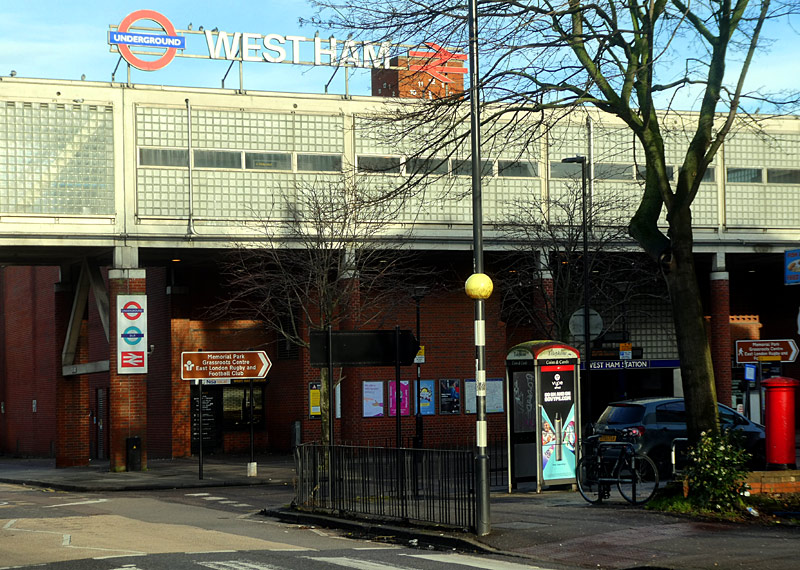
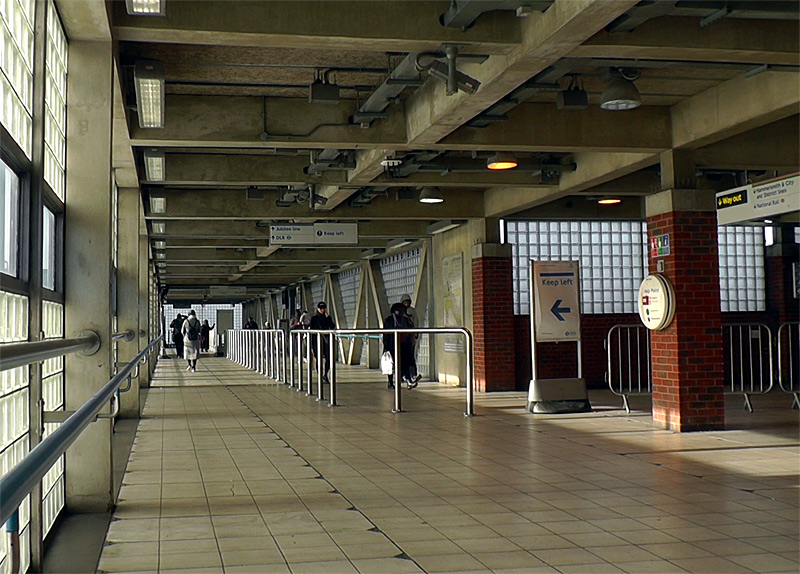
Manor Road and links platforms 3 - 6 with the station entrance
and platforms 1,2,7,8.
Behind me (and also not seen) are some accessibility lifts.
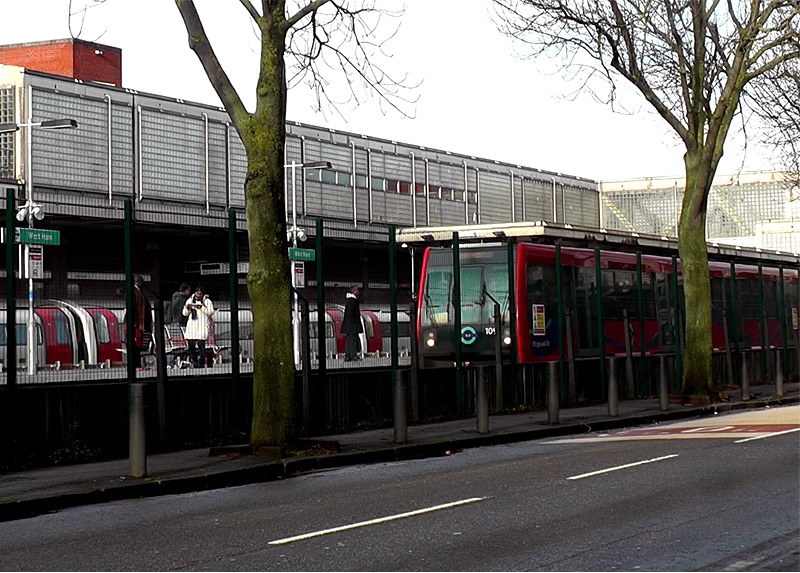
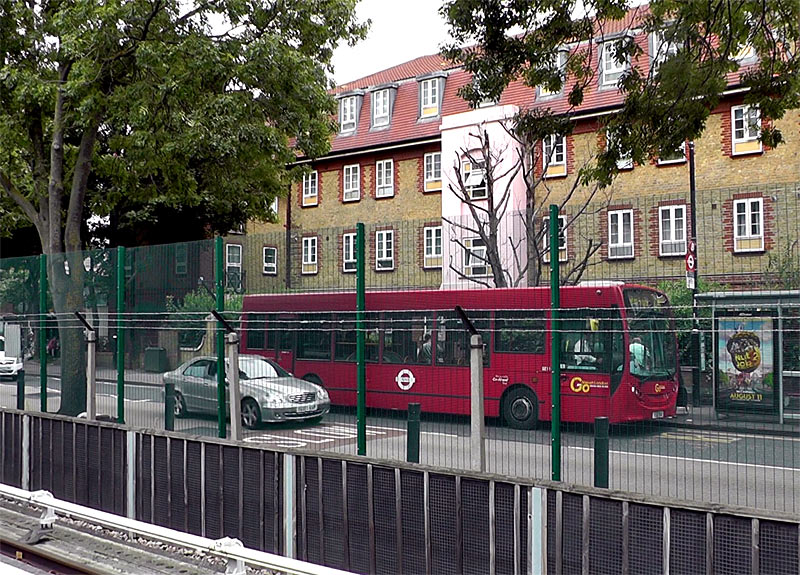

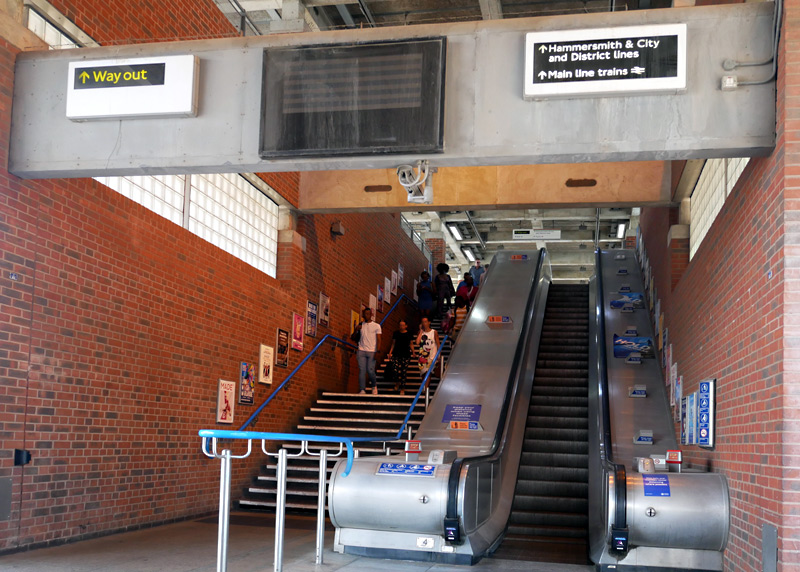
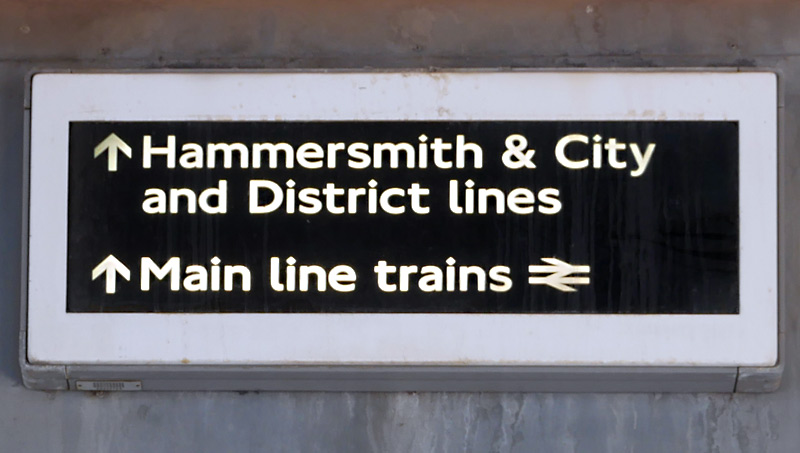
'Main line' is an older, less frequently used term for what nowadays is more usually called National Rail.
- Stratford: (east London). This very busy station is probably also London's most confusing station.
Although the highest numbered platform is No. 17 there are actually 21 platforms, including two platforms which are not used and four platforms with the suffix 'a' or 'b'.
To further add to the confusion platforms 1 & 2 are next to platform 12 whilst platform 3 is at the opposite end of the station and there are two sets of platforms (at different parts of the station) for the two different routes served by the Docklands Light Railway. The reasons for this are historic.
Changing the platform numbers to something more logical would require many changes to the main line railway's signalling systems which tell the train drivers which platforms they will be passing through, and since this change will be solely cosmetic (ie: will not improve safety and is not needed because of changes to any tracks) it was decided that this could not be justified financially - so will have to wait until another day.
Note that to avoid confusion with other British railway stations this is also sometimes known as Stratford (London) and Stratford Regional.
The two other stations are Stratford International
and Stratford-upon-Avon.
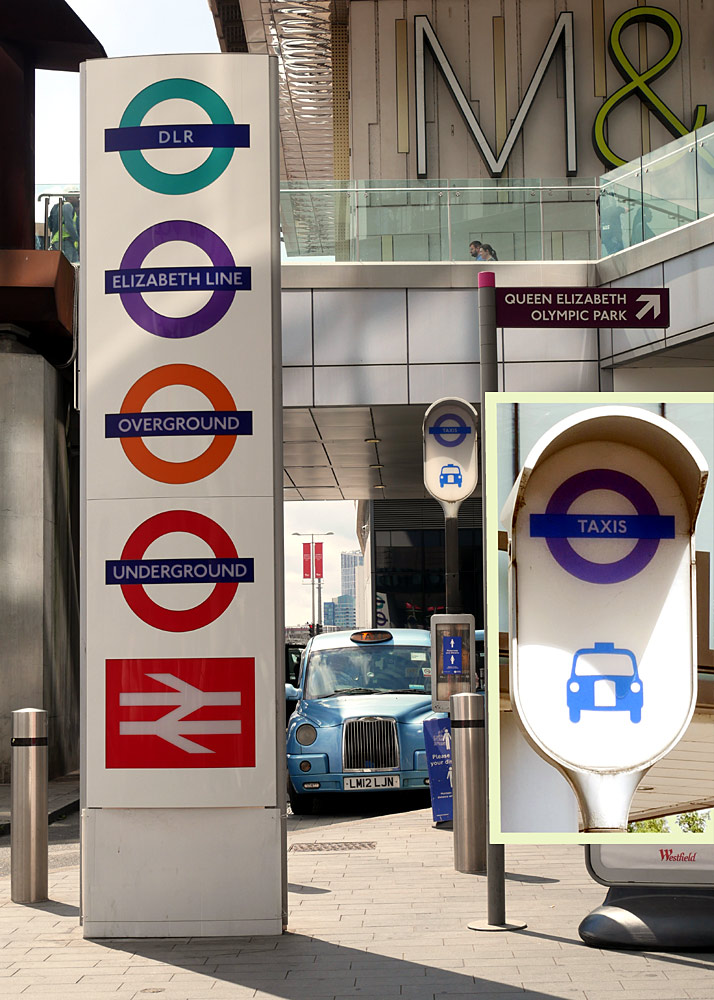
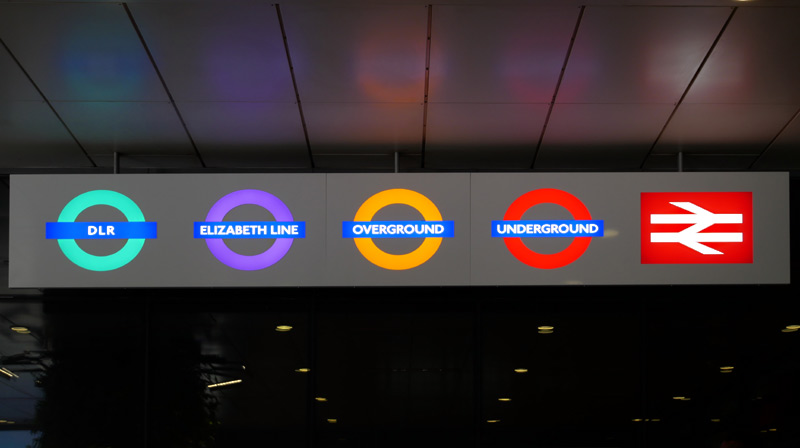
this station and for the taxi rank. The Westfield shopping centre entrance is just behind the larger version of the taxi rank sign.
Above the blue taxi is part of the footbridge over the station.
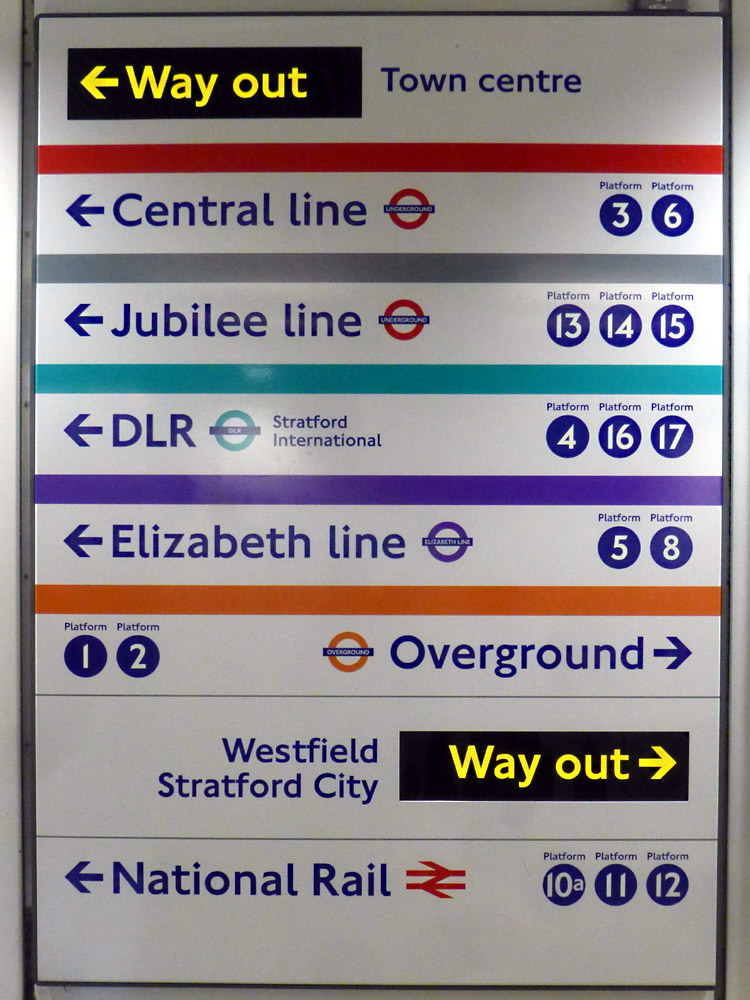
and station exits - the two bus stations are not shown.
Also not shown are platforms 9 and 10 - this is because
this sign is opposite a stairway from platforms 9 and 10.
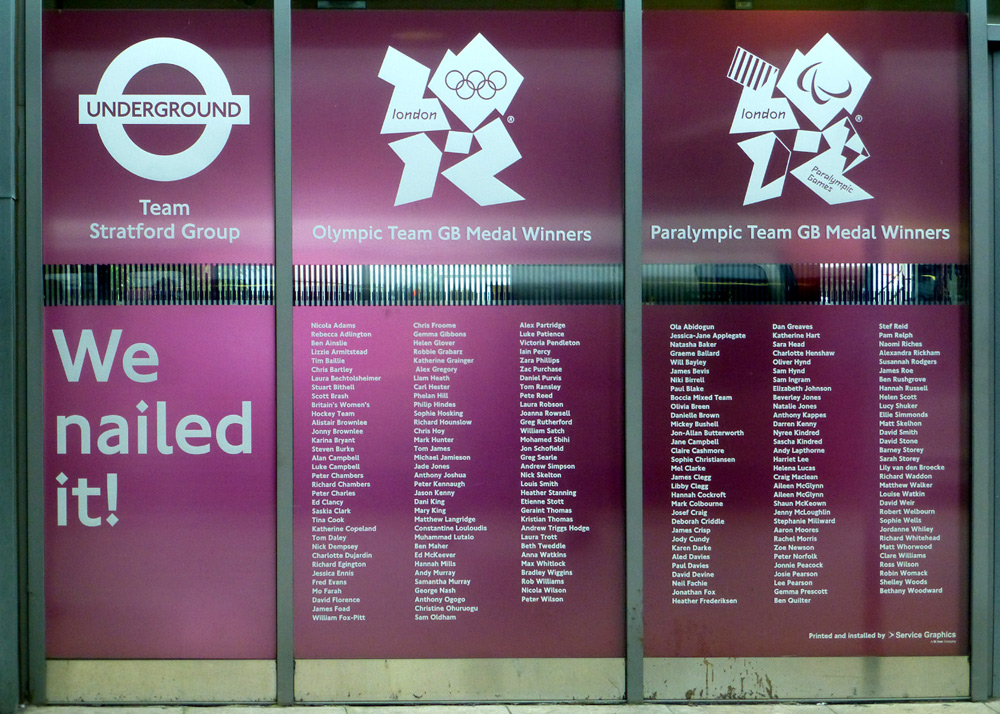
This plaque is located on Jubilee line platform 13.
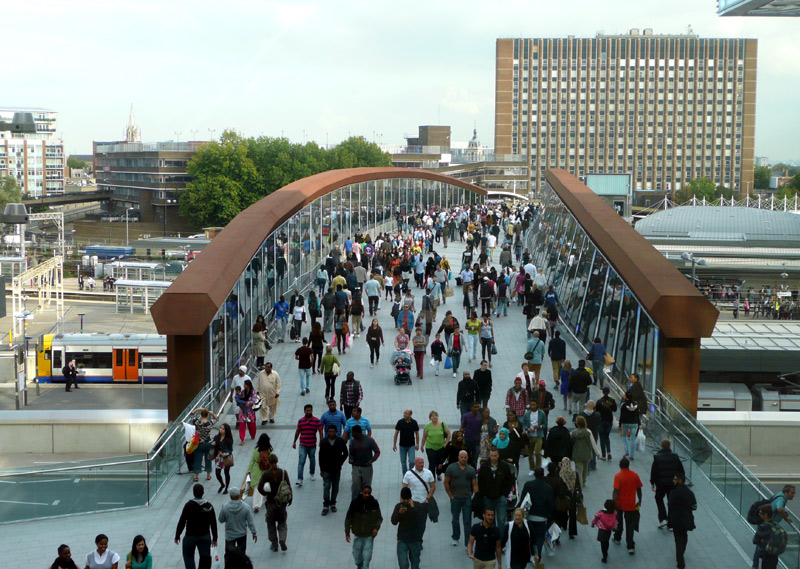
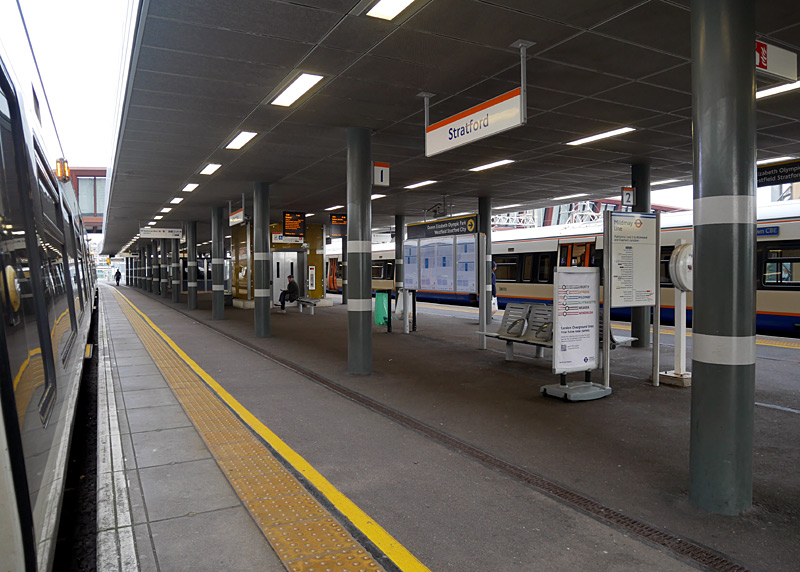
This view was filmed from the Westfield centre; a London Overground Class 378 train can be seen at platform 2.
The footbridge is for the general public and outside of the station's fares paid area.
Views From The Footbridge Over The Station - Looking East
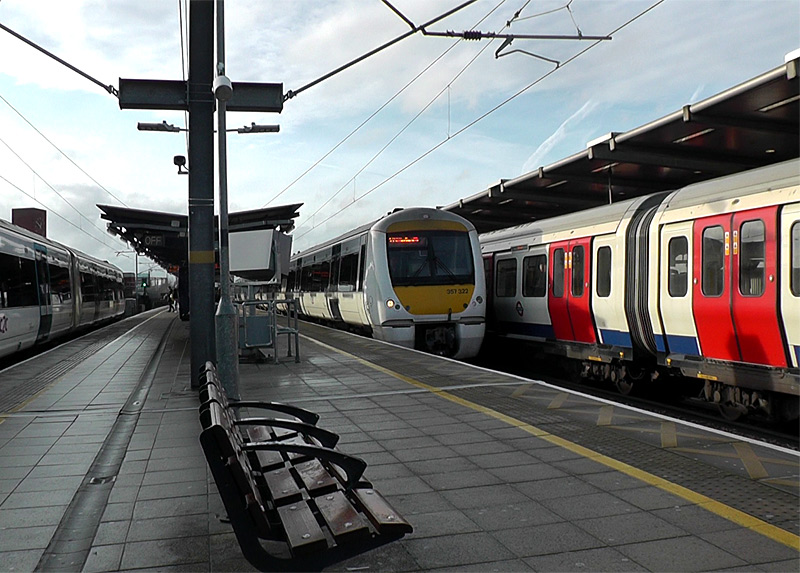
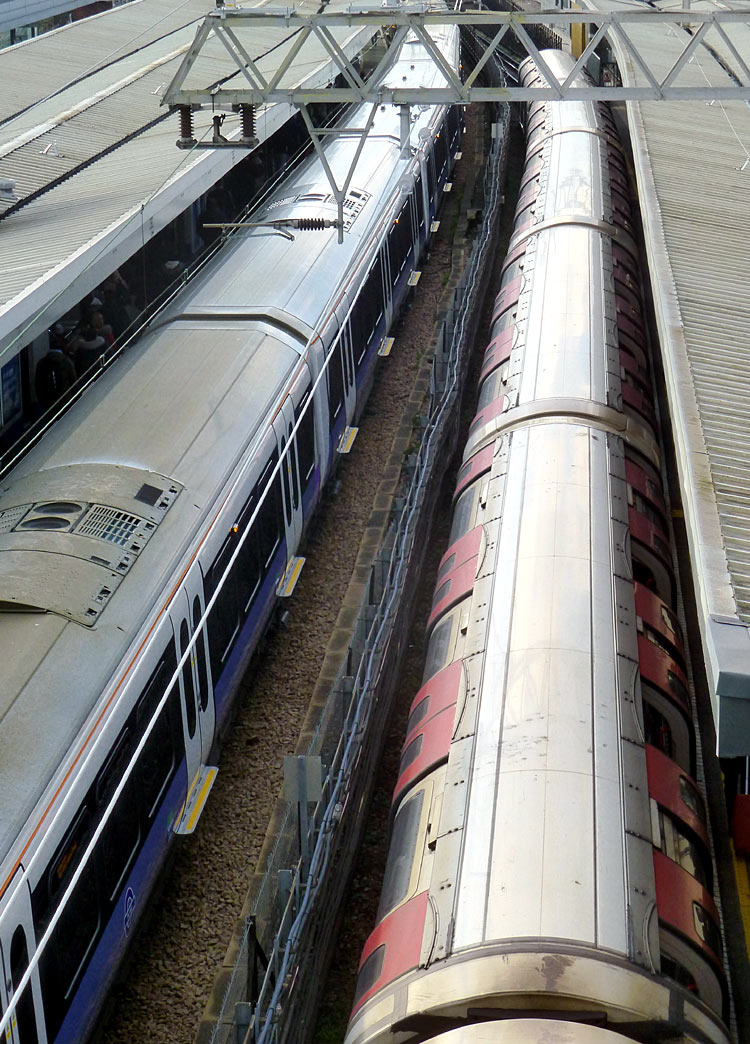
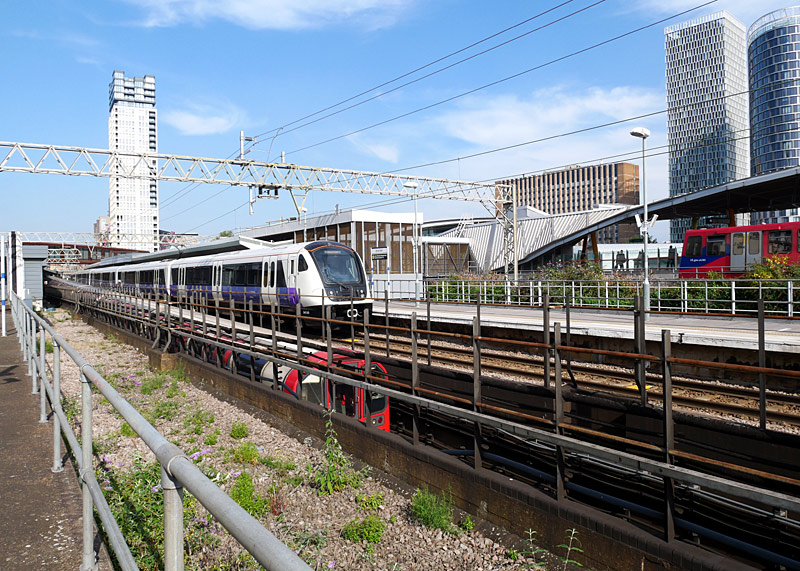
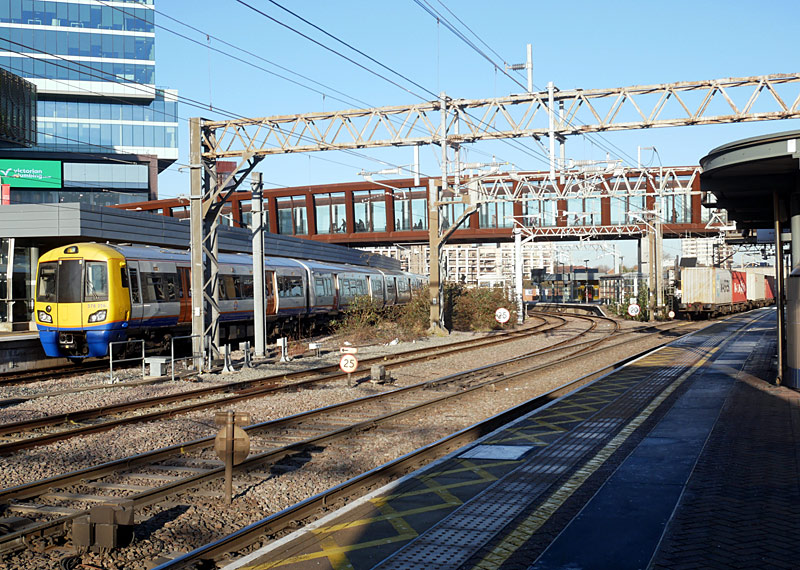
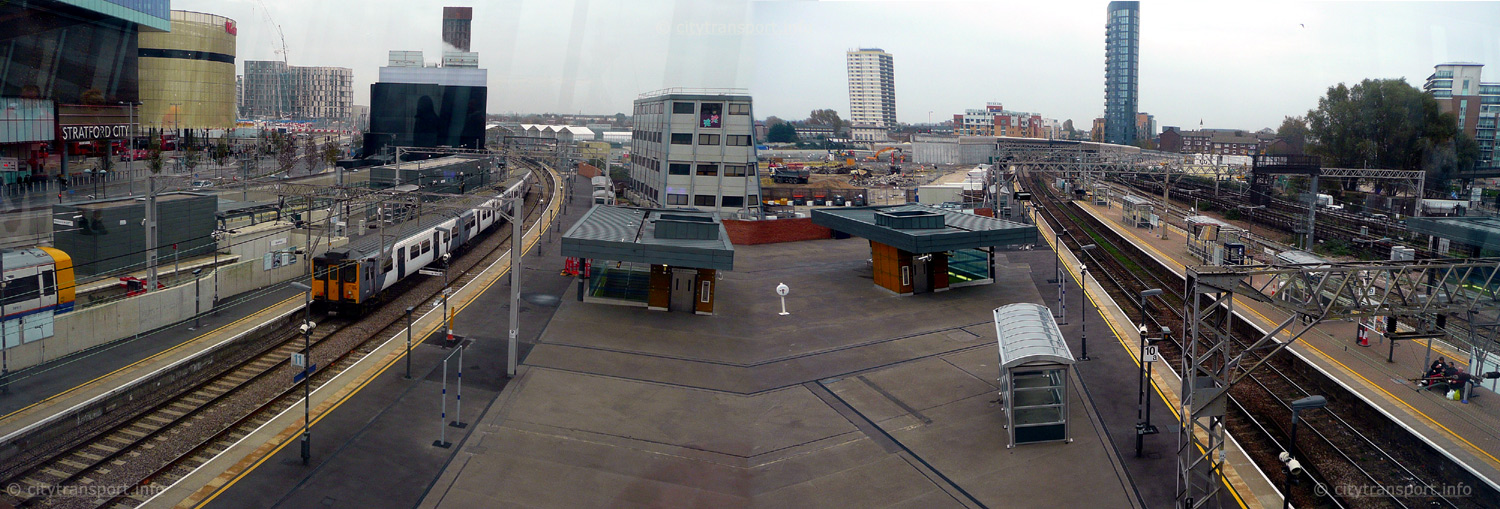 The trains seen here are: London Overground Class 378 train at platform 2, Greater Anglia Class 317 train on the Cambridge service at platform 12. For many years there were buildings on the triangular shaped platform between what is now platforms 11 and 10a. However they became derelict and were removed. Further right can be seen platforms 10, 9 and the eastern end of platforms 8 and 6. This picture was stitched together from two images. |
|
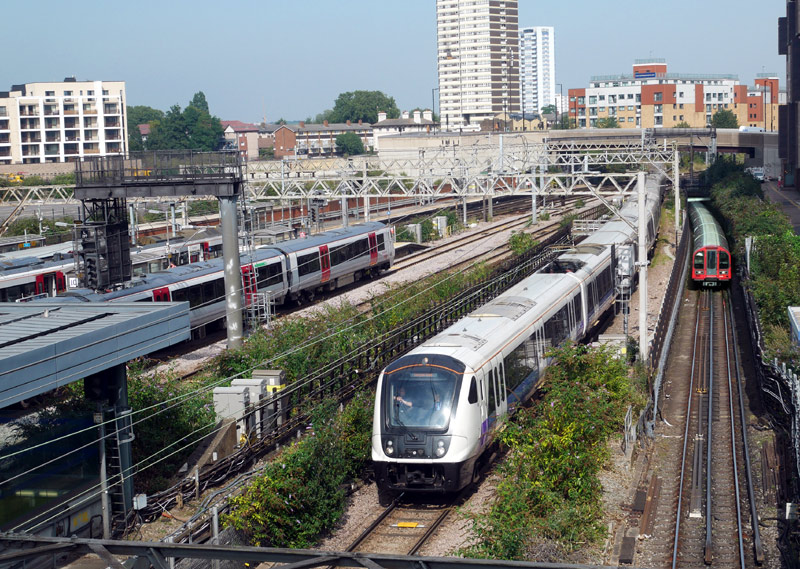 The trains seen here are: London Overground Class 378 train at platform 10a (only its white roof is visible), Greater Anglia Class 755 InterCity train at platform 10, Greater Anglia Class 720 train at platform 9, Elizabeth line Class 345 train arriving at platform 5, London Underground Central line 1992ts train arriving at platforms 3 + 3a. |
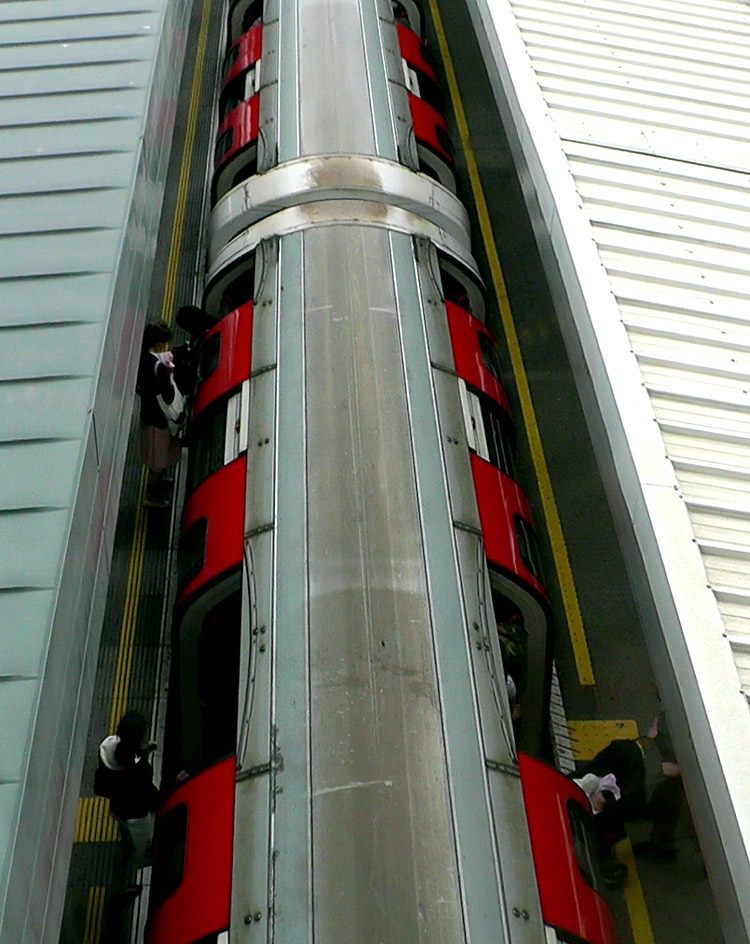
Views From The Footbridge Over The Station - Looking West
 |
|
 |
|
 |
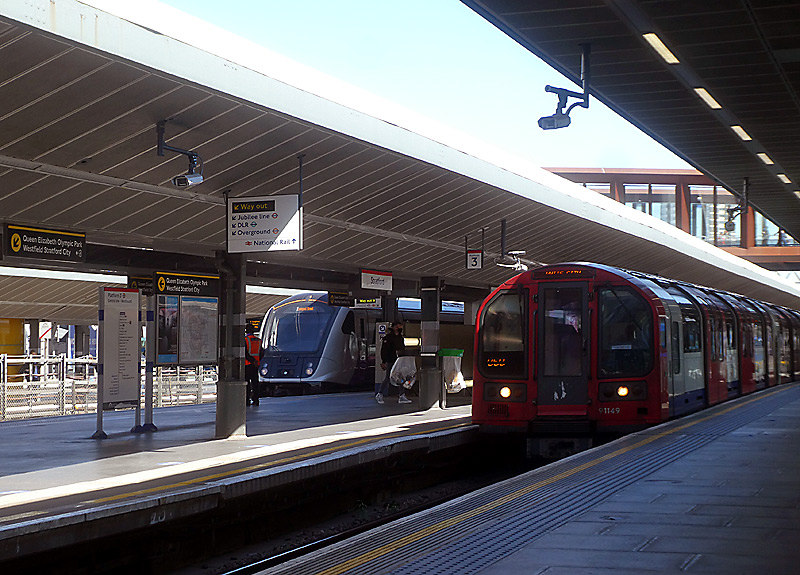
| A westbound 1992ts (tube stock) Central line train calls at platforms 3a and 3 - note that the doors are open on both sides of the train. | |
A westbound Elizabeth line Class 345 train at platform 5 and an eastbound Central line 1992ts train (with its doors open on one side) at platform 6. | |
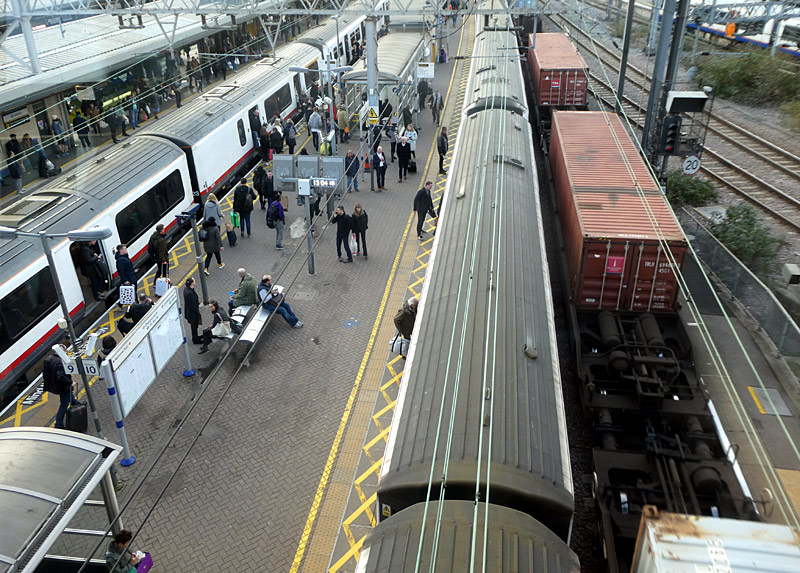
Platform 8 (far left - no train), Greater Anglia Class 321 trains at platform 9 and 10, a container train passing by platform 10a. Unfortunately when this part of Stratford station was rebuilt in the 1990s the new platforms 9, 10 and 10a were not given full length platform shelters so they are very unpleasant to use in wet weather. |
Platforms 1 and 2 are used by London Overground (Mildmay line) trains travelling to Richmond or Clapham Junction via Willesden Junction. These are new platforms which opened in 2009. Originally they were going to be called platforms 12a and 12b (as they are next to platform 12), but instead when the trains were relocated to here from the low-level tracks they kept their old platform numbers.
Platforms 3, 4, 5 are an island platform used by westbound Central line trains (platform 3) and main line trains - mostly Elizabeth line (platform 5) travelling towards Paddington station / Central London. Note that westbound Central line trains open their doors in both sides, with the other platform being No.3a. Platform 4 is no longer used, it was built for local services to Fenchurch Street station but despite all the works having been completed the new service was cancelled. It was later used by the Docklands Light Railway trains which now use platforms 4a and 4b. There are three platforms here because the Central line trains are much shorter than the main line trains, making space for platform 4 at the western (London) end of the station.
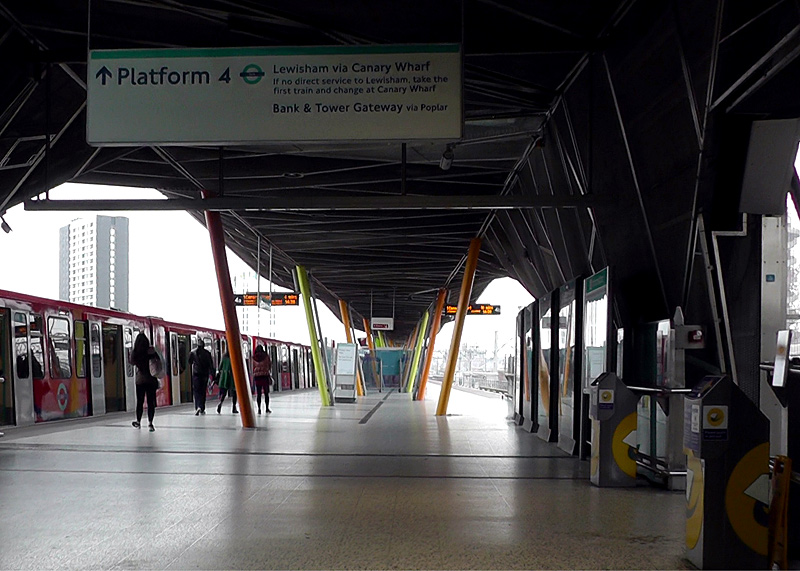
Platforms 4a and 4b are used by the Docklands Light Railway for services to Canary Wharf, Greenwich and Lewisham. To make life easier most wayfinding signage at the station still refers to these trains as using platform 4.
Platforms 6, 7, 8 are an island platform used by eastbound Central line trains (platform 6) and main line trains (platform 8). The Central line trains will be travelling towards Epping, Hainault etc. Normally platform 8 is used by Elizabeth line local trains which call at all stations to Shenfield, but sometimes it is also used by trains to other longer distance destinations, such as Southend-On-Sea, Chelmsford, Colchester, Braintree, Ipswich, Norwich, etc., and (usually only at weekends / holidays and the main Christmas shopping season) C2C Class 357 trains to Southend Central and Shoeburyness via Barking, Platform 7 has never been used - it was (also) built for local services to Fenchurch Street station but despite all the works having been completed the new service was cancelled. There are three platforms here because the Central line trains are much shorter than the main line trains, making space for platform 7 at the western (London) end of the station.
Platforms 9, 10, 10a are mostly used by longer distance trains from Liverpool Street station travelling to the part of England known as East Anglia. Some trains stop here, some do not.
Many freight trains also pass through these platforms and this helps explain why three platforms are needed. Normally westbound (London) trains call at platform 9 and eastbound trains at platform 10,
but all three tracks are bi-directional... for instance; I have been on eastbound trains which use platform 9 one day and platform 10a another day.
Platform 10a is also sometimes used by London Overground North London / Mildmay line trains instead of making trains queue to enter platforms 1 or 2 when these are both occupied.
Platforms 11 and 12 are usually used by trains to Stansted Airport and Cambridge - mostly platform 12, as platform 11 can only be used by through trains and the trains to / from Cambridge terminate here.
Platform 11 is also sometimes used by London Overground North London / Mildmay line trains instead of making trains queue to enter platforms 1 or 2 when these are both occupied.
Platforms 13, 14, 15 are used by Jubilee line trains. These are at the opposite end of the station and at a lower level (downstairs). These platforms date from the 1990's and the numbers continued on from the already existing platform number scheme, even though (when first opened) they were next to what at that time were platforms 1 and 2!
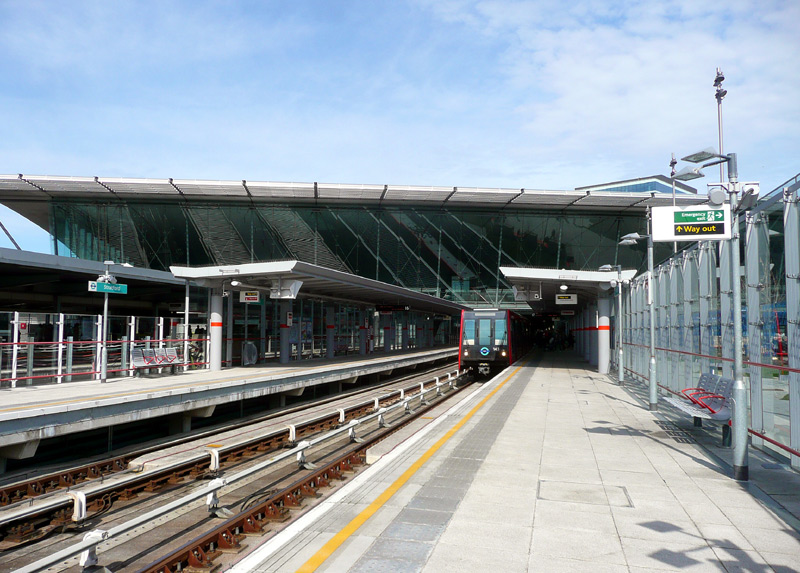
Platforms 16 and 17 are used by Docklands Light Railway trains travelling from Stratford International station (which is at the other end of the large shopping centre) and Canning
Town / Beckton / City Airport / Woolwich Arsenal.
Until 2009 these were platforms 1 and 2, this explains why the westbound Central line platform became No. 3.
Sometimes at the weekend track maintenance works requires the local 'all stations' trains Elizabeth line, etc., which normally call at platforms 5 & 8 to be diverted to platforms 9 / 10 / 10a instead OR the longer-distance Greater Anglia trains which normally call at platforms 9 / 10 / 10a to be diverted to platform 5 (westbound) and platform 8 (eastbound).
This page in the National Rail website includes much information about Stratford station and a map showing the platforms:
http://www.nationalrail.co.uk/stations/SRA/details.html
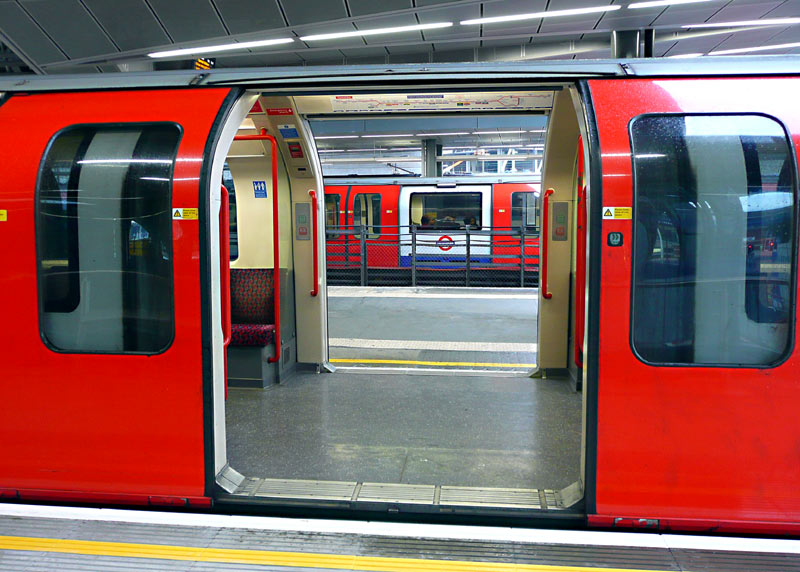
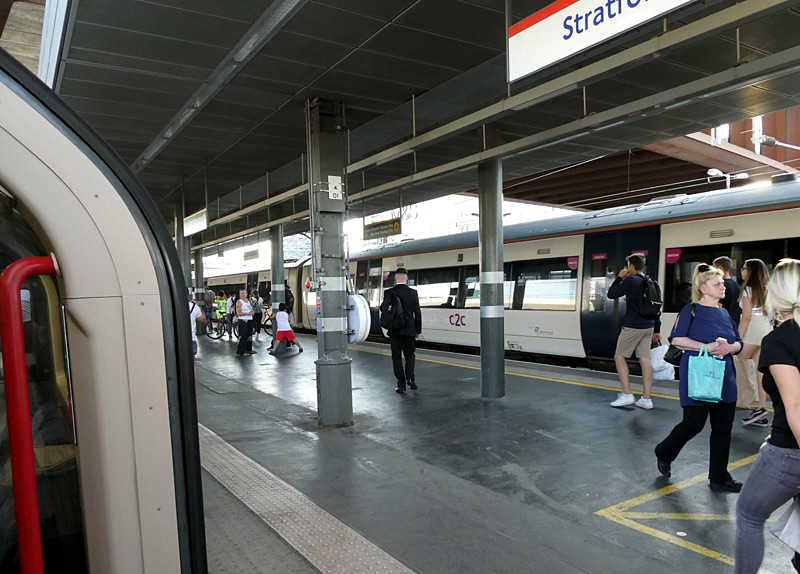
doors on both sides. This view was taken on platform 3a.
In the distance is an eastbound Central line train at platform 6.
Mostly the latter are Elizabeth line trains but services operated by Greater Anglia also use these platforms - and sometimes also C2C*.

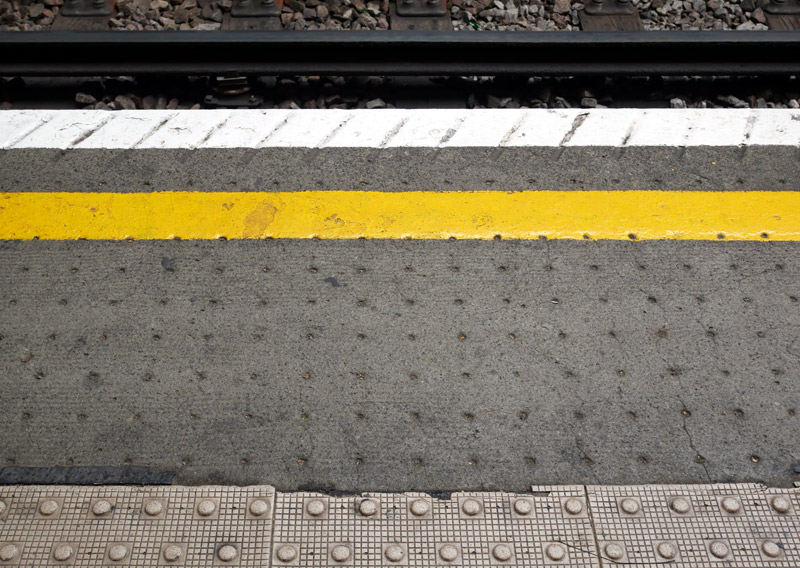
This is found on part (not all) of platforms 3, 5, 6, 8 (mostly used by Central and Elizabeth line trains) plus the never used platform 7.
The Low-Level Concourse
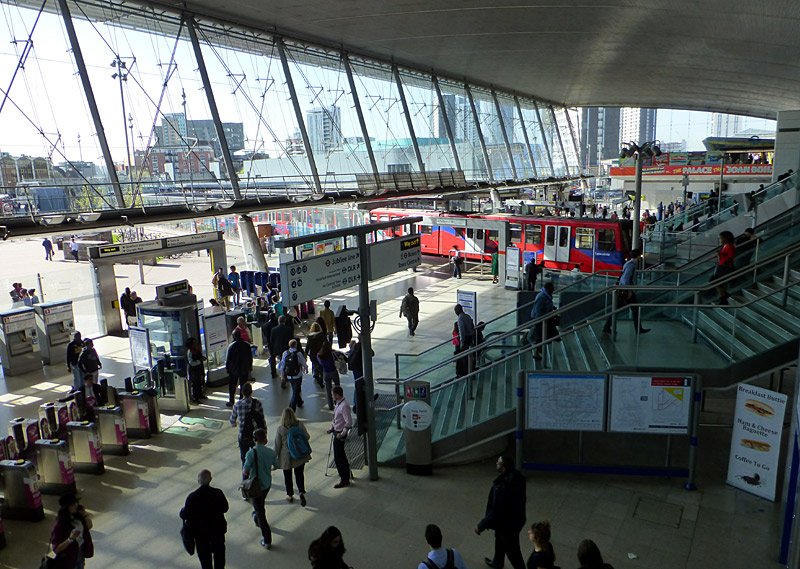
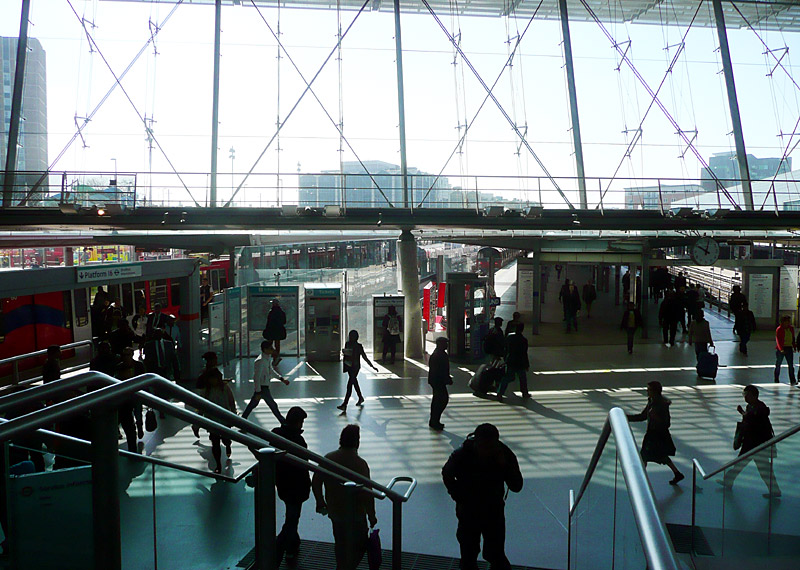
In the far distance, about 2/3rds up on the right edge of the image, is the short walkway to the DLR platforms 4a and 4b (as per arrow).
and a Jubilee line 1996ts train calls at platform 15.
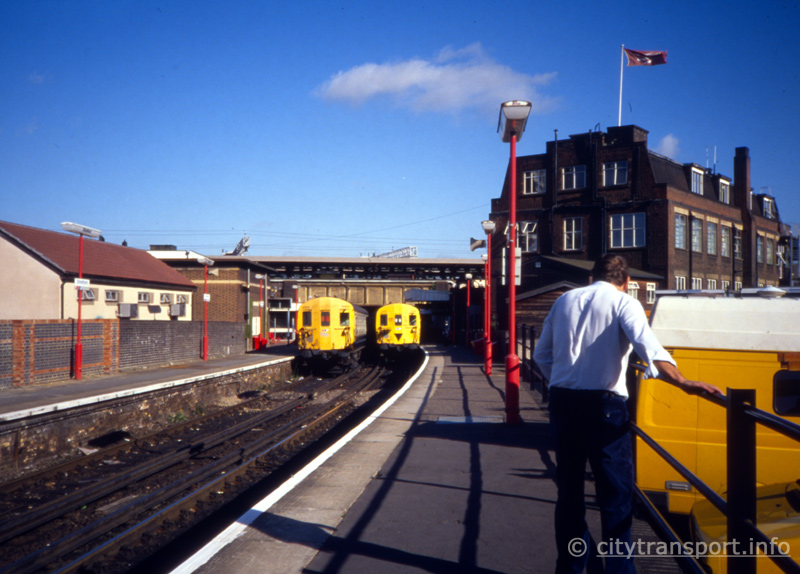
Richmond - North Woolwich North London Line service
calling at the (then) platforms 1 and 2.
The area to the left of the image is now used by the Jubilee line.
A B07 DLR train on the Stratford International - Canning Town - Beckton / Woolwich Arsenal service arrives at what is now platform 17.

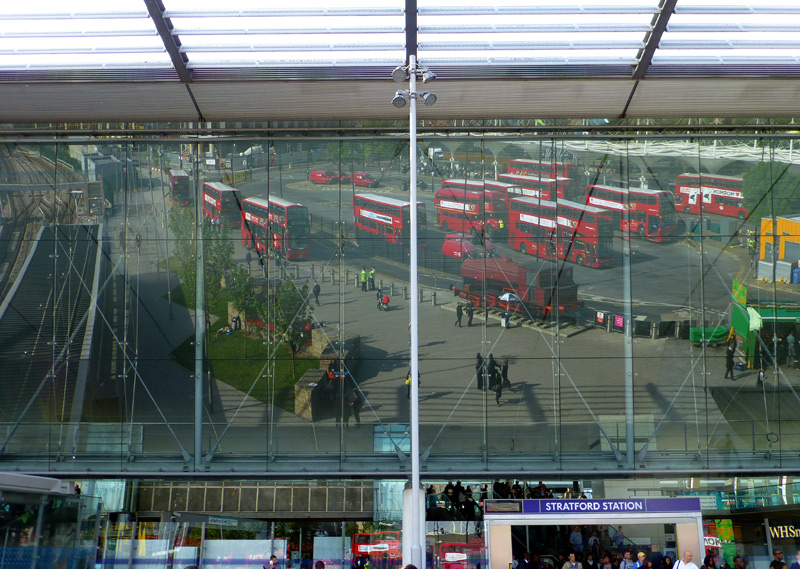
and show reflections from the glass sheets that allow light into the station building.
a DLR train arriving at platform 16.
The steam locomotive is called Robert.
| Opening Page Fares & Tickets / Photography |
|
|
|
| London Underground Small Profile ‘Tube’ Trains |
|
| Bakerloo Line | |
| Central Line | |
| Jubilee Line | |
| Northern Line | |
| Piccadilly Line | |
| Victoria Line | |
| Waterloo & City Line | |
|
|
| London Underground Large Profile ‘Subsurface’ Trains |
|
| Circle Line | |
| District Line | |
| East London Line | |
| Hammersmith & City Line | |
| Metropolitan Line | |
|
|
| National Rail ‘Tube’ Trains | |
| Northern City Line | |
| Elizabeth Line (Crossrail Line 1) | |
| Crossrail Line 2 | |
|
|
| Other National Rail Trains | |
| London Overground | |
|
|
| Local Light Railways | |
| Docklands Light Railway | |
| Croydon / London Tramlink | |
|
|
| General Information | |
| Main National Rail Stations Fast Regional Services Overhead Wire & 3rd Rail Trains |
|
| Busier Suburban Stations In Zones 1-4 With A Wider Variety Of Trains To See |
 |
| Station Architecture & Features | |
| Shared Service Routes | |
| Further Information Resources To Visit In Person Or Online |
|
|
|
| Single Page Version Of This Guide |
|

