
Visitors to London who are also transport enthusiasts (‘railfans’) sometimes ask for advice as to the ‘best’ things to see on London’s railway network. This page is part of a guide which aims to answer that question.
If this is the first time you have reached these pages then it is best to go to the Opening Page which sets the scene, explains the difference between the small and the large profile trains, offers advice on the best type of ticket to buy and photography tips.
Alternatively, it is possible to view everything on one page
Local Light Railways
London also has two rail networks which provide local transport within relatively small parts of the greater London area. In virtually any other British town these networks would be large enough to form excellent cores serving large parts of the entire conurbation; its only because London is so big that they seem so 'small'.
Many people who live in regional towns outside of London look upon London's transports with envy, wishing that similar investments could be made in their home areas as well. For lower capacity routes trolleybuses (which share the same clean air attributes) would also provide a discernable 'step change' improvement on diesel buses. The core issue here is that the Treasury wants people driving cars so that it can receive high levels of income from the taxes imposed on motoring fuels.
|
| Croydon / London Tramlink |
|
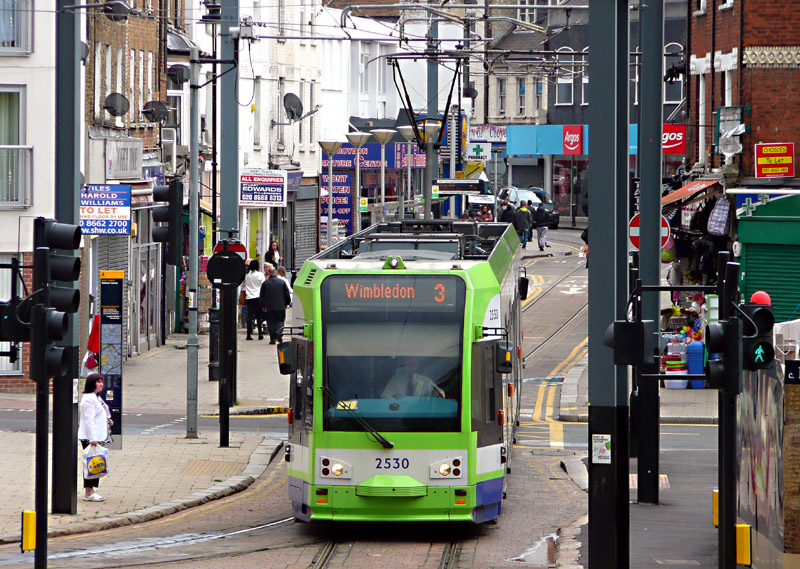
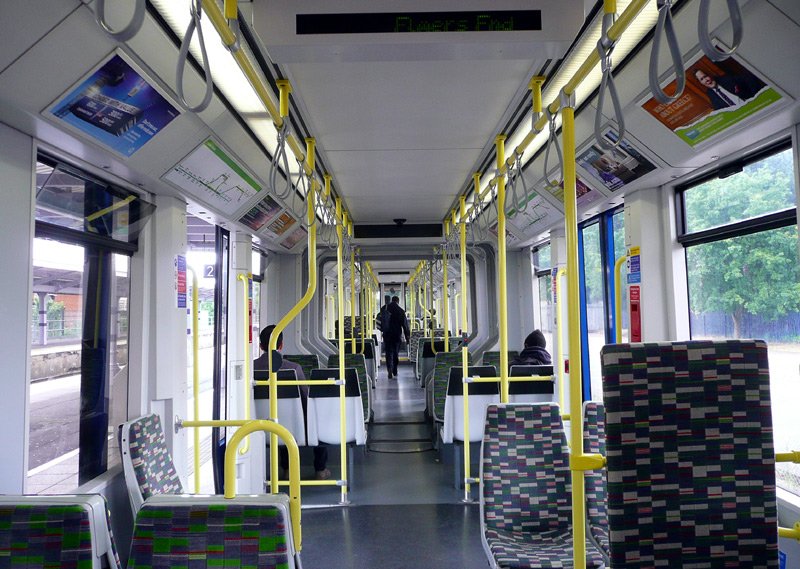
Bombardier Flexity Swift CR4000 two-section articulated low floor trams (above left, seen leaving Church Street tram stop)
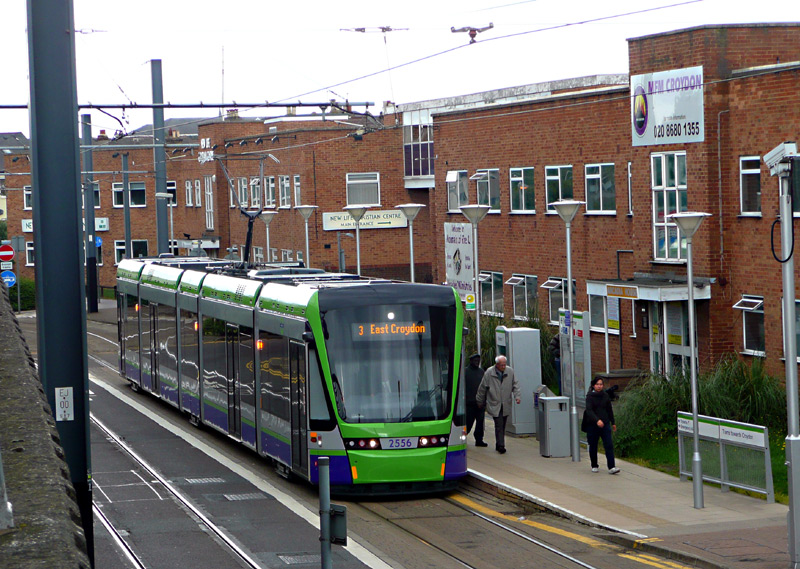
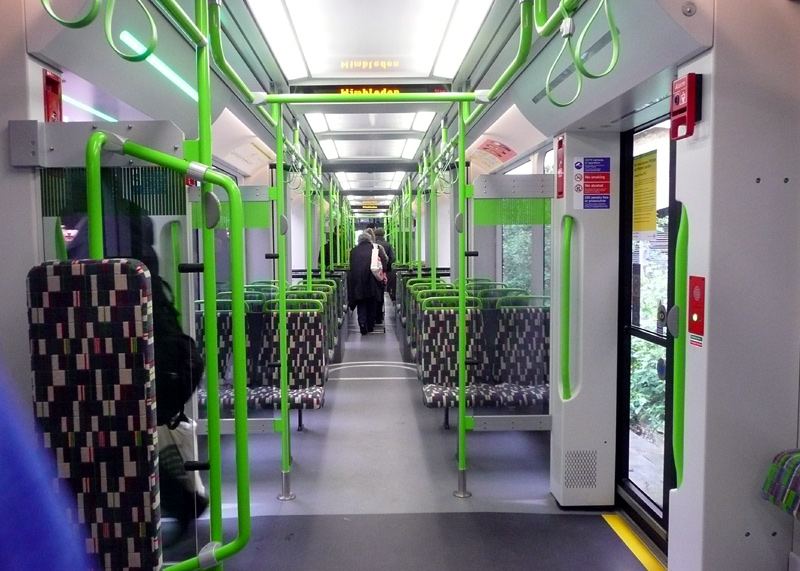
Stadler Rail Variobahn five-section multi-articulated trams (below left seen at Reeves Corner tram stop).
| General Information |
Centred on the large suburban town of Croydon, London's first Tramlink system travels through the streets in the town centre and then splits into several branches - all of which are 'off street' / on private rights of way and include sections of new-build tramway and former railway line. In Croydon town centre much of the track is in the form of a uni-directional loop which trams follow in a clockwise direction.
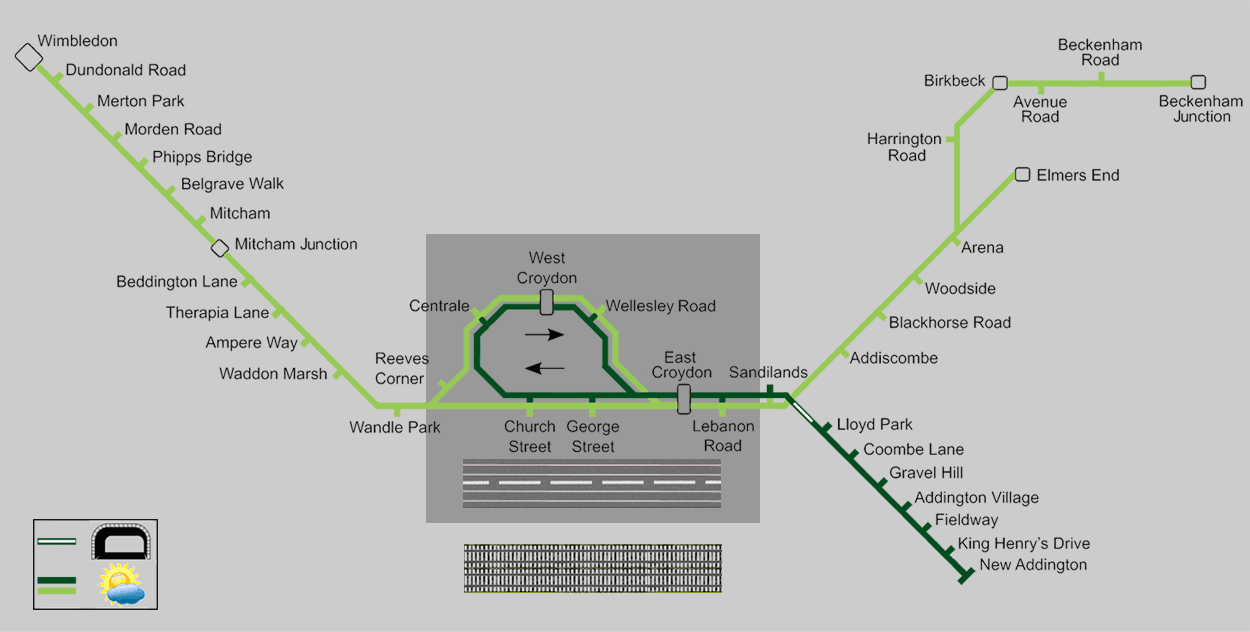
Tramlink route map showing the basic Monday - Saturday service.
On early mornings, late evenings, Sundays and Bank Holidays the service pattern might be different.
Map modified by me, original source & license: Metrophil44 / Wikipedia encyclopædia CC BY-SA 4.0 https://commons.wikimedia.org/wiki/File:Tramlink_map_2016.png
Click map to see larger version in a new window! 
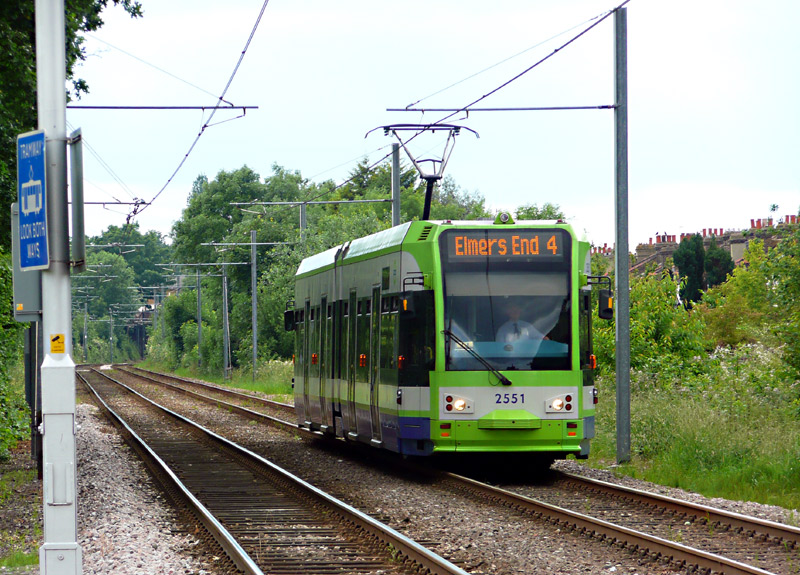
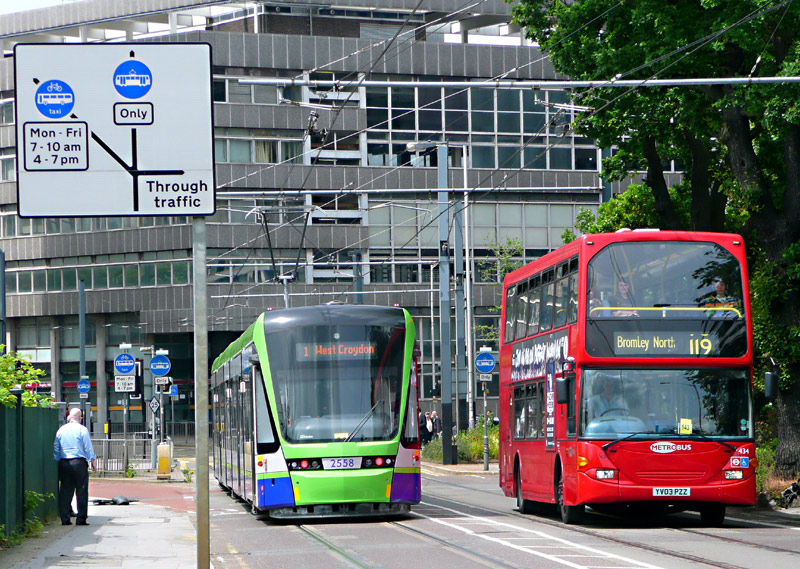


that is separate from road traffic.
Bombardier 2551 is approaching Arena tram stop.
Getting To Croydon:
The fastest trains from Central London to Croydon travel to East Croydon station from (depending on route) London Victoria station (via Clapham Junction) or Farringdon station (via London Bridge / Blackfriars stations).
Typically southbound trains will be heading for the south coast (Brighton, Eastbourne, Southampton, etc) or Horsham and also calling at Gatwick Airport. Slower ('all stations') trains also exist,
although some of these go to West Croydon station - this category includes the East London / Windrush line Overground trains that travel via Whitechapel and New Cross Gate.
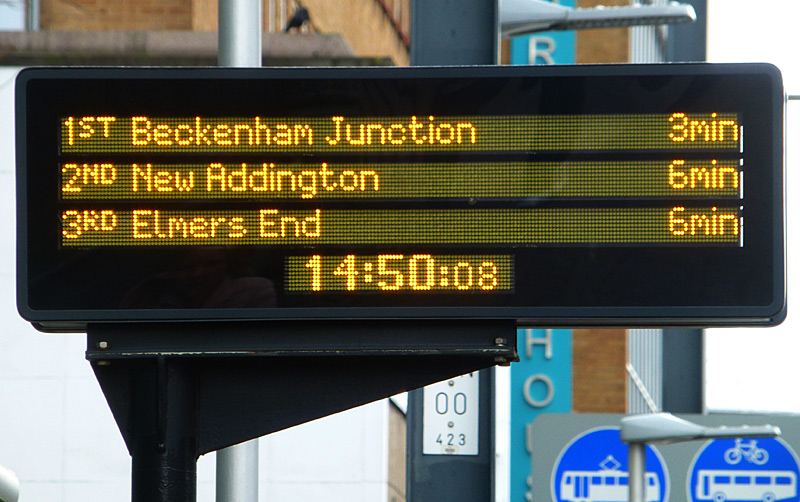
Other routes to Croydon are via the tram / train interchange stations in south London. Mitcham Junction can be reached on (some) Thameslink trains from Farringdon; Beckenham Junction can be reached by (some) trains from London Victoria station, Elmers End can be reached by (some) trains from Charing Cross and Cannon Street stations, or by travelling on the Docklands Light Railway to Lewisham station and catching a train going to Hayes. Wimbledon can be reached by trains from London Waterloo and Clapham Junction stations plus the London Underground District line.
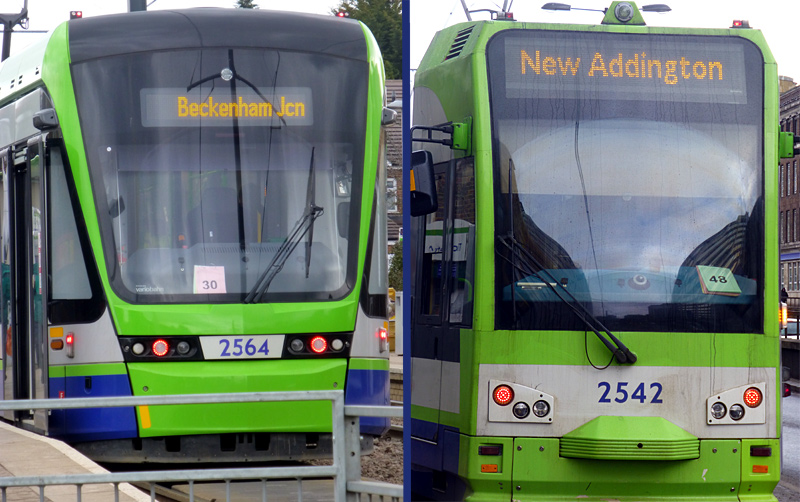
some of the photographs on this page still show these numbers.
This view dates from March 2018.
at Wellesley Road tram stop.
| For Tourists / Visitors to London |
For tourists a route which allows combining many different types of train in one day would be to take the DLR to Lewisham, a SouthEastern train (destination: Hayes) as far as Elmers End and then the tram. (If you are paying fares using in 'PAYG' mode remember to 'touch-in' at the tram card reader on the tram platform; this will automatically end your railway journey and charge you a tram fare. It is important that you use the correct Oyster card reader - as otherwise you will be travelling on the tram without having paid a fare).
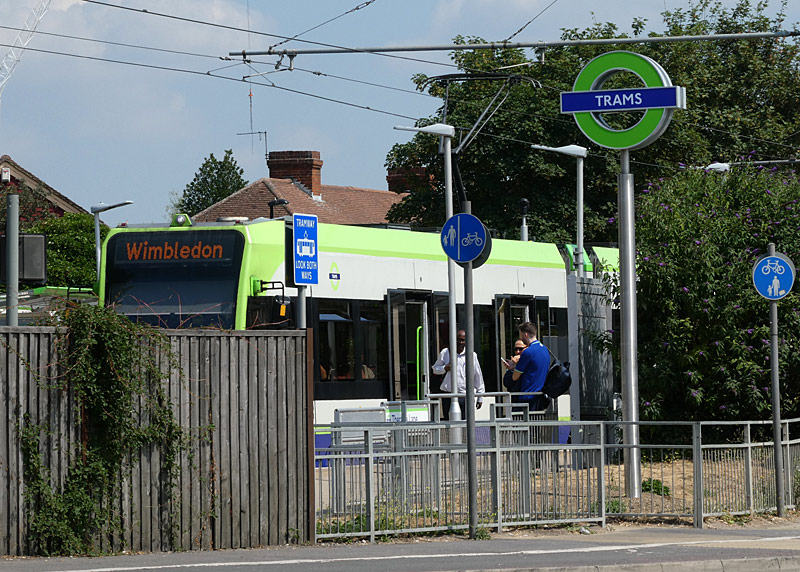
To return to Central London travel on the tram to Wimbledon, where there is a wide choice of frequent trains back to Central London. (When changing from tram to train remember to 'touch-in' on a train Oyster card reader on platforms 1 - 4 or 9 before boarding the train; this applies to all trains from all railway operators).
Despite what the transport officials may say, life really is simpler with a paper 'One Day' Travelcard, as then you do not need to worry about touching in / out, failed card reads and the risk of being overcharged.
Ticketing options are also explored further down this page.

coexist peaceably - see text below for more information.
| Street Tramway |
The street tramway part of the system starts on the Croydon side of Sandilands tram stop and extends over the full town centre loop plus a small distance on the Wimbledon route as far as the bridge (called Wandle Flyover) over the railway.
Part of the route between Sandilands and East Croydon tram stops is a local transport only corridor used by trams, buses and other local traffic. The street is called Addiscombe Road and this includes Lebanon Road tram stop.
The town centre loop is single track and mostly restricted to either to 'trams only' or trams and vehicles which need to deliver goods to local shops. Some of the loop is also pedestrianised. At some tram stops (eg: Wellesley Road) the passenger waiting area is also the public footpath which is used by pedestrians who are not travelling on the trams.
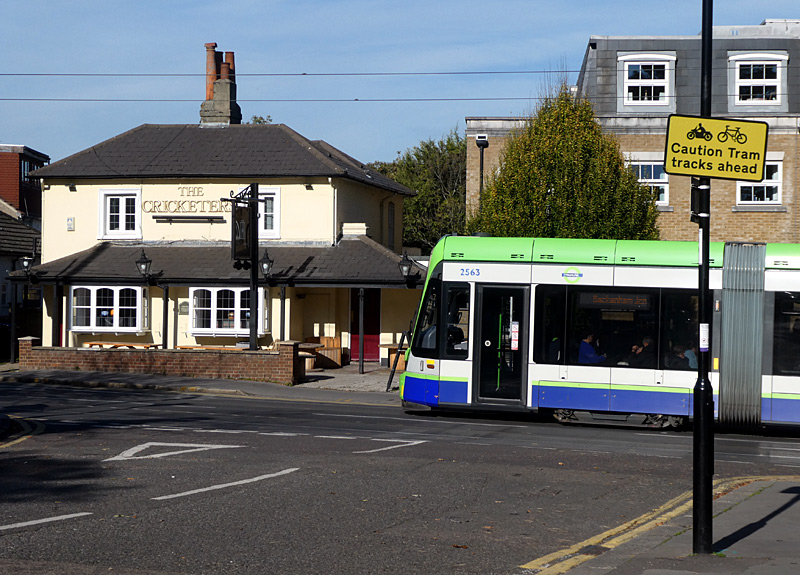
Addiscombe Road and Stadler 2563 as seen from Park Hill Rise. Also seen here is a pub called The Cricketers with outside seating where customers can watch the passing trams and buses. This location is a short walk from Lebanon Road tram stop. |
|
 Road sign on Addiscoombe Road for traffic approaching the local transport only restricted traffic corridor near to Croydon town centre. |
|
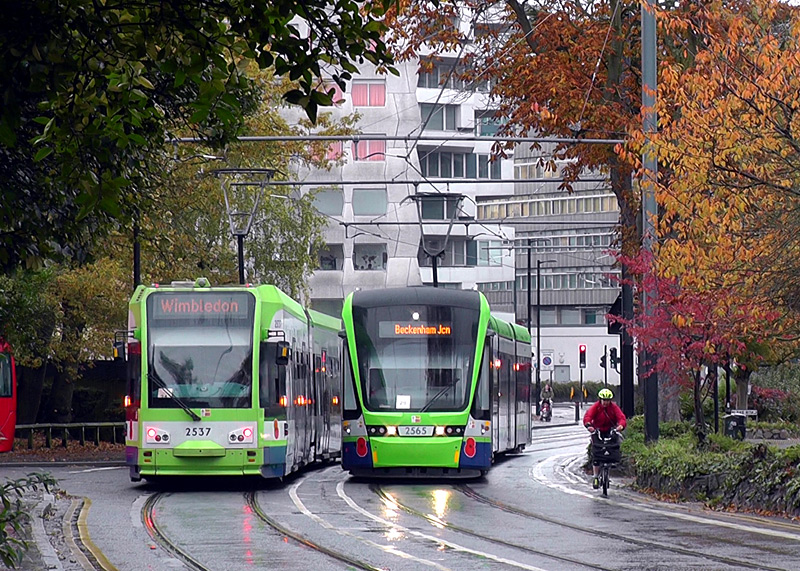
On an autumnal day a bus (seen on the far left edge) waits for Bombardier 2537 and Stadler 2565 to pass each other so that it can enter the section of Addiscombe Road that is close to the town centre and is a local transport only restricted traffic corridor. |
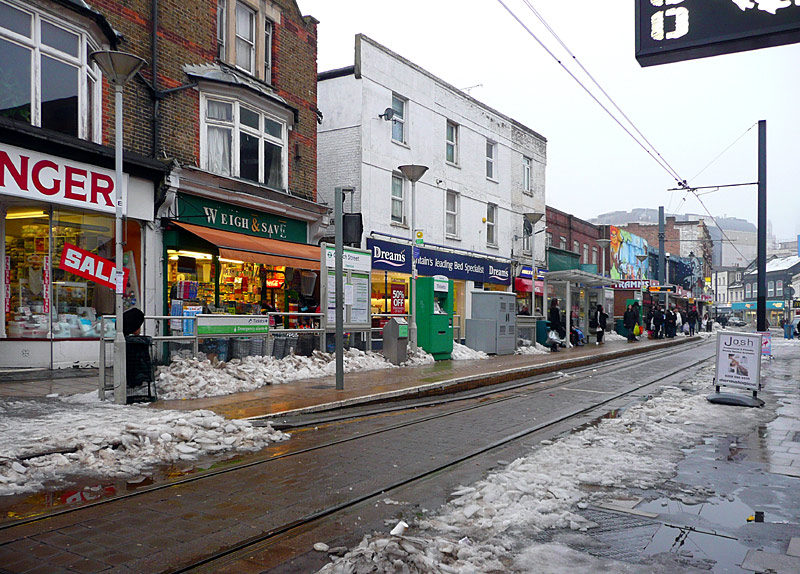
This wintry scene was photographed on a snowy day in February.
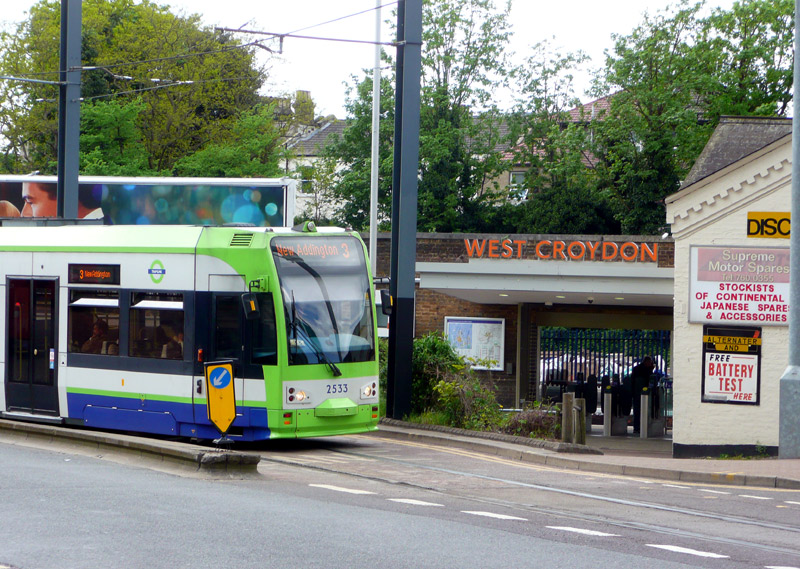
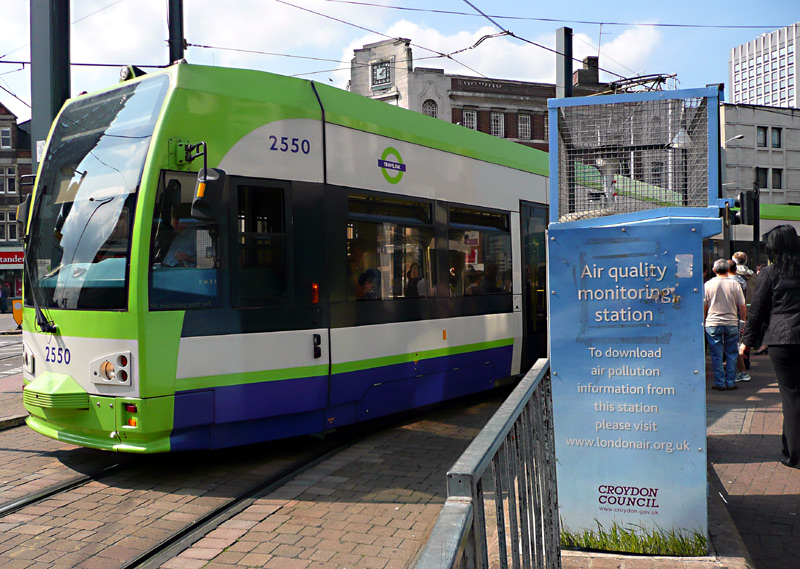
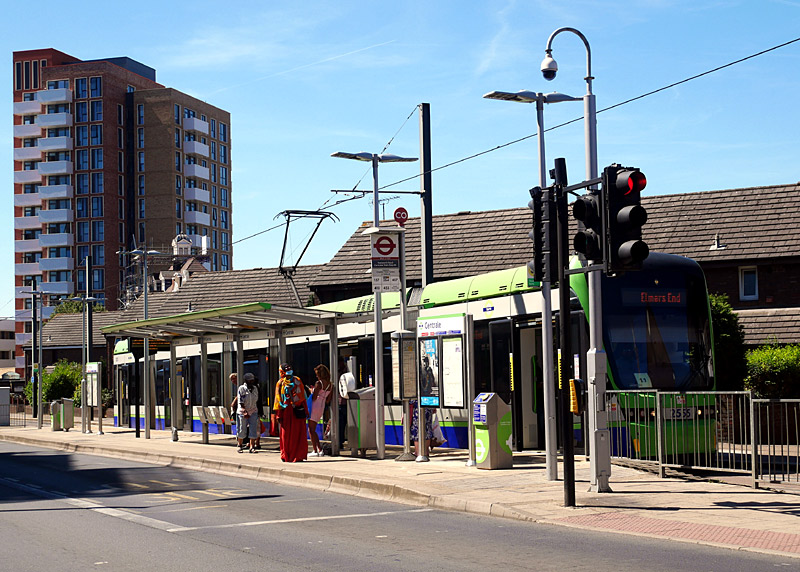
the urban environment.
Bombardier 2550 passes an air pollution monitoring facility.

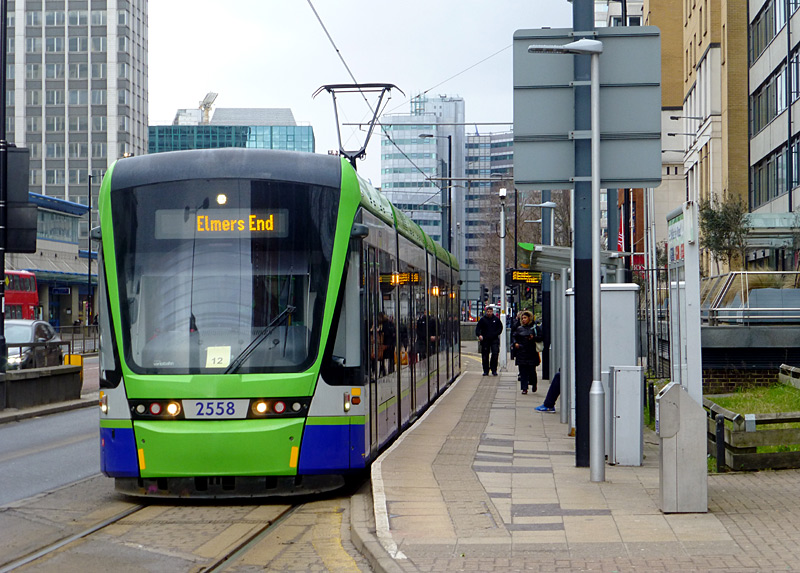
another of the tram stops located along the town centre loop.
It is also one of the kerbside tram stops where the
'platform' is part of the footpath that is used by people
who are not travelling by tram.
| Special Tram Traffic Signals |
To avoid confusing other road users Tramlink uses the British standard 'white dot' signals.
At some locations only four lamps illuminate for the 'stop' function. The central lamp is used to advise the tram driver that the traffic signal control unit has noted the presence of the tram and has (or is about to) initiate a sequence for it.

The animation correctly reflects that two trams turn right (towards Centrale) for every tram travelling 'ahead' (towards Wandle Park). The location is very close to the Church Street tram stop.
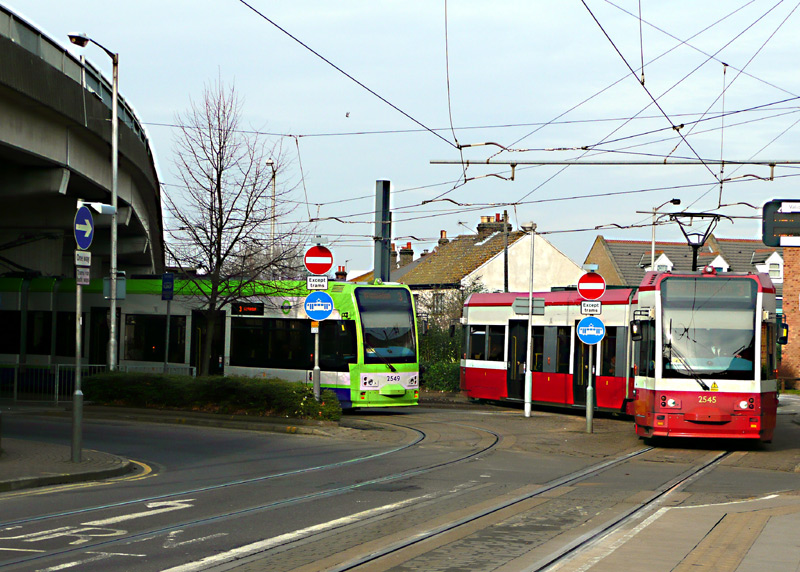
in a red and white livery similar to that used by the first generation tram system which closed in 1952.
This location is close to Reeves Corner tram stop.
Tram 2549 in the new livery had stopped to wait for tram 2545 to cross the single track Wandle flyover.
| Light Rail - Regional Branch Lines |
Away from Croydon Town centre there are three branches (one of which splits into two) which are almost fully segregated from road traffic. These operate as light railways which offer passengers all the benefits that come with having exclusive use of their own private rights of way, including freedom from delays caused by traffic congestion and hence, more reliable journey durations.
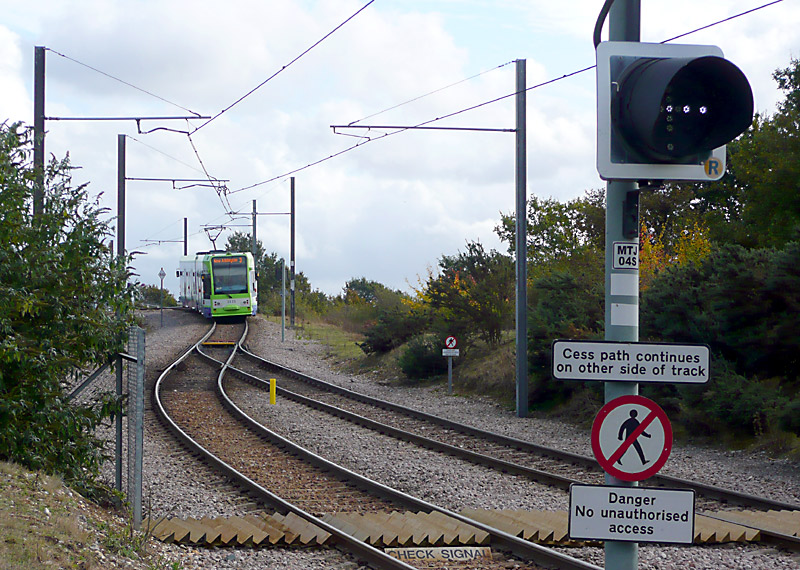
The light railway portions of Tramlink are almost fully unsignaled - instead the trams are driven on the 'line of sight' principle. However, for safety there are signals at road crossings, to control access to the few bi-directional single track sections of light railway, where routes diverge / merge and a few other places.
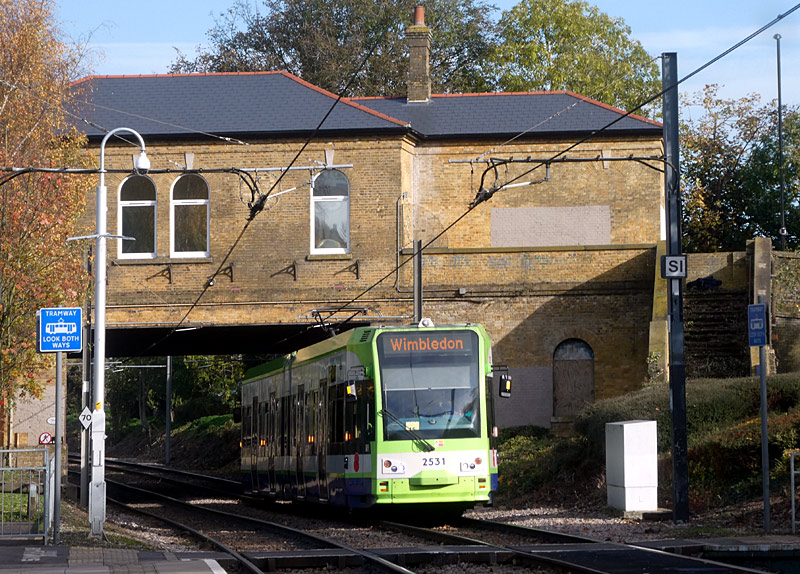

railway station building as it arrives at Woodside tram stop.
The upper signal advises tram drivers whether to 'stop' or 'go' whilst the lower signal tells them which route has been set, ie: left towards Beckenham Junction or continue ahead towards Elmers End.
The animation is of course 'speeded-up' - what are seen here as 10 second periods of apparent inactivity represents 5 - 10 minutes.
This image (along with another Tramlink signal animation) can be found on the citytransport.info website at this link:
Road Junctions, Level Crossings And Traffic Signal Priority
.Elmers End:
Most of the route from Sandilands to Elmers End is a former railway, although it has been heavily rebuilt with a former one-stop main line railway branch line (to Addiscombe) being closed and the former
railway stations now being barely recognisable as such. Apart from road crossings good places for lineside views are in the area around Arena tram stop, which includes the South Norwood Country Park.
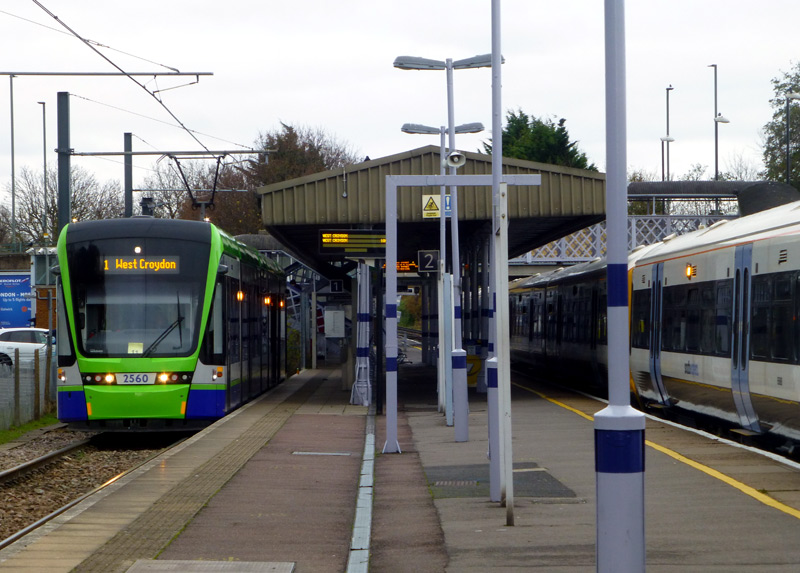
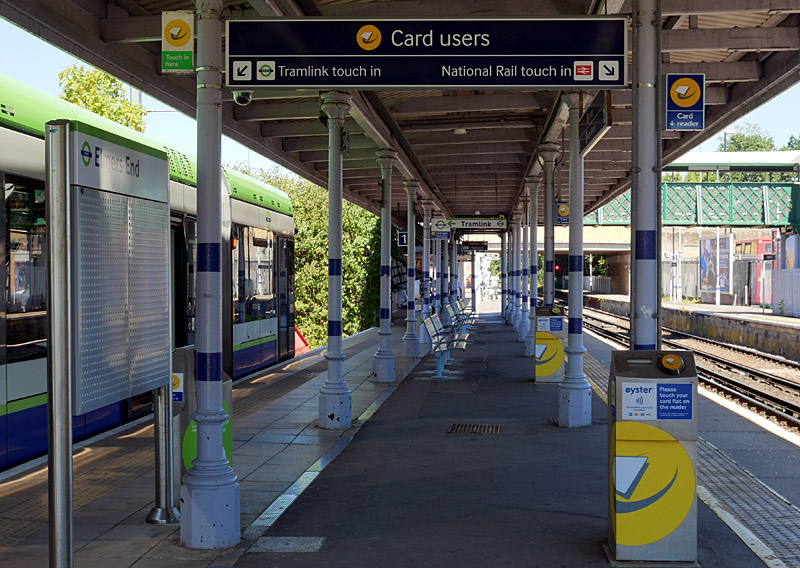
Left: Stadler 2560 in the single terminus platform and an unidentified northbound (towards London) SouthEastern train.
Right: Ticketing information, the different card readers for trams and trains, etc.
Beckenham Junction:
On the Beckenham Junction route much of the section beyond Birkbeck is alongside a little used 3rd rail electric railway branch, both railway and tramway are bi-directional single track and the trams have some passing loops
as well. One of the passing loops is at Avenue Road tram stop, which is next to a bridge over the tracks where - if you are fortunate - you will be able to film a tram and a train in the same view (alas, my attempt was not
successful, hence the composite photographic view).
Important: Because of main line trains and their third rail electric power supply system there is a very strict prohibition against walking anywhere near the track. This is for safety reasons. Anyone who is foolish enough to contravene this regulation and manages to avoid being killed by either electrocution or being hit by a passing train, and is caught by the police, can expect to be prosecuted for trespassing on the railway.
Just outside Beckenham Junction station the single track tramway passes very close to the railway station and sometimes it is possible to see a tram and a train at the same time. It is also 'just about' possible to see and photograph a tram and a train at the same time when there are trams at the tram stop.
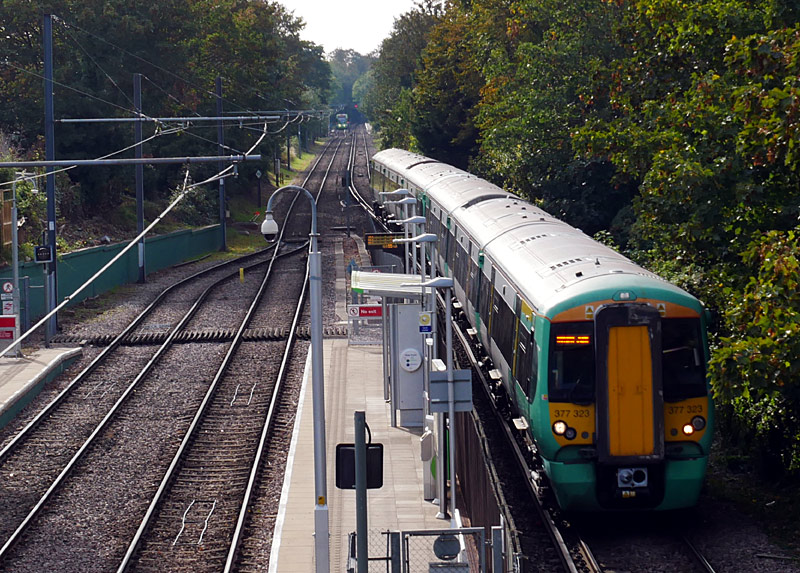
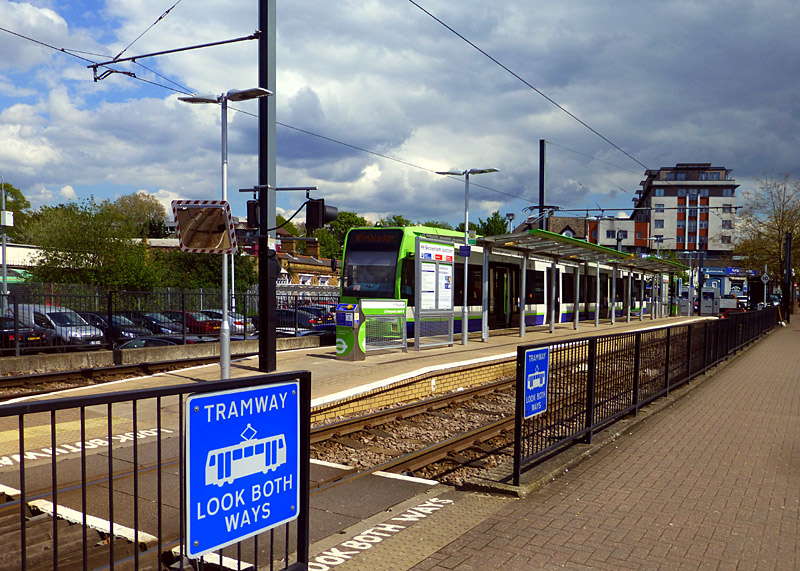
Both tramway and railway have their own bi-directional single tracks.
This view was taken from the footbridge next to Avenue Road tram stop. In the distance it is possible to see a Bombardier tram calling at Birkbeck Road station left plus the National Rail platform right
The brick building in the distance to the left of the tram is the railway station and behind the trees / at the left edge of the image can be seen a small part of a train (it is green with a black roof).
New Addington:
Apart from the tunnels midway between Sandilands and Lloyd Park tram stops, the New Addington route is entirely brand new and includes some very pleasant rides through woodland. It is often possible to observe / photograph passing trams from
a parallel road and from the many road and foot crossings across the track. One of several good places to watch passing trams from the trackside is the area around Coombe Lane tram stop. I've done this several times, and also walked deep
into the woodland areas and enjoyed what is more akin to a remote countryside walk than being in a big city.
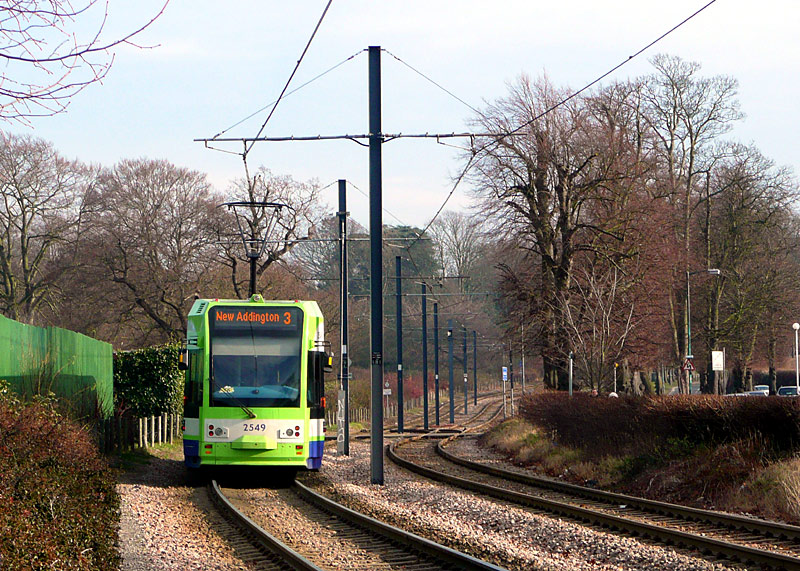
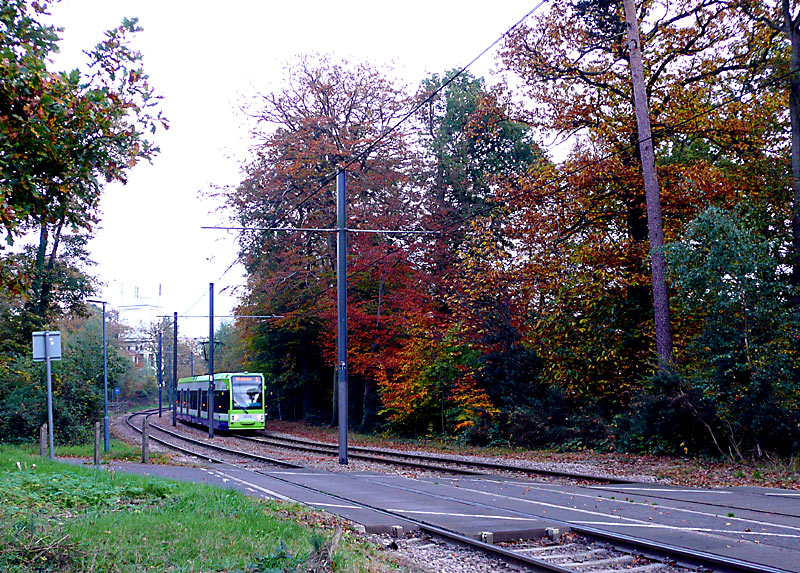
departed from Lloyd Park tram stop and now commences travelling though the woodland portion of its journey to New Addington.
The narrow road and footpath which cross the tracks lead into the woods (left) and to the road called Coombe Lane (right).
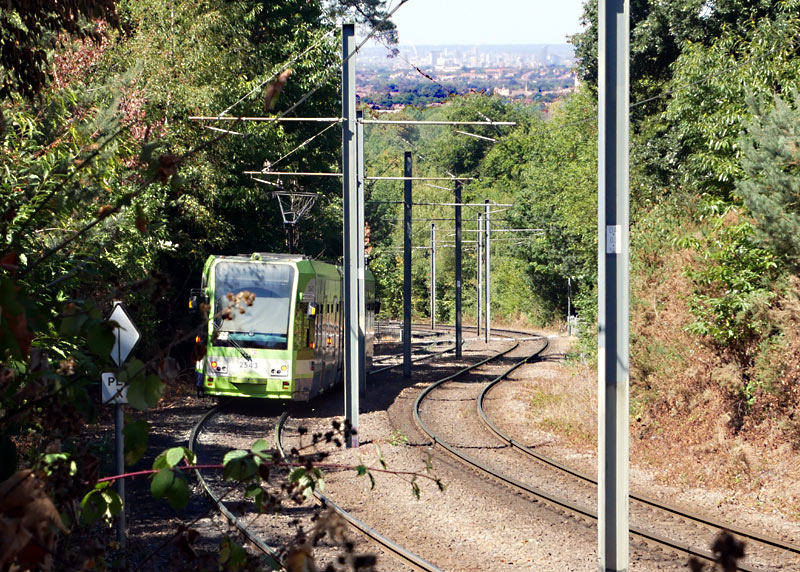

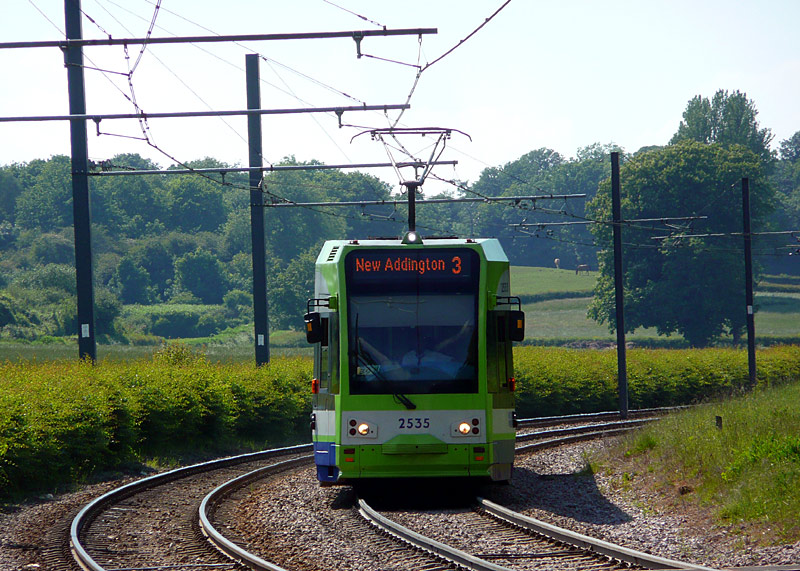
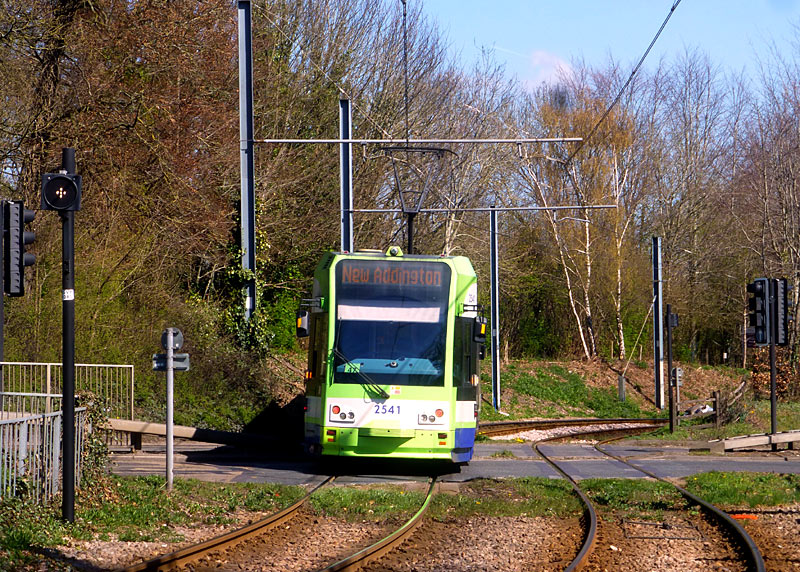
in high summer - as seen from Gravel Hill tram stop.
level crossing over the dual carriageway road named Gravel Hill.
Behind me is Gravel Hill tram stop.
Beyond Addington Village tram stop & bus interchange the trams travel alongside Lodge Lane. Just before reaching King Henry's Drive tram stop the light railway passes through the middle of a roundabout and close to the New Addington terminus there is also a small single track section where the line pass around a building which was there before the light railway was built.
In some European countries at least part the New Addington route would have featured 'lawn' track which blends in harmoniously with the local area; as I understand it this was not done on Tramlink because the people who built Tramlink had no previous experience of building light railway tracks which included lawn track. However what this also means is that it is relatively easy to follow the route of the tracks if using online satellite imagery services - such as Google or Bing maps.
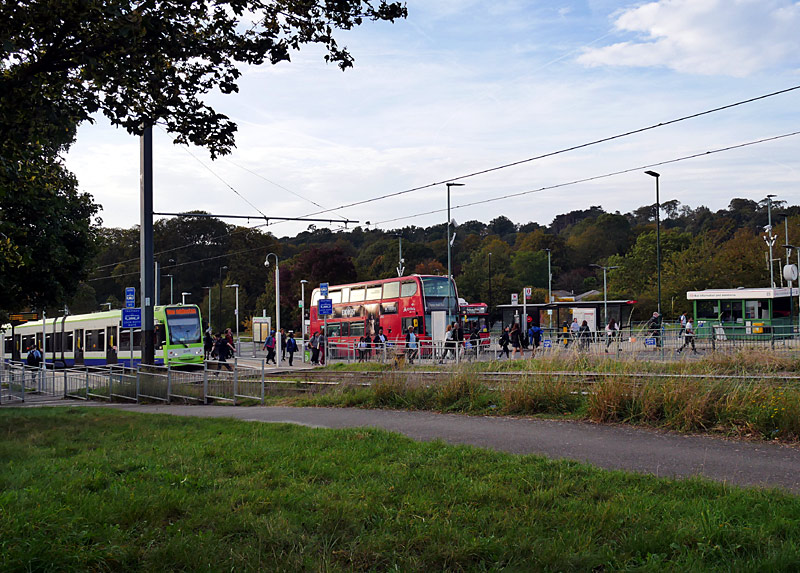
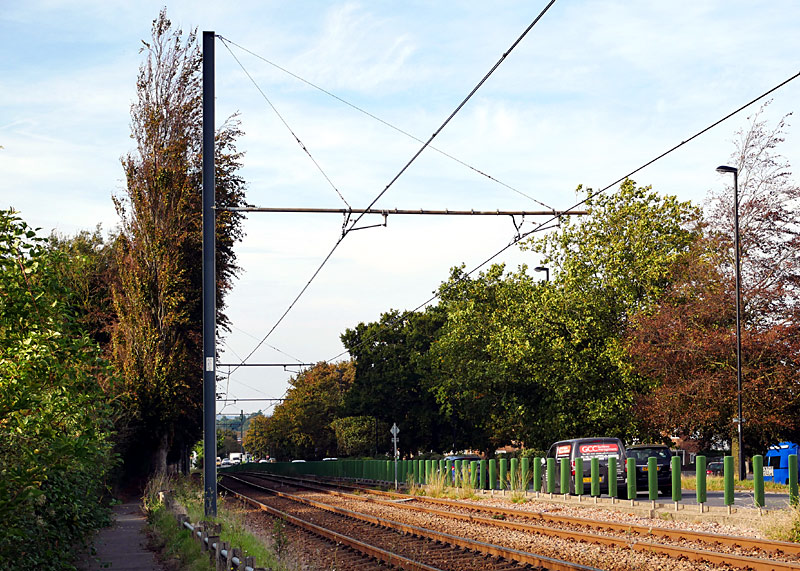
The purpose of the green wands between the tramway and the road is to block the glare of each others' headlights during the hours of darkness.
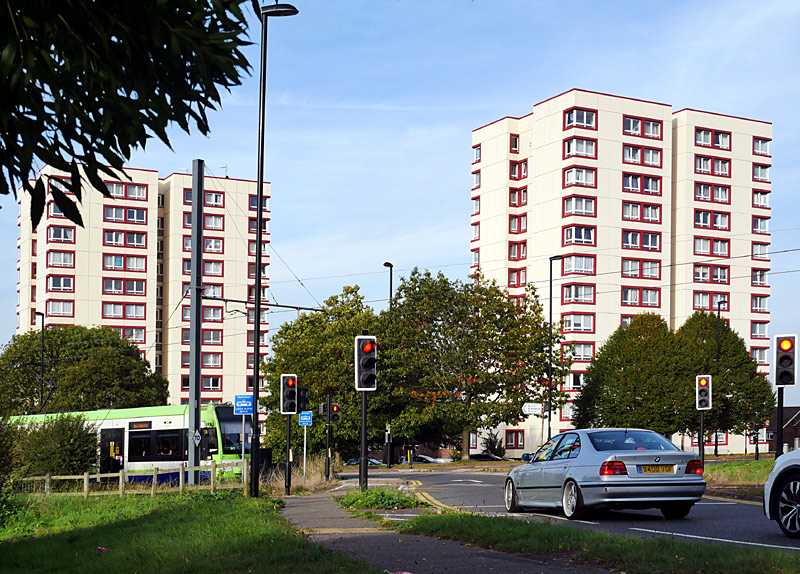

Both photographs show the trams at exactly the same location but were photographed from very different points of view.
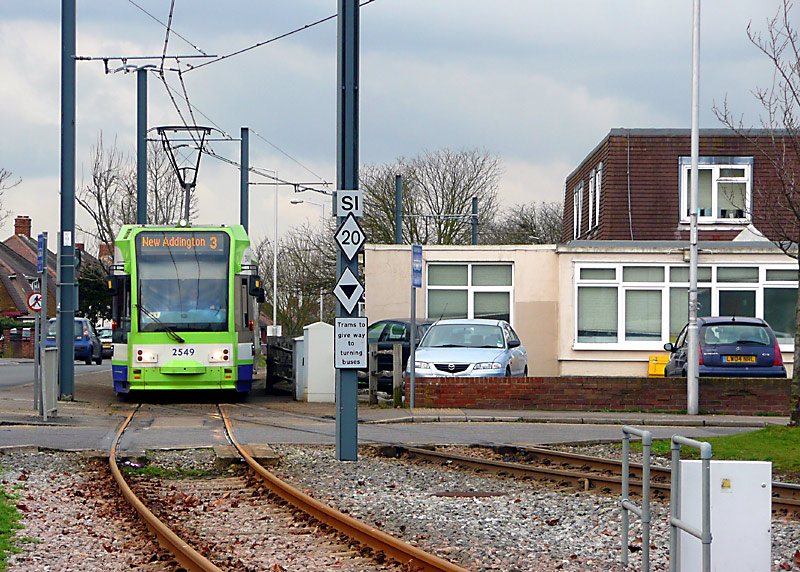

The tracks on this side of the single track section lead directly to either side of the island platform at New Addington tram stop.
The fares information on the back of the real-time information display is now out of date - cash fares no longer exist and smartcard fares are higher than shown.
Wimbledon:
The Wimbledon route is another former main line railway route. In British Railways days it was served a train that ran every 44 minutes, which for a heavily populated suburban area was a very unattractive service infrequency.
The route between Croydon and Wimbledon includes both single and double track sections, plus (just west of Mitcham tram stop) some interlaced / gauntlet track.
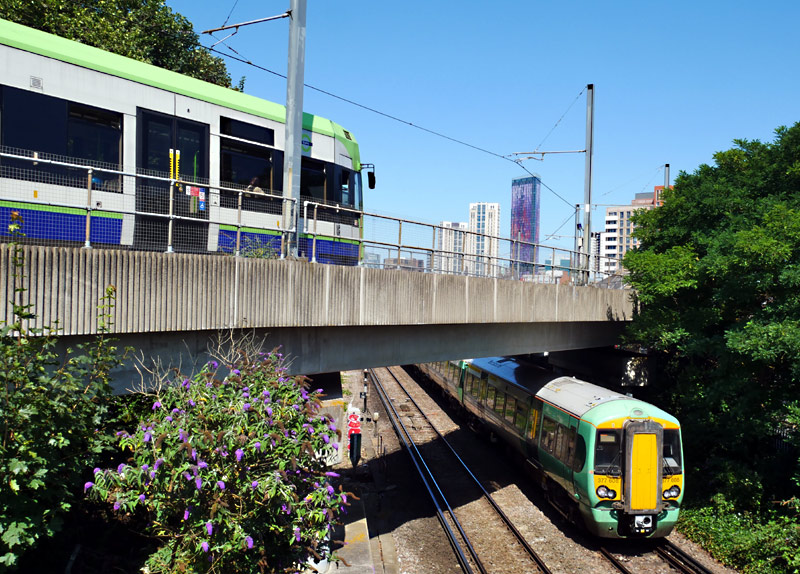
When planning the Tramlink network it was decided that it would be best if the conversion of the Wimbledon - West Croydon railway route included fully segregating the trams from the trains. This was achieved by means of bi-directional single track flyovers at two locations (see photographs below.)
Some good places to watch / photograph trams are between Ampere Way and Wandle Park. Also, at / near some of the tram stops. Being a former railway many sections of the route are not accessible, and it is also worth remembering that with trams travelling at speeds of up to 50mph (80km/h) it is often not safe for people to be too near the tracks.
Ampere Way serves a retail park, including a large IKEA home furnishings (etc.,) shop.
The tramway is also single track on the Wimbledon side of this station - this is to pass below a bridge that is not wide enough for two tram lines - instead of rebuilding the bridge.
This station is also served by other types of train which are operated by Southern.
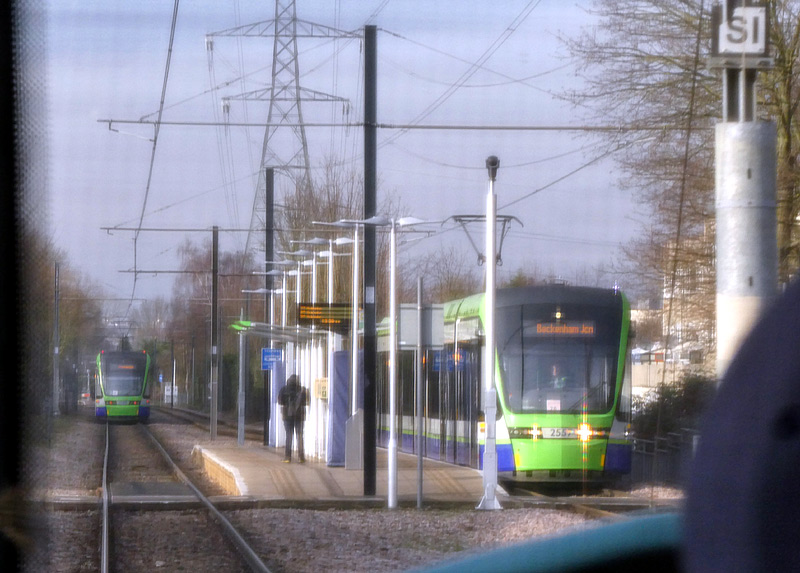
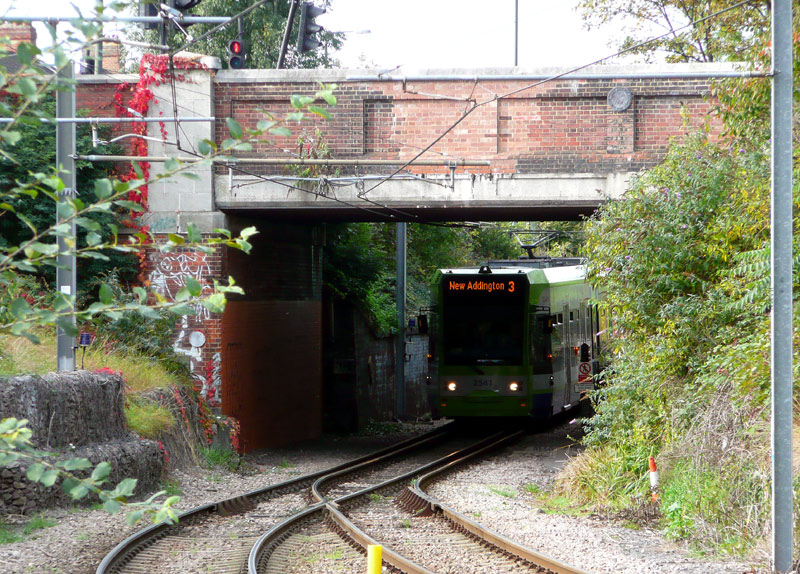
This is near Mitcham tram stop.
Bombardier 2541 is travelling from Wimbledon
to New Addington via Croydon town centre.
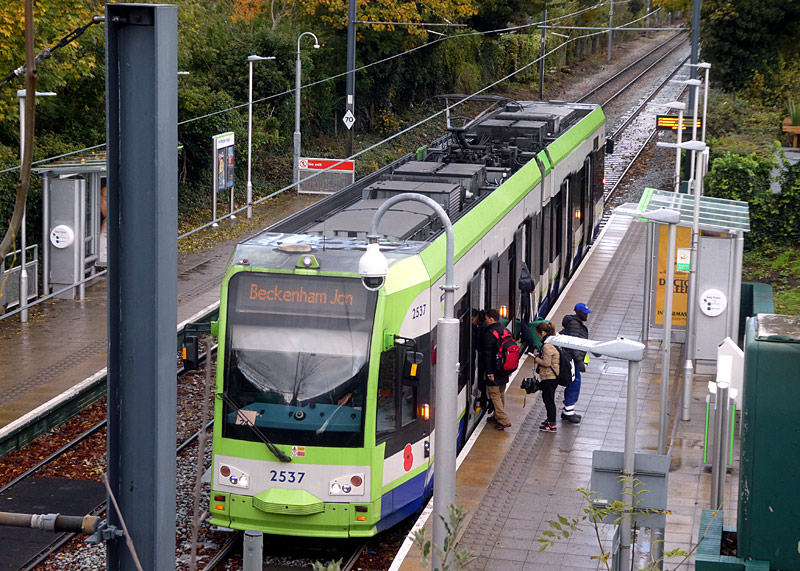
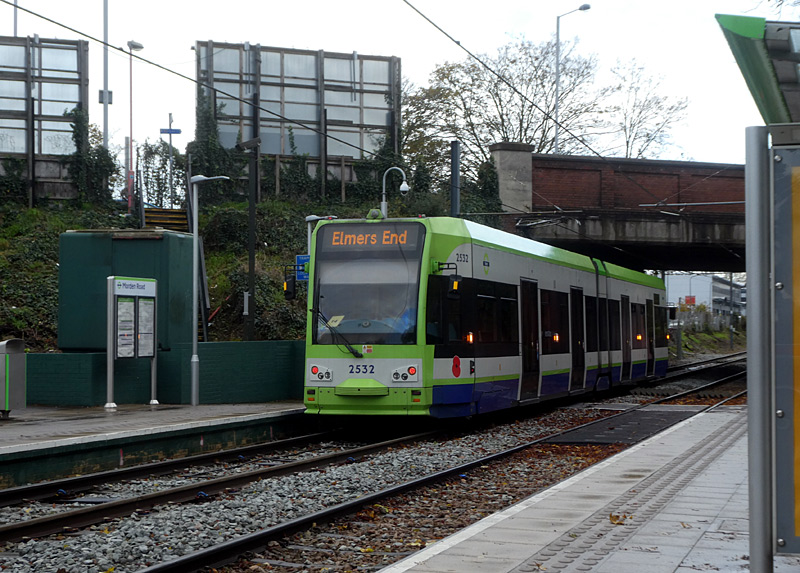
looking down from Morden Road (and Bombardier 2537) (left) and a platform view looking towards Morden Road (and Bombardier 2532) (right).
| Tramlink Ticketing |
Although the two main railway stations in Croydon are in zone 5 the entire Tramlink system is a special fares zone and any prepaid Travelcard season ticket which is valid in zones 3, 4, 5 or 6 can be used on the trams. Travelcards for just zones 1 and 2 are NOT accepted on the trams.
If you only wish to travel on the trams (and perhaps buses as well - but NOT trains) then using Oyster / Contactless bank cards / other compatible electronic payment devices in 'pay as you go' (PAYG) mode represents the cheapest way to pay fares.
Tram passengers who do not have Oyster cards and do not want to use other types of Contactless ticketing can also buy one-day Bus & Tram passes. Although more expensive than the daily fares cap these are ideal for passengers who are only in London for a day or two, who do not wish to use the railways and who want a physical souvenir of their visit. One Day Bus & Tram Passes can only be bought on the day of travel and are valid from 00:01 am and for any journey that starts before 04:30 am the next day.
Since March 2025 One Day Bus & Tram passes can only be bought in the form of special Oyster smart cards which are sold at local retail shops (Oyster Ticket Stops newsagents, etc.,) and at Visitor Centres. These are single-use smart cards which cannot be used for anything else. (The printed paper versions which used to be sold at many railway station ticket machines have been withdrawn.)
Tram passengers pay the same flat fare as bus passengers, and passengers with smartphone apps, Contactless and Oyster cards should use the card readers on the tram stop platforms before boarding the tram. However, you must NOT use a card reader to 'touch-out' at the end of the journey.
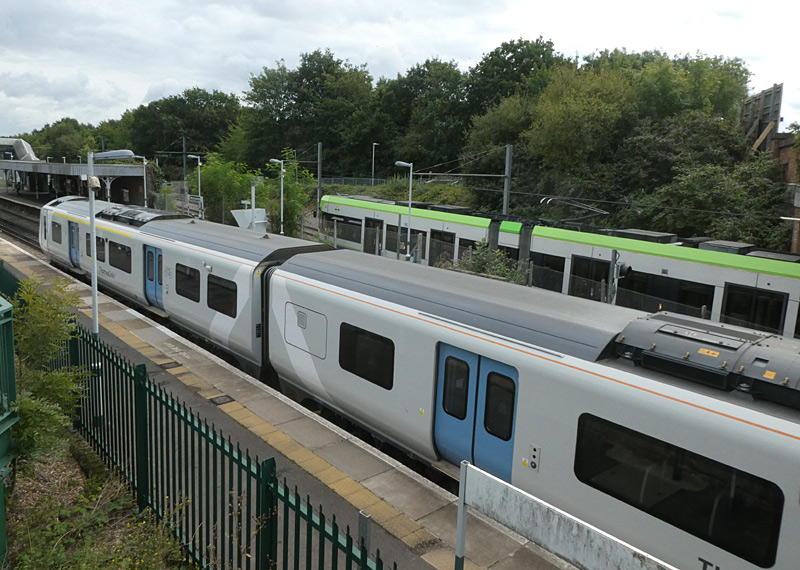
Special rules apply at Elmers End and Wimbledon stations where the trams stop inside the railway stations' fares paid areas. See below.
To ensure that the correct fares are charged by the ticketing system ALL Passengers travelling TO Wimbledon station who are using smart card / Contactless device ticketing, no matter what type - ie: even if it is a Travelcard season ticket on an Oyster card or an Oyster card Bus And Tram Pass - are supposed to 'touch-in' before boarding the tram.
Hopper Fares:
Passengers interchanging between two trams (or a tram and a bus) benefit from the 60 minute Hopper system which allows additional tram (or bus) journeys to be started within 60 minutes of touching-in
for the first journey. You must still 'touch-in' at the start of the free journey(s), but you will not be charged anything! Note that once you have 'touched-in' you can still complete that journey, even if it takes you over the 60 minute time limit.
Hopper Fares only apply to buses and trams but the 60 minute rule still applies - even if you travel by Underground / London Overground / other railway, etc., between your tram / bus journeys.
The genesis of the Hopper fare comes from when Tramlink first opened it included through tram / bus (certain bus routes only) ticketing in the Croydon area. In those days the time limit for a free subsequent
journey was 70 minutes.
When the free transfer system was expanded to all buses the official Hopper fares promotional information quoted a time period of an hour (ie: 60 minutes) - but to allow for clocks to be a little inaccurate
the system retained the 70 minute time limit. In 2021 this was reduced to 62 minutes, although promotional material still quotes an hour.
Fares Capping:
In addition to Hopper Fares tram passengers benefit from 'fares capping', which means that you will only be charged for any combination of tram and bus travel a maximum of three (3) times per day. In London daily fares
capping is based upon a 'touch-in' to start a journey after 04:30 am and a 'touch-in' to start a journey before 04:29 am the next day.
Note 1: Because an Oyster card which has a negative PAYG balance is then blocked it must be topped-up and the negative balance cleared before it will allow any free Hopper journeys.
Note 2: Free travel and fares capping only work when you use the same Oyster or other Contactless payment card (or device) at all times.
If you are staying in central London zone 1 for five days (or more) then a weekly / longer season ticket might be worthwhile - note however that these can only be used with ordinary Oyster cards - not Visitor Oystercards or any type of Contactless device.
If you are staying in suburban London for four days (or more) and do not need a ticket valid for Zone 1 then a weekly / longer season ticket might be worthwhile
Tramlink stops used to have ticket machines where passengers could buy tickets using cash. However these were withdrawn in July 2018.
There is a Tramlink information shop in George Street (near East Croydon railway station / on the other side of the road) which sells tickets and offers travel advice.
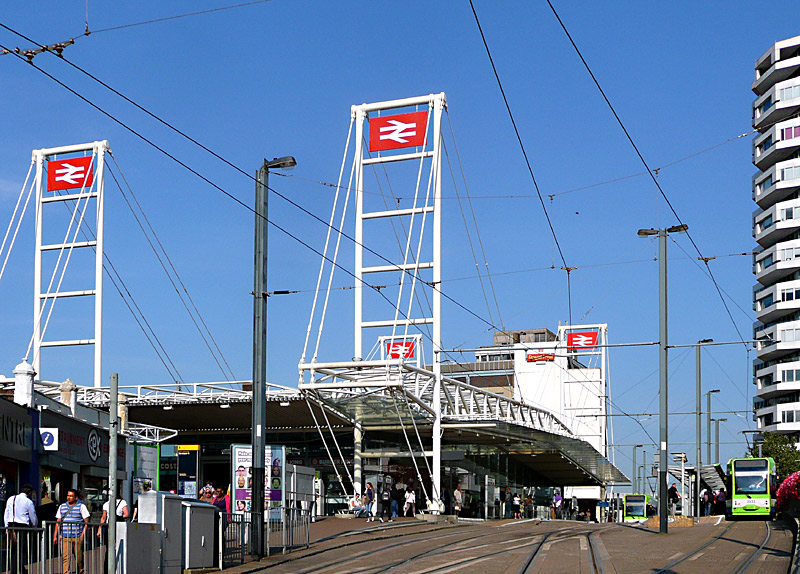
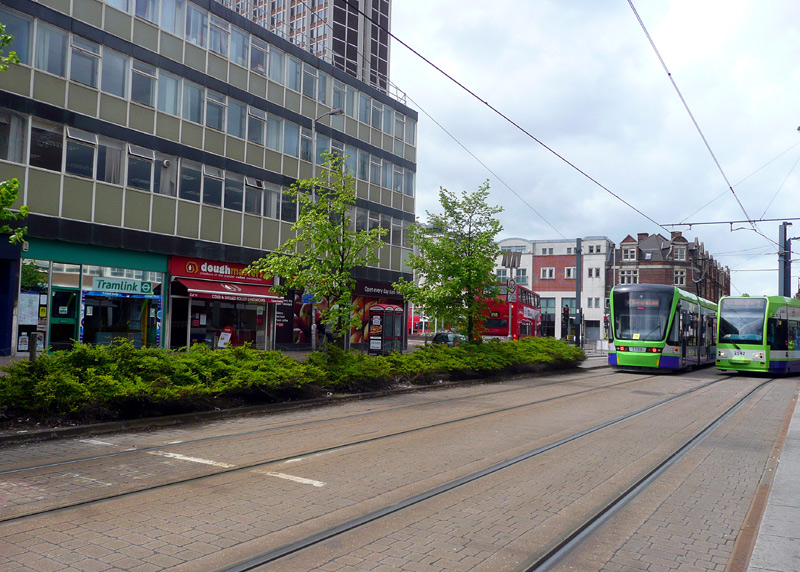
which has three platforms and is right outside East Croydon
railway station. This was filmed at about 4:30pm / 16:30.
The Cheapest Fares From Central London Zone 1:
The cheapest way to travel to Croydon from London Zone 1 is to travel via Wimbledon. This is because Wimbledon station is in Zone 3 and the maximum daily fare using pay-as-you-go (PAYG) ticketing on Oyster cards and Contactless
cards and devices is lower for zones 1 - 3. The cheapest single fares are on the District line, but if you are going to reach the daily fares cap it does not matter which railway service you use!
It is also possible to pay Zone 3 fares by travelling to Wimbledon by South Western Railway from London Waterloo station (and Southern from Victoria - but you must change to a South Western train at Clapham Junction). But it is important to be aware that main line / National Rail fares are often slightly higher than those charged the Underground. Be careful with the Thameslink trains that serve Wimbledon station as some of them travel via zones 4 and 5.
If you travel to Croydon via the train / tram interchanges at Mitcham Junction, Birkbeck, Beckenham Junction or Elmers End then you will travel in Zone 4.
East Croydon and West Croydon stations are in Zone 5.
If you buy one-day ride-at-will Zones 1-6 paper Travelcard tickets then you can travel via any route. Whilst these are the simplest tickets to use and afterwards make for nice souvenirs they are also the most expensive. Where available, Monday - Friday off-peak one-day Travelcards can be used after 9.30. For some zone combinations only the more expensive Daily Anytime one-day Travelcards are available (not off-peak). At weekends and bank / public holidays off-peak one-day Travelcards can be used all day.
BritRail / Eurail Passes:
Visitors who have BritRail / Eurail Passes can also use these to travel between central London and Croydon - they are valid on all National Rail routes in London - including the London Overground to West Croydon - but NOT to Wimbledon
via the District line. For travelling on Tramlink either use PAYG or buy a Bus And Tram Pass.
Fast Trains:
All types of London ticketing (Travelcards, PAYG, etc) can be used on the faster trains which only stop at a few stations (or even travel non-stop) between Croydon and central London: These travel via a few routes:
London Victoria and East Croydon
London Bridge and East or West Croydon (Different trains serve either one of the two Croydon stations).
Fast trains also travel between Clapham Junction and East Croydon.
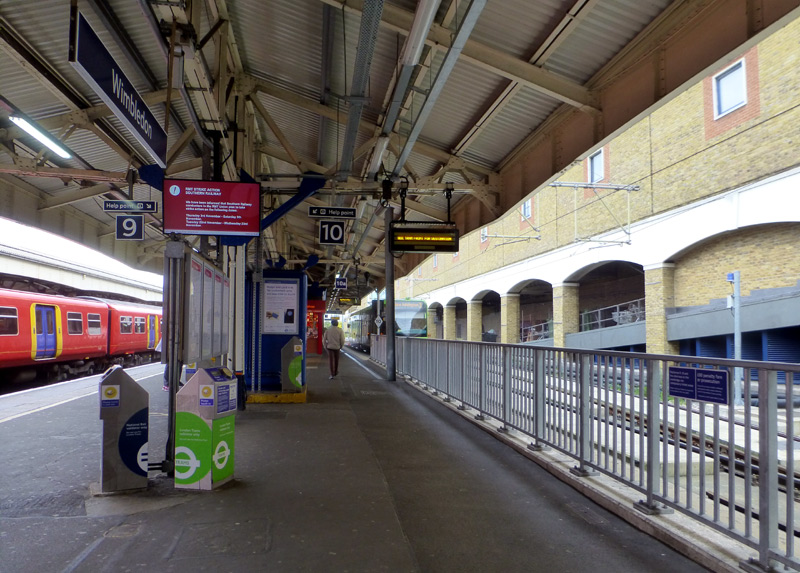
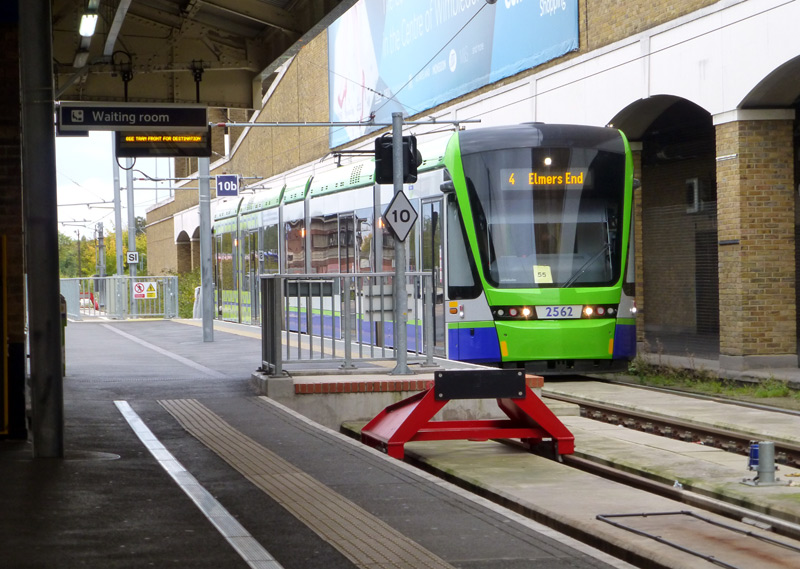
and an empty platform 10a.
* To reduce the risk of complications these rules should also be followed if you are using any type of smart card or other contactless device with a Day Anytime, Day Off-peak or 7 Day Anytime Travelcard
* If you arrive here by any of the train services and are planning to depart on the tram you must 'touch-in' using a TRAM card reader on tram platform No.10, this will end your train journey and charge you a tram fare. Otherwise you will end up being financially penalised for not 'touching-out' at the end of your train journey AND be travelling on the tram without having paid your fare.
* If you arrive here by tram and are continuing your journey by either the Underground or any National Rail (main line) train service then you must 'touch-in' on one of the railway card readers - ideally on Thameslink platform 9 which is next to the trams but you can also use a yellow card reader on District line platforms 1 - 4. Important: Only yellow card readers should be used at platforms 1-4, NOT pink card readers. Otherwise you will be travelling on the train without a valid ticket and when you 'touch-out' at your ultimate destination station you will be financially penalised.
* If you arrive here by train and are leaving the station then 'touch-out' as you exit the station in the normal way.
* If you arrive here by train and are leaving the station by a different train then you might benefit from a cheaper fare if you 'touch' your card on a pink card reader near platforms 1-4.
* Passengers who enter Wimbledon station from the street and are intending to travel on the train should 'touch-in' at the ticket gate in the normal way.
* Passengers who enter Wimbledon station from the street and are intending to travel on the tram must 'touch-in' at the ticket gate and then 'touch-in' again on one of the tram card readers located on tram platform No.10. Otherwise the system will treat you as if you are travelling by one of the other railways and you will be financially penalised.
* Whilst it is usually possible to reclaim the excess charges from the Oyster helpline the process is a hassle.
* If you are using paper One Day Travelcards or One Day Bus and Tram pass then you pass through the ticket gates in the normal way and then ignore all these ticketing complications!
* If you are using a One Day Bus and Tram pass then you must not travel on the trains - and if you are using a smart card or other contactless device remember to 'touch-in' again on one of the tram card readers located on tram platform No.10.
Special Information For Using Smart Card Ticketing (Oyster / Contactless / Other Device) In PAYG Mode At Elmers End Station
* To reduce the risk of complications these rules should also be followed if you are using any type of smartcard or other contactless device with a Day Anytime, Day Off-peak or 7 Day Anytime Travelcard
* Elmers End does not have electronic gates so life is a little easier.
* If you arrive here by tram and are leaving the station then do not use any card readers, do NOT 'touch-out'.
* If you arrive here by tram and are continuing your journey by train then you must 'touch-in' on one of the train card readers.
Otherwise you will be travelling on the train without a valid ticket and when you 'touch-out' at your ultimate destination station you will
be financially penalised.
* If you arrive here by train and are leaving the station then use a train card reader to touch out.
* If you arrive here by train and are leaving the station by tram then you should 'touch-in' on a tram card reader - this will end your train journey and charge you a tram fare.
* Passengers who enter Elmers End station from the street and are intending to travel on the tram must 'touch-in' on a TRAM card reader located on the
tram platform
* Passengers who enter Elmers End station from the street and are intending to travel on a train must 'touch-in' on a TRAIN card reader.
as otherwise when you 'touch-out' at your destination station you will also be financially penalised
* If you use the wrong card readers you will be travelling without a valid ticket and will end up being financially penalised / charged a railway maximum fare. This will be expensive!
* If you are using paper One Day Travelcards then you can ignore all these ticketing complications and just travel in the normal way!
* If you are using a One Day Bus and Tram pass you must not travel on the trains.
Paper / Smart Card Combinations. You must touch in / out as appropriate for journey where the fare is paid on a smart card and use paper tickets for the rest of the journey.
Additional reading:
https://www.oyster-rail.org.uk/trams-and-buses/
https://www.oyster-rail.org.uk/wimbledon/
https://tfl.gov.uk/modes/trams/
| What Tramlink Lacks |
Lawn / grassed trackage is a visually attractive feature which helps the tramway visually blend into the landscape - especially when the tracks are alongside existing parkland.
Where required privet hedges act as a safety barrier discouraging people from walking over the tracks.
In Europe many tramways include lawn trackage - especially on new-build systems and network extensions.
This section of tramway alongside Addiscombe Road was originally supposed to use lawn tracks, but the people who built the tramway wanted the tracks to be paved.
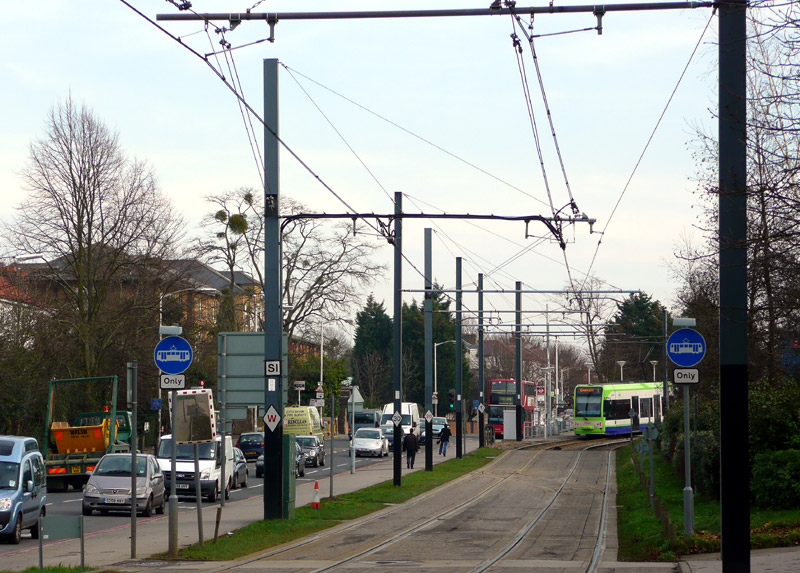
In the distance is Sandilands tram and bus stop
with a Bombardier tram travelling towards Elmers End.
Lawn trackage was included in Tramlink's design brief, but because the British Government's regulations give the company which builds tramways much control over how the construction project is achieved so it was possible for this to be omitted from the final design.
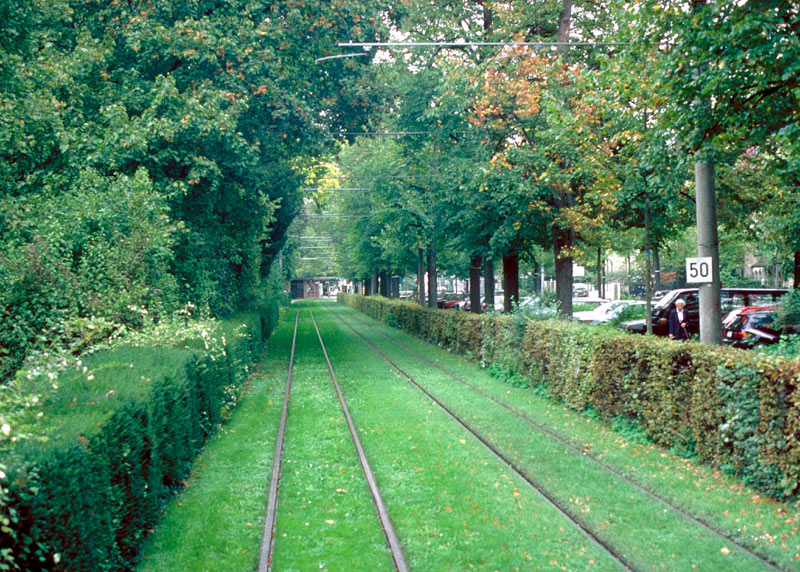

on route 8 in Basle, Switzerland.
plants around the tracks, designed to help delineate the swept
path of the tramway in Zwickau, (south eastern) Germany.
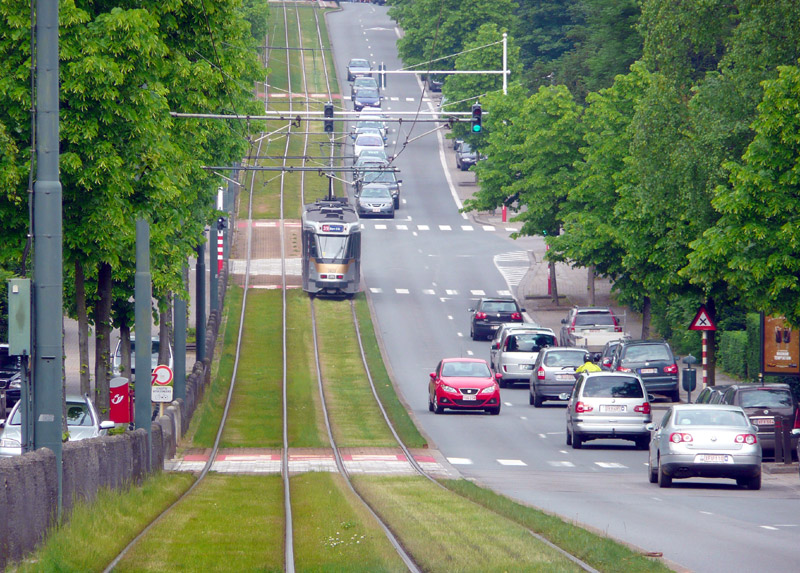
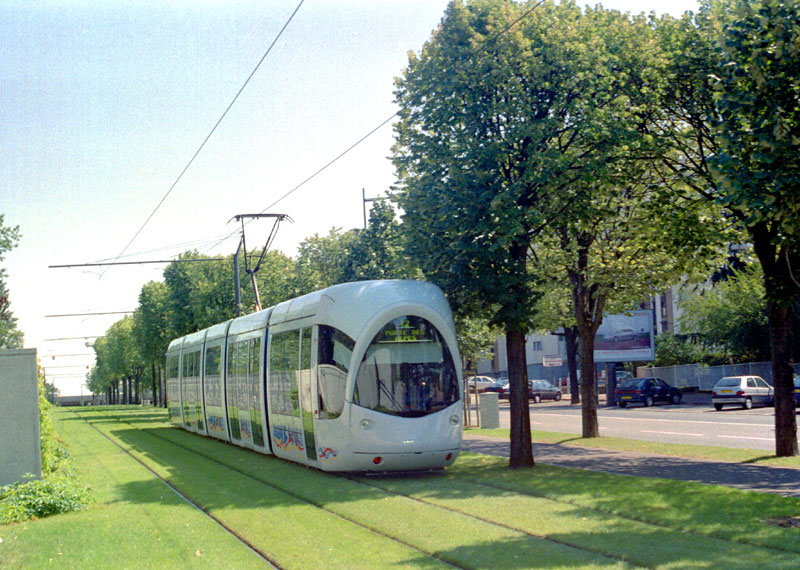
Lawn Track - Creating Green Corridors.
Tramlink is also looked at in the Wimbledon station section of the page about busier stations in zones 1-4.
| Opening Page Fares & Tickets / Photography |
|
|
|
| London Underground Small Profile ‘Tube’ Trains |
|
| Bakerloo Line | |
| Central Line | |
| Jubilee Line | |
| Northern Line | |
| Piccadilly Line | |
| Victoria Line | |
| Waterloo & City Line | |
|
|
| London Underground Large Profile ‘Subsurface’ Trains |
|
| Circle Line | |
| District Line | |
| East London Line | |
| Hammersmith & City Line | |
| Metropolitan Line | |
|
|
| National Rail ‘Tube’ Trains | |
| Northern City Line | |
| Crossrail Line 1 (Elizabeth Line) | |
| Crossrail Line 2 | |
|
|
| Other National Rail Trains | |
| London Overground | |
|
|
| Local Light Railways | |
| Docklands Light Railway | |
| Croydon / London Tramlink |  |
|
|
| General Information | |
| Main National Rail Stations Fast Regional Services Overhead Wire & 3rd Rail Trains |
|
| Busier Suburban Stations In Zones 1-4 With A Wider Variety Of Trains To See |
|
| Station Architecture & Features | |
| Shared Service Routes | |
| Further Information Resources To Visit In Person Or Online |
|
|
|
| Single Page Version Of This Guide |
|

