
Visitors to London who are also transport enthusiasts (‘railfans’) sometimes ask for advice as to the ‘best’ things to see on London’s railway network. This page is part of a guide which aims to answer that question.
If this is the first time you have reached these pages then it is best to go to the Opening Page which sets the scene, explains the difference between the small and the large profile trains, offers advice on the best type of ticket to buy and photography tips.
Alternatively, it is possible to view everything on one page
|
| London Overground |
|
| The Birth Of The Overground |
The initial London Overground network comprised seven* urban railway routes which for reasons that included a lack of investment and lack of passenger awareness were
(mostly) seen as transport backwaters. They were joined under one high-profile name and after much investment (and new trains) achieved a level
of public awareness - and patronage - similar to that of the Underground system.
(* Although there were seven routes one of them was shortened and merged with another route, losing its separate identity at the same time).
Part of the Overground ethos has been to provide a turn up and go service so that passengers do not need to consult the timetable - they will know that (on most routes) the trains come at least every 15 minutes. Such has been the success of the Overground Network that to cope with passenger numbers most of the original routes needed to have their trains extended from four to five carriages in length.
In May 2015 some more routes were added to the London Overground network. Some of these are busy urban services whilst one is a short rural branch line.
New Line Colours And Names
In February 2024 it was announced that new names had been chosen for the individual Overground lines and that they were (for the first time) to be given their own line colours. Previously they had always been depicted in orange.
The London Overground map below-right has been updated to show the line names and colours. Some of the line names were chosen to reflect the racial / ethnic diversity of London's population, and for other reasons. Not everyone is happy, not least because some of the lines already had unofficial (but long-standing) names. Another gripe is that some of the chosen names seem to be political.
| Claustrophobia |
 Information for people who are happy to travel on trains which are above ground but experience claustrophobia
when in tunnels.
Information for people who are happy to travel on trains which are above ground but experience claustrophobia
when in tunnels.
A few locations on the Overground Network have single track tunnels:
* Where trains use the historic Brunel tunnels to pass below the River Thames on the East London / Windrush line between Wapping and Rotherhithe stations.
Note that this line also includes many twin track tunnels.
* On the Euston - Watford / Lioness line between Euston and South Hampstead stations plus between Kensal Green and Willesden Junction stations. On days when this service is diverted to Stratford (instead of Euston)
then the trains pass through single track tunnels when travelling between South Hampstead and Camden Road stations.
| Overground System Maps |
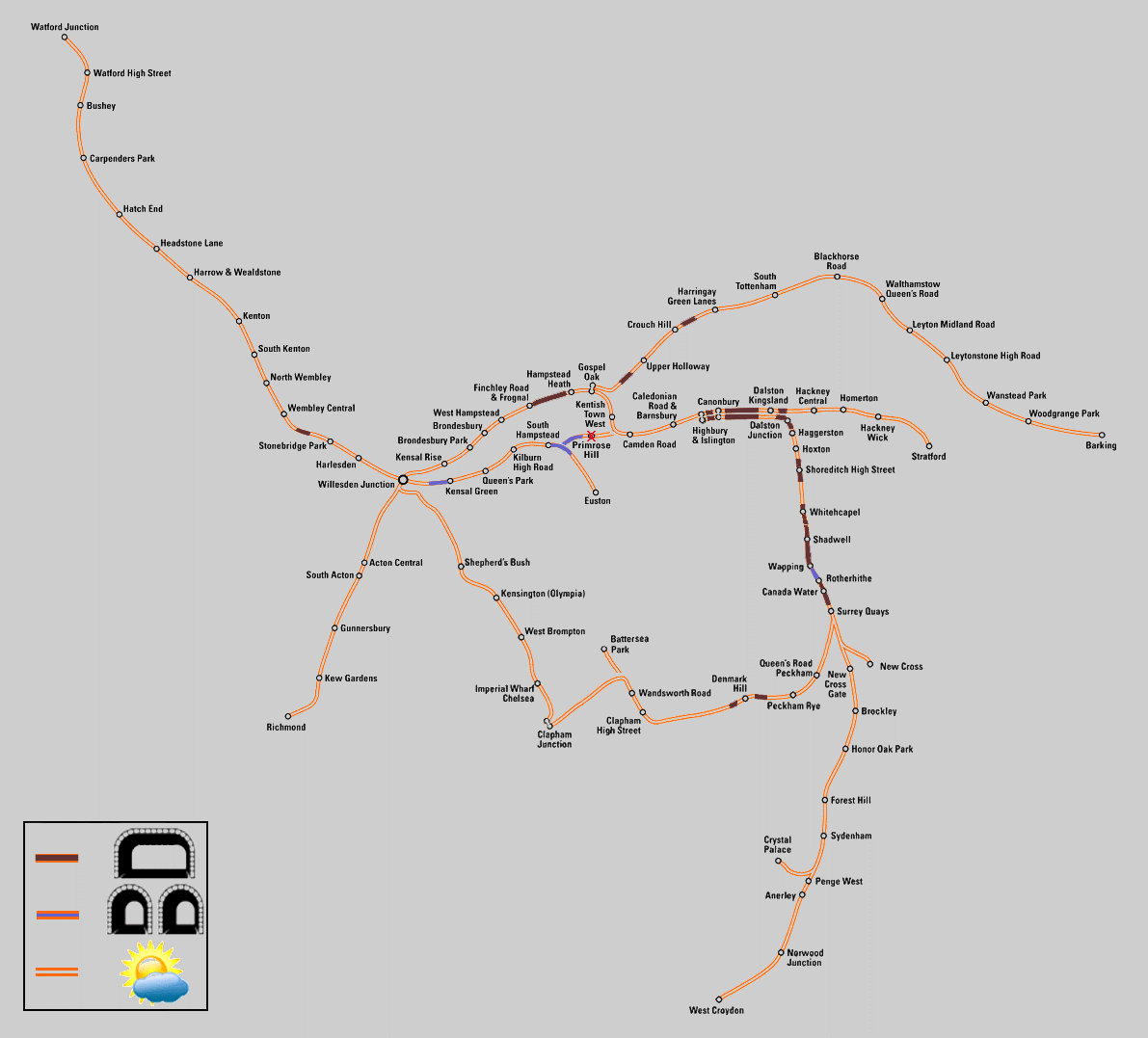
Map showing the London Overground network in 2013.
This map also shows open air and tunnelled sections of railway.
Original source & license: Cnbrb / Wikipedia encyclopædia CC BY-SA 3.0
http://commons.wikimedia.org/wiki/File:London_Overground_2013.png
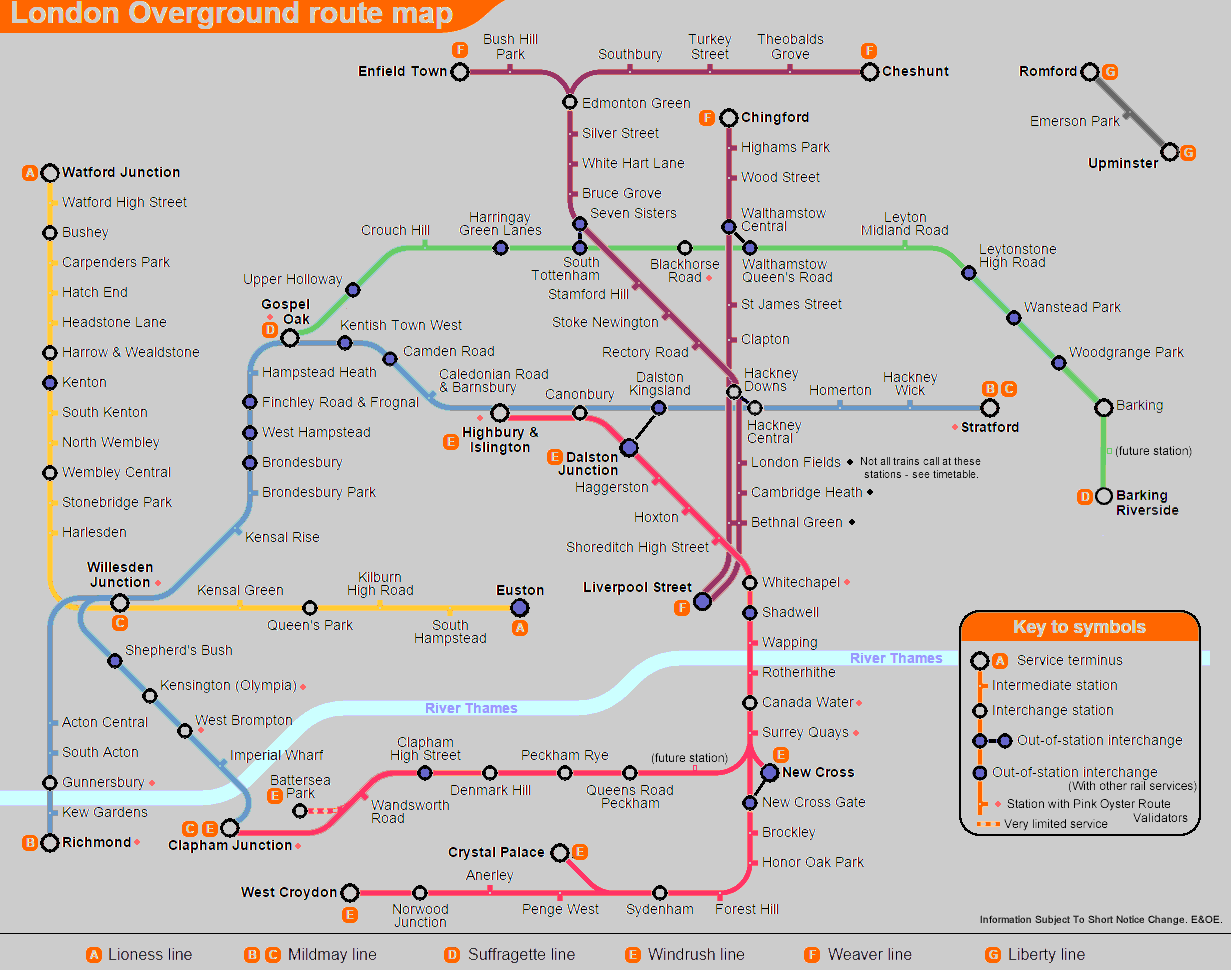
Map showing the London Overground network after more routes were added in 2015 plus interchange stations, stations with pink Oyster Route Validators and the new line colours announced in February 2024. Original source & license:
sameboat / Wikipedia encyclopædia CC BY-SA 3.0
https://commons.wikimedia.org/wiki/File:London_Overground_map_sb.svg
Click maps to see larger versions in new windows! 
The 2024 map includes information on the routes which joined the London Overground network in May 2015 and lists the services as route A - route G, as per the information below. However giving the lines letter names was done by one or several people at Wikimedia - and not Tf L / London Overground. Therefore this line information listing is the only use of these letters on this website.
- A: Euston - Watford Junction. In the 1980s this was named Harlequin line but that name did not last long, now it is called the Lioness line.
- B: Richmond - Stratford (via the North London Line). This has been renamed as the Mildmay line.
- C: Clapham Junction - Willesden Junction (via the West London Line) - most of these services are extended to Stratford via the North London Line and is now part of the Mildmay line.
- D: Gospel Oak - Barking Riverside (for many decades this route was nicknamed Goblin but has now been renamed as the Suffragette line).
- E: A group of four interworked services which travel via the East London Line and the historic Brunel Thames Tunnel. The core part of the route is: (Highbury & Islington ... some trains only) - Dalston Junction - Whitechapel - Surrey Quays, from where trains fan out to reach one of four destinations: New Cross / West Croydon / Crystal Palace / Clapham Junction. Now renamed as the Windrush line.
- F: A group of three north London services which radiate from London's Liverpool Street station to Cheshunt (via Seven Sisters) / Enfield / Chingford (This group of lines was also known as West Anglia and Lea Valley but has now been renamed as the Weaver line).
- G: A short branch line shuttle service between Romford and Upminster at the eastern edge of London - for the first time this service has been given a name ... it is the Liberty line.
This map was first issued in 2015 but was updated in February 2024 after the Overground lines were given names and line colours, which took effect in November 2024 when station signage started being updated.
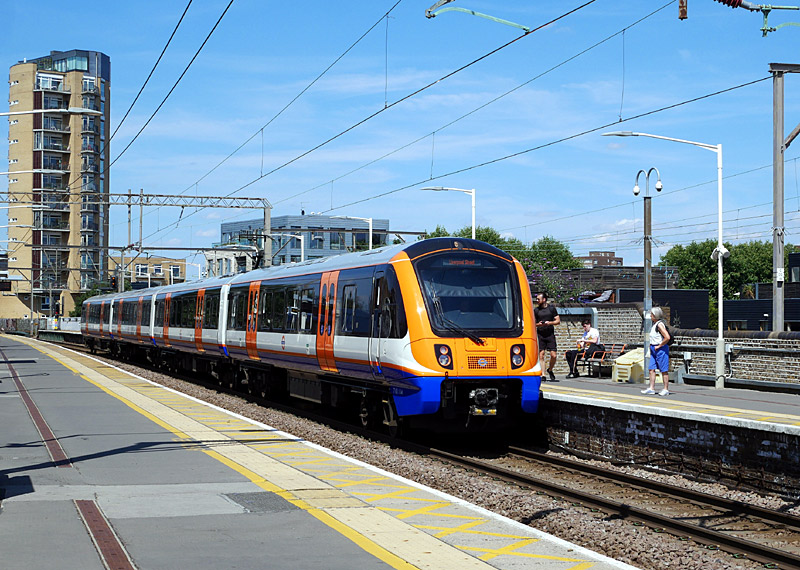
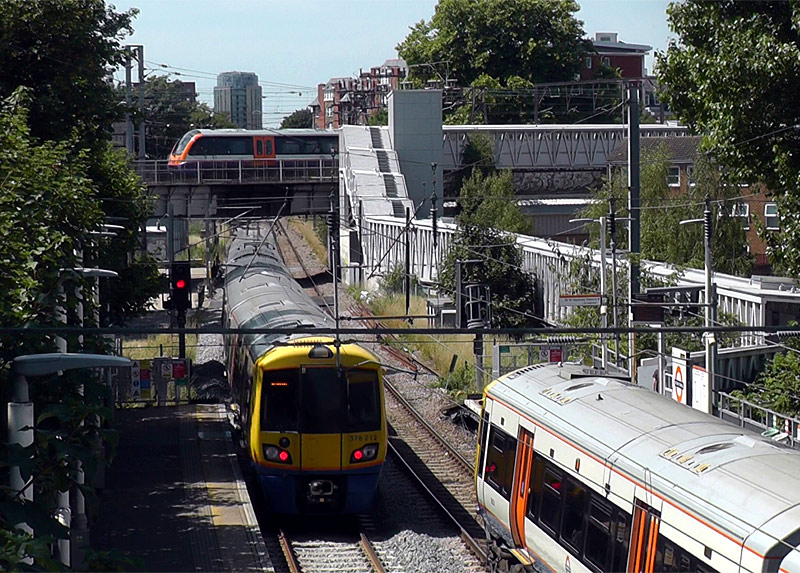
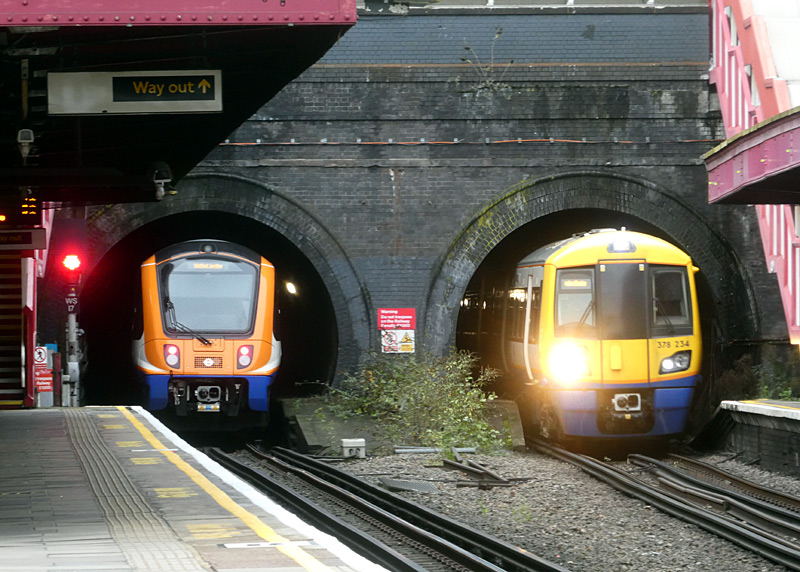
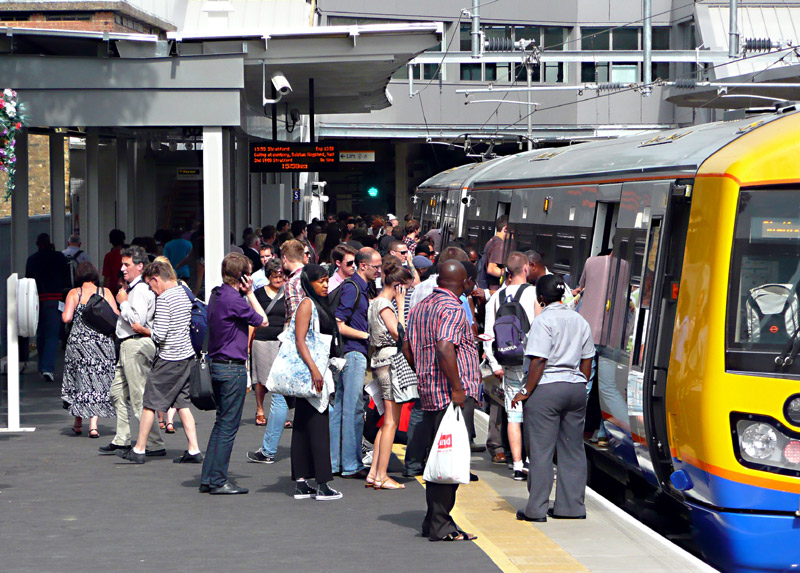
On the left is a departing westbound Class 378 train.
On the right is an eastbound train heading to Stratford.
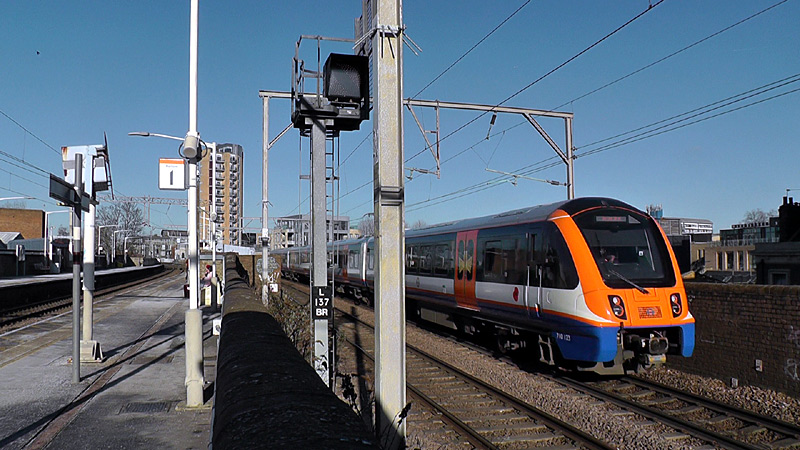
On the bridge is a northbound West Anglia / Weaver line
Class 710 train arriving at Hackney Downs station.
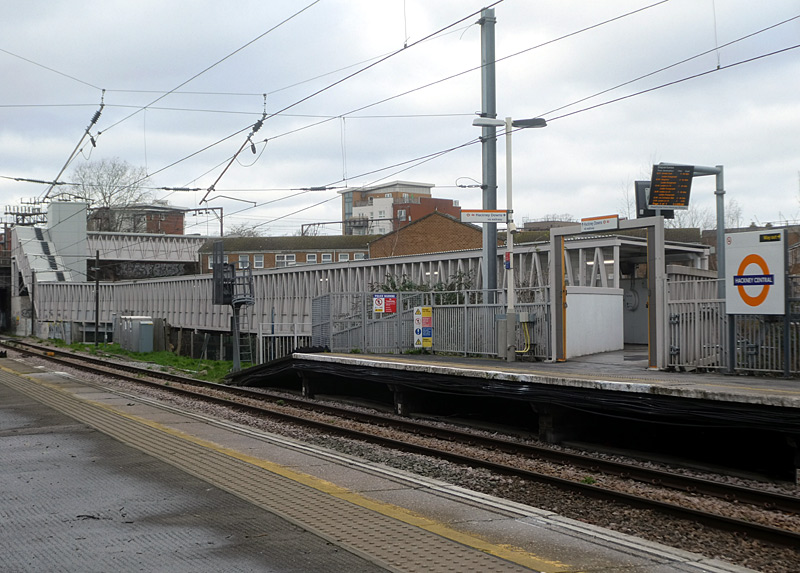
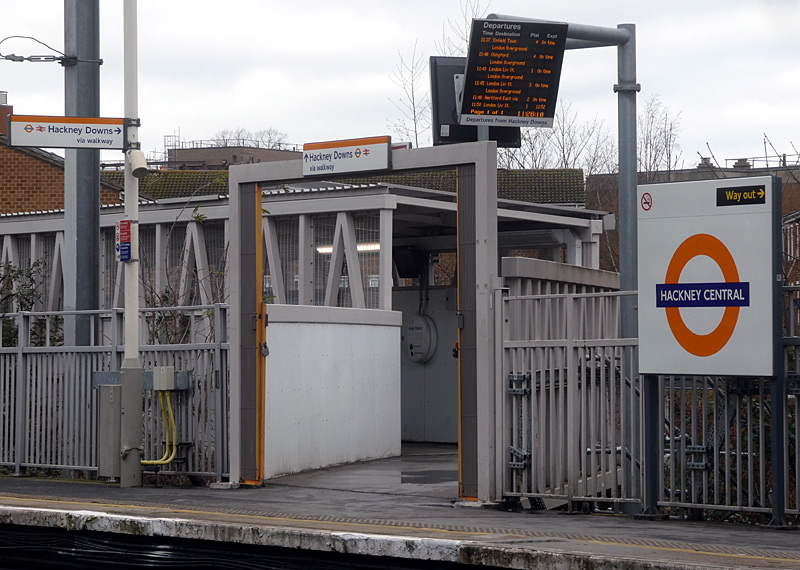
This walkway is fully accessible and also has some pink Oyster / Contactless card readers so that passengers paying train
fares using PAYG (or with Oyster Travelcard season tickets which do not include zone 1) can benefit from cheaper fares.
| Outer Circle Line |
Although not marketed as such the combination of several London Overground services forms a Circle line around London.
However, this operates in several segments, so for some journeys passengers will need to change trains at Clapham Junction [in south London] or Canonbury / Highbury & Islington plus any station between Dalston Junction and Surrey Quays [in north and east London].
Passengers paying fares using electronic smart card ticketing in PAYG (pay as you go) mode (Oyster, contactless, etc.,) are advised NOT to try and travel around the entire circle in one journey. The PAYG system is not designed for such journeys and passengers who try to do this will find themselves being charged an expensive maximum fare. NB: this advice also applies to passengers who have reached the fares cap for that day and passengers with Oyster Travelcard Season Tickets which do not include both Zones 1 and 2.
However passengers with paper One Day Travelcards which are valid in zones 1 and 2, All Line Rover, BritRail and Eurail passes (etc.,) can make such journeys without ticketing complications.
| Train Types - Class 378 |
The air-conditioned London Overground Class 378 Capitalstar trains are used on these services:
- Euston - Watford / Lioness line
- North London / Mildmay line
- West London / Mildmay line
- East London / Windrush line.
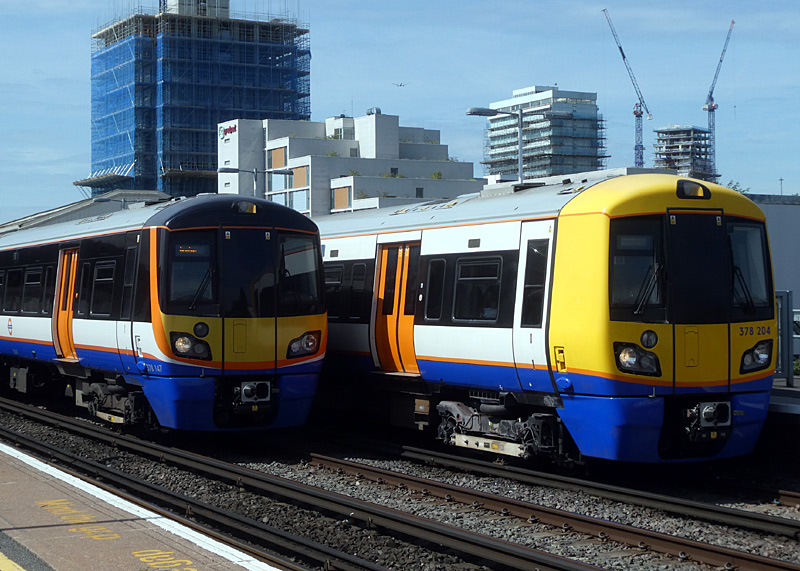
On the left is 378 147 in the newer livery, it is on a South & East London / Windrush lines service to Dalston Junction via Whitechapel.
On the right is 378 204 in the older / original livery on a West & North London / Mildmay lines service to Stratford via Willesden Junction.
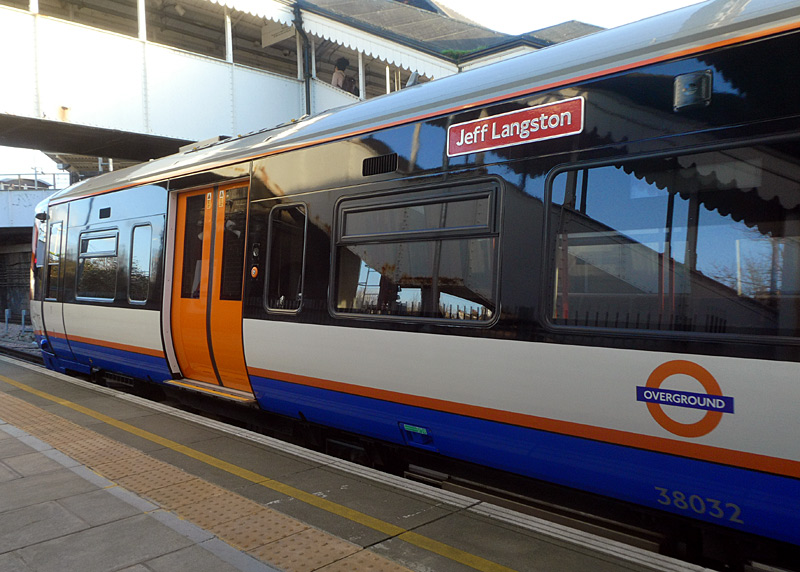
named after the late Jeff Langston, who used to work at TfL.
It is using the bay platform at Willesden Junction.
This train is in the newer livery which is designed to be similar
to the livery of the Class 710 trains.
These are powerful trains which were designed for 75mph (121 km/h) operation, although because much of the routes they serve have a top speed of just 45mph (72 km/h) they rarely demonstrate their true capabilities. Indeed, it is a characteristic of these trains that they travel calmly and sedately, with slow station approaches and gentle braking of the type which makes for very smooth journeys - and longer overall journey times.
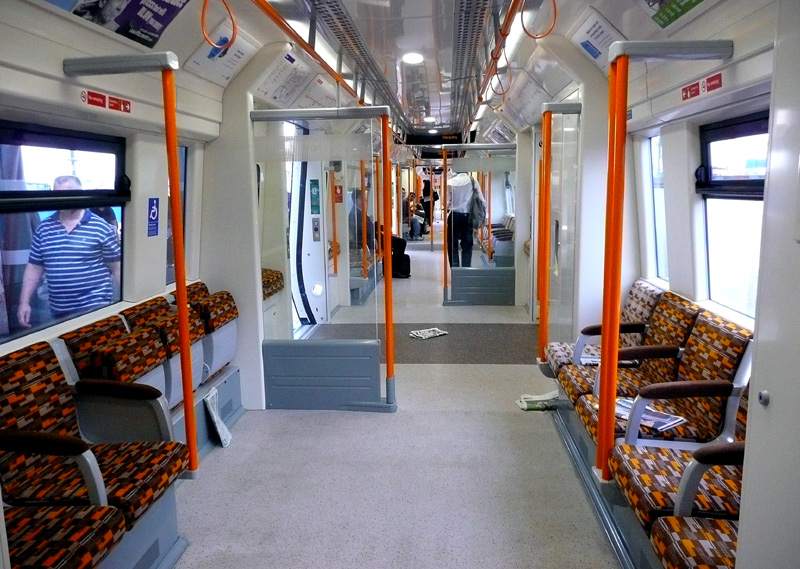
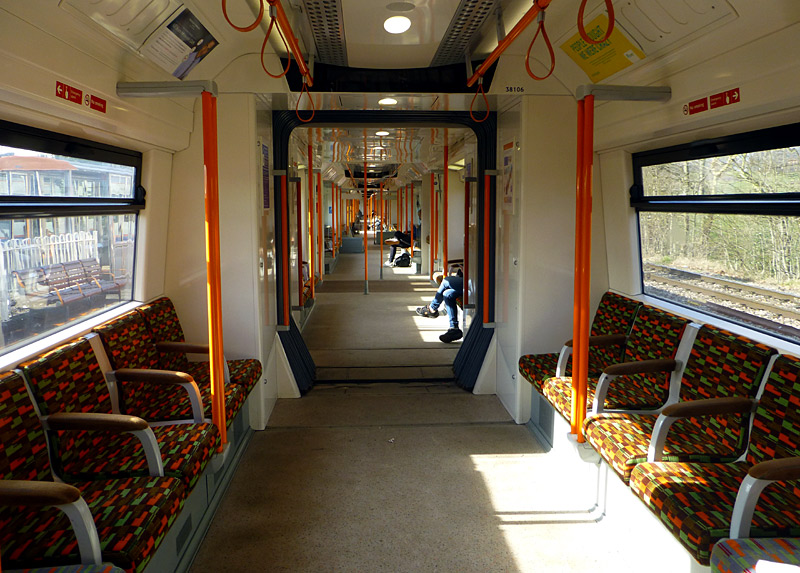
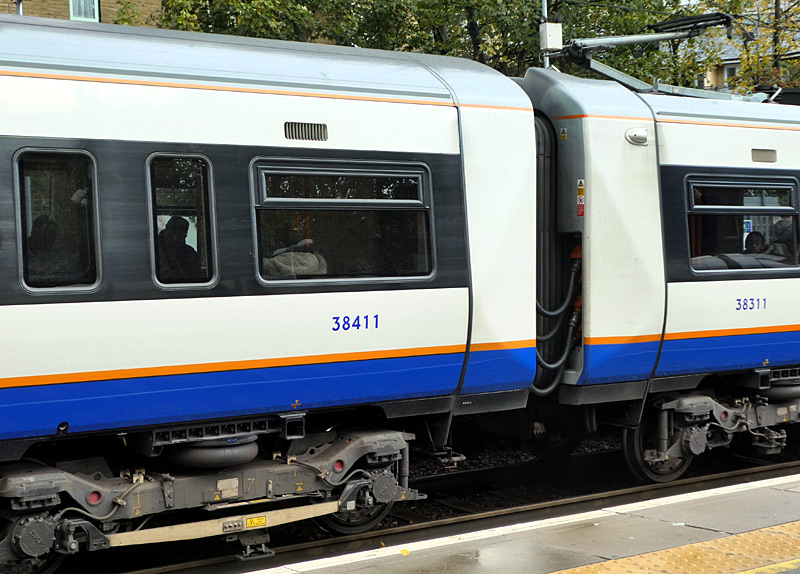
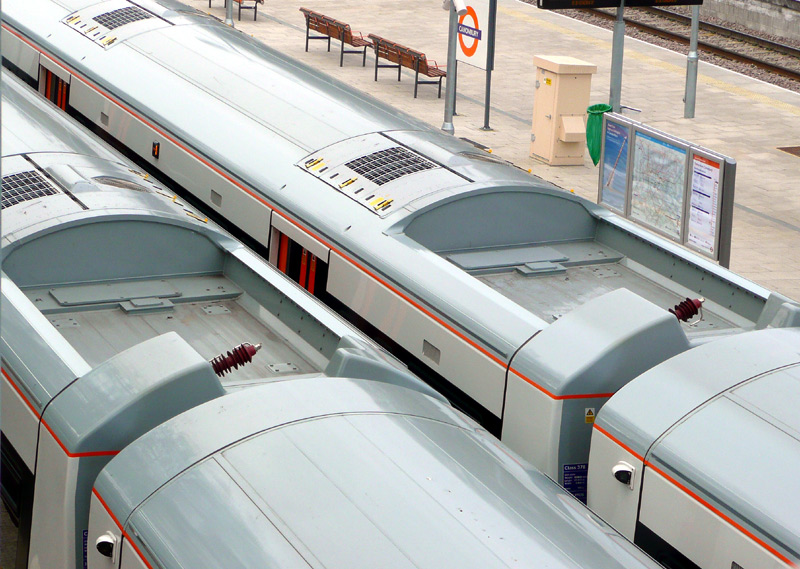
750v DC third rail system, but are designed for easy conversion
to twin system.

A short film showing Overground and other trains taken a New Cross Gate in May 2013 can
be seen on 'youtube' at this link: http://youtu.be/9EpfgK8Z34g
| Train Types - Class 710 |
The air-conditioned London Overground Class 710 Aventra trains - there are three variants of these trains.
- Class 710/1 - four carriage 25Kv AC overhead wire trains for the West Anglia / Weaver line and Romford - Upminster Liberty line.
- Class 710/2 - four carriage dual voltage (25Kv AC overhead wire and 750v DC third rail) trains for the Euston - Watford Lioness line and Goblin / Suffragette line.
- Class 710/3 - five carriage dual voltage (25Kv AC overhead wire and 750v DC third rail) trains for the Euston - Watford Lioness line plus the North and West London / Mildmay line services.
It is very unlikely that Class 710 trains will ever be used on the East London / Windrush line. This is because they do not have emergency exit doors at each end of the train and therefore it is illegal for them to carry passengers through the narrow single bore tunnels below the river Thames.
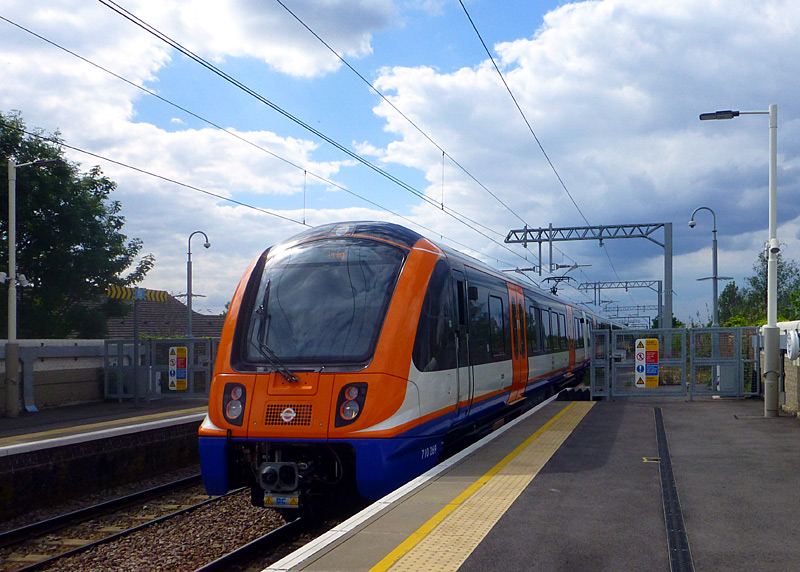
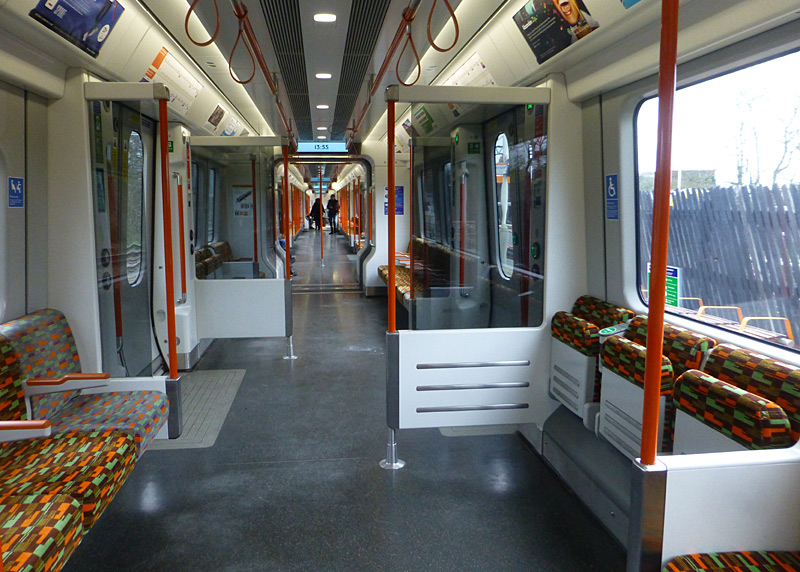
of station platform. This is one of several stations on this route where only part of a much longer platform is used.
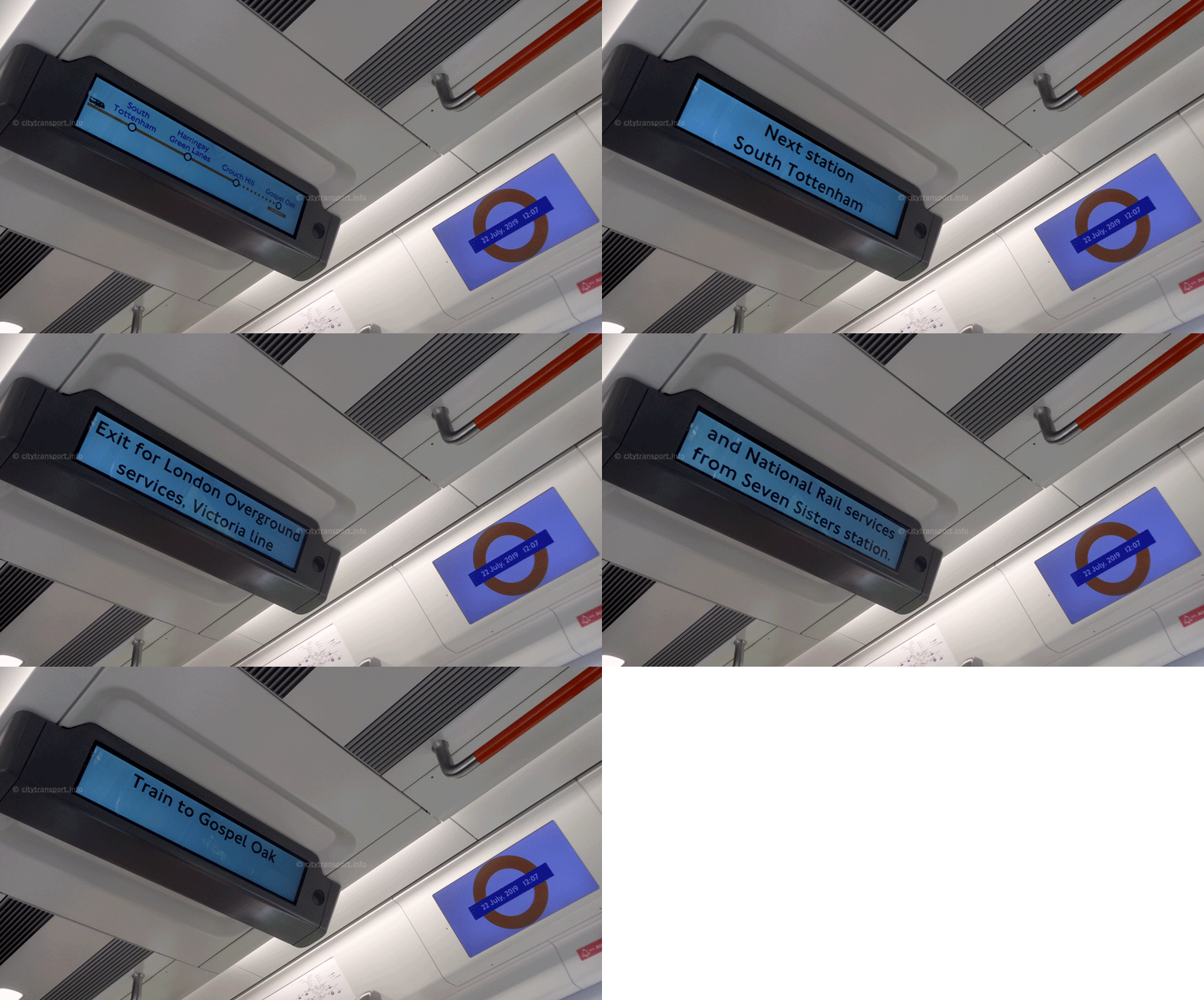
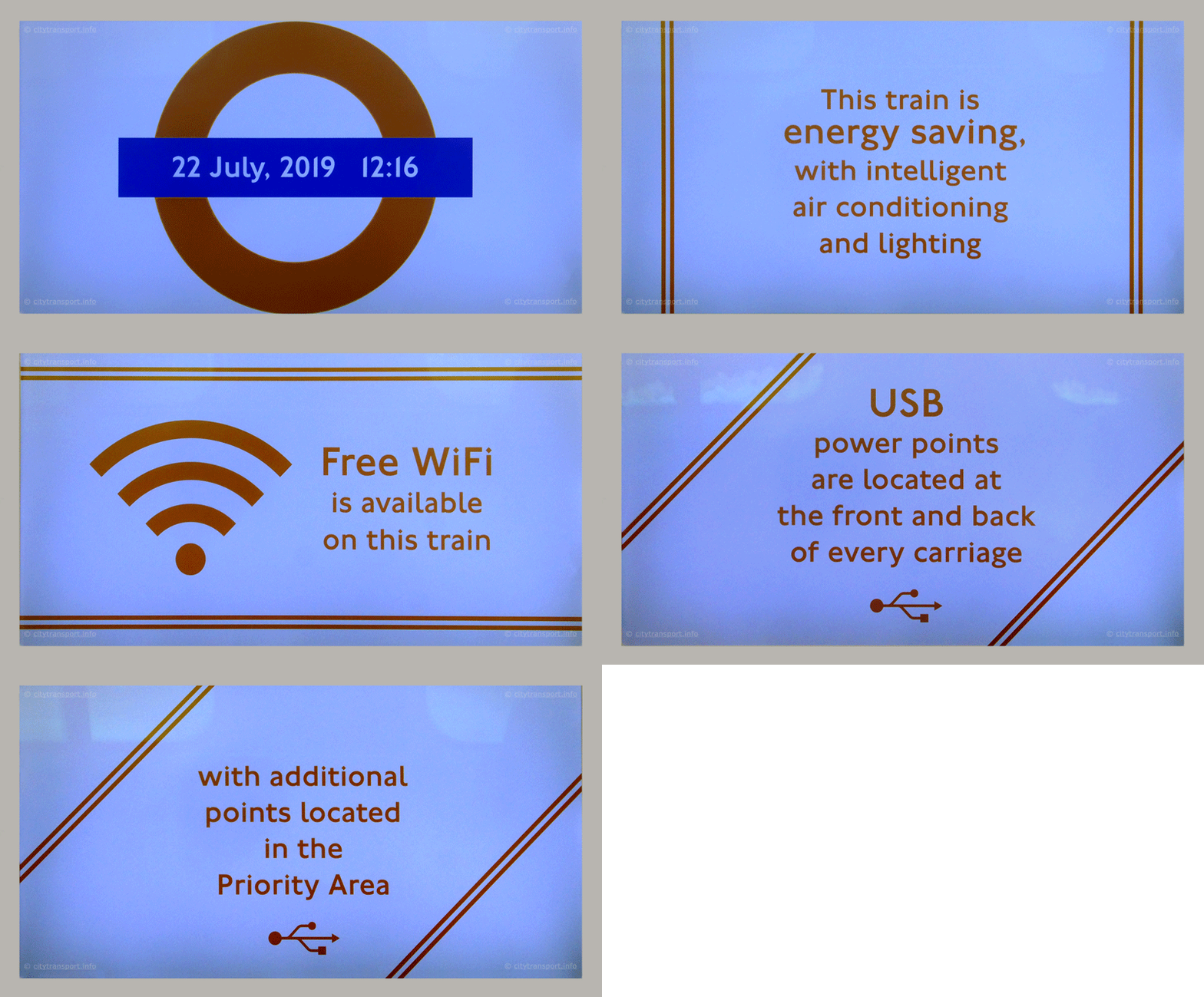
 |
|
 |
|
 |
|
 |
| Some Route Information |
- The Euston - Watford Junction (all stations) service (Lioness line).is powered at 750V dc via a third rail.
The tracks between Queens Park and Harrow & Wealdstone are shared with Bakerloo Line Underground trains.
Very occasionally the Euston - Watford trains are diverted away from Euston station and instead travel to Stratford via the former (ie: now closed) Primrose Hill station.
which is just to the north of some short tunnels.
Both train types are used on this route.
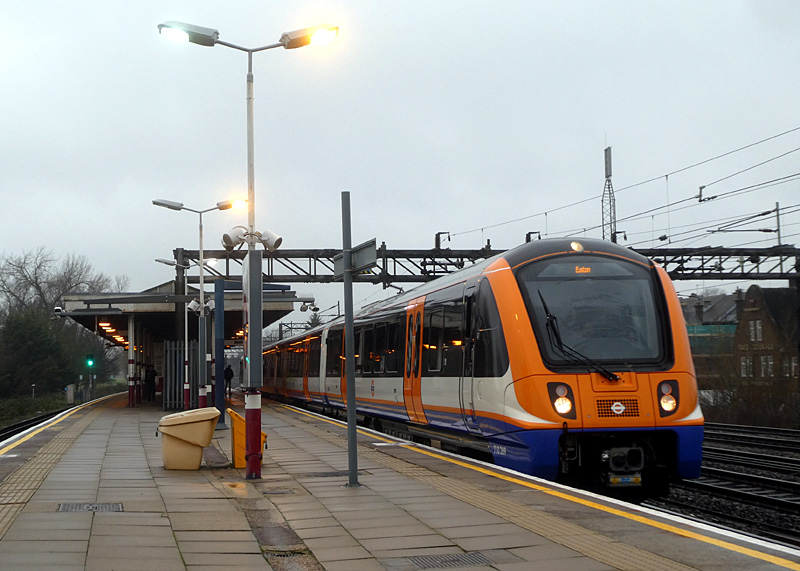
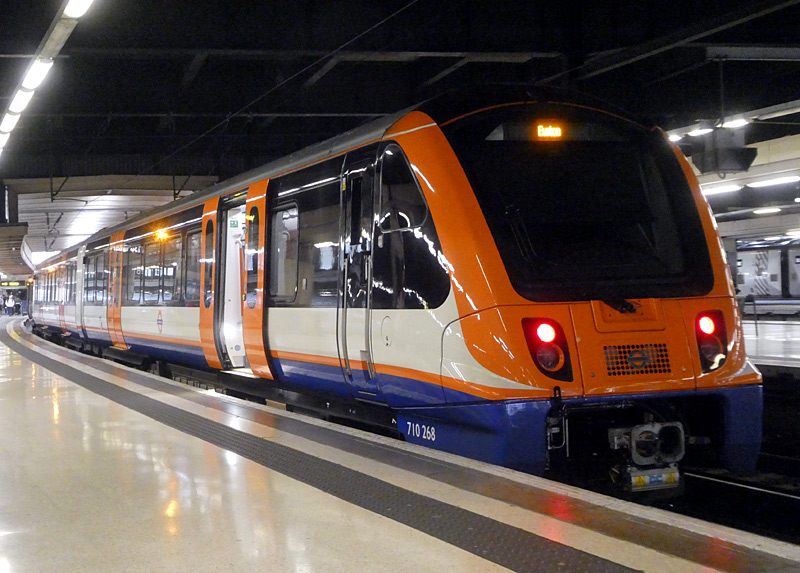
West Coast Main Line which is used by Inter-City trains to
Birmingham, Manchester, Liverpool, Carlisle and Glasgow.
| North London / Mildmay line |
- This service links Richmond in south-west London with Stratford, which is in east London.
It is almost entirely above ground and represents a good way for people who do not feel adventurous to see suburban parts of London without wandering the streets and risking becoming lost.
Between Richmond and Acton Central the trains are powered at 750V DC via an electrified third rail whilst between Acton Central and Stratford they are powered at 25kV AC from overhead wires,
Note that for 'end to end' journeys between east and west London it might be quicker to travel via Central London, however as that is via zone 1 it will also be more expensive.
The North London Line is also a very busy freight route, especially the sections between Willesden Junction and Gospel Oak plus Camden Road and Stratford.
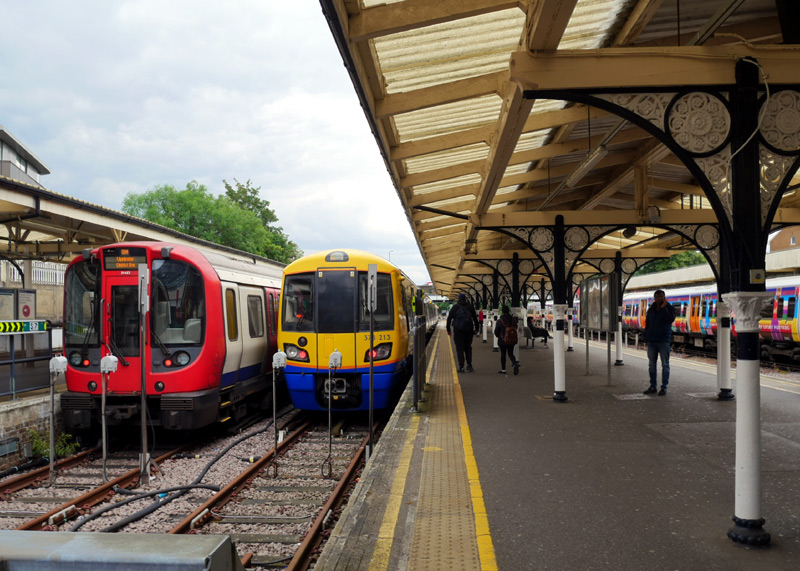
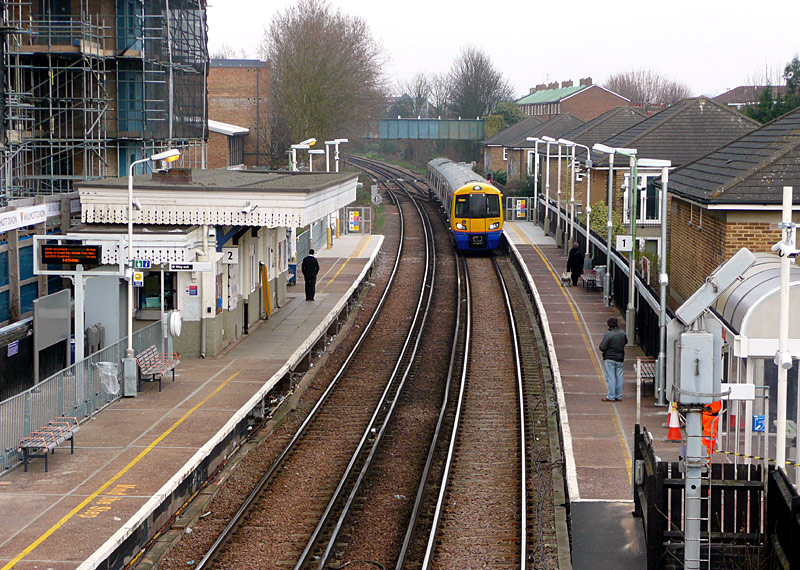
at Richmond station, south-west London.
from when they were extended as part of a project to
make all stations suitable for four and then five coach trains.
Richmond is a nice suburban area and on sunny days the areas near to the River Thames are very popular. Kew Gardens station is just a few minutes away by train and the railway crosses the River Thames on a bridge between Kew Gardens and Gunnersbury stations.
The route between Richmond and Gunnersbury is jointly operated with District line subsurface Underground trains.
Whilst calling here the trains switch between
25Kv AC overhead wire and 750v DC third rail.
This platform includes a coffee shop with an indoor eating area.
Note that there is a large height difference between the platforms and train floors. This makes accessibility somewhat challenging.
This is a busy interchange station with the jointly operated Euston - Watford / Lioness and Bakerloo lines services. To reduce crowding there are several walking interchange routes. .The Euston - Watford / Lioness / Bakerloo line platforms also have a coffee shop - and some public toilets.
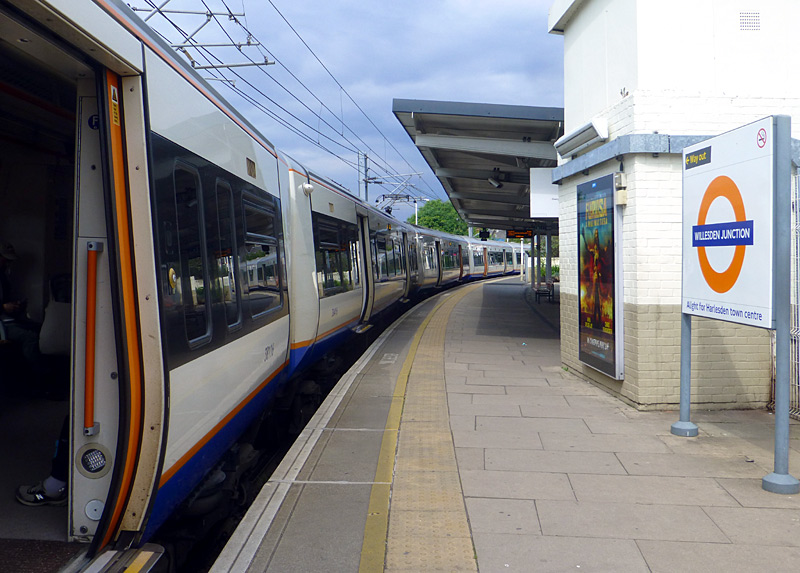
One of the sharply curved platforms used by
North and West London lines trains at Willesden Junction.
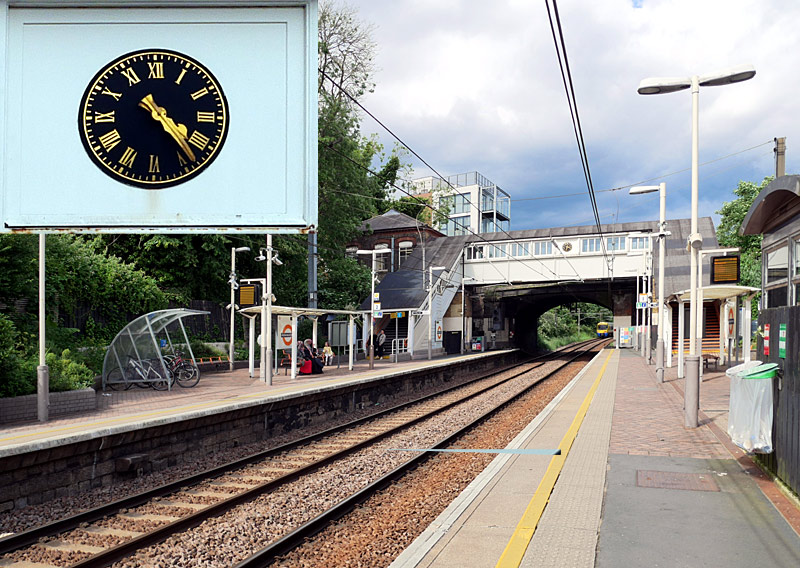
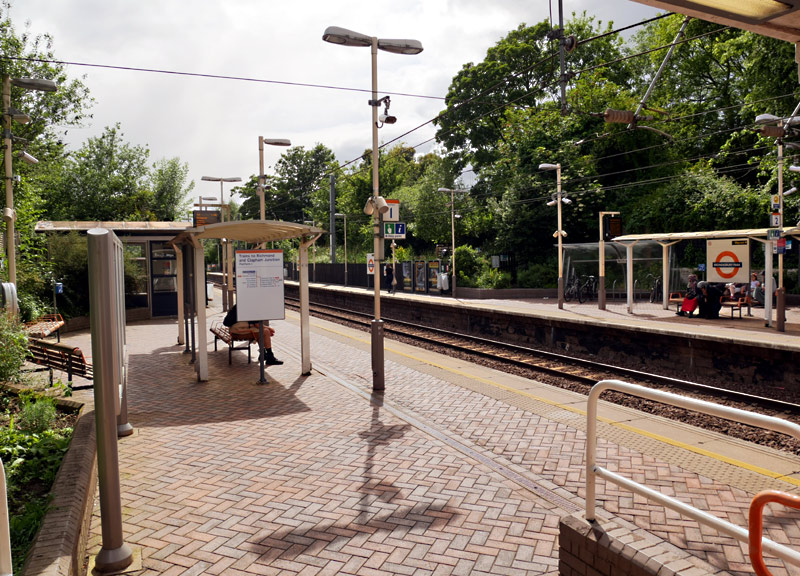
At street level passengers using this station benefit from a small but perfectly formed station building (its roof is visible to the right of the inset clock),
plus weather protected passageway and stairways. The clock on the outside wall of the passageway behind the ticket office is a distinctive feature.
At platform level there are pleasant warm weather (ie: summer) waiting areas with a garden ambience.
Both photographs were taken on the westbound platform.
 |
 |
 |
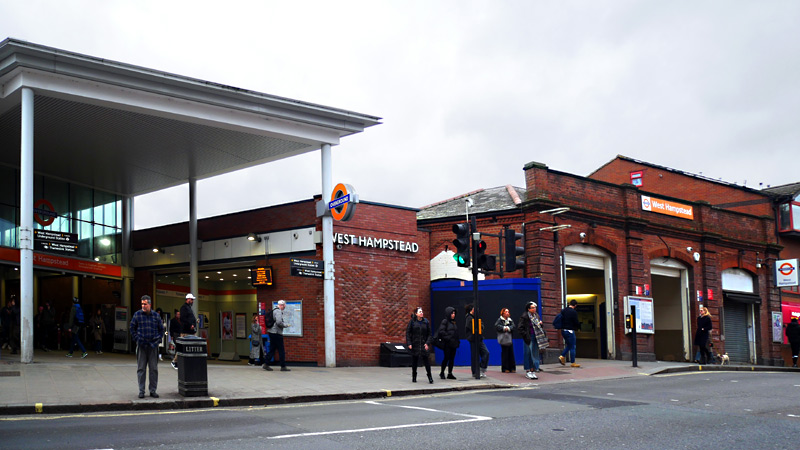
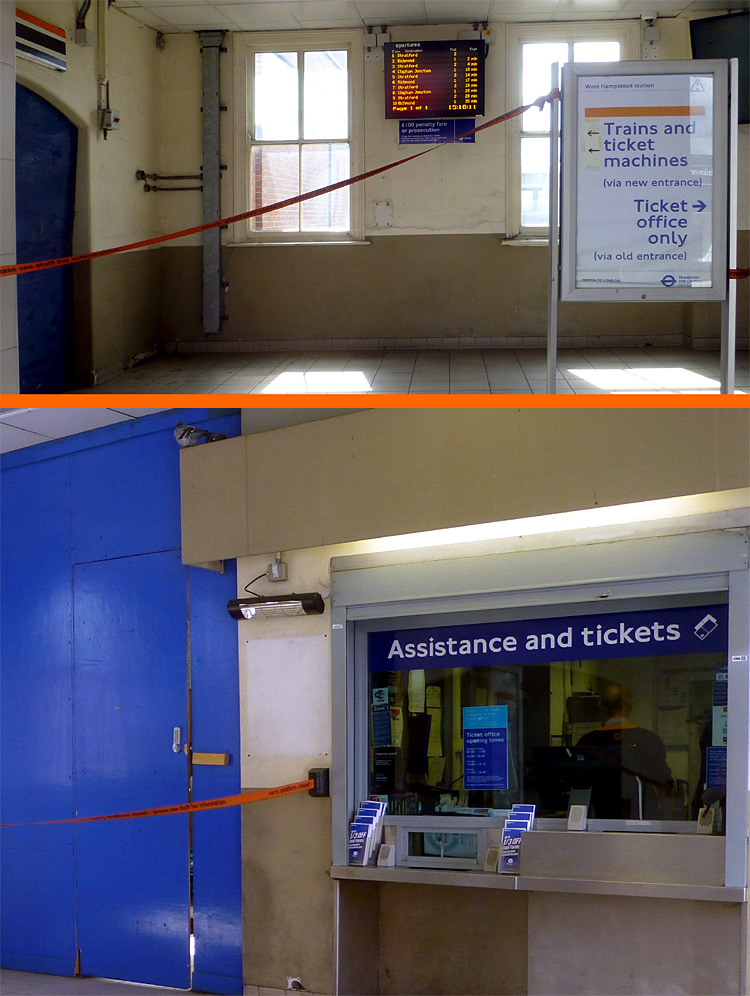
Middle: The old station building has a staffed ticket office - the blue hoardings cover the former access to steps down to the platform.
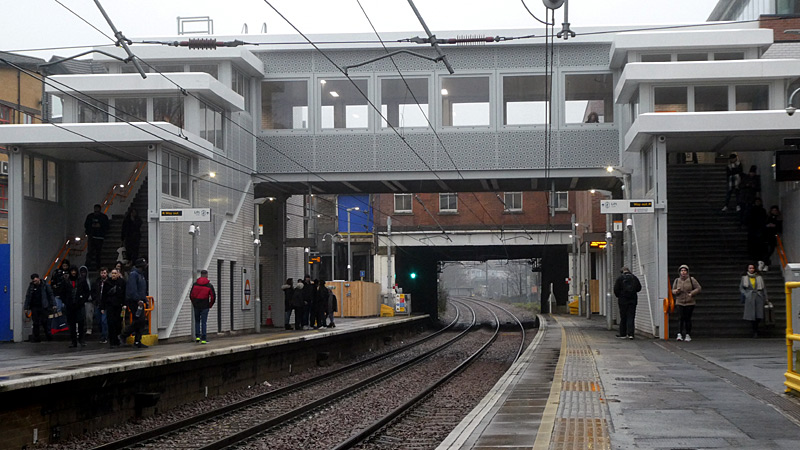
Right: Platform view showing the location of the new stairway to the platforms - the old station building is in the distance, the blue hoarding shows the former location of a flight of stairs between the ticket office and a platform.
At busy times this station was often very crowded, and a much larger replacement station building that is also fully accessible was opened in 2019.
But whilst the new building has self-service ticket machines it does not have a staffed ticket office ... and therefore the old station building is still open!
The new station building is very nice - spacious, wide ticket gateline, high ceiling, etc., but also seriously flawed. The platform access steps are now in the middle of the platforms and the increased walking distance between the street and the platforms means that passengers sometimes miss trains that they would have caught when using the old station building.
Also, the platforms do not have any weather protection canopies and the bus-stop style shelters have fully open fronts - so in wet windy weather are about as useful as the proverbial chocolate teapot. This helps explain why the waiting passengers are standing below the footbridge over the tracks and on the steps - which is not a good place to be waiting for a train.
West Hampstead Jubilee line and Thameslink stations are short walks (in opposite directions) from here. Passengers paying fares using PAYG are allowed to walk between these stations and then continue their journey at no extra cost. (Touch-out when leaving the station and touch-in when arriving at the other station). There is a generous time limit in which this journey must be completed, so people who walk slowly should not worry.
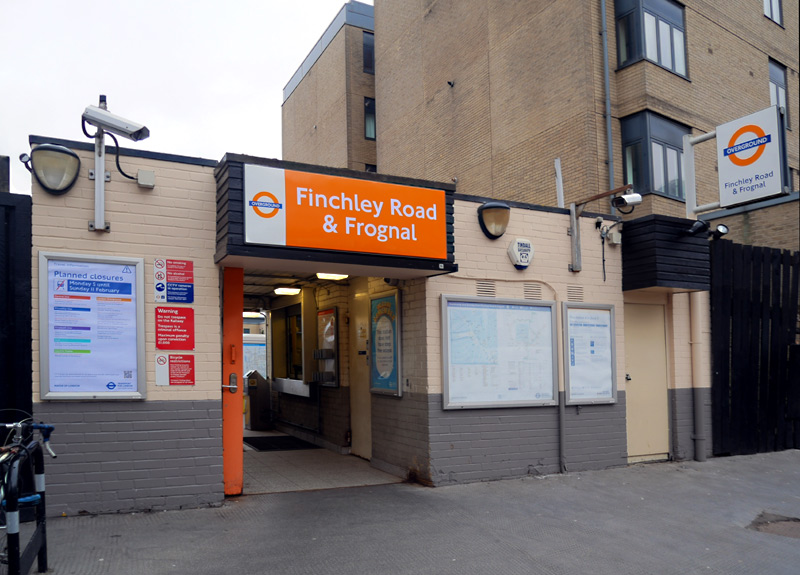
On the left of the entrance passageway there are some self-service ticket machines, on the right there is a staffed ticket office.
At the far end of the passageway through the station building are some free-standing Oyster card readers.
At street level black painted wood hides scrubland on either side of the present-day station building.
Behind the ticket office is an open air passage which leads to open air steps down to the platforms and bus-stop style platform shelters.
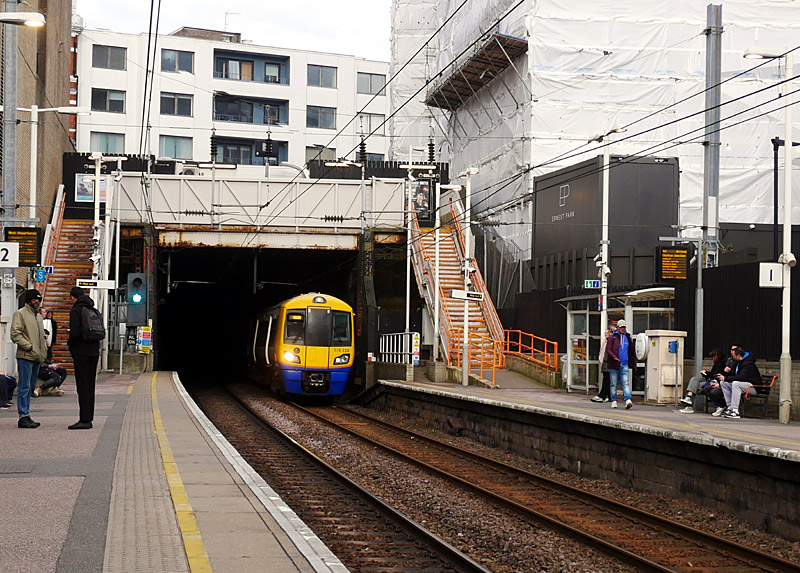
Most of the arriving westbound Class 378 train in the image on the right cannot be seen because it is still in the tunnel between here and Hampstead Heath.
Finchley Road Metropolitan and Jubilee lines station is 7 - 10 minutes walk from here. Passengers paying fares using PAYG are allowed to walk between these stations and then continue their journey at no extra cost. (Touch-out when leaving the station and touch-in when arriving at the other station). There is a generous time limit in which this journey must be completed, so people who walk slowly should not worry. However this time limit does not allow for going shopping at the O2 shopping centre.
There is a twin track tunnel between Finchley Road & Frognal and Hampstead Heath stations.
Near to Gospel Oak station look out for the childrens' play ground and the allotments (an area of urban ground split up into small patches so that people who do not have gardens attached to their houses can grow fresh vegetables and flowers).
Between Kentish Town West and Camden Road the railway passes near to the famous Camden Market.
The views out the train windows in this area are especially interesting with many types of buildings - residential (various styles), light industrial (some of which looks to have been converted to residential) open space for recreational use and more.
The Camden Road - Dalston section is mostly four-tracked, in two sections with different styles of train use.
Camden Road station has four platforms but only two of these are used by trains. The reason for this is that just outside the station there is a bridge over a road that needs replacing, and this will be expensive. So, instead that section of railway is no longer used by trains. The longer-term plan is to convert it to a leisure-themed 'highline' pedestrian walkway.
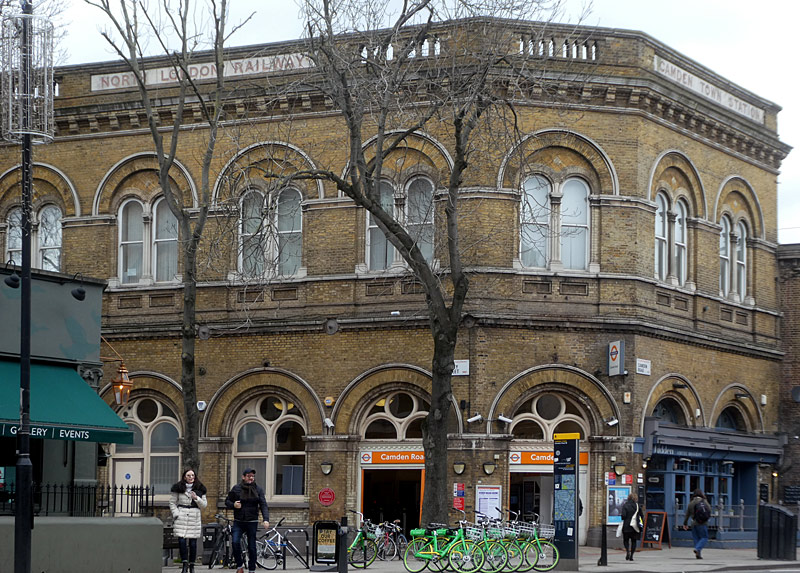
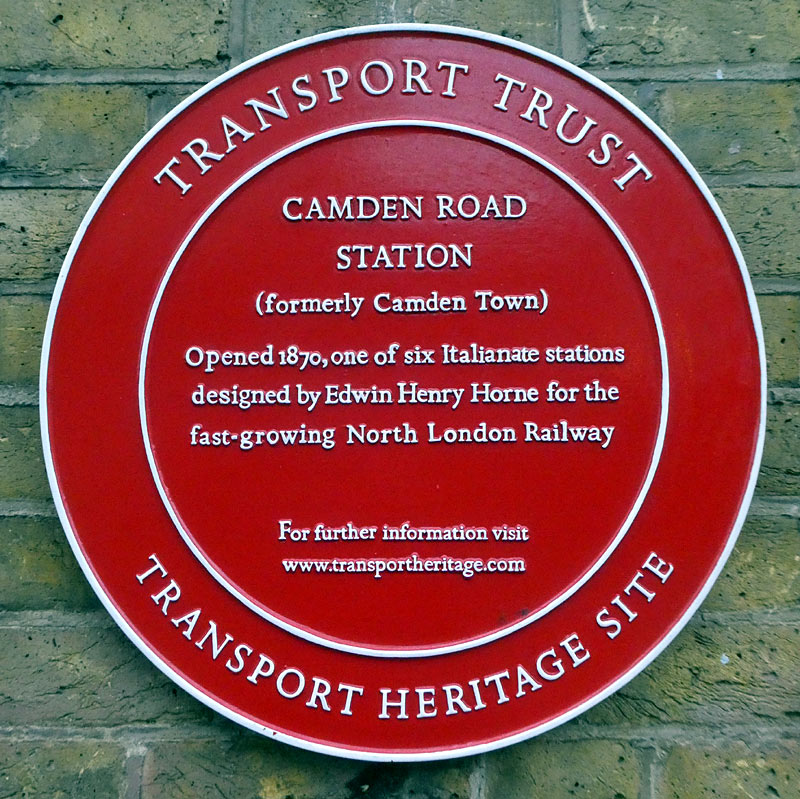
Camden Road is one of the few stations to still retain its original North London Railway station buildings. The railway company and (original) station names can be seen at the top of the building. |
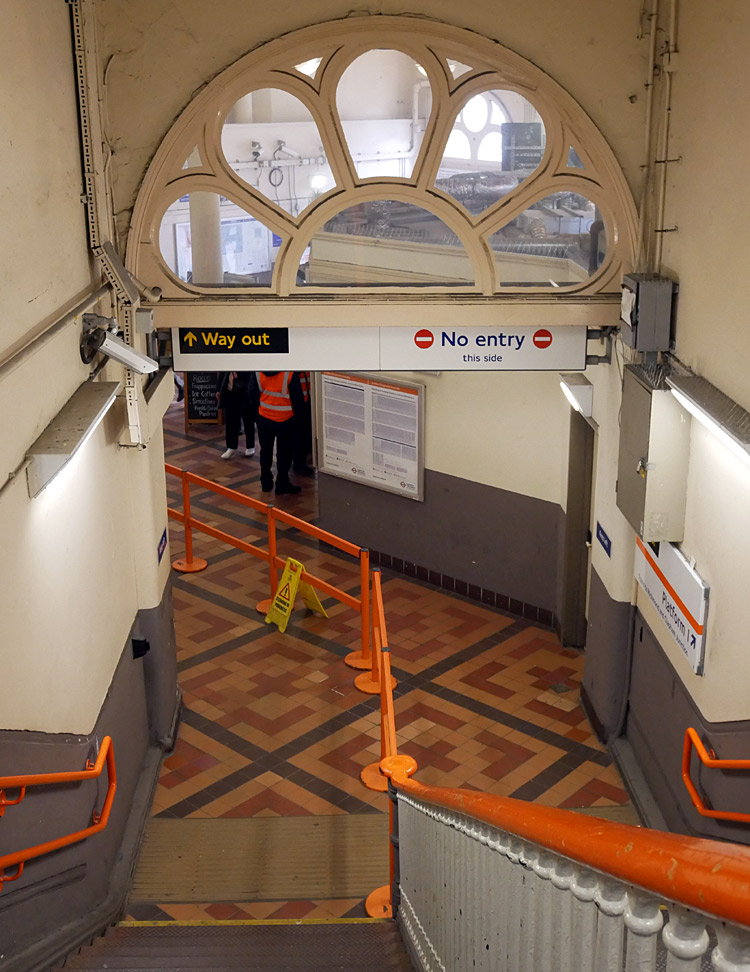
Looking down the stairs for the westbound platform - the tiled flooring is a decorative feature. |
|
 |
Camden Town Northern line station is 7 - 10 minutes walk from here. Passengers paying fares using PAYG are allowed to walk between these stations and then continue their journey at no extra cost. (Touch-out when leaving the station and touch-in when arriving at the other station). There is a generous time limit in which this journey must be completed, so people who walk slowly should not worry. However this time limit does not allow for going shopping in the market.
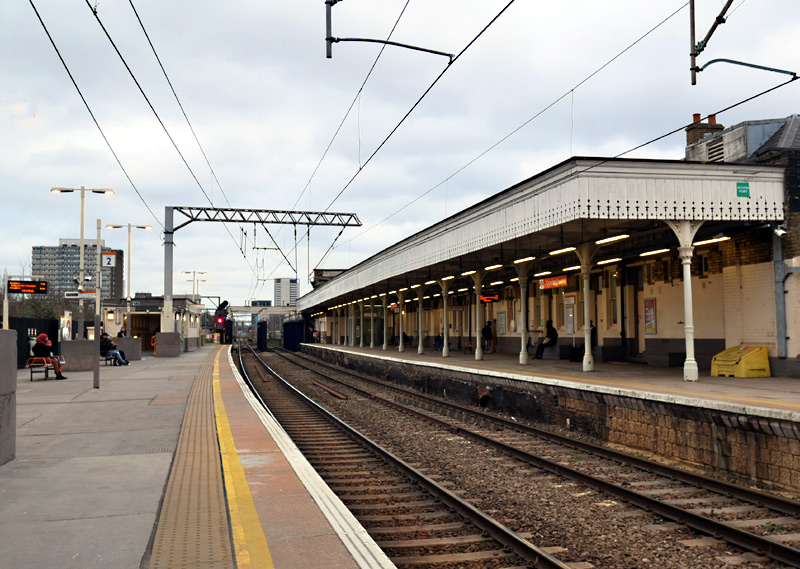
On the far left is a black-painted wooden wall that hides the rest of this double-sided island platform.
There is also a disused fourth platform out of sight on the far left.
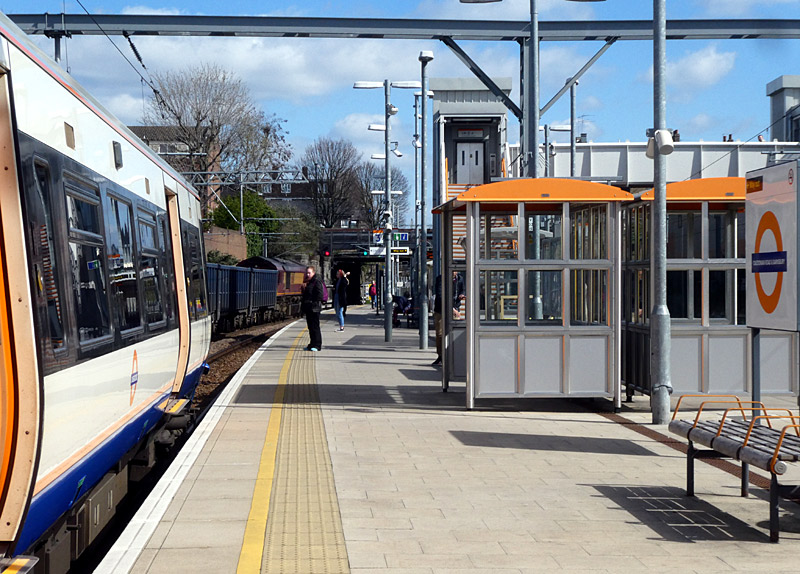
Caledonian Road & Barnsbury station, which has four tracks.
Also seen here is that there is a freight train to the left
of the passenger train - this is explained in the text below.
The four-track section through Caledonian Road & Barnsbury station is split with passenger trains normally using the middle tracks and calling at an island platform and freight / goods trains using the outside pair of tracks. This helps improve service flexibility as it allows passenger and freight trains to pass each other. Also, it means that freight trains can wait here for their correct time-slot in the timetable without delaying passenger trains.
The other four-track section is between Highbury & Islington and just outside Dalston Kingsland station. Here the northern pair of tracks are used by the North London / Mildmay line and the southern pair of tracks are used by the East London / Windrush line.
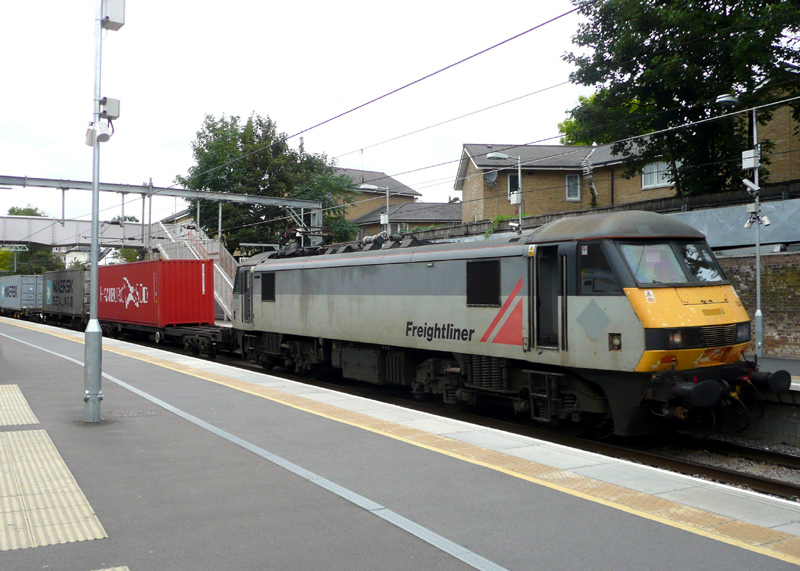
This eastbound electrically hauled container train is
passing platform 8 at Highbury & Islington station.
North London / Mildmay line) at Highbury & Islington is very busy.
Many passengers change trains here,
catching the Victoria Line to Central London.
In the Hackney area the line is on a brick arch viaduct which offers many good views of east London.
The stations Dalston Kingsland - Hackney Wick were reopened (with brand new station buildings) in the 1980s, when passenger services through east London were reintroduced after WW2. However, since then some of them have been partially / fully rebuilt.
Yes, reopened 40 years later - by a London local government politician who championed improving London's railways because better rail services improve people's quality of life. The line really should have reopened much sooner after the war but the Westminster civil servants (and politicians) who (since WW2) have been (mis)managing the railways only seem to know how to run the railway down in favour of road travel.
This is an area which some people may prefer to avoid, although it should be perfectly safe to view from passing trains.
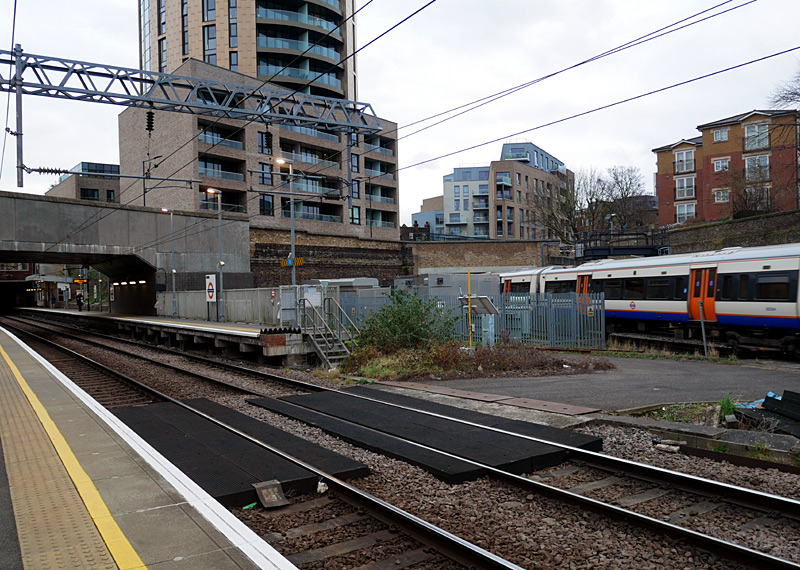
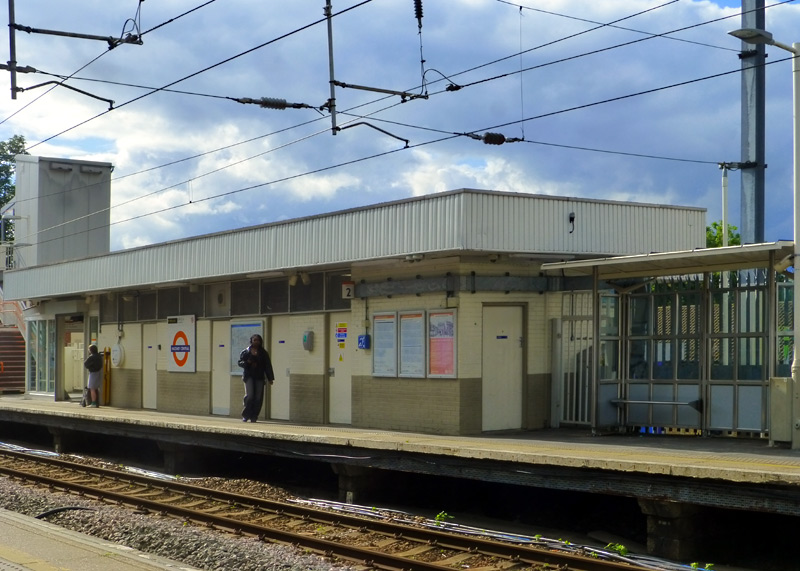
(ie: used by trains going to Stratford) at Dalston Kingsland station.
The train seen here is leaving the four-track section
and is on the East London / Windrush line with its next
station stop being at Dalston Junction.
This looks like a standard British Railways 'Clasp' building - a low-cost prefabricated modular design that was assembled on site.
The direct interchange walkway with the Lea Valley / Weaver line Hackney Downs station is seen at the start of this page.
The out of station interchange (OSI) system means that passengers paying fares using PAYG are allowed to walk between Dalston Junction and Dalston Kingsland stations and then continue their journey at no extra cost. (Touch-out when leaving the station and touch-in when arriving at the other station). There is a generous time limit in which this journey must be completed, so people who walk slowly should not worry. However this time limit does not allow for going shopping.
Hackney Wick station was rebuilt in 2018 with a multi-award winning landmark station building designed by architects, Landolt Brown.
These links lead to more information and photographs:
https://thebeautyoftransport.com/2023/08/23/chemical-attraction-hackney-wick-station-london-uk/
https://www.ianvisits.co.uk/articles/hackney-wicks-brutalist-new-london-overground-station-opens-25510/
Unfortunately there have been issues with local street artists decorating / defacing the station. Some people like such artistic endeavours, others see it as graffiti vandalism and intimidating - making them feel unsafe and hence decide to avoid the area.
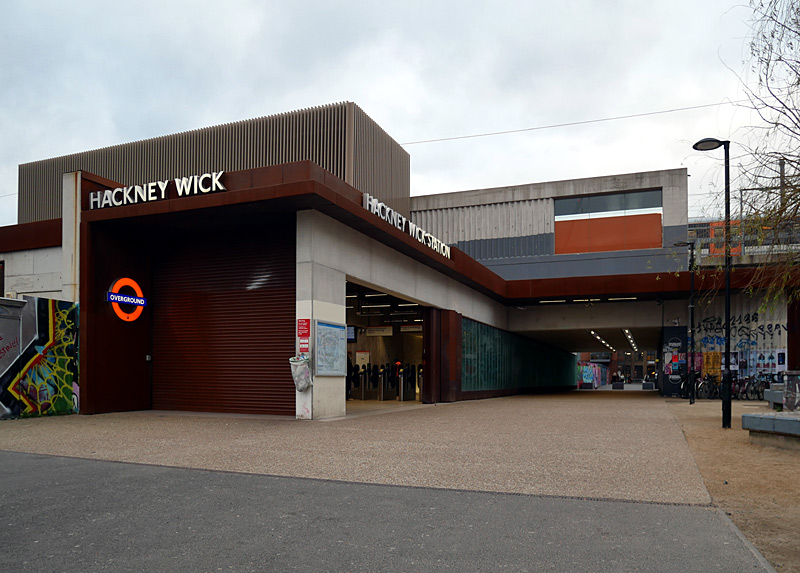
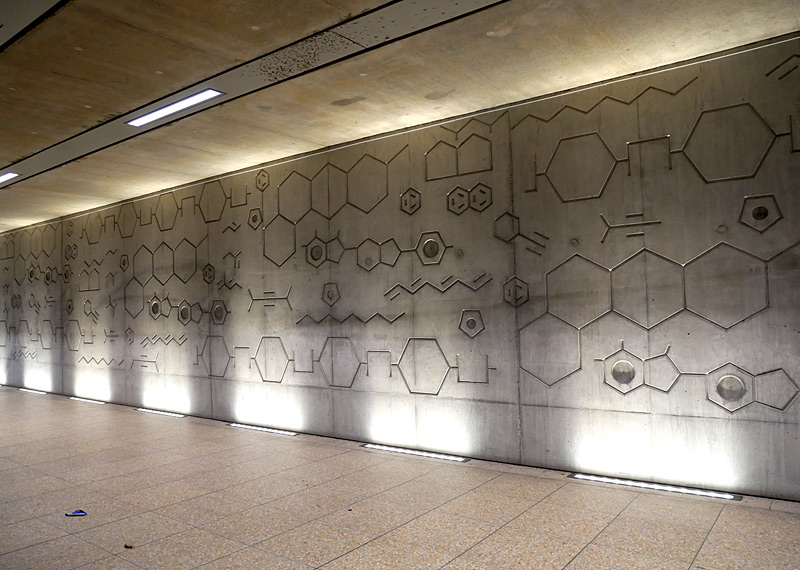
Of course the rebuilt Hackney Wick station is now fully accessible but the station rebuilding project was much grander than simply adding a few lifts.
Previously this station had a footbridge over the tracks (which are on an elevated viaduct) but when rebuilt this was replaced by a two-section underpass.
One part of the underpass is inside the station's fares paid area and leads to stairs and lifts, whilst the other section is dedicated to people who are
not travelling by train.
The divider between the two sections is a series of glass wall hexagons set in weathered steel bases. At night these are illuminated - with green glowing lights!
Another innovative design feature is that much of the concrete used on the stairways retains the imprint of the wooden formwork from when the liquid concrete was cast.
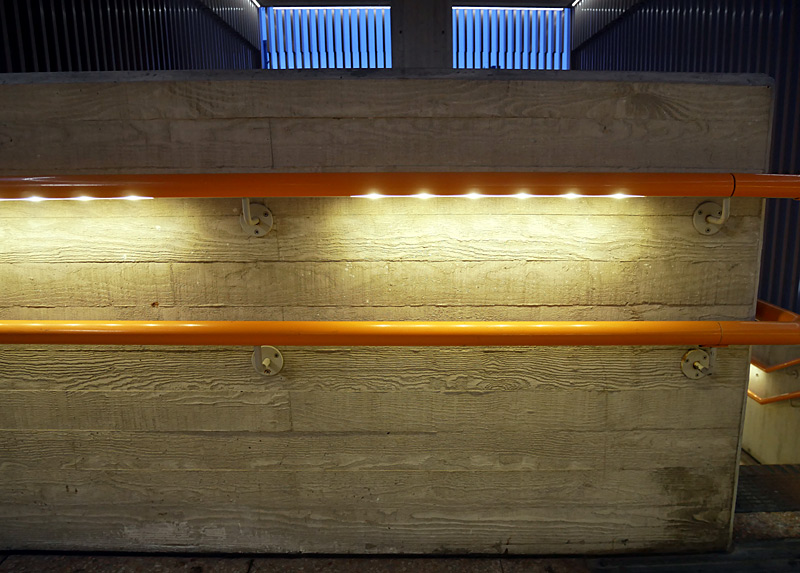
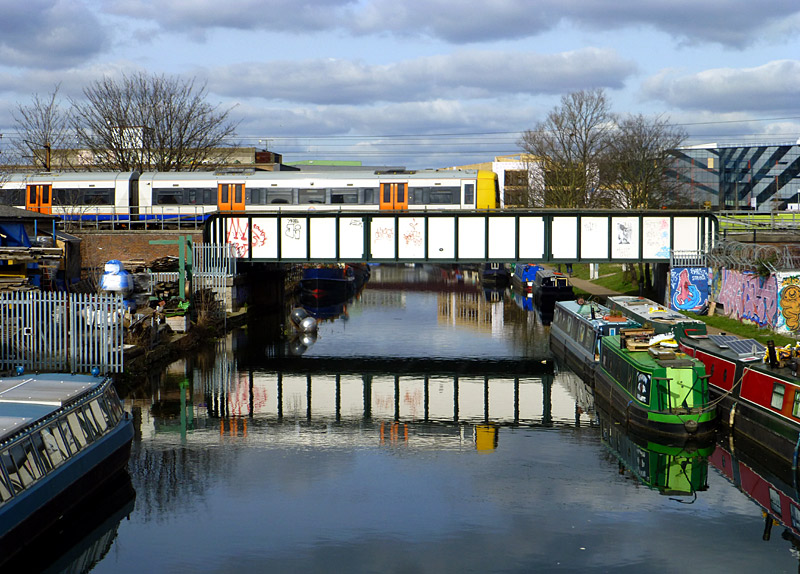
Also of note are the double-height* handrails in London Overground orange colour with downward-facing lighting from the upper handrail.
*(Why? Because people come in a wide range of heights - especially when one also thinks of children).
This location is near to Hackney Wick station.
It was photographed from White Post Lane - I had walked
to here from Stratford station via Carpenters Road and the Queen Elizabeth ll Olympic Park.
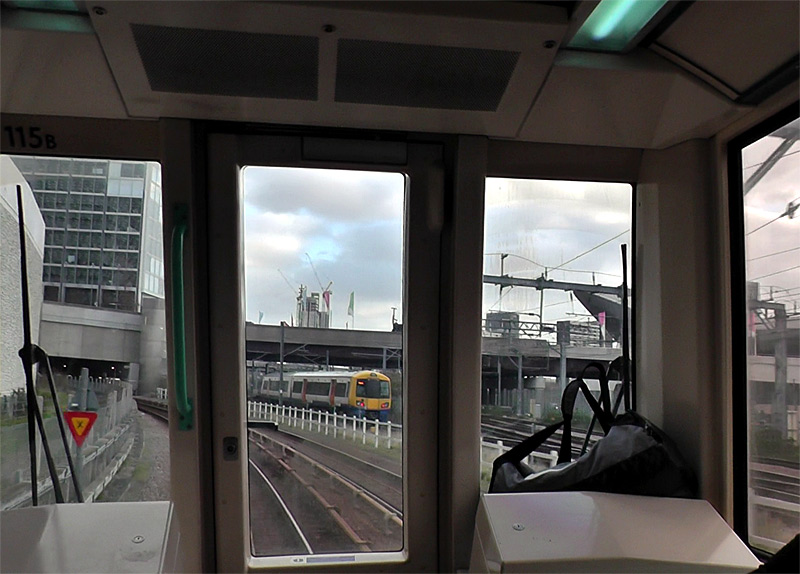
The best time to try and see this is the rush hour when both services are more frequent and eastbound Overground trains (going to Stratford) often queue to enter the station.
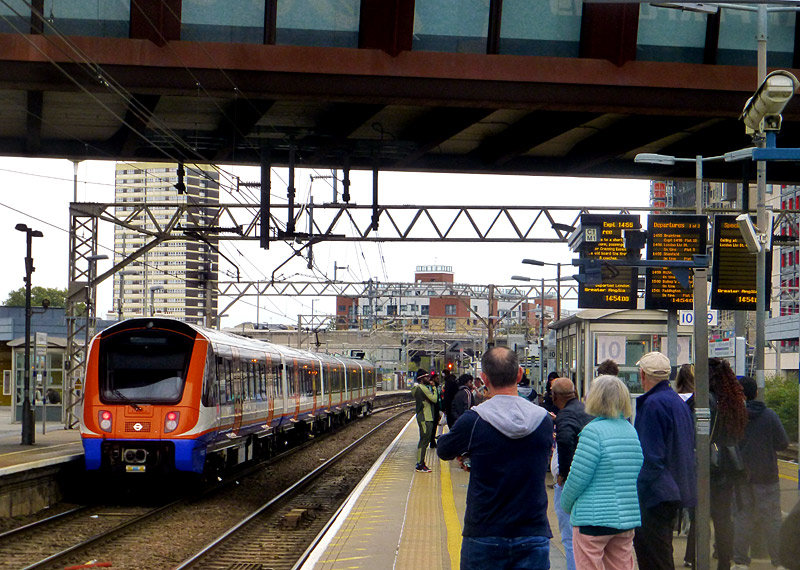

Only a few Overground trains call at these platforms.
(with a Greater Anglia Class 720 arriving at platform 12).
| West London / Mildmay line |
- This service uses the West London line to link Clapham Junction with Willesden Junction, with trains changing between 25kV AC overhead wires and 750V DC third rail part-way between Shepherds Bush and Willesden Junction
stations.
Nowadays most trains travel all the way from Clapham Junction to Stratford, enhancing the service frequency on this very busy section of railway..
The West London Line is also used by many goods / freight trains plus an hourly Southern train which travels betweenMilton KeynesWatford Junction and East Croydon. Note that these trains do NOT stop at Willesden Junction.
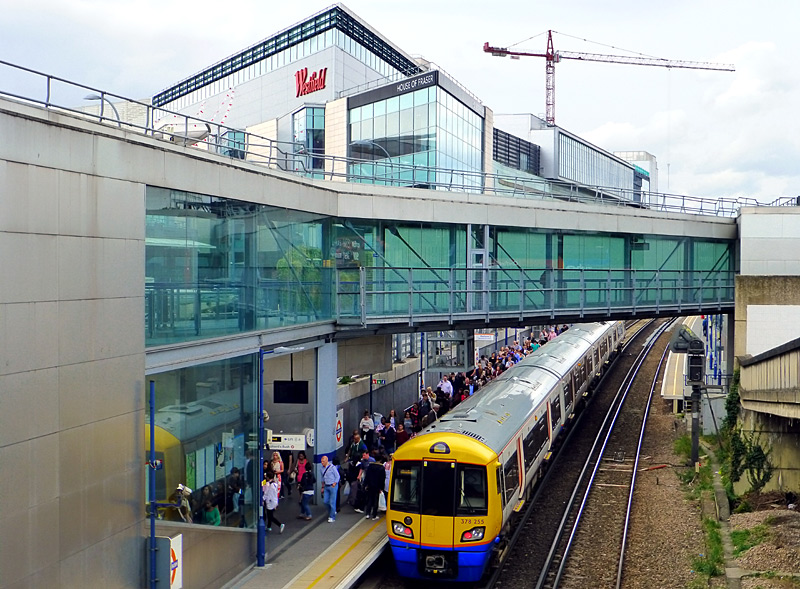
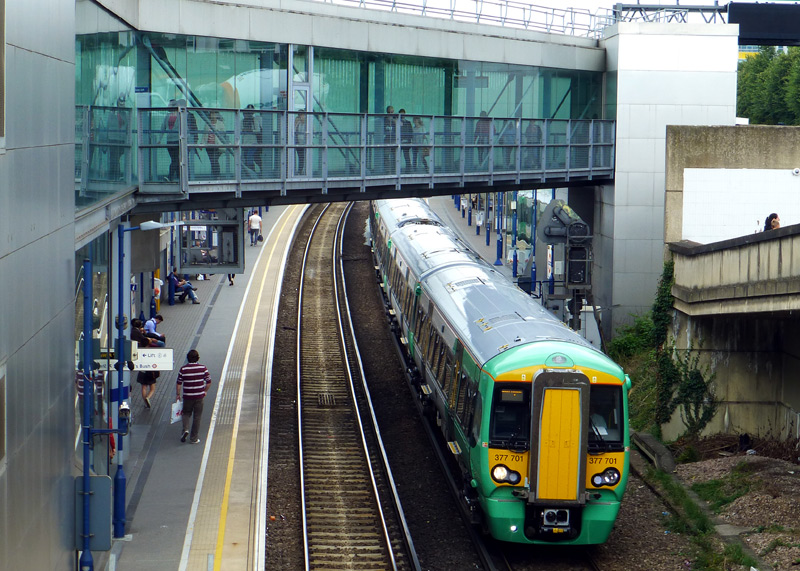
This busy station is next to a very large Westfield shopping centre and there is a Central line Underground station (also called Shepherds Bush) nearby.
The out of station interchange (OSI) system means that passengers paying fares using PAYG are allowed to walk between the two Shepherds Bush stations and then continue their journey at no extra cost. (Touch-out when leaving the first station and touch-in when arriving at the other station). There is a generous time limit in which this journey must be completed, so people who walk slowly should not worry. However this time limit does not allow for going shopping.
At West Brompton station passengers interchanging between southbound Overground (or Southern) and northbound Underground trains benefit from same-level cross-platform interchange via some gaps in the fence.
However passengers interchanging between northbound Overground (or Southern) and southbound Underground trains must use the steps / lifts - up and then down.
Most passengers who change trains here and are paying their fare using electronic smart cards (Oyster, contactless, etc.,) in PAYG mode will find their journey is cheaper if they remember to use the pink card readers. Passengers with Travelcard season tickets which do NOT include Zone 1 also need to use the pink card readers - as otherwise they risk being charged a Zone 1 fare.
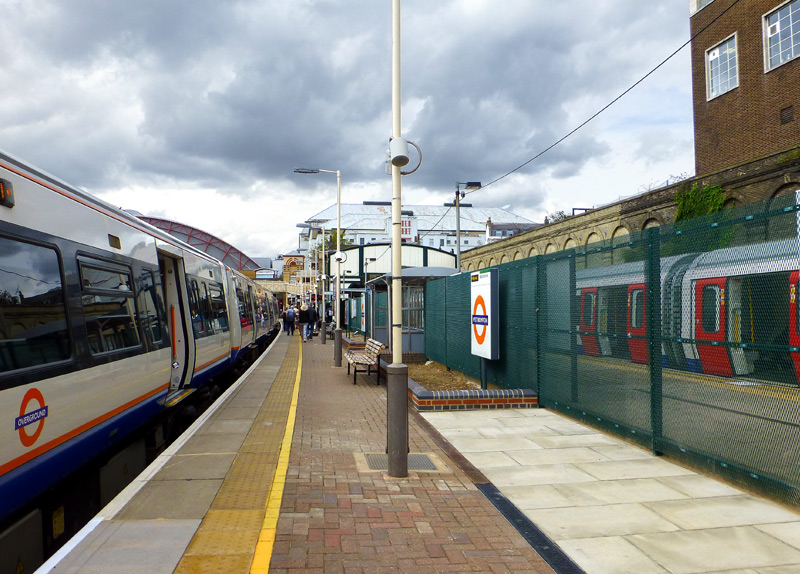
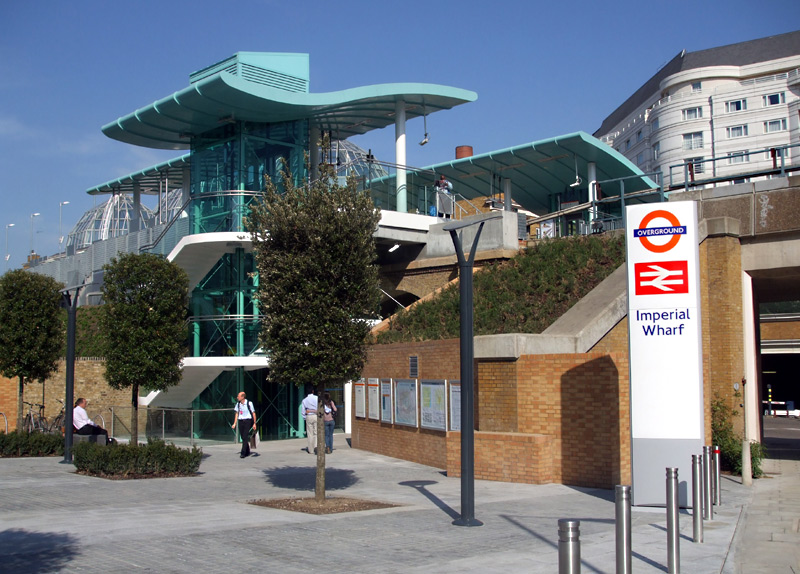
platforms are alongside the northbound District line's platforms.
Original source & license: Sunil060902 / Wikipedia encyclopædia CC BY-SA 3.0
https://commons.wikimedia.org/wiki/File:Imperial_Wharf_stn_eastern_entrance.JPG
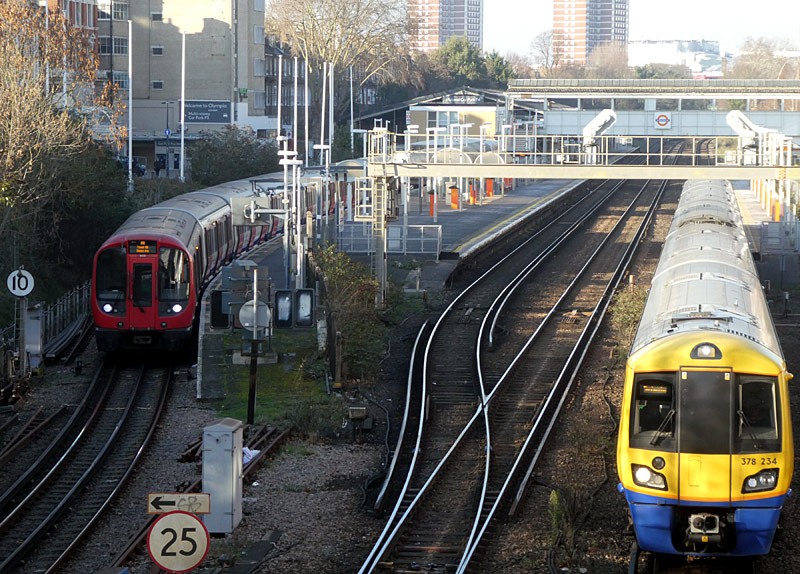
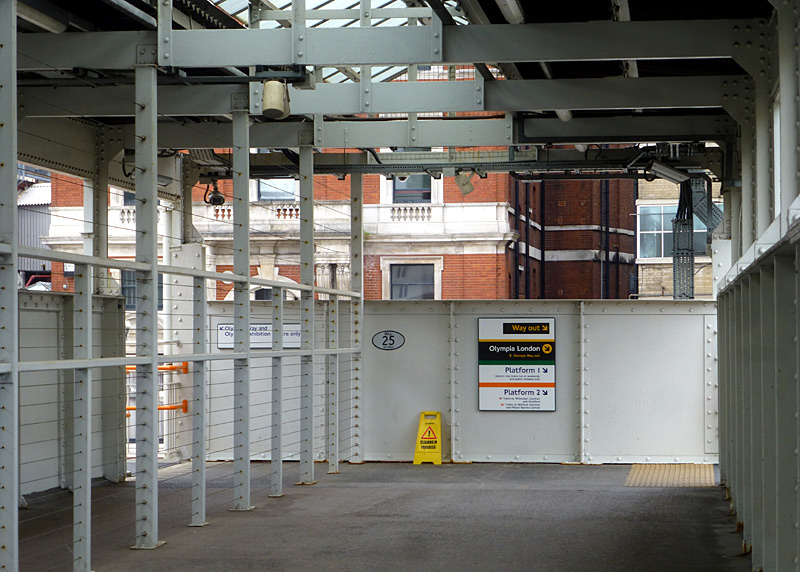
At most times Kensington Olympia is only served by trains operated by London Overground and Southern - District line Underground trains usually only come here at weekends,
during busy events at the nearby exhibition halls or when there is disruption to the (District Line) service.
In addition many goods (freight) trains travel through here.
| East And South London / Windrush lines |
- This is a group of four services. They are all powered at 750V DC via a third rail. Note that one of the intermediate stations (Shoreditch High Street) is in Zone 1,
which makes journeys through this station more expensive to travel on (higher fares).
‣ Highbury & Islington - West Croydon
‣ Dalston Junction - New Cross
‣ Highbury & Islington - Crystal Palace
‣ Dalston Junction - Clapham Junction via the part of the route of the former South London Line (SLL).
The section of East London Line between Highbury & Islington and 'near to' Shoreditch High Street was originally part of the North London Line, but for many years it had been closed. Between Dalston Junction and near to Whitechapel this line is on a viaduct which gives interesting views of the local buildings and the stations are all brand new.
The present-day Shoreditch High Street station replaces the older East London Line Shoreditch station which was demolished to allow for the construction of a new link between the railway viaduct and Whitechapel station. Just outside the station the railway crosses Shoreditch High Street on a brand new bow string bridge.
Shoreditch High Street station is fully built-over - this was done so that other buildings can be built around and above it with a much reduced safety risk from something falling on to the station.
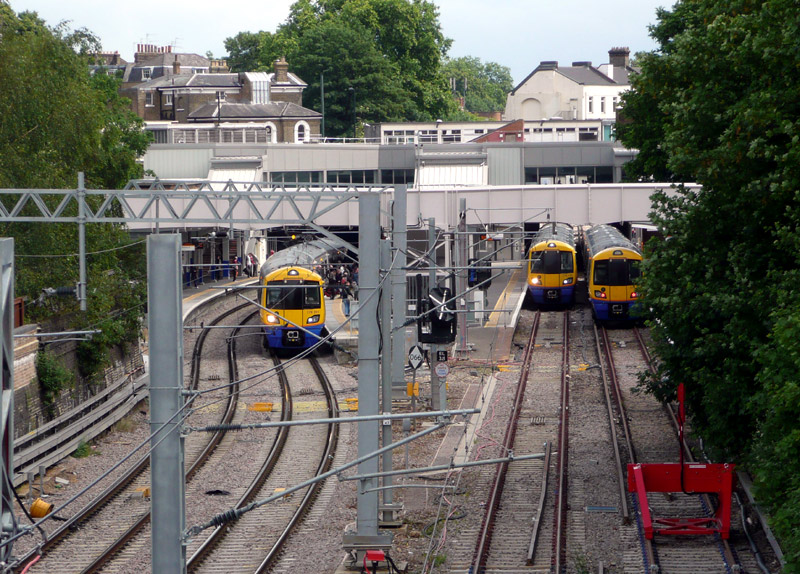
as seen from the B515 Liverpool Road.
On the left are North London / Mildmay line platforms №s 8 and 7.
On the right are East London / Windrush line platforms №s 2 and 1.
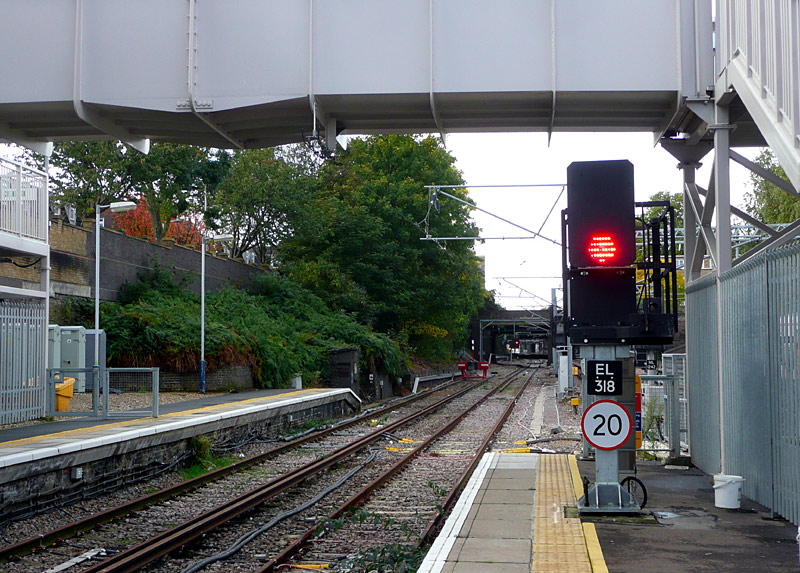
Whilst the track from platform 2 connects with the North London Line, the signalling system has been designed to not allow through trains!
The track from platform 2 extends all the way to the track for platform 7 but the third rail ends part way along the station platform. The overhead wire power supply starts from the underside of the footbridge over the tracks - as seen at the top of this photograph.
The signal is thought to be more like a fixed red light.
Perhaps the New Cross trains would be ideal for this, as this is the shortest route and it does not travel over tracks also used by other services, so is least likely to experience delays.
But when the East London / Windrush line Overground service started using Highbury & Islington station we were told that the signalling system was purposely designed to not allow through trains, this was done to prevent delays on one route affecting other routes.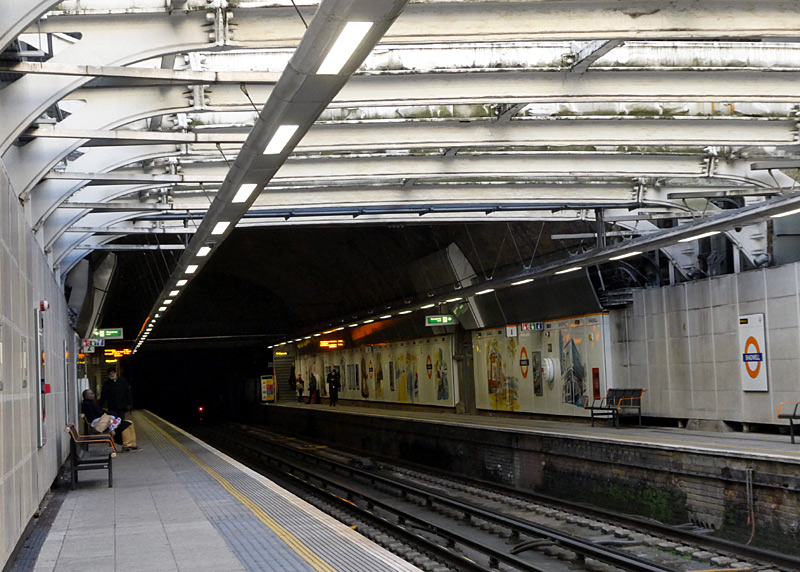
Canonbury station, where only the East London / Windrush line platforms have these 'Harrington humps' which create level access between the platform and the train floor along part of the train.
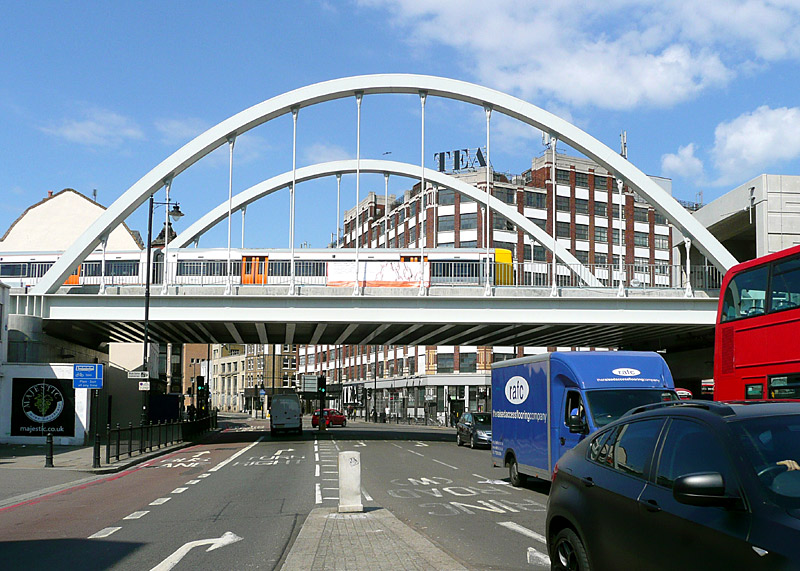
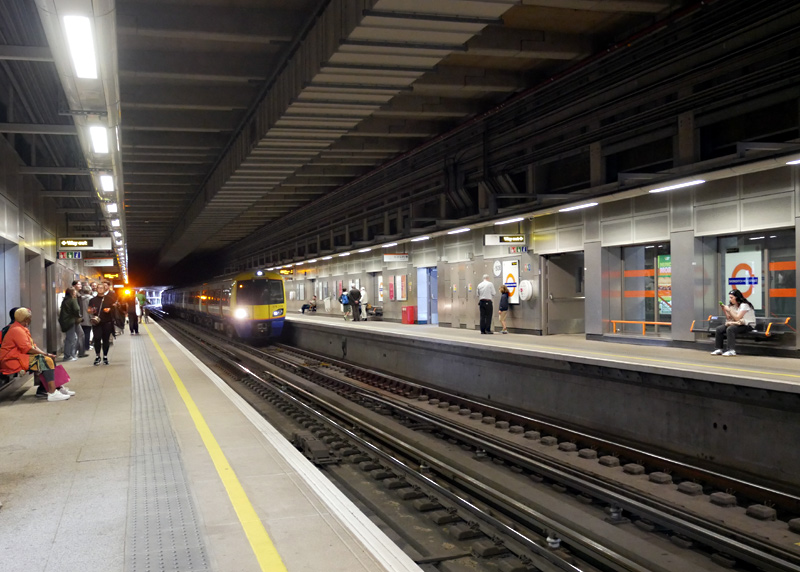
which (unlike the rest of the route) is in Zone 1.
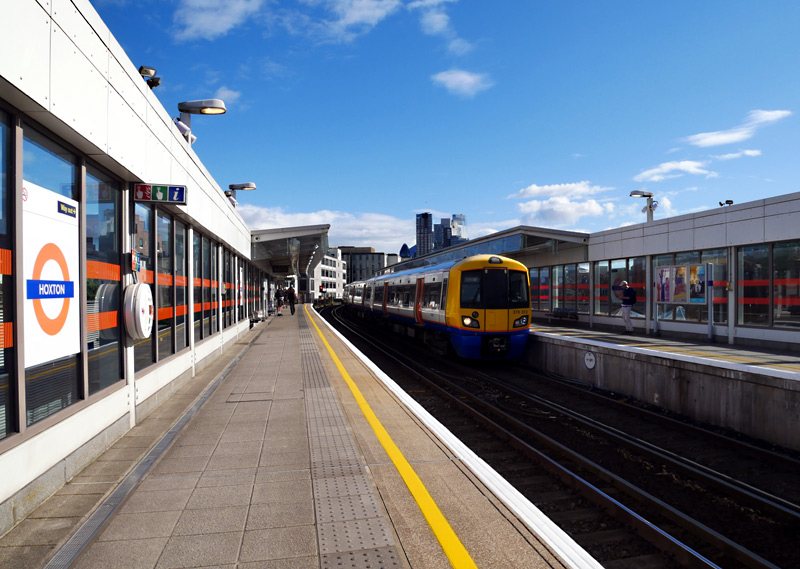
The glass walls provide some shelter from the wind.
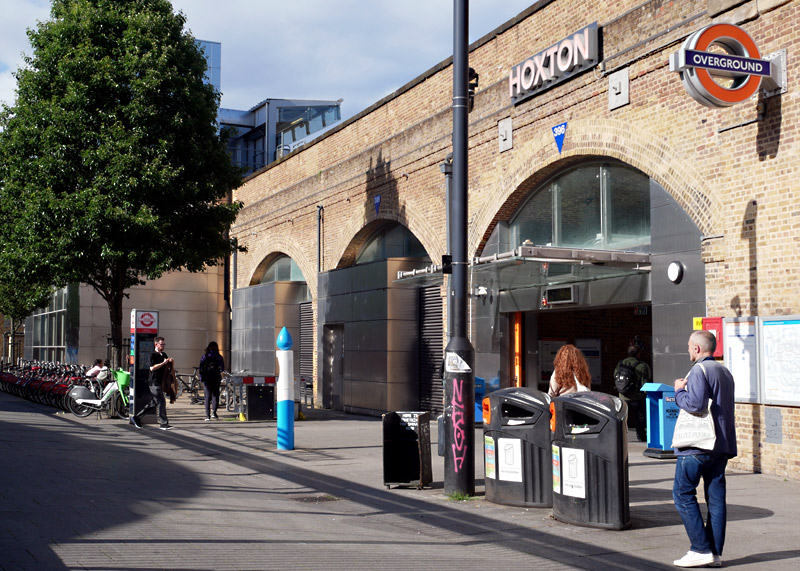
elevated above traditional brick built railway arches.
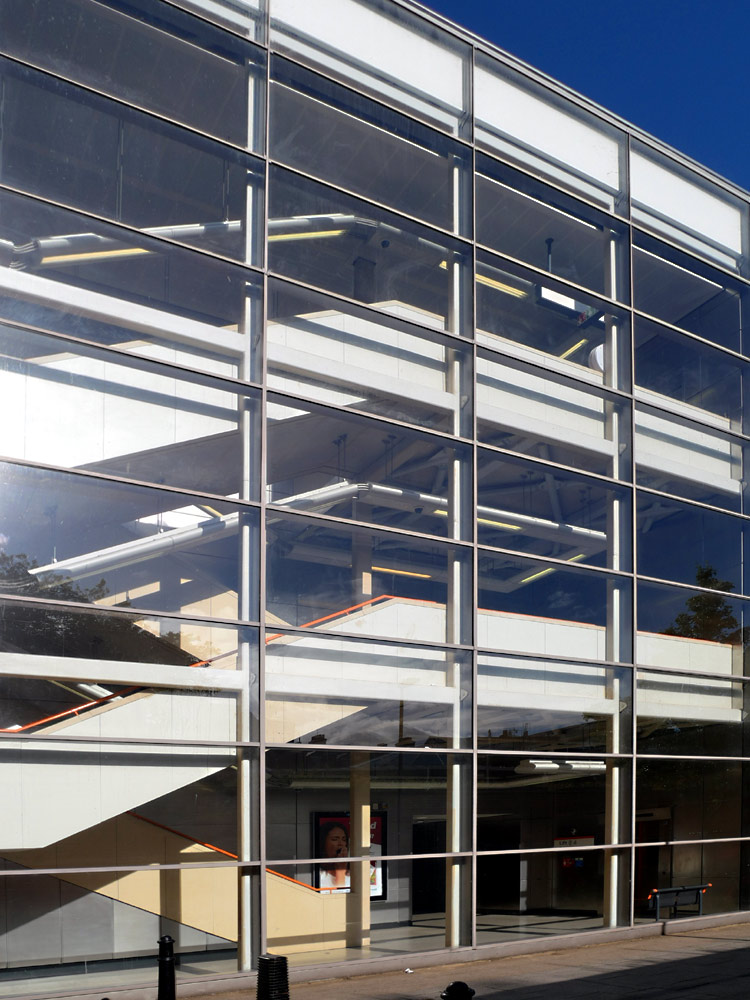
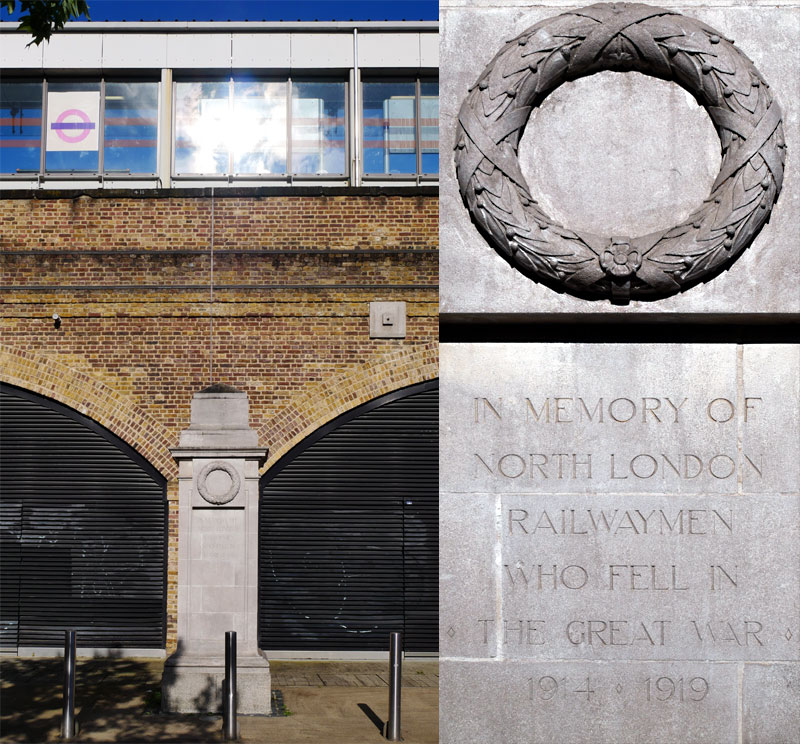
close nearby is a North London Railway war memorial for its railway staff who fell whilst in the military during WW1.
A Little History
The section of East London Line between the old Shoreditch station and New Cross / New Cross Gate was operated by Metropolitan Railway / line trains for over 100 years! This route includes the
first tunnel ever to be built under the River Thames. The text below is copied from one of the Nostalgia, Heritage & Leisure pages on the citytransport.info
website .
35ft [11m] wide, 20ft [6m] high and 1,300ft (¼ mile / 396m) long, this tunnel runs between Rotherhithe and Wapping at a depth of 75ft [23m] below London's River Thames. It was built between 1825 and 1843 using Marc Isambard Brunel's newly invented tunnelling shield technology, by him and his son Isambard Kingdom Brunel. This long time period included a seven year abandonment which was caused by financial problems. Originally the intention was that the tunnel should be used by horse-drawn carriages but ongoing financial problems meant that the access ramps could not be afforded and it remained for pedestrians only. In 1865 the tunnel was purchased by the East London Railway Company, this being a consortium of six railway companies who wanted to use the tunnel to provide a rail link for goods and passengers between Wapping (and later, Liverpool Street) and the railways in south London. The tunnel opened for trains in 1869 and in 1884 the disused entrance shafts in Wapping and Rotherhithe were converted into Wapping and Rotherhithe stations respectively.
The other four railway companies were the Great Eastern Railway (GER), the London, Brighton and South Coast Railway (LB&SCR), the London, Chatham and Dover Railway (LCDR) and the South Eastern Railway (SER) - these eventually became part of British Railways.
The Metropolitan Railway electrified the line in 1913 and ended up providing the 'local' passenger services - including many through trains over the northern part of the Circle line to destinations such as Uxbridge and Hammersmith (both via Baker Street). The through trains used a (now closed) linking track between these low level platforms at Whitechapel and Aldgate East stations.
The other railways still used steam locomotives and they operated longer distance services (eg: to the south coast) and freight trains.
Nowadays only Overground trains use this line, one reason being that the new section of track past the former Shoreditch station which joins the subterranean and elevated sections of line is quite steep and only trains which are powerful enough to negotiate this incline are allowed to use this route.
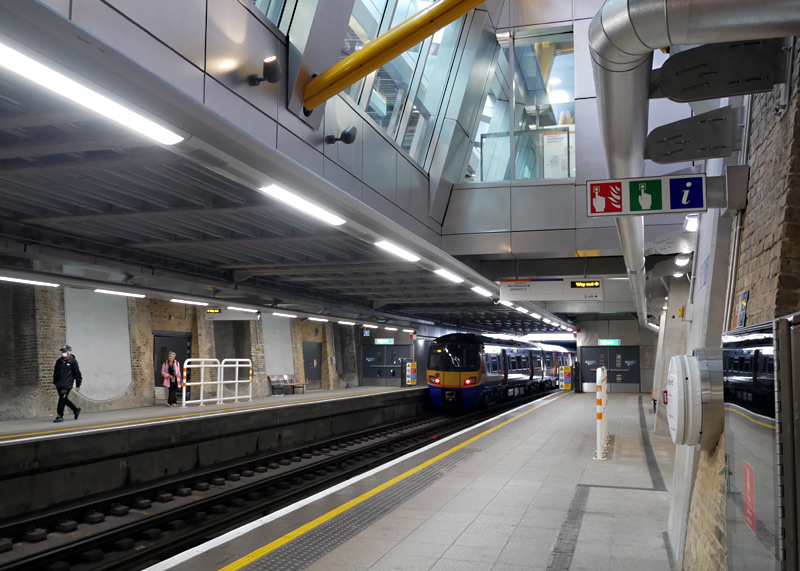
As part of the project to build new platforms for the Elizabeth line Whitechapel station has been significantly rebuilt with better interchange between Underground and Overground platforms and is also now fully accessible.
Unfortunately the changes at this station mean that it is no longer possible to see that East London / Windrush line Overground trains pass below District and Hammersmith & City lines Underground trains.

There is also a DLR station named Shadwell and passengers who wish to change trains here and are paying their fares in PAYG (pay as you go) mode can take advantage of the 'out of station interchange' feature (OSI) to be charged one through fare for their journey.


when it was used by London Transport F Stock electric passenger trains as well as British Railways steam (later diesel) powered freight trains.
A short walk along Railway Avenue from Rotherhithe station is the Brunel Museum. This includes the Brunel Engine House which was designed by Sir Marc Isambard Brunel as part of the
infrastructure of the Thames Tunnel. The museum has a website at this link:
http://www.brunel-museum.org.uk/ .
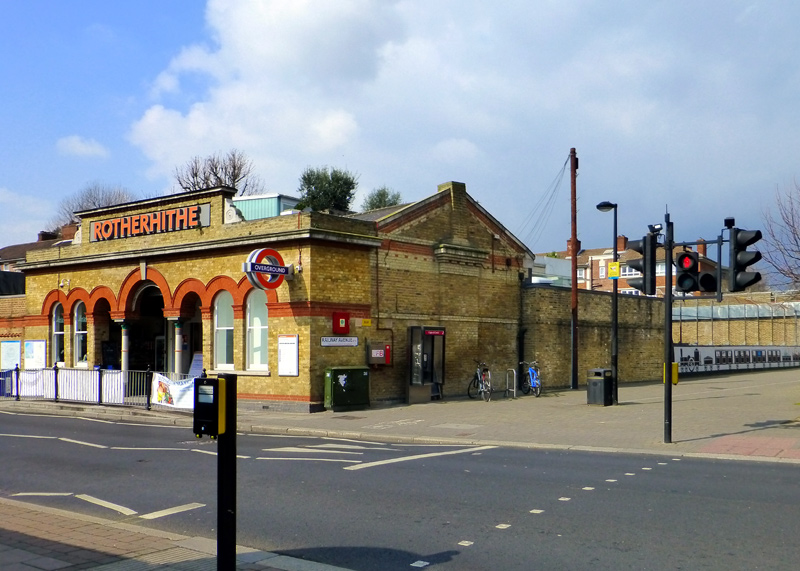
Rotherhithe station and Railway Avenue. |
|
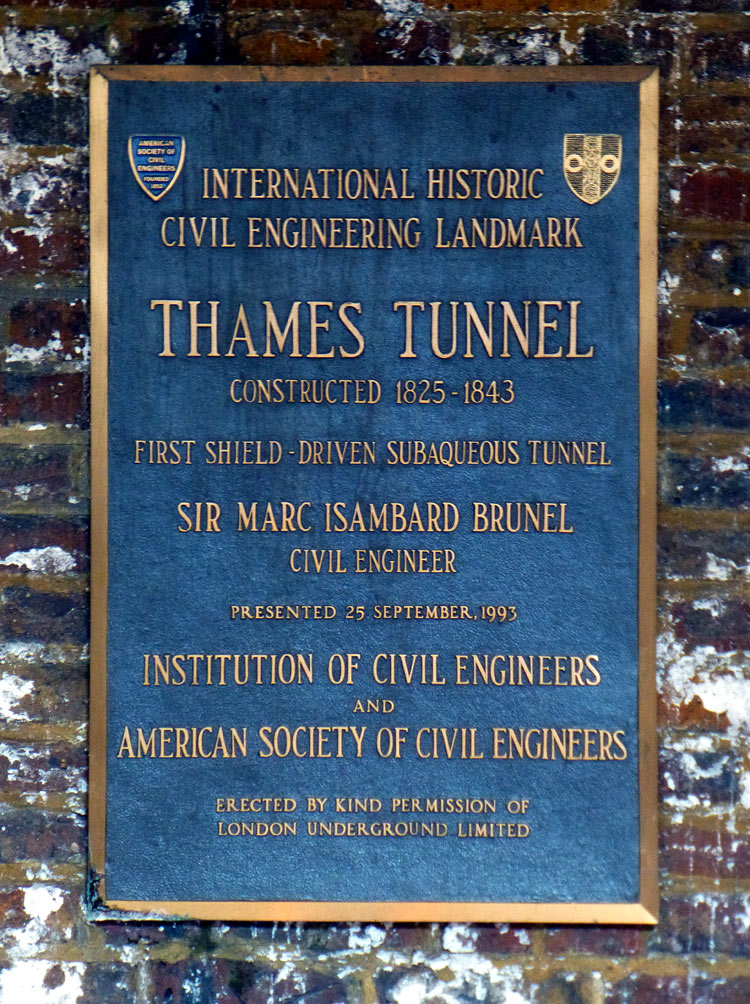
A plaque on the brickwork above the stairs to the platforms at Rotherhithe station. |
|
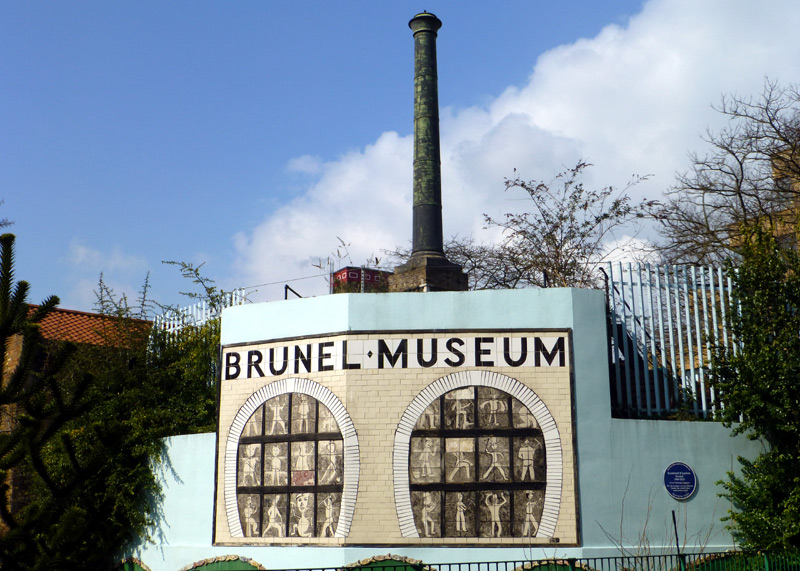
The Brunel Museum, as seen from Railway Avenue. |
Canada Water is a modern station which dates from the 1990s. It was specially added to the (then) East London Line as part of the Jubilee line extension to Stratford. Especially in the rush hours this station becomes very crowded with many passengers interchanging with Jubilee line trains (these photographs were taken at quieter times of the day).
Although not seen in these photographs the Overground platforms include some pink Oyster / Contactless card readers so that passengers not travelling via Zone 1 can benefit from cheaper fares.
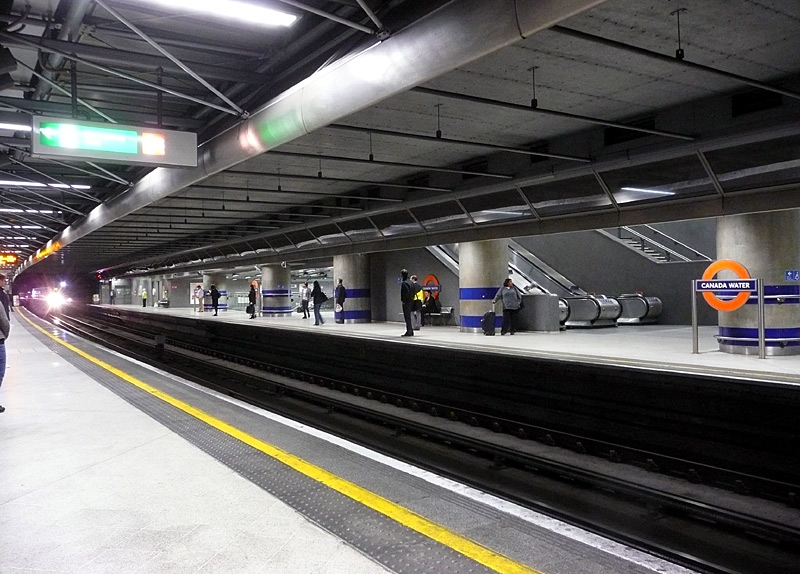
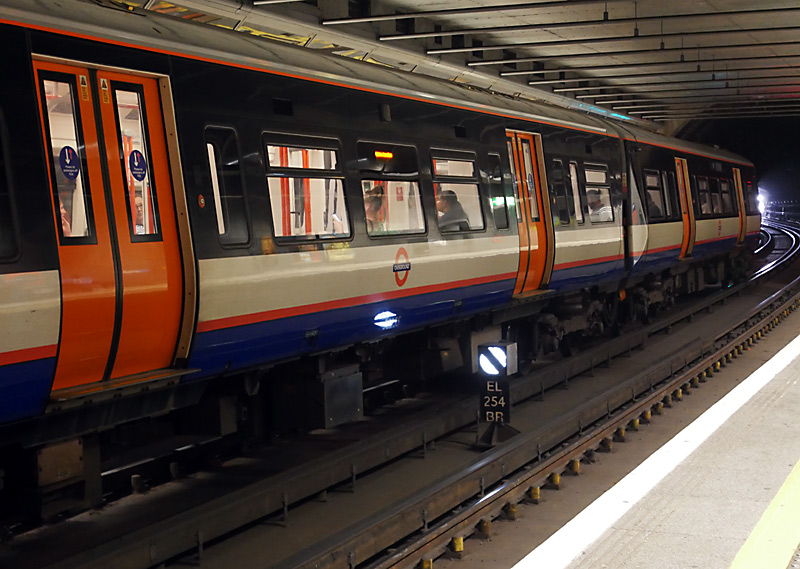
The view on the right also shows the banner repeater signal for a signal that is less visible until the train has almost reached it.
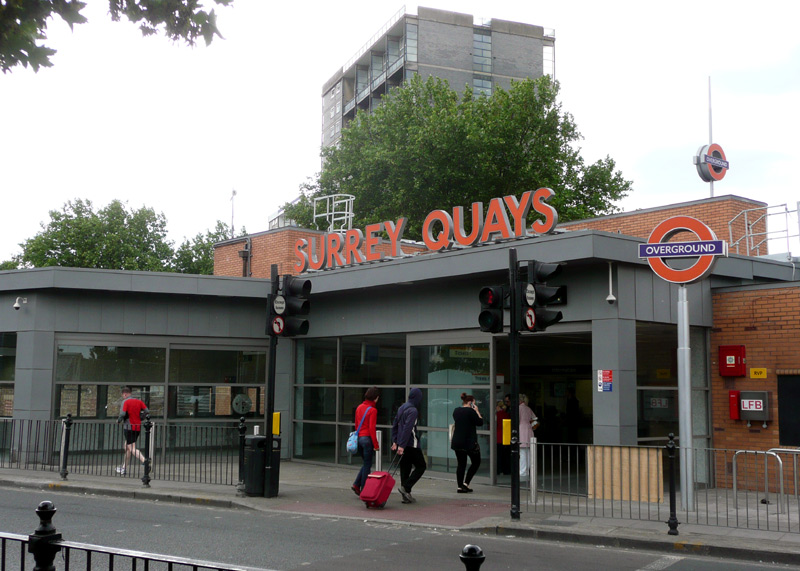
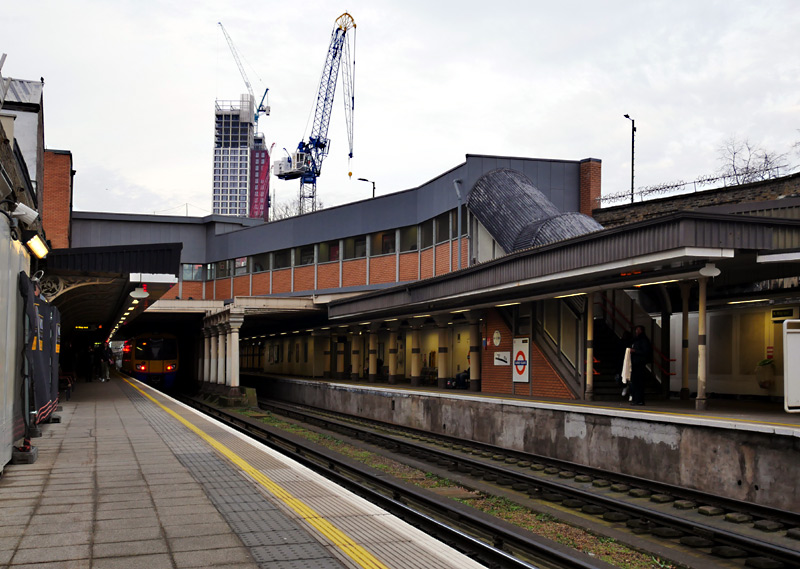
Very close to here is the Surrey Quays shopping centre which has about 40 shops, restaurants, free toilets and a large Tesco superstore.
This is very much a neighbourhood shopping centre that is used by local people, but of course visitors to London will be welcome as well.
For more information visit this website
http://www.surreyquaysshoppingcentre.co.uk/ .
After Surrey Quays station trains to Clapham Junction branch off towards Queens Road Peckham station (more information below) and trains to New Cross branch off towards that station whilst trains to Crystal Palace / West Croydon continue to New Cross Gate where they merge with a four track section of railway which extends all the way to Norwood Junction.
This part of south London is also served by trains operated by Southern from Central London terminus stations (eg: London Bridge and Victoria;) passengers paying their fares in PAYG mode should note that these other trains charge higher fares.

Class 700 Thameslink train passes a Class 378 London Overground train on the four track section of railway at Brockley station.
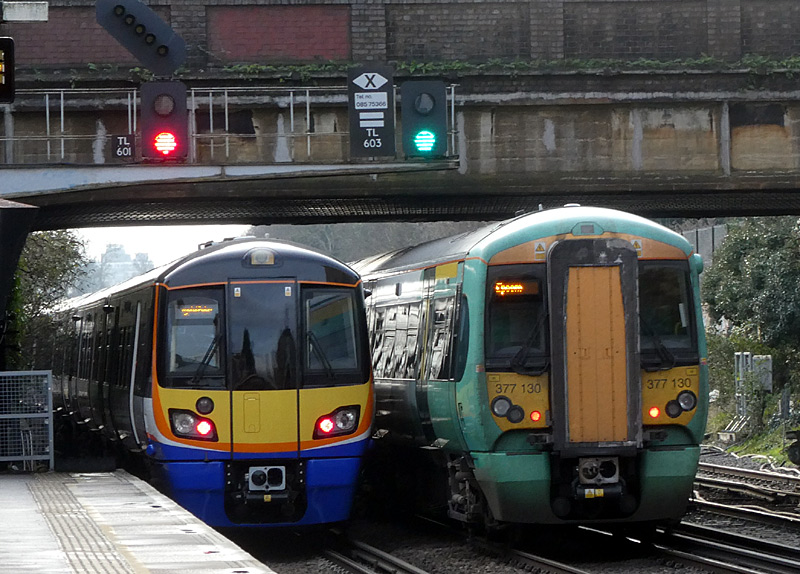
The London Overground [and Southern trains which call at intermediate stations] use the outer two tracks whilst the centre pair of tracks are used by fast Southern and Thameslink trains.
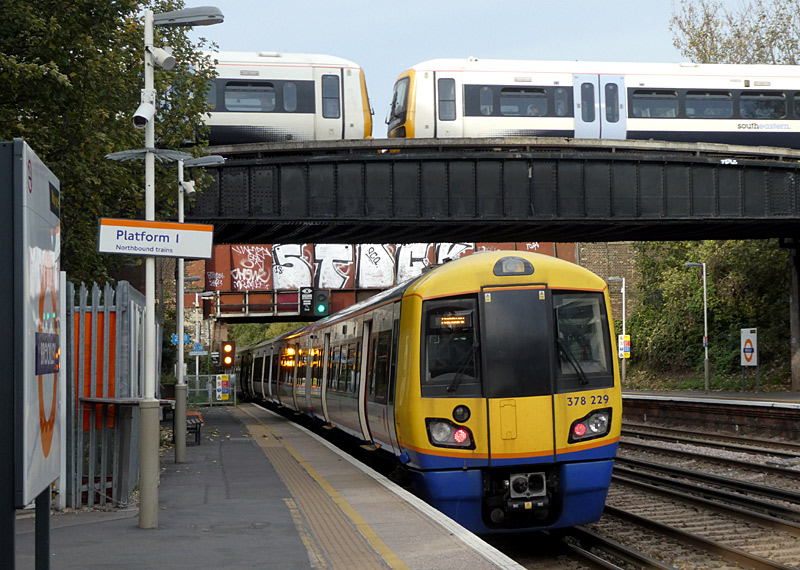
Right: Another fortunate occurrence at Brockley station - a SouthEastern Class 465 train passes above a departing Overground train.
 |
|
 |
|
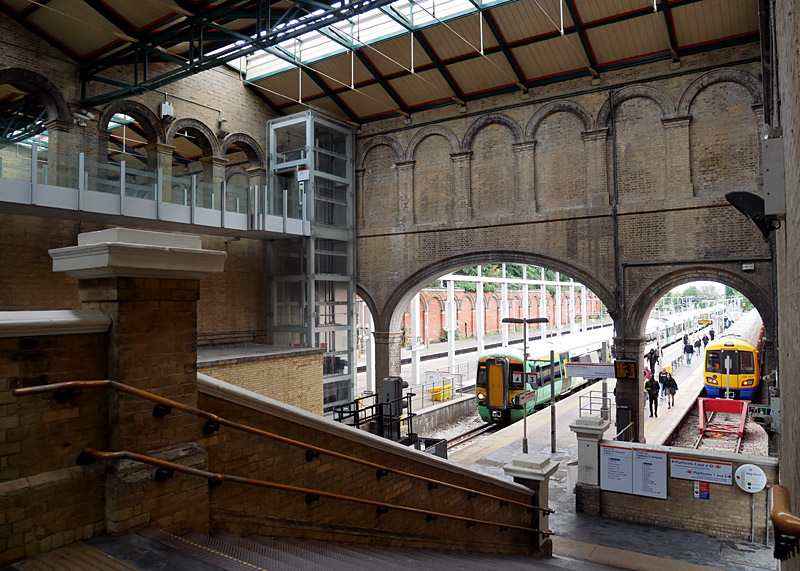 |
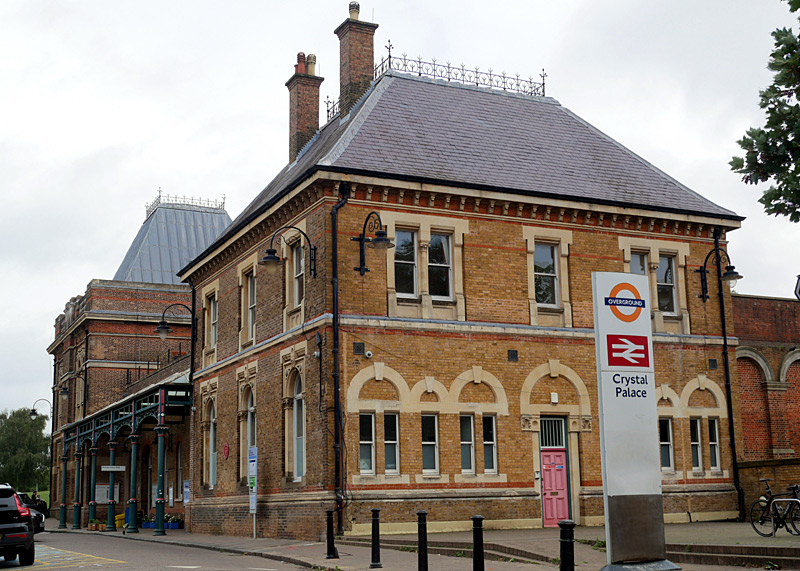
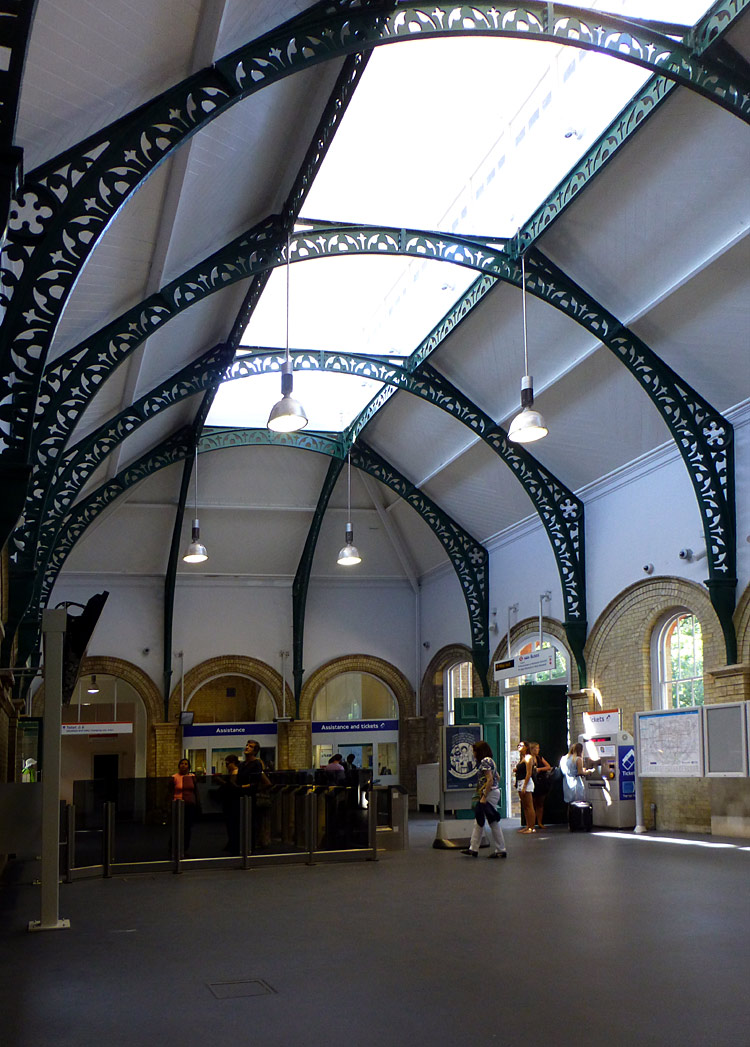
This is a much-loved Victorian-era station. Nowadays only some platforms are used, with part of the station closed to passengers.
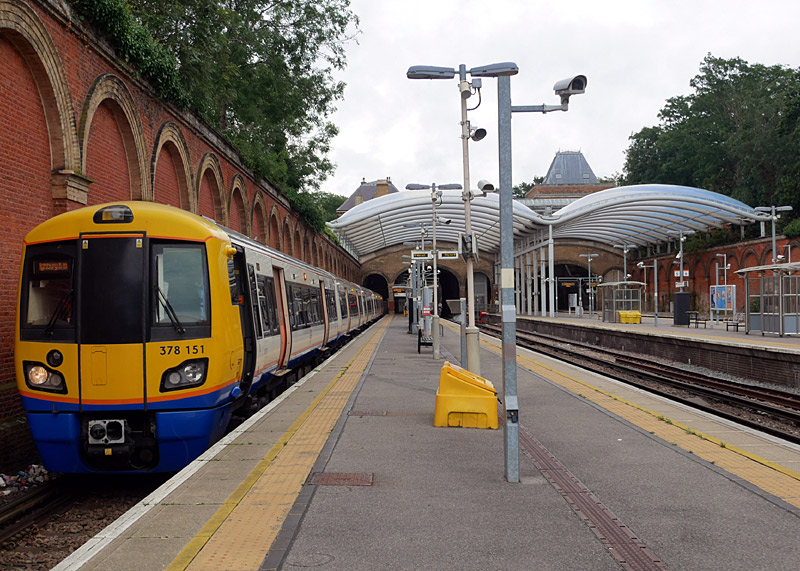
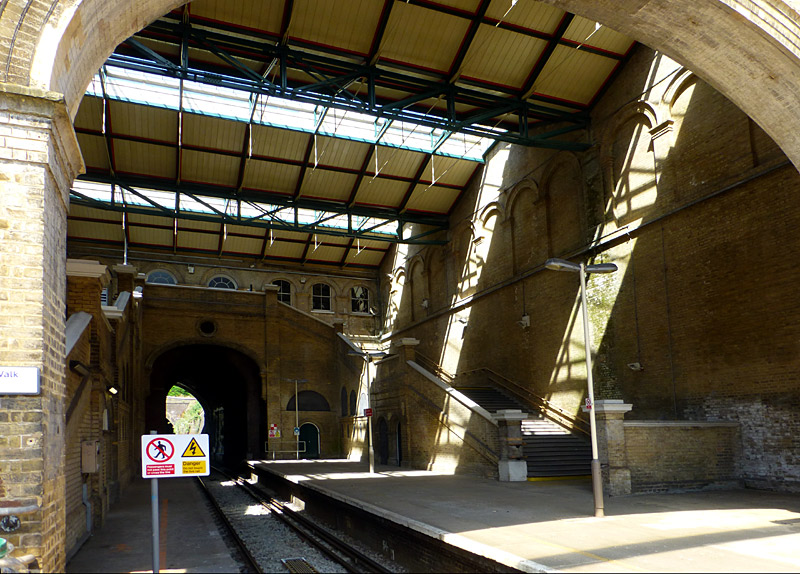
There used to be two stations at Crystal Palace, the other station was on a completely different route and was called Crystal Palace High Level. This name reflects the
hilly nature of the local area and the station being at a higher elevation. This station was so close to the glass building known as Crystal Palace that it was possible to give passengers
who had travelled first class their own private entrance to the Palace!
However after the Crystal Palace was destroyed by fire in 1936 far fewer passengers were using this station and with air raid bomb damage during WW2 forcing the temporary
closure of entire branch line passenger numbers declined even further. Although temporary repairs allowed the line to be reopened it was decided that passenger numbers were
too low to justify expensive permanent repairs and despite it being served by electric trains British Railways closed the entire branch line in 1954.

on a stairway intermediate landing - this is to discourage passengers from running whilst descending the stairs.
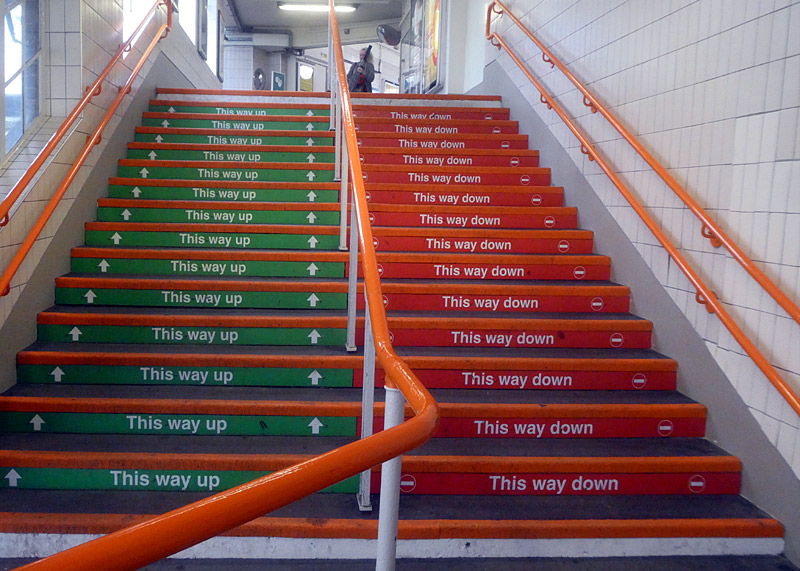
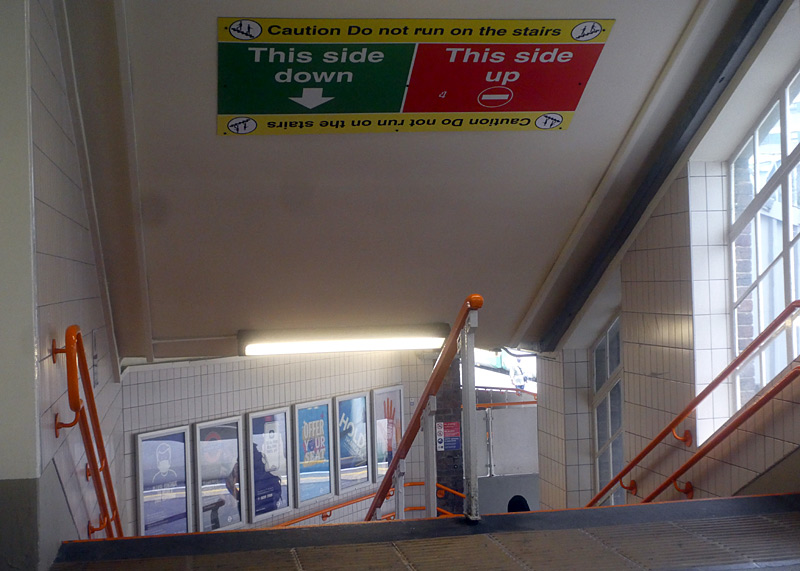
to only use one side of the steps depending on direction of travel.
To the south of Surrey Quays trains travelling to / from Clapham Junction use a section of railway which had been closed for many years but was re-opened for this service. At some stage in the future a new station will be built here.
Queens Road Peckham - Wandsworth Road is part of the former South London Line (SLL). Much of this route is elevated on brick arch viaducts.
Extending London Overground trains from Surrey Quays to Clapham Junction resulted in the closure of the SLL service between London Bridge and Victoria stations on the route via Denmark Hill. This ending of through SLL trains caused severe inconvenience to some former SLL passengers who must now travel longer, slower routes and change trains (at least once) and / or catch buses to complete journeys which could previously be accomplished on just the one train.
Note that there is still a through service between London Bridge and Victoria stations, however this travels a different and longer route via Crystal Palace.
The view from the train window between Denmark Hill and Clapham High Street will interest people who wish to see 'real' London away from the tourist areas but at the same time feel safer not walking the streets. Especially not with cameras visible for everyone to see.
Clapham High Street Overground and Clapham North Underground stations are designated interchange stations. Passengers who wish to change trains here and are paying their fares in PAYG (pay as you go) mode can take advantage of the 'out of station interchange' feature (OSI) to be charged one through fare for their journey.
Local people will perhaps disagree, but Peckham and Wandsworth are two more of the 'inner city South London' areas which some people may prefer to avoid.
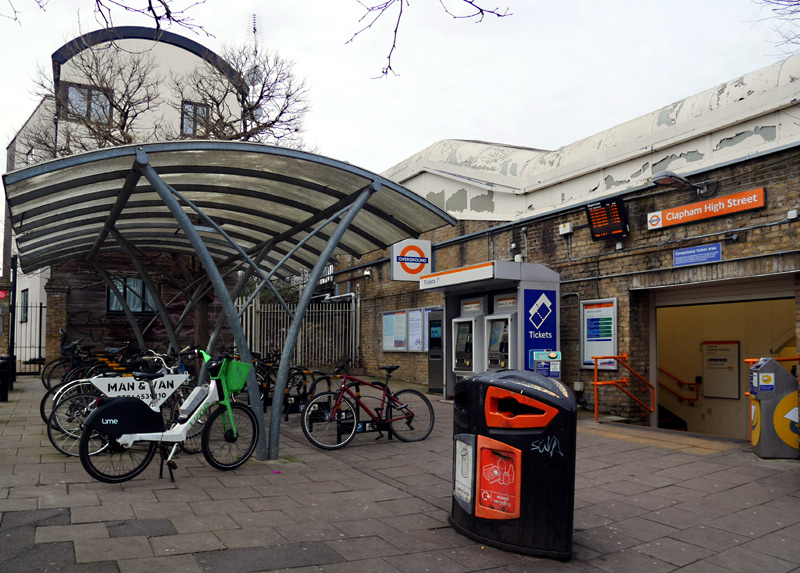
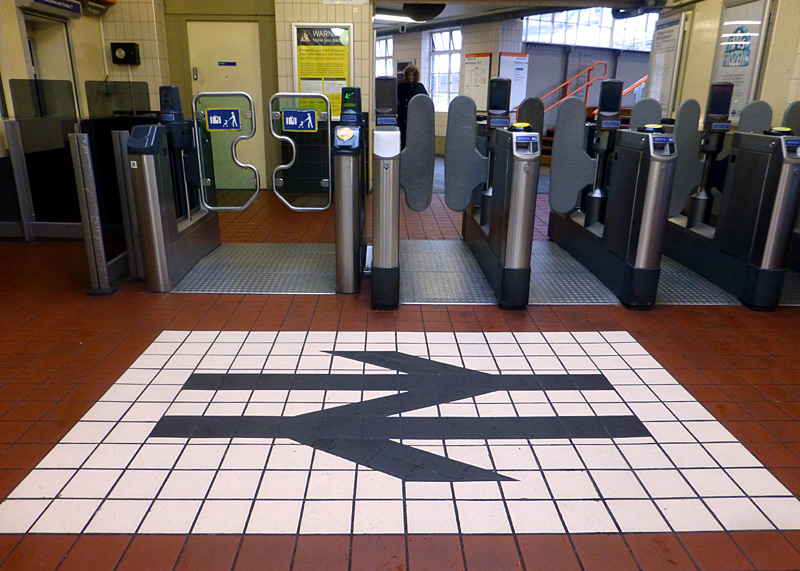
entrance is just a hole in the wall and the duty member of staff
has a small cabin on the westbound platform.
departs from Denmark Hill station.
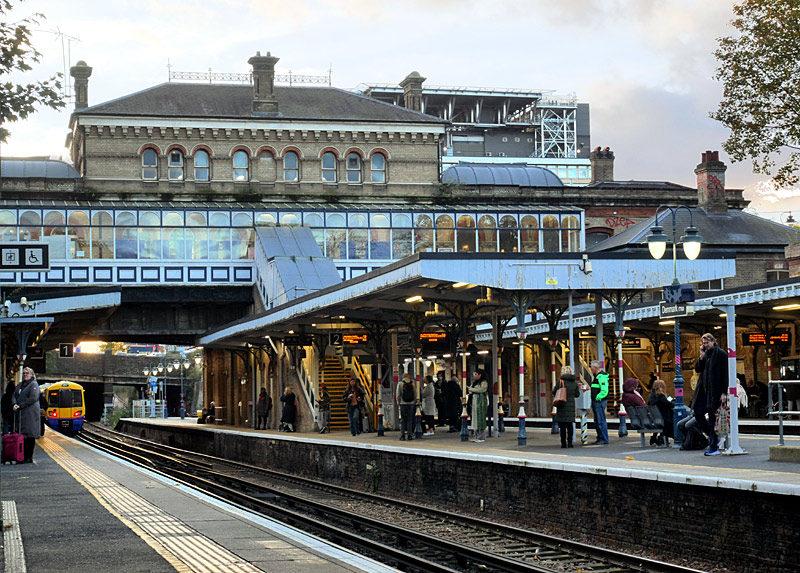
Filmed at twilight to better show the decorative platform lights.
Denmark Hill is a much-loved Victorian-era station which had to be rebuilt after a disastrous fire in 1980. Nowadays most of the station building is a pub called The Phoenix. Happily, there is a counter specially dedicated to railway passengers who can buy refreshments without leaving the fares paid area.
There are now two new entrances to this station, which is in a deep cutting. These are at street level, one each on either side of the tracks and closer to the bus stops. The new entrances feed into a new footbridge over the tracks with lifts and steps extending down to the platforms. This means that this station is also fully accessible.
Other trains seen calling at this station include SouthEastern Class 465 Networkers, Thameslink Class 700
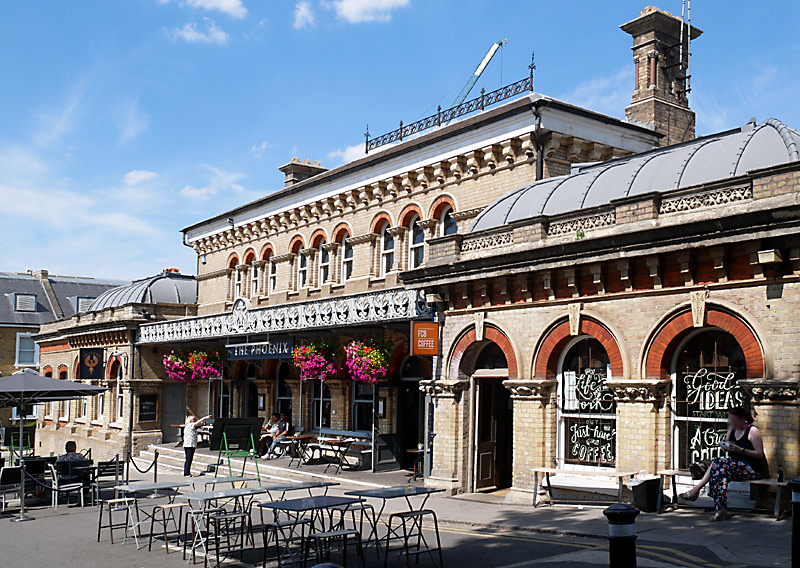
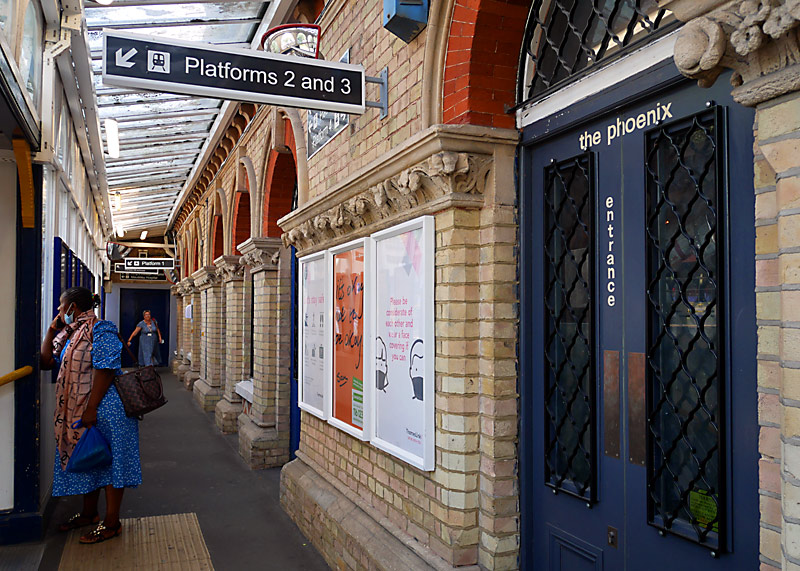
and the passageway behind this building with steps down to the platforms.
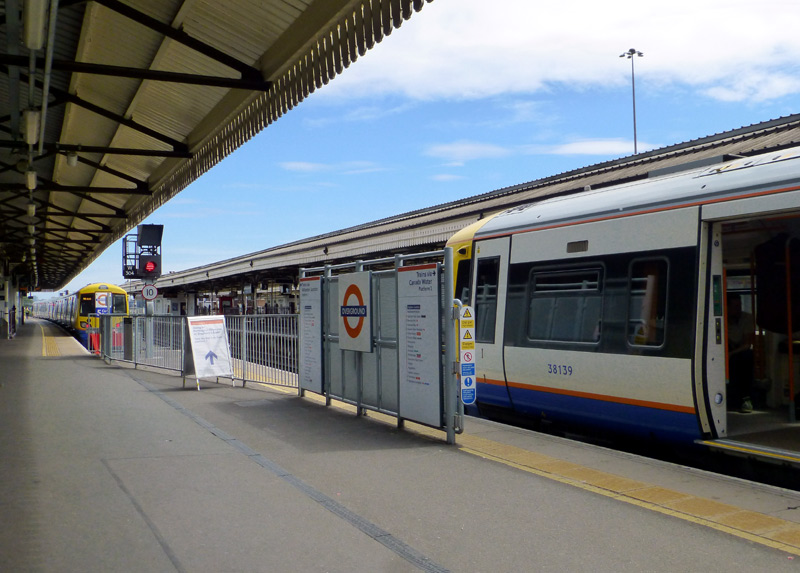
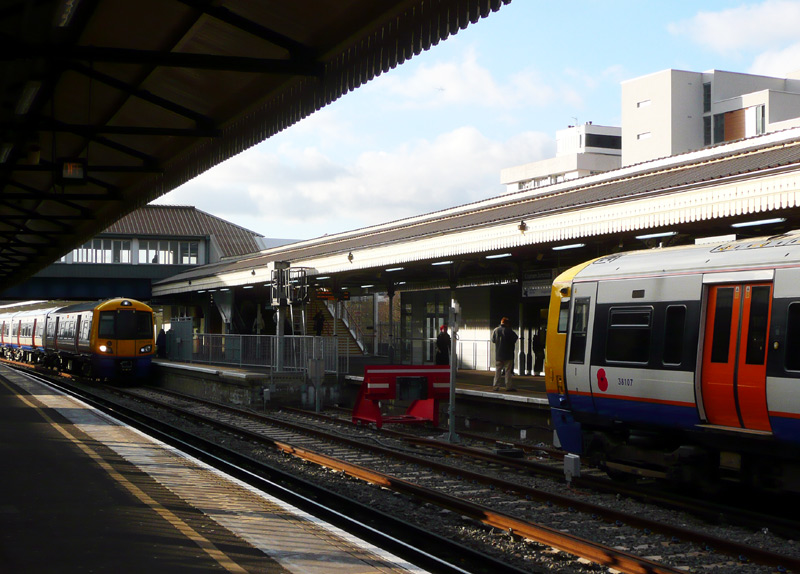
To make for an easy same-platform interchange between the two London Overground services at Clapham Junction the very long platform No.2 was split in to two sections with a platform extension added
over part of the track so as to effectively create a staggered platform face.
The train that uses the original platform face will be travelling via Willesden Junction [ie: west and north London - Mildmay line]
whilst the train that calls at the extended section of platform will be travelling via Canada Water [ie: south and east London - Windrush line].
This arrangement means that both trains can enter and leave the station at
the same time.
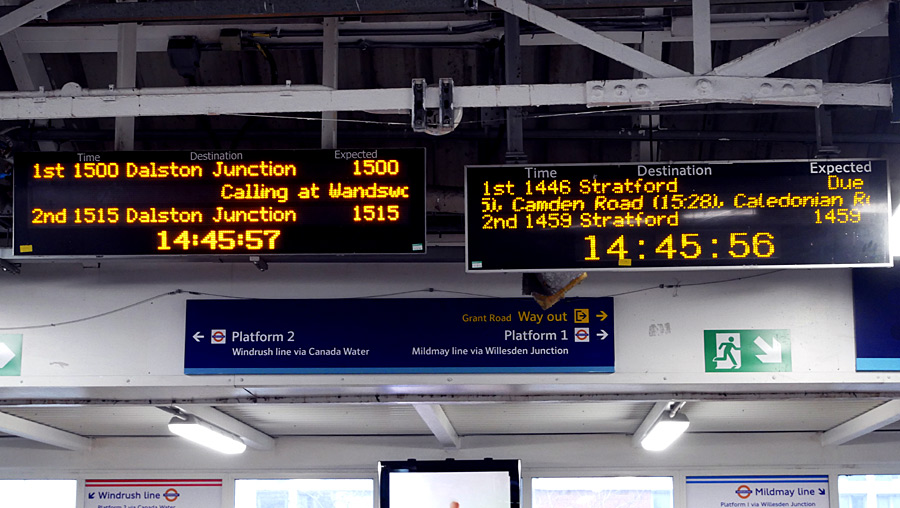
London Overground next train displays just before the
steps down to the platforms at Clapham Junction station.
Plus a logic-defying example of 'railway time'!!
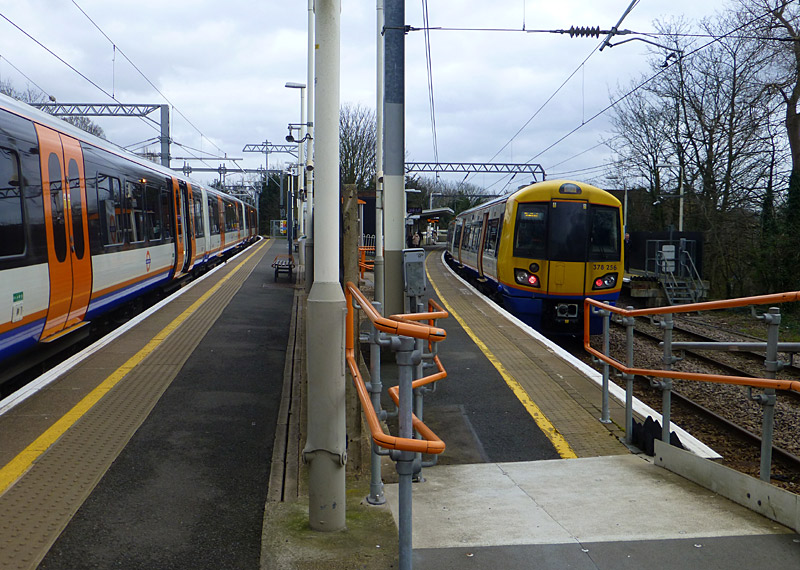
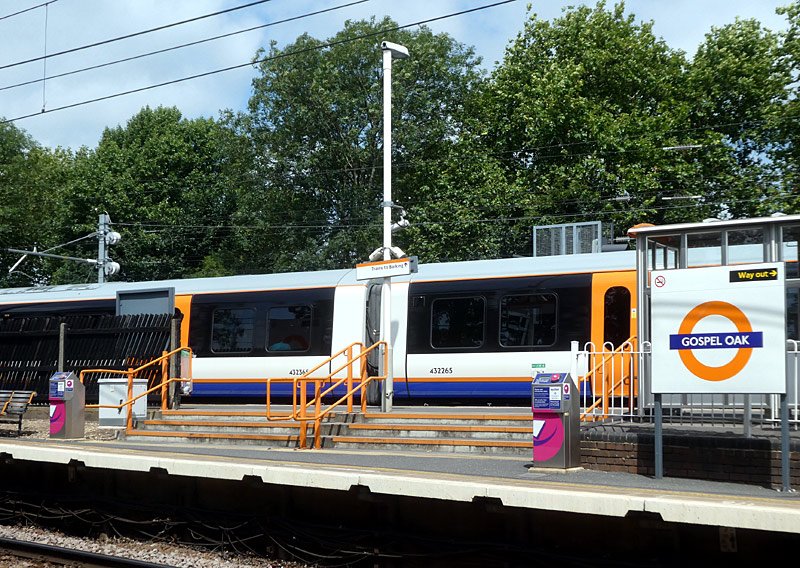
| Gospel Oak - Barking Riverside 'Goblin' / Suffragette line |
- This service links Gospel Oak station in north London with Barking Riverside station in east London.
For many years this was a neglected branch line which had an infrequent train service but since the formation of the London Overground network it has been completely transformed. Nowadays it is served by Class 710 electric trains on a 15 minute / quarter hourly frequency. Although the line is electrified using the 25Kv AC overhead wire system it uses twin-system trains which can also operate via a 750v DC third rail. This is because the same fleet of trains is also used by the Euston - Watford Junction / Lioness line which is powered via electric rails.
The Goblin Line is also a busy freight route
Much of this route is on elevated brick arch viaduct which offers a good view of the local areas and back gardens.
 |
|
 |
|
 |
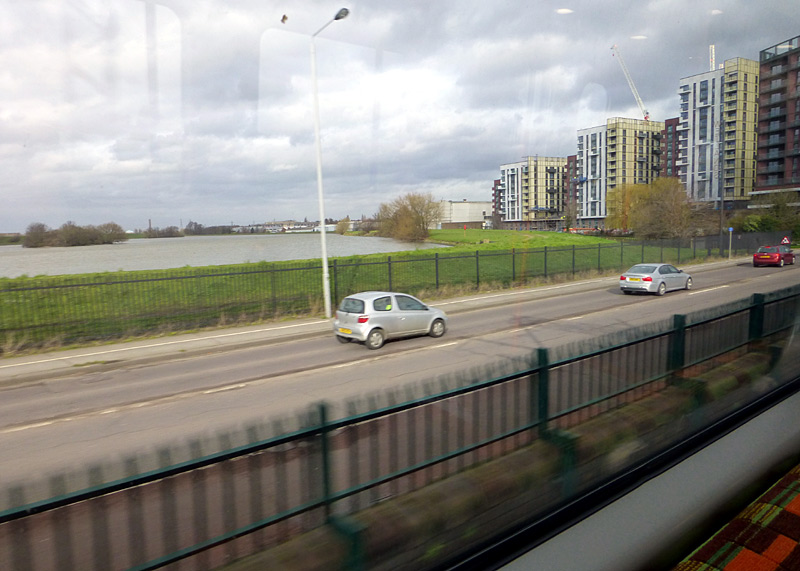
The Walthamstow Reservoirs (which includes the High Maynard Reservoir) are also a nature reserve which can be visited - this link explains more:
https://www.wildlondon.org.uk/nature-reserves/walthamstow-wetlands
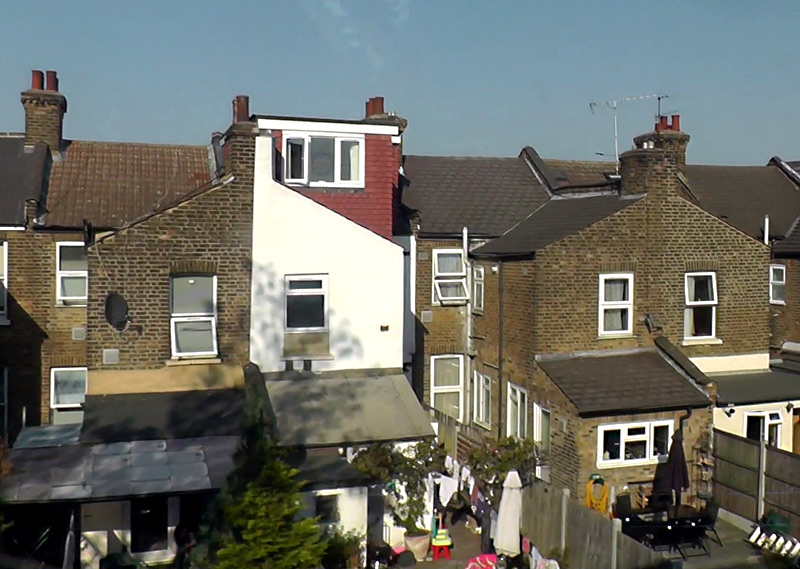
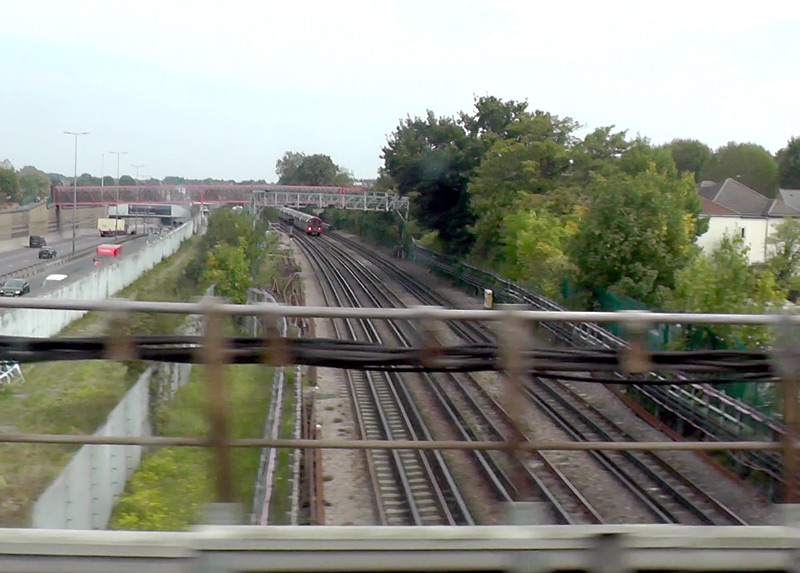
between Leyton Midland Road and Leytonstone High Road stations.
Leytonstone station. A westbound train is visible in the far distance.
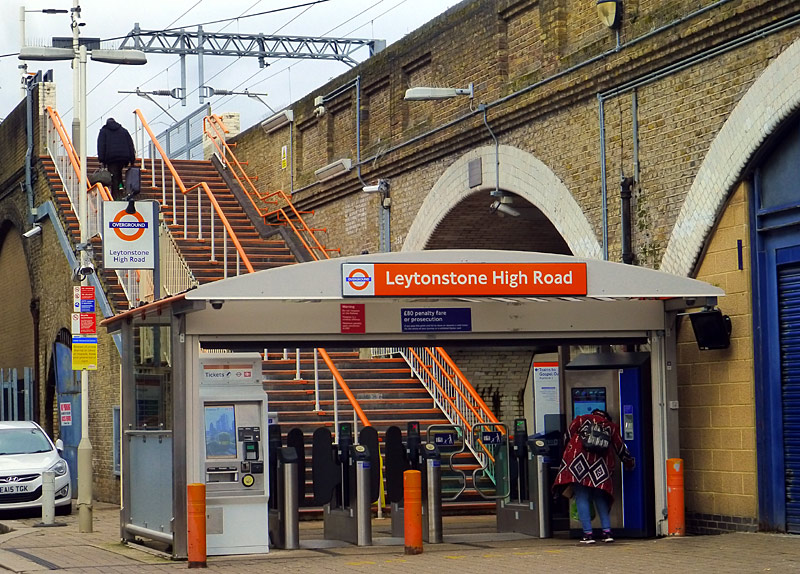
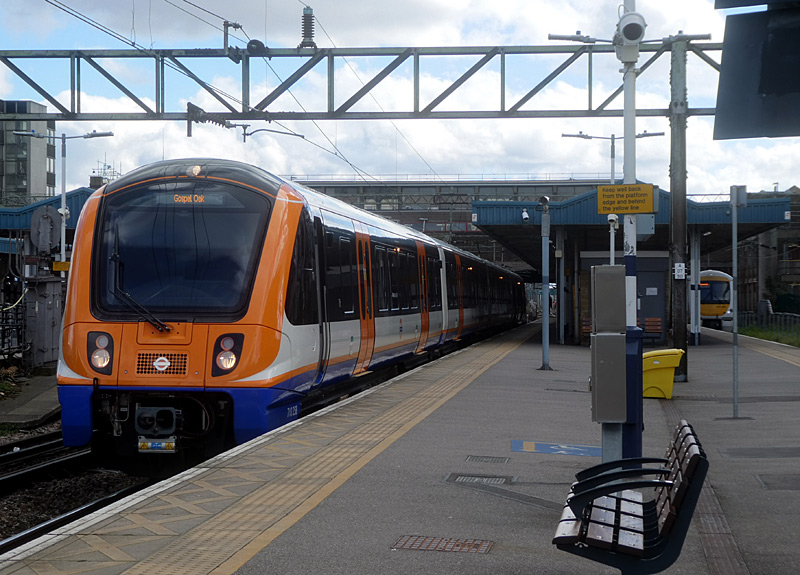
Leytonstone Underground and Leytonstone High Road Overground stations are designated interchange stations. Passengers who wish to change trains here and are paying their
fares in PAYG (pay as you go) mode can take advantage of the 'out of station interchange' feature (OSI) to be charged one through fare for their journey.
However, they must walk the whole
way - the distance between the two stations is far enough apart to be able to catch a bus (along Leytonstone High Road) but if this is done then it will break the 'single train fare' feature of the OSI.
| New Extension |
In 2022 this route was extended from the busy Barking station to a brand new station (called Barking Riverside) which had been built to serve a new residential area near to the River Thames.
The former terminus platform at Barking (Platform No. 1) enjoyed cross-platform interchange with eastbound District line trains heading towards Upminster. This platform is been retained, partly because some Goblin / Suffragette line trains sometimes still use it but also because it is the only platform at this station which has a lift - and when used in conjunction with the pedestrian underpasses that link all the other platforms it makes Barking station fully accessible. Goblin / Suffragette line trains normally now call at platforms Nos. 7 & 8 - see image above.
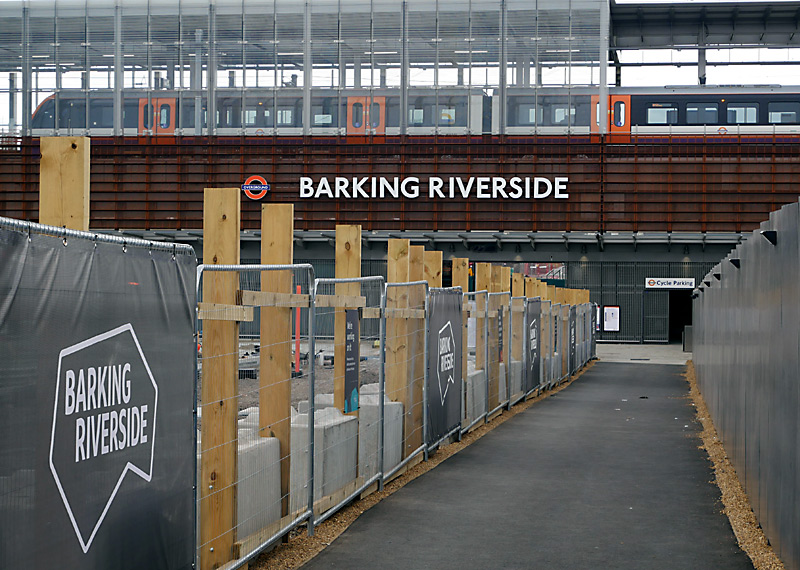
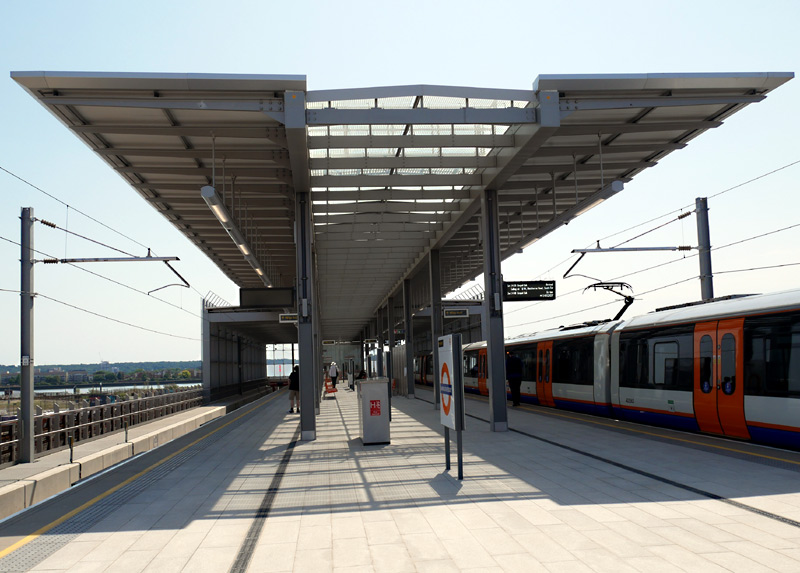
The space below the elevated island platform includes:
the station entrance, ticket sales area (ticket machines only),
space for railway staff and a weather-protected cycle parking.
weather protection that extends partway along the platform.
The lifts and stairs are at the far end of the platform.
| West Anglia / Weaver line |
- This comprises a group of three services. They are all powered via 25kV AC via overhead wires and use Class 710 trains.
‣ Liverpool Street station - Enfield Town
‣ Liverpool Street station - Chingford
‣ Liverpool Street station - Cheshunt via Seven Sisters (NOT the service via Tottenham Hale)
The desire is that all services from Liverpool Street will operate at least every 15 minutes but because these are busy routes which are also used by other trains and there is not always enough track capacity so sometimes trains are less frequent.
The core section of the West Anglia / Weaver line service is between London Liverpool Street and Hackney Downs stations, and in addition to trains operated by London Overground this route is also used by trains operated by Abellio Greater Anglia (AGA). The types of train typically operated by AGA includes Classes 720 and 745 - the latter on the Stansted Express airport service.
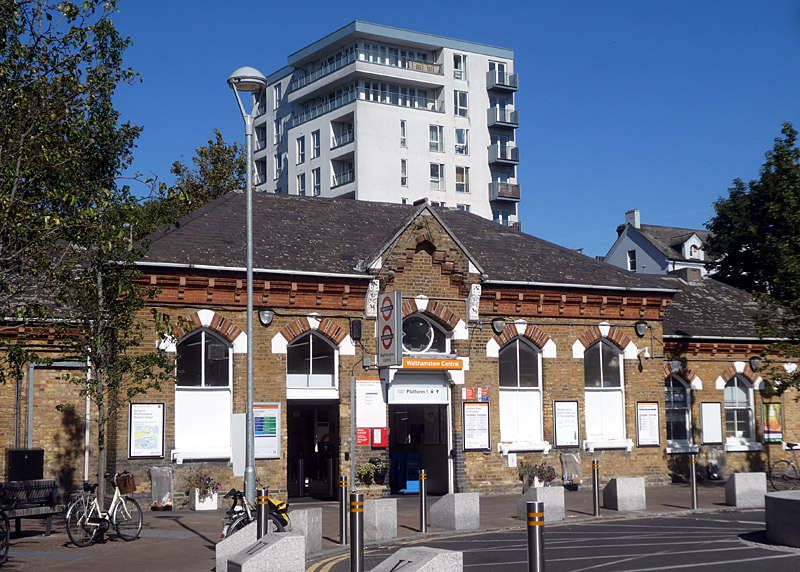
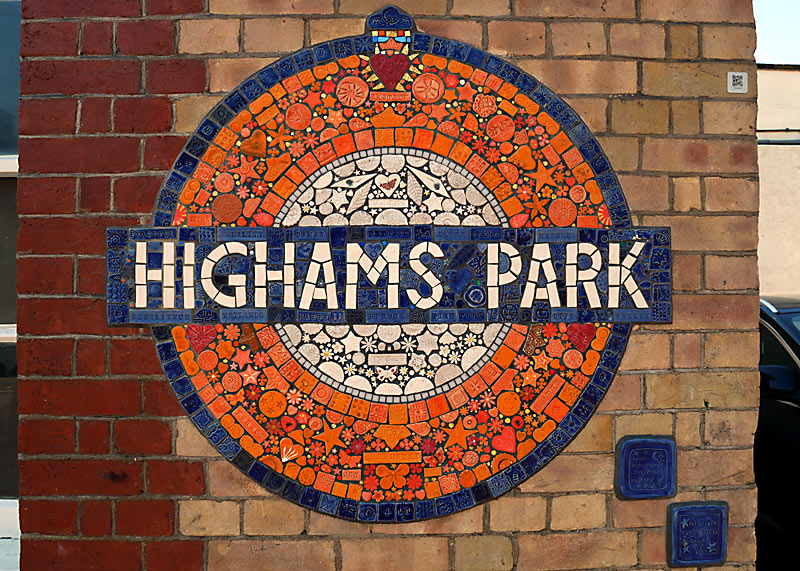
This is also a designated interchange with the Goblin / Suffragette line station named Walthamstow Queens Road. Passengers who wish to change trains here and are paying their fares in PAYG (pay as you go) mode can take advantage of the 'out of station interchange' feature (OSI) to be charged one through fare for their journey.
has one of these beautiful mosaic station name signs.
In addition to the usual clickable larger version of the image there is
an extra large image showing just a portion of the mosaic
and thewords in some of the individual mosaics that created the entire sign.
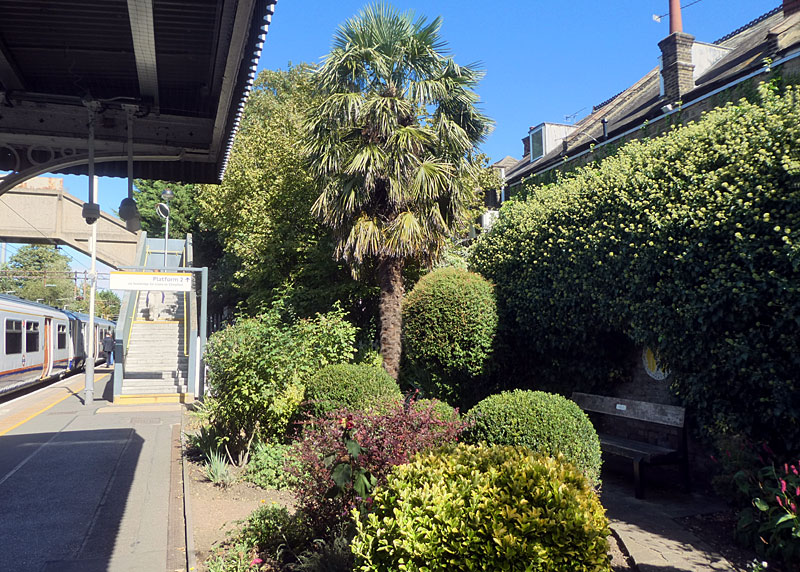
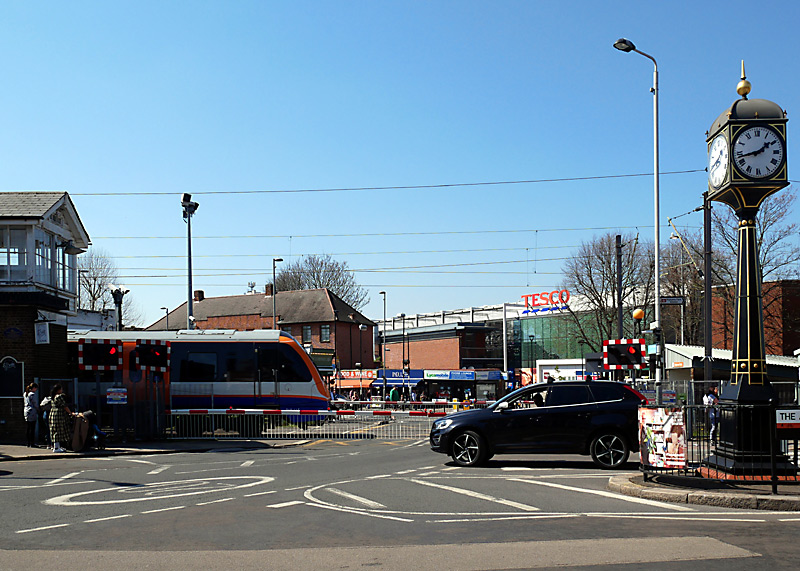
on the platform used by trains to London Liverpool Street station.
also seen here are the former signal box (left) and clock tower.
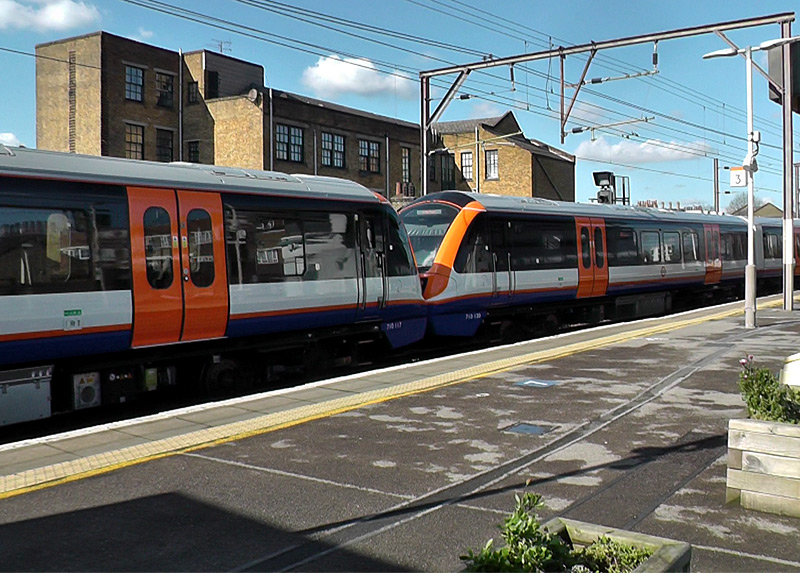
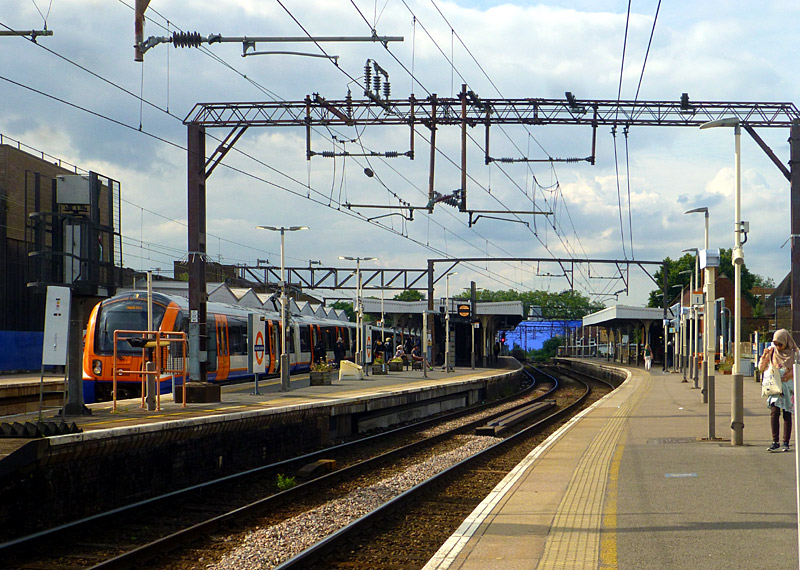
operate together as an eight (8) carriage train.
This 'middle of train' view was taken at Hackney Downs.
Chingford route trains use the tracks and platforms on the right.
Just to the north of Hackney Downs station the routes to / from Enfield Town and Cheshunt diverge to the left and the route to Chingford diverges to the right.
Also seen passing through this station (without stopping) are Greater Anglia Class 720 trains and the Stansted Express service which usually uses Class 745 trains.
To the south of here are London Fields and Cambridge Heath. These two stations only have platforms alongside the tracks used by Enfield Town and Cheshunt trains - so Chingford route trains usually travel non-stop between Hackney Downs and Bethnal Green.
Liverpool Street stations pass by London Fields station.
Because of the track layout only trains to / from Cheshunt and Enfield Town can use the tracks that allow them to call at this station.
and Romford - Upminster / Liberty line..
| Romford - Upminster / Liberty line |
- This is a single track quiet country branch line which uses just one train that provides a 30 minute service. There is no service in the evening after 8pm (20:00) or on Sundays.
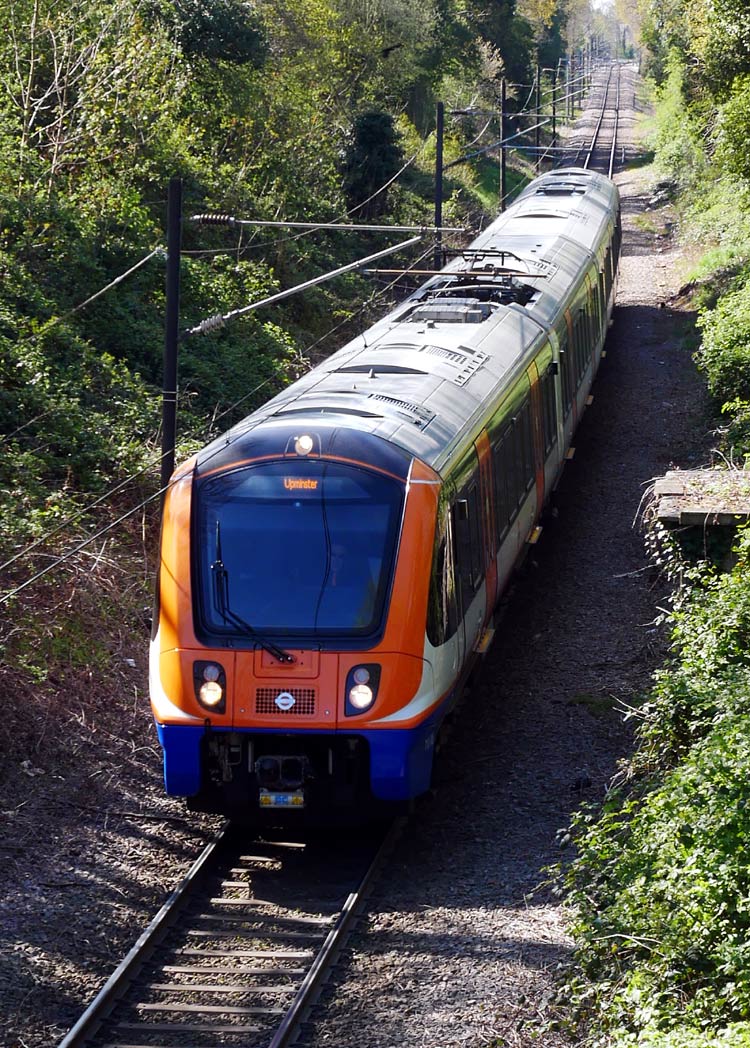
This service uses a Class 710 train.
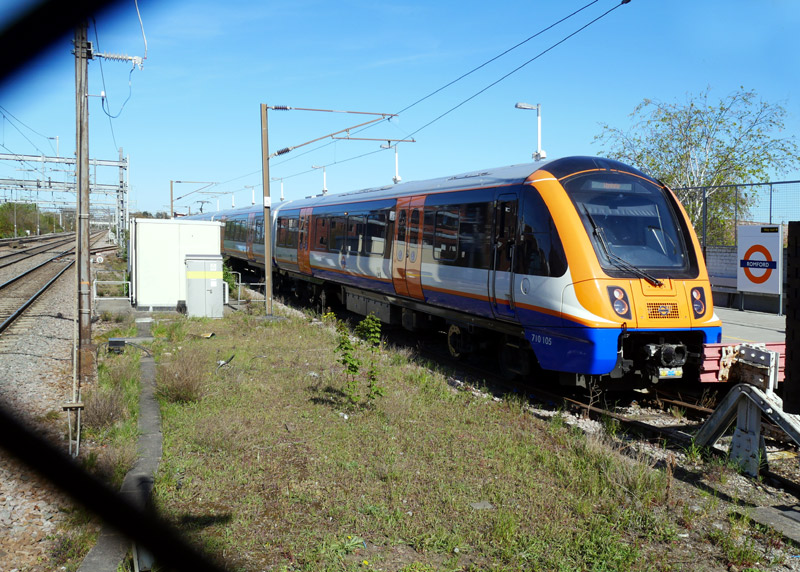 |
|
 |
|
 |
On the left is the four track Great Eastern Main Line which is used by Elizabeth line, Greater Anglia and various freight train companies.
Filmed through a chain link fence.
Middle: Approaching Emerson Park station on a journey from Romford to Upminster
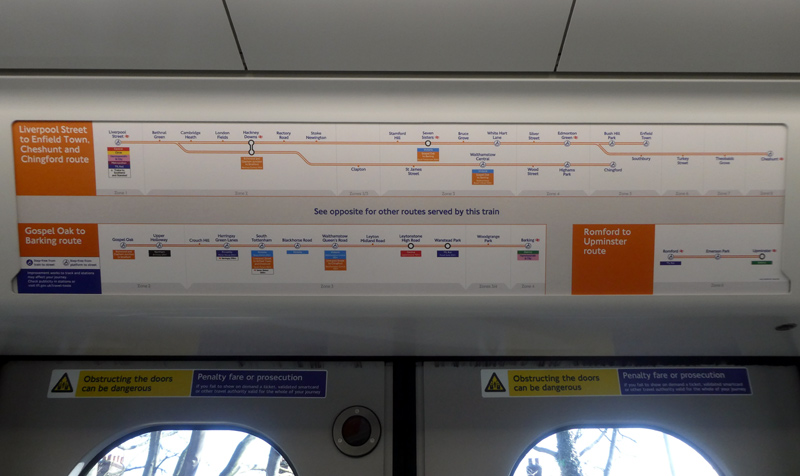
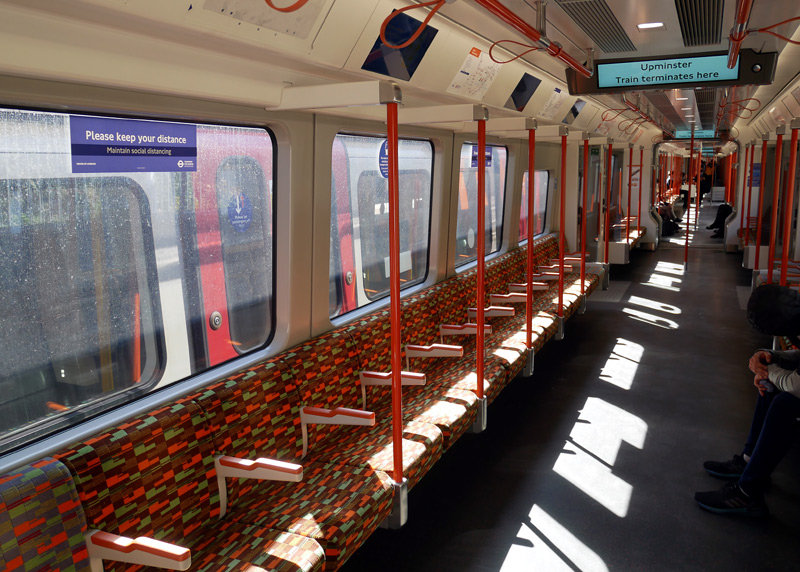
Right: Inside a London Overground Class 710 train at Upminster station with a London Underground S7 District line train alongside.
| Overground Expansion |
In January 2016 it was announced that when the franchises for all other mainline / National Rail routes which serve London are renewed control of the urban / suburban services would be transferred to Transport For London, (TfL) who it was expected would have added them to the London Overground network.
However this did not happen. One reason was thought to be related to political tensions between the Mayor of London and the national politicians, who were from different political parties.
It was also known that not all passengers were pleased by this proposal - especially as experience with the London Underground Metropolitan Line suggested that TfL would be likely to change service patterns in ways which disadvantage passengers travelling from outside of London's political boundaries. (ie: make the trains call at more stations so that journeys from outside of London become slower and take longer). The issue is that many of these services are integrated into the mainline / national railway network whilst TfL's primary interest is serving people who live inside London's political boundaries. London's hinterland includes towns which whilst just outside of its political boundaries are still part of its socio-economic zone.
| West London Orbital |
A very likely new London Overground service will create a new suburban west London orbital link by combining some existing sections of railway which carry passenger services and restoring passenger services to two other sections of railway in which (at present) are only used by goods / freight trains. One of these is the Kew Bridge Spur which extends from Bollo Lane Junction (which is near South Acton station) to Kew Bridge station. The other line is known as the Dudding Hill line (or Dudding Hill loop). This extends from Old Oak Junction to Brent and Cricklewood Junctions on the Midland Main Line.
At present this proposed new service is being called The West London Orbital however it is thought likely that it will be renamed before services commence.
In the Acton area the Orbital trains will share the tracks with the Overground's North London / Mildmay line, with both services calling at South Acton and Acton Central stations (which are already open) as well as the future Old Oak Common (OOC) Victoria Road station, which will serve the High Speed 2 InterCity rail service. At present this station is under construction. (Dateline December 2024).
It is assumed that the trains on the Orbital service will be electrically powered and will not use batteries or any other technology that has not yet entered the public arena.
Therefore it is fortunate that much of the route the Orbital service will follow is already electrified. However the Kew Bridge Spur and the Dudding Hill line will need electrifying.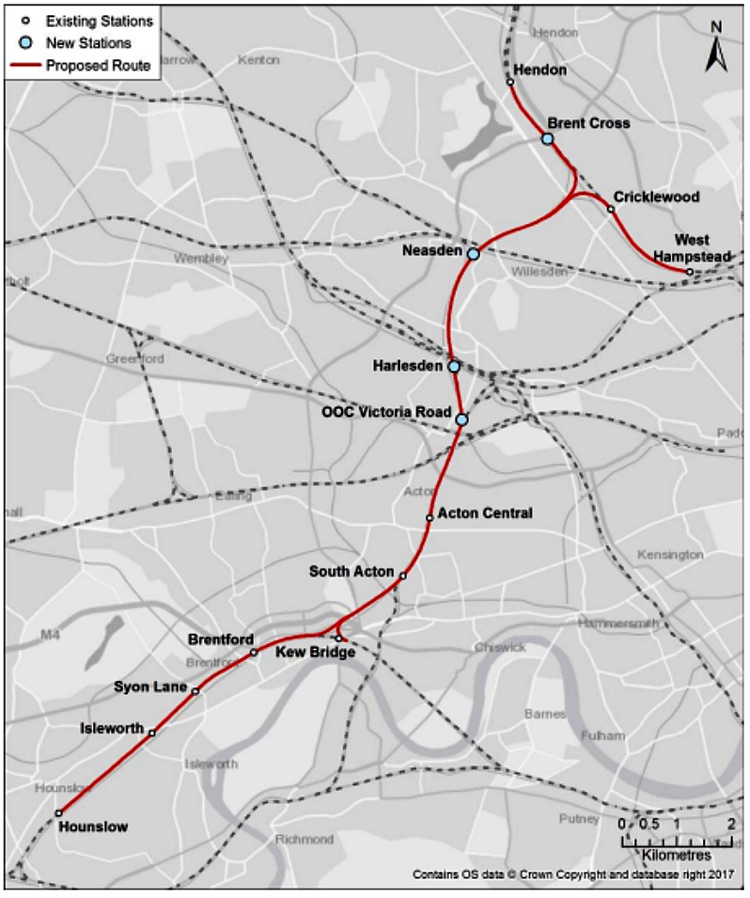
Map showing the route of the proposed West London Orbital railway.
Original source & license: WSP - West London Alliance https://wla.london/ Wikimedia / encyclopædia CC-BY-SA-4.0
https://commons.wikimedia.org/wiki/File:West_London_Orbital_Route_Map.png
As part of the North London LNWR Electrics network the Kew Bridge Spur was previously electrified (in 1916) on the 660V DC fourth rail system but lost its passenger services in 1940, as a wartime economy. It will probably be re-electrified at 750V DC third rail, as this system is now used on all other lines in this area.
By way of contrast, the Dudding Hill line will (most likely) be electrified at 25kV AC, this being the form of electrification that already exists on the Midland Main Line.
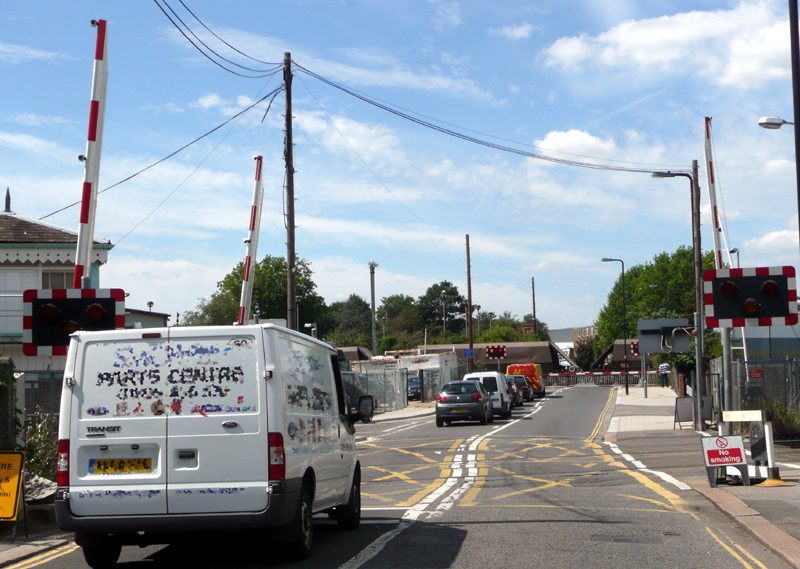
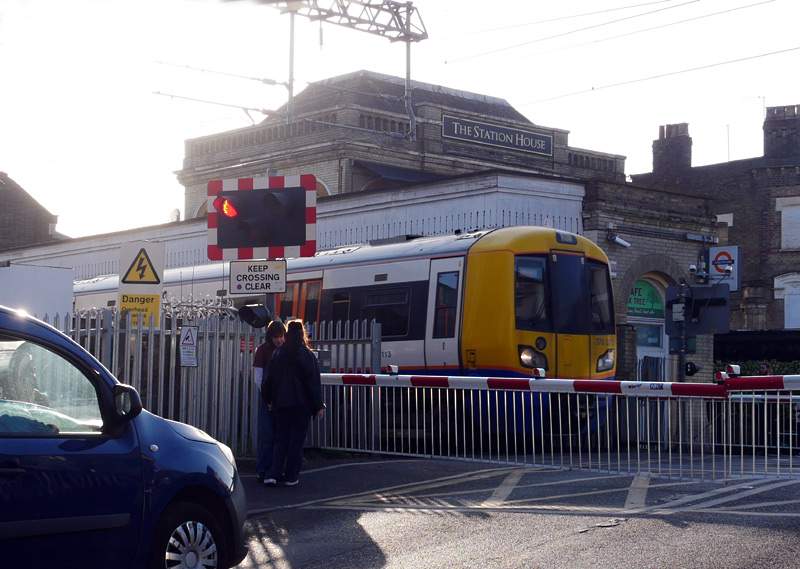
The North London / Mildmay line already uses twin-system trains, with the changeover taking place whilst calling at Acton Central station. A likely cause of friction with the local community here is that there is a level crossing right next to the station and the barriers are lowered not just for the station stop but for a while before the train has even arrived at the station. Even with just four trains an hour (per direction) the time duration involved causes considerable delay nuisance. If the Orbital service increases train throughput to 12 trains an hour (per direction - 48 trains in total, plus the occasional other train) and the station stops with barriers down last even 2 minutes each - local people are likely to become very displeased with the barriers being down for so much time.
How the new service will be integrated with existing services remains to be seen. At least one pundit has suggested that the wider ranges of interchange possibilities will make Feltham a better south-west London terminus than Hounslow. But Feltham is outside of the Greater London political area. Meanwhile, for north-west London it is thought that sending trains to West Hampstead will actually duplicate the far easier interchange possibilities that already exist with North London / Mildmay line trains in the Acton area. However, removing this part of the planned new service will deny passengers the option of interchanging with the Jubilee line's station at West Hampstead.
As an aside, between 1878 - 80 the Dudding Hill line was used by trains on the Super Outer Circle service which was operated by the Midland Railway and ran between St Pancras and Earls Court stations via Cricklewood, the Dudding Hill line, South Acton and Hammersmith. The section between Hammersmith and Earls Court saw Super Outer Circle trains travelling over tracks owned by the Metropolitan District Railway - which nowadays is the Underground's District line.
| Opening Page Fares & Tickets / Photography |
|
|
|
| London Underground Small Profile ‘Tube ’ Trains |
|
| Bakerloo Line | |
| Central Line | |
| Jubilee Line | |
| Northern Line | |
| Piccadilly Line | |
| Victoria Line | |
| Waterloo & City Line | |
|
|
| London Underground Large Profile ‘Subsurface’ Trains |
|
| Circle Line | |
| District Line | |
| East London Line | |
| Hammersmith & City Line | |
| Metropolitan Line | |
|
|
| National Rail ‘Tube’ Trains | |
| Northern City Line | |
| Elizabeth Line (Crossrail Line 1) | |
| Crossrail Line 2 | |
|
|
| Other National Rail Trains | |
| London Overground |  |
|
|
| Local Light Railways | |
| Docklands Light Railway | |
| Croydon / London Tramlink | |
|
|
| General Information | |
| Main National Rail Stations Fast Regional Services Overhead Wire & 3rd Rail Trains |
|
| Busier Suburban Stations In Zones 1-4 With A Wider Variety Of Trains To See |
|
| Station Architecture & Features | |
| Shared Service Routes | |
| Further Information Resources To Visit In Person Or Online |
|
|
|
| Single Page Version Of This Guide |
|

