
Visitors to London who are also transport enthusiasts (‘railfans’) sometimes ask for advice as to the ‘best’ things to see on London’s railway network. This page is part of a guide which aims to answer that question.
If this is the first time you have reached these pages then it is best to go to the Opening Page which sets the scene, explains the difference between the small and the large profile trains, offers advice on the best type of ticket to buy and photography tips.
Alternatively, it is possible to view everything on one page
Shared Service Routes
London has many railway routes where services are shared between two or more different train operators / underground lines.
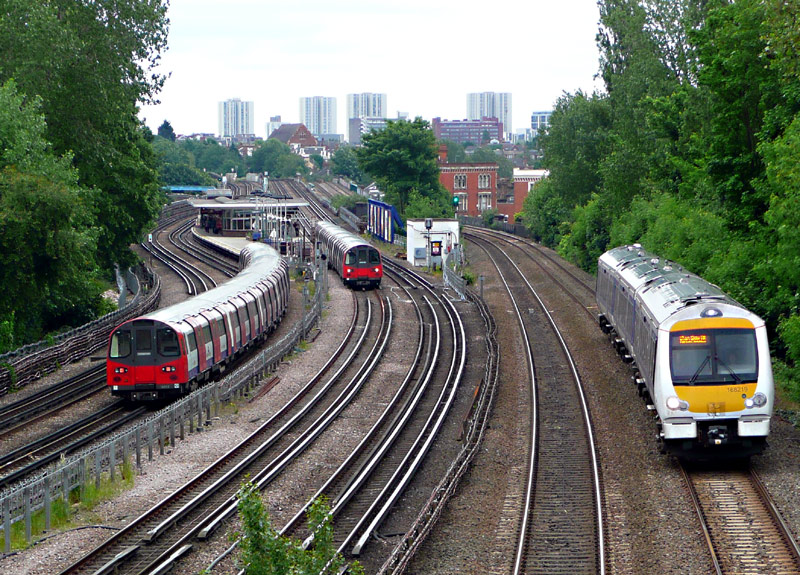
This takes two forms - either track sharing, which is where the different trains use the same tracks or route sharing, which is where the different services travel together side-by-side, but stay on their own tracks.
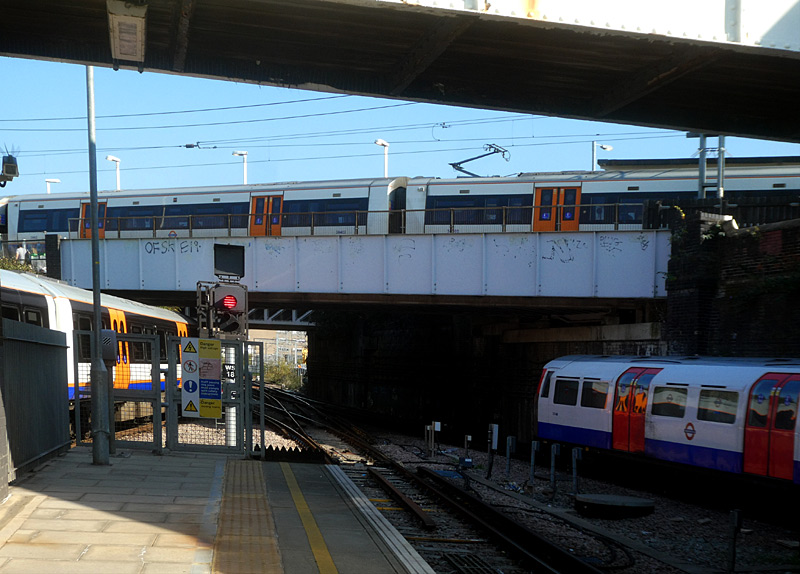
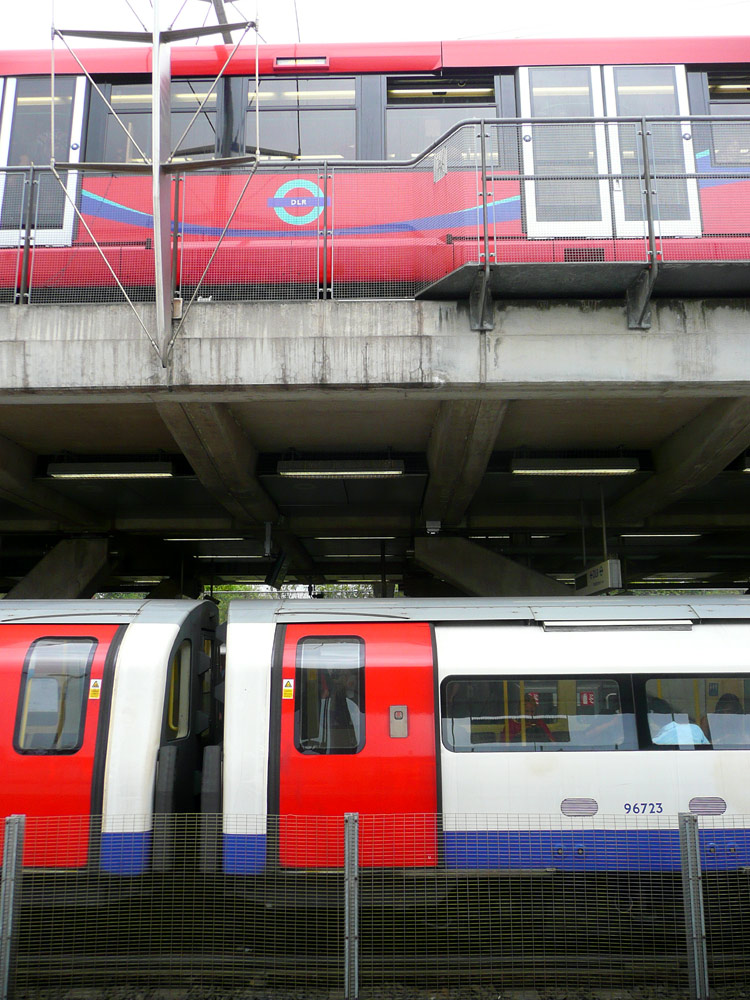
Above them is another Overground train on either the North London line Stratford - Richmond or West London line Clapham Junction - Willesden Junction - Stratford service. (both Mildmay line)
This photograph was taken on the terminus / bay platform, below one of the (several) interchange passageways.
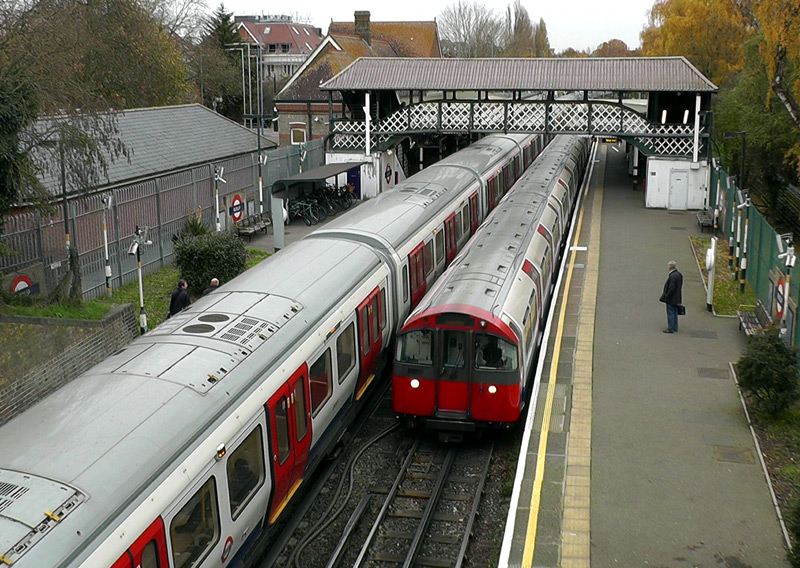
These trains share tracks between Rayners Lane and Uxbridge stations. This route is entirely within zone 6. Ruislip is a Grade ll listed Victorian-era heritage station. Beyond the lattice iron footbridge there are traditional railway style platform canopies.
Track Sharing
- Hammersmith (Met) - Near Aldgate [Circle / Hammersmith & City lines].
- Just east of Baker Street - Near Aldgate [[Hammersmith & City / Metropolitan lines]
- Just east of Baker Street - Aldgate [[Circle / Metropolitan lines]
- Gloucester Road - Tower Hill [Circle / District (main section) lines].
- Paddington (Met) - High Street Kensington [Circle / District (Edgware Road - Wimbledon) lines].
- §Aldgate East - Barking [District / Hammersmith & City lines].
- ‡Harrow-On-The-Hill - Moor Park - Amersham [Chiltern Railways / Metropolitan line].
- *(Barons Court) - Acton Town - Ealing Common [District / Piccadilly lines].
- Rayners Lane - Uxbridge [Metropolitan / Piccadilly line].
- Queens Park - Harrow & Wealdstone [Bakerloo / Euston-Watford (Lioness) lines London Overground].
- Richmond - Gunnersbury [District / North London (Mildmay) lines London Overground].
Especially in the rush hours some Metropolitan line trains travel on the fast tracks and skip Preston Road, Northwick Park and (southbound only - Wembley Park) stations, so journey times will be slightly faster. Nowadays all Metropolitan line trains call at all stations between Harrow-On-The-Hill and Uxbridge.
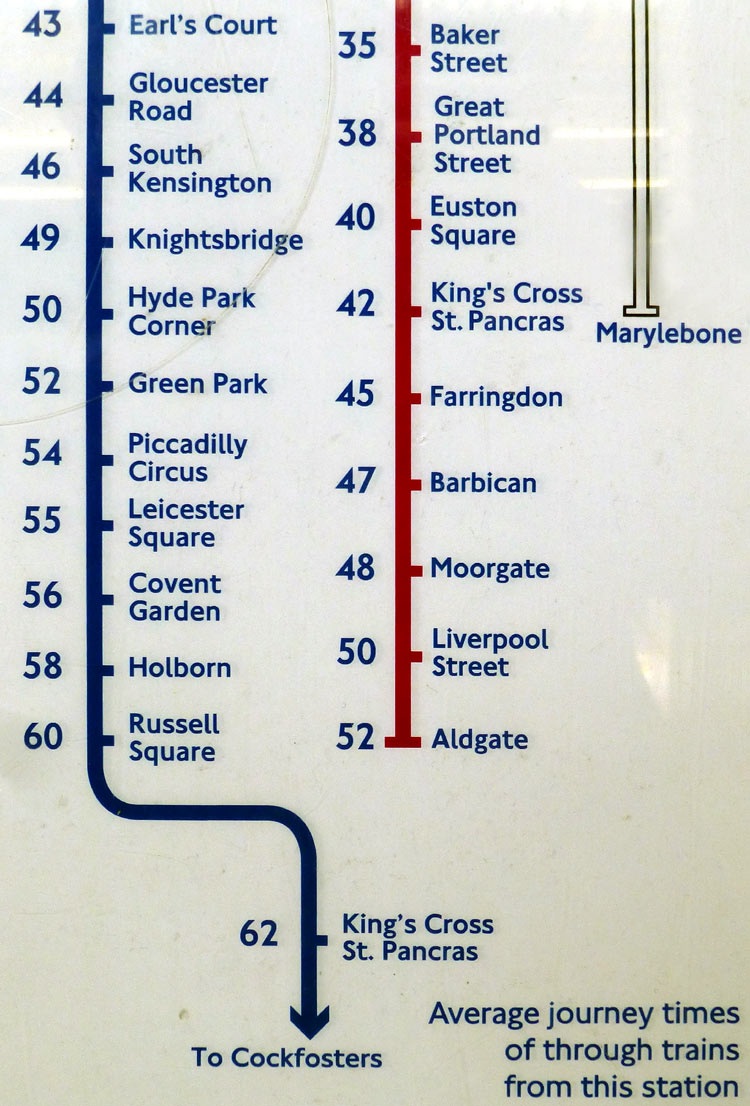
Route Sharing
- Stratford - Canning Town [Jubilee line / Docklands Light Railway].
- Fenchurch Street / Tower Gateway - Limehouse [C2C / Docklands Light Railway].
- §Bromley-By-Bow - Barking - Upminster [C2C / District / Hammersmith & City lines (not Upminster§)].
- Baker Street - Finchley Road - Wembley Park [Metropolitan / Jubilee lines].
- ‡Marylebone / Baker Street - Harrow-On-The-Hill - Moor Park [Chiltern Railways / Metropolitan line].
- Finchley Road - Wembley Park [Chiltern Railways / Jubilee / Metropolitan lines].
- Highbury & Islington - Canonbury [North London / East London lines - London Overground]
- West Ruislip - South Ruislip [Central line / Chiltern Railways].
- *South Kensington - Earls Court - Acton Town [District / Piccadilly lines].
*Piccadilly and District line trains are no longer able to use each other's tracks on the four track section between Barons Court
and Acton Town. This is because the District line (east of Stamford Brook) is being converted to computerised train control signalling.
Even when the trains could use each other's tracks they rarely did so, because some of the stations only have platforms alongside the District line's tracks.
Whilst both lines also follow the same route between Barons Court and South Kensington, they are grade separated
with Piccadilly line trains being deep underground and District line trains being at subsurface level.
§Hammersmith & City line trains do not normally travel between Barking and Upminster.
‡South of Harrow-On-The-Hill all Metropolitan line trains 'route share' with Chiltern Railways trains.
Between Harrow-On-The-Hill and Moor Park
all Metropolitan line trains to Watford plus the semi-fast and 'all stations' trains to Amersham and Chesham 'route share' with Chiltern Railways trains
whilst the 'fast' Amersham and Chesham trains track share with Chiltern trains.
North of Moor Park there are only two tracks and all Metropolitan line
trains track share with the Chiltern Railways trains.
Untill railway closures in the 1960's some of the British Railways trains travelled to Manchester via Leicester, Nottingham and Sheffield.
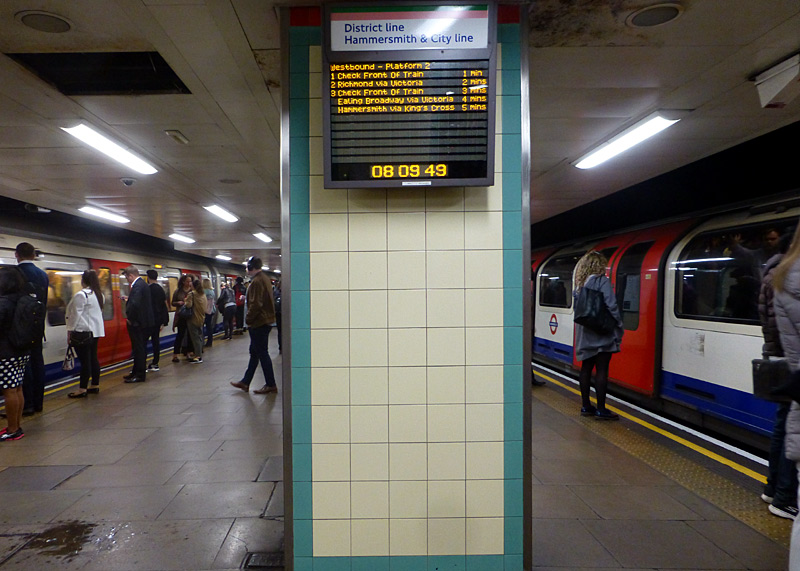
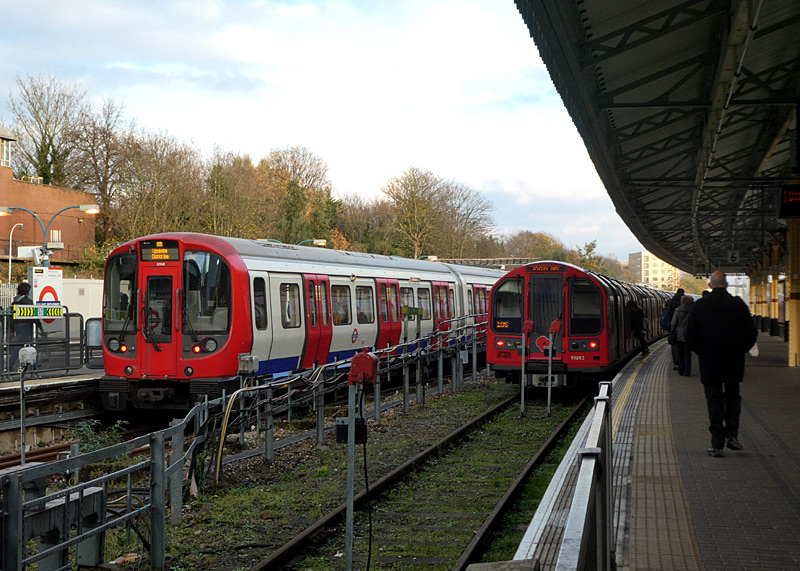
But you must take care to choose the correct train, as at Mile End only some trains actually go to Ealing Broadway.
From Ealing Broadway most of these trains do usually pass through Mile End. Also, the travel times (durations) are different - in this example the Central line will usually offer a quicker journey but especially in hot weather the air-conditioned District line trains will offer a more comfortable journey.
As an aside, there are similar cross-platform options at Stratford, this time between the Central and Elizabeth lines, with the quickest way to Ealing Broadway being on the air-conditioned Elizabeth line trains.
A to B via C or D! - By Train
Sometimes it is possible to make the same journey - starting and ending at stations with the same name and without changing trains - yet travelling via different routes with different intermediate stations and different journey times. Note that sometimes services on one of the route 'pairs' detailed below are infrequent or only possible on weekdays (ie: NOT Saturdays, Sundays or Bank Holidays).
On the Northern line 'CX Branch' refers to trains via Charing Cross.- Victoria - Kings Cross St Pancras [Circle (via Aldgate only as other direction usually requires a change of train) / Victoria lines].
- Kings Cross St Pancras - Euston [Northern (Bank branch) / Victoria lines].
- Warren Street - Euston [Northern (CX branch) / Victoria lines].
- Stockwell - Warren Street / Euston / Kings Cross [Victoria / Northern lines (CX or Bank branches as appropriate)].
- Farringdon - Kings Cross St Pancras [Metropolitan / Hammersmith & City / Circle lines (direct trains only) / Thameslink].
- Kentish Town - Farringdon - Kings Cross St Pancras - Elephant & Castle [Northern line (High Barnet + Bank branches) / Thameslink].
- Kentish Town - Farringdon - Kings Cross St Pancras - London Bridge [Northern line (High Barnet + Bank branches) / Thameslink].
- Mile End - Ealing Broadway [District / Central lines].
- Finsbury Park - Kings Cross St Pancras [Piccadilly / Victoria lines / Great Northern].
- Finsbury Park - Highbury & Islington [Victoria line / Great Northern].
- Finsbury Park - Kings Cross St Pancras - Green Park [Piccadilly / Victoria lines].
- Old Street - Moorgate [Northern line (Bank Branch) / Great Northern].
- Baker Street - Paddington [Bakerloo / Hammersmith & City / Circle lines (only platforms shared with Hammersmith & City line)].
- Baker Street - Waterloo [Bakerloo / Jubilee lines].
- London Bridge - Waterloo [Jubilee line / SouthEastern].
- Charing Cross - Embankment - Waterloo [Bakerloo / Northern lines (CX branch)].
- Liverpool Street - Stratford [Elizabeth / Greater Anglia / Central lines].
- Stratford - Shepherds Bush [Central / North + West London (Mildmay) lines London Overground (through trains take so long that despite the cheaper fare from avoiding Zone 1 this option is best avoided with Oyster PAYG)].
- Stratford - Bond Street [Central / Jubilee / Elizabeth lines].
- Birkbeck - Beckenham Junction [London Tramlink / Southern (infrequent)].
- Canary Wharf - Bond Street [Elizabeth / Jubilee lines].
- Abbey Wood - Farringdon [Elizabeth line / Thameslink].
- Liverpool Street - Tottenham Court Road - Bond Street [Elizabeth / Central lines].
- Whitechapel - Ealing Broadway [Elizabeth line / District line]
- Liverpool Street - Paddington [Elizabeth / Hammersmith & City / Circle lines]
- Liverpool Street - Farringdon (or Barbican* - westbound only) [Elizabeth / Hammersmith & City / Circle / Metropolitan lines]
*Note: There is a direct walking link between the westbound platform at Barbican and the Elizabeth line platforms at Farringdon station.
Because of the longer walking time between the street entrance and the Elizabeth line platforms, Liverpool Street - Barbican / Farringdon will usually be quicker on the older route using the Hammersmith & City / Circle / Metropolitan lines.
A to B via C or D! - With Walking Options
Whilst it is perfectly possible to stay at street level and walk (for free) on the public footpath between several stations (eg: Northen line Tottenham Court Road - Goodge Street - Warren Street) there are also a few station pairs where it is also possible to walk between the two stations whilst staying completely inside the fares paid area - which means that you will also be paying a train fare!
- Bank - Monument: There is no direct train service between this pair of stations. But there are several different walking routes which might include moving walkways and / or escalators.
- Moorgate - Liverpool Street: This journey can be made by train - Hammersmith & City / Circle / Metropolitan lines - or by using several sets of escalators and walking through the tunnel between the Elizabeth line platforms. There is also a direct interchange passageway between the Elizabeth line platforms and the Northern line platforms at Moorgate. This is the ^best^ walking route as it includes walking through some large caverns with high ceilings.
- Farringdon - Barbican (westbound platform): This journey can be made by train - Hammersmith & City / Circle / Metropolitan lines - or by walking through Elizabeth line interchange passageways which link the westbound platform (only) at Barbican station with Farringdon station.
Additional Shared Service Route Information
This section looks at some of the shared service routes in greater detail.
The routes are:
- District and Hammersmith & City lines in east London.
- Fenchurch Street - Upminster (DLR / Underground + C2C) in east London.
- Stratford - Canning Town (Jubilee line / Docklands Light Railway) in east London.
- Metropolitan / Chiltern / Jubilee in North London.
- London Overground (Lioness) and Bakerloo lines in north-west London.
- Piccadilly and District lines in west London.
- District line and North London (Mildmay) lines [London Overground] in south-west London.
Note that to avoid a very large page the shared service routes which include the Circle line are not looked at on this page. Instead they are seen on the pages for the Hammersmith & City, District and Circle lines.

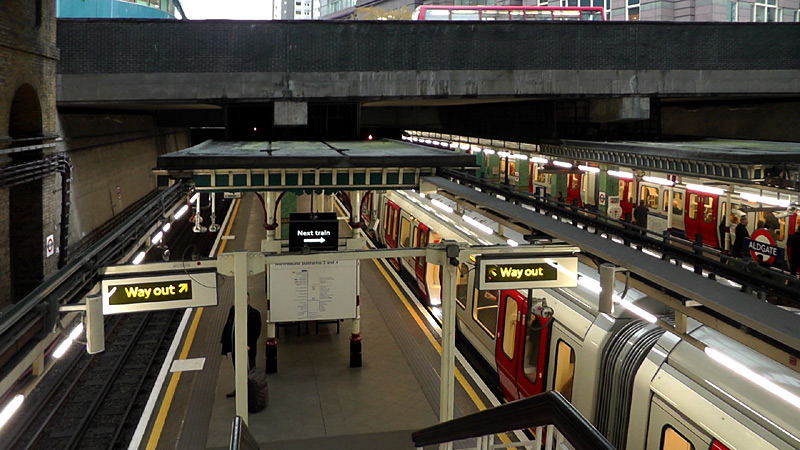
Aldgate is one of only three stations where Circle line trains have their own dedicated tracks and platforms - here they use the outer pair of tracks and Metropolitan line trains use the inner pair of tracks.
District and Hammersmith & City lines
In east London the route from Aldgate East to Barking is used by both District line trains to Upminster and Hammersmith & City line trains to Barking.
The two routes merge / diverge just to the east of Aldgate East station but whilst the junction can be seen from the station platform it is in tunnel and not easy to photograph.
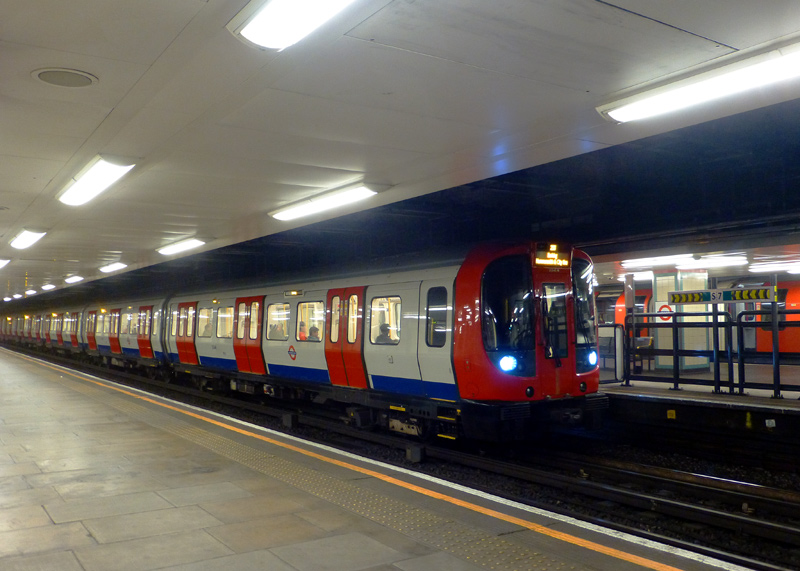
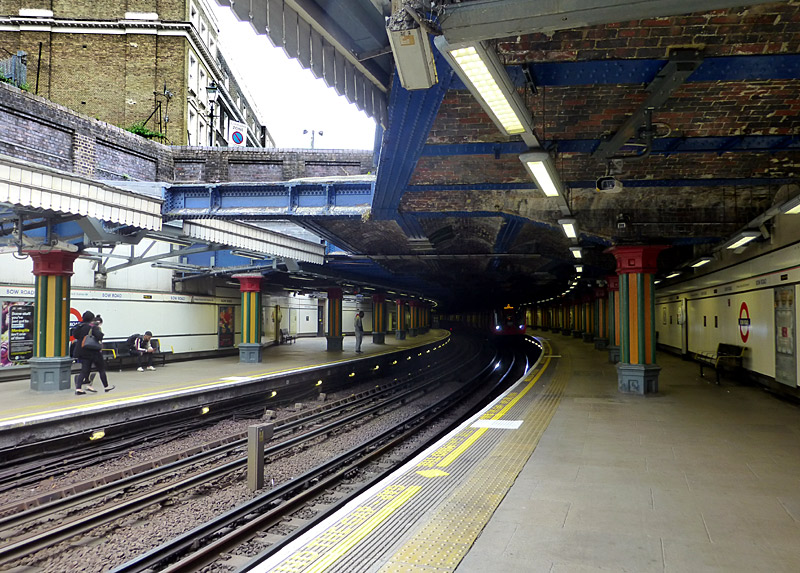
partly underground and partly in open air (in a shallow cutting).
Between Bow Road and Bromley-By-Bow stations the UndergrounD trains join the main line railway from Fenchurch Street station, as seen in the next section.
Fenchurch Street - Upminster
In East London the route from Fenchurch Street to Upminster mostly comprises four (4) tracks with C2C trains using one pair and Underground or DLR trains using the other pair.
Between Fenchurch Street / Tower Gateway and Limehouse the C2C trains travel alongside the DLR. They operate in this formation...
North
C2C   >>>
C2C   <<<
DLR   >>>
DLR   <<<
South
Between Bromley-By-Bow and Upminster the C2C trains travel alongside Underground trains, mostly operating in this formation.
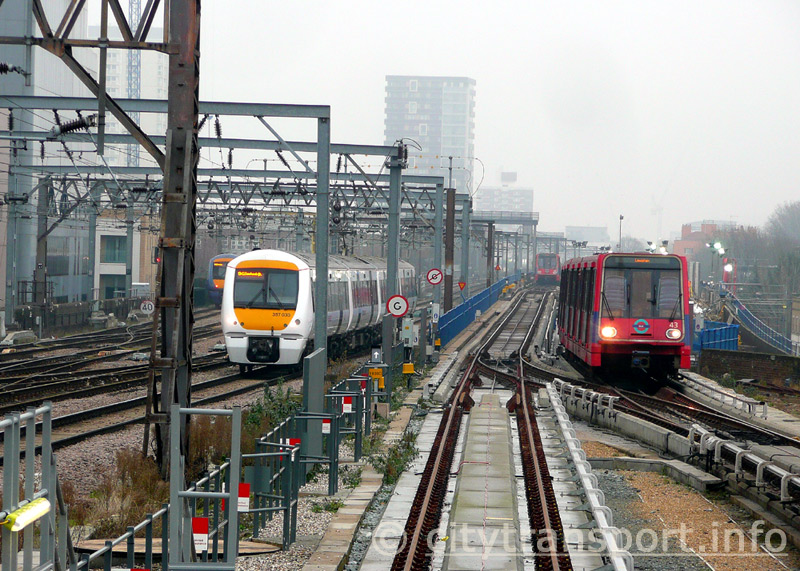
In this cold misty winter morning view looking east from Tower Gateway station we see four trains - two each C2C and DLR.
North
UND   >>>
UND   <<<
C2C    >>>
C2C    <<<
South
This section of four track route-shared railway merges / splits partway between Bromley-By-Bow and Bow Road stations, with Bow Road station being partially in open air / in a shallow cutting.
Between East Ham and Barking the route passes a C2C depot. Underground and eastbound C2C trains pass to the north of the depot whilst westbound C2C trains pass to the south of the depot.
Between Barking and Upney the route passes some District line sidings. C2C and westbound District line trains pass to the south of the sidings whilst eastbound District line trains pass to the north of the sidings.
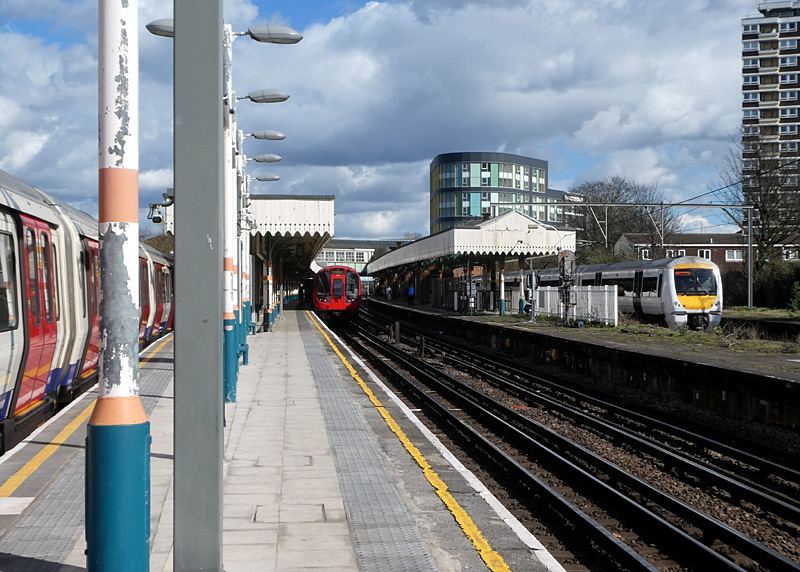
Looking east at Plaistow:
Left: a Hammersmith & City S stock train is at the bay platform.
Ahead: an eastbound S stock train departs.
Right: a westbound C2C class 357 Electrostar glides through,
these trains no longer stop here and nowadays only sections
of platform used by Underground trains remain open.
Until the line into Fenchurch Street was electrified the steam (and diesel) trains sometimes travelled on the same tracks as the Underground trains. Nowadays all trains keep to their own tracks and trains from Fenchurch Street miss out all intermediate stations - except West Ham, Barking and Upminster.
Therefore many (but not all) stations on this route have four platforms, but with two of them not being used anymore. The disused side platforms have either been removed or otherwise made so that they cannot be used. There are also many island platforms where just one side is now in use with physical barriers preventing access to the side that is no longer used. Many of these stations were originally built to accept longer trains than are used on the Underground and therefore most of them have been shortened.
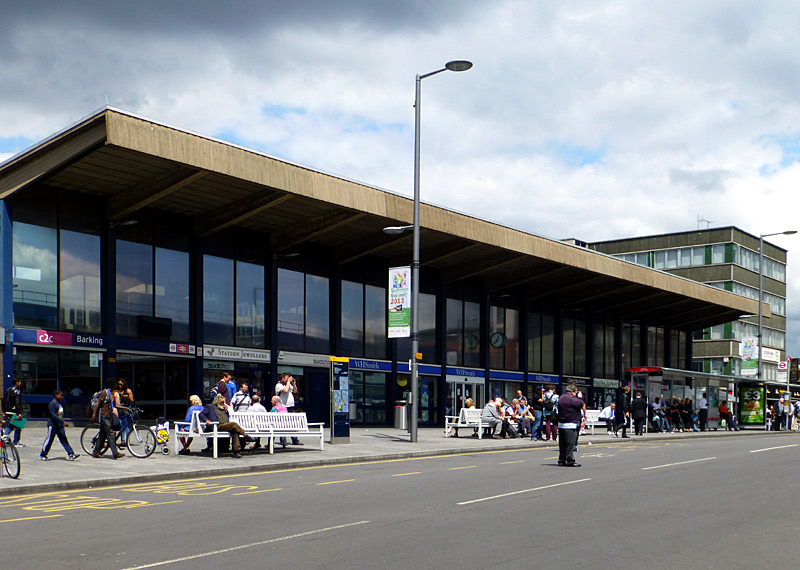
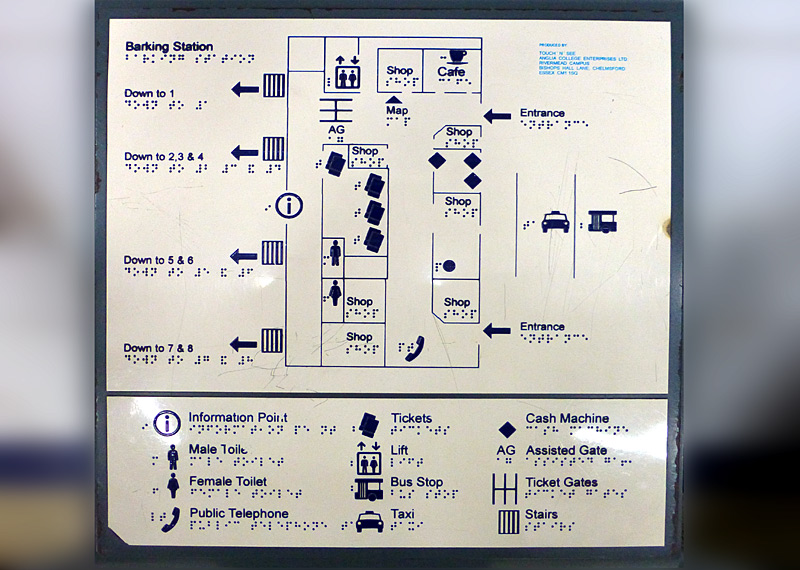
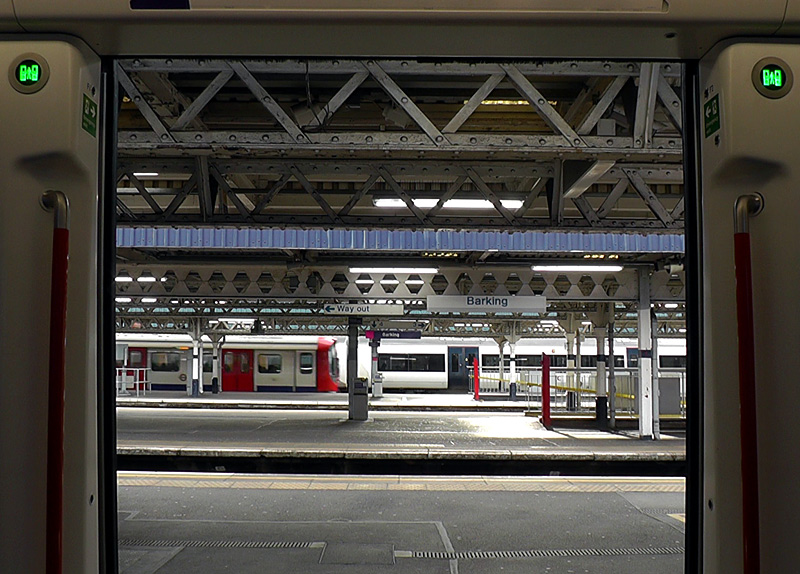
Barking Station
Barking is a large station with a reputation for railway staff who do not welcome railfans and who often go out of their way to stop them taking photographs. But it is still possible - just watch who is around you!
Usually eastbound District line trains travelling towards Dagenham East or Upminster open their doors on both sides (platforms 1a and 2) for cross platform interchange with trains to Shoeburyness or Southend-on-Sea via Upminster on the right (platform 4) and for passengers with special needs to use the accessibility lift on platform 1. This platform is also sometimes used by London Overground trains going to Gospel Oak but since the extension to Barking Riverside opened (in summer 2022) the Overground trains normally use platforms 7 / 8.
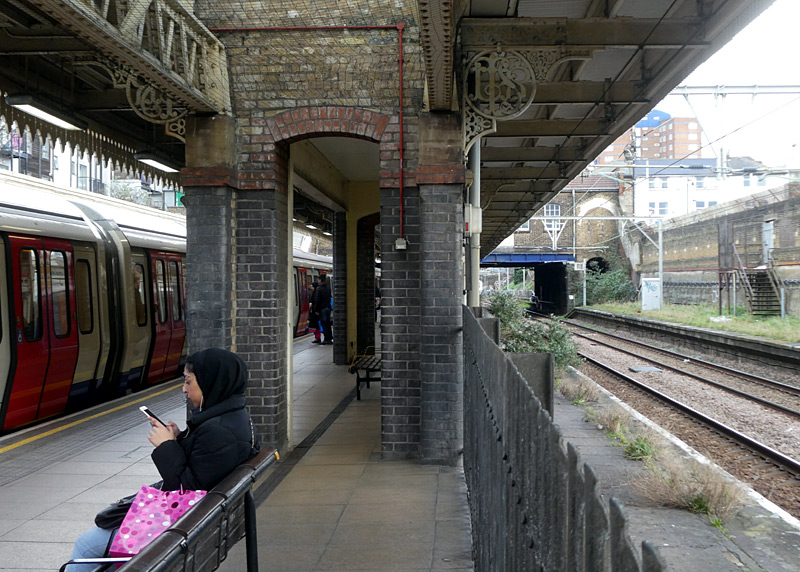
Looking east at Upton Park:
A westbound S Stock train calls at one side of an island platform,
the other side is the former eastbound C2C platform.
On the far right is the disused former westbound C2C platform towards Fenchurch Street station - even the steps
between the ticket hall and the platform have been removed.
The LTSR logo in the platform canopy ironwork is because
this section of railway was built
by the London Tilbury and Southend Railway.
Hammersmith & City and District line trains which end their journey at this station only open their doors alongside platform 2 (which is shared with C2C / platform 4) or use the dedicated bay platform 3, which is also shared with C2C platform 4.
Most westbound Underground trains use platform 6, which has cross-platform interchange with westbound C2C trains from Upminster going towards London Fenchurch Street (platform 5). The exception are the small number of Underground trains which came from central London and ended their journey at bay platform 3.
Platform 7 is used by eastbound C2C trains going to Dagenham Dock, Tilbury etc and London Overground trains going to Barking Riverside. Platform 8 is used by westbound trains from these destinations going to Fenchurch Street or Gospel Oak.
This page in the National Rail website includes much information about Barking station and a map showing the platforms:
http://www.nationalrail.co.uk/stations/BKG/details.html 
Between 1910 and WW2 in 1939 the through Southend Corridor Express trains from Ealing Broadway to the seaside resort of Southend-On-Sea would change between steam and electric locomotives at either Barking or East Ham stations.
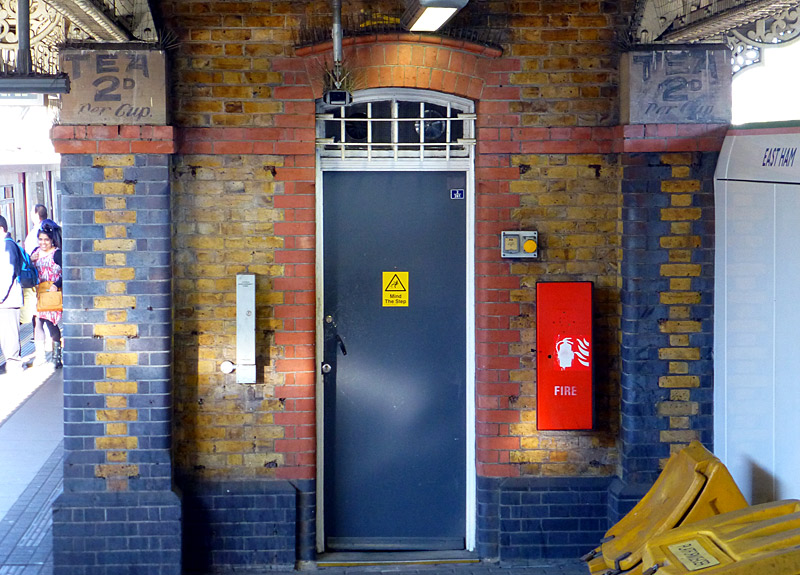
At one time the island platform at East Ham station
had a tea room and seen here on the platform building
are painted signs advertising this. The pre-decimal
price of 2d is about 1p in present-day money. The
disused platform is behind the white wall on the right
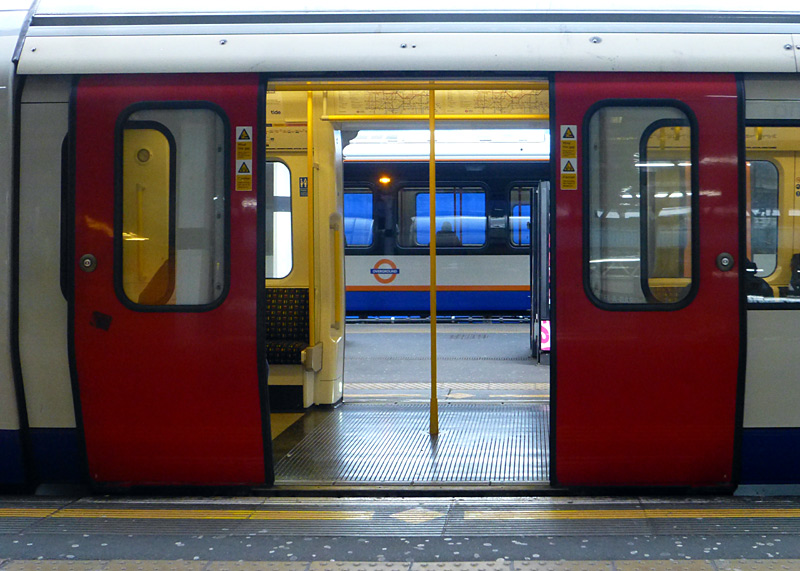
platform 2 with its doors open on both sides, behind it is a
London Overground class 710 train at platform 1.
Barking - Upminster
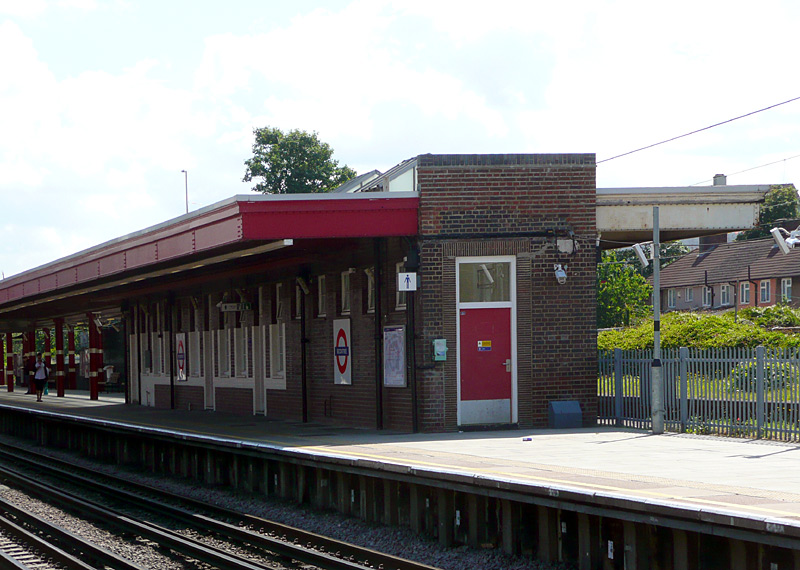
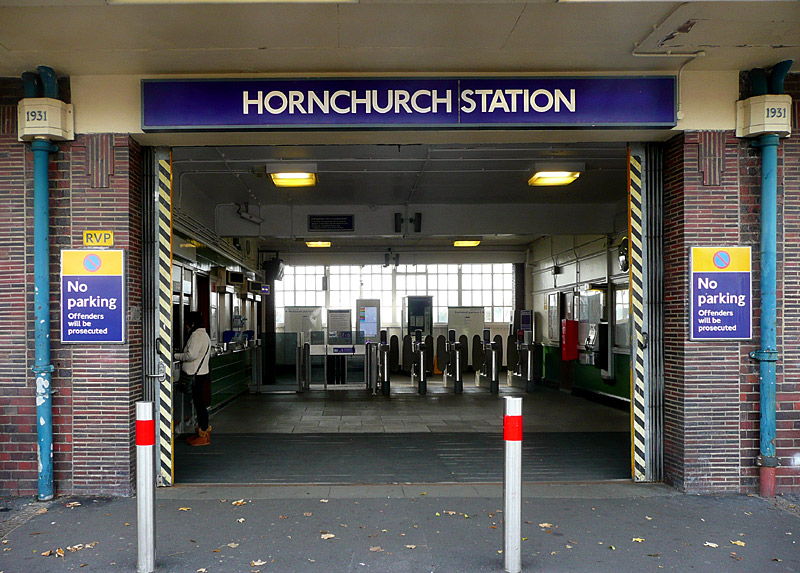
The stations with ramps between the street and platform date from the early 1930s and were built to a very similar architectural style. The stations which once had four platforms are older but were rebuilt in the 1930s to match the new stations.
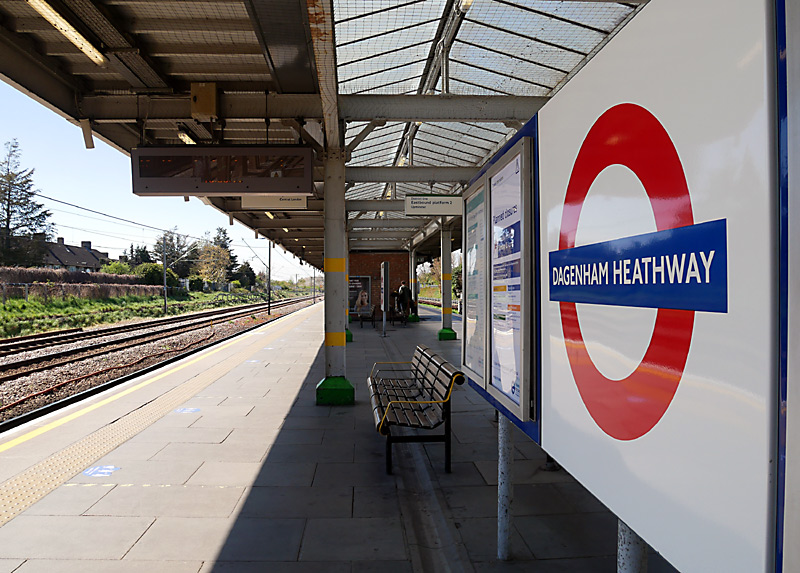
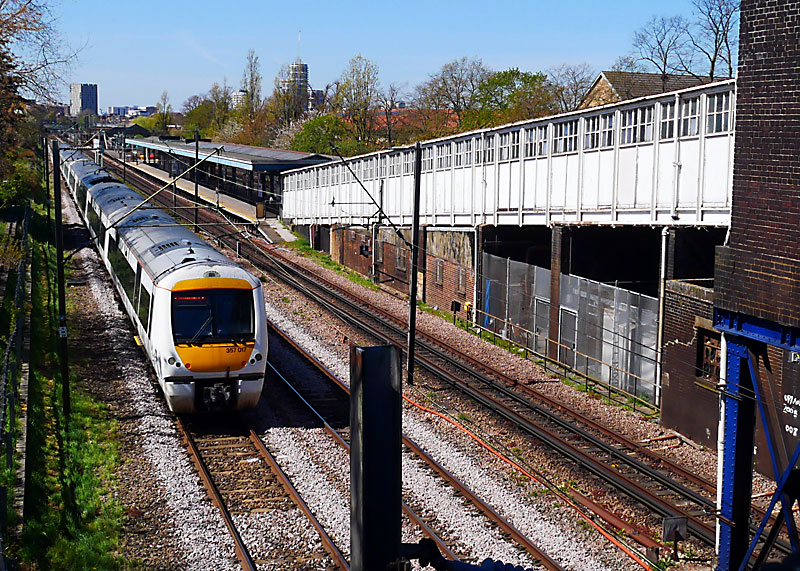
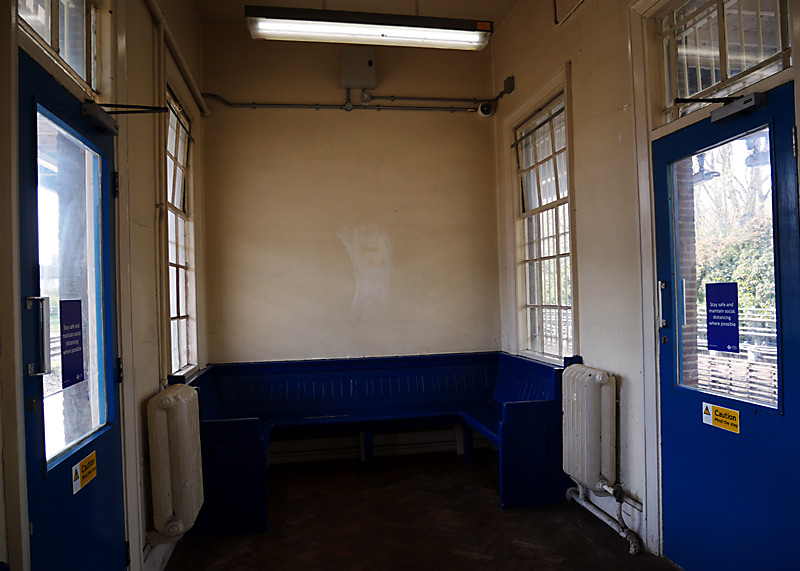 Inside the waiting room at Upney station - with radiators to keep waiting passengers warm in the winter. |
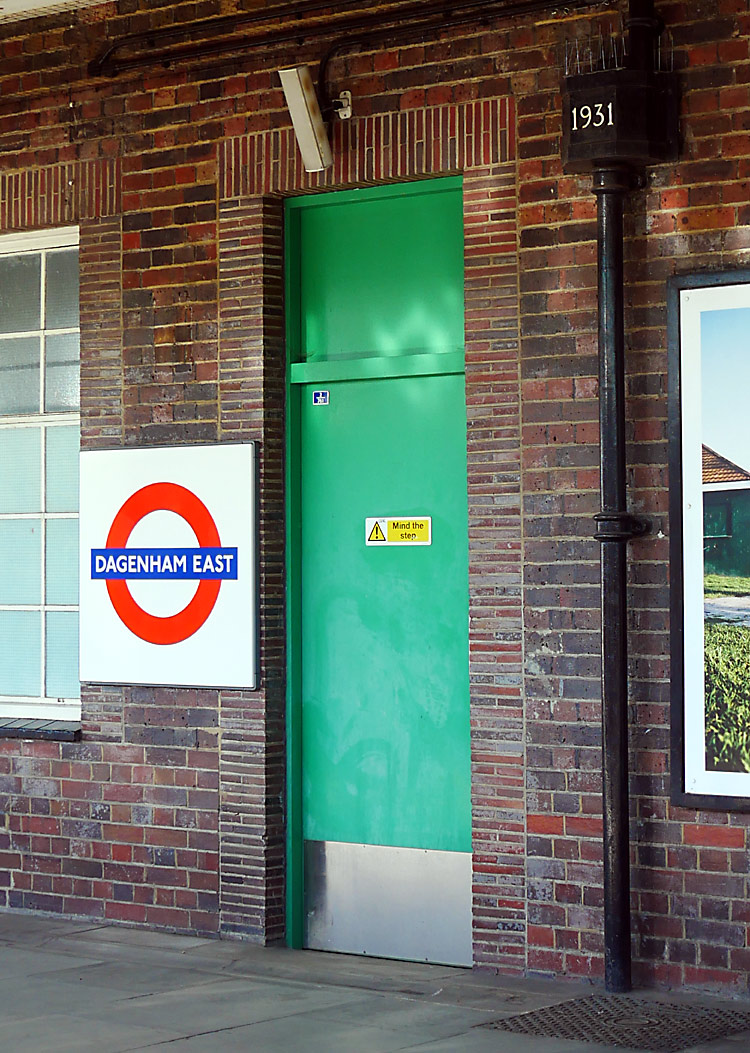 Door brickwork detail at Dagenham East station - this is typical of most stations Upney - Upminster Bridge. |
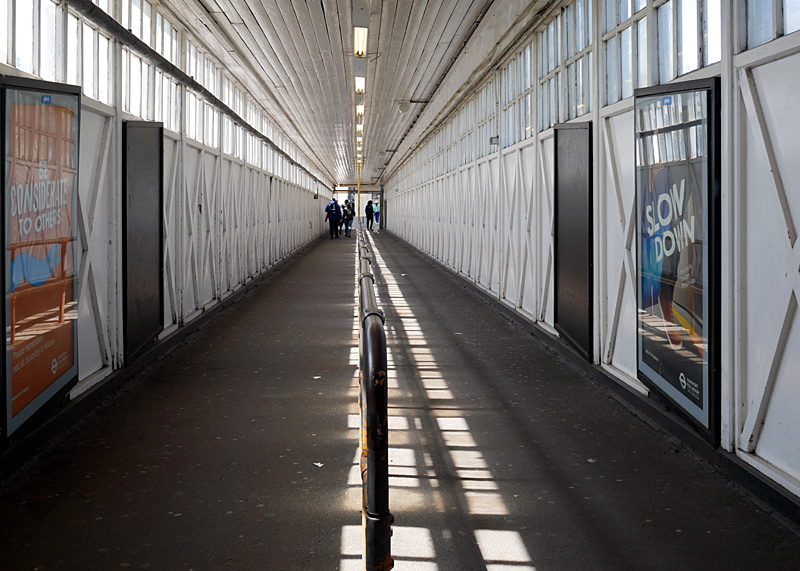 Looking down the ramp at Upney. Although not planned, these ramps make these stations fully accessible between the street and the platform. |

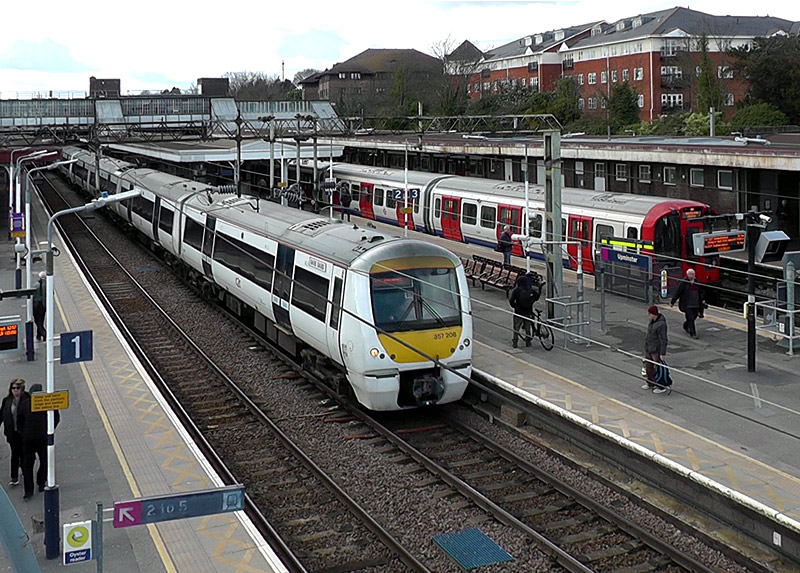
District line trains call at platforms 3, 4, & 5 and
London Overground Liberty line trains to Romford
call at platform 6 (not visible here).
Stratford - Canning Town [Jubilee line / DLR]
This section of route sharing in east London is relatively new, as the DLR service along here only started in 2011. Prior to that the route was shared between North London line and Jubilee line trains, and even earlier than that this section of railway was a busy route used by passenger and freight trains serving London's Docklands.
Along the shared section of railway the Jubilee line serves just three stations (Canning Town, West Ham, Stratford) whilst the DLR trains serve six stations. One of these is called Abbey Road, if you are a music fan and want to see the zebra crossing made famous by the Beatles pop group then you must go to St Johns Wood station on the Jubilee line, and NOT this station.
An excellent photo location is the Stephenson Road bridge over the railway near to Star Lane DLR station. The link below leads to a Google map showing this location.
https://maps.google.co.uk/maps?hl=en&ll=51.521789,0.005053&spn=0.002911,0.006899&t=m&z=17
West
Jubilee       >>>
Jubilee       <<<
DLR            >>>
DLR            <<<
East
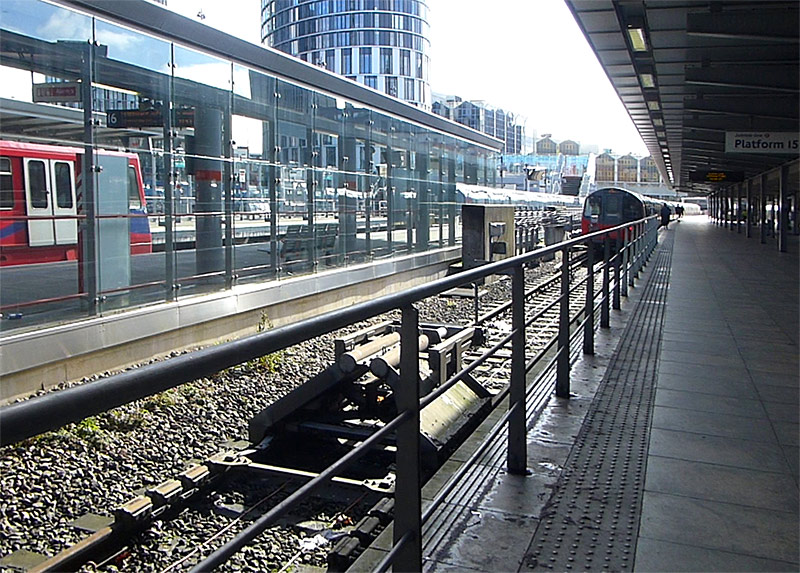
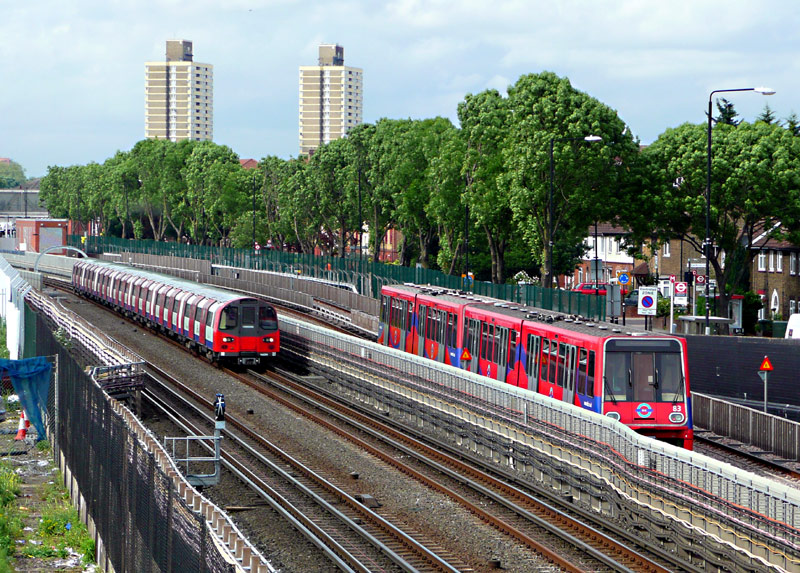
trains pass between West Ham and Star Lane stations.
Canning Town is a busy interchange station with six platforms for trains plus an adjacent bus station.
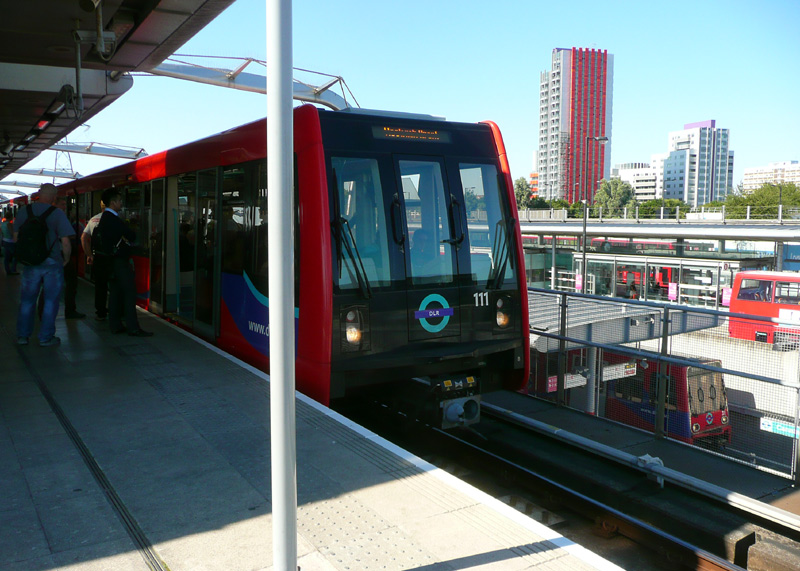
At this station DLR trains on east-west services to / from Bank or Tower Gateway stations call at platforms 3 & 4 which are above the Jubilee line trains (which call at platforms 5 & 6) whilst north-south DLR trains travelling to / from Stratford International station call at platforms 1 & 2 which are located at ground level between the westbound Jubilee line tracks and the bus station.
Choosing the correct platforms is easy for most destinations, except for DLR trains to Woolwich Arsenal via London City Airport as these depart from both platforms 1 and 3. DLR trains to Beckton mostly also depart from platform 3 but when the shortage of trains has been resolved they will also depart from platform 1 (if they came from Stratford International) or platform 2 (if they reversed their direction of travel here).
 |
 |
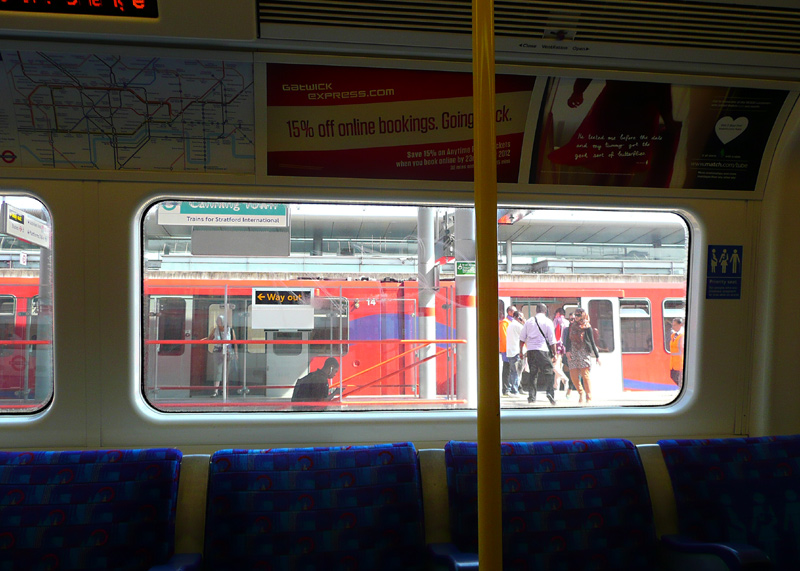 |
Centre: The view from platform 2: a Jubilee line train at platform 5 and a DLR train at platform 3
Right: The view from inside a Jubilee line train calling at platform 5: a DLR train calling at platform 1.
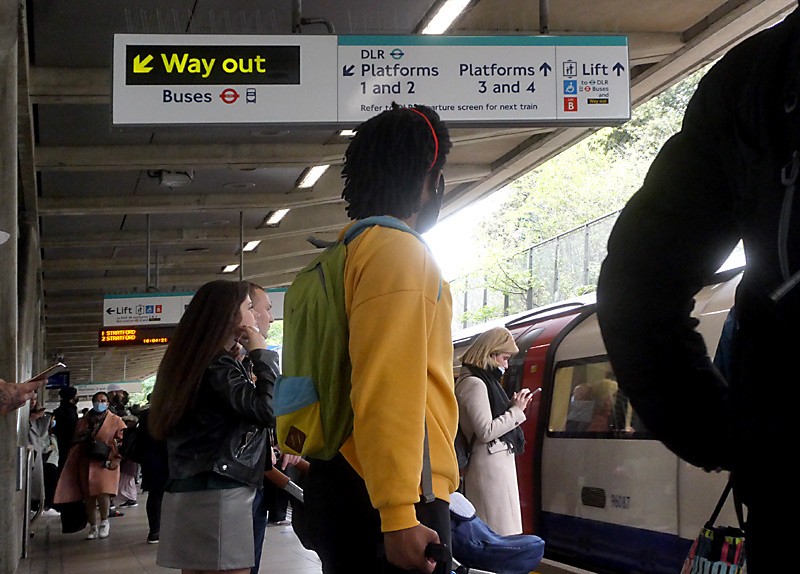 |
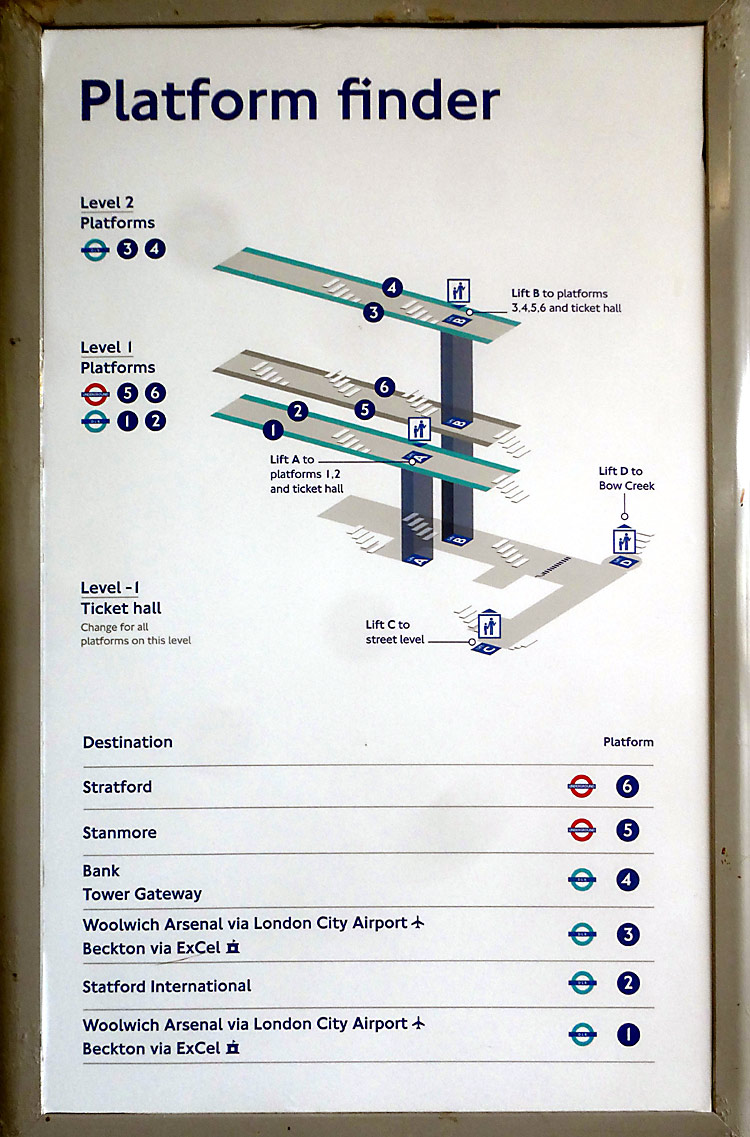 |
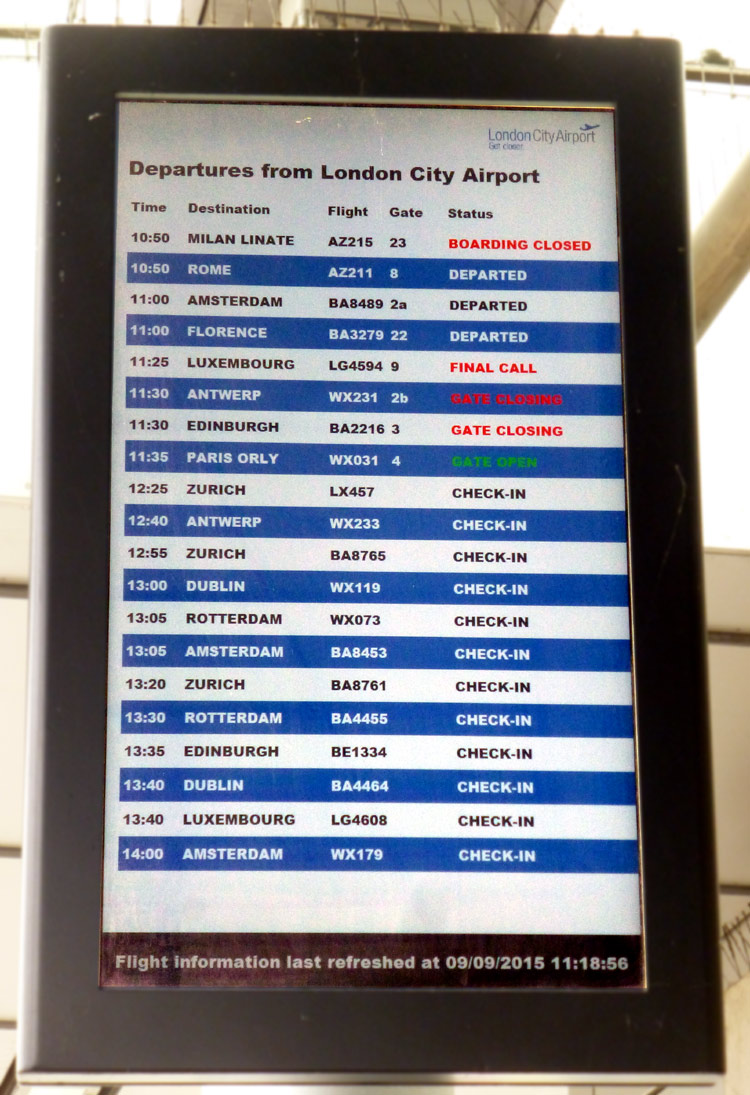 |
Centre: Some passengers find Canning Town station somewhat confusing; to help them there is this way-finding sign
Right: London City Airport (LCY) flight departure information on platforms 3 &4.
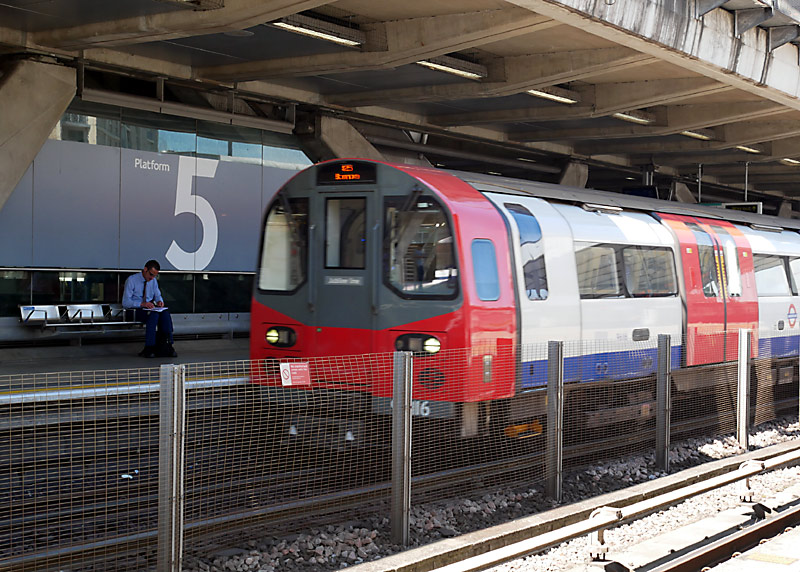
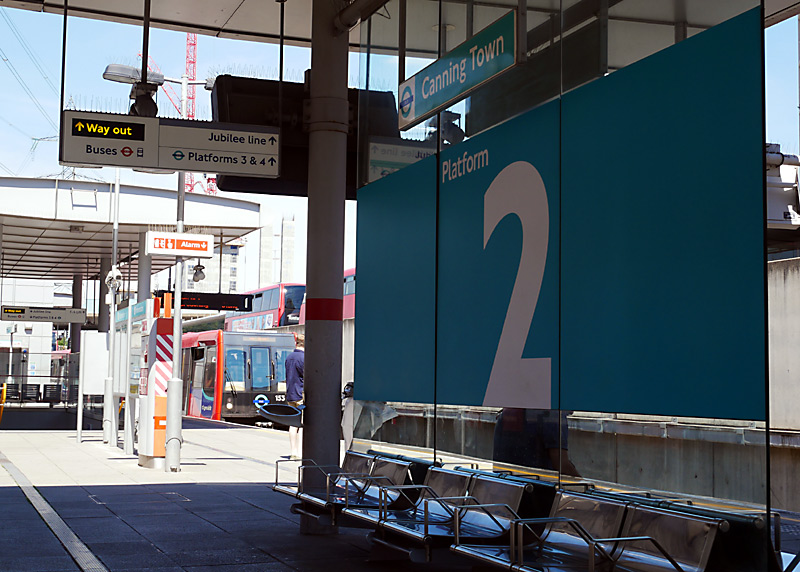
Note that the high level platforms at Canning Town station are very exposed - they are windswept and despite the platform canopy when it rains passengers need to stand well back from the platform edge to avoid becoming soaked. In the winter these platforms are also very, very cold!
London Overground Euston - Watford (Lioness line) and Bakerloo line
Located between Queens Park and Harrow & Wealdstone in north London this is part of route that is mostly located alongside the London - Glasgow West Coast Main Line (WCML). The entire route has six [6] tracks - or more!
Travelling on a Bakerloo line train north of Queens Park is very much recommended. Immediately to the north of this station through trains travel inside the depot trainshed (IMPORTANT: you *must* be on a Bakerloo line train, and not an Overground train) then the tracks merge and the Underground and Overground trains provide a shared service.
Since the Bakerloo line uses small profile ‘tube’ trains and the Overground uses ‘main line railway’ trains and the two types of train have very different internal floor heights relative to the tracks so there are also large height differences between the train floors and the station platforms - you must step up to board an Overground train, and down to board a Bakerloo line train.
At many stations you can also see many types of train passing by, including Avanti West Coast Pendolino tilting trains going to Manchester, Liverpool and Glasgow, ‘outer suburban’ London Northwestern Railway trains going to Northampton and Birmingham, Southern trains which travel to south London (Clapham Junction, Croydon) - and of course freight trains.
The location which I've used to see the passing trains that is closest to Central London is near to Kensal Green station. On leaving the station turn left. The view looking down is more 'reasonable' than 'perfect'.
Harlesden is not a nice part of London and the few times I've used that station for trainspotting I have stood at the end of the platform that is away from the exit to the street.
Close to Willesden Junction there are some sidings and depots where a constantly changing selection of mainline rolling stock can often be seen. Also here is a London Overground depot.
There is a Bakerloo line depot just to the north of Stonebridge Park station, part of it can be seen at the northern (Harrow) end of the northbound platform but it is better to travel on a train and look at it whilst passing by, as then you also pass some mainline railway sidings and depots where all sorts of InterCity and other rolling stock can sometimes be seen.
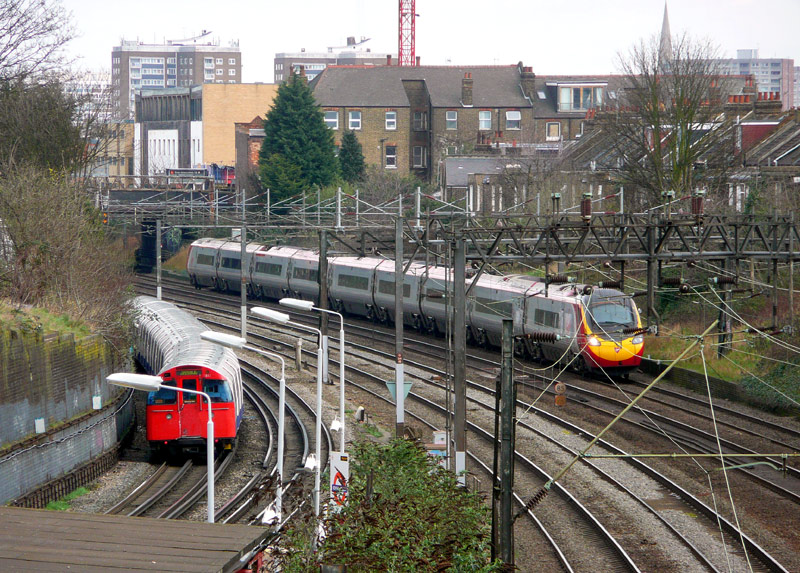
A telephoto view looking down upon Kensal Green station
with Bakerloo line and Virgin Pendolino InterCity trains visible.
Sometimes I have been able to film Overground and Underground trains ‘side by side’ as they pass each other at Stonebridge Park and North Wembley stations. I can not guarantee that you will see this. At North Wembley I normally stand at the southern (London) end of the northbound platform, as it is away from the exit to the street and offers better views of the WCML tracks. If the trains pass in the station platform then photographers will find that the direction of the sun is not a problem.
 A film which I took in 2010 and have placed on YouTube includes footage from North Wembley station showing an Underground and an Overground train passing each other.
Also seen is a 'race' between an Underground train and a container (freight) train, plus a passing class 390 Virgin Pendolino tilting train.
A film which I took in 2010 and have placed on YouTube includes footage from North Wembley station showing an Underground and an Overground train passing each other.
Also seen is a 'race' between an Underground train and a container (freight) train, plus a passing class 390 Virgin Pendolino tilting train.
This can be seen by clicking either the projector icon or this link:-
http://www.youtube.com/watch?v=-emj8ybZd38
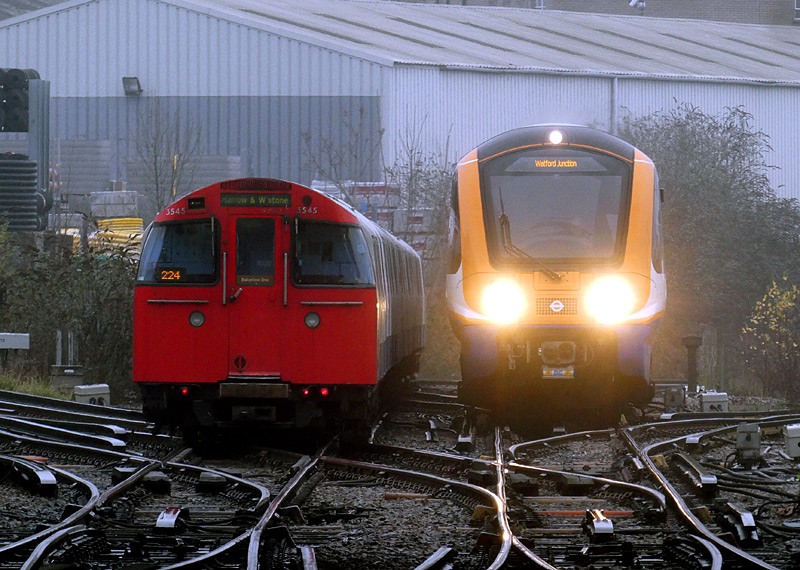
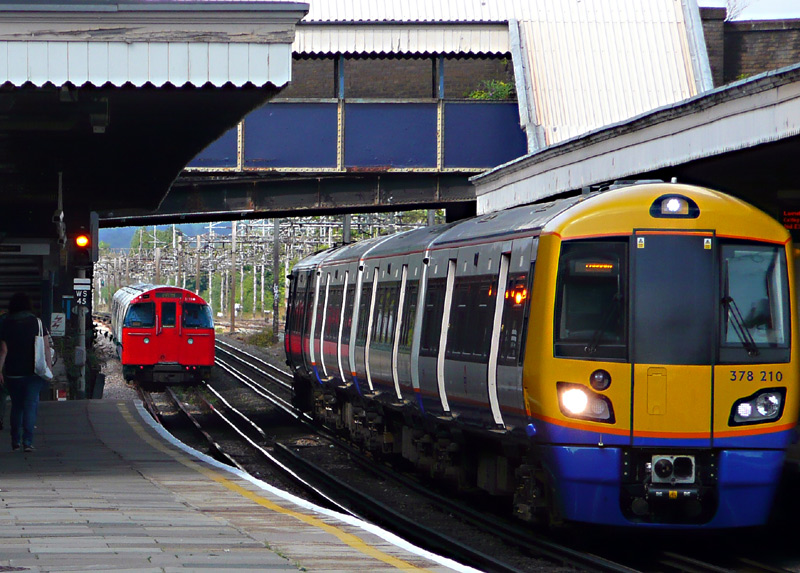
Many people like to watch trains at South Kenton station, as you are right next to the WCML. The best views are at the London (south) end of the platform, but in sunny weather this is also the direction of the sun. Therefore I normally go there before 11am (11:00) or after 2pm (14:00).
Metropolitan / Jubilee / Chiltern
Located between Finchley Road and Amersham stations this route through north London variously features either two, four or six tracks and therefore is looked at in several sections.
Finchley Road - Wembley Park
All Metropolitan and Jubilee line trains stop at Finchley Road.
All Jubilee line trains stop at Wembley Park.
Most Metropolitan line trains also stop at Wembley Park, except some southbound trains in the morning rush hour.
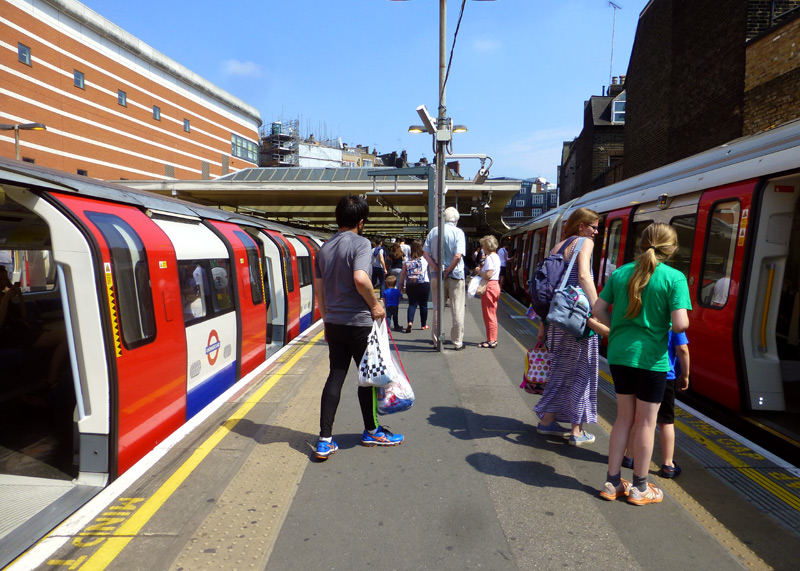
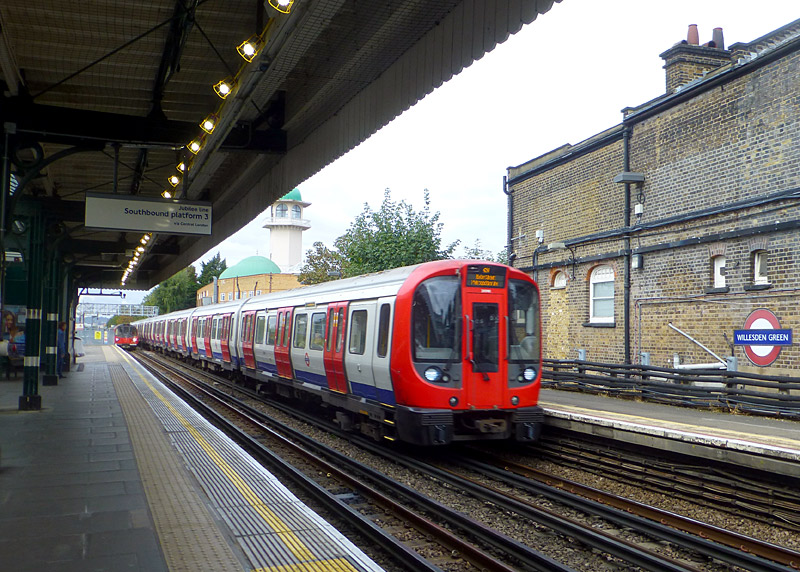
Between Finchley Road and Wembley Park Jubilee line trains call at all stations whilst Metropolitan line trains usually travel non-stop.
Neasden and Willesden Green stations
also have platforms for Metropolitan line trains, however nowadays they are only normally used when Jubilee line services are not working.
Chiltern trains have exclusive use of a dedicated pair of tracks which extend all the way from London Marylebone to Harrow-On-The-Hill and do not call at any intermediate stations.
West
Chiltern           >>>
Chiltern           <<<
Metropolitan   >>>
Jubilee            >>>
Jubilee            <<<
Metropolitan   <<<
East
I often stand at the southern end of West Hampstead station, as there is a frequent procession of Jubilee and Metropolitan line trains to see, plus Chiltern trains travelling to and from Marylebone. This includes the Chiltern trains which at Neasden diverge and head towards Birmingham via West Ruislip and High Wycombe.
Two excellent photo locations which are on road bridges over the railway are at Mapesbury Road and Lydford Road between Willesden Green and Kilburn stations. The link below leads to a Google map showing their locations.
https://maps.google.co.uk/maps?hl=en&ll=51.547403,-0.213118&spn=0.011636,0.027595&t=m&z=15
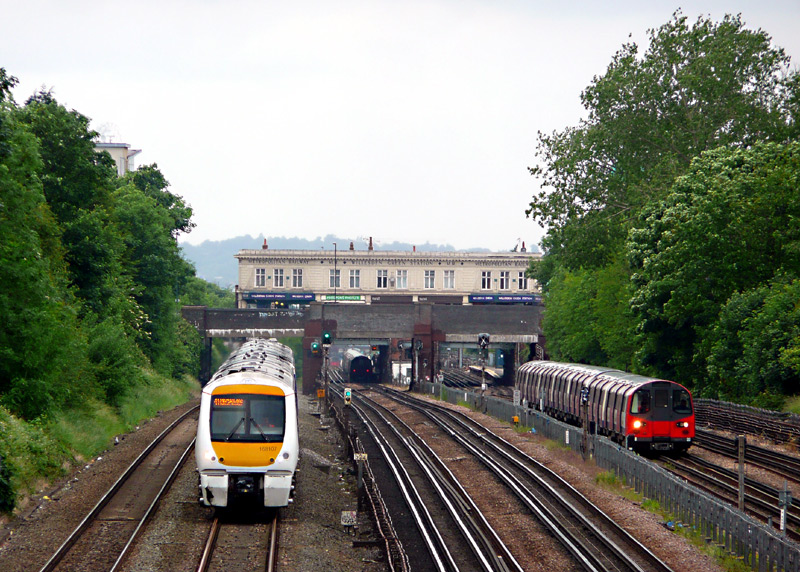
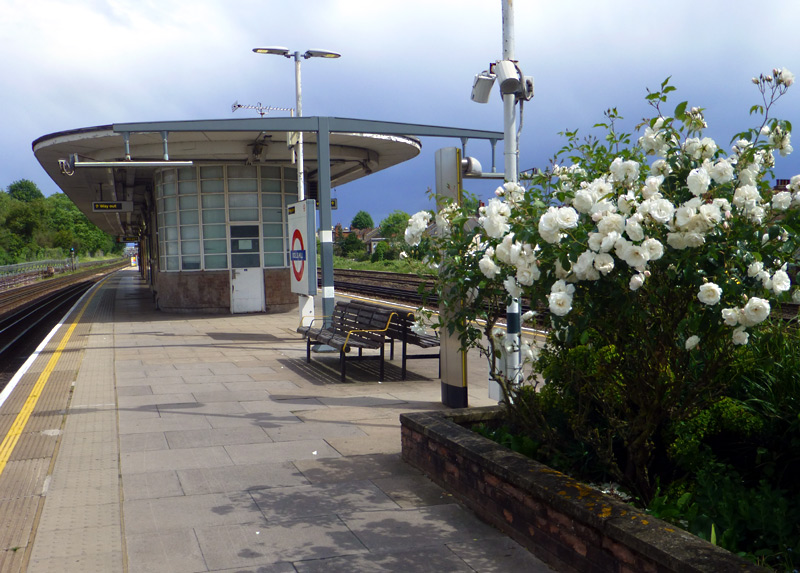
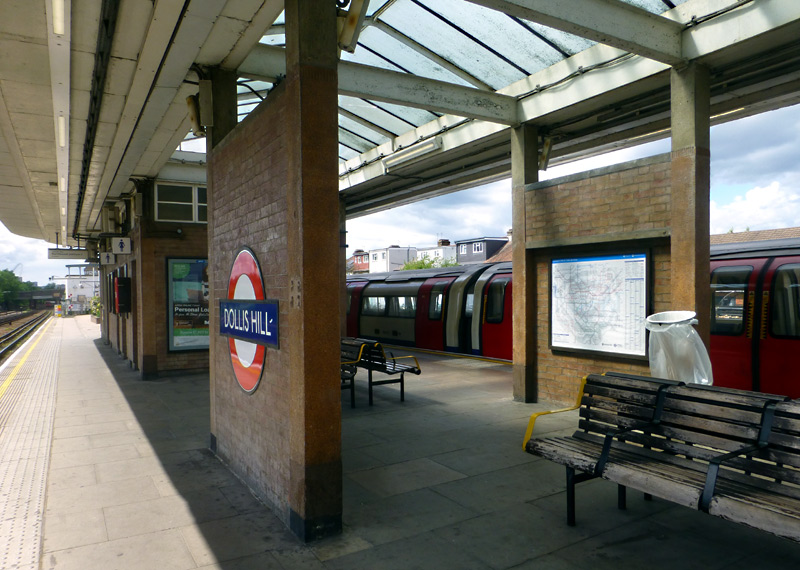
The platform buildings include a waiting room and toilets.
Several species of colourful flowers can be seen in the flower beds - the view on the left shows white roses in full bloom.
The platform offers excellent views of the varied types of diesel powered trains operated by Chiltern Railways, plus of course Metropolitan line trains.
However when trying to photograph the passing trains the very frequent Jubilee line trains sometimes 'get in the way'!
At Wembley Park the Jubilee line turns towards Stanmore and the Metropolitan line splits into four tracks.
Wembley Park - Harrow-On-The-Hill
Between Wembley Park and Harrow-On-The-Hill the Metropolitan line consists of four tracks (fast and slow / all stations) with the tracks used by Chiltern's trains located alongside. This track layout was designed in the days when trains from Marylebone went all the way to Manchester via Leicester, Nottingham, Sheffield and the Woodhead mountain pass.
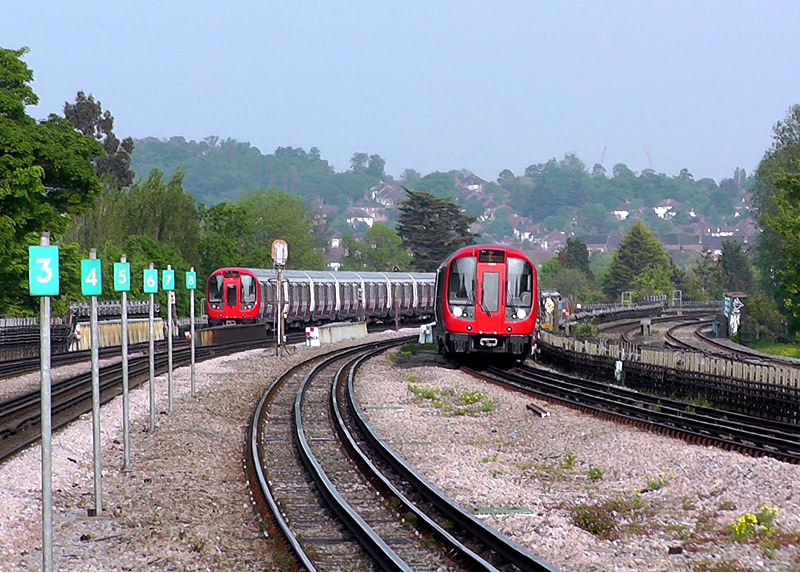
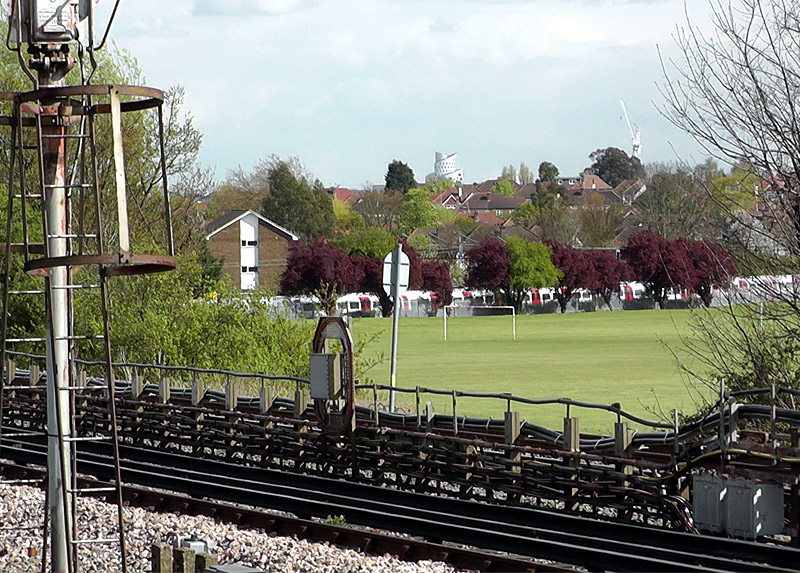
The local tracks for trains that call at this station are in the middle.
On he far right are the unelectrified tracks used by
diesel trains operated by Chiltern Railway.
the West Coast Main Line (WCML).
This image shows a 1972 Mk2ts train on the Bakerloo line,
below is a list of some of the other types of trains that
might also be seen here.
From the island platform at Northwick Park it is possible to see a very wide of trains using the West Coast Main Line
- Goods / freight / container / other non-passenger,
- Avanti West Coast,
- London Northwestern Railway (sometimes in West Midlands Railway livery),
- Southern,
- London Overground (Lioness line).
- London Underground (Bakerloo line).
Harrow-On-The-Hill has six platforms. Chiltern Railways trains to Aylesbury use platform 1 whilst trains to Marylebone use platform 2.
Fast Metropolitan line trains to Amersham and Chesham usually use either platforms 1 or 3 whilst slow (all stations) trains can only use platform 3.
Watford trains usually use platform 3 and Uxbridge trains usually use platform 4.
Platforms 5 & 6 are used by Metropolitan line trains going to Baker Street / Moorgate / Aldgate, typically platform 5 is for slow (all stations) trains and platform 6 for fast (ie: next station Wembley Park
[except morning rush hours] and Finchley Road) trains.
Worth noting is that although the tracks through platform 2 are electrified the power supply rails end just to the south of the station; therefore it is normally only used by the diesel Chiltern Railways services.
This page in the National Rail website includes much information about Harrow-On-The-Hill station and a map showing the platforms:
http://www.nationalrail.co.uk/stations/HOH/details.html
West
Chiltern                         >>>
Chiltern                         <<<
Met Fast + Semi-Fast  >>>
Metropolitan Slow       >>>
Metropolitan Slow       <<<
Met Fast + Semi-Fast  <<<
East

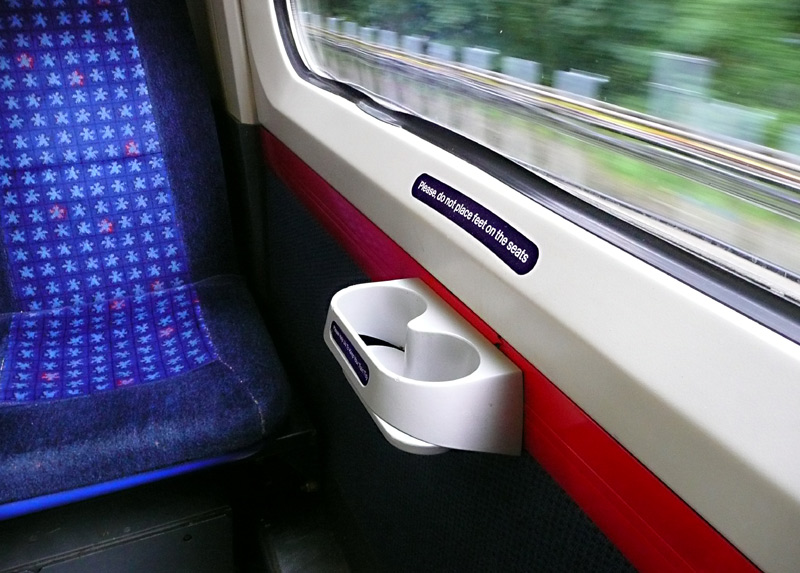
Harrow On The Hill station's platform No.2.
for part of its route on Metropolitan line tracks.
These trains also have toilets and depending on the type
of rolling stock they may have tables as well.
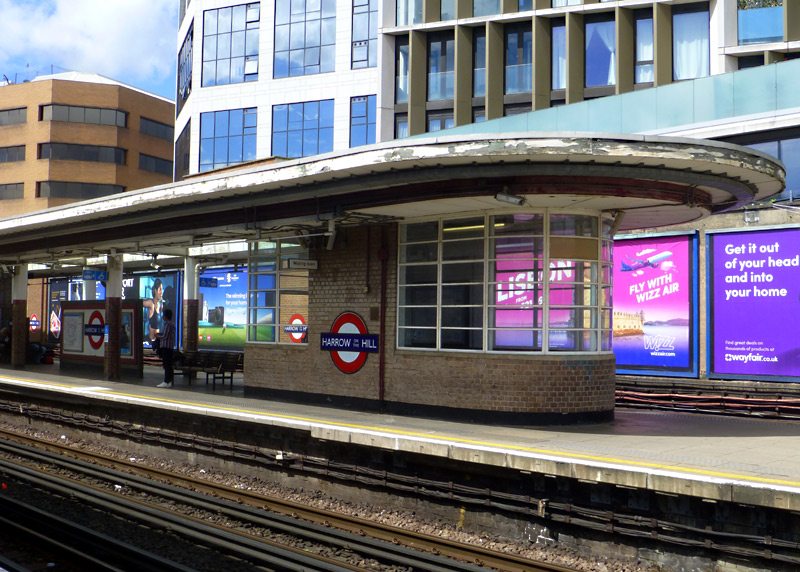
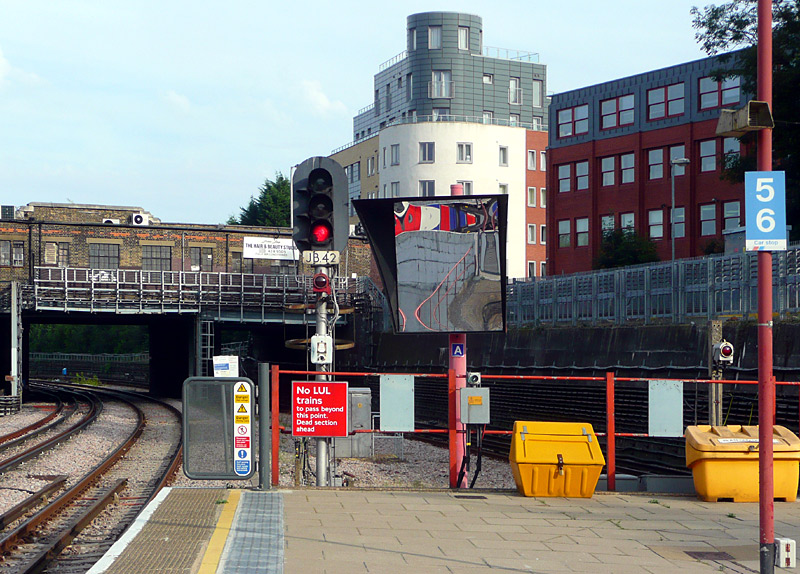
These platforms are used by Matropolitan line trains travelling
towards London Baker Street and sometimes also Aldgate stations.
train travels via this route and becomes stranded beyond the end
of the power supply rails.
Harrow-On-The-Hill - Moor Park - Amersham
Between Harrow-On-The-Hill and Moor Park there are four tracks - two are used by Chiltern Railways and fast / semi-fast Metropolitan line services and two are used by all stations Metropolitan line services. Trains travelling to Watford can only travel on the 'all stations' tracks.
North of Moor Park the fast tracks lead to Rickmansworth whilst the all stations / slow tracks split into two pair, one of which merges with the fast tracks and the other diverges towards Watford.
Between Rickmansworth and Amersham there are just two tracks which are used by both Metropolitan line and Chiltern Railways trains.
West
Met Fast + Chiltern   >>>
Met Fast + Chiltern   <<<
Met All Stations         >>>
Met All Stations         <<<
East
The direct route between Croxley and Rickmansworth is not normally used by trains carrying passengers.
Ticketing Advice
Note that going to Moor Park and further north requires a Travelcard which is valid in zones 7, 8, 9. These are very expensive!
One alternative solution would be to use PAYG and be careful to not spend too long inside the fares paid area. Some ticket machines also sell platform tickets, which cost £1. If buying a platform ticket remember to touch in/out with your Oyster or contactless card.
Passengers with BritRail / Eurail Passes or an All Line Rover can use these at Harrow-On-The-Hill and all stations Rickmansworth - Amersham. To avoid possible complications it is best to travel on Chiltern Railways trains from Marylebone station, and NOT Metropolitan line trains.
Most of the photographs seen on this website were taken when I had one-day Travelcards for zones 2-9 which did not include zone 1, however these tickets are no longer sold - which is a shame, as the 1-9 version costs more than 3x the price of the former 2-9 one-day ticket.
These videos (filmed around 1992-4) on youtube will be of related interest...
Trains at Willesden Green - filmed in the 1990's shows Metropolitan line, Jubilee line and British Railways trains.
http://www.youtube.com/watch?v=SLZ9W_wqhwU
South of Wembley Park
http://youtube.com/watch?v=sFd_7gewfGE
Metroland Racing
http://youtube.com/watch?v=Qj5MNlCl2L4
Metropolitan / Piccadilly lines
Located entirely within zone 6, this section of track sharing is between Rayners Lane and Uxbridge stations and the route has just two tracks - except at Uxbridge station where there are three tracks.
Only some Piccadilly line trains travel all the way to Uxbridge - some finish their journeys at the art deco Rayners Line station.
Passengers who are using Rayners Lane station as a convenient interchange location between Metropolitan line stations West Harrow - Harrow-On-
The-Hill (etc.,) and Piccadilly line stations South Harrow - Sudbury Hill (etc.,)
and who are paying their fares in PAYG mode or with Travelcard season ticket that does NOT include Zone 1 should use the pink Oyster / Contactless 'Route Validator' card readers on the platforms as a way to ensure that they
are charged the correct fare for their journey.
District / Piccadilly lines
Located in west London this route variously features either two or four tracks.
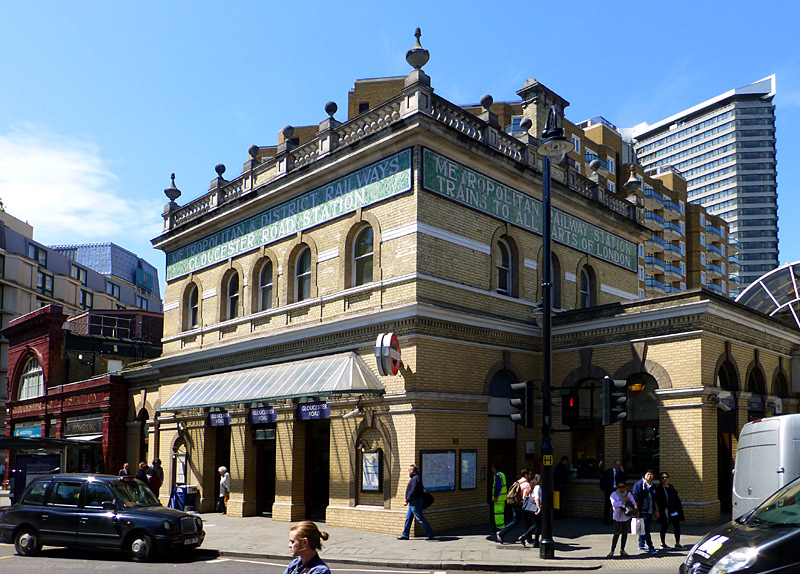
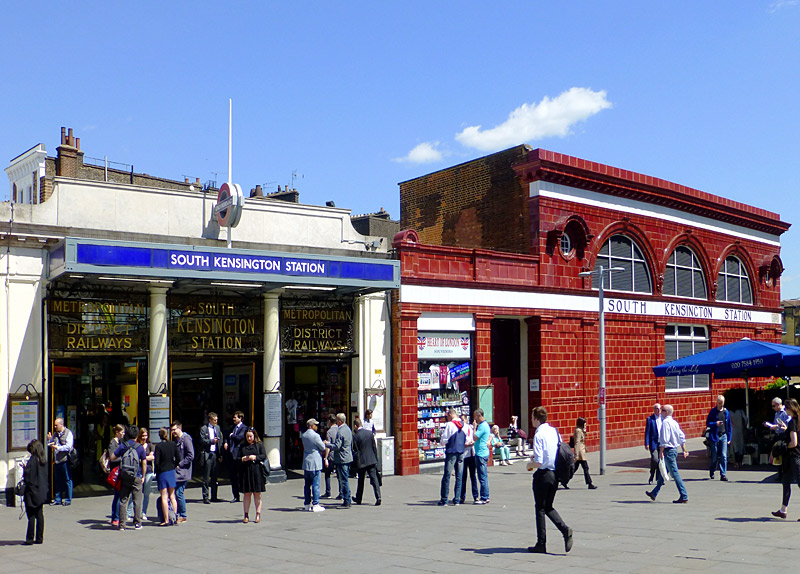
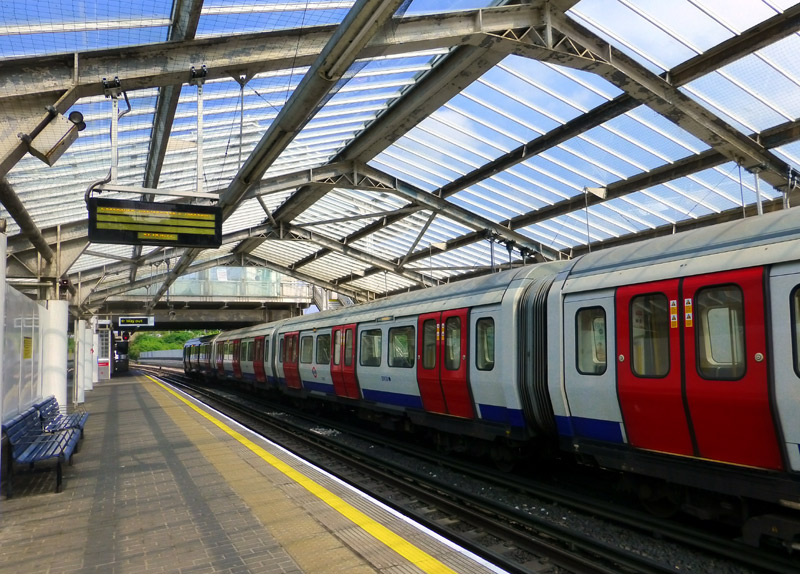
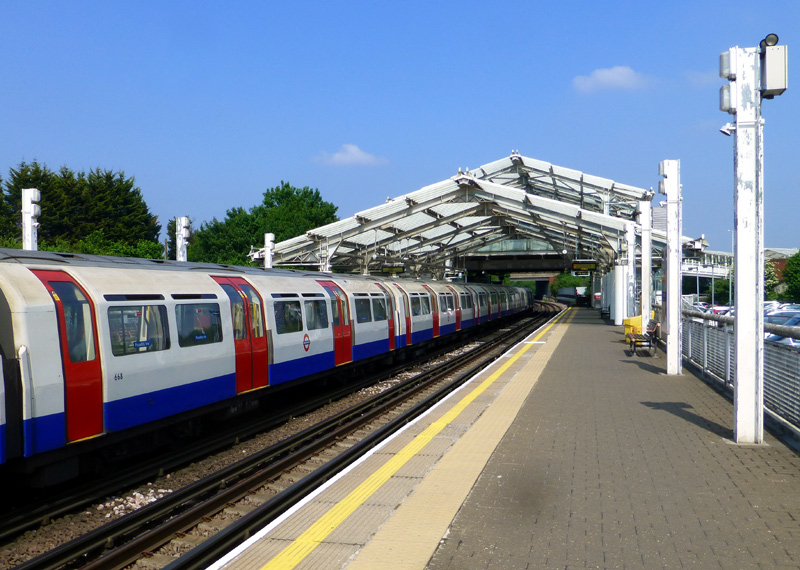
Between South Kensington and Barons Court the small profile Piccadilly line tube trains are deep underground, whilst the large profile District line subsurface trains are either on the surface or just below it.
On the four track section between Barons Court and Acton Town most Piccadilly line trains travel between Hammersmith and Acton Town without stopping
North
District      >>>
Piccadilly  >>>
Piccadilly  <<<
District      <<<
South
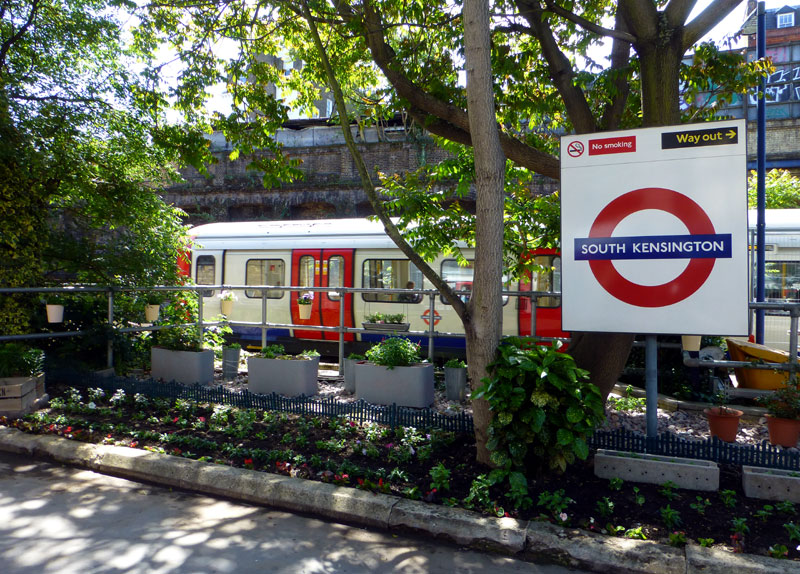
Part of a former Metropolitan Railway trackbed at
South Kensington station has become a small garden.
The District and Circle lines portions of South Kensington and Gloucester Road stations both opened in 1868, albeit a few months apart. This was in the steam train era. The parts of these stations which we nowadays know as the Piccadilly line opened in 1906.
In 1907 South Kensington station was rebuilt in its present-day format whereby the station entrance is via a small arcade of retail shops with decorative metal scrollwork at each end. In those days the station was served by both the Metropolitan and District Railways, hence their names on the metal scrollwork. A distinctive feature at this station is the subterranean footpath which links it with several of the visitor attractions in the area, including the Natural History, Victoria & Albert and Science museums.
Before the building of the Piccadilly line there was a plan by the District Railway to build an express tube line between South Kensington and Mansion House, with just one intermediate station at what nowadays is called Embankment. Whilst this never came to pass an extra deep level platform intended for westbound trains was built - and still exists today, albeit not where passengers can see it - plus with future junctions in mind part of the Piccadilly line tunnels were built to an enlarged diameter - this can be seen, if you know what to look for.

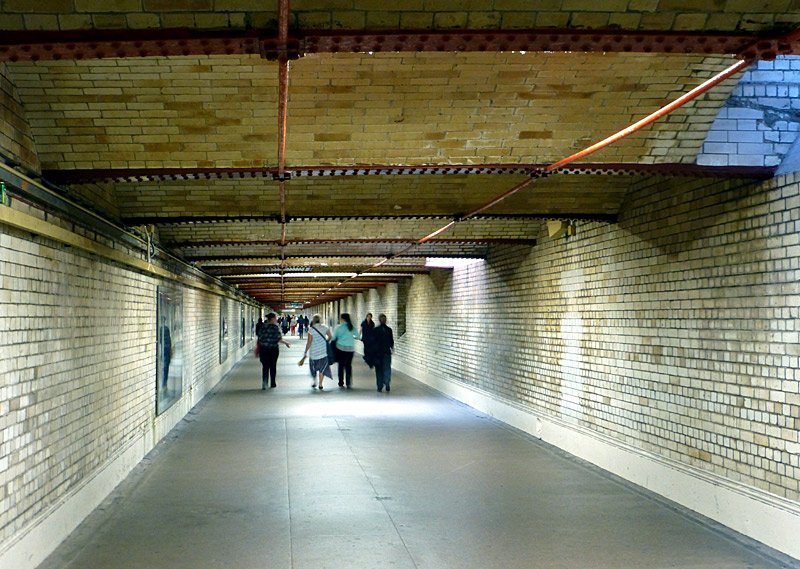
traffic-free footpath is located below Exhibition Road.
Using this footpath is free of charge.
There are two Underground stations at Hammersmith. The District and Piccadilly lines use the station which has been modernised and included as part of a shopping centre whilst the Hammersmith & City and Circle line trains use the former Metropolitan Railway station which is a short walk away and remains largely as built in 1868.
The shopping centre now surrounding Hammersmith station (District and Piccadilly) includes a very pleasant all-day pub with plenty of seating for tired railfans and a good choice of beers, with a nice atmosphere.
During the day Piccadilly line trains normally also pass through Turnham Green station without stopping, however a few Piccadilly line trains do call here very early in the morning and late in the evening.
The railway between Richmond and Addison Road station (nowadays known as Kensington Olympia) was built by the London & South West Railway (LSWR) and as part of expansion plans the District Railway was allowed to run its trains over this line as far as Richmond, which is a service that still exists today. Further extensions saw District Railway trains reach Acton Town and beyond. The agreement also included the LSWR having the right to run its trains over tracks owned by the District Railway to High Street Kensington, but they never actually got around to doing this.
For many years the LSWR route between Addison Road and Richmond was also used by trains operated by the Great Western Railway (GWR) and the Metropolitan Railway (MR). This resulted in the section between Hammersmith and Turnham Green becoming so heavily used that the LSWR built another pair of tracks to the north of the existing tracks. However, the District Railway service followed the most direct route to central London and hence was the most successful. Eventually the GWR, MR and LSWR services were withdrawn with the newer pair of tracks becoming disused.
In the late 1920s advantage was taken of a government guaranteed loan scheme (designed to reduce unemployment) to raise finance to convert the entire 4½ mile section of railway between Hammersmith and Northfields to four tracks, and to extend what nowadays we call Piccadilly line trains to Hounslow and South Harrow. It was also decided to rearrange the tracks to the format we know today and that the Piccadilly like trains would run non-stop between Hammersmith & Acton Town stations. This required a new eastbound platform for District line trains at Stamford Brook station and complete rebuilding of Chiswick Park station with new platforms for District line trains. As a result of these works there are island platforms at Ravenscourt Court Park and Stamford Brook stations which are only used on one side.
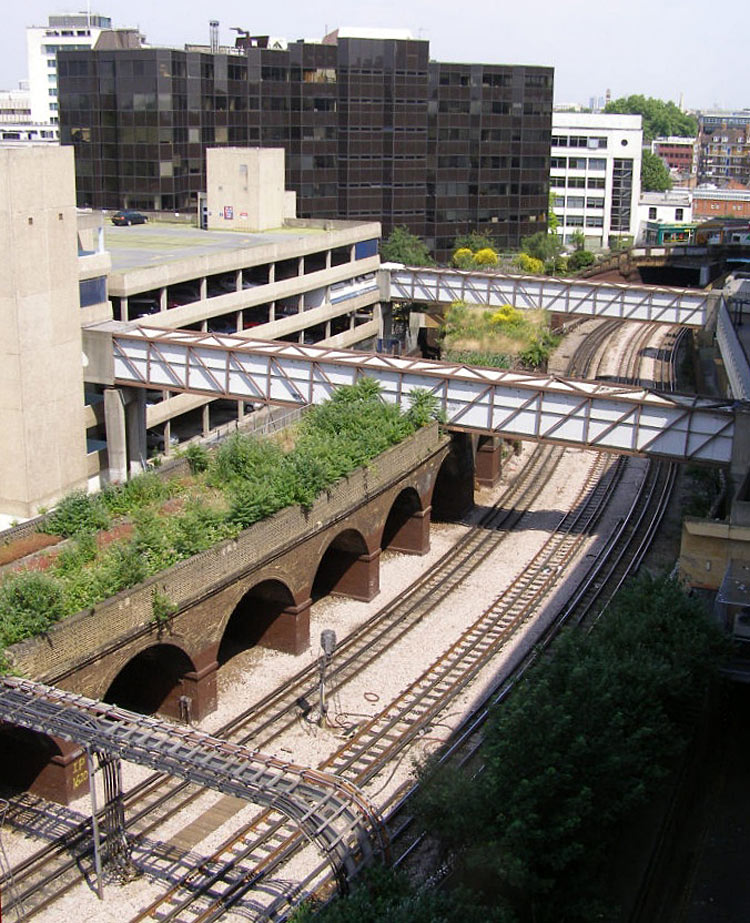
The remains of the LSWR viaduct in Hammersmith.
Image & license: Chillysnow / Wikipedia encyclopædia. CC BY-SA 3.0 https://commons.wikimedia.org/wiki/
File:Ravenscourt_Park_tube_station_approach_to_Hammersmith.jpg
In addition, following complaints by local people Piccadilly line trains will start calling at Turnham Green 'at all times'. It is not yet known whether this will apply to only some Piccadilly line trains - or all of them. It is said that despite calling at an extra station the greater performance (acceleration, etc) of the planned new trains will mean that overall journey times will not be any longer.
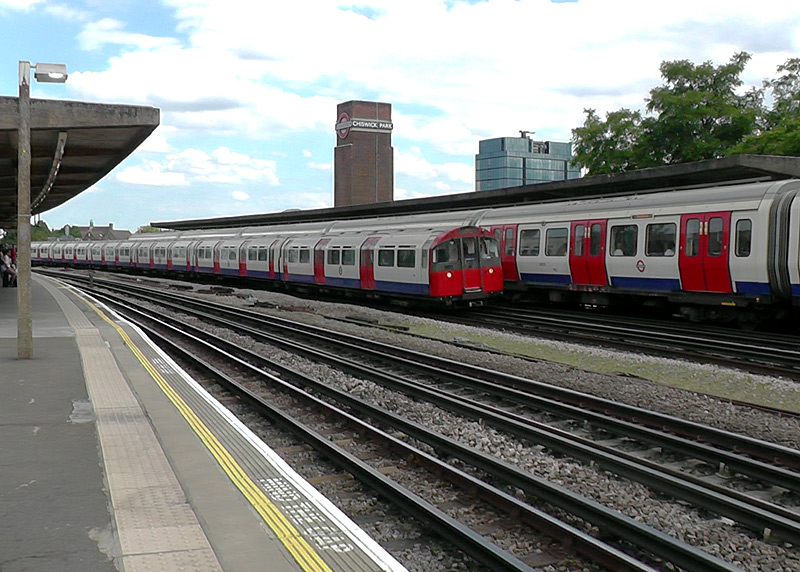
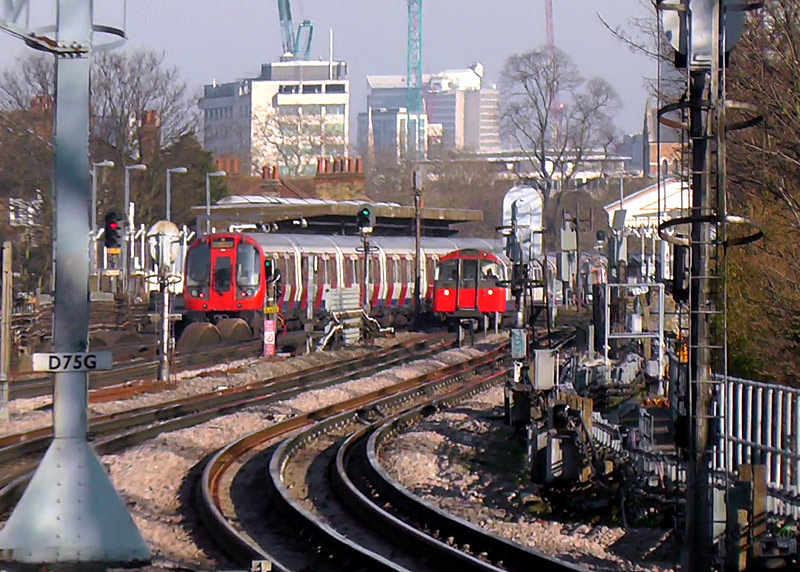
used by District line trains - have platform faces.
Piccadilly line trains travel through non-stop,
sometimes (as seen here) passing a District line train.
The four track section of railway can be seen on some of my YouTube videos which date from the early 1990's.
Chiswick Park station
http://www.youtube.com/watch?v=z2CuicFD63I
Stamford Brook Station
http://www.youtube.com/watch?v=nMG2O9I5XSs
Between Acton Town and Ealing Common stations the line passes a large District line depot.
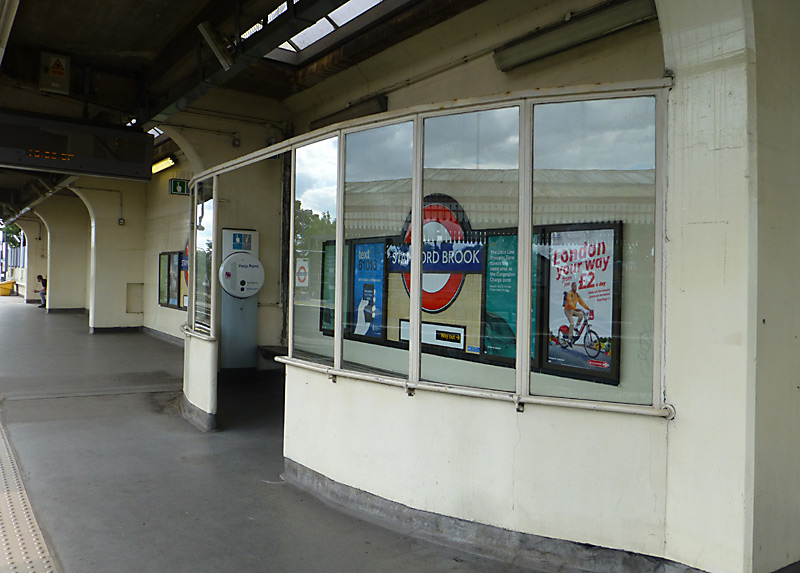
Sheltered waiting area on the Art Deco eastbound platform
at Stamford Brook station.
Ealing Common station only has two tracks which are used by both Piccadilly and District line trains. Because of the different floor heights above the tracks passengers boarding trains need to step up into the larger trains, and down into the smaller trains. Sometimes you see ‘one of each’ train in the station at the same time - probably the rush hours are best as the trains are more frequent. I normally stand on the platform used by trains going to Ealing Broadway / Rayners Lane - Uxbridge. I prefer the far end (London) end of this platform as it is away from the station exit and opposite a junction where trains can go into the depot. Because of this junction it is often possible to see a some ‘sparking’ of the electric power collection shoe as trains travelling towards Acton Town leave the station.
 |
|
 |
|
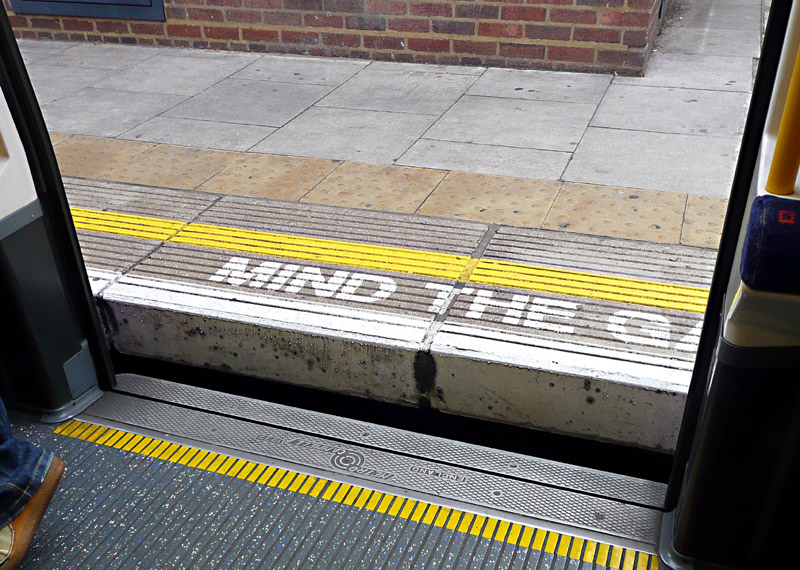 |
| District line: larger profile subsurface train - a step up from the platform into the train. |
|
Piccadilly line: smaller profile tube train - a step down from the platform into the train - as is also seen in the view looking out through the open doorway. |
||
Close observation will show that both types of train can be seen in both platform views. Filmed at Ealing Common station.
Trains at Ealing Common station feature in one of my YouTube videos.
The film is called Little And Large At Ealing Common.
It can be seen by clicking either the projector icon or this link:-
http://www.youtube.com/watch?v=Dp53UlAFOWk .
District line / North London (Mildmay) line [London Overground]
Located in south-west London the line between Gunnersbury and Richmond is used by District line trains to Upminster and London Overground (North London / Mildmay line) trains to Stratford.
Over the years I have sometimes been able to photograph one of each type of train ‘side by side’ at Kew Gardens and Gunnersbury stations, especially after 16:00 (4pm) in the evening rush hour when the District line trains are more frequent.
There is a road bridge at the southern end of Kew Gardens station which offers excellent views of passing trains. Just outside the station there is a public house which is popular with the locals.
At one time this pub had a direct entrance to one of the station platforms, however now that the station has electronic gates the doorway has been closed.
An unusual feature of this station is that the two platforms have separate sets of ticket gates - and both the pedestrian underpass and foot bridge are now 'outside' of the fares paid area. This means that passengers wishing to reach the 'other' platform must effectively leave the station and then re-enter it.
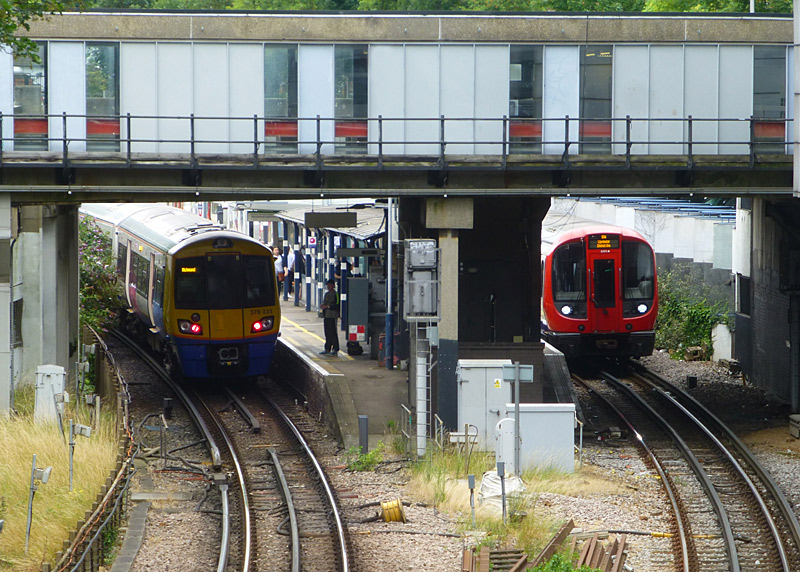
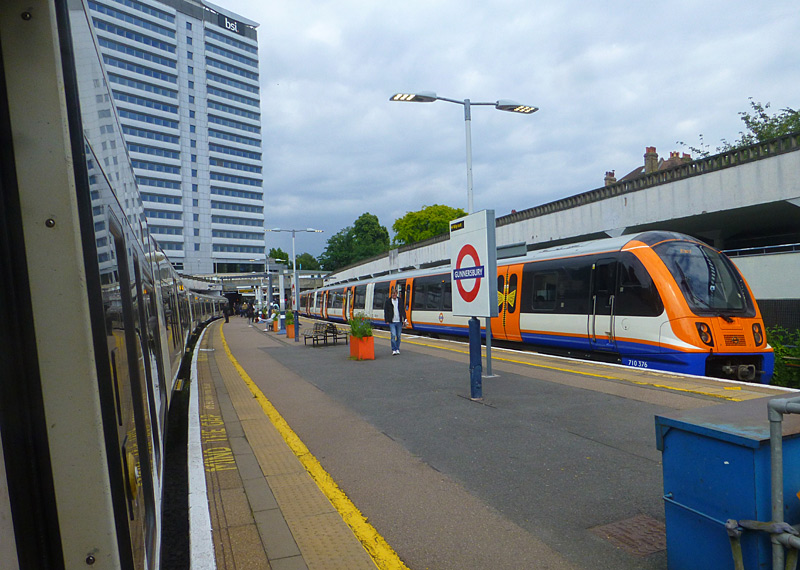
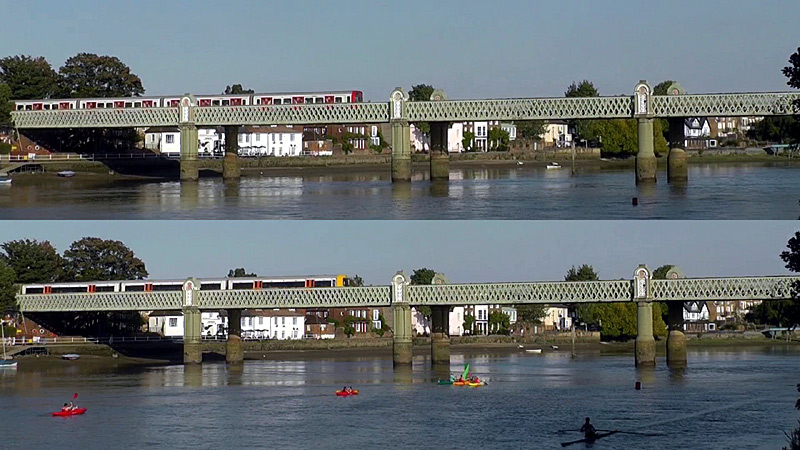
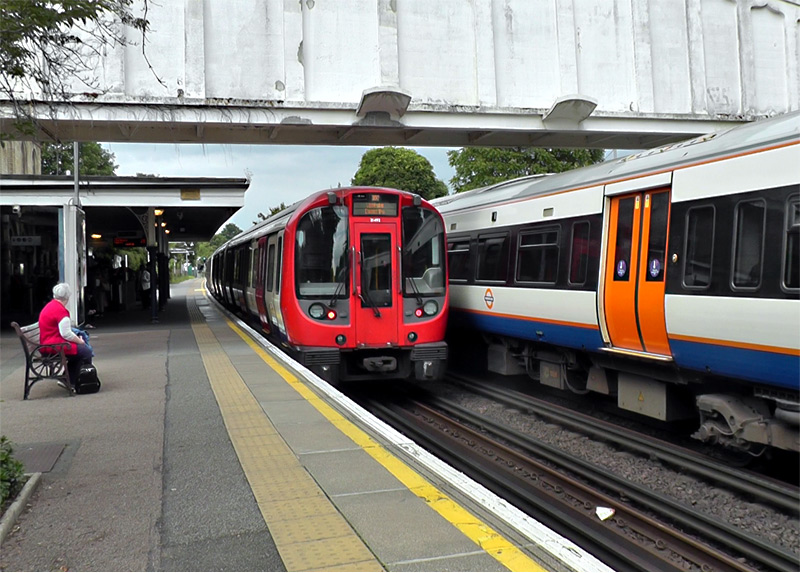
trains pass at Kew Gardens station.
Richmond is a fair-sized station controlled by South Western Railway. The platform circulating area includes a coffee shop with tables where you can watch trains come and go. The glass skylight affords
weather protection in inclement weather.
Platforms 1 and 2 are through platforms for South Western Railway services - typically nowadays just electric multiple units of various types.
Platforms
3 to 7 are terminating platforms, London Overground North London / Mildmay line trains can call at any of these platforms but the lack of fourth (electric power supply) rail prevents District line trains from
going to platform 3. When they were brand new S stock trains on the District line were prohibited from calling at platform 7 but this might have only been a temporary ban.
Richmond station is also included on the Busier Suburban Stations page about suburban stations in zones 3 or 4 where there is a wide variety of trains to see.
| Opening Page Fares & Tickets / Photography |
|
|
|
| London Underground Small Profile ‘Tube’ Trains |
|
| Bakerloo Line | |
| Central Line | |
| Jubilee Line | |
| Northern Line | |
| Piccadilly Line | |
| Victoria Line | |
| Waterloo & City Line | |
|
|
| London Underground Large Profile ‘Subsurface’ Trains |
|
| Circle Line | |
| District Line | |
| East London Line | |
| Hammersmith & City Line | |
| Metropolitan Line | |
|
|
| National Rail ‘Tube’ Trains | |
| Northern City Line | |
| Elizabeth Line (Crossrail Line 1) | |
| Crossrail Line 2 | |
|
|
| Other National Rail Trains | |
| London Overground | |
|
|
| Local Light Railways | |
| Docklands Light Railway | |
| Croydon / London Tramlink | |
|
|
| General Information | |
| Main National Rail Stations Fast Regional Services Overhead Wire & 3rd Rail Trains |
|
| Busier Suburban Stations In Zones 1-4 With A Wider Variety Of Trains To See |
|
| Station Architecture & Features | |
| Shared Service Routes |  |
| Further Information Resources To Visit In Person Or Online |
|
|
|
| Single Page Version Of This Guide |
|

