
Visitors to London who are also transport enthusiasts (‘railfans’) sometimes ask for advice as to the ‘best’ things to see on London’s railway network. This page is part of a guide which aims to answer that question.
If this is the first time you have reached these pages then it is best to go to the Opening Page which sets the scene, explains the difference between the small and the large profile trains, offers advice on the best type of ticket to buy and photography tips.
Alternatively, it is possible to view everything on one page
|
| Hammersmith and City Line |
|
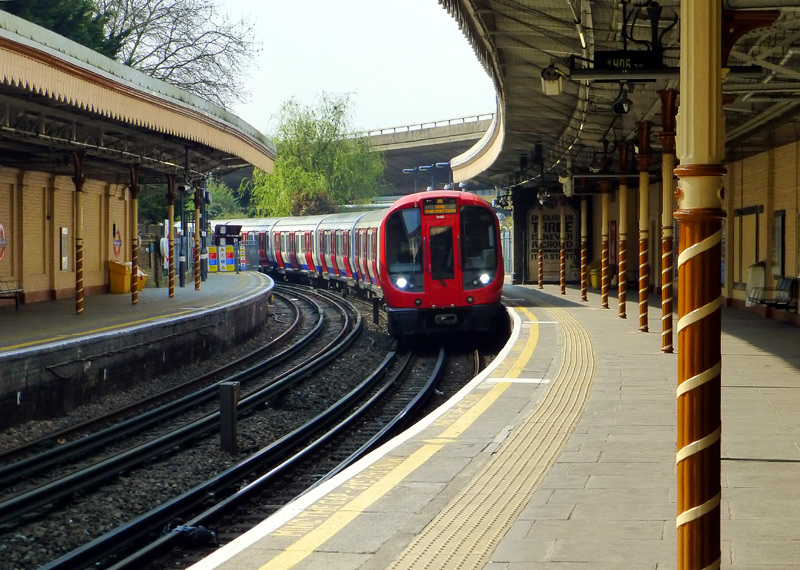
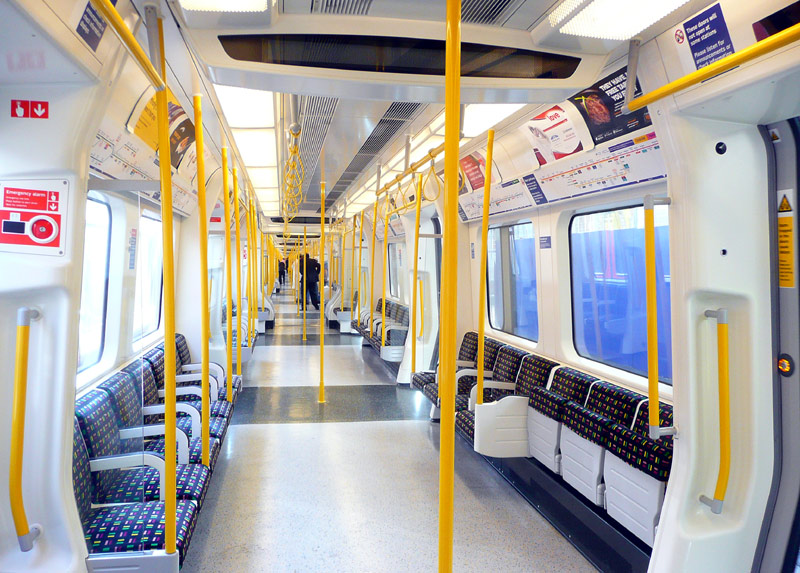
These trains have 3 sets of opening doors per car, air-conditioning and internally are of a walk-through design.
Hammersmith & City line trains use a GoA 2 (Grade of Automation level 2) semi-automatic train control system (STO) whereby the trains travel automatically from station to station but a human train driver is always present at the front of the train, with duties that include door closing and initiating station departure.
Although they all look the same there are two different types of S Stock trains.
The S7 variant have 7 cars (coaches / carriages) with only longitudinal seating.
These are used on the Circle, District and Hammersmith & City lines.
The S7+1 variant have 8 cars with only longitudinal seating.
There are very few of these trains - which are only used on the Metropolitan line.
The S8 variant have 8 cars with a mix of longitudinal and facing seats.
These are only used on the Metropolitan line.
Doors Auto-Open / Auto-Close:
At stations the passenger doors are opened by the train driver and (if not closed earlier) automatically close after 45 seconds - but are easily
re-opened using the push buttons.
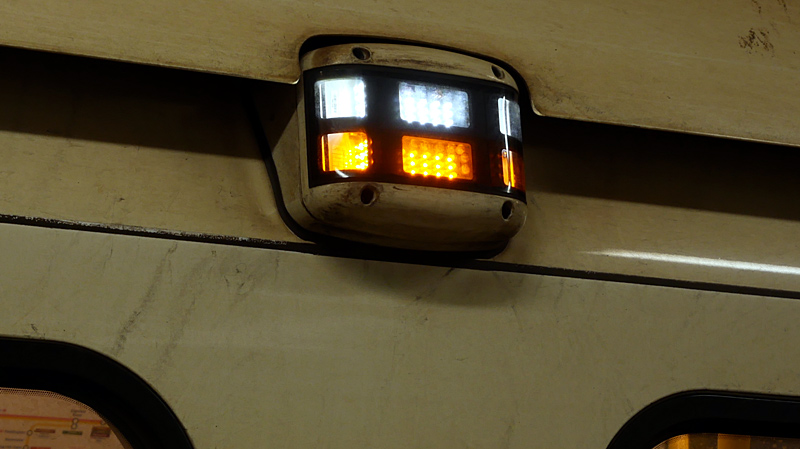
Lights on every S Stock car side:
Amber: Passenger doors are unlocked / open
White: It is time for the doors to close and the train to depart.
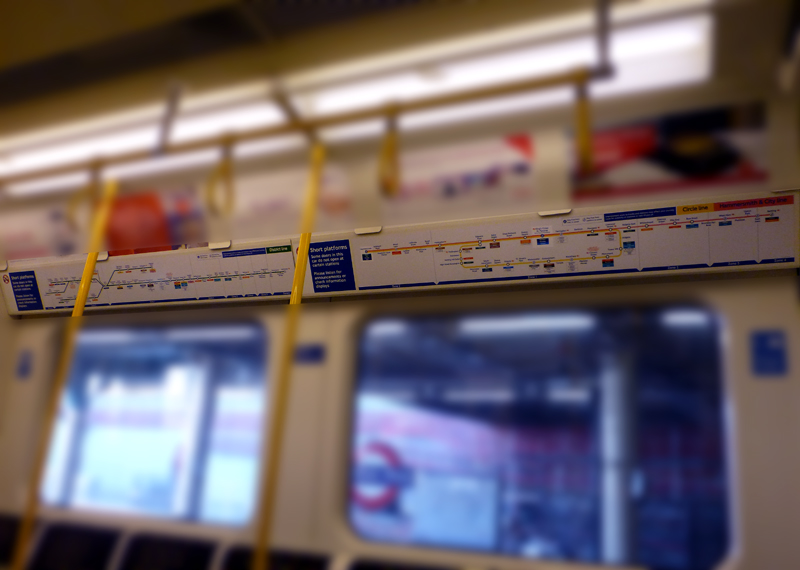
S7 trains have two route maps:
District line (left);
Hammersmith & City and Circle lines (right).
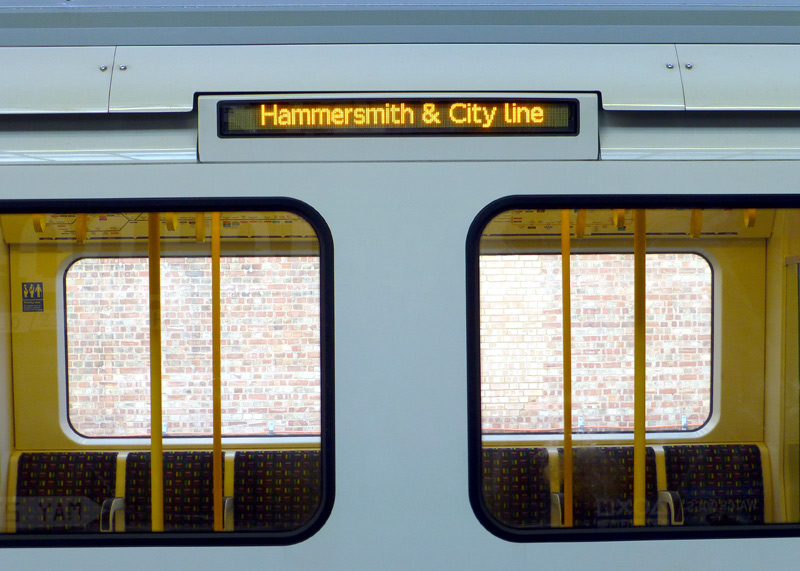
(especially visitors to London)
because they look at the wrong map!
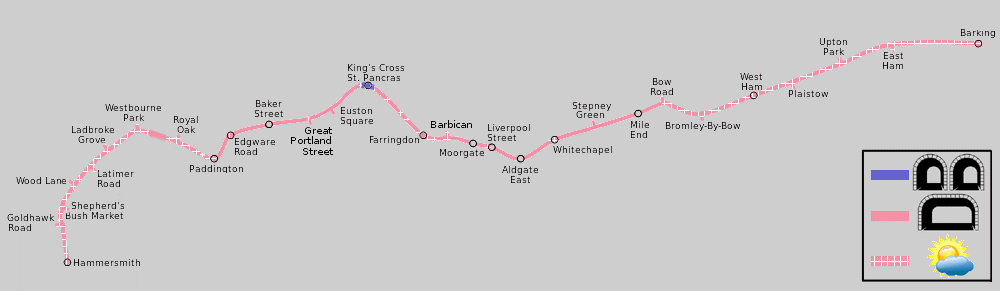
Map modified by me, original source & license: Ed g2s / Karldupart / Perhelion / Wikipedia encyclopædia CC BY-SA 3.0 http://commons.wikimedia.org/wiki/File:Hammersmith_%26_City_Line.svg
Click map to see larger version in a new window! 
| Below / Above Ground |
Almost entirely below ground in central London, Edgware Road, Farringdon and Barbican stations are in open air. At Liverpool Street one end of the platform is in open air. The tunnels between Kings Cross and Barbican stations include some short open air sections which date from the days of steam trains when ventilation openings were needed to allow the smoke to clear.
In west London open air between Hammersmith & Paddington, except for the short flyunder below the Great Western Main line between Westbourne Park and Royal Oak stations.
In east London open air at Whitechapel and then from Bow Road to Barking.
| Claustrophobia |
 Information for people who are happy to travel on trains which are above ground but experience claustrophobia
when in tunnels.
Information for people who are happy to travel on trains which are above ground but experience claustrophobia
when in tunnels.
Most of the tunnels used by Hammersmith & City line trains are wide enough for two tracks (ie: a train in each direction), however there is one location which has narrow single track tunnels.
* This is at Kings Cross St Pancras station - the platforms plus station approaches / exits.
| General Information |
Until 1988 this service was officially part of the Metropolitan line (albeit a separately operated branch) and at some locations might still be advertised as such. The name 'Hammersmith and City' is taken from the Hammersmith and City Railway (H&CR) which was jointly owned by the Metropolitan and Great Western Railways.
Stations At Different Locations With The Same Names: For historic reasons three stations served by Hammersmith & City line trains are ‘duplicates’. At Edgware Road, Paddington and Hammersmith different Underground trains call at identically named stations which are at separate locations a short walk from each other.
At Edgware Road the Hammersmith & City line, Circle line and District line trains use the former Metropolitan Railway station. The totally separate Bakerloo line station with the same name is a short walk away across busy road junctions.
At Paddington the Hammersmith & City line trains (and Circle line trains travelling to / from Hammersmith) use the suburban platforms (numbers 15 & 16) which are part of the National Rail / main line railway station and totally separate from the other underground lines. These platforms are partly in open air and the main line trains operated by Great Western Railway, Heathrow Express etc., can be seen from them.
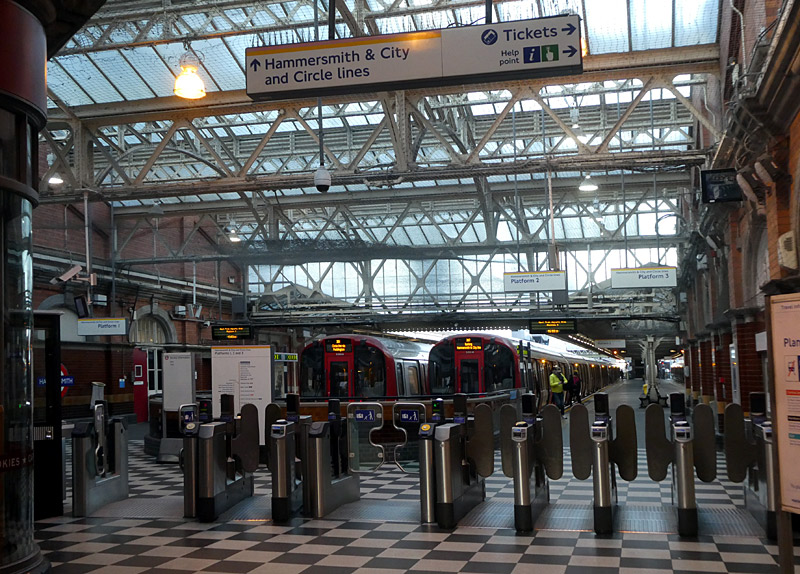
At Hammersmith the Hammersmith & City (and Circle) line trains use the former Metropolitan Railway station which remains largely as built in 1868. A short walk away across some busy roads is the former District Railway station which nowadays is used by District & Piccadilly line trains and has been modernised with its main entrance now inside a shopping centre.
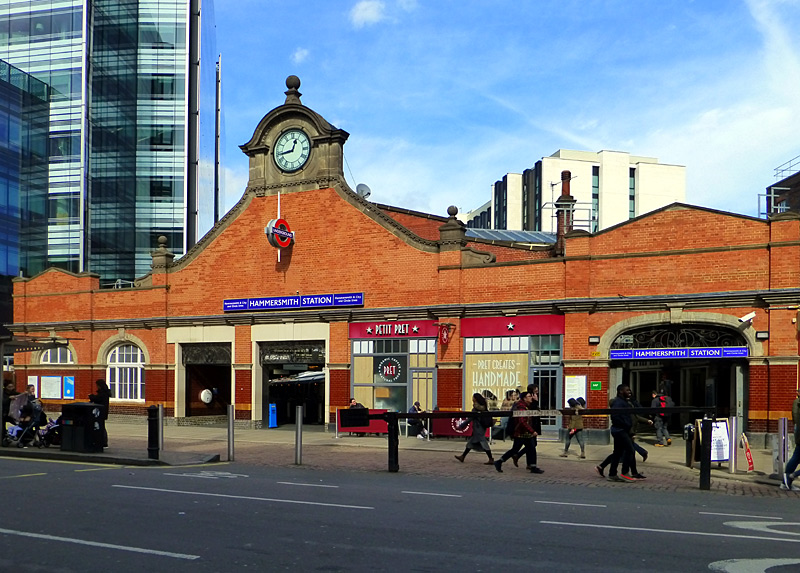
West London: Just outside Hammersmith station the trains pass a small depôt. The section Hammersmith - Westbourne Park is on a brick arch viaduct which in 1864 was built by the Great Western Railway (GWR) and served by its broad-gauge trains - these had tracks which were 7 ft 0¼ in [2140 mm] apart). Originally there were only a few stations, with more opening over a number of years.
The present-day Wood Lane station dates from 2008. Over the years this station has been opened and closed several times, its 2008 reopening was because it is very near the large ‘Westfield’ shopping centre that opened in the same year. Also nearby is the Central line‘s White City station.
The out of station interchange (OSI) system means that passengers paying fares using PAYG are allowed to change trains by walking between Wood Lane and White City stations and then continue their journey at no extra cost. (Touch-out when leaving the station and touch-in when arriving at the other station). There is a generous time limit in which this journey must be completed, so people who walk slowly should not worry. However this time limit does not allow for going shopping.
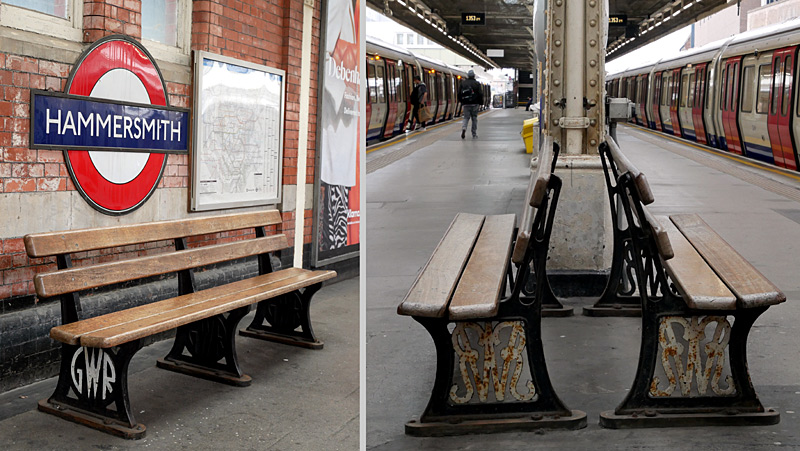

features two different styles of GWR logo.
Closed Link At Latimer Road: This link was built as part of the original Hammersmith & City Railway and went to the nearby West London Line. Over the years it was used by both GWR and Metropolitan Railway services to various destinations, including Richmond via Addison Road (now known as Kensington Olympia) and Kew Gardens stations, and the North London Railway 'Middle Circle' service which ran between Moorgate and Mansion House via Addison Road. Eventually however these services ended and it was only used by Metropolitan Railway trains on the short Edgware Road - Addison Road shuttle service. The link was completely closed in 1940 as a result of air raid bomb damage and although the line could have been repaired this did not come to pass.
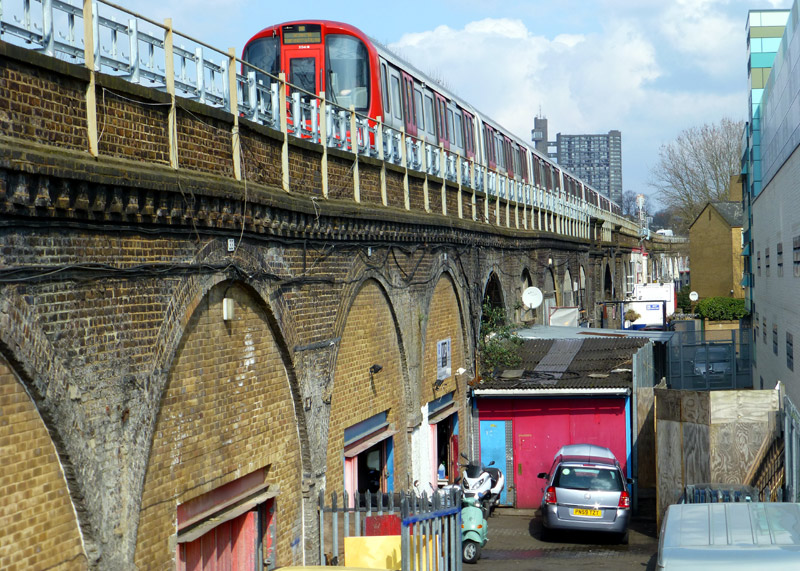
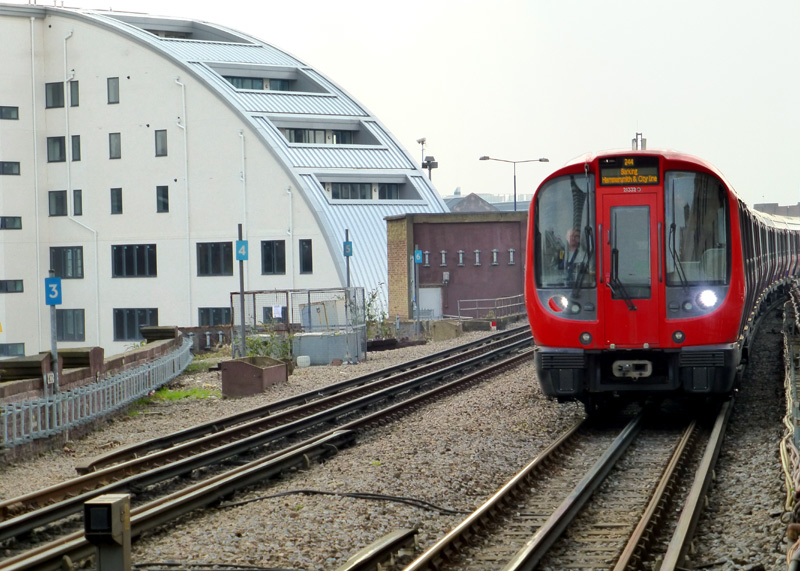
The railway arches below the tracks are used as light industrial workshops.
towards Barking passes the former route to the West London Line
as it arrives at Latimer Road station.
Between Westbourne Park and Paddington the Underground trains travel alongside the National Rail Great Western Main line tracks to Paddington station. This includes a dive-under to swap between the southern side (of the main line railway) at Westbourne Park and the northern side at Royal Oak.
Royal Oak is a good location for watching passing mainline trains, including InterCity Express Trains (IET) to Bristol, South Wales, Devon, Cornwall etc., plus outer suburban / regional and Heathrow Express Class 387 electric multiple unit trains. Also Class 345 Elizabeth line trains when they travel to the above-ground Paddington station. However, because you will be looking south it will often be easier to photograph the trains when the weather is cloudy.
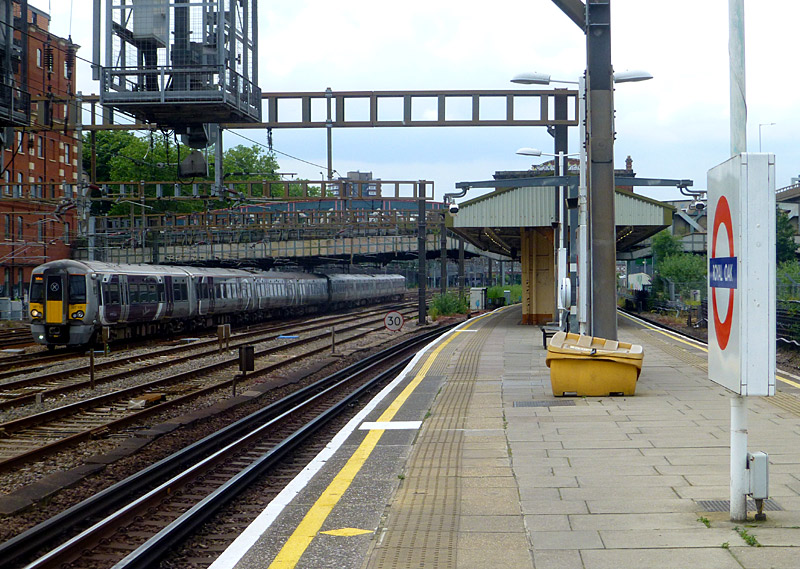
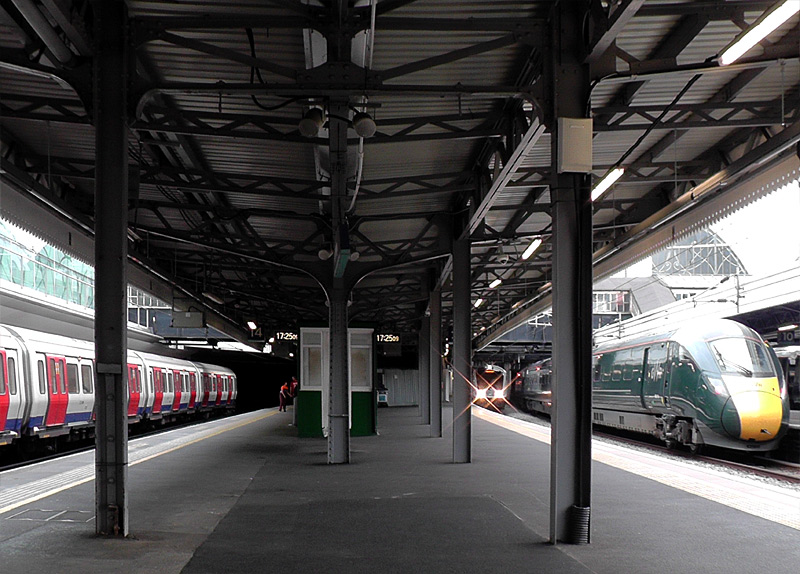
Central London: The Hammersmith & City line operates along the entire length of the first section of the Metropolitan Railway which opened in January 1863 and extended from Paddington to Farringdon Street (nowadays known as Farringdon) via Baker Street station. Over the years several of the stations on this section of railway have changed their names, these include Moorgate Street / Moorgate, Aldersgate / Barbican and Gower Street / Euston Square.
Although Edgware Road (subsurface) was an original 1863 Metropolitan Railway station, it was rebuilt in the 1920's and now has four platforms.
This was done as part of a plan to reduce congestion on the two track section of railway between Baker Street and Finchley Road stations by building new deep-level tube tunnels from just to the west of Edgware Road station to just north of the present-day Kilburn station.
However the planned new route was abandoned after the government introduced new safety rules prohibiting the compartment type of train that the Metropolitan Railway used on its main line services from travelling through deep level tube tunnels^. Instead a solution was found which included building new tunnels between Finchley Road and Baker Street stations as an extension to an existing tube line.
^The rules said that in the event of an emergency (eg: fire) it had to be possible to walk through trains which use single track deep-level tunnels (ie: flee to another part of the train) and there had to be emergency exits at the train ends. These are features that are not found on trains with full-width compartments.
 |
|
 |
|
 |
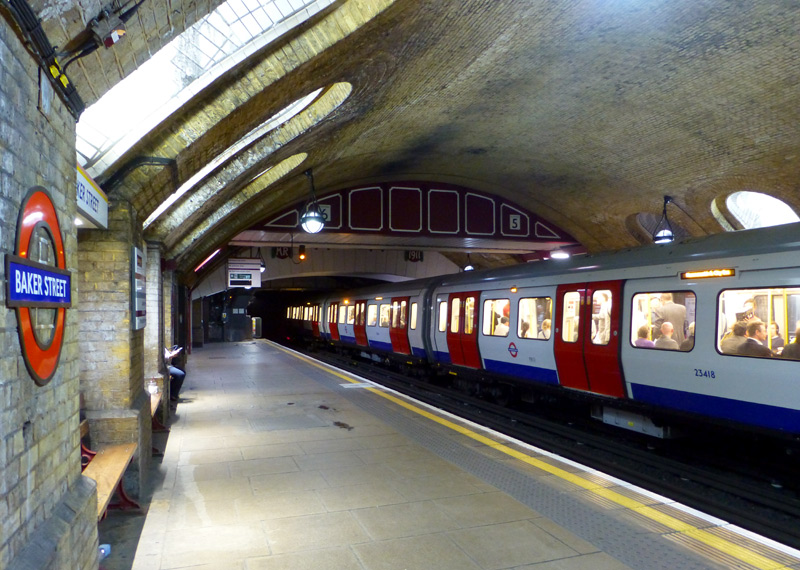
The historic platforms 5 and 6 were part of the original Metropolitan Railway of 1863.
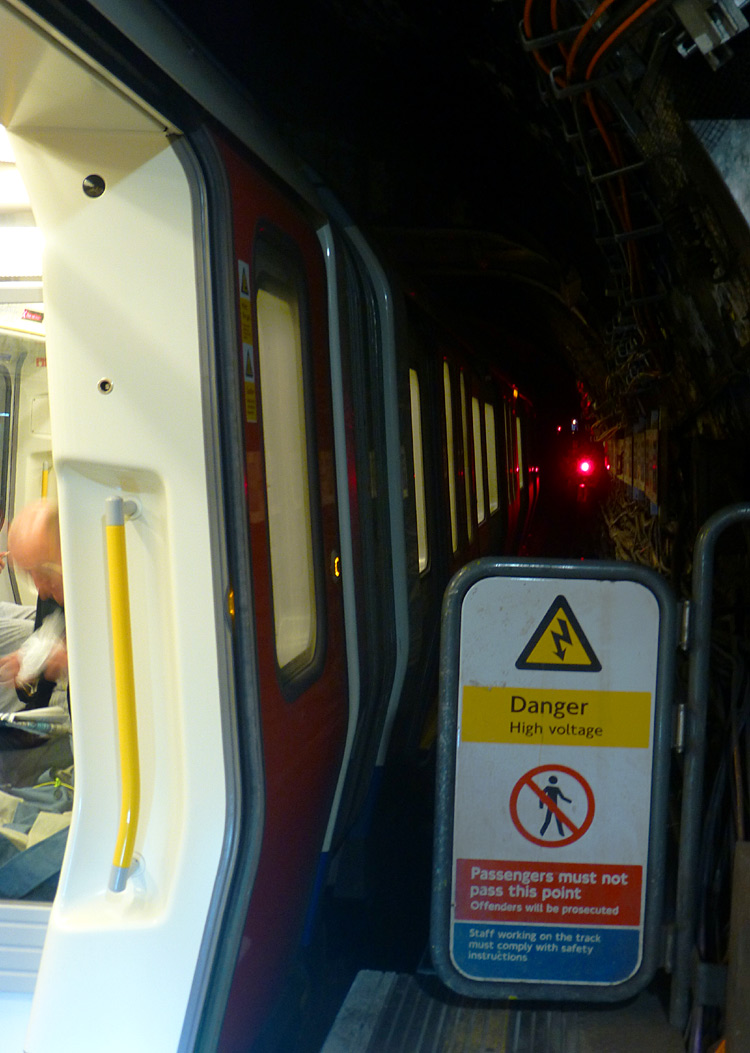
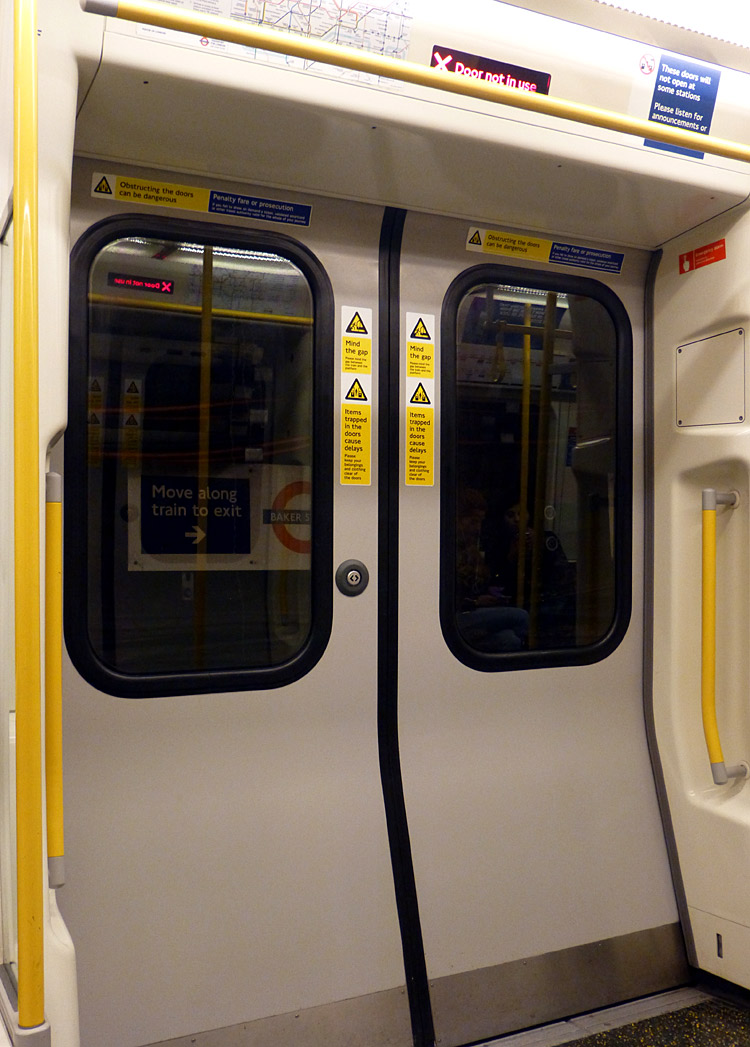
S7 trains are longer than this platform so the last car remains in the tunnel and the doors do not open.
There are more photographs from this station on the pages which look at the Metropolitan, Bakerloo and Jubilee lines.
Baker Street is of course one of London‘s most famous stations. Hammersmith & City (and Circle) line trains use the original 1863 platforms which are located just below the Marylebone Road and numbered 5 & 6.They have been restored to as near their original condition as possible. However since the original fresh air portals which allowed daylight to enter the station (and steam engine smoke to escape) have been covered over they have been fitted with electric lighting so as to help recreate this effect. The platform walls feature many plaques showing old plans and photographs of the station as it was many years ago.
Baker Street has the most platforms which are served by London Underground trains in all London. Four platforms are used by Metropolitan line trains, two platforms by Hammersmith & City and Circle lines trains plus four deep level tube train platforms which are served by the Bakerloo and Jubilee lines. - 10 in total! Just outside the front of the station there is a large statue of Sherlock Holmes which commemorates the fictional detective's association with 221B Baker Street.
The platforms at Great Portland Street also comprise much historic brickwork and heritage style lighting. There is also a daylight / ventilation portal at the west end of the station.
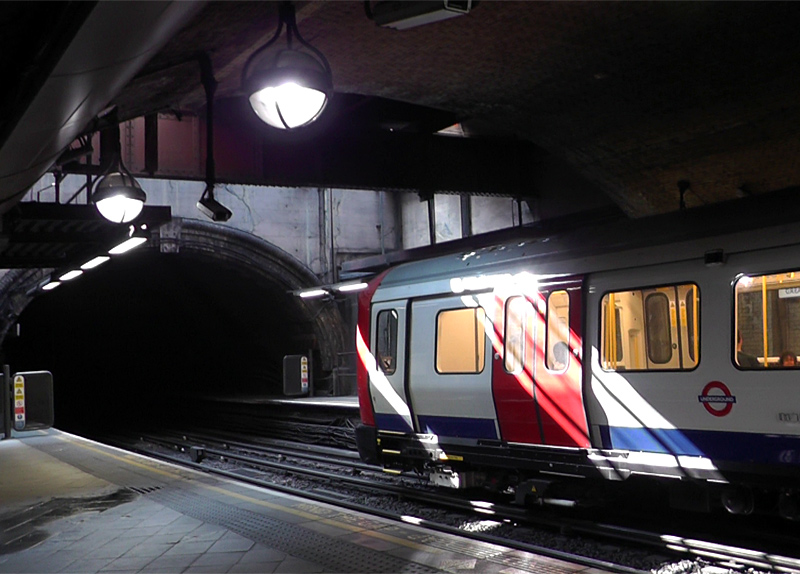
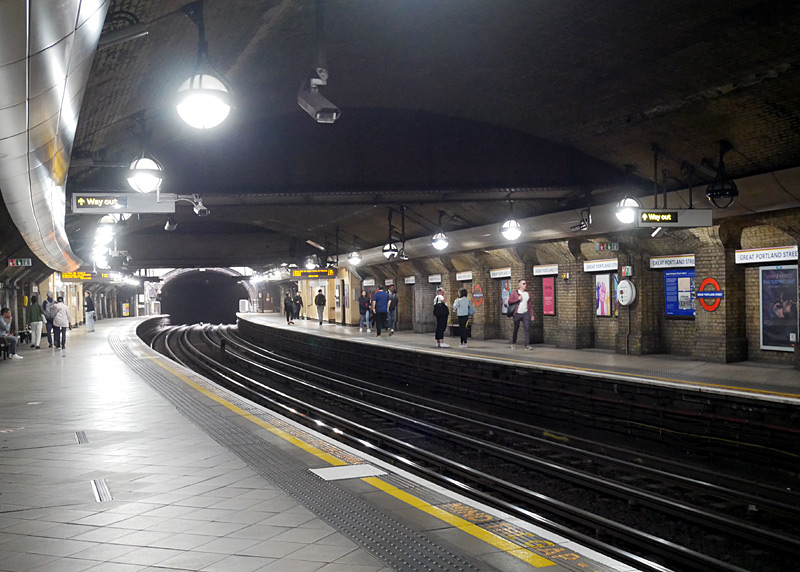
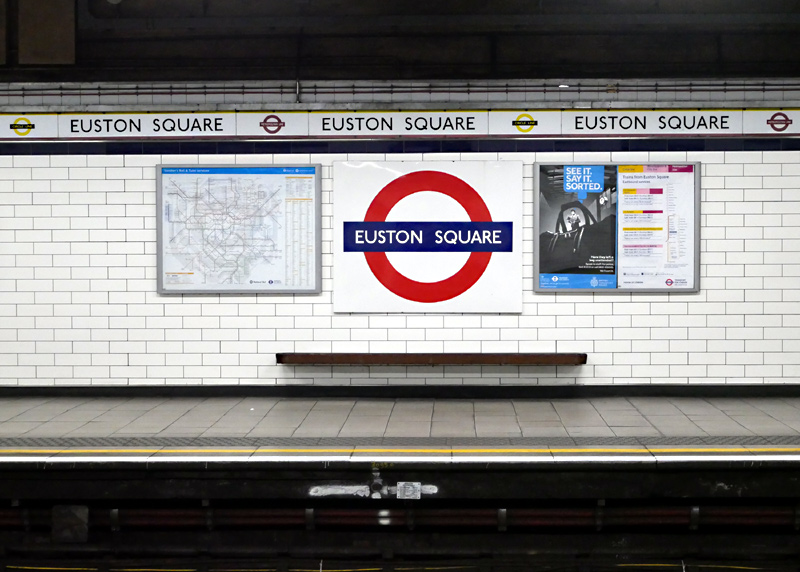

The subsurface platforms at Kings Cross St Pancras date from 1941. For most of their length they comprise twin circular shaped tunnels with a side platform, thereby creating the ambiance of a deep level ‘tube’ train station. There is a photograph showing this on the Circle line page.
The route between Kings Cross St Pancras and Moorgate has four tracks. Two of these are used by Underground trains. The other pair of tracks are known variously as the Widened Lines the City Widened Lines and even the Metropolitan Widened Lines. These are looked at in a special section below.
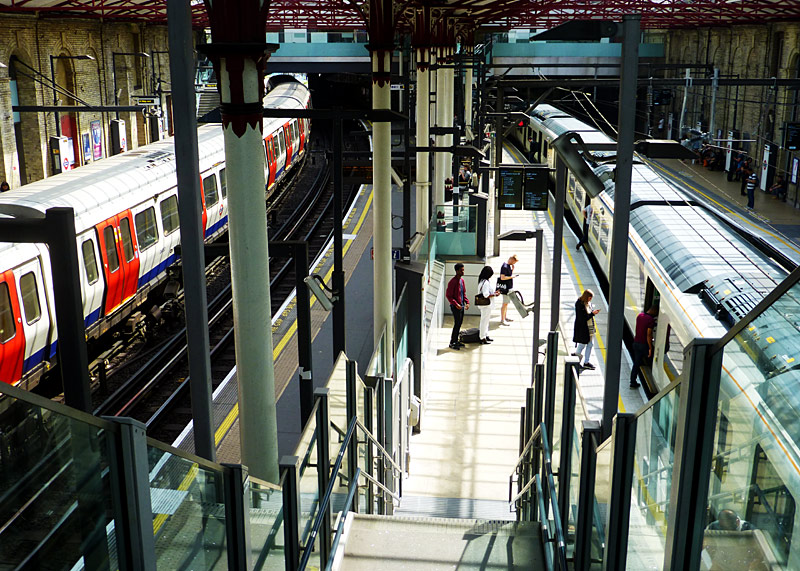
Nowadays the main line / National Rail Thameslink service between St. Pancras and Farringdon stations uses the Widened Lines. Sometimes these trains can be seen from Undergrond trains whilst travelling between Kings Cross St. Pancras and Farringdon stations. Also visible (from Underground trains) are the remains of the westbound platform at the Kings Cross station which Underground trains stopped using in 1941. However a wall prevents sight of the former eastbound platform and the platforms which Thameslink trains stopped using in 2007.
Because of the large number of trains from other railway companies§ which wanted to access London's Financial District the 1865 extension of the original Metropolitan Railway from Farringdon to Moorgate was built with four tracks, and a pair of extra tracks were added between Farringdon and Kings Cross St Pancras stations.
§The railway companies included the Midland Railway, the Great Northern Railway and the London, Chatham & Dover Railway.
Some of the trains which used the Widened Lines travelled the whole way from Kings Cross or St. Pancras to Moorgate, others only travelled between Kings Cross / St. Pancras and Farringdon - many of these trains were on services to / from various destinations in south London and crossed the River Thames on Blackfriars bridge. For a while there were also services from south London which went to Moorgate, only using the Widened Lines between Farringdon and Moorgate. In addition many goods (freight) trains used the Widened Lines, some of these served the various goods yards which were near Farringdon station, others were on longer journeys between north and south London.
In the days of electric traction some Metropolitan Railway services which terminated at Moorgate also used the Widened Lines. But only when travelling eastbound, ie: towards Moorgate.
Nowadays only the Thameslink service which links destinations to the north and south of London still uses the Widened Lines. However since 2009 they have only used the section between St Pancras and Farringdon stations.
Prior to 2009 some Thameslink trains from the north of London travelled all the way from St Pancras to Moorgate. The reason why the section between Farringdon and Moorgate closed is that when Thameslink trains were lengthened from 8 to 12 carriages it was decided that the only way that the northbound platform at Farringdon could be extended to accept the longer trains was to build over the trackbed of the route to Moorgate. Extending the other end of the platform at Farringdon was not done because of a downhill gradient that was thought to be too steep for a station platform. This explains why Moorgate and Barbican stations have two disused platforms.
Longer term plans are to re-connect the closed section of the Widened Lines to the Underground's tracks and use it as additional sidings, so it is unlikely that passengers will be able to travel along this section of track again.
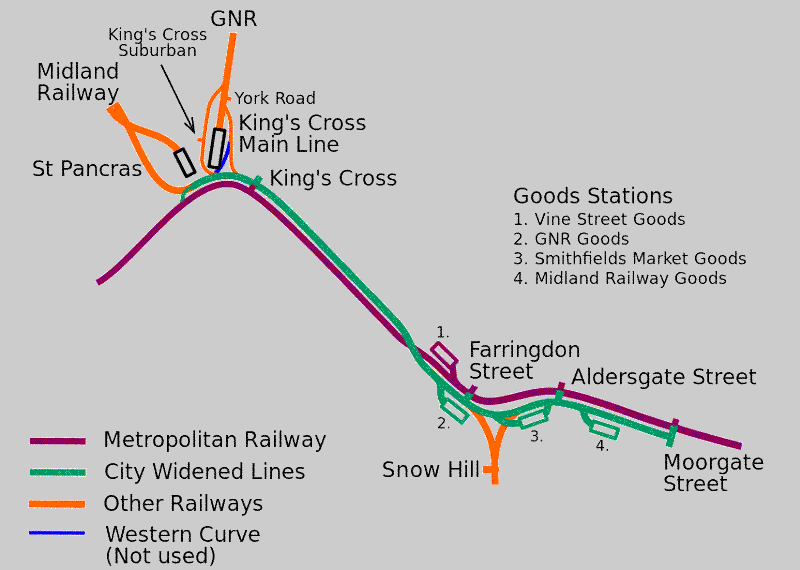
Vine Street Depot belonged to the Metropolitan Railway.
Smithfield Market Goods belonged to the GWR.
The GNR was the Great Northern Railway.
Map modified by me, original source & license:
Edgepedia / DavidCane / Wikipedia encyclopædia CC BY-SA 3.0
http://commons.wikimedia.org/wiki/File:City_Widened_Lines.svg
and on the Widened Lines a Thameslink Class 700 train.
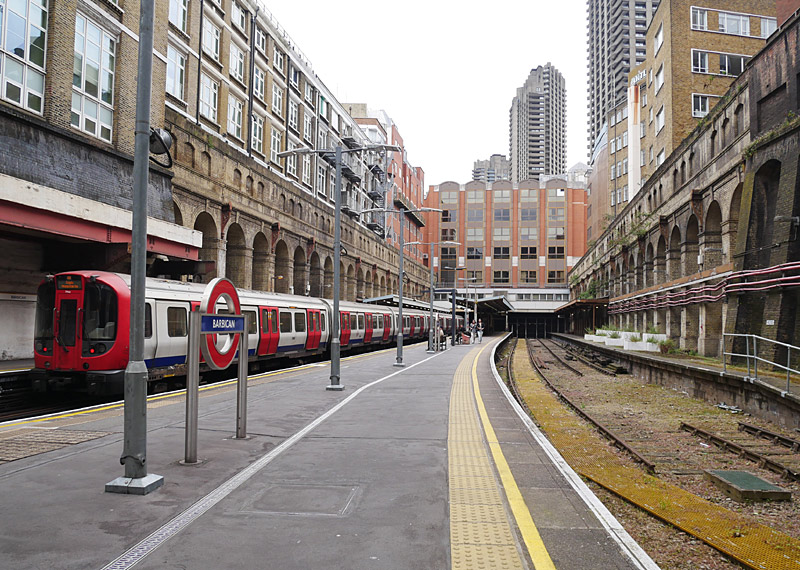
Left: 2024 view with an S stock train and disused Widened Lines
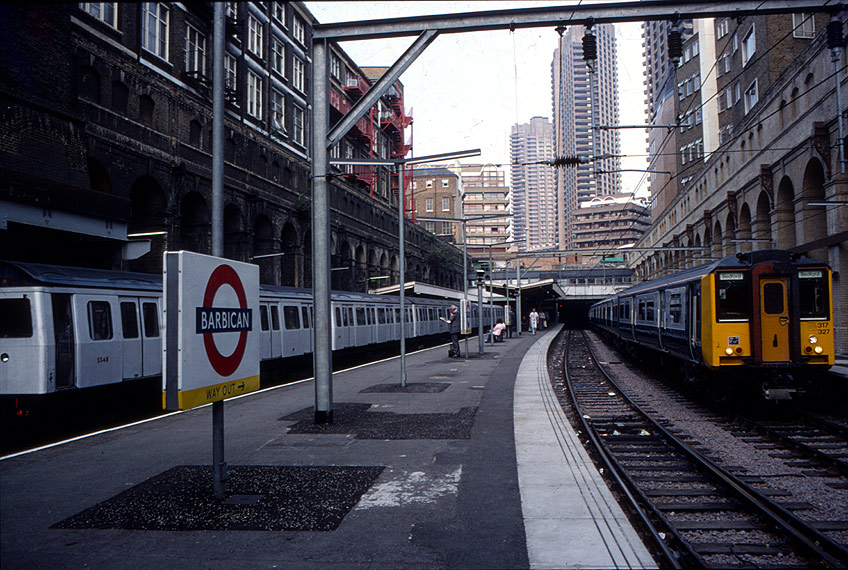
Right: 1980's view, shortly after the British Rail services London - Bedford had been converted to electric traction.
The trains seen here are London Transport C stock and British Rail Class 317 - both types of train have now been replaced.
When looking at the Metropolitan Railway it is important to remember that in those days it was just one of the many British railway companies. The Met saw itself as being a main line railway that in every way was equal in status
to its contemporaries - it ran both local 'all stations' and express trains, trains with Pullman carriages that offered freshly cooked refreshments, goods / freight trains and more... Therefore it would be wrong to think in terms of present-day terminologies
such as 'rapid transit', 'urban metro', 'subway', etc.The route between Barbican and Moorgate dates from 1965 when the tracks (all four!) were realigned and placed in tunnels as part of an urban regeneration scheme which included the building of the Barbican complex. Moorgate station used to be open air but is now under an office block. This station also has 10 platforms. Four of these are used by Metropolitan / Hammersmith & City / Circle lines trains (two for through trains and two bay platforms), two platforms were used by Widened Lines trains (but are now closed) and four platforms are used by deep level tube trains (two as part of the Northern line Bank Branch and two as part of the Northern City line main line railway service).
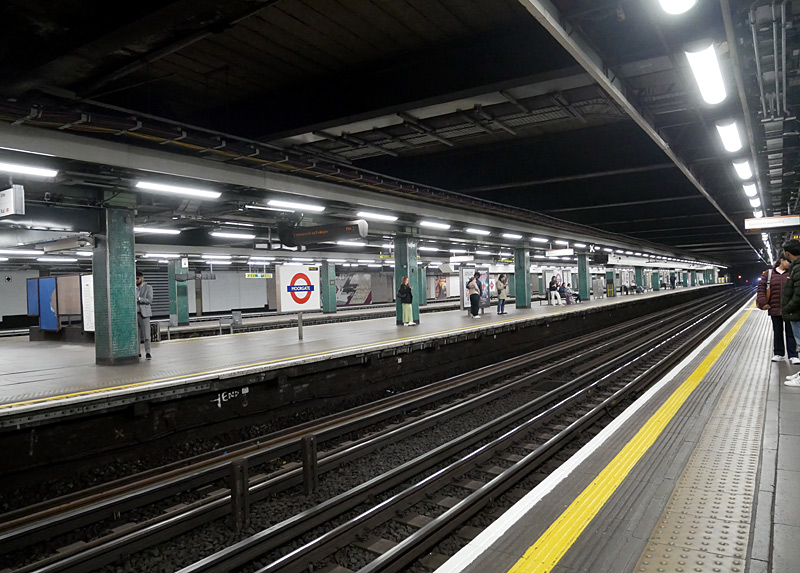
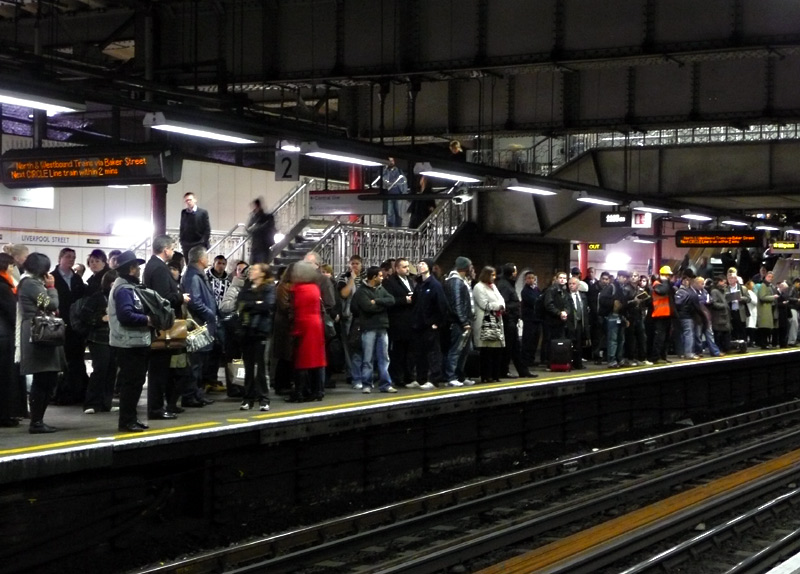
This was filmed from the eastbound platform, beyond the main westbound platform there are two terminus tracks with platforms for Underground trains and two disused terminus tracks with platforms for Widened Lines trains.
This platform is served by Hammersmith & City and Circle line trains going to Hammersmith (Met) station and longer-distance Metropolitan line trains going to Amersham / Chesham / Uxbridge / Watford stations via Harrow-On-The-Hill station. Some of these journeys will take 60+ minutes to complete!
East London: The Hammersmith & City line joins the District line at Aldgate East station. Some readers may recall that off-peak trains used to terminate at Whitechapel but nowadays they continue further, usually all the way Barking although sometimes they only travel as far as the bay platform at Plaistow. Since the introduction of the S Stock a few Hammersmith & City line trains even travel to Upminster. This is very rare. The through trains from Hammersmith to New Cross / New Cross Gate on the East London line are now but a distant memory.
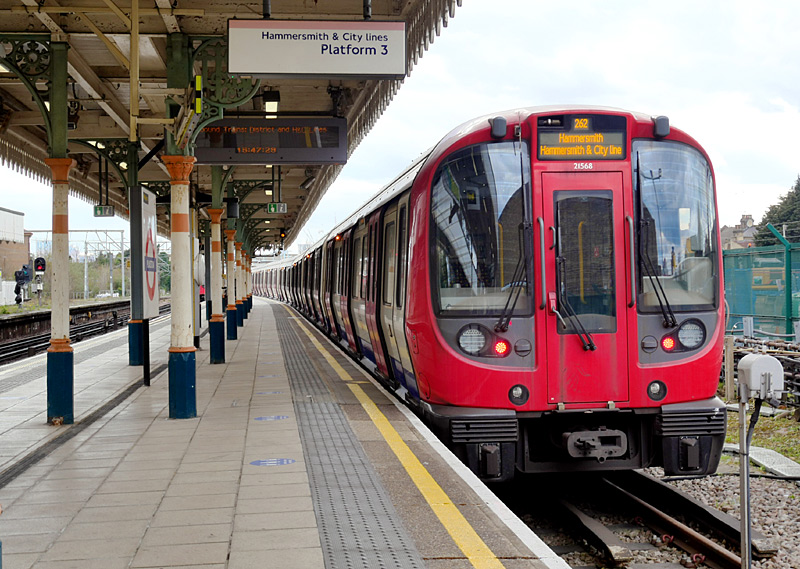
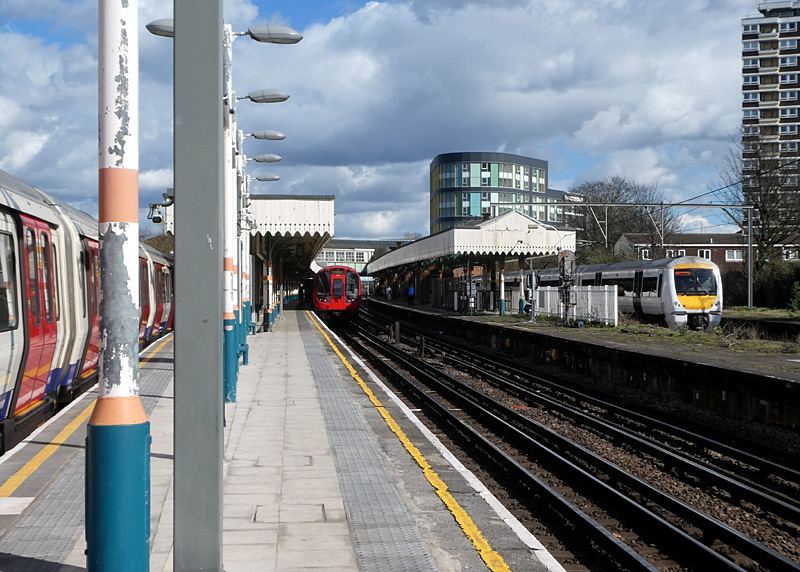
The image on the right also includes an eastbound S Stock train (could be either Hammersmith & City or District line) which is making a 'station stop' plus a westbound Class 357 C2C train which is passing through without stopping.
The route from midway between Bow Road and Bromley-by-Bow stations to Upminster has four (or more) tracks, the other pair of tracks are used by C2C services between Fenchurch Street and the coastal town of Southend-On-Sea. Further information can be found in the Shared Service Routes page.
| Opening Page Fares & Tickets / Photography |
|
|
|
| London Underground Small Profile ‘Tube’ Trains |
|
| Bakerloo Line | |
| Central Line | |
| Jubilee Line | |
| Northern Line | |
| Piccadilly Line | |
| Victoria Line | |
| Waterloo & City Line | |
|
|
| London Underground Large Profile ‘Subsurface’ Trains |
|
| Circle Line | |
| District Line | |
| East London Line | |
| Hammersmith & City Line |  |
| Metropolitan Line | |
|
|
| National Rail ‘Tube’ Trains | |
| Northern City Line | |
| Crossrail Line 1 (Elizabeth Line) | |
| Crossrail Line 2 | |
|
|
| Other National Rail Trains | |
| London Overground | |
|
|
| Local Light Railways | |
| Docklands Light Railway | |
| Croydon / London Tramlink | |
|
|
| General Information | |
| Main National Rail Stations Fast Regional Services Overhead Wire & 3rd Rail Trains |
|
| Busier Suburban Stations In Zones 1-4 With A Wider Variety Of Trains To See |
|
| Station Architecture & Features | |
| Shared Service Routes | |
| Further Information Resources To Visit In Person Or Online |
|
|
|
| Single Page Version Of This Guide |
|
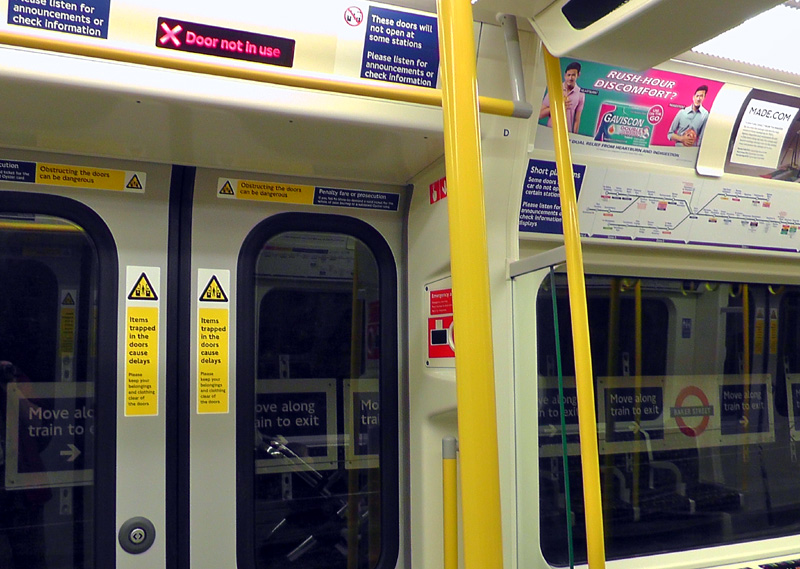
Some stations served by Hammersmith & City Line trains have short platforms where part of the train stops outside the station and the doors remain closed.
Passengers wanting these stations should walk through the inside of the train to a section which is within the station platform.

