
Visitors to London who are also transport enthusiasts (‘railfans’) sometimes ask for advice as to the ‘best’ things to see on London’s railway network. Typically they mean the London Transport railways, or in other words the underground (subway, metro) and whilst the information below is primarily about that it also briefly looks at the wider railway scene within London. This is especially important as there are many instances of interworking and shared services with London's other railway systems - the main line railway (National Rail), the Docklands Light Railway and Croydon / London Tramlink.
This guide is primarily about present day services, so historical information is only included where it helps explain aspects of the transport network as it is today.
The UndergrounD railway uses trains of two distinctive sizes, these being the small profile ‘tube’ trains and the larger profile trains which are in fact very similar in size to trains used on the rest of the British railway system. The latter would be because when they first opened most of the routes served by the larger profile trains were originally served by steam locomotives hauling unpowered passenger carriages, so (apart from the extensive operations in tunnels) they were little different from the many other British railways.
 |
|
 |
|
 |
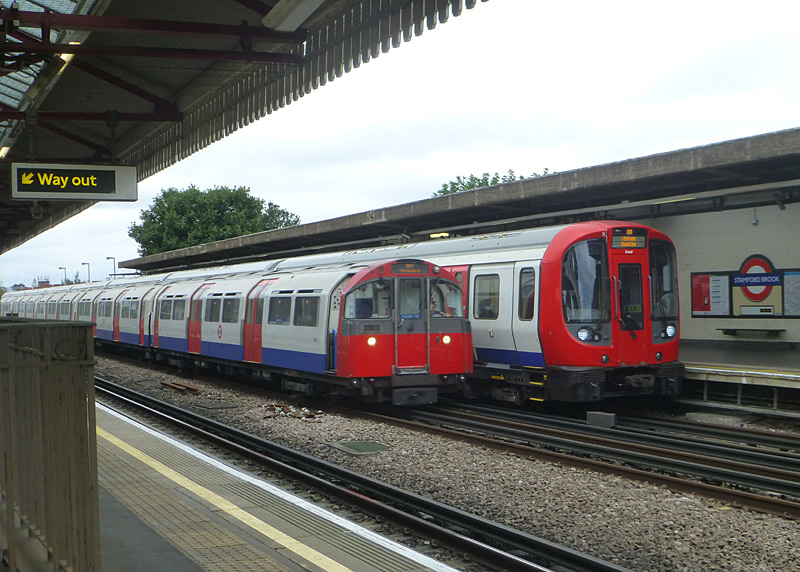
| London's underground trains come in two different sizes. A small profile 1973 'tube' stock Piccadilly line train passes a large profile subsurface S stock District line train at Stamford Brook station. |
|
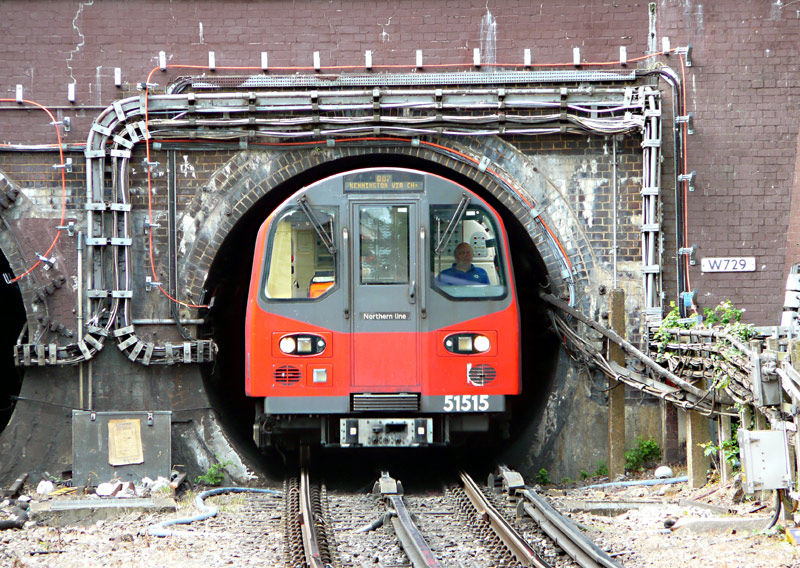
The nickname "Tube" comes from the almost circular tube-like tunnels used by the small profile trains. A 1995 'tube' stock Northern line train exits a tunnel - as seen from Hendon Central station. |
|
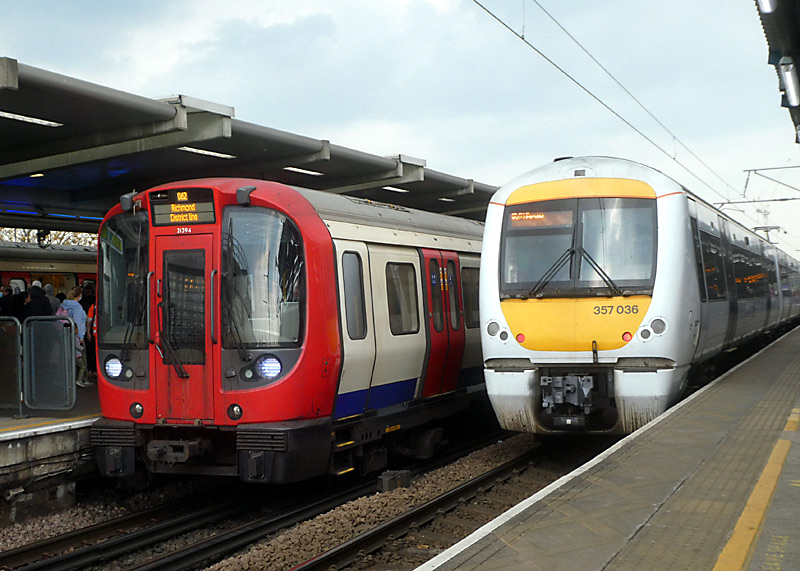
The large profile 'subsurface' trains are the same size as main line (National Rail) trains. District line S stock and C2C Electrostar Class 357 trains pass at West Ham station. |
This guide comes in two variants - this page is part of the version where the information is spread over many pages.
There is also a single page version of this guide which
can be reached at this link.
Site Index
| Small Profile ‘Tube’ Trains |
| Bakerloo Line |
| Central Line |
| Jubilee Line |
| Northern Line |
| Piccadilly Line |
| Victoria Line |
| Waterloo & City Line |
|
National Rail Trains That Also Travel Through ‘Tube Train’ Tunnels |
| Northern City Line |
| Elizabeth Line (Crossrail Line 1) |
| Crossrail Line 2 |
| Large Profile ‘Subsurface’ Trains |
| Circle Line |
| District Line |
| East London Line |
| Hammersmith & City Line |
| Metropolitan Line |
Local Light Railways |
| Docklands Light Railway |
| Croydon / London Tramlink |
Other National Rail Trains |
| London Overground |
The Docklands Light Railway and Tramlink both use modern light rail vehicles. DLR trains are computerised / self-driving whilst the trams are driven by ordinary mortal humans.
Although not defined in the listing above DLR trains could also be seen as 'tube trains'. This is because there are several places where DLR trains travel deep underground in circular tunnels, as per the more well-known tube trains.
The East London and Northern City lines were ‘London Transport’ railway services but nowadays are operated as part of the main line (National Rail) ‘London Overground’ and ‘Great Northern’ networks. For many years both lines were included on Underground maps, but nowadays the Northern City line has been removed.
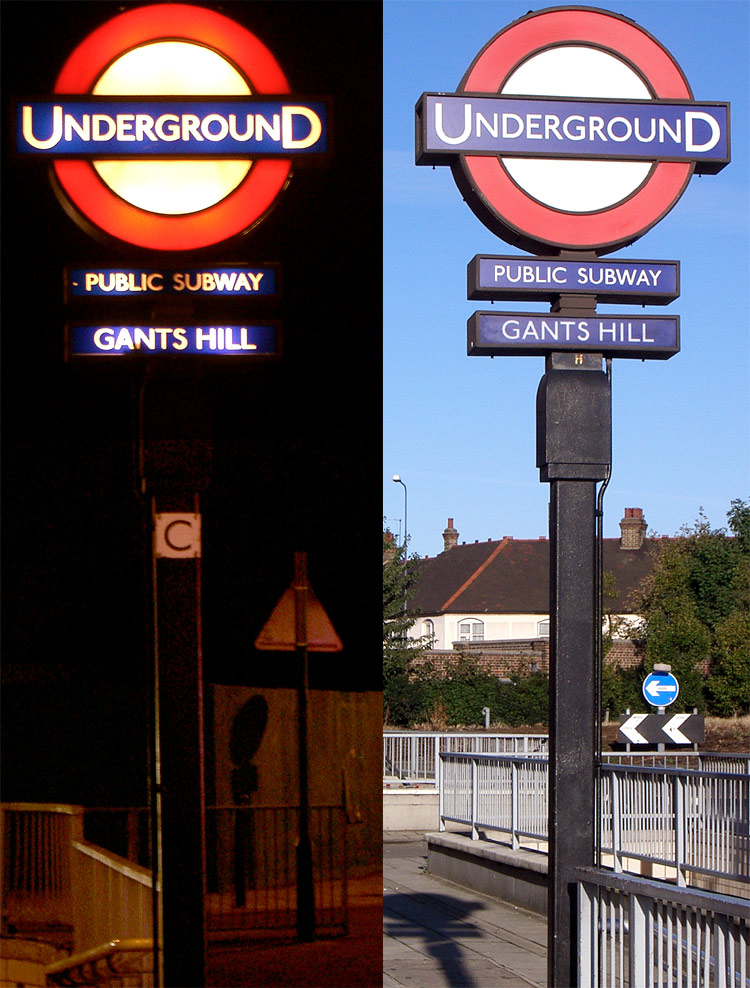
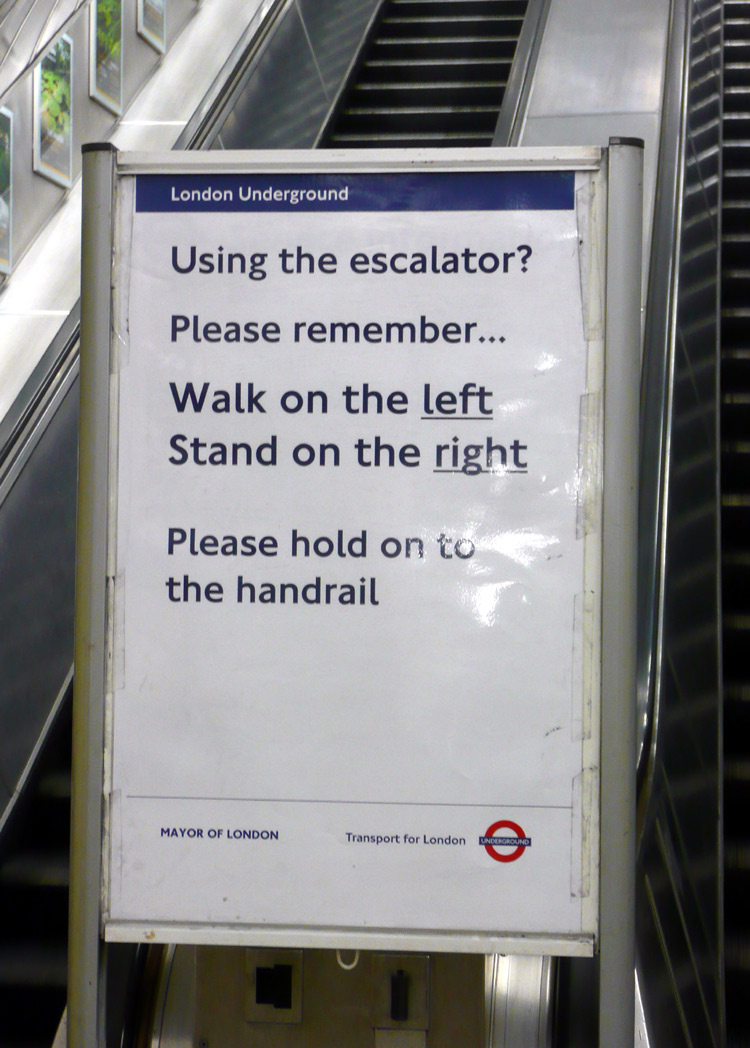
- which visitors are requested to follow.
As someone who usually walks I say "thank you" :-)
Please remember to hold the handrail: I do,
even when walking up / down the escalators!
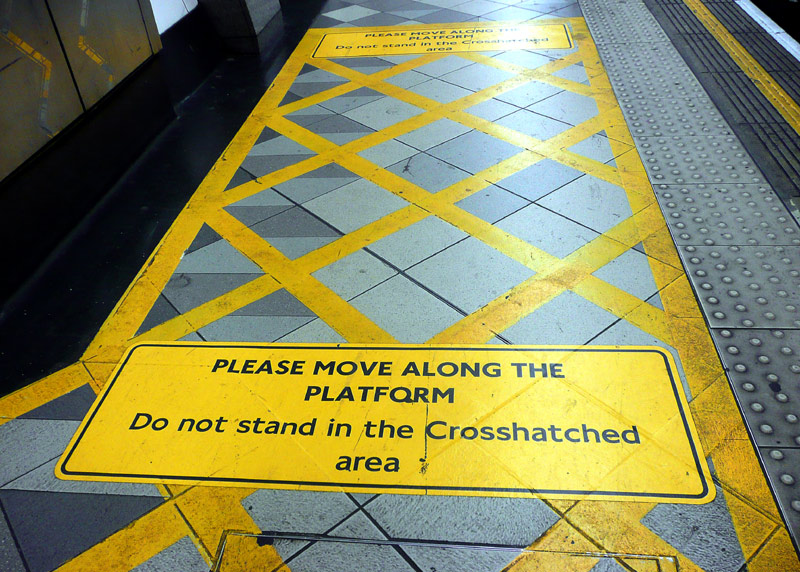
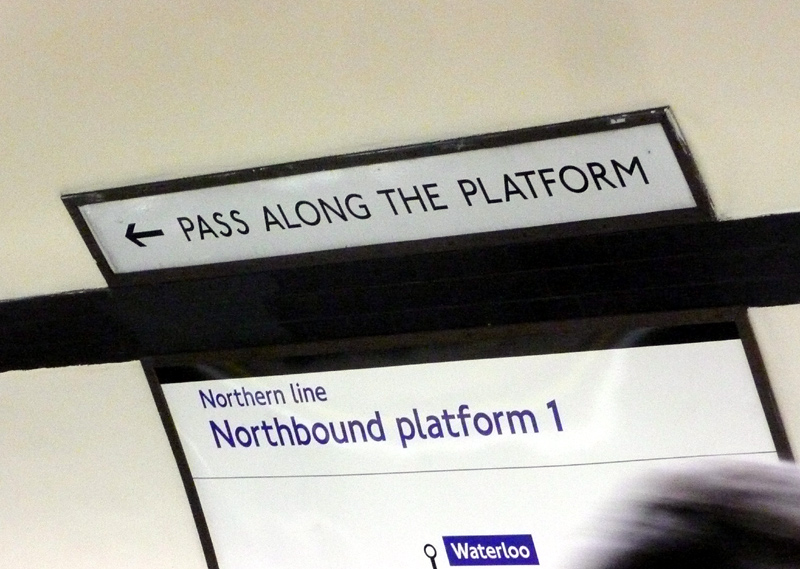
congregating near the entrance, where (at busy times) they cause congestion and prevent other passengers from also accessing the platform.
Visitor Centres
Transport For London (TfL) have several visitor centres at busier stations that are frequented by visitors to London.
These offer advice on the best ticket types for travelling around London, how to use Oyster cards, travel options for passengers who have special needs, how to reach visitor attractions - both in London and elsewhere in the UK, the most suitable ways for individuals (with their luggage) to travel to London's airports, and more.
They also sell Oyster cards, top-ups of the Oyster card electronic purse plus offer advice on refunds.
The Visitor centres can be found at:
*Heathrow Airport terminals 2 & 3 Underground station,
*King's Cross St Pancras Underground station (for arriving Eurostar passengers),
*Liverpool Street Underground station,
*Piccadilly Circus Underground station,
*Victoria main line station (opposite platform 8).
These are usually open 09:00 - 16:30 (9am - 4:30pm) but only some days of the week.
This link explains more:
https://tfl.gov.uk/travel-information/visiting-london/getting-around-london/visitor-centres 
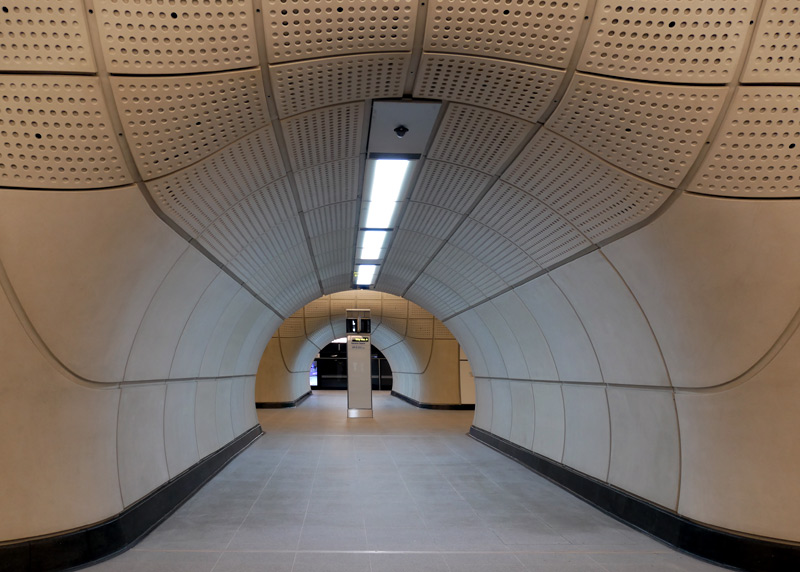
Victorian-era (pre-1901) to present-day 'space age' organic shapes that defy description.
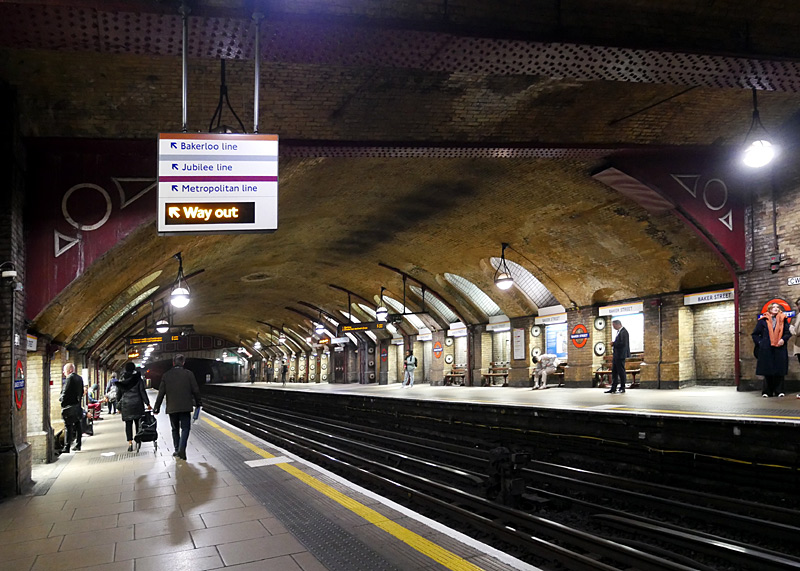
original Metropolitan Railway which opened in 1863.
The black soot on the tunnel roof comes from the 150 year celebrations in 2013 when a real steam train passed through these tunnels!!
cross passage between the platforms.
Fares and Tickets
London's railway fares are based on a zonal system, most of the information in this guide is about sights in zones 1-4 which covers the centre of London and much of the suburbs.
There are several ways to pay transport fares in London. Especially on the London Underground, Docklands Light Railway, London Overground and Elizabeth line buying paper tickets from the station at the start of the journey is the most expensive way to pay fares. But if you will only be travelling a little and just want to sample London's transports in the simplest way possible without worrying about ticket types or something going wrong which leaves you being charged more than expected, then this might be the easiest solution.
Cash cannot be used to pay a bus or Tramlink tram fare when boarding the vehicle, nor to buy tickets at the bus / tram stop - you must pay in a different way, as detailed below.
Since 2003 it has also been possible to pay transport fares using smart cards.
London's smart card is marketed as the Oyster card.
Depending on the type of Oyster card it can store a maximum of three prepaid season tickets plus some cash value in what is called an electronic purse (e-purse). Nowadays using the e-purse is known as Pay As You Go (PAYG) although sometimes you may see an old sign which refers to PrePay§.
Although Oyster cards have to be purchased the fares charged are usually significantly cheaper than the cost of paper tickets.
§The name PrePay is very accurate for smart cards which have an e-purse because the act of adding monetary value to the e-purse effectively means that the funds are given to the transport company in advance of travelling. This is in contrast with the Contactless bank card (or other device) system whereby a bank or credit card account is charged after the journey (at the end of the same day).
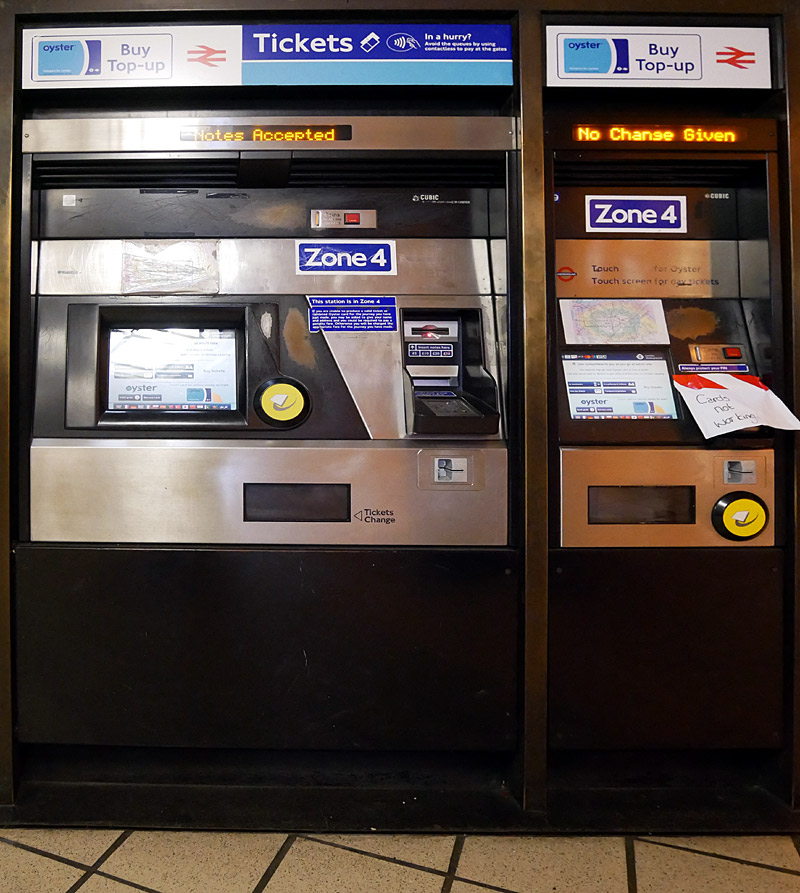
London Underground self-service ticket machines.
Some machines also sell Oyster cards.
Depending on value the refund might be in cash or it might be by cheque.
People who live in the UK can also use their UK bank account to buy Oyster cards via the online TfL contactless and Oyster account.
An anonymous Oyster card can be shared with anyone - although only one person can use it at a time. Being anonymous means that your name and address is not recorded.
If you wish an Oyster card can be registered with the user's name. An Oyster card which has been registered can accept the full range of tickets, including annual Travelcard season tickets, but it can only be used by the registered card holder. If lost or stolen the card can be cancelled and the tickets plus e-purse financial value transferred to a replacement.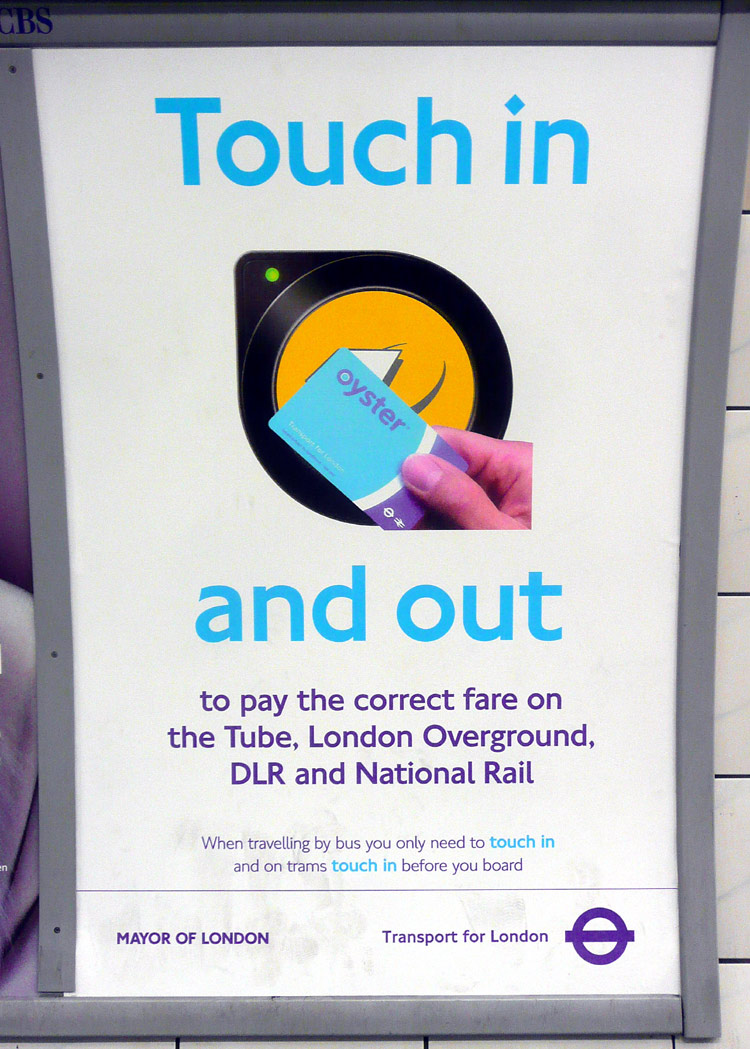
Poster reminding passengers using RFID
Oyster cards to tell the ticketing system's
computers where they are by touching in / out
every time they enter or leave a station.
It is also possible to buy a Visitor Oyster card before arriving in London.
These are sold at the Transport For London (TfL) online shop, on Eurostar trains travelling towards London, sometimes even on aircraft
flying towards London. Visitor Oyster cards are sold with some e-purse value so that they are ready to use. This is especially useful when arriving at airports / St Pancras Eurostar as it
means that you can avoid the ticket office queues and walk straight to the railway station platforms. Visitor Oyster cards have decorative designs which make for a nice souvenir of your visit. Plus you should be able to use them again on your
next visit to London! If returned for a refund only the e-purse value is refunded. Not the card fee.
Extra money can be added to the Oyster card e-purse at almost all railway stations in London (often only at the self-service ticket machines), TfL Visitor centres, the Tramlink shop in Croydon, via the TfL app, the online TfL contactless and Oyster account website and at over 3700 local shops throughout the London area.
Adding extra money to the Oyster card e-purse is known as a top-up.
No matter whether you are using cash or a plastic card there are no additional or handling fees for a top-up - so if a retail shop wants extra money then you should refuse to pay and complain to the Oyster helpline.
Please note that because of the high fees charged by the banks some retailers will refuse low-value top-ups if they are paid using a plastic card. This is fair. because otherwise the bank fees will cost the retailer more than they earn. However there should be no problem for low-value cash transactions.
Unlike Hong Kong, Singapore and other Asian cities, London's Oyster cards are only used for paying public transport fares - and not for general shopping.
In London many visitor destinations and some restaurants offer discounts to passengers who have Visitor Oyster cards. It is always good to ask!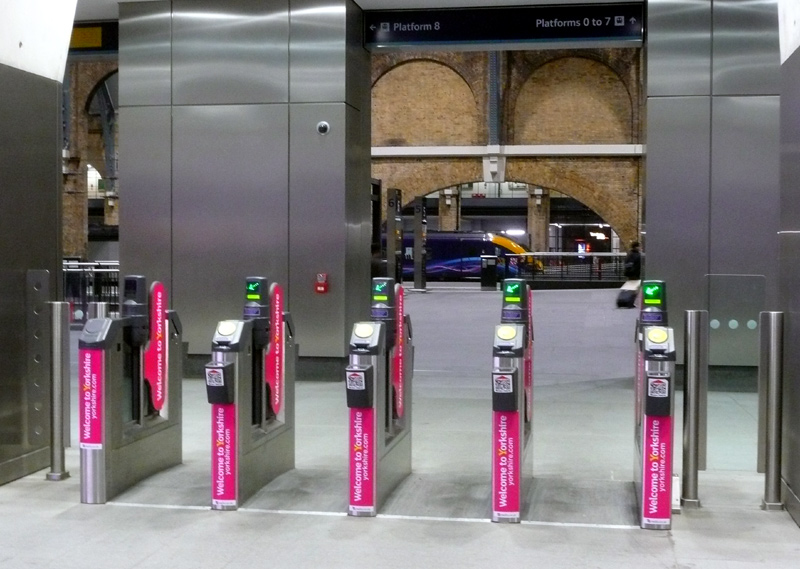
If using Oyster / Contactless PAYG to pay your
travel fares then you must always touch-in/out
when starting or ending a journey - even if
(as here) the ticket gates are open.
Filmed late at night at King Cross station.
When first introduced Visitor Oyster cards were advertised as never expiring, so that they could be used again and again on future visits to London. However, it is possible that some older types of Oyster cards will expire when the computer technology used by the PAYG ticketing system is changed. Only the Oyster cards which use older and less secure transaction protocols, such as MIFARE Classic, are expected to expire. Of course it will be possible to transfer the e-purse value to a replacement card. Oyster cards with a white letter D in a blue square on their backs will still work for years to come - these use a newer and more secure transaction technology called MIFARE Desfire. This applies to both ordinary and Visitor Oyster cards.
There is one significant disadvantage to buying a Visitor Oyster card. It is not possible to add weekly (or longer) season tickets to them. This only matters however if you are staying in London for more than a few days and wanted to buy a 'buy once - travel at will' season ticket. For this option you must buy an ordinary Oyster card.
Personal Security / Every Journey Data Tracking
If anonymous Oyster cards (and Visitor Oyster cards) are bought using cash and always have financial value added using cash then they are suitable for passengers who do not want their every movement tracked 24/7.
However it is also worth remembering that in London CCTV cameras are everywhere, and that some of these are connected to computers which detect people's activity and use facial recognition softwares.
Other Smart Card Fares Payment Options
Both Londoners and visitors from elsewhere in the UK can also pay their fares using EMV (EuroPay, MasterCard, Visa)¤ Contactless RFID credit and debit cards
and some smartphone apps. The fares are normally the same as with Oyster cards, although on days when many journeys are made the total fare charged sometimes works out as being slightly cheaper than Oyster cards!
All travel fares are charged to the credit / debit card accounts as a single transaction, overnight.
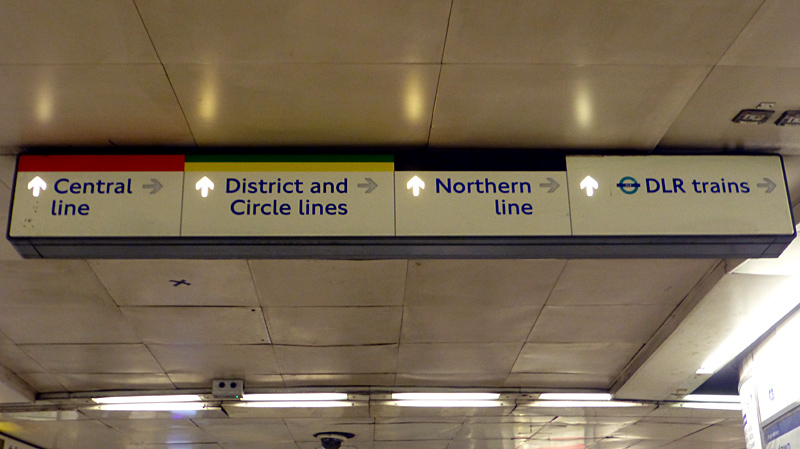
Illuminated wayfinding signage at Bank station, which
is at the heart of London's primary financial district.
Walking routes vary 'as required', especially as
part of the station is closed at weekends.
Some people from outside London may also have ITSO specification smart cards on which it might also be possible to load prepaid Travelcard season tickets that can be used within London, eg: The Key which is a ticketing solution from one of the major British transport operators. ITSO card holders need to investigate compatibility and acceptability before travelling - especially as whilst the ITSO specification includes electronic purses (for PAYG travel) these may be restricted to local geographic areas outside of London.
|
Electronic Ticketing Terminology
This website uses the word "Contactless" to refer to all forms of RFID / NFC / EMV bank debit / credit cards, smart phone apps, etc. |
In London each passenger must have their own payment card!
When using cards from bank / credit card accounts which are shared between several people (eg: a married couple) it is important that the long numbers (typically with 16 digits) and / or expiry dates are different. Otherwise only one passenger can use a card linked to that card account and the other passenger must use a card from a different account - or use an Oyster card.
Visitors from overseas will probably also be able to use Contactless bank cards and smart phone apps but should expect their bank to treat the transport fares as an overseas payment and charge currency conversion and overseas transaction fees.
There is a long term desire to encourage as many travellers as possible to use Contactless payment systems (especially EMV bank cards) instead of Oyster cards.Therefore Oyster is expected to remain for many years to come. As anonymous bank cards do not exist so it is easy for Contactless payments to include every person's travels to be tracked and recorded, in the process creating a massive database for commercial companies to exploit.
These links to other websites may also be of interest:
http://www.londontoolkit.com/briefing/travelcard_oyster.htm
http://www.oyster-rail.org.uk
https://tfl.gov.uk/fares/ The official TfL website which includes all ticketing types
https://tfl.gov.uk/fares/how-to-pay-and-where-to-buy-tickets-and-oyster/buying-tickets-and-oyster/buying-tickets-from-abroad
TfL website page which lists where to buy paper tickets and Oyster cards in many overseas countries .
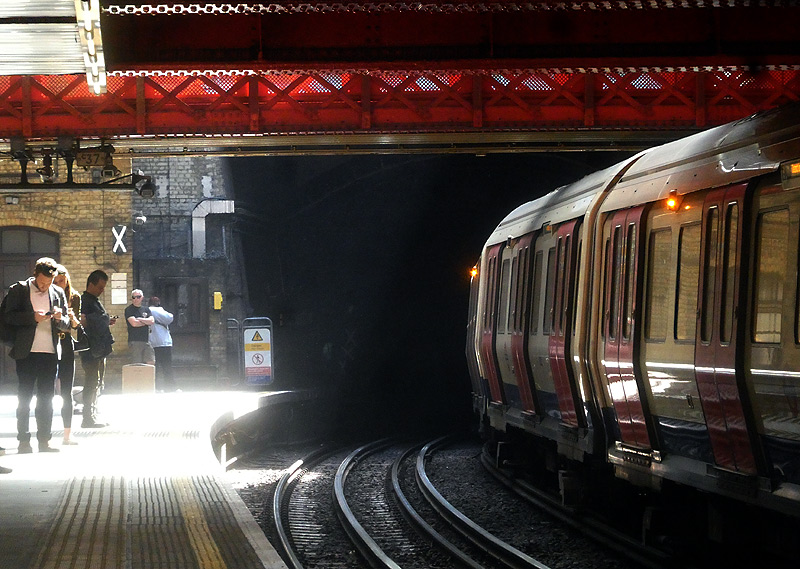
Sunshine beams down on the District & Circle line platforms
at Paddington. This is a subsurface S stock train.
Daily fares capping means that after a certain amount of travel fares have been spent on that day all future travel is free, although you must still continue to use card readers - at the start of bus and tram journeys and at both ends of train journeys. Sometimes you will also need to use a card reader during the journey - see below.
In London daily fares capping is based upon a 'touch-in' to start a journey after 04:30 am and a 'touch-in' to start a journey before 04:29 am the next day. This makes it possible for people who have been travelling on public transport during the day to stay up late at night and still benefit from fares capping when they return home (or to their hotel).
The cost of capped fares depends on the zones travelled in and sometimes also the time of day the smart card is used to touch-in. For journeys wholly within fares zones 1 - 6 the maximum daily cap is called Daily
Anytime and there is no off-peak discount.
Journeys which involve zones 7 - 9 have two daily caps - Daily Anytime and Daily Off-Peak. Daily Anytime caps are more expensive but they are only charged if you touch-in at a railway station in the morning
rush hour, Monday - Friday. Daily Off-peak caps are charged if you touch-in at any other time, and all day at weekends and bank holidays.
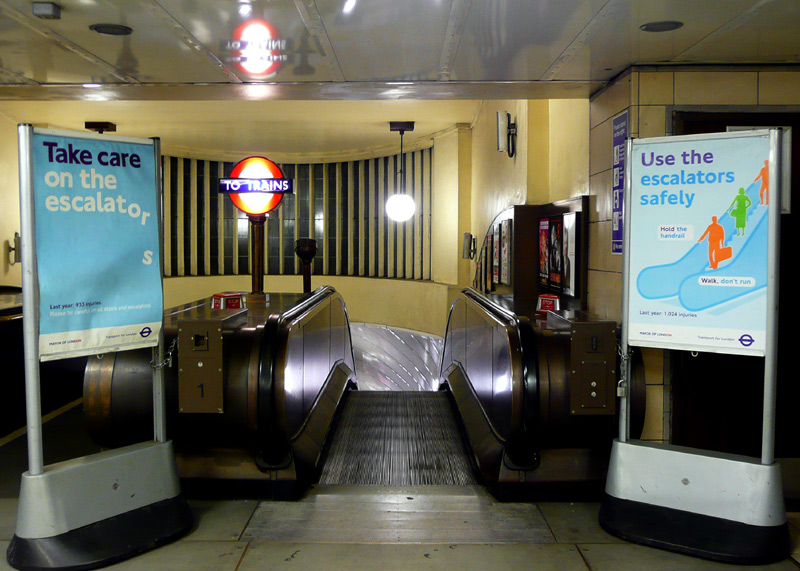
The escalator down to the trains at St Johns Wood
Jubilee line tube station, which is close to the
Abbey Road music recording studio and zebra
crossing made famous by the Beatles pop music group.
Fares Capping always includes Central London Zone 1 so if you do not need to travel in Zone 1 then (depending on zone combinations) it will usually work out cheaper to buy a weekly ticket if you are travelling for 4 (four) or more days
Most Fares Vary According To The Time The Journey Starts
With PAYG the cost of individual single fares depends on the time (and sometimes the direction) of your journey.
Fares are higher on Monday - Friday during the morning and evening busy periods. 'Rush hour' (also known as 'peak') fares are charged if you 'touch-in' at the start of a journey between 06:30 am and 09:30 am (even if the train leaves the station after this time) and between 4pm - 7pm (16:00 - 19:00). However, if you make enough journeys during on that day to reach the fares cap then this will not matter.
At weekends and on bank / public holidays off-peak fares and off-peak fare caps apply all day.
Most fares to and from Heathrow Airport are charged at peak rates all day (see below for more information ).
Some Fares Vary According To The Direction Of Travel
To encourage people to travel to central London (for shopping, to visit theatres, restaurants, etc.,) evening peak fares are not charged on journeys which start at a station
in zones 2 - 9 and ends at a station in Central London zone 1. Unfortunately this concession does not apply if the journey starts at a Zones 1 and 2 boundary station.
A special situation applies to passengers travelling on the London Overground (Lioness line) between Euston (National Rail / main line station) and Watford Junction.
Monday - Friday peak fares only apply on southbound journeys from Watford Junction station (towards Euston) in the mornings (06:30 - 09.30) and for northbound journeys towards Watford Junction in the
afternoons (4pm - 7pm / 16:00 - 19:00). Off-peak fares are charged all day on public / bank holidays and at weekends.
Oyster Card / Contactless Pink 'Route Validators'
Mostly the cheaper journey will have been made avoiding Central London Zone 1 but there are also some outer suburban journeys where different routes pass through different zone combinations and to charge for the correct fare the ticketing system needs to be told which route the passenger travelled. To encourage passengers to use pink route validators the default route will be the most expensive option.
Who Needs To Use Pink Oyster Card / Contactless 'Route Validators'?
Passengers paying their fares using PAYG on Oyster and other Contactless smart cards.
Passengers using a season ticket Travelcard (on an Oyster card) which does NOT include Zone 1.
Passengers making combination journeys using a prepaid season ticket Travelcard (on an Oyster).
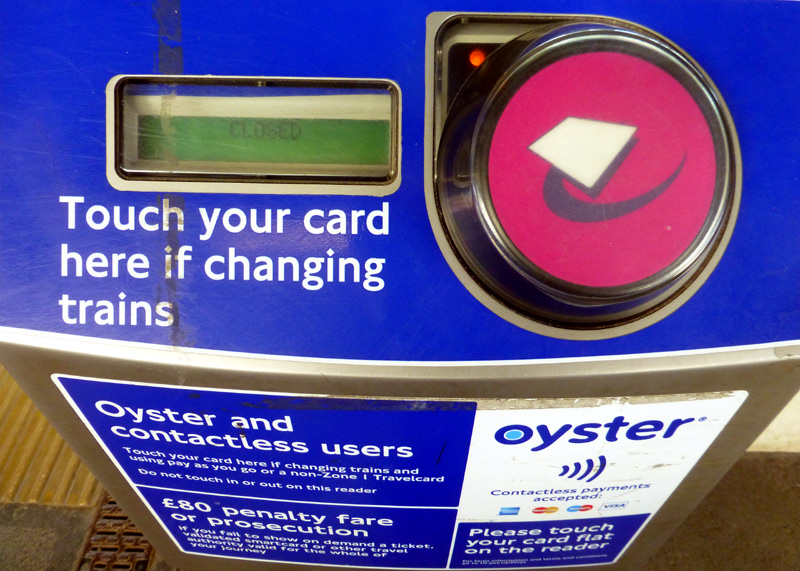
Pink 'Route Validator' Oyster / Contactless card reader.
Unfortunately for some journeys the system automatically assumes that you travelled via Zone 1 (and charges accordingly) no matter what route you actually chose to travel.
Beware London Overground (East London / Windrush line) Shoreditch station - this is in Zone 1. Many passengers do not realise this and find themselves having to pay more than they had expected.
Smart Card Reality
The RFID electronic cards used by London's Oyster / Contactless electronic ticketing system plus the ITSO compatible cards used outside of London may often be called smart cards,
but in reality they are very dumb. This is because they rely on error-prone humans to let the fares calculation system know where the passengers are at the start and end of each journey,
plus at interchange locations if they are eligible for cheaper fares.
Maybe one-day there will be no need to have card 'read' at each end of the journey (plus at interchange stations) as the fares system will simply scan people as they walk about... But do people really want to live in a society with a level of electronic surveillance which would mean that their movements are tracked 24/7, no matter where they are?
The Best Ticket For Railfanning
If you are going to spend a whole day railfanning then although they are more expensive I recommend using paper One Day Travelcard (ODTC) tickets. These can be used on almost ALL of London's trains (except Heathrow Express or the SouthEastern High Speed service between St Pancras and Stratford International) as well as most of London's buses and trams and once you have your paper ticket you are completely free to travel wherever you wish (within the zones in which it is valid) safe in the knowledge that you will not be forced into paying anything extra. The advantage of using paper tickets is that there are no time limits on how long your journey takes - so you can stop at stations and watch trains without also watching the time.
For some fares zones ODTC tickets cost the same no matter what time of day you travel. These are called 'Day Anytime'.
Other fares zones have two different prices with Day Anytime being more expensive
and 'Day Off-Peak' being cheaper. Passengers with Day Off-Peak ODTC tickets are not allowed to travel in the rush hour on Monday - Friday mornings. For most stations this means not before 09:30 am but at
some stations outside of London the rules are different. Off-Peak ODTC tickets can be used in the evening rush hours.
At weekends and bank / public holidays Day Off-Peak ODTC tickets can be used all day.
One Day Travelcard (ODTC) tickets are only available as paper tickets. These can be bought at most railway station ticket offices / ticket machines etc., and Visitor centres. Some ticket machines only sell them for travel 'today' or 'tomorrow' but at stations with proper ticket offices they can be bought a few days in advance of travel. ODTC tickets can NOT be bought at Oyster Ticket Stops (local shops). Note that in London tickets expire at 04:29 am the next morning - this allows you to use night buses as well.
DANGER! Beware Electronic Ticketing Journey Time Limits
Be VERY careful with the ‘pay as you go’ (PAYG) ticketing system. PAYG is advertised as being ideal for all passengers with the promise that providing you always 'touch-in/out' correctly when starting or ending your journey the total fares charged for that day will be 'capped' below the cost of a paper ticket (known as 'fares capping').
However, for railfanning there is a problem; PAYG enforces time limits on journeys, so if you keep stopping to watch trains and as a result the time between touching-in when you enter the 'fares paid area' and touching-out when you leave the 'fares paid area' is more than the maximum allowed journey time limit you could be charged two maximum PAYG fares - even if you have already reached the 'fares cap' for that day.
A single maximum fare in zones 1-9 can be as much as £9.40
For a journey outside zone 9 (or on the Heathow Express) a maximum fare can be as much as £26!
Because of this people on a limited budget without any spare cash may find themselves stranded somewhere in suburban London and unable to afford to get back to their hotel. This nearly happened to me (once!*) so I am speaking from the voice of experience.
| *This happened the first time I used the Oyster fares capping system instead of buying a paper One-Day Travelcard ticket.
I went out with my Oyster card plus just £10 in cash - as I was not going shopping I left my plastic bank cards at home! When I arrived at Uxbridge station I discovered that my journey had taken too long and I was being charged a maximum fare. The only way to solve this was to use the cash that I had intended for buying lunch to feed (add value / top-up) my Oyster card. |
If charged a maximum fare you should wait 48 hours before asking for a refund as sometimes the ticketing system will make an automatic refund.
Oyster card refunds are made the next time the Oyster card is used to touch-in for a rail journey
For contactless a refund will either show on the card statement or the fares charged for a subsequent journey will be adjusted.
No more than three (3) maximum fare refunds will be paid in one calendar month.
If you do not receive an automated refund then you have 8 weeks to claim (ask for) a refund.
No Single Day Oyster Pay Once Ride-At-Will Tickets
Even though this option is available elsewhere in the UK (eg: the Glasgow, Scotland Subway) as well as in many overseas cities, the people who decide London's fares have said that single-day Oyster smart card Travelcards are 'not possible' ‡ and that even if it was possible they do not want public transport passengers in London to buy electronic ticketing variants of either the Peak or Off-Peak Day Travelcard. They prefer PrePay / PAYG with fares capping, citing the ability to change one's journey at a whim without having to buy a new ticket as representing some kind of 'holy grail' that makes everything good.
‡This was in circa 2003, when the Oyster system was first introduced.
Some Londoners Avoid PAYG Ticketing - No Problems With Weekly / Other Period Oyster Tickets
There are some people here in London who dislike using PAYG electronic ticketing on the railways (buses / trams are OK). This is because they feel that there are too many problems with failed card reads (touch-in / out) that result in the system invoking maximum fares - which they see as being charged a penalty fare - even though they have done nothing wrong.
These issues do not usually cause problems to passengers with weekly or longer Travelcard period tickets that are loaded on Oyster cards - and who are only travelling within the correct fares zones for their ticket.
Staying For Several (Or More) Days?
Providing you stay within the zones of the ticket's validity there are no journey time limits.
Note that Travelcard season tickets can only be loaded on ordinary
Oyster cards and some types of National Rail ITSO compliant smartcards. They can NOT be loaded on to Visitor Oyster cards or used with any type of Contactless (bank card / smartphone, etc) payment system.
If you need to travel in Central London Zone 1 then you need to reach the Day Anytime fares cap for five (5) consecutive days before it becomes cheaper to buy a 7 Day Anytime Travelcard season ticket.
Fares Capping always includes Central London Zone 1 so if you do not need to travel in Zone 1 then depending on how many zones you need to travel in it could work out cheaper to buy a weekly Travelcard ticket if you are travelling for just four (4) consecutive days.
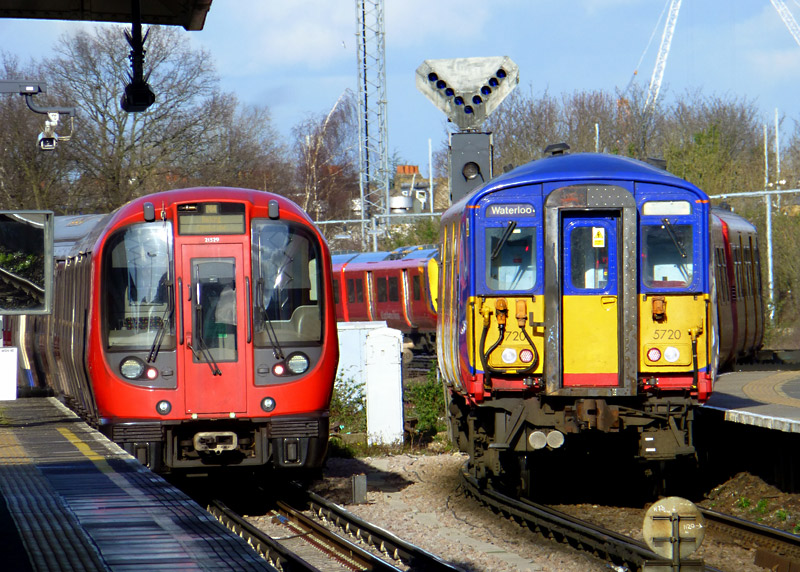
London Underground S7 District line and South Western Railway Class 455 trains side-by-side as they depart from Wimbledon station.
If you also load some PAYG value on the Oyster card and remember to 'touch-in / out' at both ends of your journey then you are also allowed to travel outside the zones of the ticket's validity. Any extra charges are automatically collected when touching out at the end of that specific journey - but beware of journey time limits.
Note that most 'National Rail' train operators require that passengers with season tickets (even if only for one week) also have a photocard. These are free to obtain and just require a passport type photograph.
BritRail / Eurail Pass? National Rail Railcard?
Overseas visitors with BritRail / Eurail passes should check their documentation as it is likely that they will need to buy additional tickets for travelling on the London Underground / DLR / Tramlink.However these passes are accepted on London's suburban trains - including the London Overground and Elizabeth line, which are also 'main line' / National Rail train services.
There could be a grey area where Underground and main line trains provide shared services - it may be best to only travel on the main line train, so that even if the Underground train comes first (and is travelling on the same tracks) you stay on the platform / wait for the main line train.
Holders of National Rail / main line railway railcards may find that they can benefit from cheaper tickets - a lot depends on the type of card they have. Sometimes the discount can be 'loaded' on to an Oyster card that is registered it in your name, as then the discount is automatically applied. Sometimes it is also possible to buy discounted one day Travelcards - although often on weekdays there is a minimum charge which negates the benefit. The documentation will explain more.
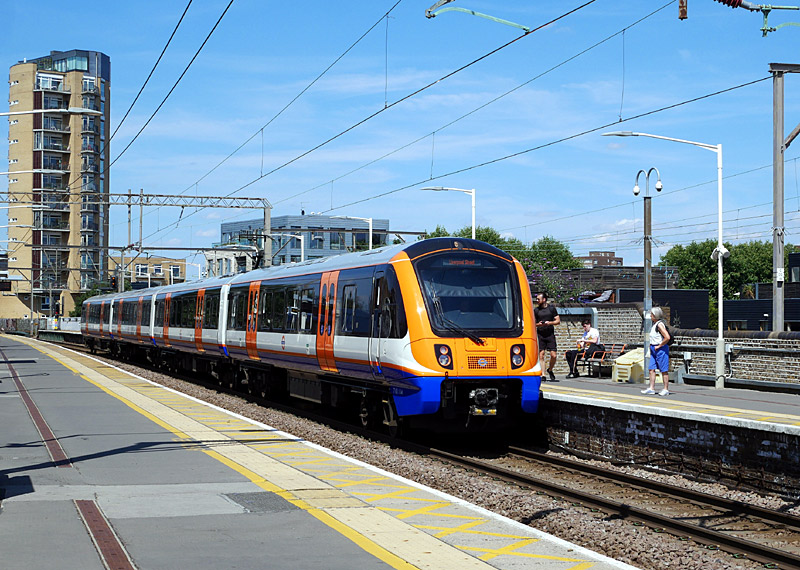
The BritRail / Eurail Pass and All Line Rail Rover tickets
can be used on 'main line' (National Rail) suburban
trains in London - this includes the London Overground
and Elizabeth lines.
Class 710 London Overground (Weaver line) train
travelling towards London Liverpool Street arrives
at London Fields station.
All Line Rover?
All Line Rovers are effectively National Rail season tickets which can be used on almost any train on the main line railway system. This includes London Overground, Elizabeth line and virtually all of London's suburban railway network. However, they are NOT accepted on the Underground / DLR / Tramlink, as these are not part of the main line / National rail network. They are also not accepted on the privately funded Heathrow Express.
All Line Rovers can be bought by anyone, whether a British resident or otherwise. They are available in 7 and 14 days versions. The various private companies which operate the national railway network do not like this ticket because they say that they do not receive enough money from it. Therefore it is hardly ever promoted and can sometimes be difficult to purchase.
Unfortunately there are some restrictions prohibiting their use to board or alight from trains at 10 railway stations - including several in or near London - before 10:00 in the morning on weekdays (Monday - Friday). However this does not apply at weekends or on bank / public holidays.
More information can be found at this link:
http://www.railrover.org/pages/all-line.html
This link which leads to information on all the British railway rover tickets by main line / National Rail companies:
http://www.nationalrail.co.uk/times_fares/rangers_and_rovers.aspx
2FOR1 Visitor Attraction Entry Discounts
This offer is also available to people who have paper One Day Travelcards BUT these MUST be bought at a National Rail / main line railway station and NOT at an Underground / DLR / Tramlink station or ticket machine. Eurostar tickets, Eurail passes, Heathrow Express, Oyster or other Contactless (ie: bank cards etc.,) are also NOT accepted for this offer.
BEWARE: Some transport staff do not understand the significance of where the ticket is bought - you want a ticket which is orange and cream with the National Rail logo (the two half arrows pointing in opposite directions). See the photograph on the right.NB: the 2FOR1 offer can even be used by people who live in London, but they must have the 'right' type of ticket!

The 2for1 offer can only be used if passengers have
paper tickets for travel to / within London which
look like this platform ticket.
Image & license: Ansbaradigeidfran / Wikipedia encyclopædia.
CC BY-SA 3.0 http://commons.wikimedia.org/wiki/
File:National_Rail_platfrom_ticket_Kings_Cross.jpg
These links explain more, and you can also download the special vouchers you will need from here:
https://www.daysoutguide.co.uk
https://www.daysoutguide.co.uk/travel-by-train/is-my-ticket-valid-for-2for1-and-other-offers
Smart Card And Other (Often Cheaper) Ticketing When Travelling To / From London's Airports
Heathrow Airport: As this airport is in London Oyster cards and other Contactless ticketing systems can be used on the Piccadilly and Elizabeth lines. Note that Day Anytime fares are charged at all times on all journeys to / from Heathrow Airport which involve travel to (or through) central London fares zone 1.
The cheapest service is via the Piccadilly line, but it can take 50+ minutes to reach central London. Note that trains going to Terminal 4 might stop / wait at that station for as long as 7 - 10 minutes, so passengers who wish to go to Terminals 1, 2 or 3 should catch a train going to Terminal 5.
The Elizabeth line replaces the former Heathrow Connect service and journeys are faster than the Piccadilly line but the fares are also higher.
One-day and period (weekly, monthly, etc) Travelcard tickets which include Zone 6 are also accepted for travel to Heathrow Airport on the Piccadilly and Elizabeth lines, and can be bought at Heathrow Airport.
If you are buying a one-day Travelcard and are travelling before 9.30 am Monday - Friday you must buy an 'Anytime' one-day Travelcard. Otherwise an off-peak Travelcard will be better (cheaper).
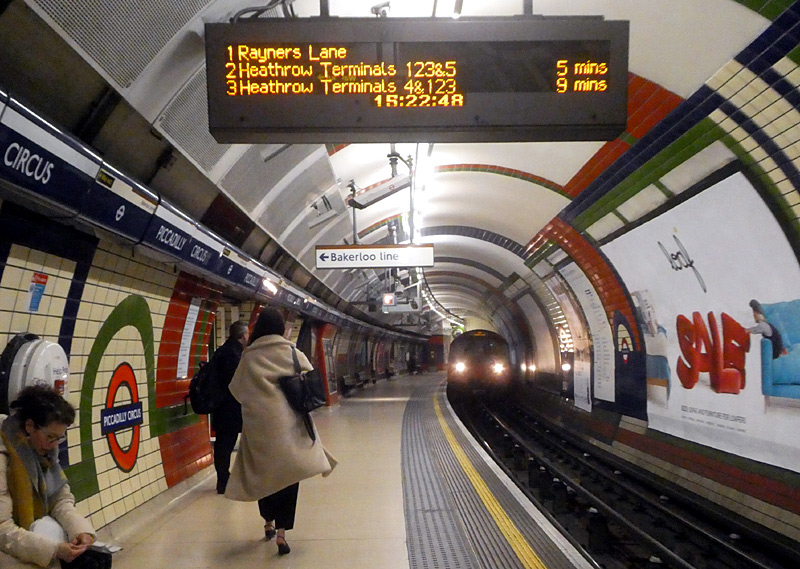
A Westbound Piccadilly line tube train for Rayners Lane
arrives at Piccadilly Circus station.
The next two trains are going to Heathrow Airport -
but different terminals 123&5 then 4 stop &123.
Oyster cards and other Contactless payment systems in PAYG mode can also be used to pay for travel on the Heathrow Express trains to / from London Paddington station. To ensure that the correct fare is charged you must touch in/out at both ends of your journey, including using the card readers at the dedicated Heathrow Express platforms at Paddington station. Travelcard tickets are not accepted on the Heathrow Express. Because the station platforms now have electronic ticket gates it is no longer possible to pay for travel once on the train - instead tickets must be bought at the station before boarding the train.
Note that whilst it is possible to buy tickets at the stations immediately before travel it is better to buy advance purchase tickets on the Heathrow Express website or app - the cheapest fares are available when bought 90+ days in advance of travel.
Passengers who wish to travel in Business First carriages who only have ordinary Express Class tickets will be asked to pay the upgrade fare once on the train. Business First offers a more private, spacious environment with wider seating and tables where passengers can work, plus a selection of complimentary magazines and newspapers. Also, Business First passengers departing from Heathrow Airport are entitled to a special Fast Track lane through security at Heathrow Airport.
Gatwick Airport: There are three main ways to travel by train between Gatwick Airport and central London.
i) The Gatwick Express is a premium express service running non-stop between Gatwick Airport and London Victoria railway station.
ii) Southern operate the ordinary stopping (all stations), semi-fast and fast trains which only call at a few stations. Mostly these trains travel between other destinations in southern England and London's Victoria station, with Gatwick Airport
being just one of the stations served during the journey.
iii) Thameslink trains also travel to the south coast but the trains that go to Gatwick Airport also serve the following important central London railway stations: London Bridge, City Thameslink, Farringdon and St. Pancras. Some Thameslink trains
also call a few other stations in south London. After St Pancras Thameslink trains travel to various destinations to the north of London - some of these trains also call at Luton Airport Parkway.
Oyster cards in PAYG mode and Contactless ticketing are accepted on all three of these services as a way to pay fares when travelling between London and Gatwick Airport. You need to ensure that you have sufficient financial credit on your Oystercard before travelling - the actual cost of the travel will depend on the time of day when you touch-in at the start of the journey (rush hours are more expensive) and the fare charged by the train company.
Whilst Oyster / Contactless etc., offer the easiest and simplest ticketing solution (ie: no need to queue to buy tickets at the airport) it is important to note that these can sometimes be the most expensive way to pay fares between London and Gatwick airport. Depending on the time of travel (rush hour? off-peak?) paper tickets bought at stations might offer cheaper fares. Very often the cheapest fares come from pre-paid advance purchase tickets (bought from the Internet). As Gatwick Airport is outside of London it is possible to buy Visitor Oyster cards here - this will make life easier when you arrive in London.
Note that Gatwick Express trains are only about 5 minutes faster than many longer-distance Southern services (which might only call at one or two station within London Clapham Junction, East Croydon) so unless you bought a very cheap Gatwick Express ticket on the internet or are in a big hurry it is often more sensible (cheaper) to travel on Southern trains - or Thameslink if their services serve stations that are more convenient for you.
In theory Travelcard tickets are not accepted on the Gatwick Express but some passengers have found that it is allowed if they also have an 'out-boundary' ticket to cover the section of the journey beyond the range of the Travelcard with a route of 'Any Permitted' (see below).
Luton, Southend Airports: These airports are only served by regular train services - not airport express trains. They are also both outside of London and whilst neither of the train services to these airports accepts Oyster smart card ticketing - they *do* accept Contactless bankcards, etc.
Tickets can also be bought online and at stations immediately before travelling. Advance purchase tickets are usually cheaper than paying at the time of travel - ideally the train tickets should be bought at the same time as the air tickets. 'Print at home' tickets (perhaps with a QR code) are sometimes an option when buying train tickets on the Internet.
Stansted Airport: No 'London' ticketing system is accepted on the Stansted Express - it is best to buy Advance purchase travel tickets on the Internet - at the same time as when you buy your air tickets.
You can buy a Visitor Oyster card at Stansted airport - this might make life easier when you arrive in London. The Stansted Express is the only train service between Stansted Airport and London Liverpool Street station.
City Airport: This airport is inside London and Oyster cards / Contactless are the most cost-efficient way to pay travel fares. Travelcard tickets should be available from the ticket machines.
St Pancras Eurostar: This too is inside London and Oyster cards / Contactless are accepted. The last time I travelled on a Eurostar train it was possible to buy a Visitor Oyster card at the buffet counter on a Eurostar train travelling towards London. Travelcard tickets should be available from the ticket machines.
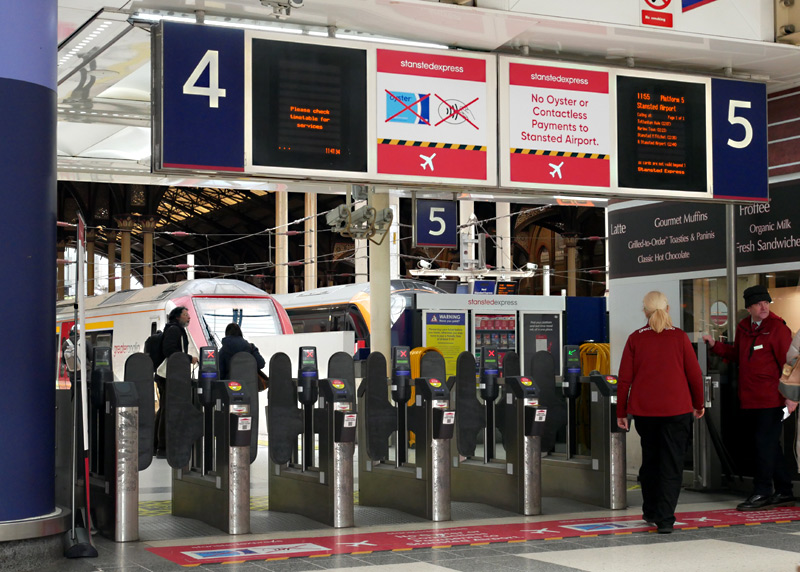
The ticket gates at London Liverpool Street
station for the Stansted Express trains.
Note the signage above the gates making it
quite clear that Oyster and other contactless
payment systems are not accepted.
Whilst Oyster and other Contactless cards are accepted for travel on the SouthEastern High Speed service between London St Pancras and Stratford International stations, special (higher!) fares are charged and these are NOT included in the fares capping system.
Boundary Zone / Out Boundary Tickets
Londoners who have Travelcard season tickets and wish to travel to an airport outside of London (Gatwick / Luton / Southend) often buy Boundary Zone tickets. Note that these are rarely sold on the Internet and might not be available at ticket machines - you will probably need to go to a ticket office at a National Rail station. Boundary Zone tickets can be bought for use with one-day Travelcards but the rules are different and evening peak hour restrictions might affect your journey.
Boundary Zone tickets are also useful if you have a Travelcard season ticket and (for instance) wish to visit attractions / destinations outside of London (eg: Brighton, Southend-On-Sea, Windsor). These make travel cheaper because passengers are only charged for the part of the journey beyond the zones of the Travelcard season ticket.
For someone visiting London one-day Out Boundary tickets will probably only make financial sense if they arrived at one of these airports and are in London on a day trip - or are on a short visit (just a few days) and are staying at a hotel that
is outside of London. For longer visits a weekly Out Boundary season ticket might make financial sense - especially if you wish to travel before 9:30am in the morning. Buying a single ticket that covers all travel will make life more convenient!
(for Luton the fare on the DART shuttle might need paying separately).
Gatwick Airport Out Boundary Ticket Cost Variations
This is a crazy situation but because of railway privatisation the cost of Out-Boundary tickets will vary depending on whether you were travelling on Gatwick Express, Southern or Thameslink
trains - they all charge different fares!...
Tickets valid on all trains, including Gatwick Express will show a route of 'Any Permitted'. (These are the most expensive)
Tickets for Southern will show 'Not Gatwick Express'
Tickets for Thameslink only will show 'Thameslink Only'
The cost will also vary depending on whether the ticket is valid all day or only off-peak. Thameslink also offers 'super-off-peak' (ie: slightly cheaper) fares at weekends and Bank Holidays.
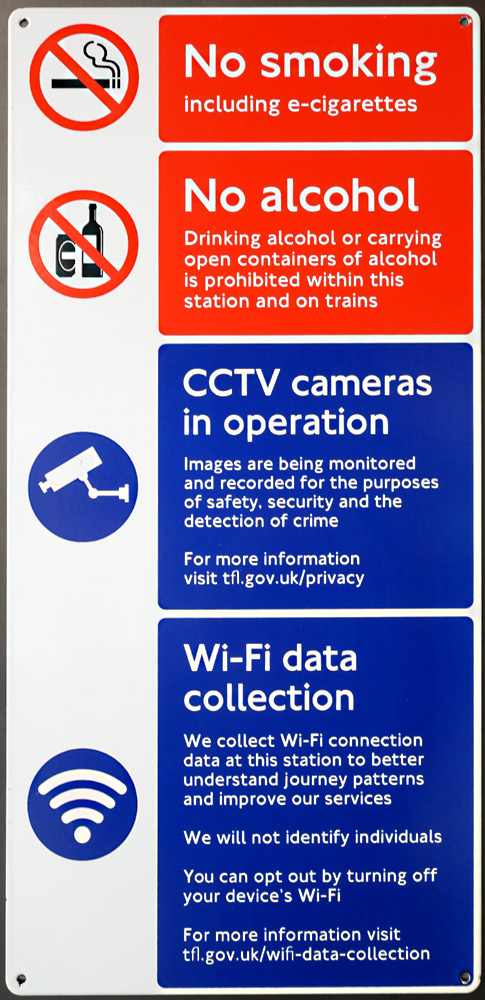
A sign seen at an entrance to an Elizabeth line
ticket hall at Bond Street station.
Only Travelling By Bus?
London’s buses charge a flat fare irrespective of distance travelled and time of day travelled. Bus passengers only need to 'touch-in' when boarding at the start of the journey.
In London it is NOT possible to pay bus fares to the driver using cash.
For people who will only be travelling on buses - and not trains - then using Oyster / Contactless in PAYG mode represents the cheapest way to pay fares.
What is called a Hopper fare means that passengers can benefit from an unlimited number of bus journeys within 60 minutes of the 'touch-in' at the start of the first journey. You must still use the card reader when boarding the bus, but you will not be charged anything! Once you are on the bus you are allowed to complete that bus journey, even if it takes you over the 60 minute time limit
Hopper Fares do not apply to the railways, river buses or IFS Cloud Cable Cars but the 60 minute rule still applies - even if you travel on any of these between your bus journeys.
Bus / Tram Fares Capping
In addition to Hopper Fares bus passengers benefit from bus / tram fares capping, which means that no matter how many bus / tram journeys you make you will only be charged a maximum of three (3) times per day. In London daily fares capping
is based upon a 'touch-in' to start a journey after 04:30 am and a 'touch-in' to start a journey before 04:29 am the next day. The same bus / tram fares cap applies at all times. There is no 'peak' or 'off-peak'.
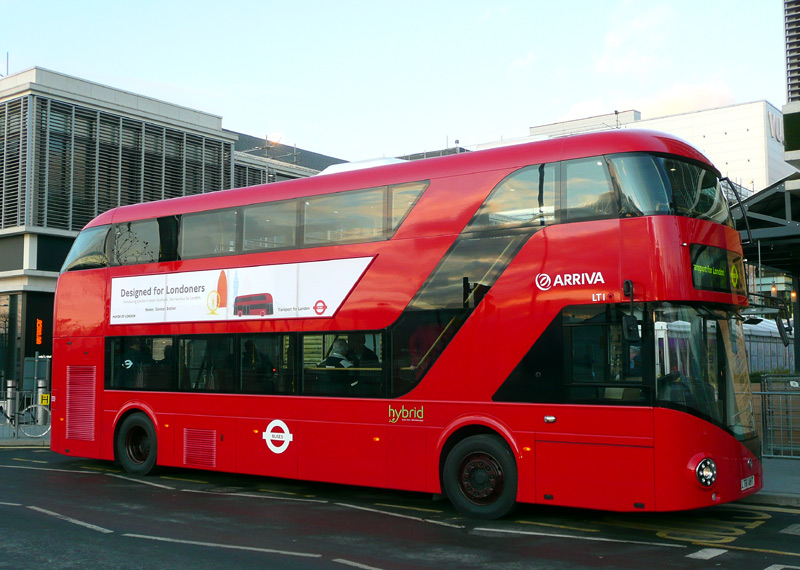
The first of the 1000 New Routemaster buses
which were created to fulfill an election promise
for (former) Mayor Boris Johnson.
These buses are used on many bus routes serving
much of Central London and some suburban districts.
Note 2: Free travel and fares capping only work when you use the same Oyster or other Contactless payment card (or device) at all times.
If staying for five days (or more) then a weekly bus pass might be worthwhile.
Typically these are loaded on an ordinary Oyster card (but NOT Visitor Oyster cards,
Contactless cards or smartphone app).
One Day Bus & Tram Pass
People who wish to travel by bus and neither have Oyster cards nor any of the other types of Contactless ticketing solutions can pay their bus fare by buying a one-day Bus & Tram pass. Although slightly more expensive than the daily Bus & Tram fares cap these are ideal for
passengers who are only in London for a day or two, are not also travelling by train and / or want a physical souvenir of their visit. One Day Bus & Tram Passes can only be bought on the day of travel and are valid from 00:01 am on that
day and for any journey that starts before 04:30 am the next day.
Since March 2025 One Day Bus & Tram passes can only be bought in the form of special Oyster smart cards which are sold at local retail shops (Oyster Ticket Stops newsagents, etc.,) and at Visitor Centres. These are single-use smart cards which cannot be used for anything else. (The printed paper versions which used to be sold at many railway station ticket machines have been withdrawn.)
Buses Have Just One Fare Zone
London's buses only have one fares zone so it does not matter where you are, the fare is the same. Also, Day Anytime, Day Off-peak and 7 Day Anytime Travelcard season tickets can be used anywhere in London - even if the ticket is only for
railway Zones 1-2, on the buses this ticket can be used to travel in all the zones - and also on most of the red London buses which travel outside of London.
Superloop
Superloop is a new bus service which started in 2023, with most routes being introduced in 2024 and one (SL4) in 2025 when two new road tunnels below the River Thames opened.
Superloop comprises a network of 10 limited-stop bus routes. Seven of them link to form an ^almost^ circle around suburban London and the other three link outer suburban areas with destinations nearer to central London. Most Superloop routes are brand new, however a few previously existed and have now been rebranded.
The various Superloop bus routes use a mix of single and double deck buses, most of which have white upper decks / roofs.
The official description of the Superloop bus network is: Connecting key outer London town centres and transport hubs.
^There is a gap at the River Thames - whilst SL2 serves the free Woolwich Ferry on the northern side of the river the SL3 goes to Thamesmead and therefore no Superloop buses serve the southern side of the Woolwich Ferry.
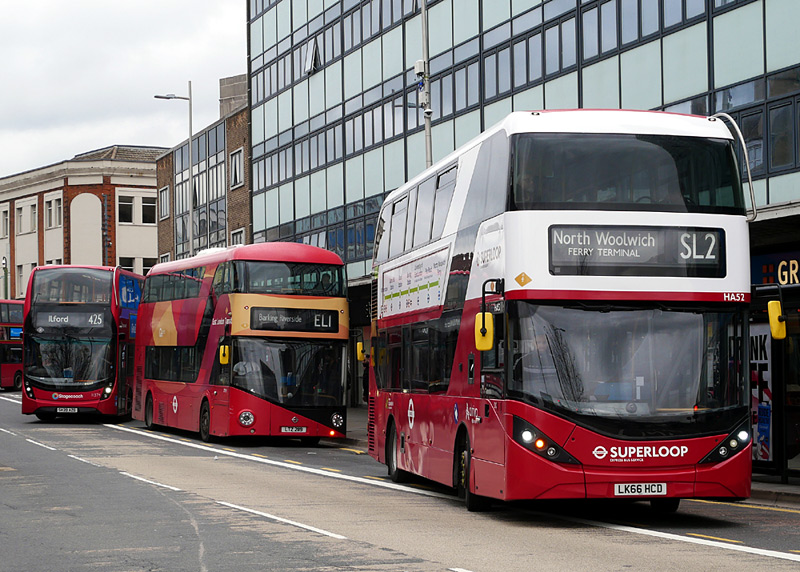
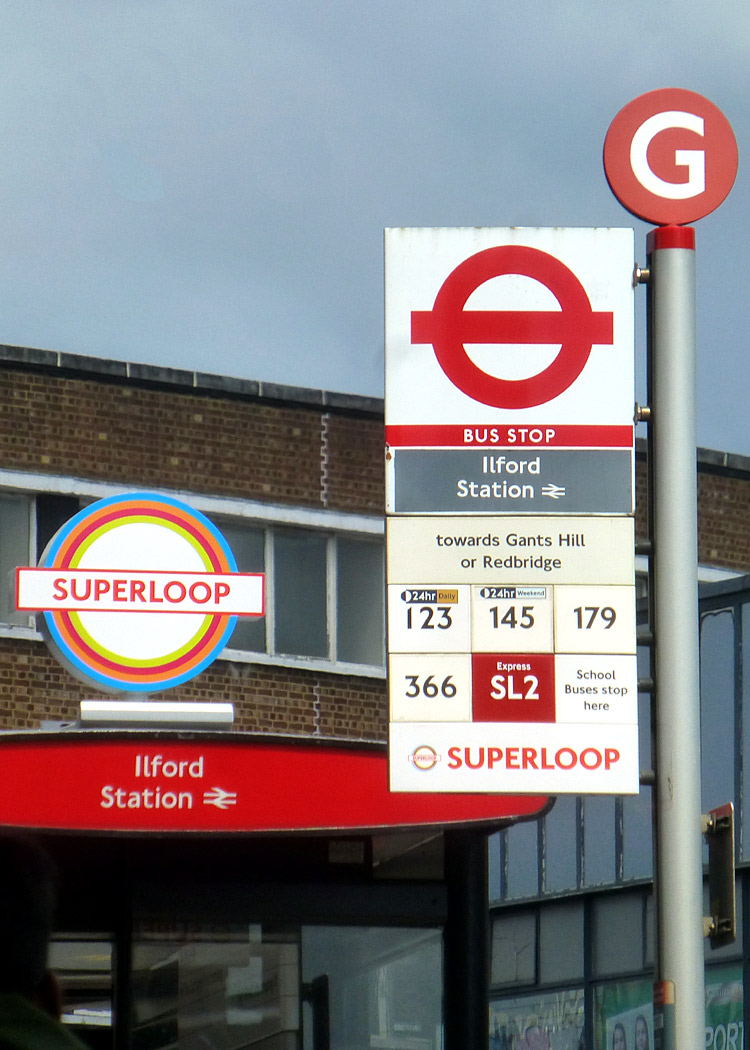
The Superloop is a limited stop service whilst
East London Transit buses call at all bus stops.
Both Superloop and East London Transit charge normal London bus fares and the full range of Oyster / Contactless,Travelcard etc., tickets are also accepted.
The East London Transit (ELT) is a network of three specially-branded bus routes (EL1 - EL3) which link rejuvenated riverside areas with neighbouring areas.
ELT bus services use New Routemaster buses, most of which are in a special red and beige livery.
Although originally planned to be more significant the ELT is just a normal urban bus service.
Other Bus Services
Also note that there are a few other bus services in London which do not accept any type of 'London' ticket.
Some of these are longer-distance tourist-themed sightseeing services, often using open-top double deck buses, or longer distance motor coach services to airports and other towns and cities within the UK. These are beyond the scope of this website.
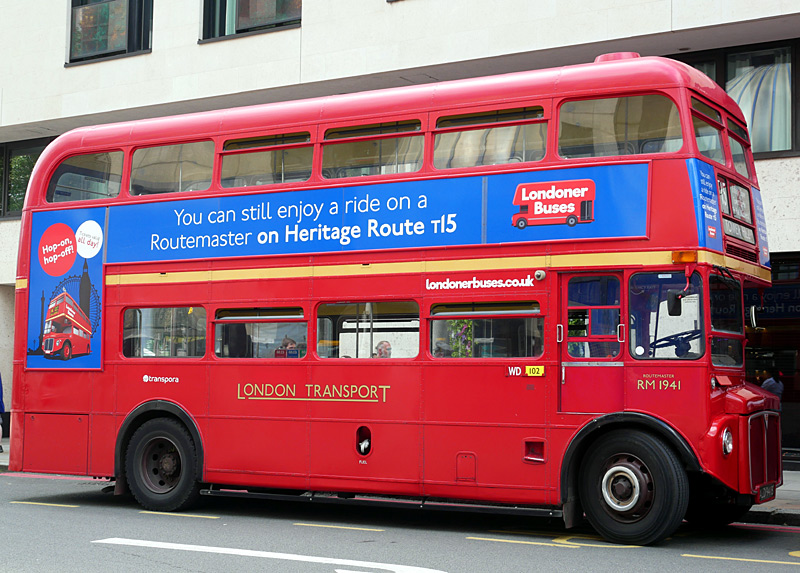
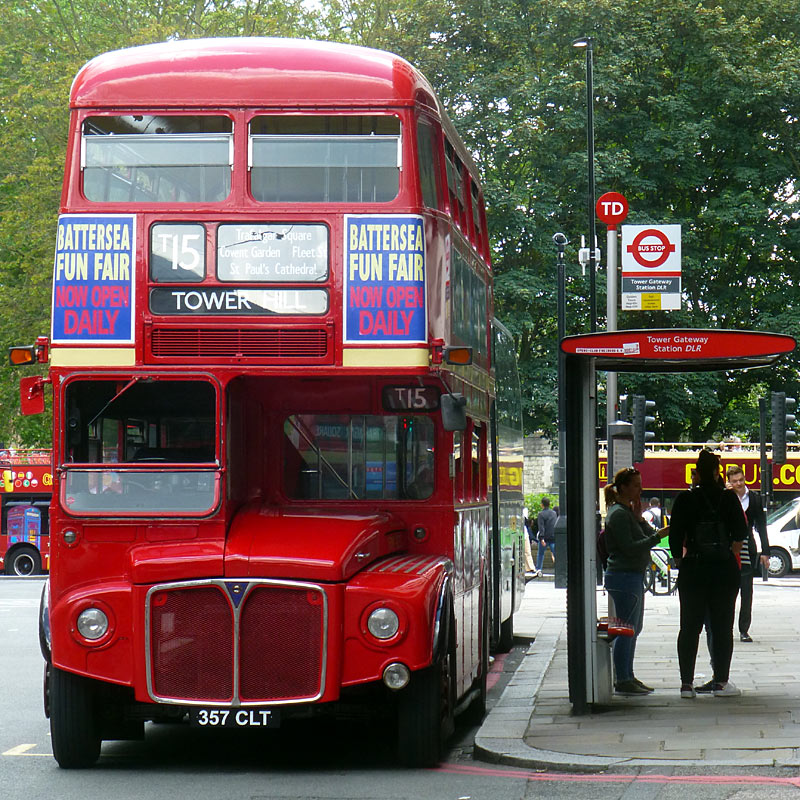
but only on privately operated leisure services.
These links lead to *some* of the private companies which operate the original iconic Routemaster buses in London. As a general theme they are used as sightseeing tour buses - often with a tour guide who also acts as an entertainer. There are also some companies which specialise in hiring a Routemaster bus, eg: for a private tour of London's sights, sometimes with afternoon tea / other refreshments, as transport for guests to a family wedding, more... All these services charge special fares.
https://www.londonerbuses.co.uk/
A regular service every 40 minutes from special bus stops passing many top visitor sights. Both single fares and hop-on hop-off ride-at-will day fares are available.
https://www.theclassictour.com/
Sometimes uses open top double deck Routemaster buses.
https://www.theghostbustours.com/london/
A comedy - horror theatre experience on wheels as the specially decorated Routemaster bus passes London locations with gruesome histories.
https://b-bakery.com/london/bus-tours/afternoon-tea-bus-london
Afternoon tea on a Routemaster bus tour.
More information about afternoon tea tours - on other types of buses, including river buses can be found here:
https://www.visitlondon.com/things-to-do/sightseeing/sightseeing-tours/afternoon-tea-tours
Visitors on a limited budget who cannot afford special services can use ordinary buses to create their own sightseeing tour of London - bus route No.11 is sometimes used for this much cheaper solution. Normal bus fares apply.
There is also a website where it is possible to find the location of any bus is London
http://londonvf.co.uk/.
Tram Fares
Tram passengers generally pay the same flat fare as bus passengers, and passengers with smartphone apps, Contactless and Oyster cards should use the card readers on the tram stop platforms before boarding the tram. This includes at Elmers End and Wimbledon stations where the trams stop inside the railway stations' fares paid areas. ALL Passengers travelling TO Wimbledon who are using electronic ticketing, no matter what type - ie: even if it is a Travelcard season ticket - are supposed to 'touch-in' before boarding the tram.
It is also possible for passengers interchanging between a tram and a bus (or between two trams) to benefit from the Hopper fare for free journeys, as detailed above.
Special Tram Fares Zone / Travelcards And Trams
Although Croydon and its railway stations are in zone 5 and some tram stops are also in zones 3, 4 and 6, to make life simple the entire tramway system is a special fares zone of its own and only Travelcard
season tickets which are valid in railway zones 3, 4, 5 or 6 can be used on the trams. Note that this need for Travelcards to be valid in at least one of the zones served by the trams is one of the few
differences between tram and bus fares.
Tramlink stops used to have ticket machines where passengers could buy tickets using cash. However these were withdrawn in July 2018.
There is more tram ticketing information on the Tramlink page.
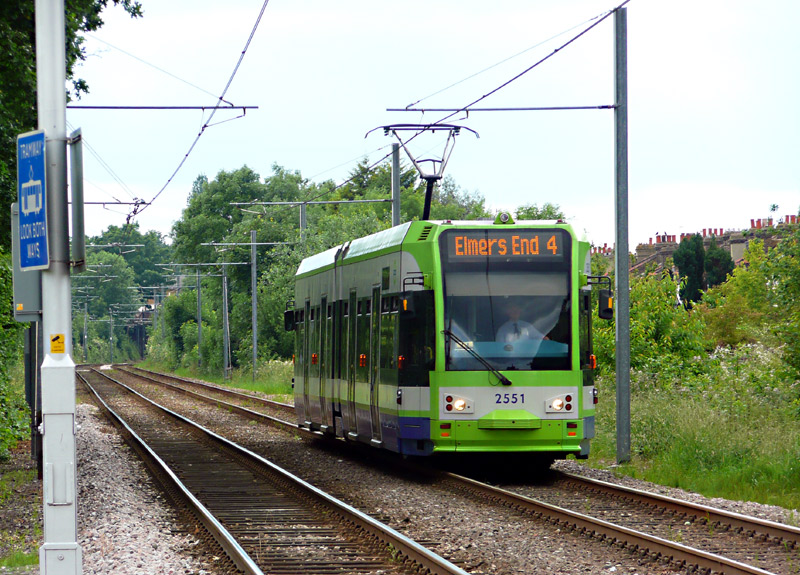
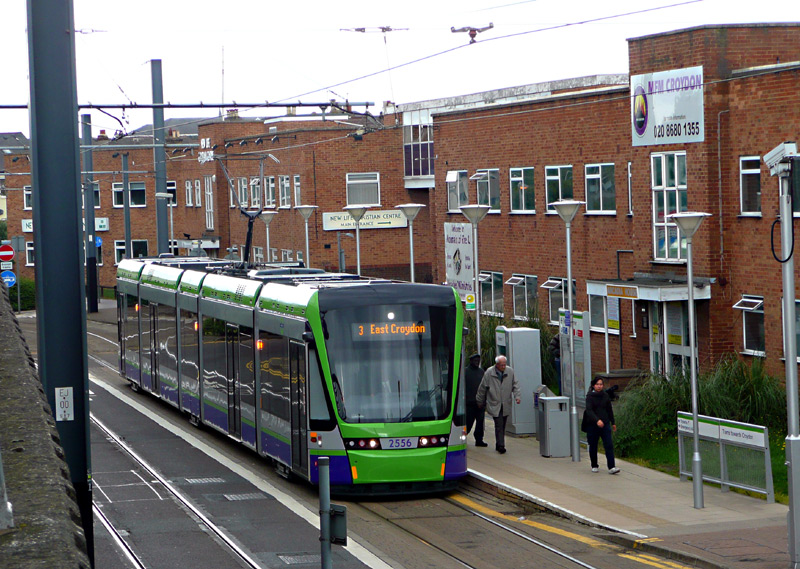
which is to the south of the Greater London metropolitan area.
River Buses
There are many different river bus operators and they all seem to charge different fare scales. Some of them accept Oyster Cards and even offer discounts for passengers who are using Oyster PAYG or have a Travelcard. It is a good idea to ask for the discount! River bus fares are not included in fares capping.
London's river bus services vary between tourist-themed leisure cruises and public transport-type services
aimed at local people.
This page at the TfL (Transport for London) website offers more detailed information.
https://tfl.gov.uk/fares/find-fares/river-fares .
Note that the Woolwich Ferry in east London is free to use - and offers excellent views of the Thames Barrier.
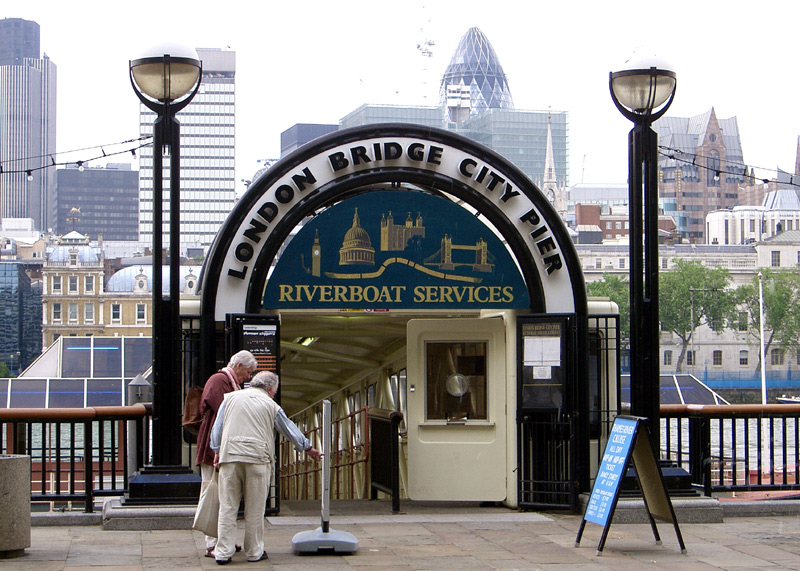
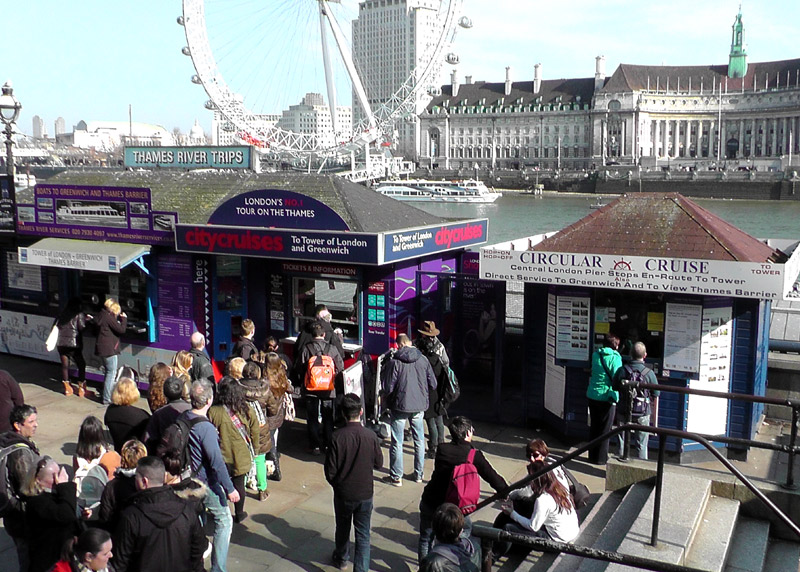
whether it is a tourist-themed leisure cruise or aimed at local people making normal public transport-type journeys.
Cable Cars
The IFS Cloud Cable Car in east London uses small gondolas which hang from overhead cables and can carry up to ten passengers. There are two terminals - one on each side of the river Thames. Special fares are charged, these are different than the rest of London's public transport networks. Passengers who pay using Oyster / Contactless in PAYG mode should remember to 'touch-in' at the start of their 'flight' and touch-out on arrival at the other end. Note that the cost of cable car 'flights' is excluded from fares capping. Passengers with Oyster cards may receive discounts which are not available to passengers who pay their fares in a different way - it is a good idea to ask!
Passengers with paper tickets and Travelcard season tickets (of whatever type) will also need to pay an extra fare but should let the ticket staff know about their other tickets as these too *might* entitle the holder to a discount / cheaper fare. Passengers who wish to travel on a 360° 'out and back' ride should visit the ticket office to buy a special two-way pass.
It is also possible to buy a carnet of ten rides which work out much cheaper than paying for each ride at the time of travel. However these tickets are aimed at local people who make frequent journeys and all ten journeys must be made by the same person.
Between 10:00 and 15:00 (10am and 3pm) flights normally take about 10 minutes. Note that for the benefit of regular passengers who commute on the cable car earlier and later flights will usually take about 5 minutes, and that at very busy times daytime flights may be speeded up as well, so as to reduce queuing / waiting times.
Realistically, as long as passengers with prepaid Travelcard Season Tickets have to pay a surcharge to travel on the cable car and the fare charged to PAYG passengers is not included in daily and weekly price capping, the cable car will remain a niche tourist ride that is of little relevance to Londoners for regular travel. The ten ride carnet is still an extra financial burden which only some people will be willing (or able) to pay.
More information about the IFS Cable Car, where it is in London, the fares, etc., can be found at the TfL (Transport for London) website:
https://tfl.gov.uk/modes/london-cable-car/ .
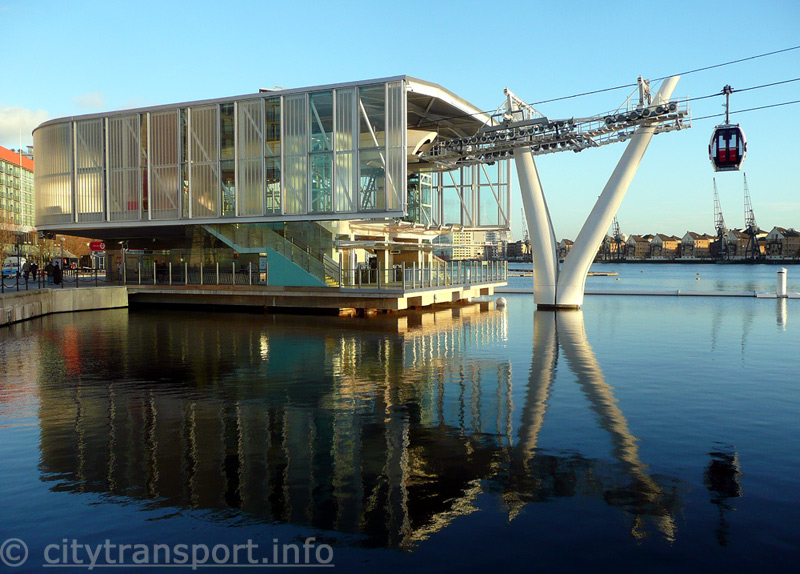
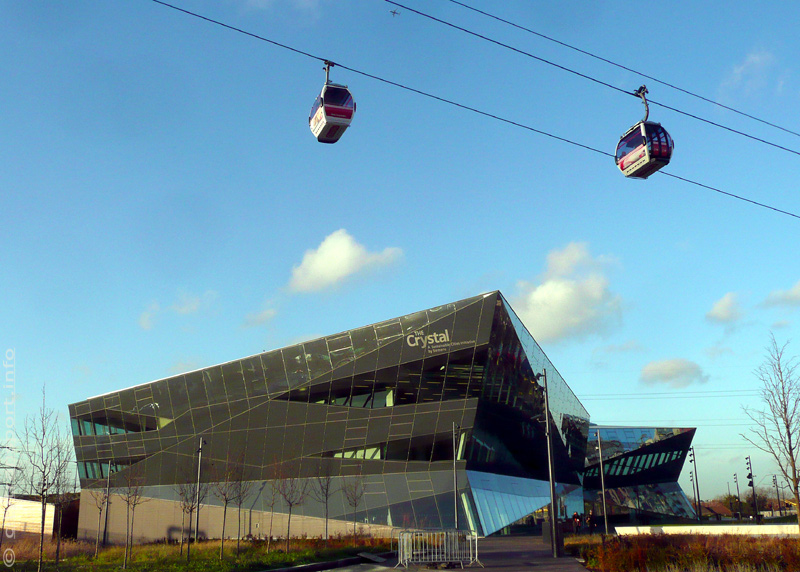
from when the Royal Victoria Dock was a working dockyard.
Close nearby is Royal Victoria DLR station.
Cryptocurrency
In London cryptocurrencies (eg: Litecoin, Bitcoin Cash, Dogecoin, etc.,) are NOT accepted for fares payments.
Photography
The railways say that their trains and stations are private property to which the public are only admitted for the purpose of travelling - and not ‘railfanning’ or filming. That said, as a general theme the 15 different organisations which operate local railway services within London tolerate amateur photography anywhere where passengers are admitted and whilst the passenger is passing through the station as part of a journey from A to B. A few train operators only permit photography in bad grace and mainly because so many people / tourists have mobile phones with cameras nowadays that it is virtually impossible (and represents bad ‘public relations’) to even try and stop them taking photographs - especially of family groups (for instance: standing next to a station name sign).
Railfans should note that if intending to stay at one station for longer than the next train they are supposed to visit the station master’s office and let them know who you are and why you are there. Some station staff might ask what you are doing or even tell you photography is not allowed. This is NOT correct but alas, some station staff like to make their own rules. (This can also happen because they were not trained properly when they started their job). It is important to understand that there is a high state of alert about a possible terrorist attack so you may be questioned by the police if taking photos. This has happened to me, several times. Of course answering truthfully about who you are, what you are doing and why is the only way to keep the authorities happy - and it saves you having to remember your previous answers. Sometimes it is useful to have a few ‘railfan’ style magazines (etc) which can be shown to anyone who questions your interest in transport. Whilst we here in Britain do not need to always carry identity cards / internal passports with us, it can be useful to have something with your name and address just in case the police decide to verify that you are of no interest to them.
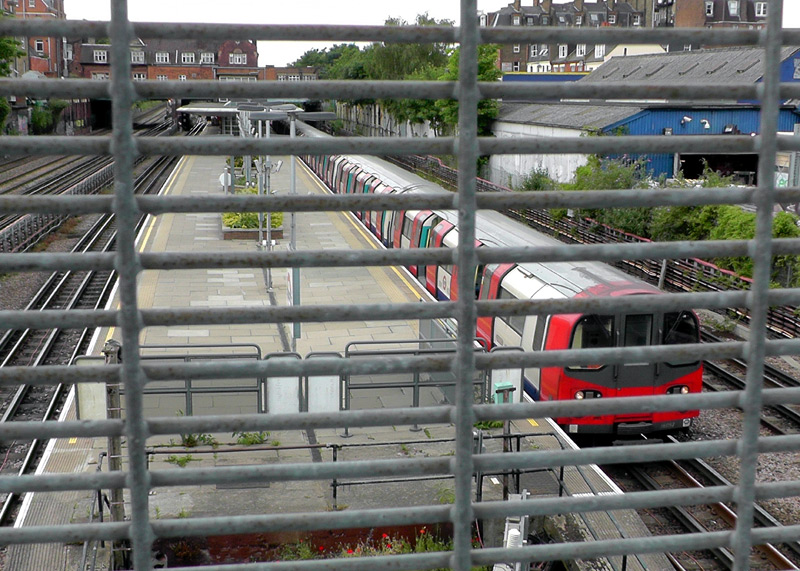

Sudbury Town Piccadilly line station.
If you are stopped by any official (especially a security guard) for using your camera try to put it away (a zipped pocket is ideal) as quickly as possible. By law only a judge in a court of law has the right to demand that you delete your photographs from your camera. So it is actually a criminal offence for any police officer or member of station / railway staff to force you to do this. If in the unlikely event you are asked to do this its best to try to avoid confrontation by suggesting that you will leave the station on the next train (and of course you must then do this). If the official is really intent on you deleting your images then refuse and demand to see a superior officer. Whilst it is unlikely that events will reach this stage you should note that a police officer can confiscate your memory cards to use in a court of law at a later date.
There is a known issue (that is, known amongst ordinary people - officialdom seem to be blind to this) where some people who wear official uniforms (especially PCSO's - Police Constable Support Officers and private security guards) do not seem to understand that photography is permitted and even within the general street scene harass otherwise innocent people who are using cameras. There was one extreme example where someone believed to be a PCSO told some Austrian tourists that it was illegal to photograph buses and that they must delete their images. Tragically the tourists did not know better and complied with this request - just because someone may be an overseas visitor does not give people in authority the right act illegally.
At some stations the station master interprets the photography rule as being that whilst still image cameras are acceptable, video cameras are not.
As a general guide tripods should not be used, as they create a tripping hazard. Tripods are prohibited at London Underground stations. Also railfans should be sensitive in their subject material and try to avoid photographing people - especially ‘close-up’. Even though this is sometimes done with the CCTV surveillance cameras (albeit without the person being filmed realising it) few passengers like camera-wielding railfans being intrusive with their photography.
It is strictly forbidden to use flash or other artificial lighting on station platforms. This is especially harmful when filming trains entering stations as it can induce short-term blindness for train drivers whose eyes have become accustomed to the dark tunnels. You may be asked to leave the station if you break this rule.
Another issue is that the press officers / media centres of some of London's rail operators are so concerned about their public image that they want to maintain 100% control of anything that shows or visually represents the transport services they provide. It is if anything an understatement to say that their attitude is one of a paranoid fear that people with cameras (even tourists) have the sole desire to use whatever they photograph in ways which damage the reputation of the organisation. This attitude is of course quite normal for large commercial companies, with it even having happened that they threaten transport enthusiasts who create personal websites (such as this) with prosecution (slander / libel etc) for saying things about them which they do not like. Not me, thankfully, but it has happened... of course no names will be revealed here!
The topic of harassment of people using cameras is also raised on one of the Nostalgia, Heritage & Leisure pages on the citytransport.info
web site .
Advice If Asked To Pay An 'On The Spot' Fine
British police do not ask for money so you should NEVER be asked to pay a fine to someone who claims to be a police officer. If in doubt ask to see a superior police officer.

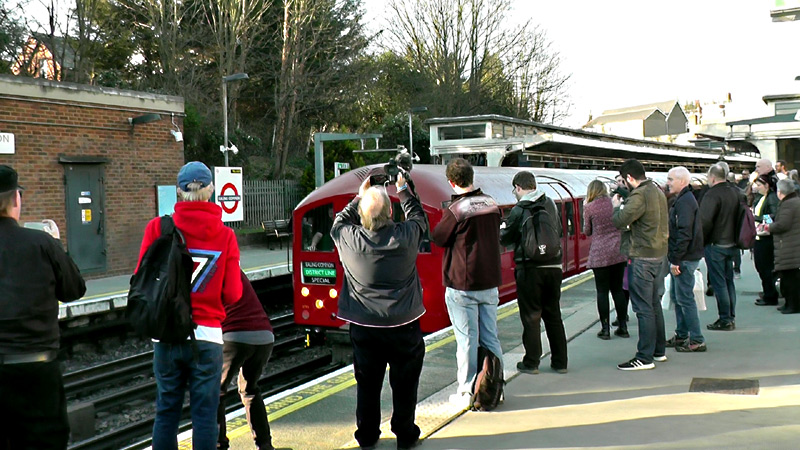
Why Taking Photographs Is Important And Good
Photography is a creative activity which expands upon an historic meme of recording events which in later years will be of interest to historians and the wider population, helping future generations discover and understand how people lived in times past and how that era contributed towards creating the society in which we live today. In 'olden times' this data recording might have included paintings, mosaics, rock / cave wall art, statues, busts, miniature models, etc.
Photography also conforms with the important ethical motto of doing no harm unto others
and the moral code which requires that people
take nothing but photographs, leave nothing but footprints, kill nothing but time.
Further Reading / Second Opinion
For further reading about railway photography this page at the District Dave London Underground themed discussion forum may be of interest. Although the page is titled
"Photography on the Underground: Rules and Advice" it also looks at the Docklands Light Railway, Tramlink and the main line railways (including Network Rail).
http://districtdave.proboards.com/index.cgi?board=selfhelp&action=display&thread=6610
Links to web pages published on the websites of local governments, transport operators and the police which include information that may be of interest to transport enthusiasts. Some of these links also require the use of a portable document pdf reader, such as Adobe Acrobat.
Question to the Mayor of London on the topic of permitting photographs on TfL property at a meeting of the London Assembly.
https://london.gov.uk/questions/2017/1791
Transport for London Conditions of Carriage.
http://content.tfl.gov.uk/tfl-conditions-of-carriage.pdf
Filming & photography on TfL - the information here is mostly for professional film crews, not amateurs filming on their own or people taking family snapshots with small hand-held cameras.
https://tfl.gov.uk/info-for/media/filming-and-photography/filming-and-photography-on-tfl?intcmp=1594
Network Rail guidelines for taking photos at stations (mostly applies to large city centre stations).
https://networkrail.co.uk/communities/railway-enthusiasts/guidelines-for-taking-photos-at-stations/
Advice for Rail Enthusiasts visiting stations on the National Rail network.
https://www.nationalrail.co.uk/stations_destinations/51952.aspx
British Transport Police information for rail enthusiasts.
http://btp.police.uk/advice_and_information/safety_on_and_near_the_railway/rail_enthusiasts.aspx
Photography advice from the Metropolitan Police.
https://www.met.police.uk/advice/advice-and-information/ph/photography-advice/
So, What To See????
As a general guide all services in the Central London area are below ground, whilst the services which reach the suburbs travel in the open air. People who just wish to sample a 'tube' train can do so by travelling on any of the 'small profile' lines as listed below. Just expect to be in a deep level subterranean section of railway.
If you would like to see detailed diagrams showing track layouts and on which side of the track station platforms are located, then the London maps at
this website may be of interest.
http://cartometro.com/metro-tram-london/
More links to websites of interest can be found on the further information resources page.
To make planning easier this guide lists services line by line, detailing what part of the line is below ground, what part is in 'open air' and some other information which may be of interest. Because of the extensive interworking of some services some sections of line are also detailed in a separate page which looks at routes with shared services.
| Opening Page Fares & Tickets / Photography |
 |
|
|
| London Underground Small Profile ‘Tube’ Trains |
|
| Bakerloo Line | |
| Central Line | |
| Jubilee Line | |
| Northern Line | |
| Piccadilly Line | |
| Victoria Line | |
| Waterloo & City Line | |
|
|
| London Underground Large Profile ‘Subsurface’ Trains |
|
| Circle Line | |
| District Line | |
| East London Line | |
| Hammersmith & City Line | |
| Metropolitan Line | |
|
|
| National Rail ‘Tube’ Trains | |
| Northern City Line | |
| Elizabeth Line (Crossrail Line 1) | |
| Crossrail Line 2 | |
|
|
| Other National Rail Trains | |
| London Overground | |
|
|
| Local Light Railways | |
| Docklands Light Railway | |
| Croydon / London Tramlink | |
|
|
| General Information | |
| Main National Rail Stations Fast Regional Services Overhead Wire & 3rd Rail Trains |
|
| Busier Suburban Stations In Zones 1-4 With A Wider Variety Of Trains To See |
|
| Station Architecture & Features | |
| Shared Service Routes | |
| Further Information Resources To Visit In Person Or Online |
|
|
|
| Single Page Version Of This Guide |
|
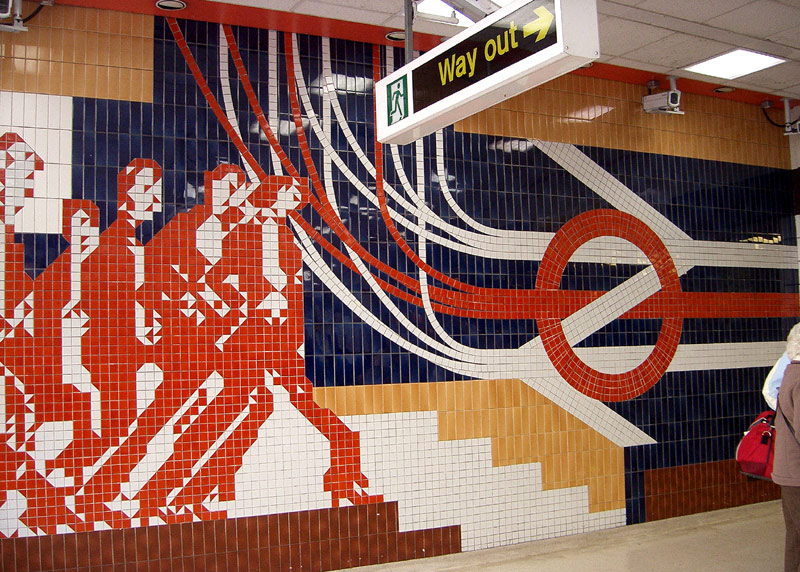
The background image for these pages: a tiled mural at Kings Cross station (Pentonville Road entrance) which celebrates the merging of London Transport and British Railways services when the north-south Thameslink service was introduced.
Unfortunately this station entrance is now closed
and the fate of this mural is unknown.


