
Visitors to London who are also transport enthusiasts (‘railfans’) sometimes ask for advice as to the ‘best’ things to see on London’s railway network. This page is part of a guide which aims to answer that question.
If this is the first time you have reached these pages then it is best to go to the Opening Page which sets the scene, explains the difference between the small and the large profile trains, offers advice on the best type of ticket to buy and photography tips.
Alternatively, it is possible to view everything on one page
|
| Waterloo and City Line |
|
 |
|
 |
|
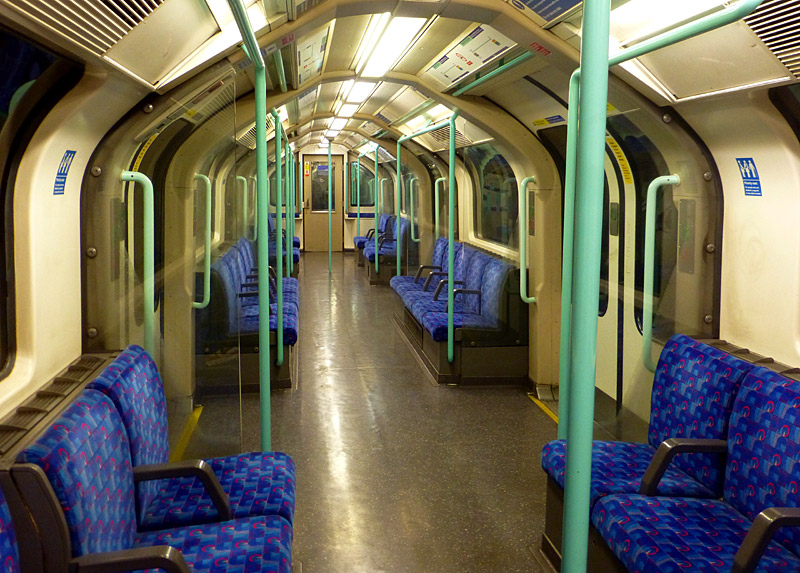 |
What can not be seen in these photographs are the CCTV cameras.
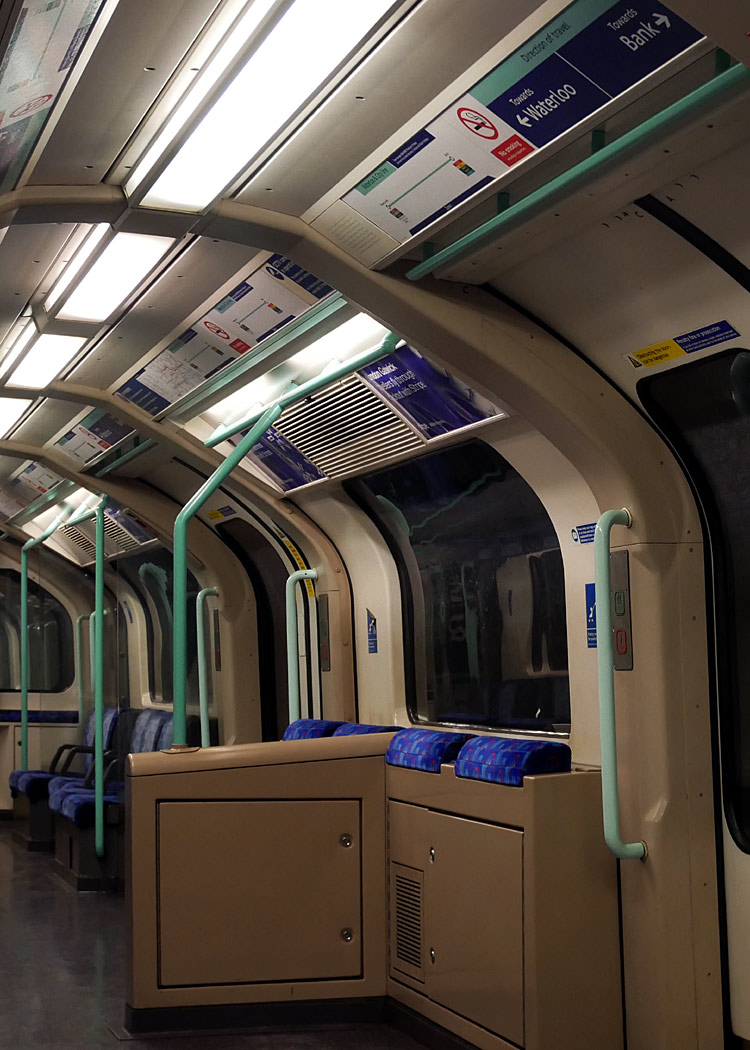
Waterloo & City line 1992 tube stock trains are formed of two semi-permanently coupled two-car units. One of these cars has a train driver's cab and at the opposite end of the other car there are rudimentary driving controls - for use in the depot. This means that each two-car unit can be driven from each end.
Normally Waterloo & City line services operate as 4 car trains, with drivers' cabs only at the outer ends of the train - it is very rare to see a drivers' cab elsewhere along a train.
Waterloo & City line 1992ts trains use a train control system which is different from that used by the Central line's 1992ts trains, making the two fleets electrically incompatible.
| Below / Above Ground |
Entirely underground.
Click map to see larger version in a new window! 
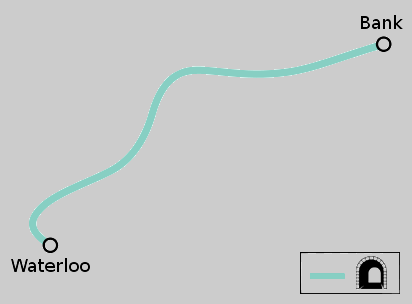
Map modified by me, original source & license:
Mr Thant / Wikipedia encyclopædia CC BY-SA 3.0
http://commons.wikimedia.org/wiki/File:Waterloo_%26_City_Line.svg


| General Information |
This line closed completely during the 2020 - 2022 virus pandemic. Although it has now reopened the service only operates Monday - Friday. It remains closed at weekends and on bank / public holidays.
It is best to avoid the rush hours - when the trains are very, very, busy.
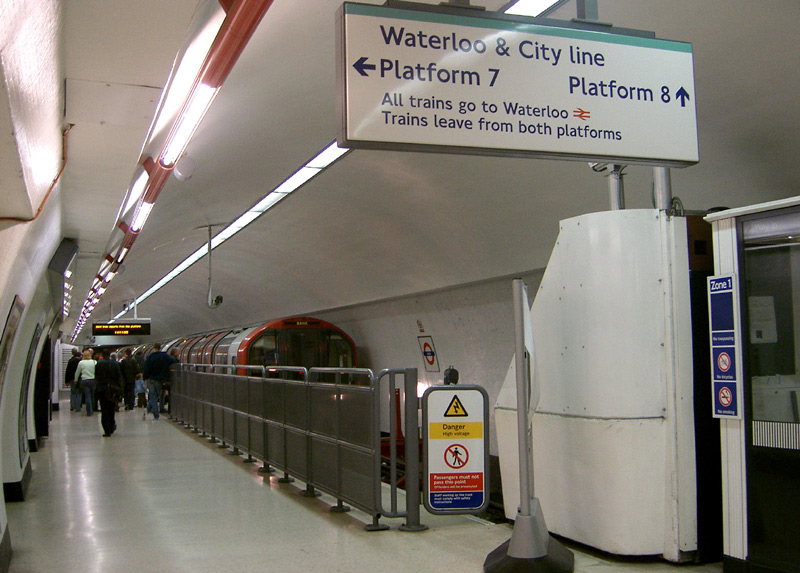
At Waterloo there are separate arrival and departure platforms which have independent platform accesses, and between journeys the trains go into the depot - which can be seen from both platforms.
Until railway privatisation in 1994 this line was part of British Railways - Network SouthEast - and on some station platforms you will still see some Network SouthEast logos.
Services on this line are provided by trains which were built at the same time as the Central line 1992 Tube Stock. At the time British Railways called them class 482, but nowadays they are known as 1992 Tube Stock.
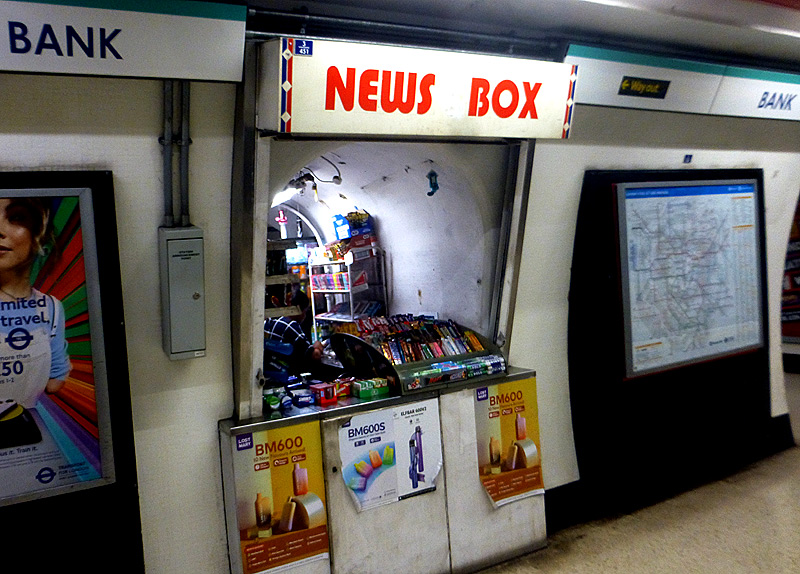
Located in the tunnel wall at Bank station this small
confectionary and soft drinks outlet has sales windows
at both ends so that it can serve both platforms.

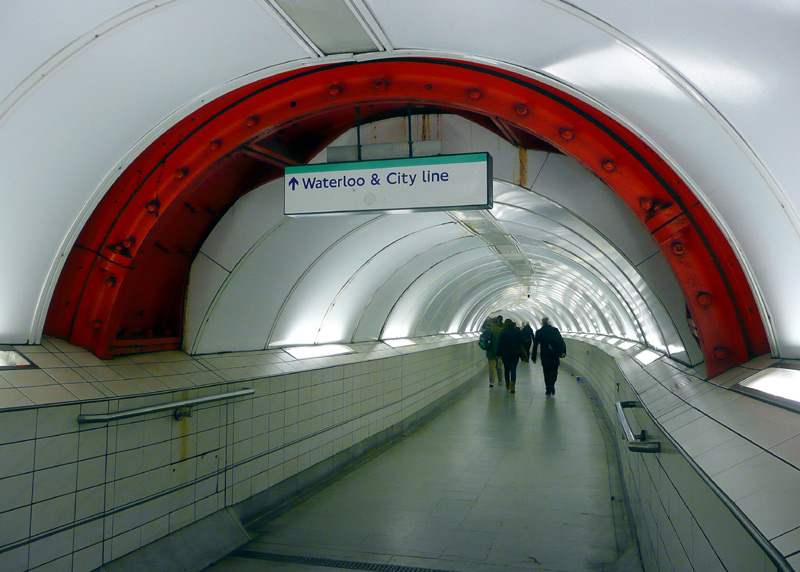
This view also shows the raised section of platform which formed part of the first experimental attempts to find an affordable solution to creating 'easy access / level entry' (albeit only at certain specified train doorways) on older sections of the London Underground.
This can be seen in an interchange passageway at Bank station.

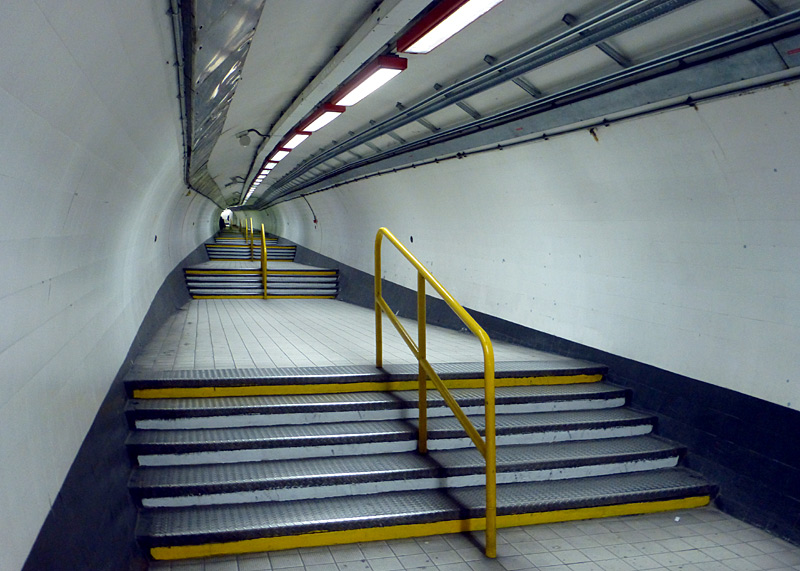
The Waterloo and City line is unique in London in that it is not directly connected to any other railway tracks. The only way for trains to 'get in' (or out) is by crane through an access hatch in Spur Road, which is near the exit from Waterloo National Rail (main line) station next to platform 1 - cross the taxi road at the pedestrian traffic signals; pass through the opening in the wall; turn left and descend the steps / ramp along Spur Road and the crane & hatch will be on your left.
A link to a Google map showing this location can be found below
http://maps.google.co.uk/maps?q=spur+road+waterloo+london&hl=en&ll=51.502332,-0.109756&spn=0.00561,0
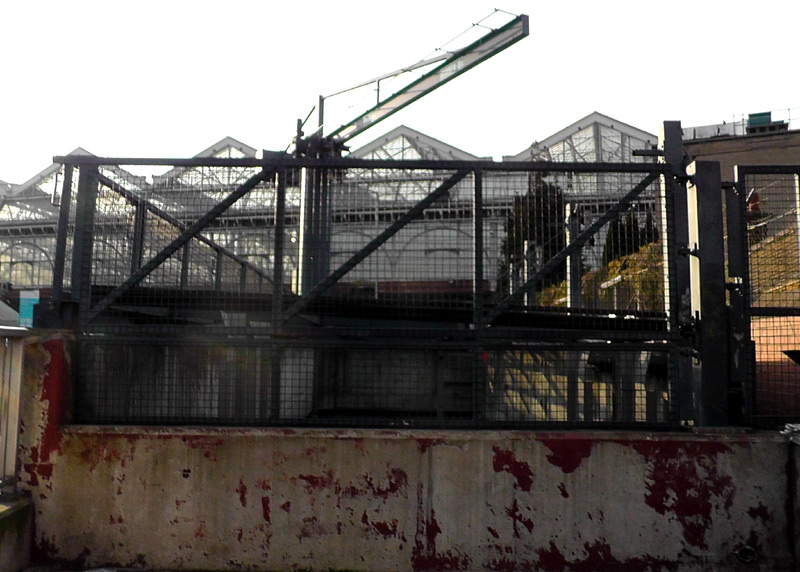
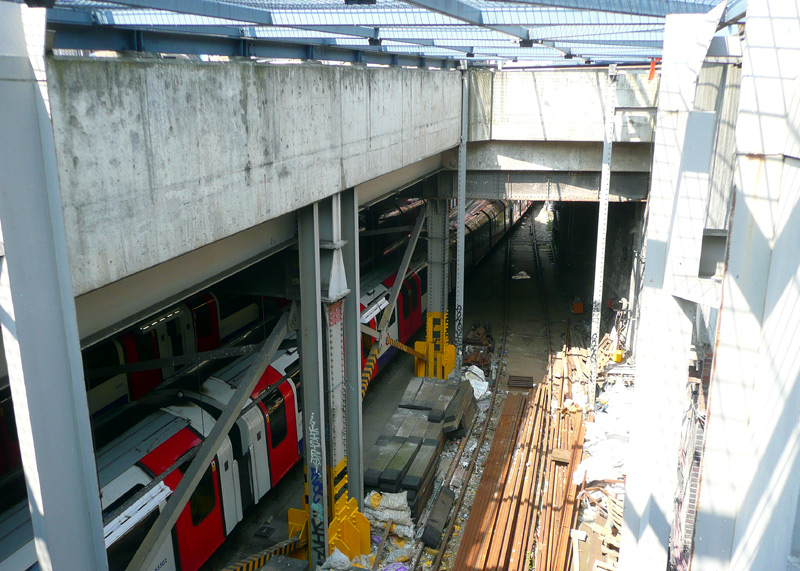
The view on the left was taken looking towards Waterloo main line station, which can be seen in the background.
The view on the right looks down into the Waterloo and City line depot. The opening has a metal mesh cover designed to prevent unauthorised access.
Since these two photographs were taken a barrier has been installed to prevent people accessing this location.
| Extra Information |
The Waterloo & City line has a different history than most of London's tube lines in that it was built by an existing main line steam railway - the London and South Western Railway (L&SWR). The reason was that the L&SWR wanted to link its large terminus station at Waterloo with London's Financial District.
Over the years there have been suggestions that this line should be extended so that it becomes more than a simple two station shuttle, and that an intermediate station should be built where the it passes below Blackfriars station.. However none of this is likely to happen. This line is so busy in the rush hours (and the trains are so crowded) that there is a very good case for leaving it exactly as it is.
Two changes which could yet come to pass are:
1) A small platform extension at Bank station to make it possible to use longer five carriage trains. This would be to help ease severe rush hour overcrowding. The platforms at Waterloo can already accept
longer trains.
2) Conversion to have London's first fully automated driverless / unstaffed passenger trains - such systems already operate in many overseas cities very successfully and as this
line only has two stations it has sometimes been suggested that it could act as a present-era demonstration system for similar train operations elsewhere on the London Underground.
Both of these ideas will probably be realised when the trains are replaced, as part of a route upgrade project.
For those who have heard of the terminologies, what is being proposed here conforms to the International Association of Public Transport (UITP) classification grade of automation 4 (GoA 4) and unattended train operation (UTO).
The use of unstaffed trains in London has historical precedents. The former Post Office railway used unstaffed trains but these only carried mail - and not passengers. In the 1970's unattended train operation was tested on the Hainault - Woodford section of the Central line, albeit not in public service. This project was called FACT - Fully Automatic Control of Trains. It is understood to have concluded in 1978 - due to a lack of finance.
Two fully unstaffed automated passenger transport 'people-mover' systems are already being used in London - at Heathrow Airport Terminal 5. One is 'airside' so only accessible to arriving and departing passengers. This uses Bombardier Innovia APM 200 vehicles. The technology is already well-proven as for many decades Gatwick and Stansted airports have also used similar fully automated airport transit systems, albeit with earlier generations of rolling stock. Although rubber-tyred these are still trains which (in some cases) call at multiple stations. Especially in France some of the automated unstaffed urban metro systems use rubber tyred trains.
The other automated service at Heathrow Terminal 5 links the terminal (and a hotel) with the car park and uses small battery powered pod cars designed for just four passengers plus their luggage.
This is a road-based PRT (personal rapid transit ./ transport) system called ULTRA ('urban light transit') which was developed by the British engineering company Ultra Global PRT (formerly Advanced Transport Systems).
https://clondoner92.blogspot.com/2016/11/ultra-heathrow-pods-prt-we-need-them.html
https://www.ultraglobalprt.com/
| Opening Page Fares & Tickets / Photography |
|
|
|
| London Underground Small Profile ‘Tube’ Trains |
|
| Bakerloo Line | |
| Central Line | |
| Jubilee Line | |
| Northern Line | |
| Piccadilly Line | |
| Victoria Line | |
| Waterloo & City Line |  |
|
|
| London Underground Large Profile ‘Subsurface’ Trains |
|
| Circle Line | |
| District Line | |
| East London Line | |
| Hammersmith & City Line | |
| Metropolitan Line | |
|
|
| National Rail ‘Tube’ Trains | |
| Northern City Line | |
| Crossrail Line 1 (Elizabeth Line) | |
| Crossrail Line 2 | |
|
|
| Other National Rail Trains | |
| London Overground | |
|
|
| Local Light Railways | |
| Docklands Light Railway | |
| Croydon / London Tramlink | |
|
|
| General Information | |
| Main National Rail Stations Fast Regional Services Overhead Wire & 3rd Rail Trains |
|
| Busier Suburban Stations In Zones 1-4 With A Wider Variety Of Trains To See |
|
| Station Architecture & Features | |
| Shared Service Routes | |
| Further Information Resources To Visit In Person Or Online |
|
|
|
| Single Page Version Of This Guide |
|
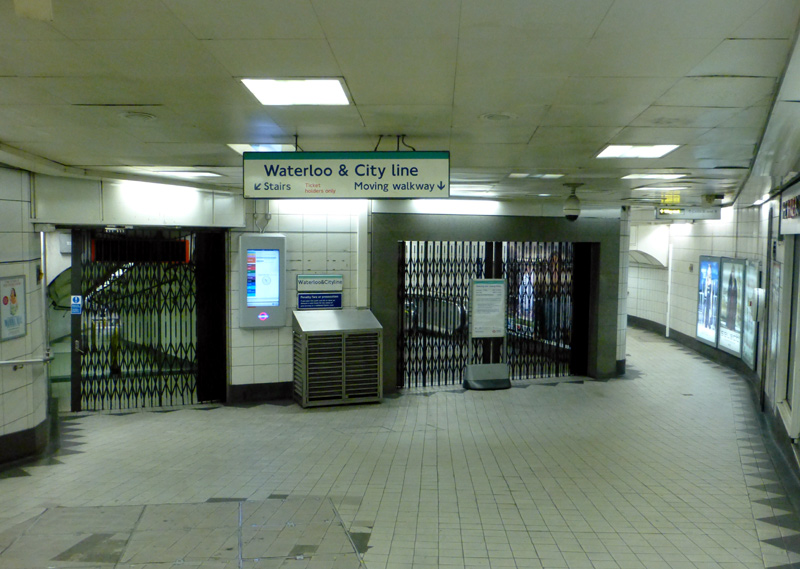
The entrance to the Waterloo & City Line at Bank station
on a Sunday when the line is (usually) closed.

