
Visitors to London who are also transport enthusiasts (‘railfans’) sometimes ask for advice as to the ‘best’ things to see on London’s railway network. This page is part of a guide which aims to answer that question.
If this is the first time you have reached these pages then it is best to go to the Opening Page which sets the scene, explains the difference between the small and the large profile trains, offers advice on the best type of ticket to buy and photography tips.
Alternatively, it is possible to view everything on one page
Local Light Railways
London also has two rail networks which provide local transport within relatively small parts of the greater London area. In virtually any other British town these networks would be large enough to form excellent cores serving large parts of the entire conurbation; its only because London is so big that they seem so 'small'.
Many people who live in regional towns outside of London look upon London's transports with envy, wishing that similar investments could be made in their home areas as well. For lower capacity routes trolleybuses (which share the same clean air attributes) would also provide a discernable 'step change' improvement on diesel buses. The core issue here is that the Treasury wants people driving cars so that it can receive high levels of income from the taxes imposed on motoring fuels.
|
| The Docklands Light Railway |
|
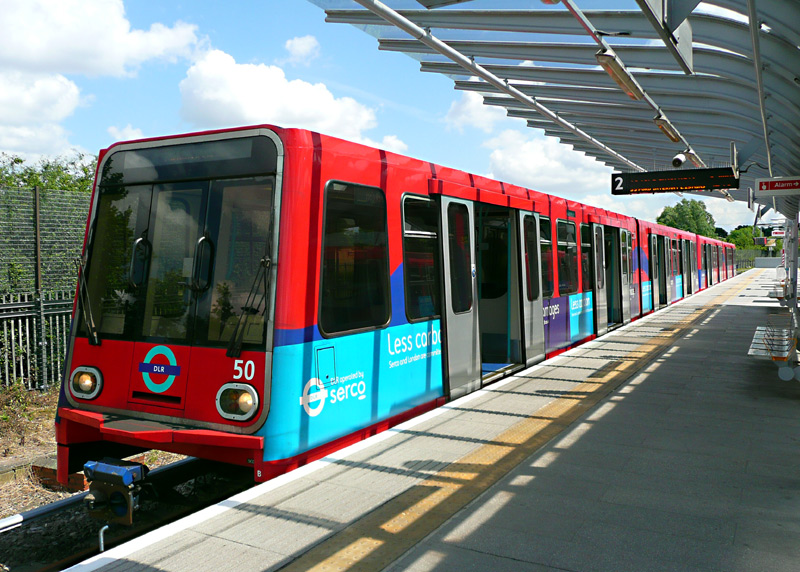
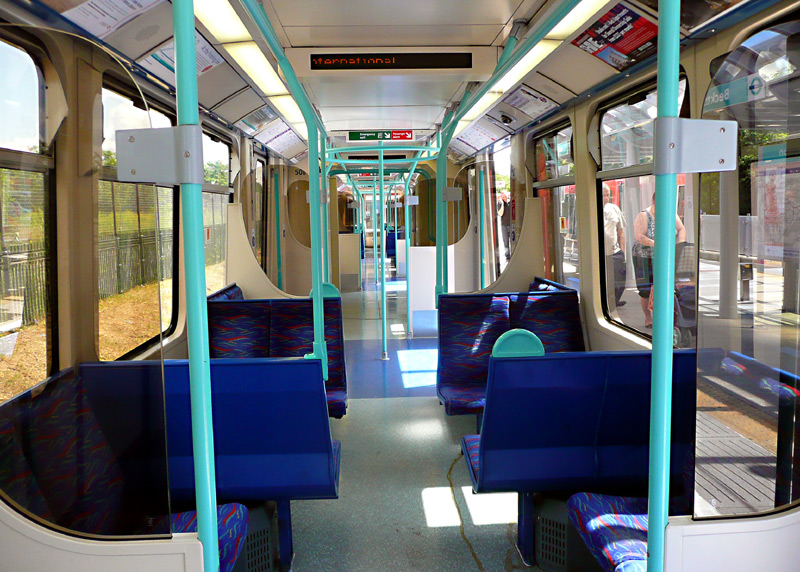
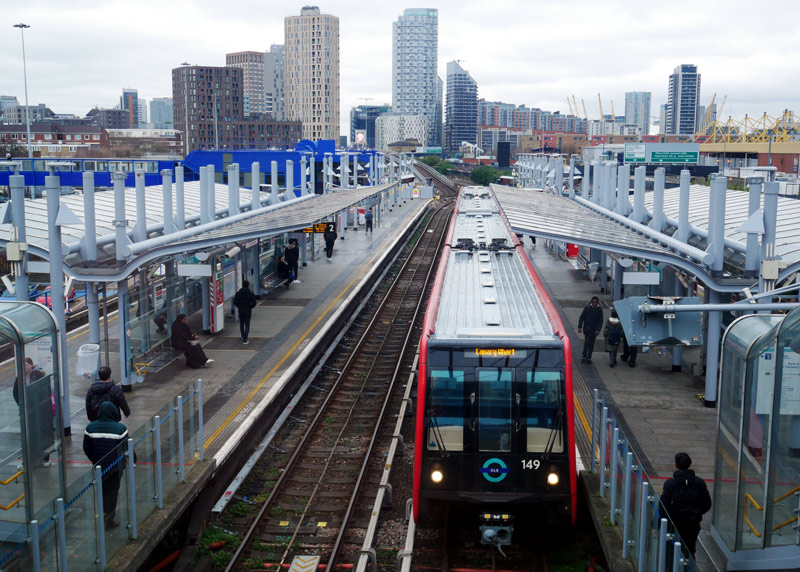
When this page was created (autumn 2015) DLR trains had either red or black ends; however they are all now black.
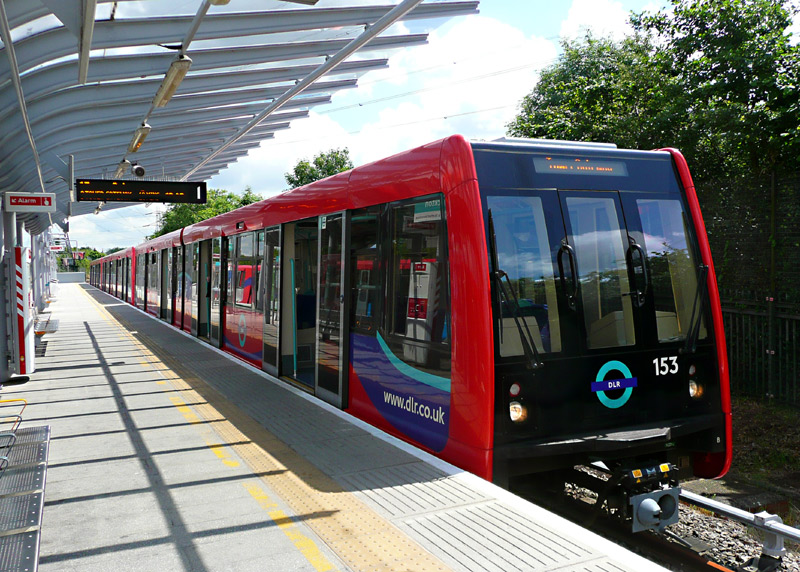
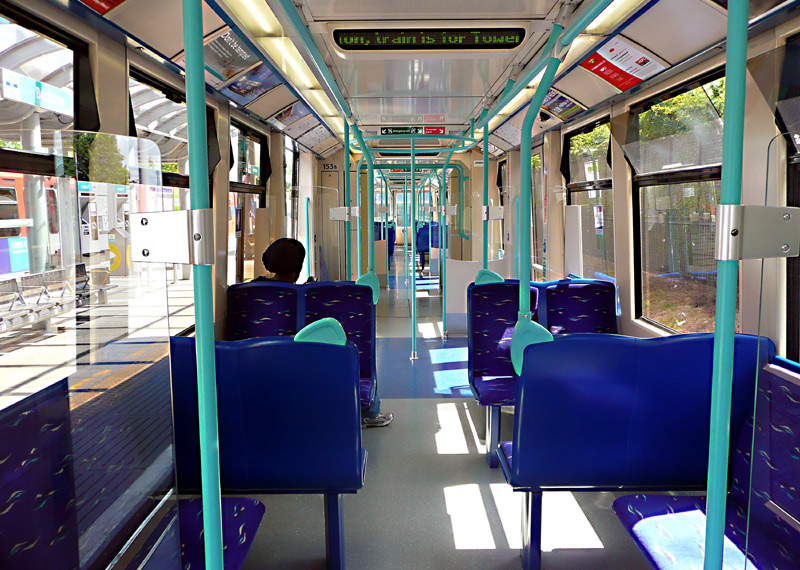
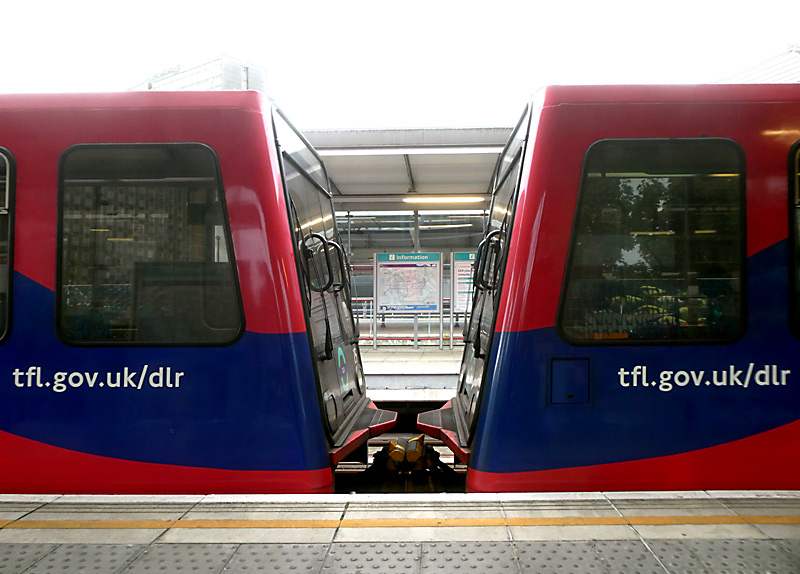
DLR services using these older types of rolling stock seen
comprise two or three 'two section' train units which when coupled together leave some wasted space at the internal train ends.
This image: platform 17, Stratford station.
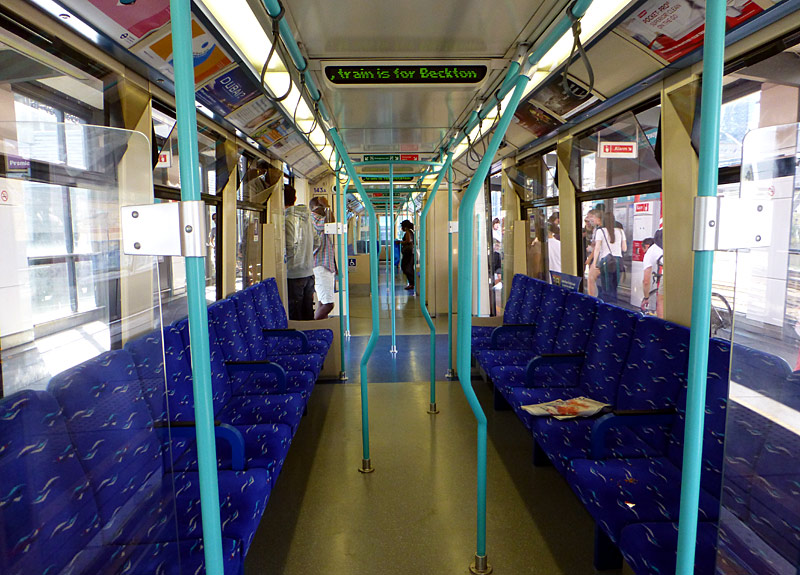
To encourage standing passengers to move inside the trains the seating layout inside some B07 trains has been changed with some transverse seats being turned around to become longitudinal seats.
B23 Trains: Since its inception all DLR trains comprised 'two section' articulated train units which when coupled together leave some wasted space at the internal train ends. However this situation is changing - because a new fleet of trains has started replacing the trains which date from the 1990s. The new trains have five carriages and are approximately the same length as older triple-unit / six section trains and by being of a fully walk-through design offer an advertised 10% increase in passenger capacity.
Built by spanish train builder CAF and part of their Inneo brand of trains, the B23's are fully air-conditioned and for the first time on the DLR include several designs of full colour information display screens - the wide format displays are for real-time passenger information and the upright format display are expected to be used for other information and perhaps even paid advertising. The trains also feature the 'more traditional' plain paper route maps above the passenger doors.
One bizarre quirk with the new rolling stock is that carriages 1, 3 and 5 have two sets of double passenger doors per side whilst carriages 2 and 4 have three sets of double passenger doors per side.
Two sets of doors per side mean that there is more 'wall space' available for more passenger seats. Three sets of doors allow for faster passenger alighting and boarding, which should mean shorter 'station stop' dwell times.
The first B23 train entered service (after a long delay) in September 2025. During the delay there was the discovery of a totally unexpected and unrelated automated train control signalling issue and even though it was realised to have been extant for many years (without ever compromising safety) the various authorities decided that until it is resolved the top speed of the existing trains should be reduced, journey times extended plus the cancellation of the peak-hour through service between Lewisham and Stratford.
Unfortunately, in early November 2025 a B23 train overshot a station whilst trying to stop, and then performed an emergency stop.. This was during a torrential rain storm which had made the rails very slippery.
Following this it was decided that the B23 trains were to be temporarily withdrawn from service.
(Slipping on wet rails is a rare - but not unknown - issue with the other DLR trains and indeed other
railways that use automated train control to 'drive' the trains).
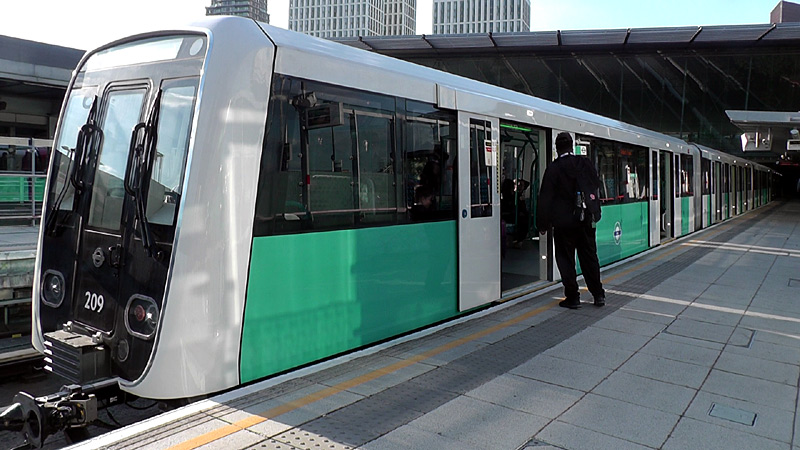
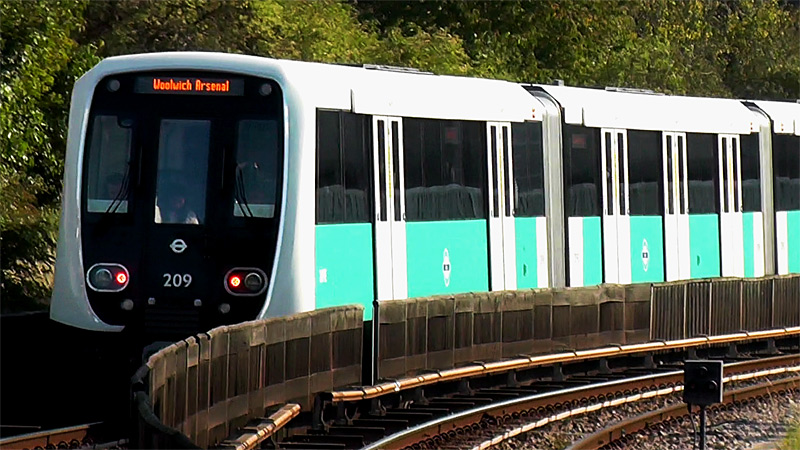
The Abbey Road view clearly shows the mix between two and three pairs of passenger doors along different parts of the train.
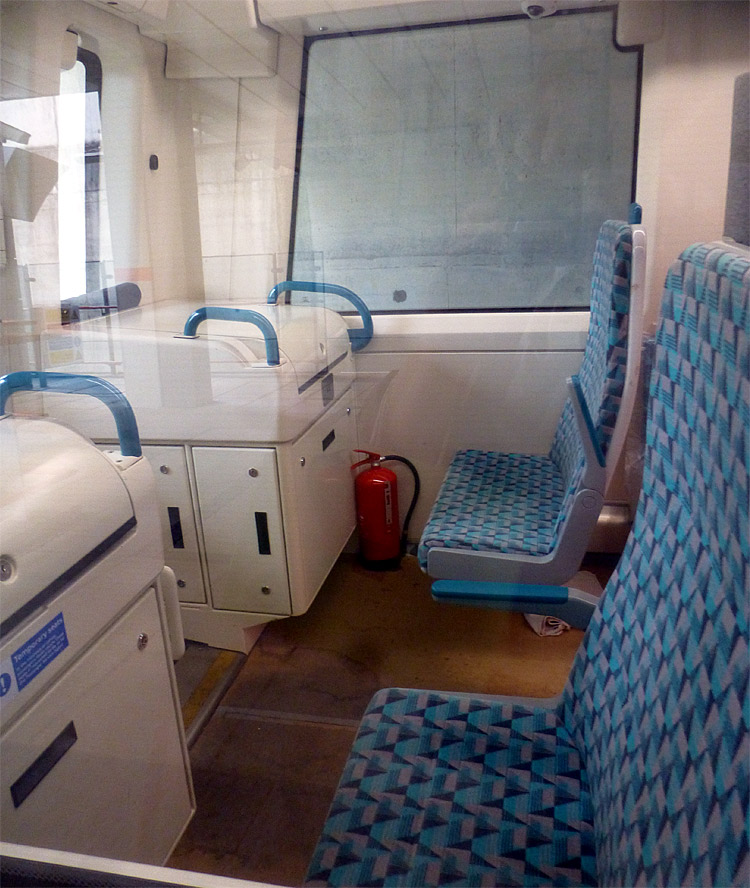

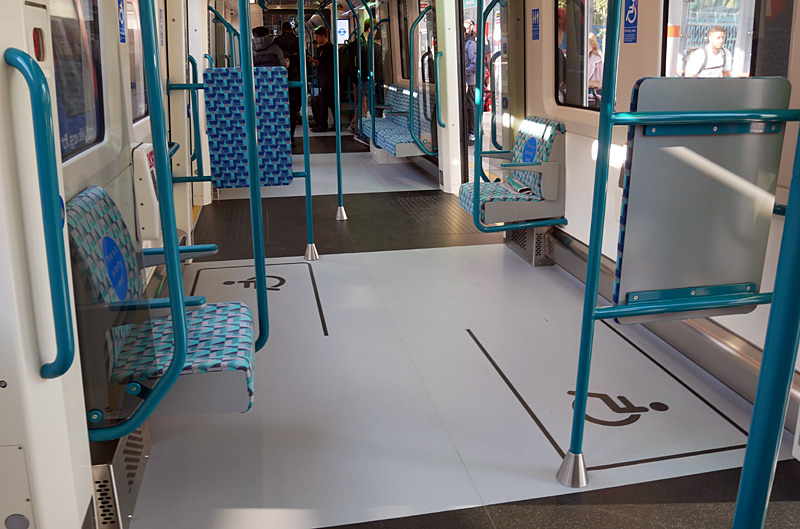
Some of the longitundal seats are fixed, others are folding (tip-up). Some seats next to grabrails are identified as 'priority' seats.
All transverse seats have armrests (seen above-left with one deployed, one folded up) but only some longitidinal seats have armrests.
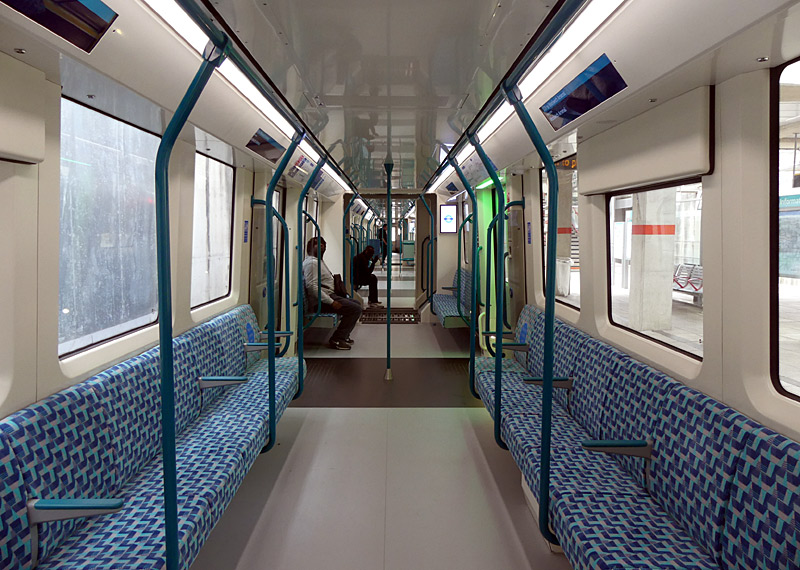
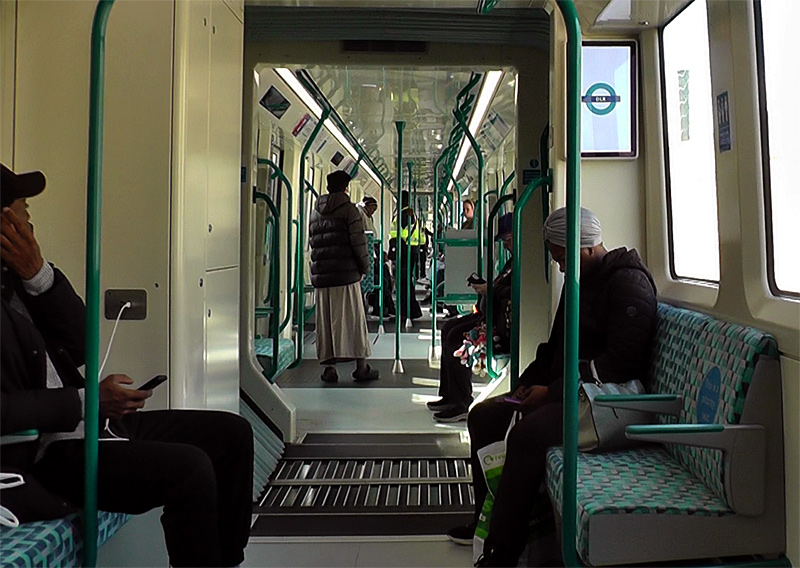
Image & license: Fortek67 / Wikipedia encyclopædia CC BY SA 4.0 https://commons.wikimedia.org/wiki/File:London_Underground_2024
_Stock_during_testing_at_Hammersmith_station_(2).jpg
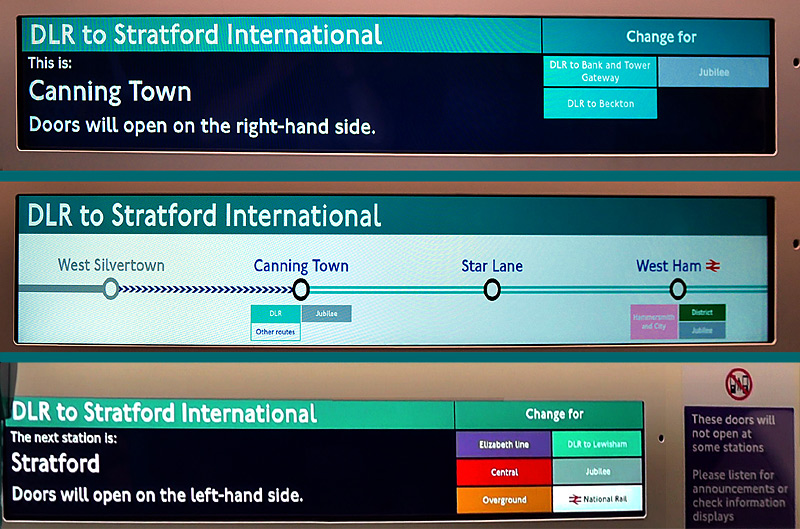
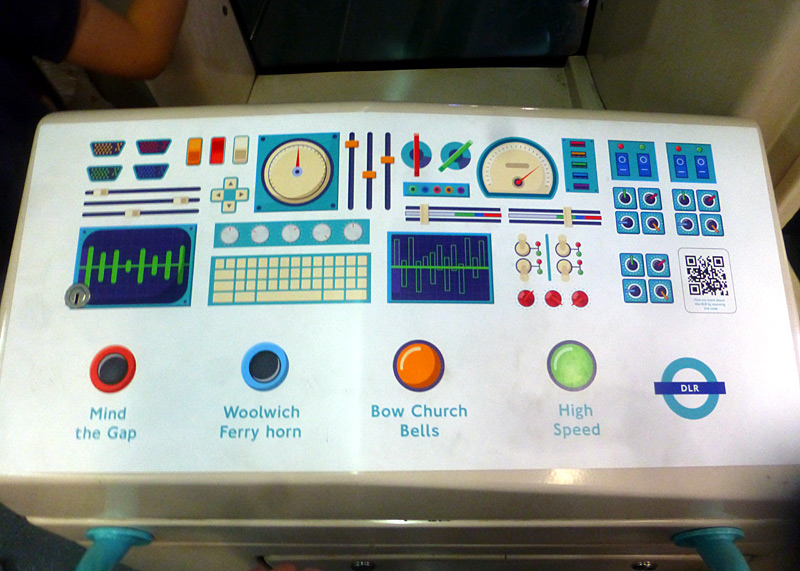
There is also spoken word information.
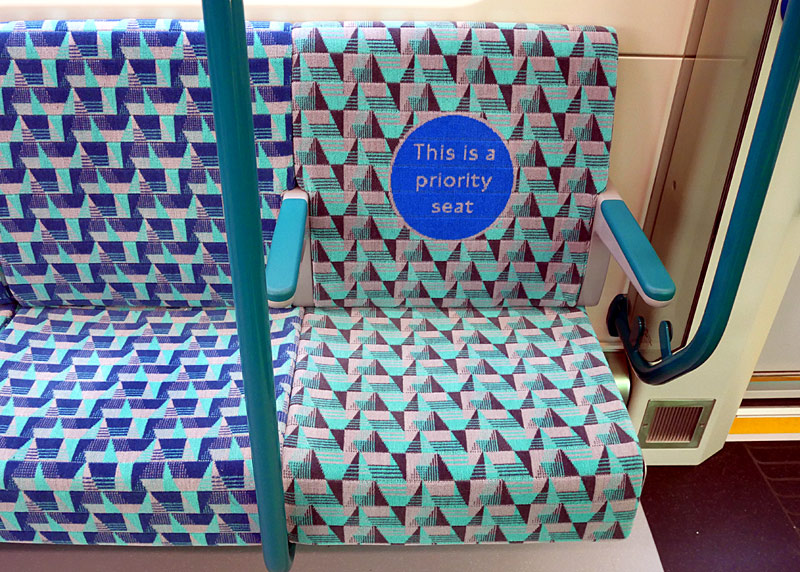
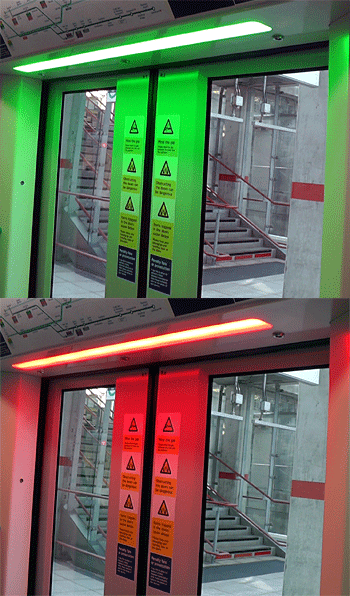
and next to a floor to ceiling handrail.
| Below / Above Ground |
Whilst most of the DLR system is elevated on modern or historic viaducts, some sections are at ground level and there are also some tunnels - in both single track 'tube train' and twin track configurations.
| Claustrophobia |
Information for people who are happy to travel on trains which are above ground but experience claustrophobia when in tunnels.
Not all sections of tunnel on the DLR are actually underground. Some of the tunnels are surface routes which have been been built over, for instance: just north of Stratford station.
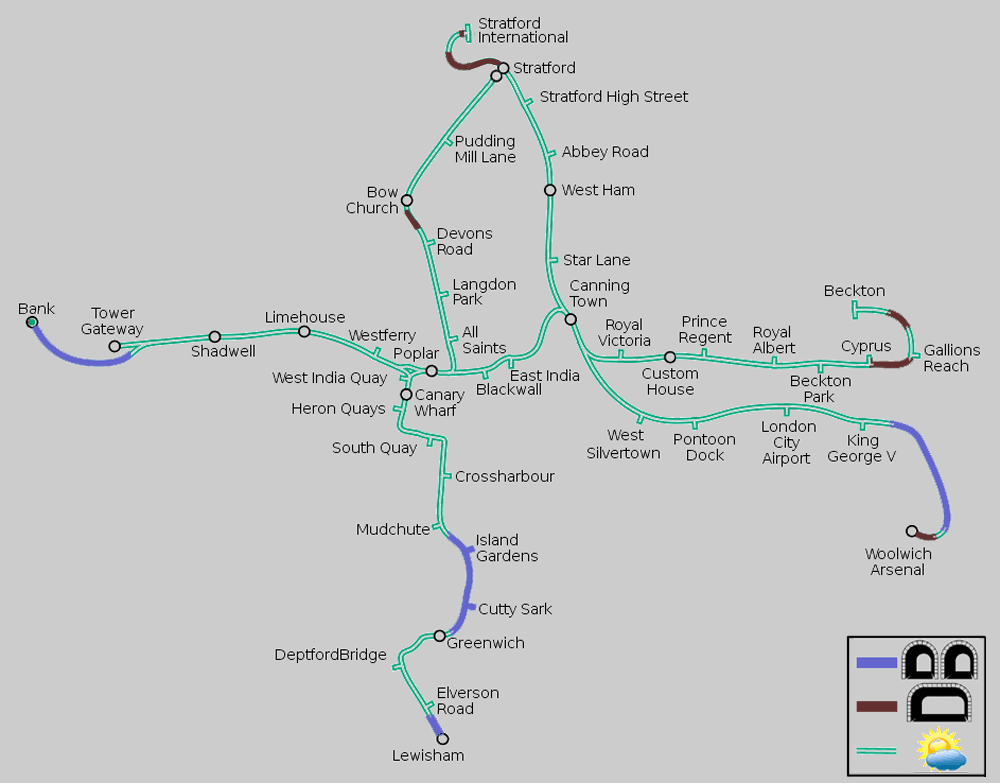
Map modified by me, original source & license:
Ed g2s / Dtcdthingy / Wikipedia encyclopædia CC BY-SA 3.0 http://commons.wikimedia.org/wiki/File:Docklands_Light_Railway.svg
Click map to see larger version in a new window! 
* Stratford - Stratford International
|
* King George V - Woolwich Arsenal (passes below the River Thames)
|

| General Information |
The DLR is unique amongst London's railways in that it uses an under-running third rail power supply system. The advantages of this system are twofold. It is much safer, as the sides and top can be covered - reducing the danger to railway staff who work in close proximity to the tracks. In snowy weather the underside is protected from the snowfall and therefore considerably less likely to be covered / blocked by snow or ice. This helps keep the service running in weather conditions which sometimes defeats London's other railways. London's other railways which use powered rails collect their power from the top surface, which is easily blocked by snow / ice, preventing the train collecting electrical power.
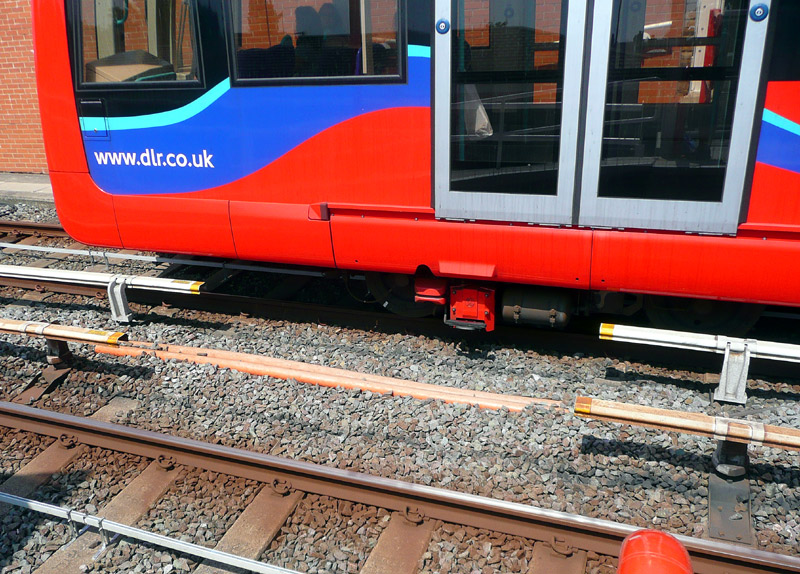
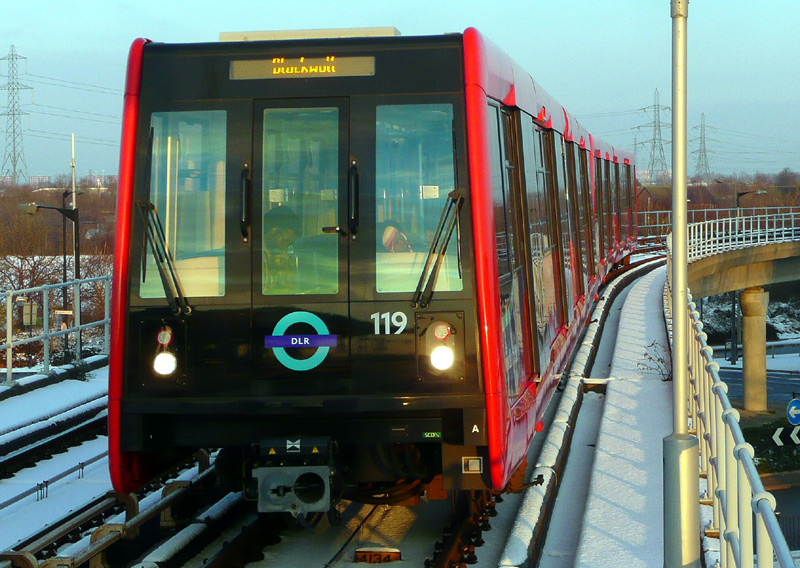
The snow in the image on the right makes it very easy to see third rail power collection shoes sticking out from the side of a train.
The DLR uses GoA 3 Driverless train operation (DTO), which includes there always being a human member of staff (a passenger service agent / PSA) on every train. In addition to closing train doors at stations and initiating station departure the duties of the PSA include checking that passengers have valid tickets and offering travel advice.
DLR stations are mostly modern with glass shelters, although exact architecture will vary depending on when they were built or rebuilt. One of the most modern stations is Langdon Park which is on the Canary Wharf - Stratford (platform No.4) route. This is on a north-south alignment and if you wish to photograph the station name this is best attempted in the morning.
When it first opened the DLR comprised three main branches which met at a triangular junction (called: Delta Junction) between Poplar, Westferry and West India Quay stations. This included newly built track on viaducts in the former docks area which (at that time) was being repurposed as London's second financial district (Crossharbour - Delta Junction) and former mainline railway routes. (Stratford - Poplar, Tower Gateway - Poplar and Crossharbour - Island Gardens).
Mostly the former mainline railway sections were first built over 100 ago and for various reasons had later closed, however part of the route between Tower Gateway and Limehouse had four tracks - all of which were still being used by passenger trains operated by British Railways - and the government forced them to give up two of the tracks along this section of railway so that DLR trains could use them.
The routes to Bank, Lewisham, Beckton and Woolwich Arsenal were built as brand-new extensions to the system, however whilst Stratford International - Canning Town was also an extension most of this route replaces a mainline / National Rail service that was closed specially so that it could become part of the DLR.
Abbey Road Station One of the album cover photographs of the famous music pop group called The Beatles shows them on a zebra (pedestrian) crossing close to the Abbey Road studios where they recorded some of their songs. Tourists wanting to visit this location should go to St John's Wood Jubilee line underground station - and NOT the DLR station called Abbey Road.
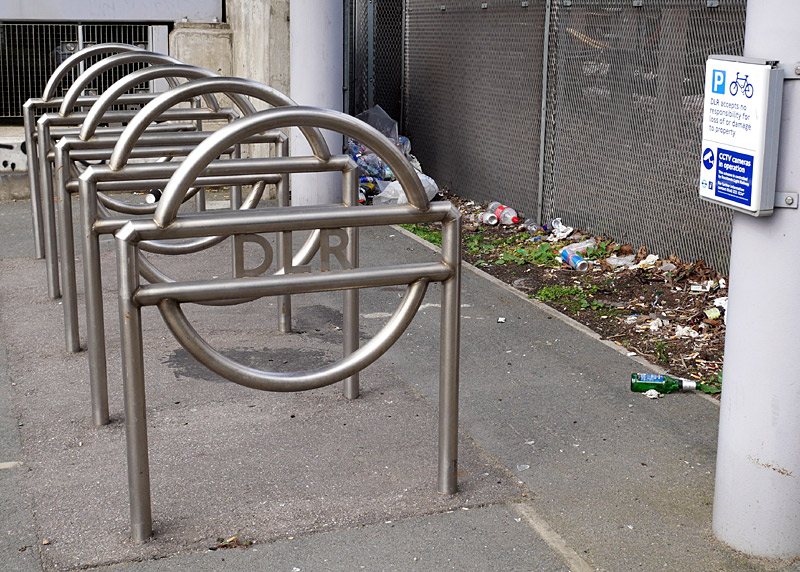
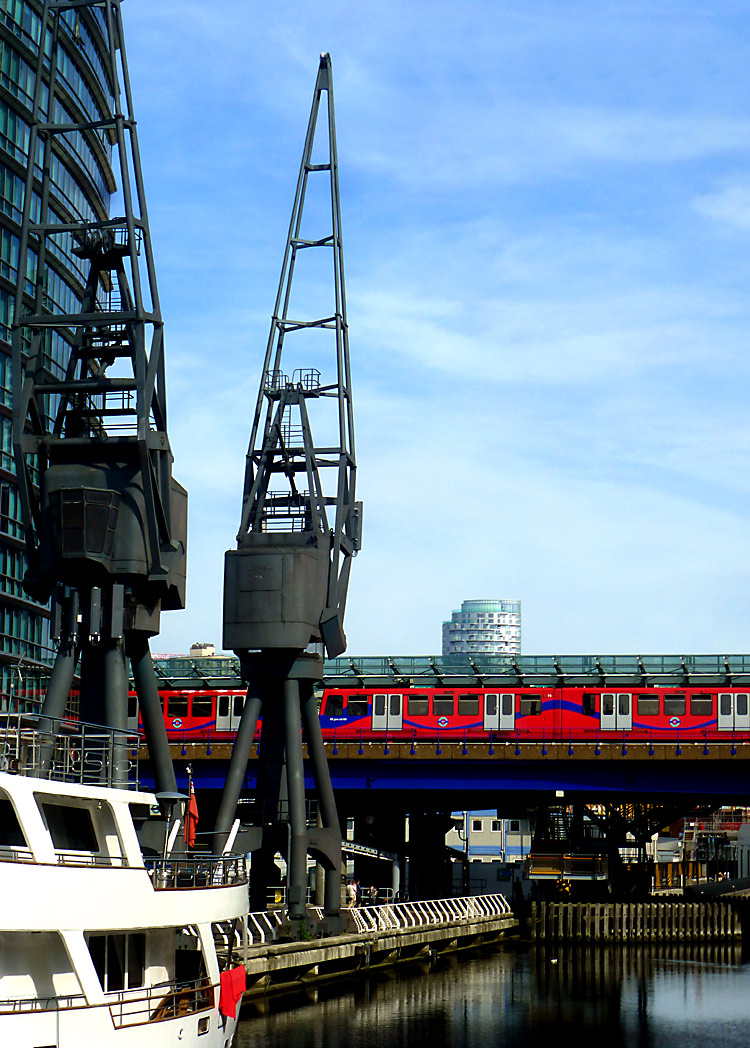
- but at owner's risk!
| Photographic Advice |
Transport enthusiasts need to be aware that the DLR has photography rules which differ from London's other railways (of all types). To the DLR anyone using cameras (still image / video) at the same station for more than 10 minutes is seen as "working" there. Even tourists taking a few photographs!
Normally when people are working on a railway they need to comply with a range of safety requirements which includes completing a risk assessment, having public liability insurance, signing in and out at the start and end of the work duties and possibly even undergoing safety-related training. Sometimes the railway operator would also wish to supply a member of staff to oversee the filming and help ensure safety. All these cost money!
The best advice which can be given here is to explore the system filming one train and catching the next (even if only to the next station)... which for some routes will be very easy as even on Sundays trains come every 10 minutes (or more frequently) whilst at stations served by multiple routes trains are even more frequent.
The DLR also prohibits filming during the Monday - Friday rush hours, when many stations are very busy. But they welcome visitors at quieter times - which means all day weekends plus Monday - Friday 10am - 4pm (10:00 - 16:00) and after 7.30pm (19:30).
Unfortunately, as on all railway systems there are some staff who make up their own rules and simply say "no".


Passengers wanting these stations should walk through the inside of the train to a section which is within the station platform.
| For Tourists / Visitors to London |
Many tourists like to take the DLR out of Bank station, sitting at the front and watching where they are going. At an absolute minimum you should travel at least as far as Canary Wharf. This station has 3 tracks, but 6 platforms. Every train opens its doors on both sides! Canary Wharf is at the heart of London's Docklands financial district and there are also several indoor shopping malls which include food courts and free toilets / restrooms.
If you go to Crossharbour and walk alongside the railway northbound towards South Quay then you will pass a road junction (Marsh Wall South Quay and Limeharbour) where the elevated railway turns a sharp corner, and from the opposite side of the road it is possible to see (and photograph) both sides of the train simultaneously! Plus for added benefit you will see the train’s reflection in the glass wall building. This is easiest with triple-unit and B23 trains and at times of the year when the trees are not in leaf.
To increase system capacity and avoid delays whilst travelling over a flat crossing, trains from Bank going to Lewisham usually travel on a by-pass track which misses out West India Quay station; the ride is the nearest to a (low-speed) rollercoaster that public transport could ever offer, with the by-pass track threading its way over and then under existing lines.
Another popular destination is the historic Greenwich area; Greenwich station is a Victorian-era building dating from 1838 with 4 platforms and is also served by SouthEastern and Thameslink trains (from Cannon Street and London Bridge mainline / National Rail stations).
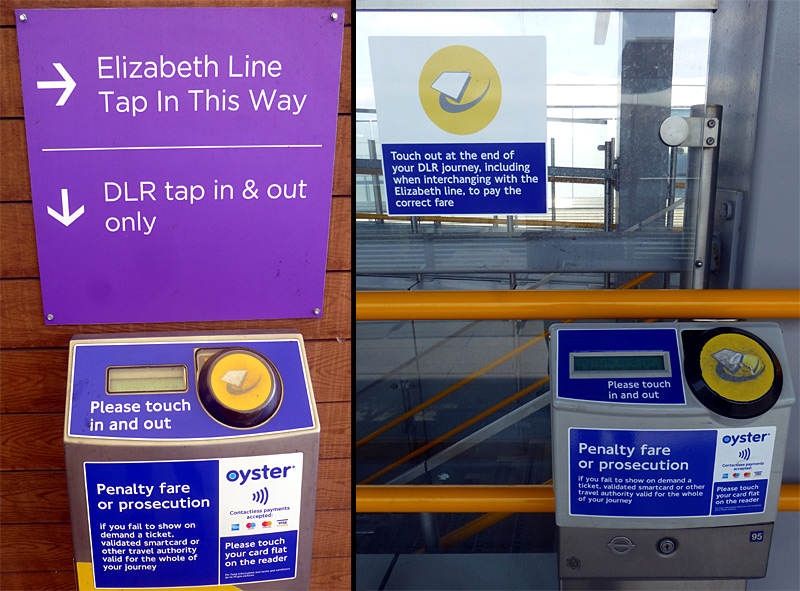
South of Greenwich the line is mostly elevated and twists and turns as it follows a river valley. Especially when looking out of the window on the left (travelling south) many historic wharfs and other light industrial sites can be seen, although some of these may be disused. The DLR station at Lewisham is next to the mainline / National Rail station; interchanging passengers paying fares using Oyster / smartcard PAYG will need to use the freestanding - card readers when leaving the DLR station plus the ticket gates when entering the mainline Lewisham station. Cbviously since you should have a valid ticket so this should not be a problem.
Having arrived at Lewisham, if you then catch a train (destination: Hayes) to Elmers End you can also sample the Tramlink system (PAYG users: it is important to use the Tramlink card readers on the platform at Elmers End before boarding the tram!) See the Tramlink page for further information. NB: Although I have always been happy to pass through the Lewisham stations, this is a high crime area where I would NOT be happy walking about the streets, especially not with cameras visible.
| Present-day DLR Services |
Over the years train services have varied slightly as the system has expanded; nowadays there are five primary routes, some of which overlap to provide multiple destinations from many stations.
Despite the many routes the DLR system does not have route names or numbers, which can sometimes be confusing.
- Bank - Lewisham
- Bank - Woolwich Arsenal (via London City Airport)
- Tower Gateway - Beckton
- Stratford - Bow Church - Canary Wharf.
- Stratford International - Canning Town (via West Ham) - and then
eitherto Woolwich Arsenal (via London City Airport)or Beckton.*
*Because of a shortage of trains the Beckton service has been temporarily cancelled - passengers wanting the Beckton branch are best advised to take the first train and change at Canning Town.
Even on Sundays the DLR operates frequent services - typically every 10 minutes, or less. But before travelling it is always wise to check whether weekend engineering works mean that some of the system is closed.
| Same Station - Different DLR Routes - Different Platforms |
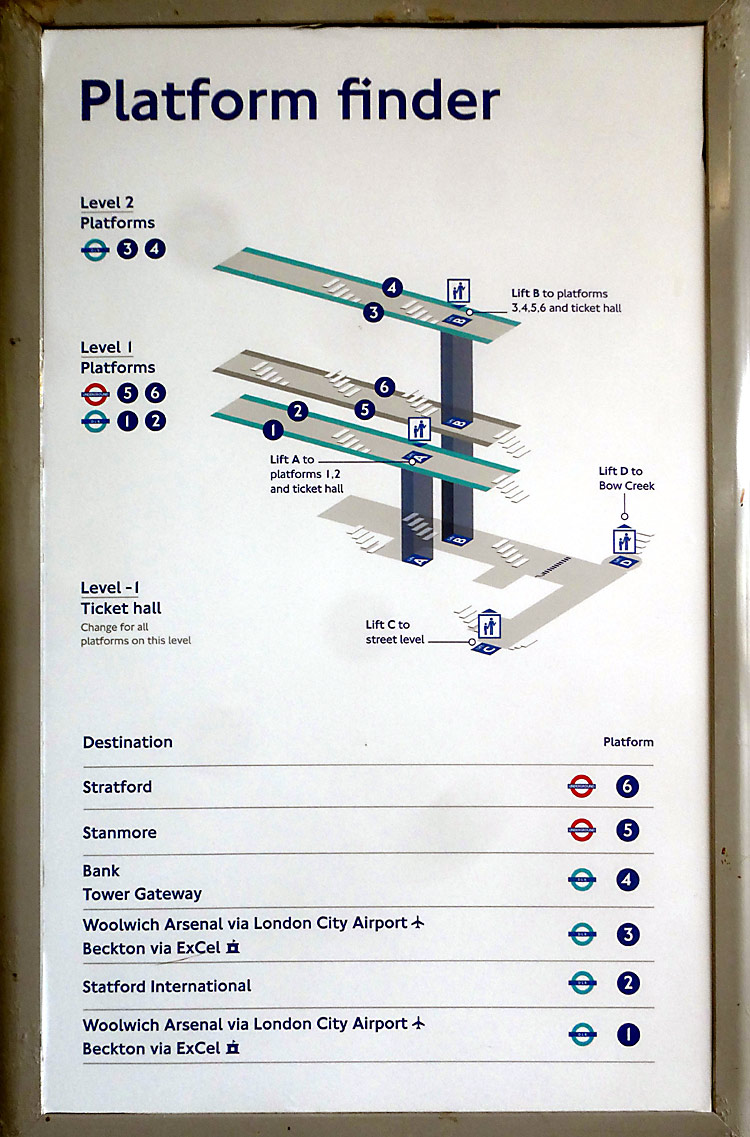
At Stratford and Canning Town stations different DLR services use different sets of platforms. This can be confusing!
Stratford:
Trains to Canary Wharf via Pudding Mill Lane use platforms 4a and 4b which are at the upper level at the western end of the station. Most signs in the station just refer to platform 4.
Trains to Stratford International use platform 16 and trains to Woolwich Arsenal use platform 17. These are at the lower level, near to the platforms for the Jubilee line.
The situation at Stratford is looked at in greater detail on the page about busier stations in zones 1-4 where there is a wider variety of trains to see.
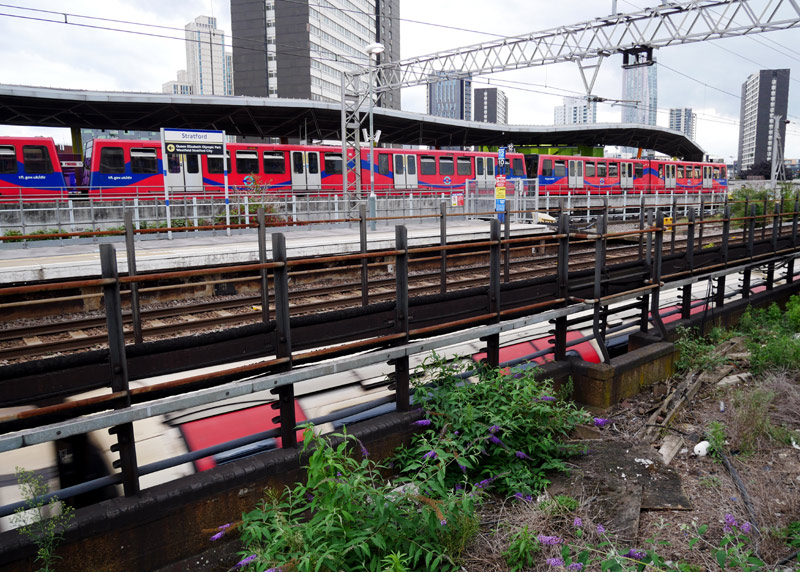
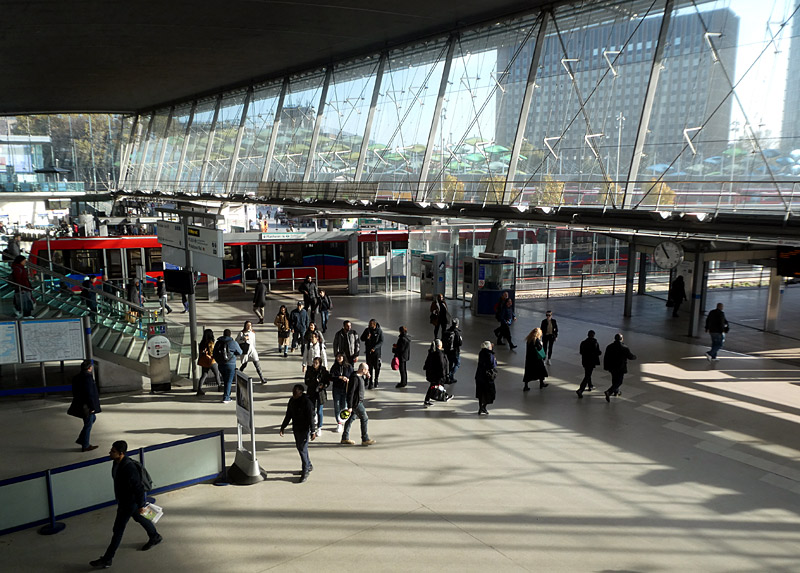
Left: A DLR train on the route to Canary Wharf via Pudding Mill Lane at platform 4b. Also seen here is an eastbound Central line train arriving at platform 6.
Right: A DLR train going to Stratford International on the route via Canning Town calls at platform 16. This is on the lower level / next to the Jubilee line.
Canning Town:
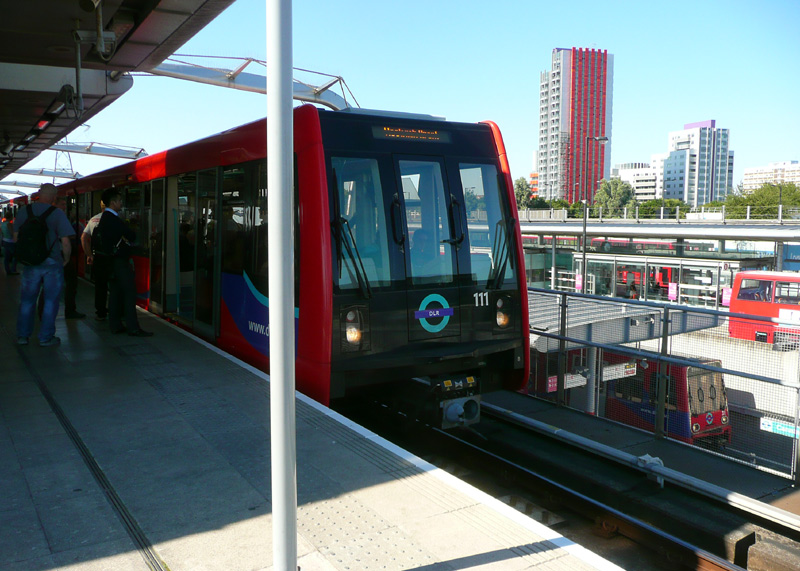
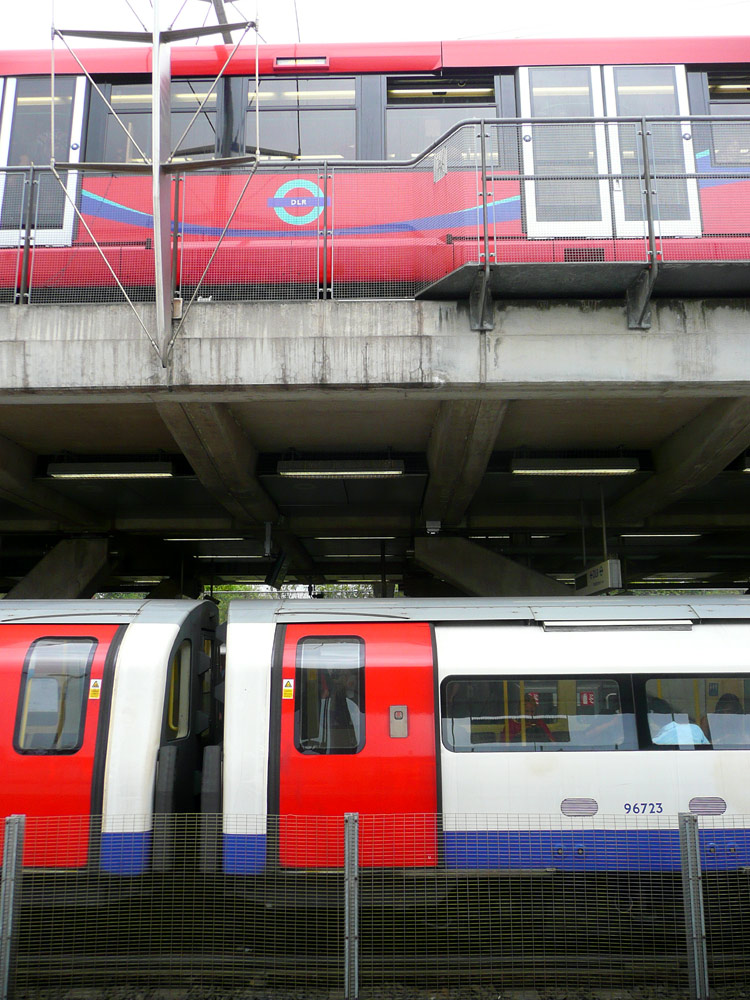
Trains on east-west DLR services to / from Bank or Tower Gateway stations call at platforms 3 & 4 (above the Jubilee line) whilst north-south DLR trains
travelling to / from Stratford International station call at platforms 1 & 2 which are located at ground level between the Jubilee line and the bus station.
Choosing the correct platforms is easy for most destinations, except for trains to Woolwich Arsenal via London City Airport as these depart from both platforms 1 and 3. Trains to Beckton mostly also depart from platform 3 but when the shortage of trains has been resolved they will also depart from platform 1 (if they came from Stratford International) or platform 2 (if they reversed their direction of travel here).
Also note that the elevated platforms 3 & 4 (ie: above the Jubilee line) are very exposed and windswept - this means that passengers using these platforms will find them very cold in winter, and wet in rainy weather.
The situation at Canning Town is looked at in greater detail on the shared service routes page.
 |
 |
 |
 |
Centre - left: The view from platform 2: a Jubilee line train at platform 5 and a DLR train at platform 3
Centre - right: Some passengers find Canning Town station somewhat confusing; to help them there is this way-finding sign.
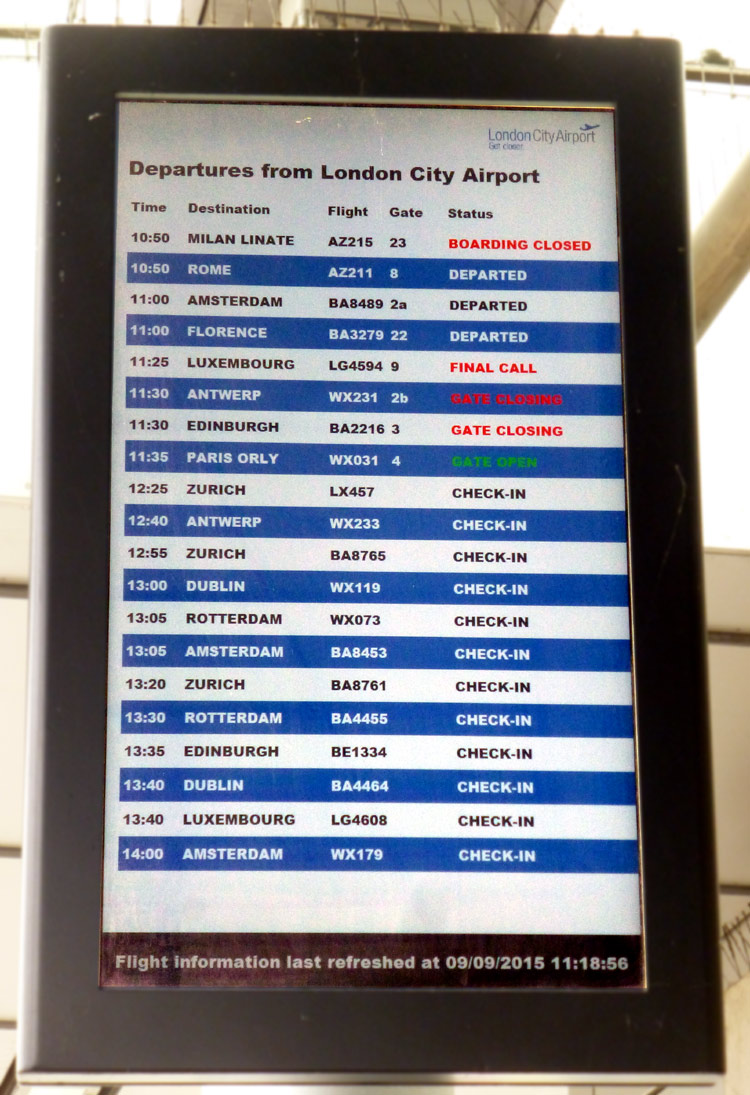
Right: London City Airport (LCY) flight departure information on the high level DLR platforms.
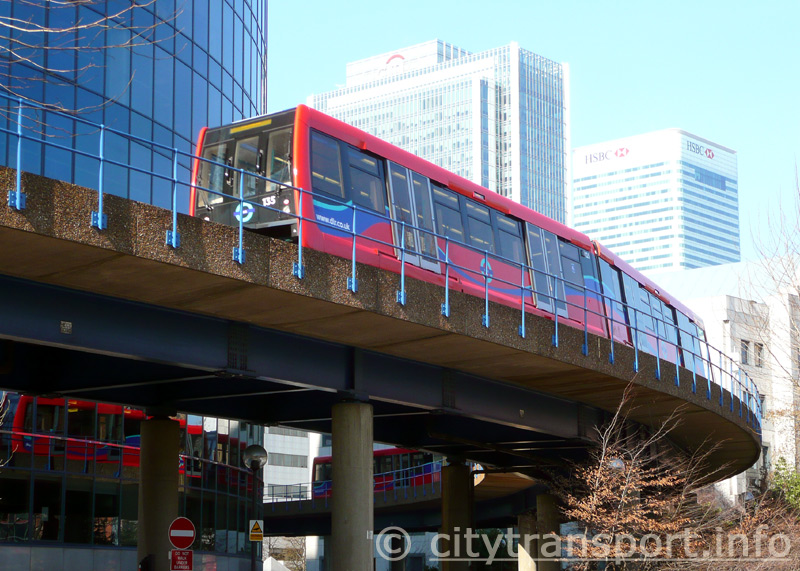
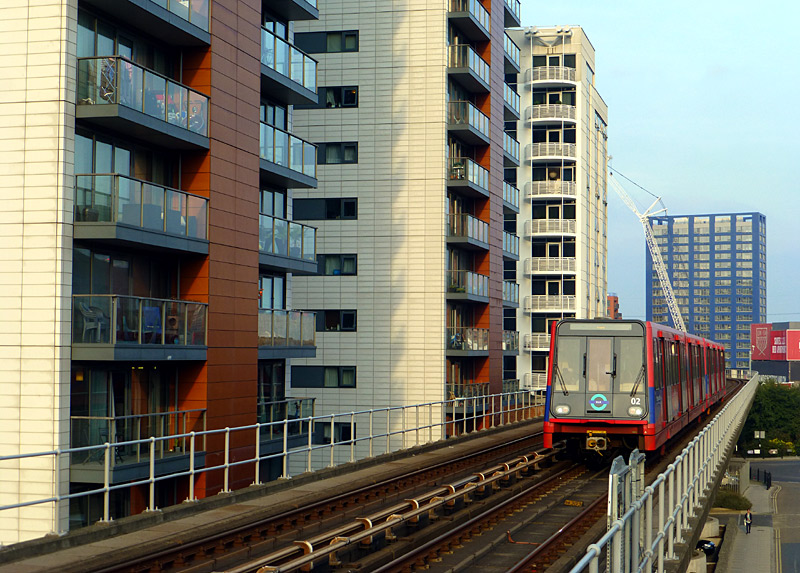
Harbour Exchange Square, which is between South Quay and Crossharbour stations. The glass wall building adds extra interest.
This southbound triple-unit train was photographed a little after midday, on a sunny winter day when the trees were not in leaf.
Depending on the type of English one speaks these could be
known as a block of flats, apartments, condominiums...
| DLR Branch Lines 1: The Initial System |
This section looks at the DLR network - starting with the system as it was when services began in 1987.
This is triangular shaped and located between Westferry, Poplar and West India Quay stations.
The original 1987 network only normally saw through trains between West India Quay and either Westferry or Poplar. Until the opening of the extension to Beckton the direct route between Westferry and Poplar was mostly used by trains not carrying passengers.
As the DLR expanded it was realised that there were too many conflicting moves in this area, so many by-pass tracks were built as this allowed some trains to avoid the Delta Junction. These by-pass tracks make it possible to prevent trains on one route from being delayed whilst waiting for trains on another route to pass by.
The 2011 opening of the route between Canning Town and Stratford International meant that for the first time there was a service that completely avoided this area.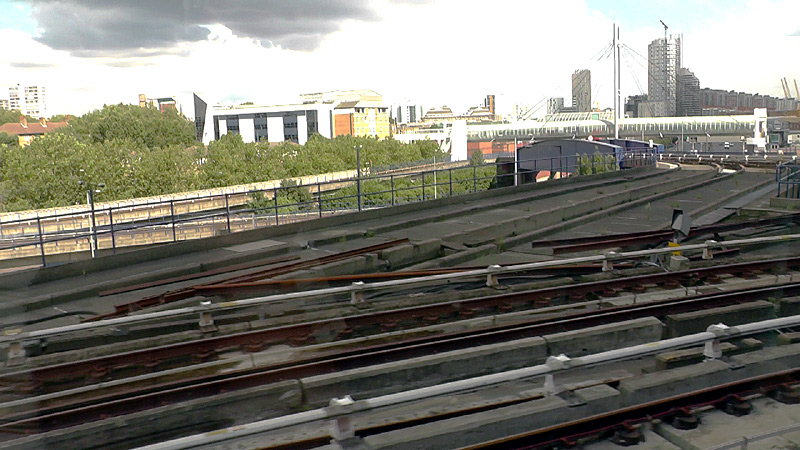
The Delta Junction:
Nowadays the tracks which form the direct route between Westferry and Poplar stations have been removed and replaced with by-pass tracks that allow trains to avoid conflicting movements.
Filmed on a train travelling from West India Quay to Westferry.
The white structure on the right is the footbridge just outside Poplar station. This is an excellent viewpoint from where to watch trains and the stairways (at each end) allow clear unobstructed photography.
The area around the Delta Junction is the busiest part of the DLR system - it is served by trains in four different routes and and even at quieter times hardly more than a few minutes pass before the next train(s) arrive on the scene.
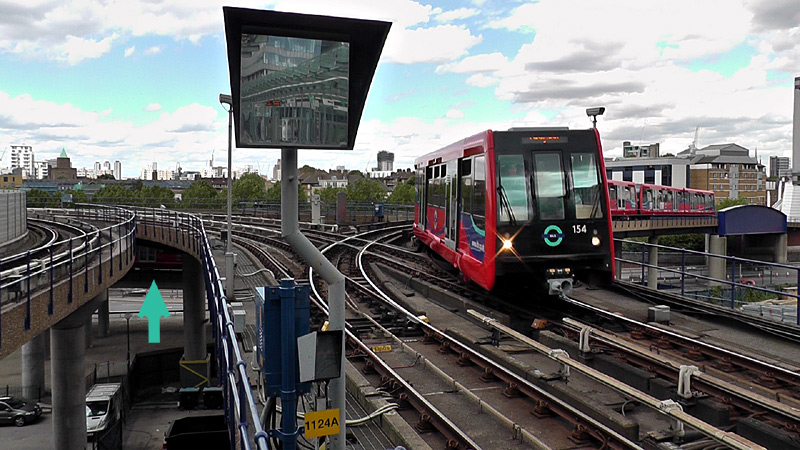
The two views below show trains travelling from Poplar to Westferry using an underpass track to bypass the Delta Junction
and travel below a train travelling from Poplar to West India Quay.
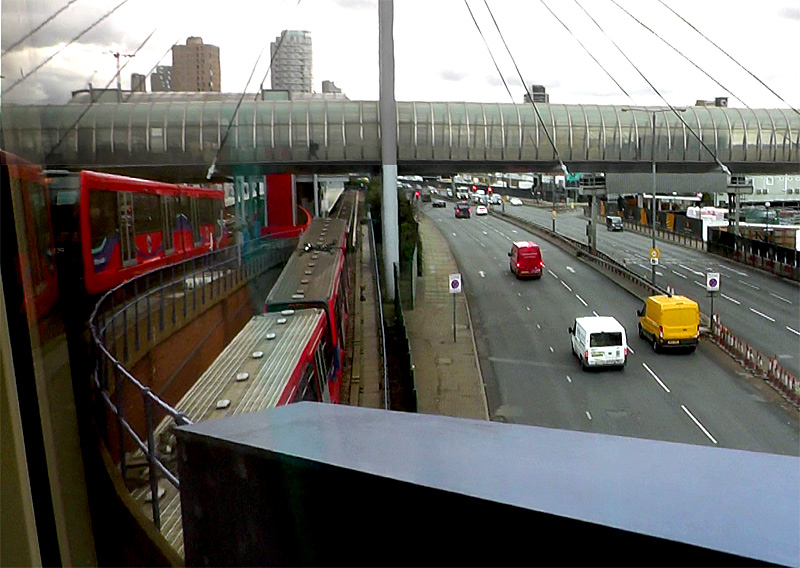
 A
APoplar to West India Quay, below me is a train travelling
from Poplar to Westferry.
The train with unit No. 154 at its front is travelling over the Delta Junction on a journey from Poplar and West India Quay. The teal coloured arrow on the left points to a train that is using an underpass track to avoid the Delta Junction on a journey from Poplar to Westferry.
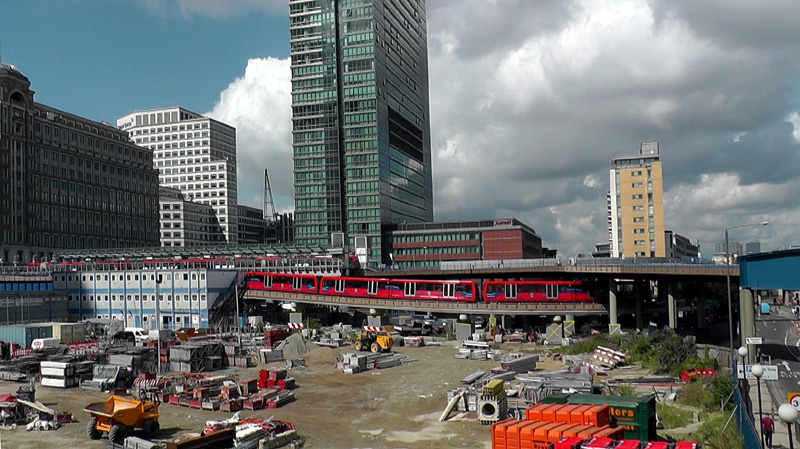
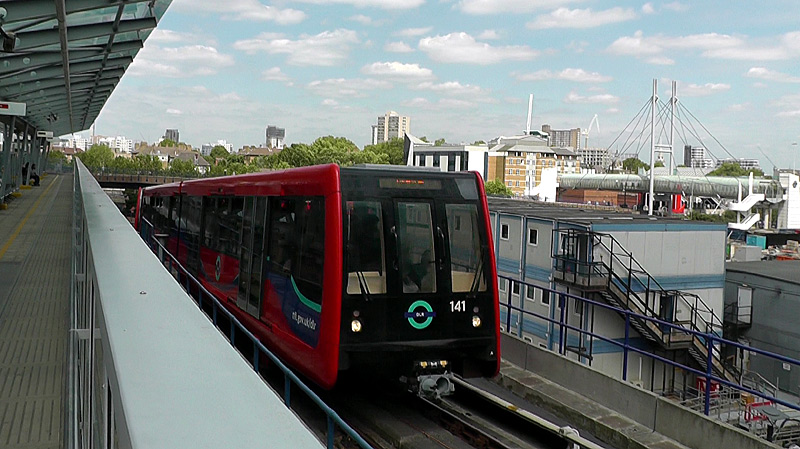
and then under the tracks used by trains between West India Quay and Poplar (as seen above-left).
They then rise up alongside West India Quay station, but because of the steepness of the incline they pass through without stopping (as seen above-right)
These views at Poplar were filmed from a public footpath just outside the station.
With four tracks and two island platforms Poplar is one of the largest stations to be served solely by DLR trains.
The outer two platforms are served by trains travelling east-west between Bank / Tower Gateway and Woolwich Arsenal / Beckton.
The inner two platforms are served by trains on the north-south Stratford - Bow Church - Canary Wharf (- Lewisham) service.
This station is designed for easy cross-platform interchange. Maybe I've just been unlucky but I've never known a train to be held if another train is arriving at the other platform!
Bank / Tower Gateway:
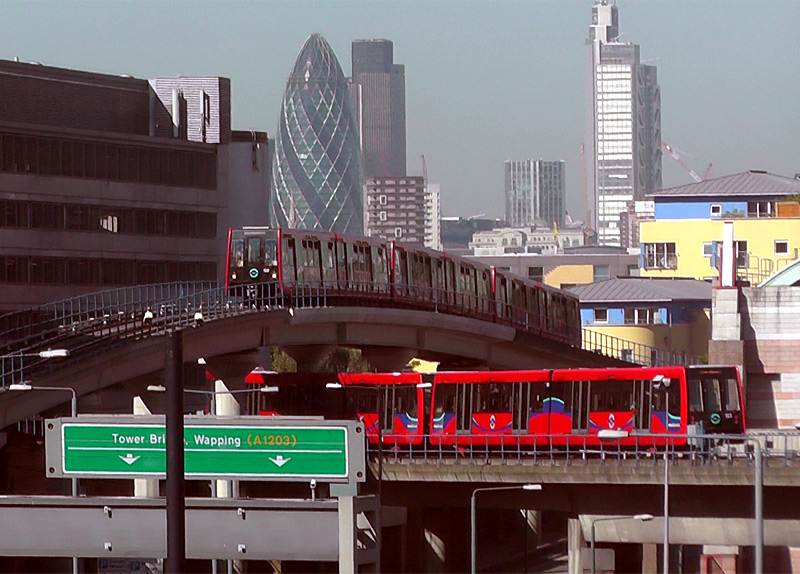
Apart from the tunnels to Bank station the entire route between Bank / Tower Gateway stations and Limehouse station is alongside the tracks used by C2C electric multiple-unit trains from Fenchurch Street station,
using an historic elevated viaduct that was built in 1840 by London and Blackwall Railway and widened to four tracks in 1893.
Tower Gateway station is a (short) walk from Tower Hill Underground and Fenchurch Street C2C railway stations. The station is distinctive because it has 2 platforms but just 1 track. To make life easier one platform is for arriving passengers and the other platform is for departing passengers. This is the only station in London which uses this system. The arrival platform is also a good photo-spot to watch trains on the nearby C2C service travelling to / from Fenchurch Street station. (It is not illegal to photograph the C2C trains but some DLR staff complain if they see you with a camera!)
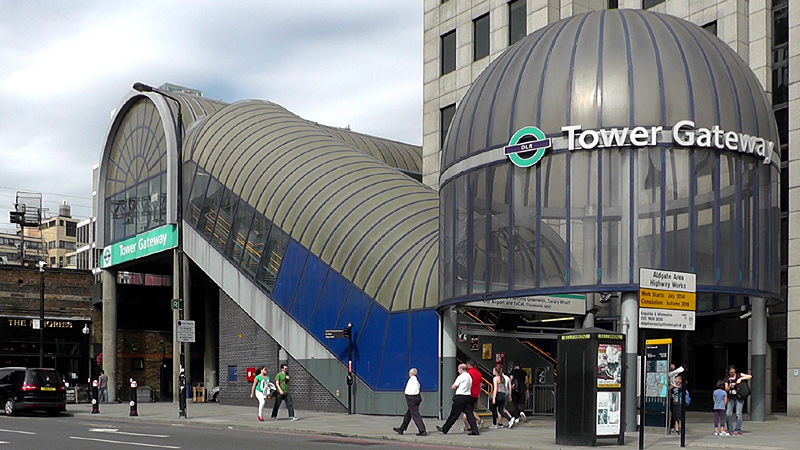

from when the DLR first opened in 1987.
and the other to departing passengers.
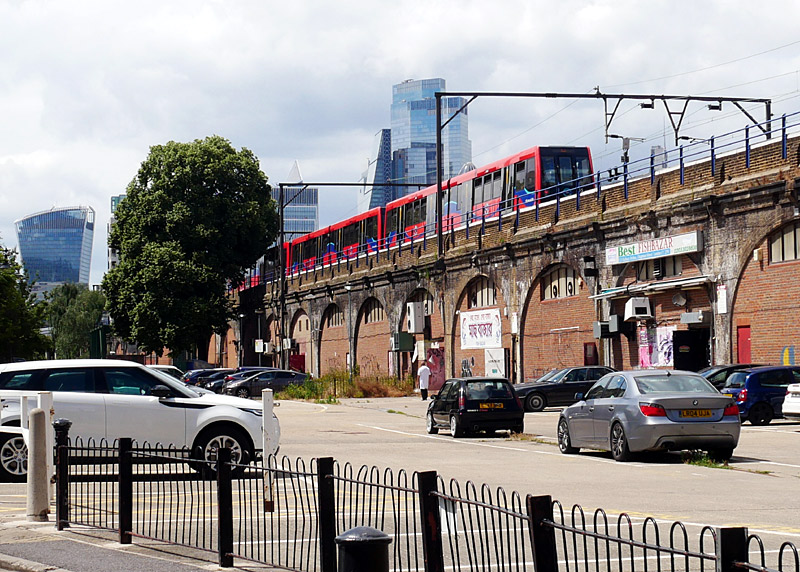
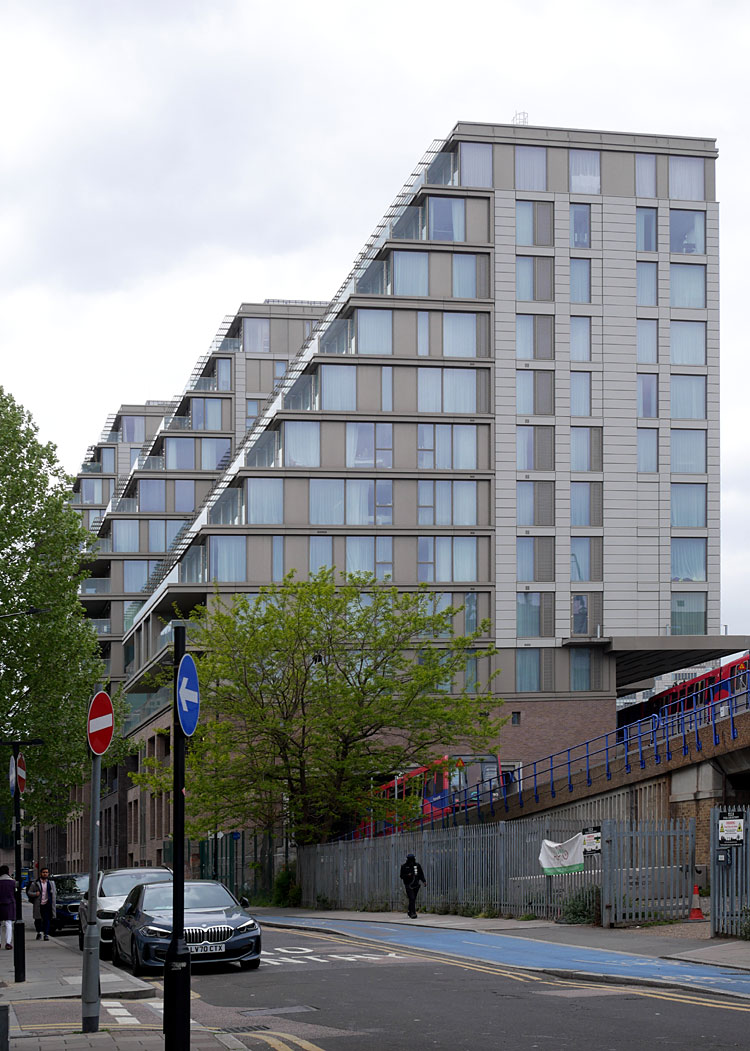
Filmed looking west along Cornwall Road, next to the exit from Shadwell London Overground station - Shadwell DLR station is close nearby.
The DLR came first - the buildings were constructed above and around the trains!
Filmed looking west on Royal Mint Street very close to the junction with John Fisher Street.
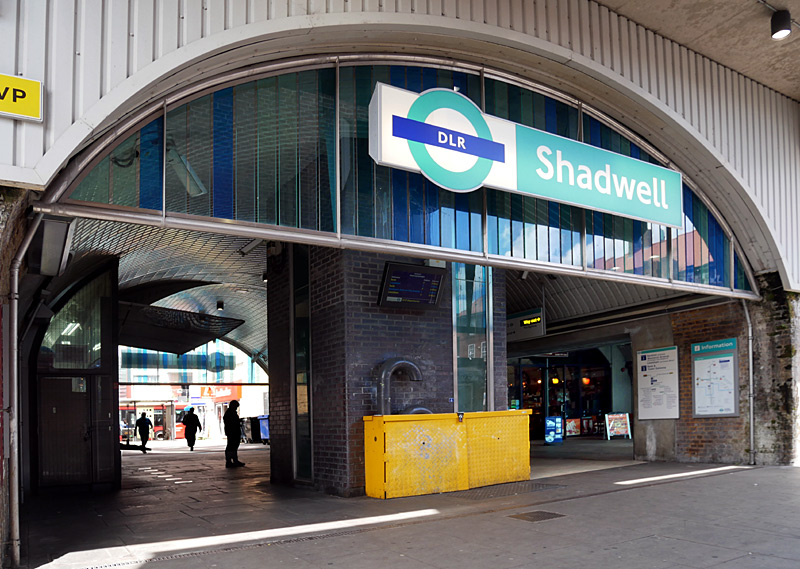
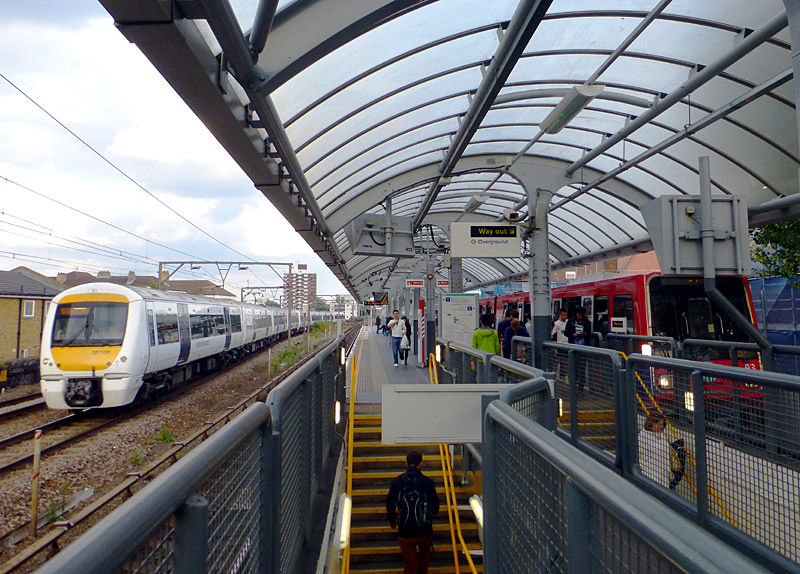
Pasengers who wish to change trains between the DLR Shadwell station and London Overground Shadwell station and are paying their fares in PAYG (pay as you go) mode can take advantage of the 'out of station interchange' feature (OSI) to be charged one through fare for their journey.
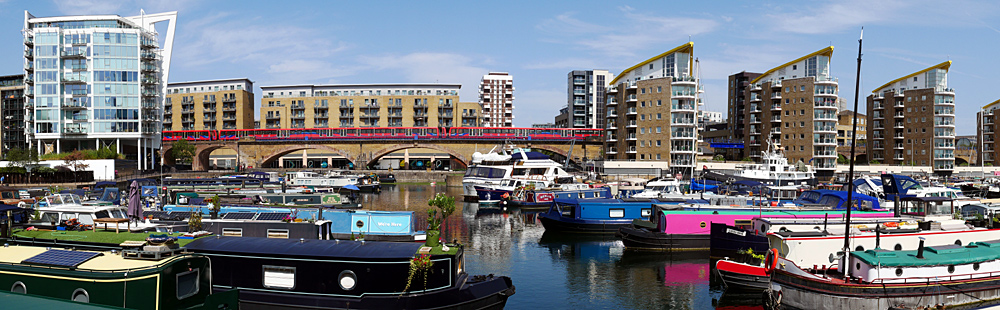
A DLR train passes Limehouse Basin, which is very close to the River Thames.
This is a panoramic photograph as it is a better way to show this location. The train was moving at the time so is somewhat 'elongated'.
Stratford via Bow Church:
Most of the DLR's route between Stratford and Bow Church station is located alongside the mainline railway out of Liverpool Street station. Especially at busier times you have a good chance of seeing
many types of mainline trains, including Greater Anglia Class 745 Stadler Flirt InterCity trains, Bombardier (now Alstom) Aventra Class 720 trains and Class 345 Elizabeth line (Crossrail line 1)
trains.
At weekends and Bank Holidays you might also see trains operated by C2C - who use Class 357 Electrostar and Class 720 Aventra trains.
Apart from a passing loop at Pudding Mill Lane station this section of the DLR is bi-directional single track. At Stratford this DLR service a specially-built island platform. To make life easier for passengers all signage at Stratford station refers to this as platform No.4 although there are two tracks and these are actually numbered 4a and 4b.
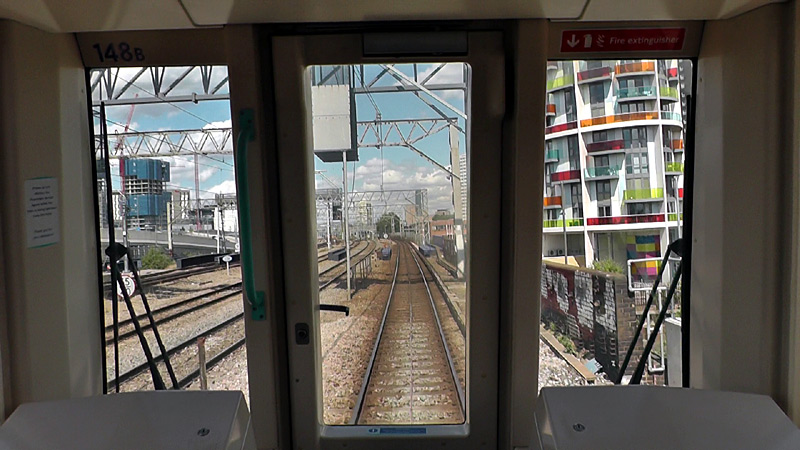
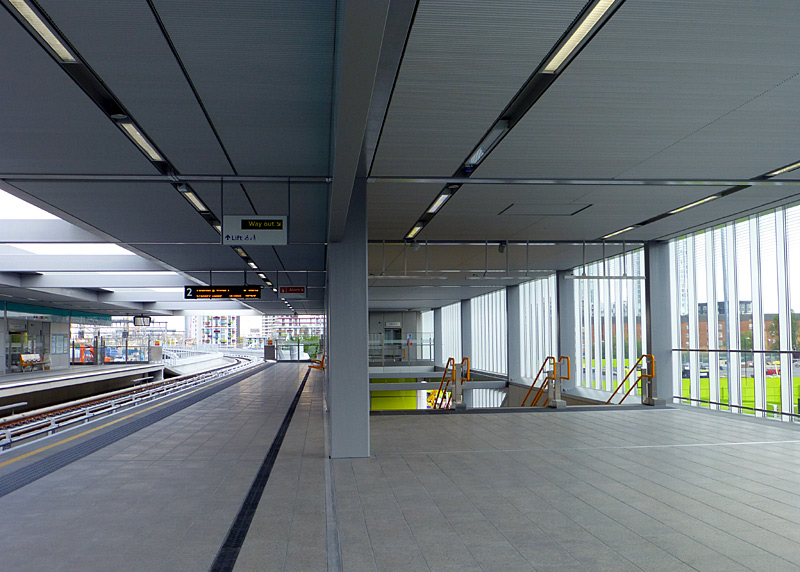
This was filmed in the afternoon on an eastbound train that is travelling towards Stratford.
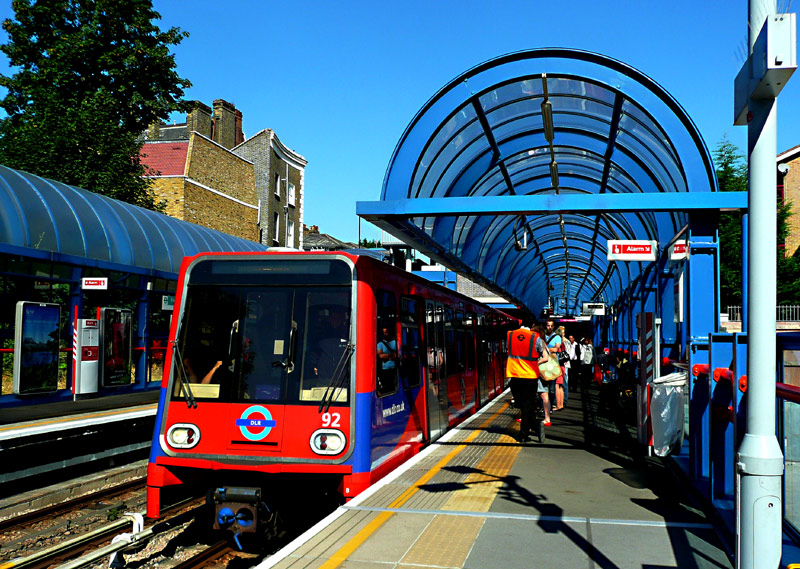
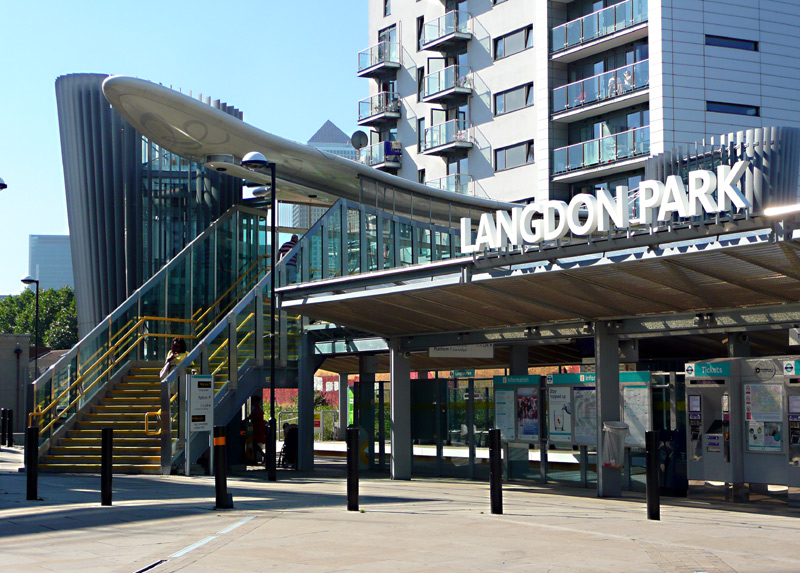
Some of these shelters come from stations that were later rebuilt
The Docks:
This section of the DLR is on new-build elevated viaduct. It extends from West India Quay to Crossharbour stations, twisting and turning through the former docklands area on the River Thames
peninsular known as The Isle Of Dogs.
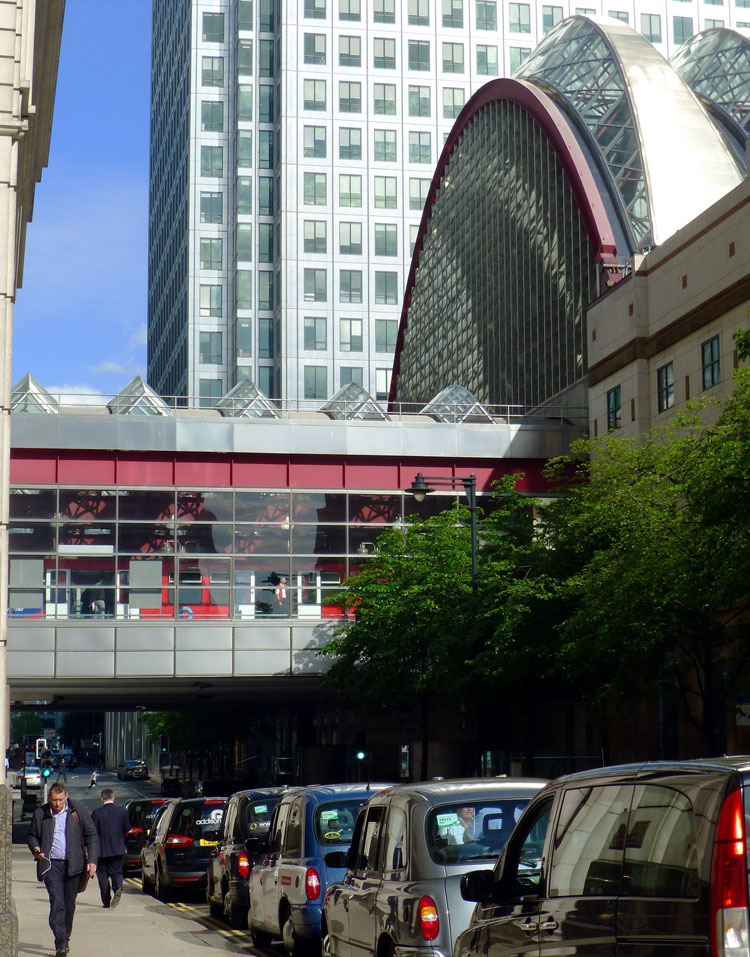
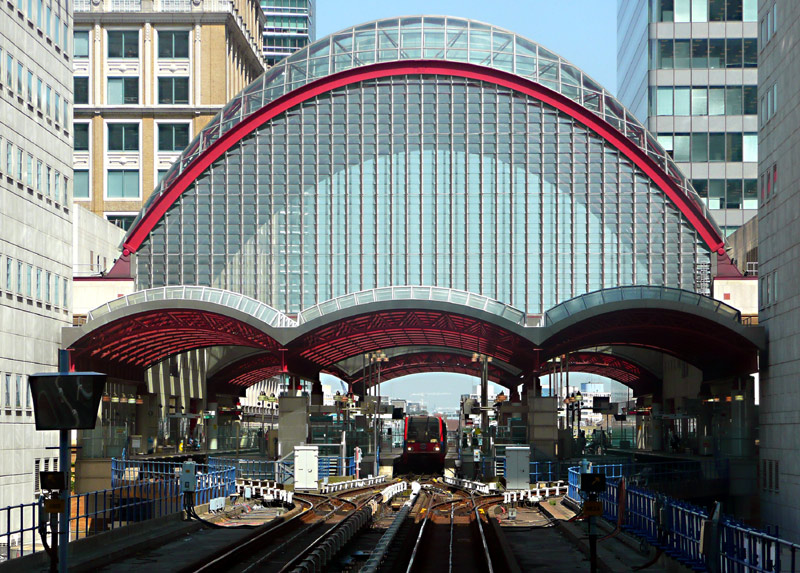
Canary Wharf is the flagship DLR station and it has six platforms - the most of any station solely served by DLR trains. However ... it only has three tracks. This is possible because it uses what is called The spanish Solution whereby all tracks have two platforms (one each side) and all trains open their doors on both sides. In terms of physical platforms there are four - two double-sided island platforms and two side platforms. If station platforms were counted the American way (based on tracks which pass through the station) then this station only has three platforms.
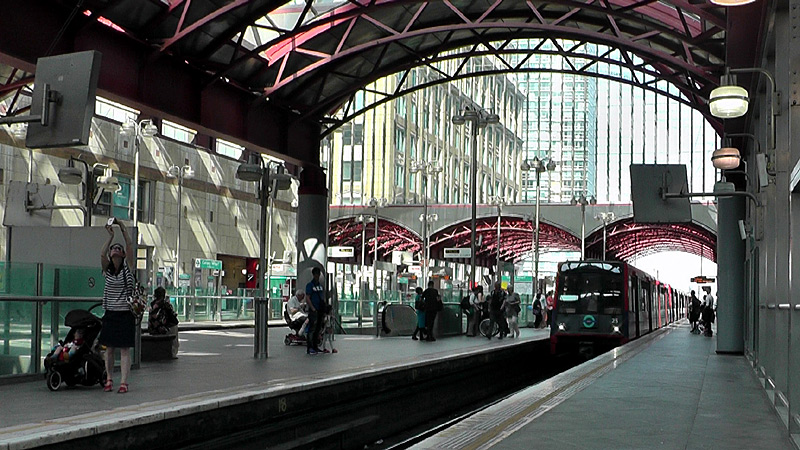 |
|
 |
|
 |
middle: one of the streets which passes below it and
right: the back of a southbound train which has just departed from this station.
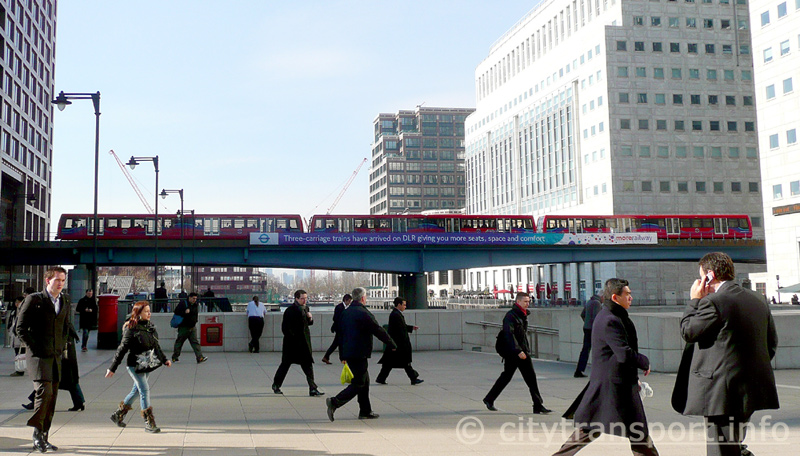
The DLR has expanded very considerably from the early days when it used single-unit trains.
The viaduct signage promotes the introduction of triple-unit trains.
Heron Quays and Canary Wharf stations.
Out of sight behind me is the Jubilee line Canary Wharf station.
This photograph looks west towards Middle Dock, in the background a DLR train is travelling between Heron Quays and Canary Wharf stations.
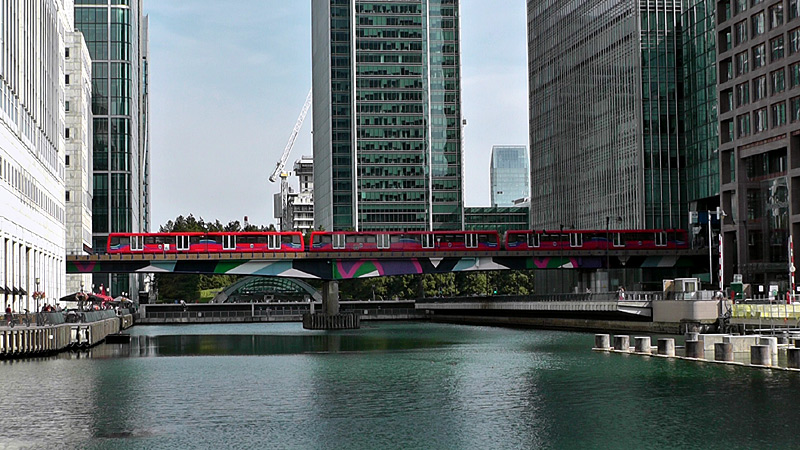
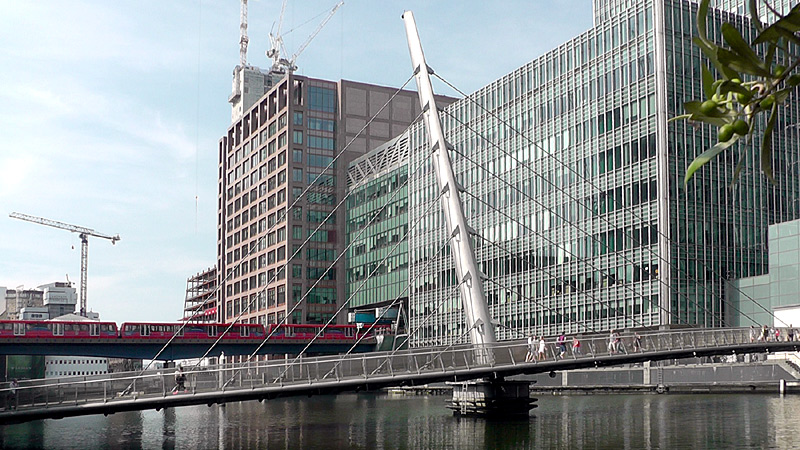
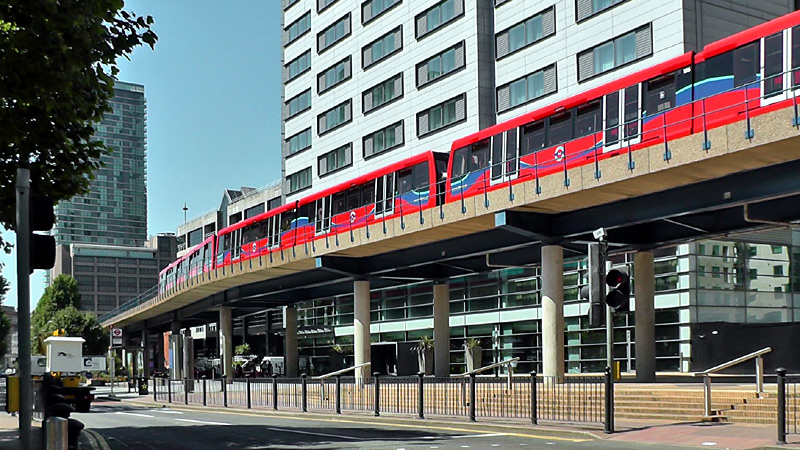
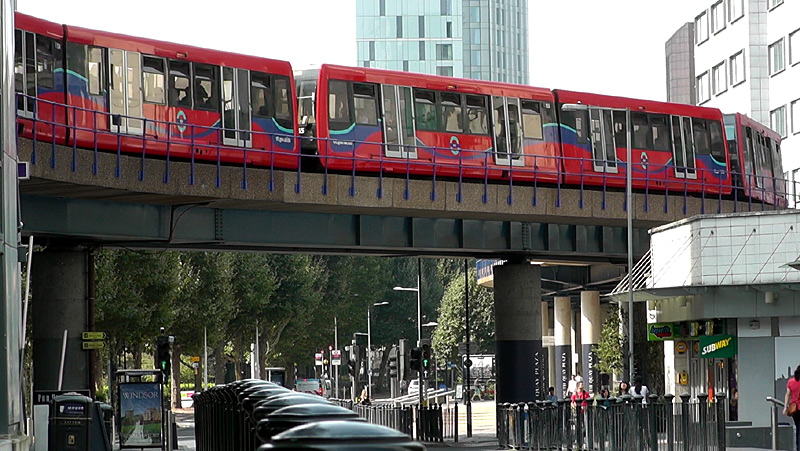
Crossharbour - Island Gardens re-uses the route of the 1870s Millwall extension of the London and Blackwall Railway. This included a single-track brich arch viaduct through Millwall Park plus an elevated twin-track terminus at Island Gardens. However the DLR's Lewisham extension required the DLR trains to pass below the River Thames via some deep-level tube-train tunnels and therefore Mudchute station was re-sited and the elevated Island Gardens station was replaced with a new underground station.
Whilst the disused brick arch viaduct remains extant the original Island Gardens station has been demolished and replaced with a non-railway building.
| DLR Branch Lines 2: The Extensions |
The Beckton Branch:
The first extension to the DLR was the Beckton route between Poplar and Beckton.
This passes through semi-derelict industrial and residential areas which are (v-e-r-y) slowly being regenerated.
Royal Victoria station is very close to the Emirates Airline Cable car station.
Custom House station was almost completely rebuilt as part of the construction of the Elizabeth line and by being next to the ExCel Exhibition centre it has become very busy. ExCel has many exhibition halls and the building is so long that it extends all the way to Prince Regent station - which is usually less crowded than Custom House.
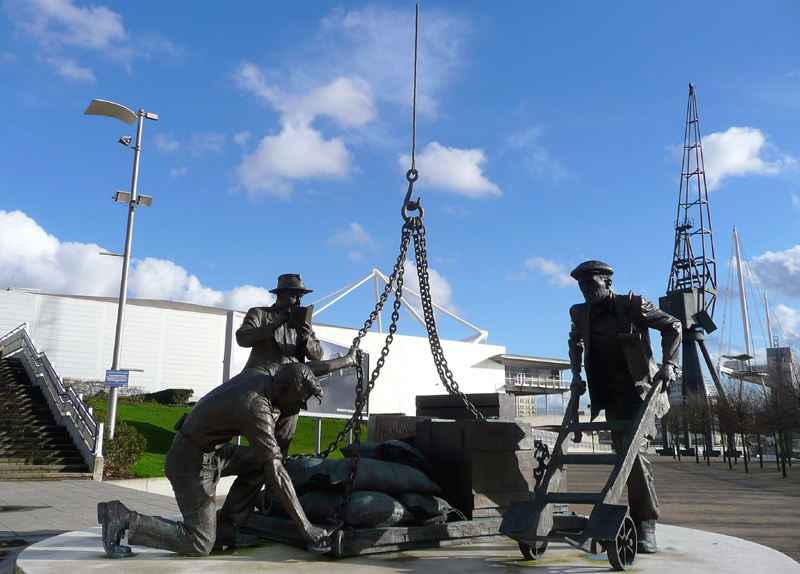
Close to the ExCel Exhibition Centre is a sculpture by Les Johnson / Bronze Age Foundry in tribute to the communities of the Royal Docks and the men who worked there between 1885 and 1983. Built in 2009,
the sculpture was funded by a charitable appeal supported by the Royal Docks (London) Trust who have a webpage at this link
http://www.royaldockstrust.org.uk/ . The sculpture can be a challenge to
photograph, especially on sunny days when shadows and the direction of the sun can get in the way.
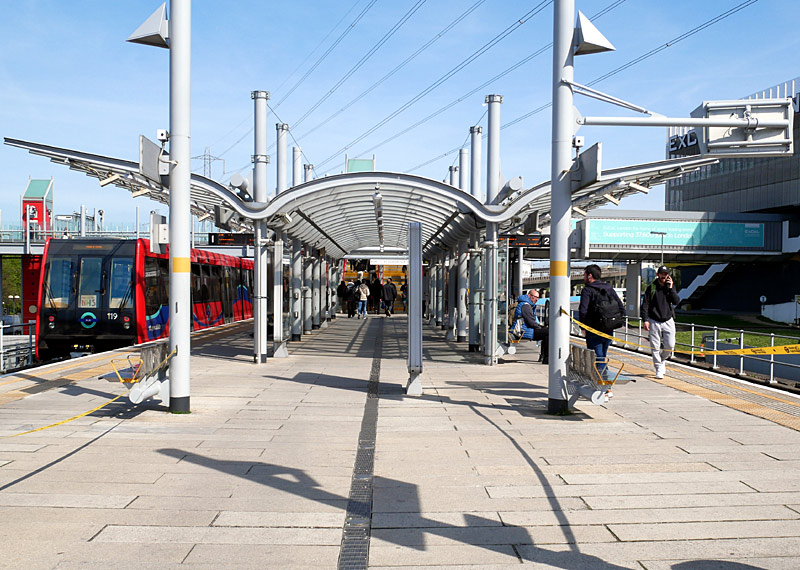
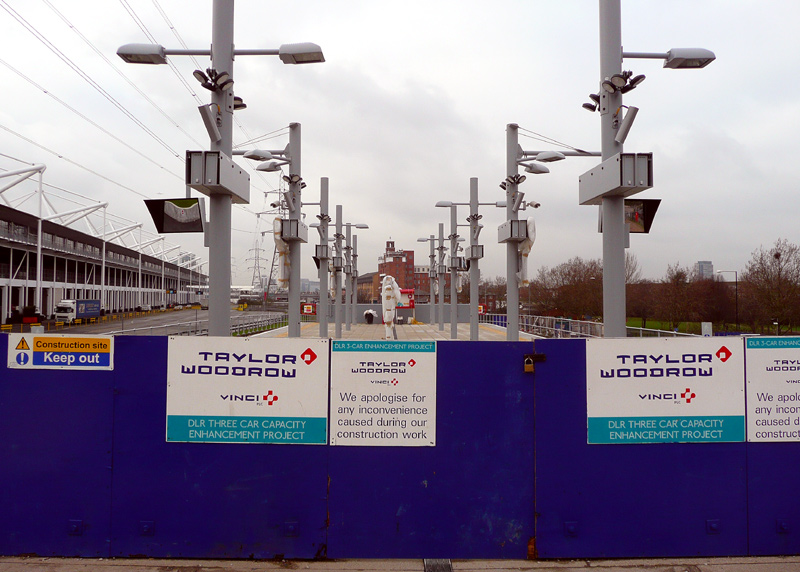
Originally built for two-unit DLR trains the platforms were later extended for three-unit trains.
This station is located at the far end of the Excel Exhibition Centre and as it is usually less busy it is often a better choice than
Custom House station - especially when going home afterwards as there is a greater chance of finding empty seats on the train.
One very unusual (for the UK) feature of the Beckton branch is that part of it was built as a combined road and rail project. This was only possible because it was built by a government-sponsored development agency which had been made exempt from the governments' usual financial criteria for railway investment. These financial criteria were so onerous (in other words heavily biased against rail-bourne public transport investment) that it was usually impossible to build road and rail (or road and light rail / tramway) as one financial package.
This was despite it often being financially advantageous to build road and rail as one financial package.
Beckton Park and Cyprus stations are located below traffic roundabouts but the section of railway between them is in the median of a dual carriageway.
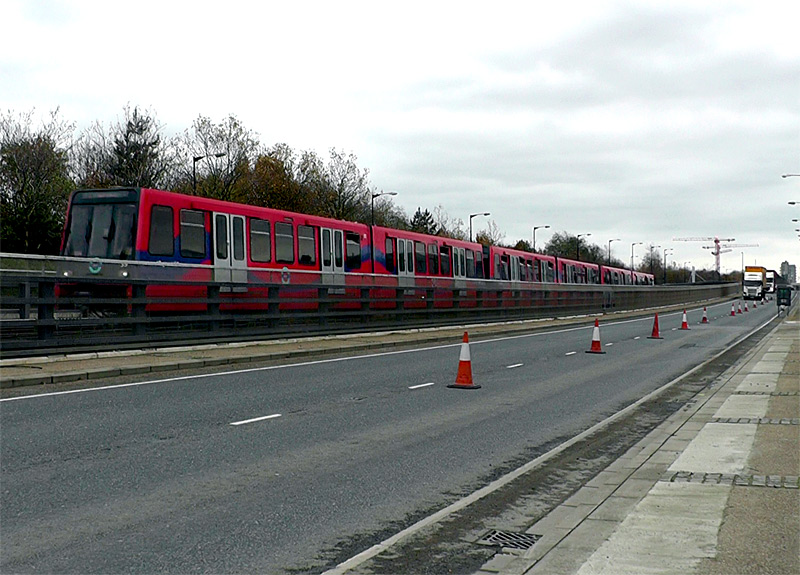
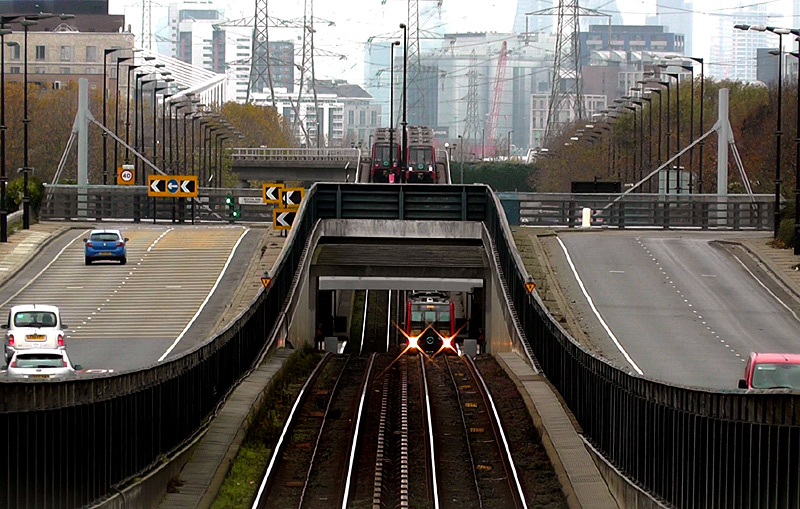
rises up to travel alongside the road traffic.
An eastbound DLR train is calling at Beckton Park and behind it can be seen two passing trains. One of the eastbound trains might be travelling to Beckton depot, and not carrying passengers.
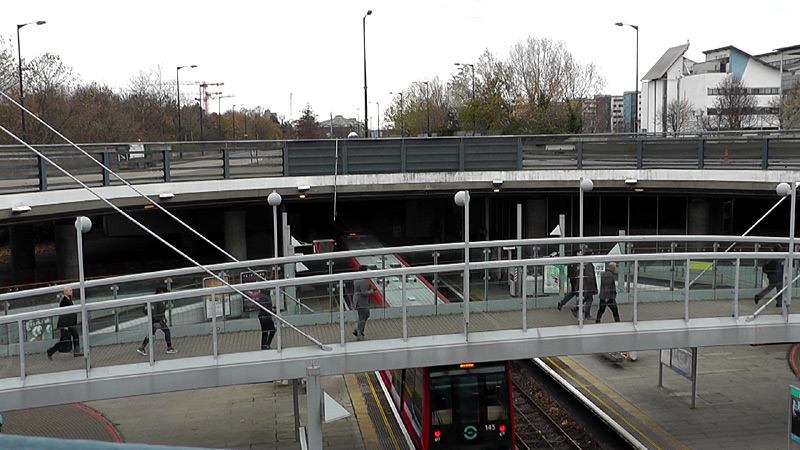
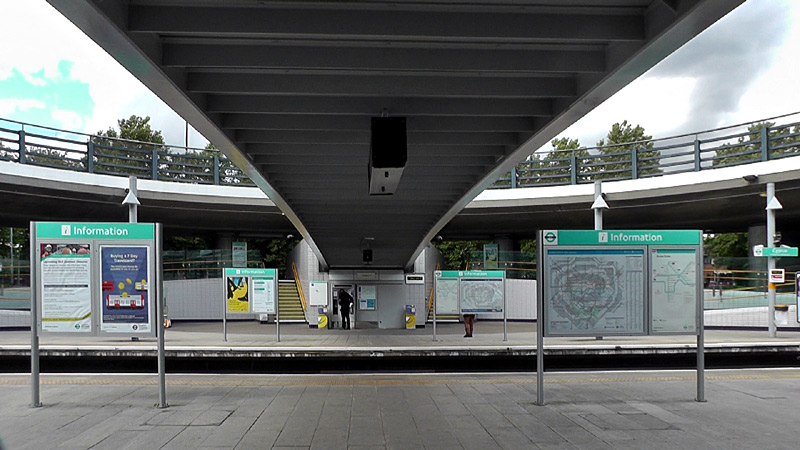
After the tunnels below roads the DLR rises to an elevated viaduct that partially encircles a busy traffic roundabout .... after the elevated Gallions Reach station the line ends at a twin track / island platform terminus at Beckton. This is close to a large food etc., supermarket and regional bus station.
The Lewisham Branch:
This was so that the trains could access the two single-track 'tube-train' style tunnels below the River Thames.
Also wholly underground is the brand-new Cutty Sark station which is located in Maritime Greenwich.
When Cutty Sark station was built the DLR only used two-unit trains and when longer trains were introduced it was realised that lengthening the platforms would cause very significant disruption - plus be very expensive - and therefore it was decided to not do this.
Cutty Sark station has short platforms and on triple-unit B07 and all B23 trains some doors are in the tunnel - so they do not open.
Passengers at the train ends must walk through the inside the train to the nearest doors which have opened.

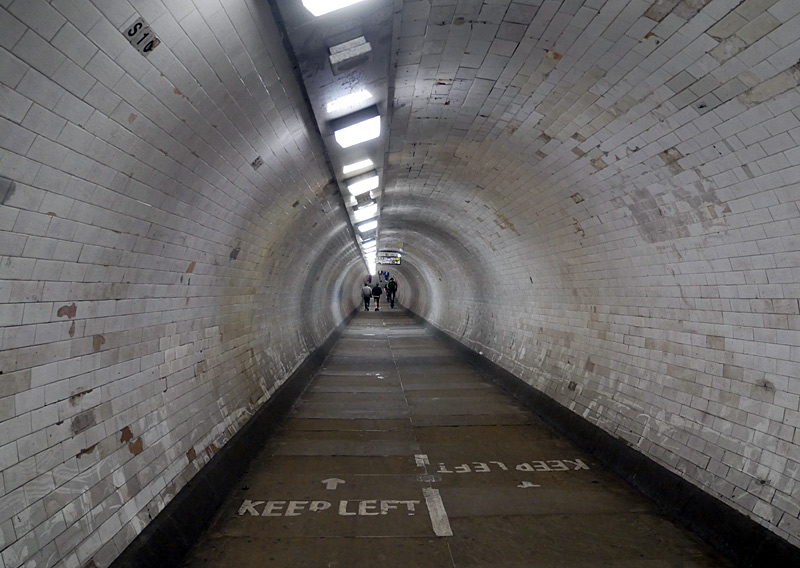
These views were taken at the southern entrance with the River Thames behind the entrance and the Docklands Financial District visible in the distance.
The foot tunnel entrances include a spiral staircase and a lift (which only sometimes works). Cycling is prohibited ... but is also common.
The Greenwich foot tunnel is near to Island Gardens and Cutty Sark DLR stations. This marvel of Victorian engineering was built so that people who live in this part of south London could reach jobs in the docklands area without having to use the expensive and unreliable ferry boat. It opened in 1902 and is free to use.
The southern entrance is very close to the Cutty Sark historic visitor attraction (a preserved 1869 tea clipper / ship) and also near to the historic centre of Maritime Greenwich, the Greenwich Observatory and more.
On hot summer days what is said to be a 10 minute walk through the tunnel offers a cool refuge from the ferocious summer sun - and in the winter a dry milder refuge from the often windswept bitter cold.
Note: During the time of this page update (November 2025) Cutty Sark DLR station is closed whilst new escalators are installed, passengers coming here will have to choose between using Island Gardens or Greenwich stations - and walking the rest of the way - or catching a waterbus to the nearby Greenwich Pier!
More information about the Greenwich Foot Tunnel can be found at these links:
http://www.royalgreenwich.gov.uk/directory_record/2013/greenwich_foot_tunnel .
http://www.tripadvisor.co.uk/Attraction_Review-g186338-d1821177-Reviews-Greenwich_Foot_Tunnel-London_England.html .
The DLR's tunnels end just at the northern end of the historic Greenwich station. This is one of London's oldest railway stations - it opened in 1834!
Greenwich station originally had four tracks - the two outside tracks were alongside platforms and two centre tracks which did not have platforms. The centre tracks ended up disused and were later removed, and for the coming of the DLR the station was reconfigured to create platform space for DLR trains within the existing station envelope.
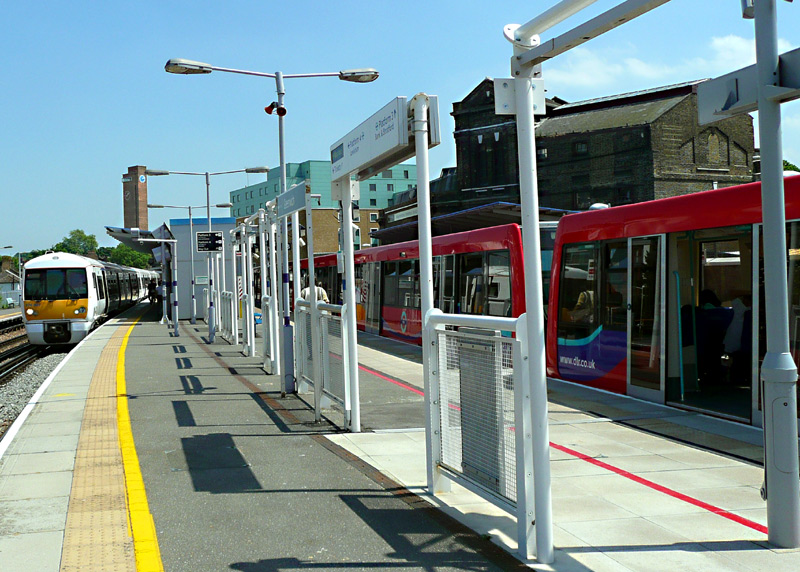
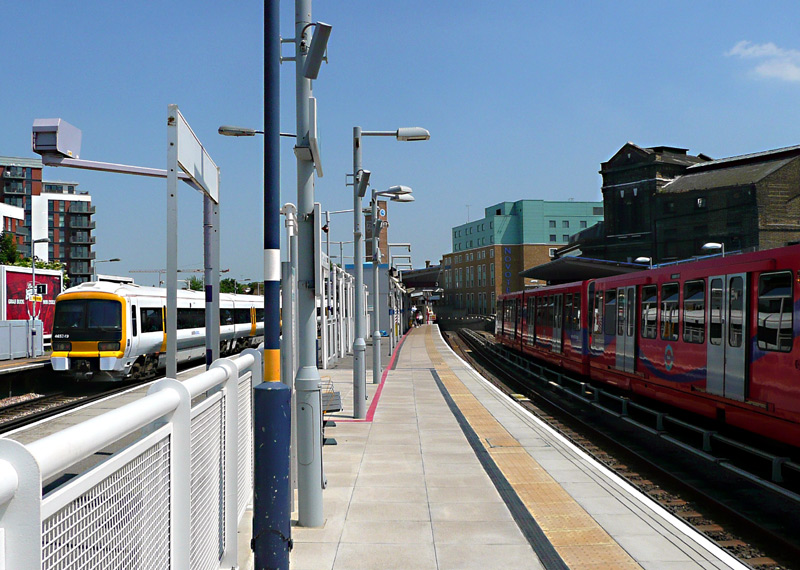
cross-platform interchange. However passengers changing trains travelling in the opposite direction will need to use steps.
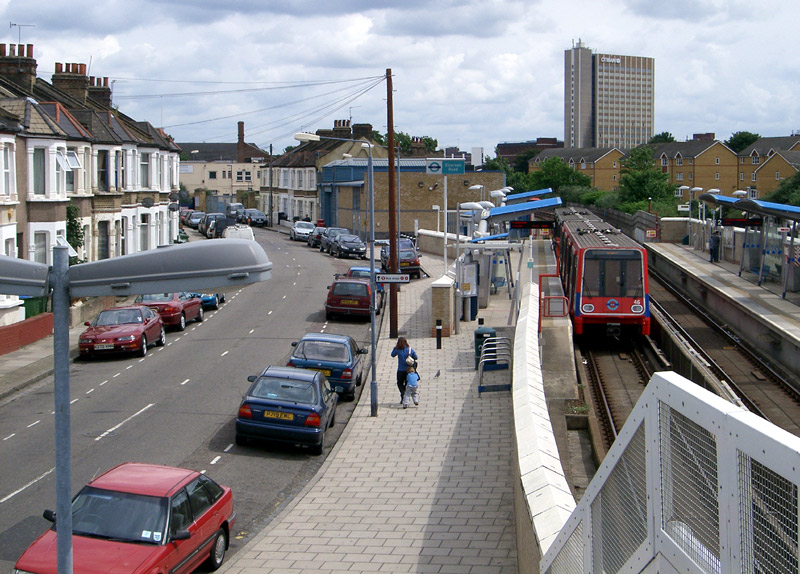
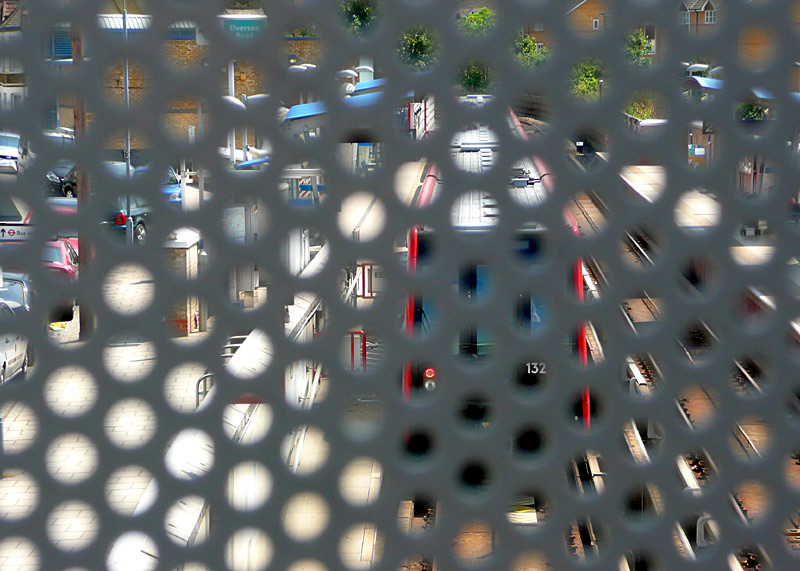
The bridge side walling includes painted sheet metal with many small holes which allow people crossing the bridge to see the station but not to throw anything down on top of the tracks / trains.
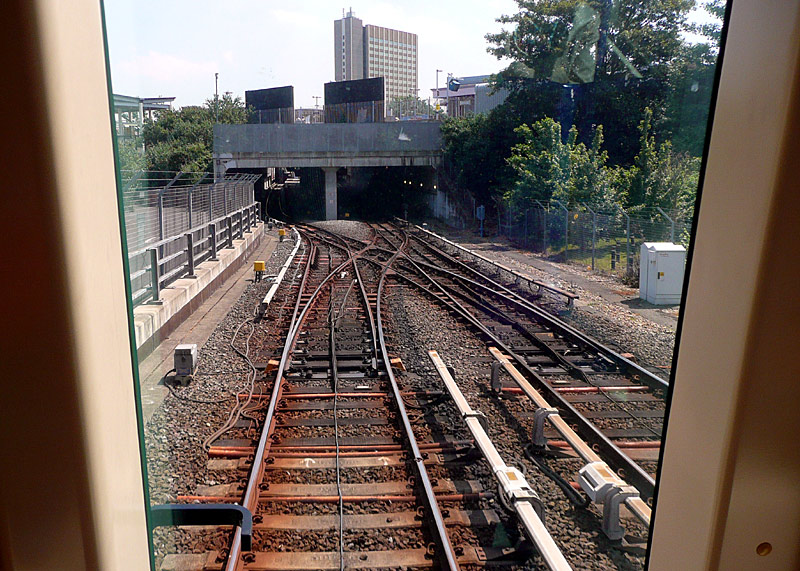
The Woolwich Arsenal Branch:
The route to Woolwich Arsenal passes below the Emirates Airline Cable car and includes a station for London City Airport.
Between Canning Town and West Silvertown stations the line is mostly at grade. Then the line switches to elevated viaducts and passes through semi-derelict industrial and residential areas which are very slowly being regenerated. Between London City Airport and King George V stations the line returns to being at grade. Most of the route between King George V and Woolwich Arsenal station scomprises two single-track 'tube-train' style tunnels below the River Thames.
Although serving different parts of the Docklands, for part of the way the Beckton and Woolwich Arsenal two branches are within eyesight of each other so that it is possible to see and photograph 'trains in the distance'.
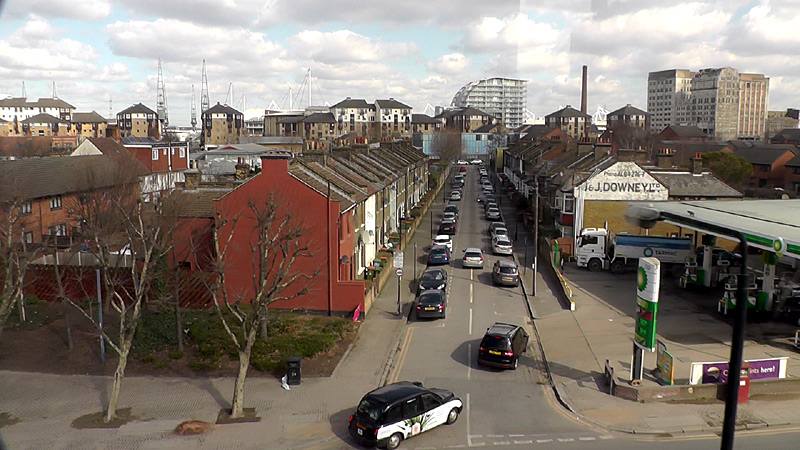
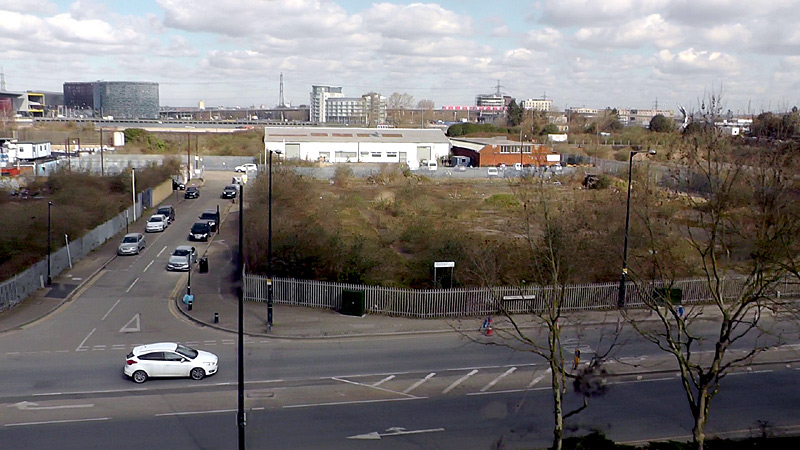
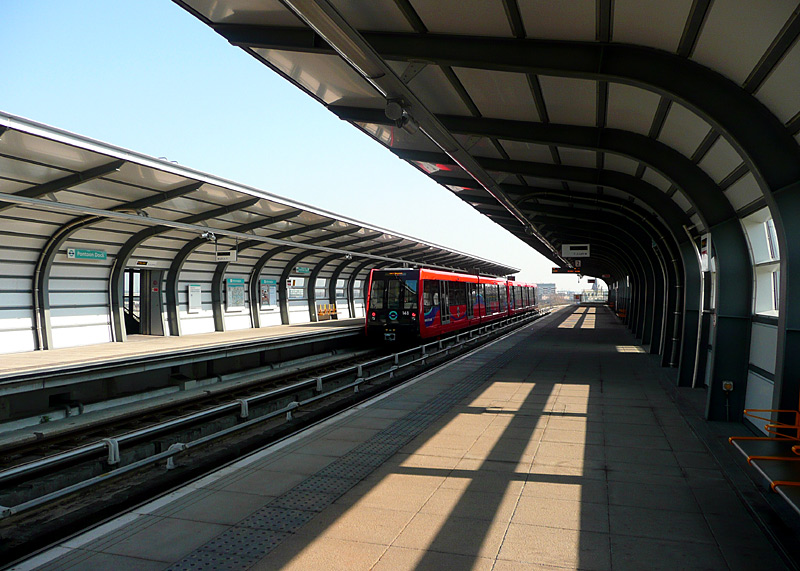
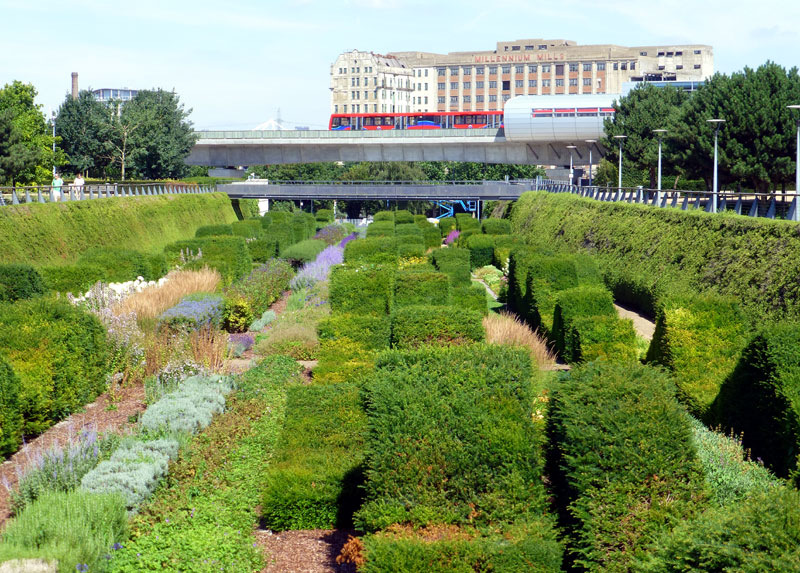
The Thames Barrier Park is free to enter. Its facilities include: the unique sunken garden seen in the image above-right, pleasant lawned areas to sit on, a childrens' playground, a small café and free toilets - which are very cramped and perhaps more suited to smaller people! NB: because of vandalism the toilets are only open when the café is open.
More information about the Thames Barrier Park can be found at these links: (the first link also includes a second foot tunnel in Woolwich)
http://www.gardenvisit.com/garden/thames_barrier_park .
http://www.tripadvisor.co.uk/Attraction_Review-g186338-d1826194-Reviews-Thames_Barrier_Park-London_England.html .
Note that on the other (south) side of the River Thames there is also a Thames Barrier visitor centre, however this is only open 4 days a week, charges an entry fee and is in an industrial area that is a walk or bus ride from a railway station.
http://www.daysoutguide.co.uk/thames-barrier-information-centre .
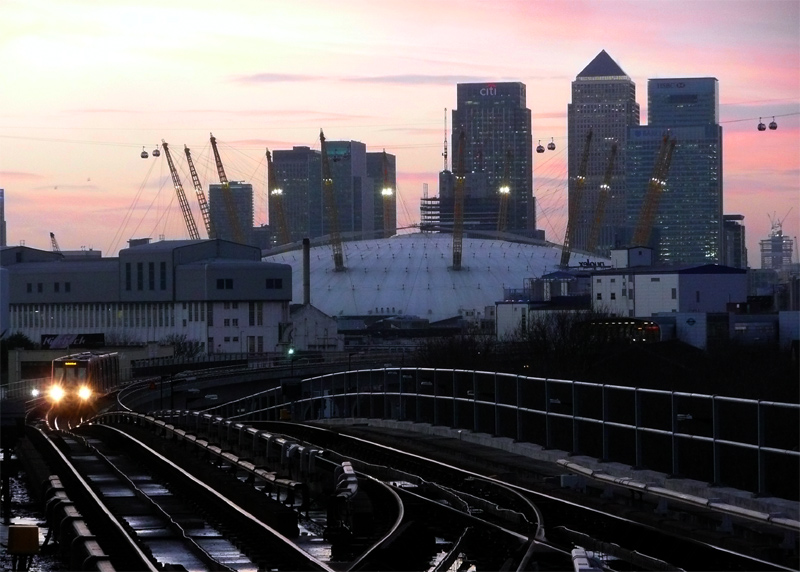
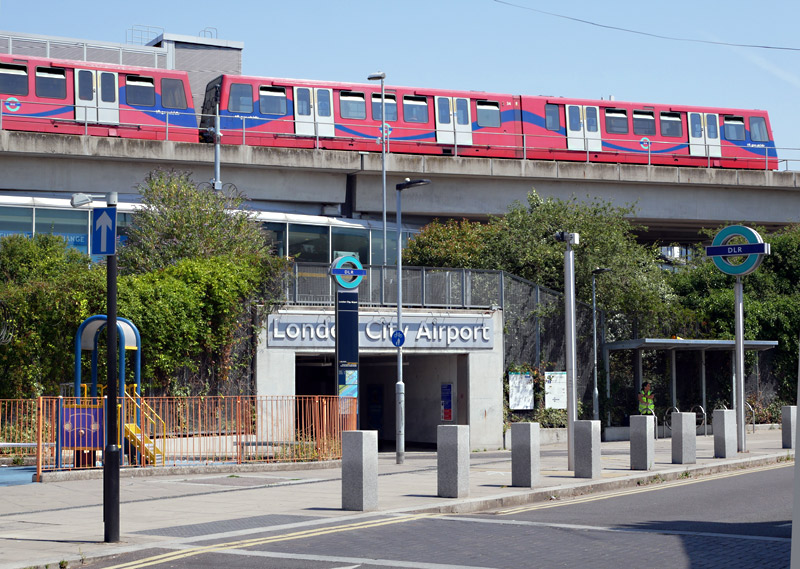
This image shows the Drew Road exit, which serves the local community.
Previously local residents used the nearby Silvertown station but it was not reopened when the Elizabeth line was built.
The platforms at Woolwich Arsenal station are just below ground level. The station building is almost next to a main line station with the same name and there is a direct connection between the two rail system within the same 'fares paid' area. A few minutes walk away is the Elizabeth line Woolwich station.
Stratford International Branch:
The Stratford International branch is the most recent part of the DLR to have been opened.Stratford International station is brand new.
The tunnel between Stratford International and Stratford is artificial - it is actually 'at grade' and was covered over as part of the works for the London 2012 Olympic / Paralympic Games and Westfield shopping centre.
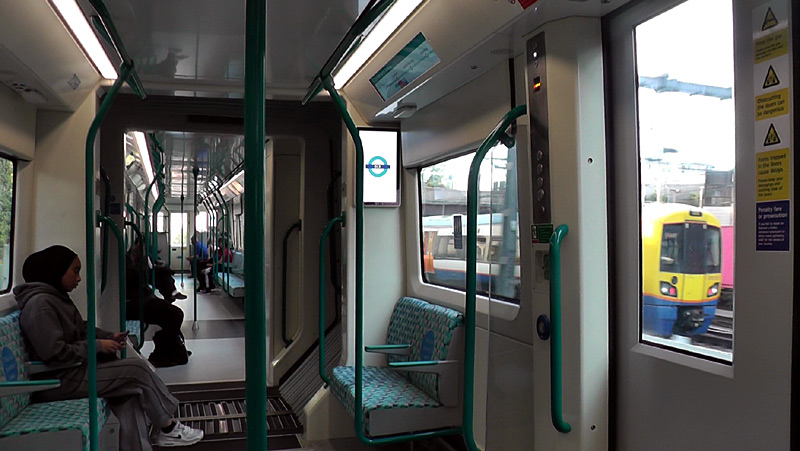
London Overground North London (Mildmay) line Class 378 train as seen whilst travelling between Stratford International station and the tunnel.
Sometimes freight trains (especially container trains) are also seen when passing by this location.
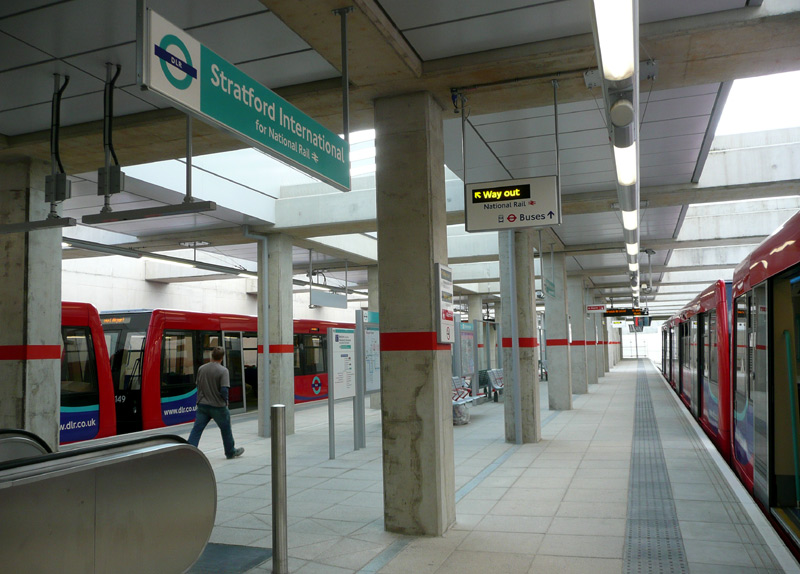
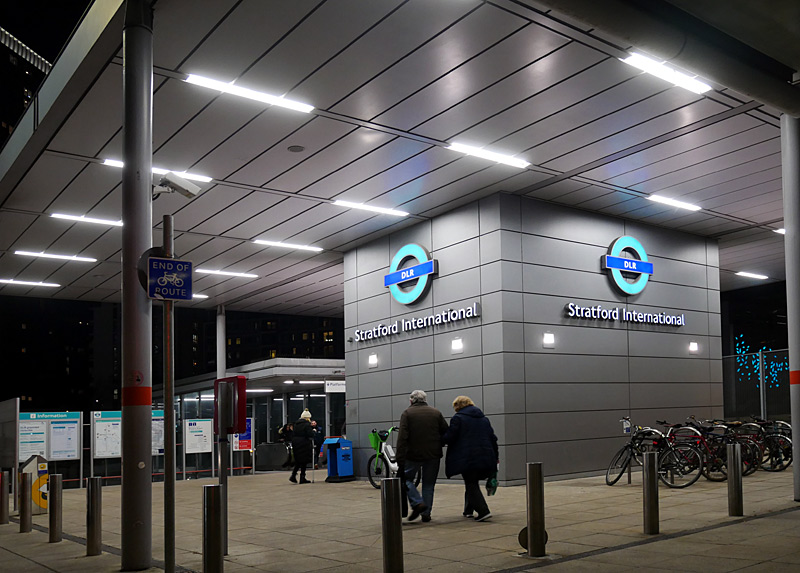
SouthEastern Javelin trains from London St. Pancras station which travel on HS1 (High Speed 1). The view on the right was filmed at night.
More information and photographs about the Stratford International branch can be found on the page about shared service routes - this page also includes a separate dedicated feature about Canning Town station ...
West Ham and Stratford stations are also looked at in greater detail on the page about busier stations in zones 1-4 where there is a wider variety of trains to see.
Will there be more DLR extensions??
More extensions have often been talked about but until funds have been allocated and work actually commences what can be seen as mere proposals are meaningless.
It is likely however that the DLR will be extended
from the Beckton area to a new station in Thamesmead, which is a relatively modern residential area on the southern side of the River Thames. Thamesmead should have had a rail connection when it was built but this did not
happen and this has seriously disadvantaged local residents.
| Opening Page Fares & Tickets / Photography |
|
|
|
| London Underground Small Profile ‘Tube’ Trains |
|
| Bakerloo Line | |
| Central Line | |
| Jubilee Line | |
| Northern Line | |
| Piccadilly Line | |
| Victoria Line | |
| Waterloo & City Line | |
|
|
| London Underground Large Profile ‘Subsurface’ Trains |
|
| Circle Line | |
| District Line | |
| East London Line | |
| Hammersmith & City Line | |
| Metropolitan Line | |
|
|
| National Rail ‘Tube’ Trains | |
| Northern City Line | |
| Crossrail Line 1 (Elizabeth Line) | |
| Crossrail Line 2 | |
|
|
| Other National Rail Trains | |
| London Overground | |
|
|
| Local Light Railways | |
| Docklands Light Railway |  |
| Croydon / London Tramlink | |
|
|
| General Information | |
| Main National Rail Stations Fast Regional Services Overhead Wire & 3rd Rail Trains |
|
| Busier Suburban Stations In Zones 1-4 With A Wider Variety Of Trains To See |
|
| Station Architecture & Features | |
| Shared Service Routes | |
| Further Information Resources To Visit In Person Or Online |
|
|
|
| Single Page Version Of This Guide |
|

